
 100% FREE ACCESS
7th Standard Syllabus & Materials
7th Standard
TN 7th Tamil பருவம் -1 இயல் 1 - அமுதத்தமிழ் - ஒன்றல்ல இரண்டல்ல Important Questions And Answers Study Material - QB365 Set A
NEW7th Standard
TN 7th Tamil பருவம் -1 இயல் 1 - அமுதத்தமிழ் - எங்கள் தமிழ் Important Questions And Answers Study Material - QB365 Set A
NEW7th Standard
TN 7th English T1 - Poem - Your Space Important Questions And Answers Study Material - QB365 Set A
NEW7th Standard
TN 7th English T1 - Prose - A Prayer to the Teacher Important Questions And Answers Study Material - QB365 Set A
NEW7th Standard
TN 7th English T1 - Poem - The Listeners Important Questions And Answers Study Material - QB365 Set A
NEW7th Standard
TN 7th English T1 - Prose - The Wind on Haunted Hill Important Questions And Answers Study Material - QB365 Set A

Published on: 04/10/2019
HIS - Rise of Marathas and Peshwas
Download Tamil Nadu 7th Standard Social Science question papers, model tests, one-mark questions, important questions, and public exam papers in PDF format. Free study materials and answer keys for TN State Board students.
Questions + Answers key
Take MCQ Social Science Test
1.
Who proclaimed wars and freed Malwa and Gujarat from Mughal domination?
Balaji Vishwanath
Bajirao
Balaji Bajirao
Shahu
2.
What was the backbone of Shivaji’s army in the beginning?
Artillery
Cavalry
Infantry
Elephantry
3.
Who was the teacher and guardian of Shivaji?
Dadaji Kondadev
Kavi Kalash
Jijabai
Ramdas
4.
Afzal khan
5.
Jijabai
6.
Shahu
7.
Shambhuji
8.
Shaji Bhonsle
9.
Abdali invaded ten times before finally marching on Delhi.
10.
Deshmukhs held sway over rural regions and their control was over between twenty and hundred villages.
11.
Hymns composed in Sanskrit by the Bhakti saints were sung by people of all castes and classes.
12.
The rocky and mountainous terrain gave protection to the Marathas from invaders.
13.
1. Gaikwad - Baroda
2. Peshwa - Nagpur
3. Holkar - Indore
4. Shinde - Gwalior
14.
I) Shivaji became totally independent after the death of his guardian Kondadev.
II) Emperor Shahu died when Balaji Bajirao was Peshwa.
III) Shivaji resumed his military raids after his father’s death and conquered Javali.
IV) Balaji Vishwanath became Peshwa
15.
Battle of Panipat fought in 1761.
16.
Chauth and Sardeshmukhi.
17.
The impact of Bhakti movement on Marathas.
18.
Compare the revenue administration of the Peshwas with that of Shivaji.
19.
Examine the essential features of Maratha administration under Shivaji.
20.
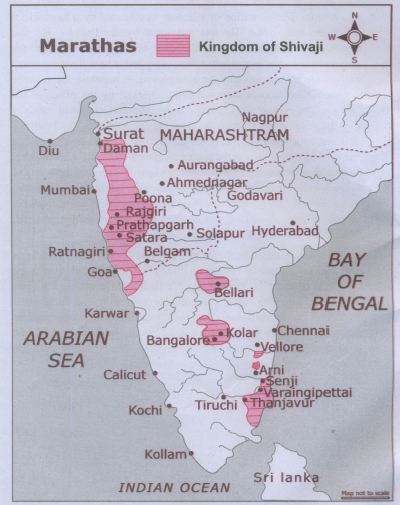
Maratha Empire with prominent cities and forts.
1.
(b)
Bajirao
2.
(c)
Infantry
3.
(a)
Dadaji Kondadev
4.
General of Bijapur
5.
Mother of Shivaji
6.
Shivaji’s grandson
7.
Son of Shivaji
8.
Shivaji's father
9.
(b)
10.
(a)
11.
(b)
12.
(a)
13.
Peshwa - Nagpur
14.
I) Shivaji became totally independent after the death of his guardian Kondadev.
III) Shivaji resumed his military raids after his father's death and conquered Javali.
IV) Balaji Vishwanath became Peshwa
II) Emperor Shahu died when Balaji Bajirao was Peshwa
15.
The imperial moment of the Marathas sadly ended at Panipat near Delhi in 1761. The king of the Afghans, Ahmad Shah Abdali, invaded eight times before finally marching onto Delhi. The Marathas were now divided among several commanders, who approached the battle with different tactics. Artillery decided the battle in January 1761. The mobile artillery of the Afghans proved lethal against both Maratha cavalry and infantry.
16.
Shivaji claimed suzerainty, but he did not administer them himself. He protected the people from loot and plunder for which they were required to pay Chauth (one-fourth of the revenue as protection money) and Sardeshmuki (an extra one-tenth, as the chieftain's due).
17.
The spread of the Bhakti movement in Maharashtra helped the Maratha people develop consciousness of their identity and oneness. It promoted a feeling of unity, especially in terms of social equality, among the Marathas.
18.
Revenue administration of Shivaji :
(i) Shivaji abolished the zamindari system.
(ii) Loans were provided to the farmers in the times of famine.
(iii) The state also collected custom duties and professional taxes.
(iv) The two important taxes collected during his time were Chauth and Sardeshmuki.
Revenue administration of Peshwas:
(i) The revenue administration of peshwas was headed by a key official called the kamavisdar.
(ii) He was expowered to maintain a small body of soldiers to police the administrative area, from where tribute or tax had to be collected.
(iii) A prospective tax or revenue collector who won the contract was expected to have a reputation for wealth and probity.
(iv) He was required to pay a portion of the whole of the anticipated revenue - one third to one half-either out of his own wealth or from the money borrowed from bankers.
19.
Shivaji's political system consisted of three circles. At the centre was the swaraj. Shivaji would not allow the people to be harassed in any way. In the second circle, Shivaji claimed suzerainty, He protected the people from loot and plunder for which they were required to pay chauth (one fourth of the revenue as protection money) and sardeshmukhi (an extra one-tenth, as the chieftain's due). In the third circle, Shivaji's only objective was plunder. Deshmukhs held sway over rural regions and their control was over between twenty and hundred villages. Each village had a powerful headman (patil), who was assisted by a village accountant of a keeper of records (kulkami).
Army:
Shivaji gave utmost attention to his army and training of its personnel. In the beginning, the backbone of his army was the infantry. In the plains, his cavalry force grew in size and importance. Every soldier was selected personally by Shivaji. Retired captains holding a high reputation were put in charge of guarding the forts.
Ashtapradha
Shivaji designated eight ministers as the Ashtapradhan, each holding an important portfolio. Peshwa was the equivalent of a modem prime minister in the Maratha Empire. Originally, they were subordinates to the Chhatrapati.Shivaji was influenced by the Mughal revenue system. The assessments were made on the actual yield, with three-fifths left to the cultivator and two-fifths taken by the government. In judicial administration, civil cases continued to be decided by the panchayat, the village council, while criminal law was based on the shastras, the Hindu law hooks.
Responsibilities of the Astarpradhan:
Pantpradhan / Peshwa - Prime Minister
Amatya / Mazumdar - Finance Minister
Shurunavis/Sacheev - Secretary
Waqia-Navis - Interior Minister
Sar-i-Naubat / Senapati - Commander-in-Chief
Sumant / Dubeer - Foreign Minister
Nyayadhish - Chief Justice
Panditrao - High Priest
20.

7th Standard Syllabus & Materials
7th Standard
TN 7th English T1 - Supplementary - On Monday Morning Important Questions And Answers Study Material - QB365 Set A
NEW7th Standard
TN 7th English T1 - Prose - Eidgah Important Questions And Answers Study Material - QB365 Set A
NEW7th Standard
TN 7th Social Science T1 - ECO - Production Important Questions And Answers Study Material - QB365 Set A
NEW7th Standard
TN 7th Social Science T1 - GEO - Interior of the Earth Important Questions And Answers Study Material - QB365 Set A



Tamilnadu Stateboard 7th Standard Subjects
Tamilnadu Stateboard Standards



