
 100% FREE ACCESS
7th Standard Syllabus & Materials
7th Standard
TN 7th Tamil பருவம் -1 இயல் 1 - அமுதத்தமிழ் - ஒன்றல்ல இரண்டல்ல Important Questions And Answers Study Material - QB365 Set A
NEW7th Standard
TN 7th Tamil பருவம் -1 இயல் 1 - அமுதத்தமிழ் - எங்கள் தமிழ் Important Questions And Answers Study Material - QB365 Set A
NEW7th Standard
TN 7th English T1 - Poem - Your Space Important Questions And Answers Study Material - QB365 Set A
NEW7th Standard
TN 7th English T1 - Prose - A Prayer to the Teacher Important Questions And Answers Study Material - QB365 Set A
NEW7th Standard
TN 7th English T1 - Poem - The Listeners Important Questions And Answers Study Material - QB365 Set A
NEW7th Standard
TN 7th English T1 - Prose - The Wind on Haunted Hill Important Questions And Answers Study Material - QB365 Set A

Published on: 19/08/2019
Download Tamil Nadu 7th Standard Social Science question papers, model tests, one-mark questions, important questions, and public exam papers in PDF format. Free study materials and answer keys for TN State Board students.
Questions + Answers key
Take MCQ Social Science Test
1.
Large deposits of loess are found in ______.
USA
India
China
Brazil
2.
_____ completed the construction of the Qutb-Minar.
Razia
Qutb-ud-din -Aibak
Iltutmish
Balban
3.
Who revived the later Chola dynasty?
Vijayalaya
Rajaraja I
Rajendra I
Athirajendra
4.
What was the most important cause of the invasion of Mahmud of Ghazni?
To destroy idolatry
To plunder the wealth of India
To spread Islam in India
To establish a Muslim state in India
5.
______ was the land gifted to temples.
Vellanvagai
Shalabhoga
Brahmadeya
Devadana
6.
_____is a fixed in supply.
7.
________form the back bone of democracy
8.
_________ patronized the famous Persian poet Amir Khusru.
9.
______ was the founder of Vikramashila University.
10.
3.6 grains of silver amounted to a________.
11.
Sima
12.
Razia
13.
Anju- Vannattar
14.
Sun temple
15.
Konark
16.
FirozShah Tughluq refused to accept an invitation from a Bahmani Prince to intervene in the affairs of the Deccan.
17.
Razia was an able and brave fighter.
18.
Chola kingdom was situated in Vaigai delta.
19.
Indians learnt the numerals 0 – 9 from Arabs.
20.
The composition of metal coins gives us information on the political condition of the empire.
21.
On what basis Urban settlements are classified?
22.
Who founded the city of Agra?
23.
Name any four Rajput clans.
24.
Name Jahangir’s memoir.
25.
Explain the merits and demerits of division of labour.
26.
Describe the classification of volcanoes based on the eruptions.
27.
Describe the different types of coins introduced by the rulers of Delhi Sultanate.
28.
On the river map of India draw the extent of Tughluq Dynasty and mark the following places.
1. Delhi, 2. Devagiri, 3. Lahore, 4. Madurai.
29.
City and town.
30.
What is capital?
31.
What is a Minority party?
32.
What is a river?
1.
(c)
China
2.
(c)
Iltutmish
3.
(a)
Vijayalaya
4.
(b)
To plunder the wealth of India
5.
(d)
Devadana
6.
()
Land
7.
()
Political parties
8.
()
Balban
9.
()
Dharmapala
10.
()
Jital
11.
Silica and magnesium
12.
Jalal-ud-din Yakut
13.
Maritime traders
14.
Konark
15.
Odisha
16.
(a)
17.
(a)
18.
(b)
19.
(b)
20.
(b)
21.
Urban settlements are classified on the basis of
(i) Size of population
(ii) Occupational structure
(iii) Administration
22.
Sikandar Lodi founded the city of Agra.
23.
The Pratiharas, the Chauhans, the Chalukyas (different from the Deccan Chalukyas), known as Solankis, and the Paramaras of Pawars.
24.
Tuzk-i-Jahangiri
25.
Merits of division of labour
(i) It improves efficiency of labour when labour repeats doing the same tasks.
(ii) Facilitates the use of machinery in production? resulting in inventions.
(iii) Time and Materials are put to the best and most efficient use.
Demerits of division of labour
(i) Repetition of the same task makes labour to feel that the work is monotonous and stale. It kills the humanity in him.
(ii) Narrow specialization reduces the possibility of labour to find alternative avenues of employment. This results in increased unemployment.
(iii) Reduce the growth of handicrafts and the worker loses the satisfaction of having made a commodity in full.
26.
(i) Volcanoes are also grouped according to-their periodicity of eruptions such as active, dormant and extinct.
(ii) These names refer to the state of activity rather than the types of volcanoes
(iii) Active Valcanoes that erupt frequently are called active volcanoes. Most of the active volcanoes lie in the Pacific Ring of Fire belt which lies along the Pacific coast.
(iv) Mt. Stromboli in Mediterranean Sea, St.Helens in USA, Pinatubo in Philippines.
(v) Dormant volcanoes have shown no sign of activity for many years but they may become active at any time. It is also called Sleeping Volcano
(vi) Vesuvius mountain of Italy, Mt Fujiyama in Japan, Mt. Krakatoa of Indonesia are famous examples of this types.
(vii) Extinct The top of extinct volcanic mountains have been eroded. Mt Popa of Myanmar and Mt. Kilimanjaro and Mt. Kenya of Africa are examples of extinct volcanoes.
27.
(i) The picture and the legend on the coins convey the names of kings with their titles and portraits, events, places, dates, dynasties and logos.
(ii) The composition of metals in the coins gives us information on the economic condition of the empire.
(iii) Mention of king's achievements like military conquests, territorial expansion, trade links and religious faith can also be found in the coins.
(iv) Muhammad Ghori had stamped the figure of Goddess Lakshmi on his gold coins and had his name inscribed on it.
(v) This coin tells us that this early Turkish invader was in all likelihood liberal in religious outlook.
(vi) Copper Jitals are available for the study of the period of the Delhi Sultans.
(vii) Silver Tanka introduced by Iltutmish, Ala-ud-din Khalji's gold coins, Muhammad-bin- Tughluq's copper token currency are indicative of coinage as well as the economic prosperity or otherwise of the country of the time.
(viii) Ajital contained 3.6 grains of silver. Forty eight jitals were equal to 1 silver tanka.
28.
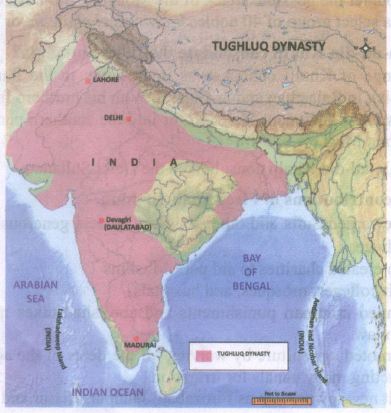
29.
| S.No | City | Town |
| 1. | Large urban place | Urban place |
| 2. | Population more than 1 lakh | Population more than 5,000 people |
30.
Capital is man made physical goods used to produce other goods and services. In short, Capital means money.
31.
The Political Party with lesser number of elected candidates are called the Minority party.
32.
The water flowing from its source to river mouth, along a definite course is called a River.

7th Standard Syllabus & Materials
7th Standard
TN 7th English T1 - Supplementary - On Monday Morning Important Questions And Answers Study Material - QB365 Set A
NEW7th Standard
TN 7th English T1 - Prose - Eidgah Important Questions And Answers Study Material - QB365 Set A
NEW7th Standard
TN 7th Social Science T1 - ECO - Production Important Questions And Answers Study Material - QB365 Set A
NEW7th Standard
TN 7th Social Science T1 - GEO - Interior of the Earth Important Questions And Answers Study Material - QB365 Set A



Tamilnadu Stateboard 7th Standard Subjects
Tamilnadu Stateboard Standards



