
 100% FREE ACCESS
7th Standard Syllabus & Materials
7th Standard
TN 7th Tamil பருவம் -1 இயல் 1 - அமுதத்தமிழ் - ஒன்றல்ல இரண்டல்ல Important Questions And Answers Study Material - QB365 Set A
NEW7th Standard
TN 7th Tamil பருவம் -1 இயல் 1 - அமுதத்தமிழ் - எங்கள் தமிழ் Important Questions And Answers Study Material - QB365 Set A
NEW7th Standard
TN 7th English T1 - Poem - Your Space Important Questions And Answers Study Material - QB365 Set A
NEW7th Standard
TN 7th English T1 - Prose - A Prayer to the Teacher Important Questions And Answers Study Material - QB365 Set A
NEW7th Standard
TN 7th English T1 - Poem - The Listeners Important Questions And Answers Study Material - QB365 Set A
NEW7th Standard
TN 7th English T1 - Prose - The Wind on Haunted Hill Important Questions And Answers Study Material - QB365 Set A

Published on: 30/09/2019
The Mughal Empire
Download Tamil Nadu 7th Standard Social Science question papers, model tests, one-mark questions, important questions, and public exam papers in PDF format. Free study materials and answer keys for TN State Board students.
Questions + Answers key
Take MCQ Social Science Test
1.
Who was the revenue minister of Akbar?
Birbal
Raja Bhagwan Das
Raja Todarmal
Raja Man Singh
2.
Who introduced Mansabdari system?
Sher Sha
Akbar
Jahangir
Shah Jahan
3.
Whose palace in Delhi was destroyed by Sher Shah?
Babur
Humayun
Ibrahim Lodi
Alam Khan
4.
Who introduced the Persian style of architecture in India?
Humayun
Babur
Jahangir
Akbar
5.
_________ were tax-free lands given to scholars and religious institutions.
6.
During the reign of _________ the Zabti system was extended to the Deccan provinces.
7.
______ was a hall at FatehpurSikri where scholars of all religions met for a discourse.
8.
_____was the name of the horse of Rana Pratap.
9.
Babur
10.
Daulat Khan Lodi
11.
Raja Man Singh
12.
Rani Chand Bibi
13.
Babur
14.
During Aurangzeb’s reign, architecture received much patronage.
15.
Jahangir ordered execution of Sikh leader Guru Arjun for helping his son Khusrau.
16.
Humayun succeeded in recapturing Delhi in 1565.
17.
Babur inherited Farghana, a small kingdom in Central Asia.
18.
Assertion (A) : Aurangzeb’s intolerance towards other religions made him unpopular among people.
Reason (R) : Aurangzeb re-imposed the jizya and pilgrim tax on the Hindus.
a) R is the correct explanation of A.
b) R is not the correct explanation of A.
c) A is wrong and R is correct.
d) (A) and (R) are wrong.
19.
Assertion (A) : The British established their first factory at Surat.
Reason (R) : Jahangir granted trading rights to the English.
a) R is the correct explanation of A.
b) R is not the correct explanation of A.
c) A is wrong and R is correct.
d) (A) and (R) are wrong.
20.
(I) Kamran was the son of Afghan noble, Hasan Suri, ruler of Sasaram in Bihar.
(II) Akbar abolished the jizya poll tax on non-Muslims and the tax on Hindu pilgrims.
(III) Aurangzeb acceded the throne after killing his three brothers.
(IV) Prince Akbar entered into a pact with Shivaji’s son Shambuji in the Deccan.
(a) (i), (ii) and (iii) are correct
(b) (ii), iii) and (iv) are correct
(c) (i), (iii) and (iv) are correct
(d) (ii), (iii), (iv) and (i) are correct
21.
Write a note on Mansabdari system.
22.
Write the circumstance that led to the Battle of Panipat in 1526.
23.
Describe the land revenue administration of the Mughals.
24.
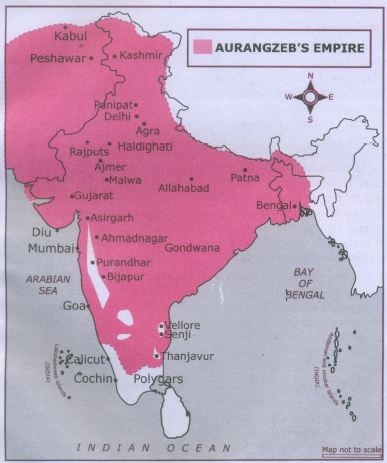
Mark the extent of Mughal Empire during the reign of Akbar and Aurangzeb with special focus on important battle fields.
1.
(c)
Raja Todarmal
2.
(b)
Akbar
3.
(b)
Humayun
4.
(b)
Babur
5.
()
Suyurghal
6.
()
Salim Jahan
7.
()
Ibadat Khana
8.
()
Chetak
9.
Humayun
10.
Dilawar Khan
11.
Jaipur
12.
Ahmednagar
13.
Chanderi
14.
(b)
15.
(a)
16.
(b)
17.
(a)
18.
a) R is the correct explanation of A.
19.
(a) R is the correct explanation of A
20.
(b) (ii), (iii), (iv) are correct
21.
Akbar introduced the Mansabdari system. According to this system, the nobles, civil and military officials were combined to form one single service. Everyone in the service was given a mansab, meaning a position or rank. A Mansabdar a holder of such a rank. Mansabdar rank was dependent on zat and Sawar.
22.
Babur did not have any ambition beyond Punjab till 1524. Then a greater opportunity came knocking. Dilawar Khan, who was Daulat Khan Lodi's son, and Alam Khan, who was the uncle of Sultan of Delhi, arrived in Kabul to seek Babur's help in removing Ibrahirn Lodi from power. Babur defeated Ibrahim Lodi in the famous Battle of Panipat in 1526.
23.
Land revenue administration:
Land revenue administration was toned up during the reign of Akbar. Raja Todar Mal, Revenue Minister of Akbar, adopted and refined the system introduced by Sher Shah.
Zabt System:
(i) According to Zabt system, after a survey, lands were classified according to the nature and fertility of the soil.
(ii) The share of the state was fixed at one-third of the average produce for 10 years.
Jagir:
(i) The Mughal emperors enforced the old iqta system, renaming it jagir. It is a land tenure system developed during the period of Delhi Sultanate.
(ii) Under the system, the collection of the revenue of an area and the power of governing it were bestowed upon a military or civil official now named Jagirdar.
(iii) Every Mansabdar was a Jagirdar if he was not paid in cash. The Jagirdar collected the revenue through his own officials.
Zamindars:
(i) Those appointed to collect the revenue from the landholders were called zamindars.
(ii) Zamindars collected taxes and maintained law and order with the help of Mughal officials and soldiers.
(iii) The local chieftains and little kings were also called zamindars.
24.

7th Standard Syllabus & Materials
7th Standard
TN 7th English T1 - Supplementary - On Monday Morning Important Questions And Answers Study Material - QB365 Set A
NEW7th Standard
TN 7th English T1 - Prose - Eidgah Important Questions And Answers Study Material - QB365 Set A
NEW7th Standard
TN 7th Social Science T1 - ECO - Production Important Questions And Answers Study Material - QB365 Set A
NEW7th Standard
TN 7th Social Science T1 - GEO - Interior of the Earth Important Questions And Answers Study Material - QB365 Set A



Tamilnadu Stateboard 7th Standard Subjects
Tamilnadu Stateboard Standards



