
 100% FREE ACCESS
8th Standard Syllabus & Materials
8th Standard
TN 8th Tamil இயல் 3 - கல்வி கரையில - வினைமுற்று Important Questions And Answers Study Material - QB365 Set A
NEW8th Standard
TN 8th Tamil இயல் 2 - ஈடில்லா இயற்கை - மயங்கொலிகள் Important Questions And Answers Study Material - QB365 Set A
NEW8th Standard
TN 8th Tamil இயல் 2 - ஈடில்லா இயற்கை -பட்டமரம் Important Questions And Answers Study Material - QB365 Set A
NEW8th Standard
TN 8th Tamil இயல் 2 - ஈடில்லா இயற்கை - இயற்கையை போற்றுவோம் Important Questions And Answers Study Material - QB365 Set A
NEW8th Standard
TN 8th Tamil இயல் 1 - தமிழ் இன்பம் - ஆழிக்கு இணை Important Questions And Answers Study Material - QB365 Set A
NEW8th Standard
TN 8th Tamil இயல் 2-ஈடில்லா இயற்கை - திருக்குறள் Important Questions And Answers Study Material - QB365 Set A

Published on: 18/09/2019
Geometry
Download Tamil Nadu 8th Standard Maths question papers, model tests, one-mark questions, important questions, and public exam papers in PDF format. Free study materials and answer keys for TN State Board students.
Questions + Answers key
Take MCQ Maths Test1.
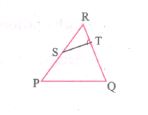
In the given figure if \(\angle \)P =\(\angle \)RTS, prove that \(\triangle \)RPQ ~\(\triangle \) RTS.
2.
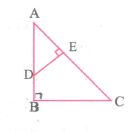
In the figure AB\(\bot \) BC and DE\(\bot \)AC prove that \(\triangle \)ABC ~\(\triangle \)AED.
3.
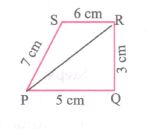
Is it possible to construct a quadrilateral PQRS with PQ = 5 cm, QR = 3 cm, RS = 6 cm, PS = 7 cm and PR = 10 cm. If not, why?
4.
Fill in the blanks with the correct term from the given list.
(in proportion, similar, corresponding, congruent shape, area, equal)
(i) Corresponding sides of similar triangles are _______.
(ii) Similar triangles have the same _________ but not necessarily the same size.
(iii) In similar triangles, ______ sides are opposite to equal angles.
(iv) The symbol ≡ is used to represent _______ triangles.
(v) The symbol ~ is used to represent ________ triangles
5.
Construct the following quadrilaterals with the given measurements and also find their area.
YOGA, YO = 6 cm, OG = 6 cm, ∠O = 55°, ∠G = 35° and ∠A = 100°.
6.
Construct the following quadrilaterals with the given measurements and also find their area.
AGRI, AG = 4.5 cm, GR = 3.8 cm, ∠A = 60°, ∠G = 110° and ∠R = 90°.
7.
Construct the following quadrilaterals with the given measurements and also find their area.
PLAY, PL = 7 cm, LA = 6 cm, AY = 6 cm, PA = 8 cm and LY = 7 cm.
8.
Construct the following quadrilaterals with the given measurements and also find their area.
KITE, KI = 5.4 cm, IT = 4.6 cm, TE = 4.5 cm, KE = 4.8 cm and IE = 6 cm.
9.
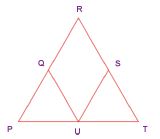
In the figure, PQ ≡ TS, Q is midpoint of PR, S is the midpoint TR and ∠PQU ≡ ∠TSU. Prove that QU ≡ SU.
10.
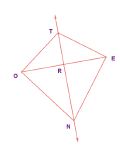
In the figure, ∠TEN ≡ ∠TON = 90o and TO ≡ TE. Prove that ∠ORN ≡ ∠ERN.
11.
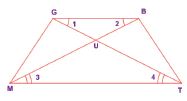
In the figure, given that ∠1 = ∠2 and ∠3 ≡ ∠4. Prove that ΔMUG ≡ ΔTUB.
12.
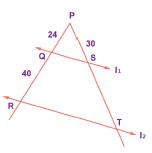
In the given figure, find PT given that l1|| l2.
13.
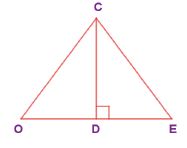
In the given figure, D is the midpoint of OE and ∠CDE = 90°. Prove that ΔODC ≡ ΔEDC
14.
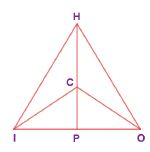
In the given figure, ∠CIP ≡ ∠COP and ∠HIP ≡ ∠HOP . Prove that IP ≡ OP.
15.
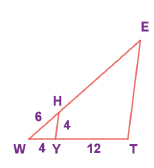
In the given figure YH||TE . Prove that ΔWHY~ΔWET and also find HE and TE.
1.
In triangles \(\triangle \)RPQ and \(\triangle \) RTS, we have
\(\angle \)RPQ=\(\angle \)RTS [∵ given]
\(\angle \)PRQ =\(\angle \)TRS [∵ common]
\(\angle \)PQR =\(\angle \)RST l∵ Remaining angle]
\(\triangle \)RPQ ~ \(\triangle \)RTS [∵ By AAA similarity]
2.
In triangles \(\triangle \)ABC and \(\triangle \)AED.
\(\angle \)ABC=\(\angle \)AED = 90°
\(\angle \)BAC=\(\angle \)EAD [Each equal to A]
∴ \(\angle \)ADE=\(\angle \)ACB [∵ Remaining angles]
∴ By AAA criteria of similarity \(\triangle \)ABC ~\(\triangle \)AED.
3.
The lower triangle cannot be constructed as the sum of two sides 5 + 3 = 8 < 10 cm. So this quadrilateral cannot be constructed.
4.
(i) in proportion
(ii) shape
(iii) equal
(iv) congruent
(v) similar
5.
YO = 6 cm, OG = 6 cm, ∠O = 55°, ∠G = 35° and ∠A = 100°.
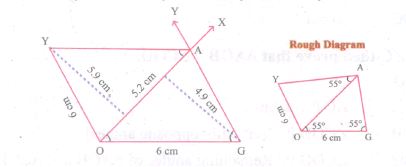
Steps:
1. Drawn a line segment OG = 6 cm
2. At G on DG made an angle ∠OGY = 55°
3. At G on GO made ∠GOX = 55°.
4. GY and OX meet cut A.
5. At A on OA made∠OAZ = 55°
6. Drawn an arc of radius 6 cm with center O. It cut AZ at Y.
7. Joined OY.
8. YOGA is the required quadrilateral.
Calculation of Area:
Area of the quadrilateral YOGA = \(\frac { 1 }{ 2 } \times\ d\times({ h }_{ 1 }+{ h }_{ 2 })sq.units\) = \(\frac { 1 }{ 2 } \times5.2\times({ 5.9}+4.9)\) cm2
= \(\frac { 1 }{ 2 } \times5.2\times10.8\) cm2 = 5.2 x 5.4 cm2 = 28.08 cm2
Area of the quadrilateral = 28.08 cm2
6.
AG = 4.5 cm, GR = 3.8 cm, ∠A = 60°, ∠G = 110° and ∠R = 90°.
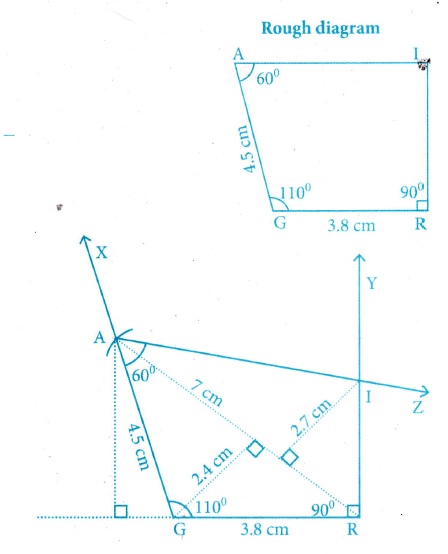
steps:
1. Draw a line segment AG = 4.5 cm
2. At G on AG made ∠AGX = 110°
3. With G as centre drawn an arc of radius 3.8 cm let it cut GX at R.
4. At R on GR made ∠GRZ = 90°
5. At A on AG made ∠GAY = 90°
6. AY and RZ meet at I.
7. AGRI is the required quadrilateral.
Calculation of Area:
Area of the quadrilateral AGRI
\( =1 / 2 \times \mathrm{d} \times\left(\mathrm{h}_{1}+\mathrm{h}_{2}\right) \text { sq. units } \)
\(=1 / 2 \times 7 \times(2.4+2.7) \)
\(=1 / 2 \times 7 \times 5.1=17.85 \text { sq. cm. }\)
7.
Given, PL = 7 cm, LA = 6 cm, AY = 6 cm, PA = 8 cm and LY = 7 cm.
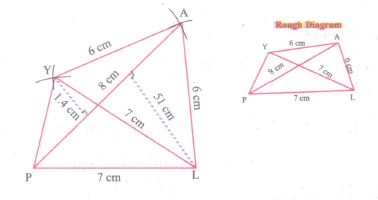
Steps:
1. Drawn a line segment PL = 7 cm
2. With P and L as centers, drawn arcs of radii 8 cm and 6 cm respectively, let them cut at A.
3. Joined PA and LA.
4. With L and A as centers, drawn arcs of radii 7 crn and 6 cm respectively and let them cut at Y.
5. Joined LY, PY and AY.
6. PLAY is the required quadrilateral.
Calculation of Area:
Area of the quadrilateral PLA Y = \(\frac { 1 }{ 2 } \times\ d \times({ h }_{ 1 }+{ h }_{ 2 })sq.units\)
\( =1 / 2 \times d \times\left(h_{1}+h_{2}\right) \text { sq. units } \)
\(=1 / 2 \times 8 \times(5.2+1) \)
\(=1 / 2 \times 8 \times 6.2 \)
= 24.8 sq. cm.
8.
Given, KI = 5.4 cm, IT = 4.6 cm, TE = 4.5 cm, KE = 4.8 cm and IE = 6 cm.
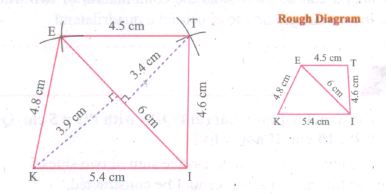
Steps:
1. Drawn a line segment KI = 5.4 cm
2. With K and I as centers drawn arcs of radii 4.8 cm and 6 cm respectively and let them cut at E.
3. Joined KE and IE.
4. With E and I as centers, drawn arcs of radius 4.5 cm and 4.6 cm respectively and let them cut at T.
5. Joined ET and IT.
6. KITE is the required quadrilateral.
Calculation of Area:
Area of the quadrilateral = \(\frac { 1 }{ 2 } \times\ d\times({ h }_{ 1 }+{ h }_{ 2 })sq.units\)
= \(\frac { 1 }{ 2 } \times6\times({ 3.4 }+3.9)\)cm2
= 3 x 7.3 cm2 = 21.9 cm2
Area of the quadrilateral = 21.9 cm2
9.
| S.No. | Statements | Reasons |
| 1. | PQ = TS | Given |
| 2. | PQ = QR ;TS = SR | given S is the midpoint of TR and Q is the midpoint of PR |
| 3. | PQ = QR = SR = TS ⇒PQ + QR = TS + SR |
By 1,2 |
| 4. | PR = TR | By 3 |
| 5. | \(\angle \)RPT = \(\angle \)RTP | In \(\triangle \)RPT by 4 PR =TR Angle opposite to equal sides are equal |
| 6. | \(\angle \)GPU = \(\angle \)STU | By 5 5 and 6 are same given |
| 7. | \(\angle \)PQU \(\equiv \\ \) \(\angle \)TSU | given |
| 8. | \(\triangle \)PQU \(\equiv \\ \) \(\triangle \)TSU | By 6, 7 and 1 ASA criteria |
| 9. | QU \(\equiv \\ \) SU | By CPCTC |
10.
| S.No. | Statements | Reasons |
| 1. | \(\angle \)TEN = \(\angle \)TON = 90o | Given |
| 2. | TD = TE | Given |
| 3. | TN = TN | Common |
| 4. | \(\triangle \)TEN ~\(\triangle \)TEO | RHS criteria and by 1,2,3 |
| 5. | \(\angle \)TEO =\(\angle \)TOE | By 2, Angles opposite to equal sides are equal. |
| 6. | \(\angle \)REN =\(\angle \)RON | By 1, 3 |
| 7. | EN = ON \(\angle \)ENT = \(\angle \)ONT |
CPCTC in 4 |
| 8. | \(\angle \)ENR = \(\angle \)ONR | By 5 |
| 9. | \(\angle \)ORN \(\equiv \\ \)\(\angle \)ERN | By 6, 7 Remaining angle in \(\triangle \)ERN and \(\triangle \)ORN |
11.
\(
\text { In } \Delta \mathrm{GUB},
\) \(\angle \mathrm{G} =\angle \mathrm{B}
\)
\(\therefore \mathrm{GU} =\mathrm{BU}
\)
\(\text { In } \Delta \mathrm{MUT}, \ \therefore \mathrm{M} =\angle \mathrm{T}
\)
\(\therefore \mathrm{MU} =\mathrm{TU}
\)
\(
In \triangle \mathrm{MUG} \ and \ \triangle TUB
\)
\(G U=B U\)
\(\angle \mathrm{GUM}=\angle \mathrm{BUT}\)
\(\Delta \mathrm{MUG} \equiv \Delta \mathrm{TUB}\)
Hence proved
12.
Given that l1 || l2
∴ In \(\triangle \)PQS and \(\triangle \)PRT
\(\angle \)P is common
\(\angle \)Q =\(\angle \)R [ ∵ PR is the transversal for l1 and l2 corresponding angles]
\(\angle \)S =\(\angle \)T [∵ corresponding angles]
∴ \(\triangle \)PQS ~ \(\triangle \)PRT [ ∵ By AAA congruency]
In similar triangles, corresponding sides are proportional.
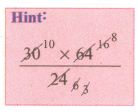
\(\frac { PQ }{ PR } =\frac { PS }{ PT } \\ \frac { 24 }{ 24+40 } =\frac { 30 }{ PT } \\ \frac { 24 }{ 64 } =\frac { 30 }{ PT } \\ PT=\frac { 30\times64 }{ 24 } \\ PT=80\)
13.
\(\text { In } \triangle \mathrm{ODC} \text { and } \triangle \mathrm{EDC} \text {, }\)
CD = CD
\(\angle \mathrm{CDO}=\angle \mathrm{CDE}=90^{\circ}\)
OD = ED (given)
\(\therefore \triangle \mathrm{ODC} \equiv \Delta \mathrm{EDC}(\mathrm{SAS})\)
Hence proved
14.
\(In \ \triangle\ \mathrm{HIO}, \)
\(\angle \mathrm{HIP}=\angle \mathrm{HOP}(\text { given })\)
Then \(\triangle\) HIO is isosceles
HI = HO
In \(\triangle\) HIP and \(\triangle\) HOP,
HI = HO
\(\angle \mathrm{HIP}=\angle \mathrm{HOP}\)
Side HP is common
\(\triangle\) HIP = \(\triangle\) HOP
Then IP = OP
Hence proved
15.
Given in\( \triangle \mathrm{WHY} and \ \triangle \mathrm{WET}, \)
\(\angle \mathrm{W} =\angle \mathrm{W} \)
\(\angle \mathrm{WYH} =\angle \mathrm{WTE} \)
\(\angle \mathrm{WHY} =\angle \mathrm{WET} \\ \therefore \Delta \mathrm{WHY} \sim \Delta \mathrm{WET} \)
Also \(\triangle \)WHY ~ \(\triangle \)WET
∴ Corresponding sides are proportionated
\(\frac { WH }{ WE } =\frac { HY }{ ET } =\frac { WY }{ WT } \)
\(\\ \frac { 6 }{ 6+HE } =\frac { 4 }{ ET } =\frac { 4 }{ 16 }\)
\( \\ \frac { 6 }{ 6+HE } =\frac { 4 }{ 16 }\)
\( \\ 6+HE=\frac { 6 }{ 4 } \times16\)
\(\\ 6+HE=24\)
\(\\ \therefore HE=24-6\\ HE=18\)
\(\\ Again\quad \frac { 4 }{ ET } =\frac { 4 }{ 16 } \)
\(\\ ET=\frac { 4 }{ 4 } \times 16\)
\(\\ ET=16\)

8th Standard Syllabus & Materials
8th Standard
TN 8th Tamil இயல் 3 - கல்வி கரையில - பாடறிந்து ஒழுகுதல் Important Questions And Answers Study Material - QB365 Set A
NEW8th Standard
TN 8th Tamil இயல் 3-கல்வி கரையில - பல்துறைக் கல்வி Important Questions And Answers Study Material - QB365 Set A
NEW8th Standard
TN 8th Tamil இயல் 3-கல்வி கரையில - புத்தியைத் தீட்டு Important Questions And Answers Study Material - QB365 Set A
NEW8th Standard
TN 8th Tamil இயல் 2 - ஈடில்லா இயற்கை - தமிழர் மருத்துவம் ( நேர்காணல்) Important Questions And Answers Study Material - QB365 Set A



Tamilnadu Stateboard 8th Standard Subjects
Tamilnadu Stateboard Standards




