
 100% FREE ACCESS
8th Standard Syllabus & Materials
8th Standard
TN 8th Tamil இயல் 3 - கல்வி கரையில - வினைமுற்று Important Questions And Answers Study Material - QB365 Set A
NEW8th Standard
TN 8th Tamil இயல் 2 - ஈடில்லா இயற்கை - மயங்கொலிகள் Important Questions And Answers Study Material - QB365 Set A
NEW8th Standard
TN 8th Tamil இயல் 2 - ஈடில்லா இயற்கை -பட்டமரம் Important Questions And Answers Study Material - QB365 Set A
NEW8th Standard
TN 8th Tamil இயல் 2 - ஈடில்லா இயற்கை - இயற்கையை போற்றுவோம் Important Questions And Answers Study Material - QB365 Set A
NEW8th Standard
TN 8th Tamil இயல் 1 - தமிழ் இன்பம் - ஆழிக்கு இணை Important Questions And Answers Study Material - QB365 Set A
NEW8th Standard
TN 8th Tamil இயல் 2-ஈடில்லா இயற்கை - திருக்குறள் Important Questions And Answers Study Material - QB365 Set A

Published on: 20/09/2019
Download Tamil Nadu 8th Standard Maths question papers, model tests, one-mark questions, important questions, and public exam papers in PDF format. Free study materials and answer keys for TN State Board students.
Questions + Answers key
Take MCQ Maths Test1.
Reduce to the standard form
\(\frac { -18 }{ -42 } \)
2.
Expand (y - 5)3
3.
Guna has fixed a single door of 3 feet wide in his room where as Nathan has fixed a double door, each 1\(\frac{1}{2}\) feet wide in his room. From the closed state, if each of the single and double doors can open up to 1200, whose door requires a minimum area?
4.
Find the unknowns in the following figures
.JPG)
5.
Simplify: \(\\ \\ \\ \frac { 1 }{ 8 }- \left( \frac { 1 }{ 6 } -\frac { 1 }{ 4 } \right) .\)
6.
Mangalam buys a water jug of capacity \(3\frac { 4 }{ 5 } \) litres. If she buys another jug which is \(2\frac { 2 }{ 3 } \) times as large as the smaller jug, how many liters can the larger one hold?
7.
Find the rational numbers represented by each of the question marks marked on the following number lines.

8.
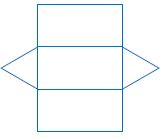
Which 3-D shapes do the following nets represent? Draw them.
9.
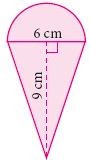
Find the area of the combined figure given, formed by joining a semicircle of diameter 6 cm with a triangle of base 6 cm and height 9 cm. ( π = 3.14 )
10.
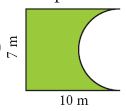
Find the perimeter and area of the combined figures given below. \(\left( \pi =\frac { 22 }{ 7 } \right) \)
11.
Find the area of a sector whose perimeter is 64 cm and length of the arc is 44 cm.
12.
Factorize
(x+1)2-(x-2)2
13.
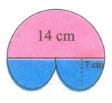
Find the area of the shaded region in the figure.
14.
Factorise : x2 + 8x + 16
15.
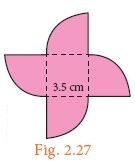
Find the perimeter and area of the given Figure. \(\left( \pi =\frac { 22 }{ 7 } \right) \)
16.
The number which is subtracted from \(\frac { -6 }{ 11 } \) to get \(\frac { 8 }{ 9 } \) is
\(\frac { 34 }{ 99 } \)
\(\frac { -142 }{ 99 } \)
\(\frac { 142 }{ 99 } \)
\(\frac { -34 }{ 99 } \)
17.
If ΔABC~ΔPQR in which ∠A = 53o and ∠Q = 77o, then R is
50°
50°
70°
80°
18.
How many 2 digit numbers contain the number 7?
10
18
19
20
19.
If the area of a rectangle is 48m2n3 and whose length is 82mn2 then, its breadth is______
6mm
8m2n
7m2n2
6m2n2
20.
The multiplicative inverse exists for all rational numbers
21.
The rational numbers that are equal to their additive inverses are 0 and –1.
22.
0 is the smallest rational number
23.
8x3y ÷ 4x2 = 2xy
24.
Expand the following
(m -10)(m + 5) =______
25.
The meeting point of more than two edges in a polyhedron is called as ______________
26.
A line segment which joins any two points on a circle is a _________.
27.
\(\frac { 1 }{ 0 } \)
28.

29.

30.
Area of the sector of a circle
1.
Method 1:
\(\frac { -18 }{ -42 } =\frac { -18\div (-2) }{ -42\div (-2) } =\frac { 9\div 3 }{ 21\div 3 } =\frac { 3 }{ 7 } \) (dividing by –2 and 3 successively)
Method 2:
The HCF of 18 and 42 is 6 (Find it). Thus, we can get its standard form by dividing it by 6.
\(\frac { -18 }{ -42 } =\frac { -18\times (-1) }{ -42\times (-1) } =\frac { 18 }{ 42 } =\frac { 18\div 6 }{ 42\div 6 } =\frac { 3 }{ 7 } \)
2.
Comparing (y-5)3 with (a-b)3,we get a = y,b = 5
(a-b)3 = a3- 3a2b + 3ab + 3ab2-b2
(y - 5)3 = (y)3 + 3(y)2(5) + 3(y)(5)2 - (-5)3
= (y)3+ 3y2(5) + 3(y)(25)-125
(y - 5)3 = y3-15y2 + 75y-125
3.
Guna fixed a single door of 3 feet wide.
Radius of this single door = 3 feet.
Nathan fixed a double door each of 1 1/2 feet wide.
Radius of each of this double door
\(=\frac{3}{2} \text { feet. } \)
The area required for the single door
\(=\frac{\theta}{360} \times \pi r^{2} \)
\(=\frac{120}{360} \times 3.14 \times 3 \times 3 \)
= 9.42 m2 ............(i)
The area required for the double door
\(=2 \times \frac{\theta}{360} \times \pi r^{2} \)
\(=2 \times \frac{120}{360} \times 3.14 \times \frac{3}{2} \times \frac{3}{2} \)
= 4.71 m2 ........................(ii)
From (i) and (ii), the double door requires minimum area.
4.
Now, from Fig PQ = PR
⇒\(\angle\)Q = \(\angle\)R (angles opposite to equal sides are equal)
⇒ \(\angle\)x = \(\angle\)y
⇒\(\angle\)x+ \(\angle\)y + 50o = 180o (angle sum property in ΔPQR)
⇒ 2\(\angle\)x = 130o
⇒\(\angle\)x = 65o
⇒ \(\angle\)y = 65o
5.
\(\frac { 1 }{ 8 } \left( \frac { 1 }{ 6 } -\frac { 1 }{ 4 } \right) =\frac { 1 }{ 8 } -\left[ \frac { (1\times 2)-(1\times 3) }{ 12 } \right] \)
\(=\frac { 1 }{ 8 } -\left( \frac { 2-3 }{ 12 } \right) \)
\(=\frac { 1 }{ 8 } -\left( -\frac { 1 }{ 12 } \right) \)
\(=\frac { 1 }{ 8 } +\frac { 1 }{ 12 } =\frac { (1\times 3)+(1\times 2) }{ 24 } \)
\(=\frac { 3+2 }{ 24 } =\frac { 5 }{ 24 } \)
6.
Capacity of the small water jug = 3\(\frac{4}{5}\)litres.
Capacity of the big jug = 2\(\frac{2}{3}\) times the small one.
\(2\frac { 2 }{ 3 } \times 3\frac { 4 }{ 5 } =\frac { 8 }{ 3 } \times \frac { 19 }{ 5 } =\frac { 152 }{ 15 } \)
= \(10\frac { 2 }{ 5 } \) litres
Capacity of the large jug = \(10\frac { 2 }{ 5 } \) litres
7.
The rational number for the point marked on the number line is -3\(\frac{2}{3}\) = \(\frac{-11}{3}\)
8.
Triangular Prism
9.
The given figure is a combination of a semicircle and a triangle.
diameter = 6 cm
radius = 3 cm
base = 6 cm
height = 9 cm
The shaded area of the figure = Area of the semicircle + Area of the triangle
\(=\frac{1}{2} \pi \mathrm{r}^{2}+\frac{1}{2} \mathrm{bh} \)
\(=\frac{1}{2} \times 3.14 \times 3 \times 3+\frac{1}{2} \times 6 \times 9 \)
= 14.13 + 27 = 41.13 cm2
10.
From this figure, perimeter
= 10 m + 7 m + 10 m + L
\(\begin{equation}
=27 \mathrm{~m}+\frac{\theta}{360} \times 2 \pi \mathrm{r}
\end{equation}\)
\(=27+\frac{180}{360} \) \(\times
2 \times \frac{22}{7} \times \frac{7}{2}\)
= 27 + 11 = 38 m
Area of the shaded part - Area of the rectangle - Area of the semicircle
=\((l\times b)-\frac { 1 }{ 2 } \times \pi { r }^{ 2 }\)
= \((10\times 7)-\frac { 1 }{ 2 } \times \frac { 22 }{ 7 } \times \frac { 7 }{ 2 } \times \frac { 7 }{ 2 } \)
= 50.75 m2
11.
Length of the arc of the sector l = 44 cm
Perimeter of the sector P = 64cm
l+ 2r = 64cm
44 + 2r = 64
2r = 64-44
2r = 20
r = \(\frac{20}{2}\) = 10cm
Area of the sector = \(\frac { lr }{ 2 } \) sq. units
= \(\frac { 44\times 10 }{ 2 } \) cm2 = 22 x 10 cm2 = 220 cm2
Area of the sector = 220 cm2
12.
(x-1)2-(x-2)2={(x-1+(x-2)}{(x-1)-(x-2)}
= (2x-3)-(x-1-x+2)
= (2x-3)X1=2x-3
13.
Radius of the big semicircle = 14 cm
∴ Area of big semicircle = \(\frac { 1 }{ 2 } \)πr2 sq. units
= \(\frac { 1 }{ 2 } \times \frac { 22 }{ 7 } \times 14\times 14\)
= 308 cm2
Radius of small semi circles = 7cm
Area of 2 small semi circles = \(\frac { 1 }{ 2 } \times \frac { 22 }{ 7 } \times 7\times 7\)
= 154 cm2
∴ Required area = 308 + 154 cm2
= 462 cm2
14.
Now, x2 + 8x + 16
This can be written as x2 + 8x + 42
Comparing this with a2 + 2ab + b2 = (a + b)2 we get a = x; b = 4
(x2) + 2(x)(4) + (4)2 = (x + 4)2
x2 + 8x + 16 = (x + 4)2
15.
Radius of a circular quadrant, r = 3.5 cm and side of a square, a = 3.5 cm.
The given figure is formed by the joining of 4 quadrants of a circle with each side of a square. The boundary of the given figure consists of 4 arcs and 4 radii.
(i) Perimeter of the given combined shape
= 4 x length of the arcs of the quadrant of a circle + 4 x radius
\(=\left( 4\times \frac { 1 }{ 4 } \times 2\pi r \right) +4r\)
\(=\left( 4\times \frac { 1 }{ 4 } \times 2\times 3.5 \right) +(1\times 3.5)\)
= 22 + 14 = 36 cm (approximately)
(ii) Area of the given combined shape
= area of the square + 4 x area of the quadrants of the circle
\({ a }^{ 2 }=\left( 4\times \frac { 1 }{ 4 } \times \pi { r }^{ 2 } \right) \)
\(=(3.5\times 3.5)+\left( \frac { 22 }{ 7 } \times 3.5\times 3.5 \right) \)
A = 12.25 + 38.5 = 50.75 cm2 (approximately)
16.
(b)
\(\frac { -142 }{ 99 } \)
17.
(a)
50°
18.
(c)
19
19.
(a)
6mm
20.
(b)
21.
(b)
22.
(b)
23.
(a)
24.
()
(m - 10)(m + 5) = m2+ (-10+ 5)m + (-10)(5) = m2 - 5m -50
25.
()
Vertex
26.
()
chord
27.
does not exist
28.
Triangular Prism
29.
Cylinder
30.
\(=\frac { { \theta }^{ 0 } }{ { 360 }^{ 0 } } \times { \pi r }^{ 2 }\)

8th Standard Syllabus & Materials
8th Standard
TN 8th Tamil இயல் 3 - கல்வி கரையில - பாடறிந்து ஒழுகுதல் Important Questions And Answers Study Material - QB365 Set A
NEW8th Standard
TN 8th Tamil இயல் 3-கல்வி கரையில - பல்துறைக் கல்வி Important Questions And Answers Study Material - QB365 Set A
NEW8th Standard
TN 8th Tamil இயல் 3-கல்வி கரையில - புத்தியைத் தீட்டு Important Questions And Answers Study Material - QB365 Set A
NEW8th Standard
TN 8th Tamil இயல் 2 - ஈடில்லா இயற்கை - தமிழர் மருத்துவம் ( நேர்காணல்) Important Questions And Answers Study Material - QB365 Set A



Tamilnadu Stateboard 8th Standard Subjects
Tamilnadu Stateboard Standards




