
 100% FREE ACCESS
8th Standard Syllabus & Materials
8th Standard
TN 8th Tamil இயல் 3 - கல்வி கரையில - வினைமுற்று Important Questions And Answers Study Material - QB365 Set A
NEW8th Standard
TN 8th Tamil இயல் 2 - ஈடில்லா இயற்கை - மயங்கொலிகள் Important Questions And Answers Study Material - QB365 Set A
NEW8th Standard
TN 8th Tamil இயல் 2 - ஈடில்லா இயற்கை -பட்டமரம் Important Questions And Answers Study Material - QB365 Set A
NEW8th Standard
TN 8th Tamil இயல் 2 - ஈடில்லா இயற்கை - இயற்கையை போற்றுவோம் Important Questions And Answers Study Material - QB365 Set A
NEW8th Standard
TN 8th Tamil இயல் 1 - தமிழ் இன்பம் - ஆழிக்கு இணை Important Questions And Answers Study Material - QB365 Set A
NEW8th Standard
TN 8th Tamil இயல் 2-ஈடில்லா இயற்கை - திருக்குறள் Important Questions And Answers Study Material - QB365 Set A

Published on: 04/11/2019
Term 2 Algebra
Download Tamil Nadu 8th Standard Maths question papers, model tests, one-mark questions, important questions, and public exam papers in PDF format. Free study materials and answer keys for TN State Board students.
Questions + Answers key
Take MCQ Maths Test1.
Relation between Time and Distance:
A train runs constantly at a speed of 80km/hr. Draw a time – distance graph for this situation. Also find the
(i) time – taken to cover 240 km.
(ii) distance covered in 5 ½ hours.
2.
Relation between Principal and Simple Interest:
A bank gives 10% simple interest on deposits made by Senior citizens. Illustrate by a graph the relation between the deposit and the interest gained. Use the graph to compute
(i) The annual interest obtainable for investment of Rs.450;
(ii) The amount a Senior citizen has to invest to get an annual simple interest of Rs.80.
3.
Relation between Quantity and Cost
The following table gives the quantity of milk and its cost.
| Quantity of milk | 5 | 10 | 15 | 20 |
| Cost of milk | 150 | 300 | 450 | 600 |
Plot the graph.
4.
Graph the equation y = x + 1.
Begin by choosing a couple of values for x and y. It will firstly help to see
(i) what happens to y when x is zero and
(ii) what happens to x when y is zero.
After this we can go on to find one or two more values.
Let us find at least two more ordered pairs. For easy graphing, let us avoid fractional answers. We shall make suitable guesses.
5.
Draw the graph of y = 5 x
| x | -3 | -1 | 0 | 2 | 3 |
| y | -15 | -5 | 0 | 10 | 15 |
6.
Solve \(\frac { 4y }{ 3 } -7=\frac { 2 }{ 5 } y\)
7.
Solve 2x + 5 = 9
8.
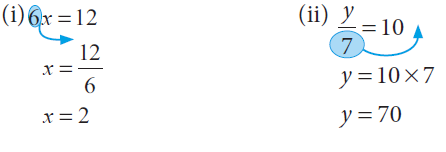
Solve the equation: 3x = 51
9.
Solve the equation: x − 7 = 6
10.
The sum of 4 times a number and 18 is 28.
11.
7 is added to a given number to give 19.
1.
Given, the train runs constantly at a speed of 80 km/hr.
i.e For 1 hour = 80 km
2 hours = 2 × 80 = 160 km
3 hours = 3 × 80 = 240 km
| Hour | 1 | 2 | 3 | 4 | 5 |
| Distance | 80 | 160 | 240 | 320 | 400 |
We can tabulate as above, Take a suitable scale
1) Mark the number of hours on the x-axis.
2) Mark the distance inKm on the y-axis.
3) Plot the points (1,80) (2,160) (3,240) (4,320) and (5,400).
4) Join the points and get a straight line3.
5) From the graph.
(i) Time taken to cover 240 km is 3 hrs.
(ii) Th e distance covered in 5 ½ hrs 440 km.
.png)
2.
Using the formula for calculating the simple interest, the following table of values is prepared.
| Deposit(in.Rs) | 100 | 200 | 300 | 500 | 1000 |
| Anaual S.I(in.Rs) | 10 | 20 | 30 | 50 | 100 |
| Deposit | Interest |
| 100 | \(\frac { 100\times 1\times 10 }{ 100 } \)=10 |
| 200 | \(\frac { 200\times 1\times 10 }{ 100 } \)=20 |
| 300 | \(\frac { 300\times 1\times 10 }{ 100 } \)=30 |
| 500 | \(\frac { 500\times 1\times 10 }{ 100 } \)=50 |
| 1000 | \(\frac { 1000\times 1\times 10 }{ 100 } \)=100 |
These are the points which are to be plotted in the graph sheet. Let us take the deposits along x-axis and
annual simple interest along y-axis.
We choose the scale as follows:
Then we plot the points and draw the straight line.
From the graph we find:
(i) Corresponding to Rs.300 on the x-axis, we get the interest as Rs.30 on the y-axis.
(ii) Corresponding to Rs.70 on the y-axis, we get the deposit as Rs.700 on the x-axis.
.png)
3.
1. Take a suitable scale on both the axes Here, we take on the x axis
1cm = 5 litres on the, y axis
1cm = 100 rupees.
2. Mark number of litres of milk along the x -axis.
3. Mark the cost of milk along the y-axis.
4. Plot the points (5,150) (10,300) (15,450) (20,600).
5. Join the points.
This graph can help us to estimate few more things also. Suppose we like to find the cost of 25 litres of milk. Mark 25 on the x-axis, follow the line parallel to y-axis through 25 till we meet the drawn line at P. From P we take a horizontal line to meet the y-axis. This meeting point of y-axis is the required answer.
Thus, the cost of 25 litres of milk is Rs.750. This is the graph of linear equation in two quantities, and hence they are in direct variation.
.png)
4.
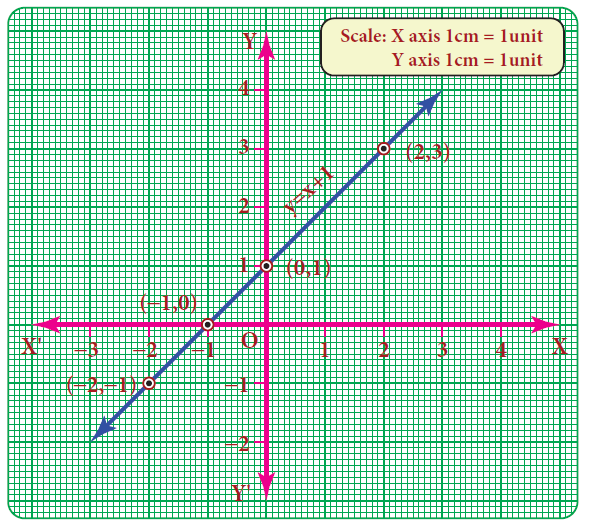
| x | -2 | -1 | 0 | 1 | 2 |
| y | -1 | 0 | 1 | 2 | 3 |
| x | y = x+1 |
| −2 −1 0 1 2 |
−2+1 = –1 −1+1 = 0 0+1 = 1 1+1 = 2 2+1 = 3 |
5.
The given equation y = 5 x means that for any value of x , y takes five
times of x value.
Plot the point (−3,−15) (−1,−5) (0,0) (2,10) (3,15)
| x | y=5x+1 |
| −3 −1 0 2 3 |
5 × (−3) = −15 5 × (−1) = −5 5 × (0) = 0 5 × (2) = 10 5 × (3) = 15 |
.png)
6.
(Rearranging the like terms)
\(\frac { 4y }{ 3 } -\frac { 2 }{ 5 } =7\)
\(\frac { 20y-6y }{ 15 } =7\)
14y = 7 ×15
y = \(\frac { 7\times 15 }{ 2 } \)
y = \(\frac { 15 }{ 2 } \)
7.
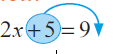
2x = 9 − 5
2x = 4
x = \(\frac { 4 }{ 2 } \)
x = 2
8.
3x = 51 (Given)
3 x x = 51
\(\frac { 3\times x }{ 3 } =\frac { 51 }{ 3 } (\div 3\quad on\quad both\quad sides)\)
x = 17
likewise, doing division by 3 on both sides is the same as changing the number 3 on the LHS to it's reciprocal \(\frac { 1 }{ 3 } \) and multiplying it on the RHS and vice-versa.
9.
x – 7 = 6
x – 7 + 7 = 6 + 7
x = 13
10.
Let the number be x.
4 times the number is 4x.
Adding 18 now, we get 18 + 4x.
The result now should be 28.
Thus, the equation has to be 18 + 4x = 28.
11.
Let the number be n.
When 7 is added to this number we get n + 7.
This result is to give 19.
Therefore, the equation is n + 7 = 19.

8th Standard Syllabus & Materials
8th Standard
TN 8th Tamil இயல் 3 - கல்வி கரையில - பாடறிந்து ஒழுகுதல் Important Questions And Answers Study Material - QB365 Set A
NEW8th Standard
TN 8th Tamil இயல் 3-கல்வி கரையில - பல்துறைக் கல்வி Important Questions And Answers Study Material - QB365 Set A
NEW8th Standard
TN 8th Tamil இயல் 3-கல்வி கரையில - புத்தியைத் தீட்டு Important Questions And Answers Study Material - QB365 Set A
NEW8th Standard
TN 8th Tamil இயல் 2 - ஈடில்லா இயற்கை - தமிழர் மருத்துவம் ( நேர்காணல்) Important Questions And Answers Study Material - QB365 Set A



Tamilnadu Stateboard 8th Standard Subjects
Tamilnadu Stateboard Standards




