
 100% FREE ACCESS
8th Standard Syllabus & Materials
8th Standard
TN 8th Tamil இயல் 3 - கல்வி கரையில - வினைமுற்று Important Questions And Answers Study Material - QB365 Set A
NEW8th Standard
TN 8th Tamil இயல் 2 - ஈடில்லா இயற்கை - மயங்கொலிகள் Important Questions And Answers Study Material - QB365 Set A
NEW8th Standard
TN 8th Tamil இயல் 2 - ஈடில்லா இயற்கை -பட்டமரம் Important Questions And Answers Study Material - QB365 Set A
NEW8th Standard
TN 8th Tamil இயல் 2 - ஈடில்லா இயற்கை - இயற்கையை போற்றுவோம் Important Questions And Answers Study Material - QB365 Set A
NEW8th Standard
TN 8th Tamil இயல் 1 - தமிழ் இன்பம் - ஆழிக்கு இணை Important Questions And Answers Study Material - QB365 Set A
NEW8th Standard
TN 8th Tamil இயல் 2-ஈடில்லா இயற்கை - திருக்குறள் Important Questions And Answers Study Material - QB365 Set A

Published on: 02/11/2019
Term 2 Geometry
Download Tamil Nadu 8th Standard Maths question papers, model tests, one-mark questions, important questions, and public exam papers in PDF format. Free study materials and answer keys for TN State Board students.
Questions + Answers key
Take MCQ Maths Test1.
I. Construct the following parallelograms with the given measurements and find their area.
1. ARTS, AR = 6 cm, RT = 5 cm and ㄥART = 700. .
2. CAMP, CA = 6 cm, AP = 8 cm and CP = 5.5 cm.
3. EARN, ER = 10 cm, AN = 7 cm and ㄥEOA = 110° where \(\overset { \_ \_ }{ ER } \) and \(\overset { \_ \_ }{ AN } \) intersect at O.
4. GAIN, GA = 7.5 cm, GI = 9 cm and ㄥGAI = 1000.
2.
I. Construct the following trapeziums with the given measures and also find their area.
1. AIMS with \(\overset { \_ \_ }{ AI } \) || \(\overset { \_ \_ }{ SM } \), AI = 6 cm, IM = 5 cm, AM = 9 cm and MS = 6.5 cm.
2. CUTE with \(\overset { \_ \_ }{ CD } \) || \(\overset { \_ \_ }{ ET } \), CU = 7 cm, ㄥUCE = 800 CE = 6 cm and TE = 5 cm..
3. ARMY with \(\overset { \_ \_ }{ AR } \) || \(\overset { \_ \_ }{ YM } \), AR = 7 cm, RM = 6.5 cm ㄥRAY = 1000 and ㄥARM = 600
4. CITY with \(\overset { \_ \_ }{ CI } \) || \(\overset { \_ \_ }{ YT } \), CI = 7 cm, IT = 5.5 cm, TY = 4 cm and YC = 6 cm.
3.
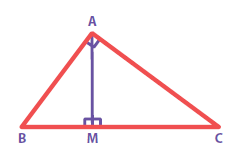
∆ ABC is a right angled triangle in which ㄥA = and AM ⊥ BC. Prove that AM = \(\frac { AB\times AC }{ BC } \). Also if AB = 30 cm and AC = 40 cm, find AM.
4.
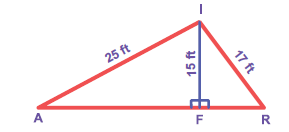
In the figure, find AR.
5.
The diagonals of the rhombus is 12 cm and 16 cm. Find its perimeter. (Hint: the diagonals of rhombus bisect each other at right angles).
6.
If ∆ APK is an isosceles right angled triangle, right angled at K. Prove that AP2 = 2AK2.
7.
Mayan travelled 28 km due north and then 21 km due east. What is the least distance that he could have travelled from his starting point?
8.
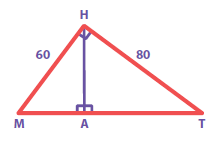
In the figure, find MT and AH.
9.
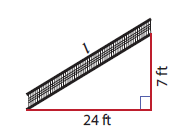
A ramp is constructed in a hospital as shown. Find the length of the ramp.
10.
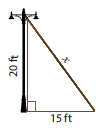
Find the length of the support cable required to support the tower with the floor.
11.
Rithika buys an LED TV which has a 25 inches screen. If its height is 7 inches, how wide is the screen? Her TV cabinet is 20 inches wide. Will the TV fit into the cabinet? Why?
12.
The sides of a triangle are 1.2 cm, 3.5 cm and 3.7 cm. Is this triangle a right triangle? If so, which side is the hypotenuse?
13.
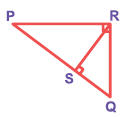
If RQ = 15 cm and RP = 20 cm, find PQ, PS and SQ.
14.
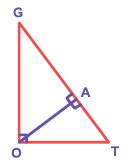
From the figure,
(i) If TA = 3cm and OT = 6cm, find TG.
15.
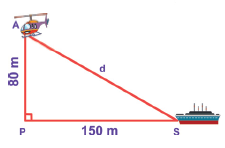
Find the distance between the helicopter and the ship.
16.
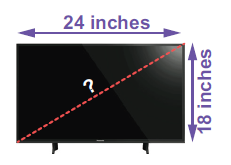
The length and breadth of the screen of an LED-TV are 24 inches and 18 inches. Find the length of its diagonal.
17.
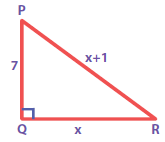
In the figure, find PR and QR.
18.
An isosceles triangle has equal sides each 13 cm and a base 24 cm in length. Find its height.
19.
Find the unknown side in the following triangles.
.png)
.png)
.png)
20.
Check whether given sides are the sides of right-angled triangles, using Pythagoras theorem.
(i) 8,15,17
(ii) 12,13,15
(iii) 30, 40, 50
(iv) 9, 40, 41
(v) 24, 45, 51
1.
1. AR = 6 cm; RT = 5 cm and
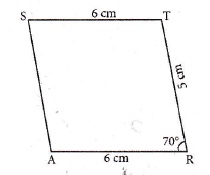
.jpg)
Steps:
1. Diaw a liqe segment AR = 6 cm.
2. Make an angle
3. With R as centre, draw an arc of radius 5 cm cutting RX at T.
4. With A and T as centres draw arcs of radii 5 cm and 5 cm respectively. Let them cut at S.
5. ]oin AS and TS
6. ARTS is the required parallelogram
Calculation of area:
Area of the Parallelogram ARTS
= bh sq. units
= 6 x 4.2 = 28.2 sq. cm
2. Given: CA = 6 cm; AP = 8 cm and CP = 5.5 cm.
Rough diagram
.jpg)
Steps:
1. Draw a line segment CA = 6 cm.
2. With C and A as centres, draw an arc of radius 5.5 cm and 8 cm respectively. Let them cut at p.
3. ]oin CP and AP.
4. With A and P as centres draw an arcs of radius 5.5 cm and 6 cm respectively. Let them cut at M.
5. Join AM and PM.
6. CAMP is the required parallelogram.
Calculation of area:
Area of the Parallelogram CAMP '
= bh sq. units
= 6 x 5.4 = 32.4 sq. cm
3. Given: ER = 10cm ; AN = 7 cm and
Rough diagram
.jpg)
Steps:
1. Draw a line segment ER = 10 cm.
2. Mark O the mid point of an angle
5. EARN is the required parallelogram.
Calculation of area:
Area of the Parallelogram EARN
= bh sq. units
= 7 x 4.8 = 33.6 sq. cm
4. Given: GA,=7.5 cm; GI = 9 cm and
Rough diagram
.jpg)
Steps:
1. Draw a line segment GA = 7.5 cm.
2. Make an angle IGAI = 100o at A on GA.
3. With G as centre, draw an arc of radius 9 cm cutting AX at I and join GI.
4. With G as centre drawer an arc of radius equal to the length of AI.
5. With I as centre, draw an arc of radius 7.5 cm. Let both arcs cut at N.
6. Join IN and GN.
7. GAIN is the required parallelogram
Calculation of area:
Area of the Parallelogram GAIN
= bh sq. units .
= 7.5 x 3.7 = 27.75 sq. cm
2.
Given:
AI = 6 cm,
IM = 5 cm,
AM = 9 cm,
MS = 6.5 cm.
Rough Diagram
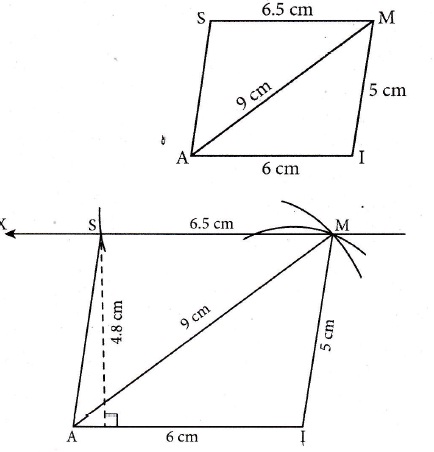
Steps:
1. Draw aline segment AI = 6 cm.
2. With A and I as centres draw arcs of radius
9 cm and 5 cm respectively and let them cut at M.
3. Join AM and IM.
4. Draw MX parallel to AI.
5. With M as centre, draw an arc of radius6.5 cm cutting MX at S.
6. |oin AS. AIMS is the required trapezium
Calculation of Area:
Area of the trapezium AIMS
\(=1 / 2 \times h \times(a+b) \)
\(=1 / 2 \times 4.8 \times(6+6.5) \)
\(=1 / 2 \times 4.8 \times 12.5=30 \mathrm{sq} . \mathrm{cm} . \)
2. Given:
CU = 7cm;
CE = 6cm; TE = 5cm.
Rough Diagram
.jpg)
Steps:
1. Draw a line segment CU = 7cm
2. Constract an angle
3. With C as centre, draw an arc of radius 6 cm cutting CX at E.
4. Draw EY parallel to CU.
5. With E as centre, draw an arc of radius 5 cm cutting EY at T.
6. Join TLI CUTE is the required trapezium.
Calculation of Area:
Area of the trapezium CUTE
\(=1 / 2 \times \mathrm{h} \times(\mathrm{a}+\mathrm{b}) \)
\(=1 / 2 \times 6 \times(5+7) \)
\(=1 / 2 \times 6 \times 12=36 \text { sq. } \mathrm{cm} . \)
3. Given:
AR = 7 cm; RM = 6.5 cm
ZRAY = 100o; ZARM = 60o
Rough Diagram
.jpg)
Steps: -
1. Draw a line segment AR 7 cm.
2. Construct an angle
3. With R as centre draw an arc of radius 6.5 cm cutting RX at M.
4. Draw MZ parallel to AR.
5. Construct an angle ZRAY = 100o A cutting MZ at Y.
6. ARMY is the required trapezium
Calculation of Area:
Area of the trapezium ARMY
\(=1 / 2 \times h \times(a+b) \)
\(=1 / 2 \times 5.6 \times(7+7) \)
\(=1 / 2 \times 5.6 \times 14=39.2 \text { sq. cm } \)
4. Given:
CI = 7 cm ; IT = 5.5 cm
TY = 4 cm ; YC = 6cm.
Rough Diagram
.jpg)
Steps:
1..Draw a line segment CI = 7 cm.
2. Mark the point A on CI such that CA = 4 cm.
3. With A and I as centres, draw arcs of radii 6 cm and S.S cm. Let them cut at T. join AT and IT.
4. With C and T as centres, draw arcs of radii 6 cm and 4 cm respectively. Let them cut at Y. Join TY and CY.
5. CITY is the required trapezium.
Calculation of Area:
Area of the trapezium CITY
\(=1 / 2 \times h \times(a+b) \)
\(=1 / 2 \times 6 \times(4+4) \)
\(=1 / 2 \times 6 \times 8=24 \text { sq. } \mathrm{cm} . \)
3.
24 cm
4.
\(\triangle\) AFI is a right angled triangle
(AI)2 = (AF)2 + (FI)2
252 = (AF)2 + 152
625 = (AF)2 + 225
(AF)2 = 625 - 225
= 400
\(\mathrm{AF}=\sqrt{400}\)
AF = 20ft
\(\triangle\) FRI is a right angled triangle.
(FI)2 + (FR)2 = (RI)2
(FR)2 + 152 = 172
(FR)2 + 225 = 289
(FR)2 = 289 - 225
= 64
\(A R=\sqrt{64}\)
= 8ft
AR = AF+FR
= 20 + 8
= 28 ft
AR = 28 ft
5.
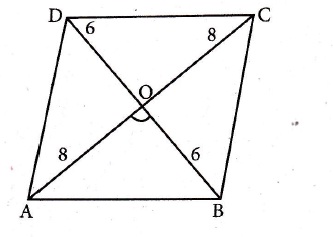
Let ABCD be a rhombus. The diagonals of the rhombus meet at O.
Since \(\triangle\) AOB is a right angled triangle
AB2 = AO2 + OB2
= 82 + 62
= 64 + 36
= 100
\(\mathrm{AB}=\sqrt{100}=10\)
The perimeter of the rhombus = 4 x AB
= 4 x 10
= 40cm
6.
By using Pythagoras theorem,
AP2 = AK2 + PK2 = AK2 + AK2 (since it is an isosceles A) = 2AK2
Hence it is proved
7.
From the figure AC is to be found.
By using Pythagoras theorem,
AC2 = AB2 + BC2 = 282 + 212 = 784 + 441 = 1225 = 352
∴ AC = 35 km
8.
100, 48
9.
4. 25 ft
10.
From the figure
x2 = 202 + 152
= 440 +225
= 625
\(\therefore x=\sqrt{625}\)
x = 25
The length of the support cable is 25 ft.
11.
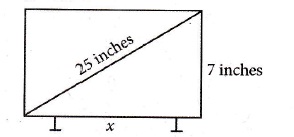
Let x be the wide of the screen.
From the figure,
x2 + 22 = 252
x2 + 49 = 625
x2 = 625 - 49
= 576
\(x=\sqrt{576}\)
= 24
The wide of the screen is 24 inches
The TV cabinet wide is 21 inches. It is not fit for the TV which has the wide screen 24 inches
12.
Yes, the side of length 3.7 cm is the hypotenuse.
13.
25cm, 16cm, 9cm
14.
(i) 12 cm
15.
From the figure
d2 = 802 + 1502
= 6400 + 22500
d2 = 28900
d = 170
The distance between the helicopter and the ship is 170 m.
16.
30 inches
17.
25, 24
18.
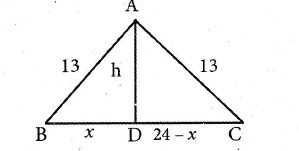
Let \(\triangle\) ABC is a isosceles triangle.
Draw AD perpendicular to BC, we get two right angled triangles.
In \(\triangle\)ABD
132 = x2 + h2 ..........(1)
In \(\triangle\) ADC,
132 = h2 +(24 - x)2 .........(2)
From (1) and (2)
\(
x^{2}+\mathrm{h}^{2} =(24-x)^{2}+\mathrm{h}^{2}
\)
\(x^{2} =(24-x)^{2} \\
x^{2} =576-48 x+x^{2}
\)
\(0 = 576-48 x \\
\therefore \ 48 x =576
\)
\(x =\frac{576}{48} \\
x =12
\)
Put x = 12 in (1), we get 132 = x2 +h2
\(
13^{2} =12^{2}+h^{2}
\)
\(169 =144+h^{2}
\)
\(\therefore h^{2} =169-144
\)
\(h^{2} =25
\)
\(h =\sqrt{25}\)
= 5
Height of the isosceles triangle is 5 cm.
19.
(i) From the figure,
x2 = 92 + 402
= 81 + 1600
= 1681
\(x=\sqrt{1681}\)
x = 41
(ii) From the figure
342 = 302 + y2
1156 = 900 + y2
y = 1156 - 900
y2 = 256
\(y=\sqrt{256}\)
y = 16
(iii) From the figure
392 = 362 + z2
1521 = 1296 + Z2
z2 = 1521- 1296
z2 = 225
\(z=\sqrt{225}\)
z = 15
20.
(i) 8,15,17
82 + 152 = 64+ 225
= 289
= 172
i.e., 82 + 152 = 172
8, 15, 17 are the sides of a right-angled triangle
(ii) 12,13, t5
122 + 132 = 144+ 164
= 313
152 = 225
\(\text { i.e., } 12^{2}+13^{2} \neq 15^{2}\)
12, 13, 15 are not the sides of a right angled triangle
(iii) 30,40,50
302 + 402 = 900 + 1600
= 2500 ;
= 502
i.e,, 302 + 402 = 502
30 ,40,50 are the sides of a right angled triangle.
(iv) 9, 40,41
92 + 402 = 81 + 1600
= 1681
= 412
i.e., 92 + 402 = 412
9, 40, 41 are the sides of a right angled triangle
(v) 24,45,51
242 + 452 = 576 + 2025
= 2601 = 512
24,45,51 are the sides of a right angled triangle

8th Standard Syllabus & Materials
8th Standard
TN 8th Tamil இயல் 3 - கல்வி கரையில - பாடறிந்து ஒழுகுதல் Important Questions And Answers Study Material - QB365 Set A
NEW8th Standard
TN 8th Tamil இயல் 3-கல்வி கரையில - பல்துறைக் கல்வி Important Questions And Answers Study Material - QB365 Set A
NEW8th Standard
TN 8th Tamil இயல் 3-கல்வி கரையில - புத்தியைத் தீட்டு Important Questions And Answers Study Material - QB365 Set A
NEW8th Standard
TN 8th Tamil இயல் 2 - ஈடில்லா இயற்கை - தமிழர் மருத்துவம் ( நேர்காணல்) Important Questions And Answers Study Material - QB365 Set A



Tamilnadu Stateboard 8th Standard Subjects
Tamilnadu Stateboard Standards




