
 100% FREE ACCESS
8th Standard Syllabus & Materials
8th Standard
TN 8th Tamil இயல் 3 - கல்வி கரையில - வினைமுற்று Important Questions And Answers Study Material - QB365 Set A
NEW8th Standard
TN 8th Tamil இயல் 2 - ஈடில்லா இயற்கை - மயங்கொலிகள் Important Questions And Answers Study Material - QB365 Set A
NEW8th Standard
TN 8th Tamil இயல் 2 - ஈடில்லா இயற்கை -பட்டமரம் Important Questions And Answers Study Material - QB365 Set A
NEW8th Standard
TN 8th Tamil இயல் 2 - ஈடில்லா இயற்கை - இயற்கையை போற்றுவோம் Important Questions And Answers Study Material - QB365 Set A
NEW8th Standard
TN 8th Tamil இயல் 1 - தமிழ் இன்பம் - ஆழிக்கு இணை Important Questions And Answers Study Material - QB365 Set A
NEW8th Standard
TN 8th Tamil இயல் 2-ஈடில்லா இயற்கை - திருக்குறள் Important Questions And Answers Study Material - QB365 Set A

Published on: 29/07/2019
Geometry
Download Tamil Nadu 8th Standard Maths question papers, model tests, one-mark questions, important questions, and public exam papers in PDF format. Free study materials and answer keys for TN State Board students.
Questions + Answers key
Take MCQ Maths Test1.
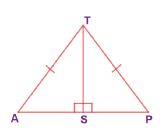
(Illustrating RHS Congruence)
If TAP is an isosceles triangle with TA = TP and ∠TSA = 90°
Is ∠P = ∠A? Why?
2.
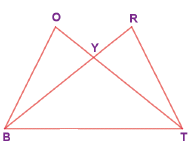
(Illustrating ASA Congruence)
If ∠YTB ≡∠YBT and ∠BOY ≡∠TRY, prove that Δ BOY ≡ Δ TRY
3.
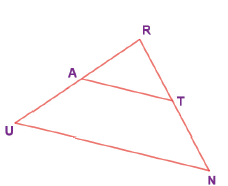
(Illustrating SAS Similarity)
If A is the midpoint of RU and T is the midpoint of RN, prove that ΔRAT ~ ΔRUN .
4.
Find the unknowns in the following figures
.JPG)
5.
Find the unknowns in the following figures
.JPG)
6.
If PQ || RS and ∠ONR = 30o find ∠MON and hence ∠MOX .
7.
Construct the following quadrilaterals with the given measurements and also find their area.
YOGA, YO = 6 cm, OG = 6 cm, ∠O = 55°, ∠G = 35° and ∠A = 100°.
8.
Construct the following quadrilaterals with the given measurements and also find their area.
MIND, MI = 3.6 cm, ND = 4 cm, MD = 4 cm, ∠M = 50° and ∠D = 100°.
9.
Construct the following quadrilaterals with the given measurements and also find their area.
PQRS, PQ = QR = 3.5 cm, RS = 5.2 cm, SP = 5.3 cm and ∠Q = 120o.
10.
Construct the following quadrilaterals with the given measurements and also find their area.
KITE, KI = 5.4 cm, IT = 4.6 cm, TE = 4.5 cm, KE = 4.8 cm and IE = 6 cm.
11.
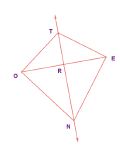
In the figure, ∠TEN ≡ ∠TON = 90o and TO ≡ TE. Prove that ∠ORN ≡ ∠ERN.
12.
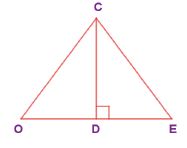
In the given figure, D is the midpoint of OE and ∠CDE = 90°. Prove that ΔODC ≡ ΔEDC
13.
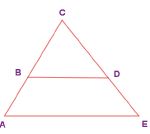
In the given figure, \(\triangle\)BCD is isosceles with base BD and ∠BAE ≡ ∠DEA Prove that AB ≡ ED.
14.
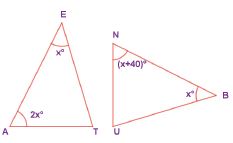
In the given figure, if ΔEAT~ΔBUN, find the measure of all angles.
15.
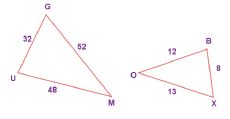
In the given fi gure prove that ΔGUM ~ ΔBOX
16.
Construct a quadrilateral MATH with MA = 4 cm, AT = 3.6 cm, TH = 4.5 cm, MH = 5 cm and ∠A = 85°. Also find its area.
17.
Construct a quadrilateral DEAR with DE = 6 cm, EA = 5 cm, AR = 5.5cm, RD = 5.2 cm and DA = 10 cm. Also find its area.
18.
In the figure, which of the following statements is true?
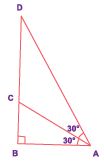
AB = BD
BD < CD
AC = CD
BC = CD
19.
If ΔABC~ΔPQR in which ∠A = 53o and ∠Q = 77o, then R is
50°
50°
70°
80°
20.
If in triangles PQR and XYZ, \(\frac{PQ}{XY}=\frac{QR}{ZX}\) then they will be similar if
∠Q = ∠Y
∠P = ∠X
∠Q = ∠X
∠P ≡ ∠Z
21.
Two similar triangles will always have ________angles
acute
obtuse
right
matching
1.
Given TA = TP
∴ ∠P = ∠A (if angles then sides)
2.
Proof:
| Statements | Reasons | |
|---|---|---|
| 1 | ∠YTB ≡ ∠YBT | given |
| 2 | BY ≡ TY | if angles, then sides |
| 3 | ∠BYO ≡ ∠TYR | vertical angles are congruent |
| 4 | ∠BOY ≡ ∠TRY | given |
| 5 | Δ BOY ≡ Δ TRY | by AAS (4,3,2) |
| 6 | ∠OBY ≡ ∠RTY | follows from 3 and 4 |
| 7 | Δ BOY ≡ Δ TRY | by ASA (6,2,3) |
3.
Proof
| Statements | Reasons | |
|---|---|---|
| 1 | ∠ART = ∠URN | ∠R is common in ΔRAT and ΔRUN |
| 2 | RA = AU = \( \frac12\) RU | A is the midpoint of RU |
| 3 | RT = TN = \( \frac12\)RN | T is the midpoint of RN |
| 4 | \(\frac { RA }{ RU } =\frac { RT }{ TN } \)=\( \frac12\) | the sides are proportional from 2 and 3 |
| 5 | ΔRAT~ΔRUN | by SAS (1 and 4) |
4.
Now, from Fig in ΔABC \(\angle\)A = x (vertically opposite angles)
Similarly \(\angle\)B = \(\angle\)C = \(\angle\)x (Why?)
⇒ \(\angle\)A + \(\angle\)B + \(\angle\)C = 180o (angle sum property in ΔABC)
⇒ 3x = 180o
⇒ x = 60o
⇒ y = 180o − 60o = 120o
5.
Now, from Fig PQ = PR
⇒\(\angle\)Q = \(\angle\)R (angles opposite to equal sides are equal)
⇒ \(\angle\)x = \(\angle\)y
⇒\(\angle\)x+ \(\angle\)y + 50o = 180o (angle sum property in ΔPQR)
⇒ 2\(\angle\)x = 130o
⇒\(\angle\)x = 65o
⇒ \(\angle\)y = 65o
6.
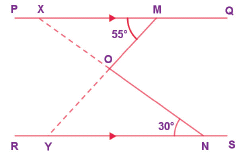
Extend MO and let it meet RS at Y. Extend NO and let it meet PQ at X.
As PQ || RS,
∠OYN = ∠OMX = 55o (alternate angles are equal)
∴ ∠MON = ∠OYN +∠ONY (exterior angle of ΔOYN = sum of interior opposite angles)
= 55o + 30o = 85o
⇒∠MOX = 180o− 85o = 95o (∠MON, ∠MOX are linear pair)
7.
YO = 6 cm, OG = 6 cm, ∠O = 55°, ∠G = 35° and ∠A = 100°.
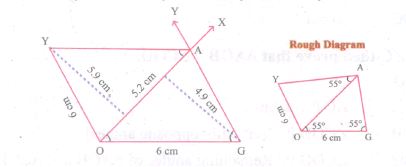
Steps:
1. Drawn a line segment OG = 6 cm
2. At G on DG made an angle ∠OGY = 55°
3. At G on GO made ∠GOX = 55°.
4. GY and OX meet cut A.
5. At A on OA made∠OAZ = 55°
6. Drawn an arc of radius 6 cm with center O. It cut AZ at Y.
7. Joined OY.
8. YOGA is the required quadrilateral.
Calculation of Area:
Area of the quadrilateral YOGA = \(\frac { 1 }{ 2 } \times\ d\times({ h }_{ 1 }+{ h }_{ 2 })sq.units\) = \(\frac { 1 }{ 2 } \times5.2\times({ 5.9}+4.9)\) cm2
= \(\frac { 1 }{ 2 } \times5.2\times10.8\) cm2 = 5.2 x 5.4 cm2 = 28.08 cm2
Area of the quadrilateral = 28.08 cm2
8.
MI = 3.6 cm, ND = 4 cm, MD = 4 cm, ∠M = 50° and ∠D = 100°.
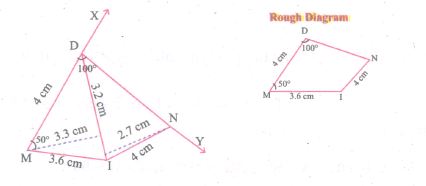
Steps:
1. Drawn a line segment MI = 3.6 cm
2. At M on MI made an angle ∠IMX = 50°
3. Drawn an arc with center M and radius 4 cm let it cut MX it D
4. At D on DM made an angle LMDY = 100°
5. With I as center drawn an arc of radius 4 em, let it cut DY at N.
6. Joined DN and IN.
7. MIND is the required quadrilateral.
Calculation of Area:
Area of the quadrilateral MIND
\( =1 / 2 \times \mathrm{d} \times\left(\mathrm{h}_{1}+\mathrm{h}_{2}\right) \text { sq. units } \)
\(=1 / 2 \times 2.4 \times(3.3+2.9) \)
\(=1 / 2 \times 2.4 \times 6.2 \)
= 7.44 sq. cm.
9.
PQ = QR = 3.5 cm, RS = 5.2 cm, SP = 5.3 cm and ∠Q = 120o.
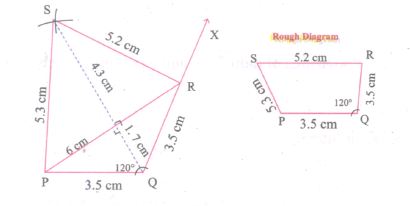
Steps:
1. Draw a line segment PQ = 3.5 cm
2. Made \(\angle \)Q = 120°. Drawn the ray QX.
3. With Q as centre drawn an arc of radius 3.5 cm. Let it cut the ray QX at R.
4. With Rand P as centres drawn arcs of radii 5.2 cm and 5.5 cm respectively and let them cut at S.
5. Joined PS and RS.
6. PQRS is the required quadrilateral.
Calculation of Area:
\(
=1 / 2 \times \mathrm{d} \times\left(\mathrm{h}_{1}+\mathrm{h}_{2}\right) \text { sq. units }
\)
\(=1 / 2 \times 6.3 \times(1.8+4.2)
\)
\(=1 / 2 \times 6.3 \times 6\)
= 18.9 sq. cm.
10.
Given, KI = 5.4 cm, IT = 4.6 cm, TE = 4.5 cm, KE = 4.8 cm and IE = 6 cm.
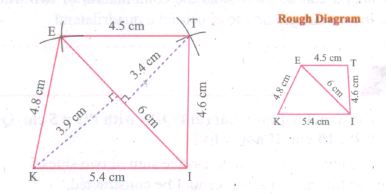
Steps:
1. Drawn a line segment KI = 5.4 cm
2. With K and I as centers drawn arcs of radii 4.8 cm and 6 cm respectively and let them cut at E.
3. Joined KE and IE.
4. With E and I as centers, drawn arcs of radius 4.5 cm and 4.6 cm respectively and let them cut at T.
5. Joined ET and IT.
6. KITE is the required quadrilateral.
Calculation of Area:
Area of the quadrilateral = \(\frac { 1 }{ 2 } \times\ d\times({ h }_{ 1 }+{ h }_{ 2 })sq.units\)
= \(\frac { 1 }{ 2 } \times6\times({ 3.4 }+3.9)\)cm2
= 3 x 7.3 cm2 = 21.9 cm2
Area of the quadrilateral = 21.9 cm2
11.
| S.No. | Statements | Reasons |
| 1. | \(\angle \)TEN = \(\angle \)TON = 90o | Given |
| 2. | TD = TE | Given |
| 3. | TN = TN | Common |
| 4. | \(\triangle \)TEN ~\(\triangle \)TEO | RHS criteria and by 1,2,3 |
| 5. | \(\angle \)TEO =\(\angle \)TOE | By 2, Angles opposite to equal sides are equal. |
| 6. | \(\angle \)REN =\(\angle \)RON | By 1, 3 |
| 7. | EN = ON \(\angle \)ENT = \(\angle \)ONT |
CPCTC in 4 |
| 8. | \(\angle \)ENR = \(\angle \)ONR | By 5 |
| 9. | \(\angle \)ORN \(\equiv \\ \)\(\angle \)ERN | By 6, 7 Remaining angle in \(\triangle \)ERN and \(\triangle \)ORN |
12.
\(\text { In } \triangle \mathrm{ODC} \text { and } \triangle \mathrm{EDC} \text {, }\)
CD = CD
\(\angle \mathrm{CDO}=\angle \mathrm{CDE}=90^{\circ}\)
OD = ED (given)
\(\therefore \triangle \mathrm{ODC} \equiv \Delta \mathrm{EDC}(\mathrm{SAS})\)
Hence proved
13.
\(\text { In } \triangle \mathrm{CAE} \angle \mathrm{A}=\angle \mathrm{E} \text { (given) }\)
\(\triangle\)CAE is isosceles
CA = CE .........(1)
\(\triangle\)BCD is isosceles with base BD (given)
CB = CD .........(2)
\((1)-(2) \Rightarrow \mathrm{CA}-\mathrm{CB} \equiv \mathrm{CE}-\mathrm{CD}\)
AB = ED
Hence proved.
14.
\(Given \triangle \mathrm{EAT} \sim \triangle \mathrm{BUN}
\)
\(\therefore \angle \mathrm{E}=\angle \mathrm{B}, \angle \mathrm{A}=\angle \mathrm{U}, \angle \mathrm{T}=\angle \mathrm{N}\)
Sum of the angles of a triangle is 180o
\(\angle \mathrm{E}+\angle \mathrm{A}+\angle \mathrm{T}=180^{\circ}\)
x + 2x + x + 40 = 180o
4x = 180o - 40o = 140o
\(
x =\frac{140^{\circ}}{4}=35^{\circ}
\)
\(x\therefore \angle \mathrm{E} =\angle \mathrm{B}=x=35^{\circ}
\)
\(\angle \mathrm{A} =\angle \mathrm{U}=2 x
\)
\(=2 \times 35^{\circ}=70^{\circ}
\)
\(\angle \mathrm{T} =\angle \mathrm{N}=x+40^{\circ}
\)
\(=35^{\circ}+40^{\circ}=75^{\circ}
\)
15.
\(\frac { GU }{ BO} \)= \(\frac { 32 }{ 8 } \) = \(\frac { 4 }{ 1 } \)
\(\frac { UM }{ OX} \)= \(\frac { 48 }{ 12 } \)= \(\frac { 4 }{ 1 } \)
\(\frac { GM }{ BX} \)= \(\frac {52 }{ 13 } \)=\(\frac { 4 }{ 1 } \)
We find that \(\frac { GU }{ BO} \)= \(\frac { UM }{ OX} \)= \(\frac { GM }{ BX} \)= \(\frac { 4 }{ 1 } \)
That is their corresponding sides are proportional.
:. By SSS similarity \(\triangle \)GUM ~ \(\triangle \)BOX.
16.
Given:
MA = 4 cm, AT = 3.6 cm,
TH = 4.5 cm, MH = 5 cm and ∠A = 85°
.JPG)
.JPG)
Steps:
1. Draw a line segment MA = 4 cm.
2. Make ∠A = 85°.
3. With A as centre, draw an arc of radius 3.6 cm. Let it cut the ray AX at T.
4. With M and T as centres, draw arcs of radii 5 cm and 4.5 cm respectively and let them cut at H.
5. Join MH and TH.
6. MATH is the required quadrilateral.
Calculation of Area:
Area of the quadrilateral MATH = \(\frac12\) × d × (h1+ h2) sq.units
= \(\frac12\) x 5.1 x (3.9 + 2.8)
= 2.55 x 6.7 = 17.09 cm2
17.
Given: DE = 6 cm, EA = 5 cm, AR = 5.5 cm,
RD = 5.2 cm and a diagonal DA = 10 cm
.JPG)
.JPG)
Steps:
1. Draw a line segment DE = 6 cm.
2. With D and E as centres, draw arcs of radii 10 cm and 5 cm respectively and let them cut at A.
3. Join DA and EA.
4. With D and A as centres, draw arcs of radii 5.2 cm and 5.5 cm respectively and let them cut at R.
5. Join DR and AR.
6. DEAR is the required quadrilateral
Calculation of Area:
Area of the quadrilateral DEAR = \(\frac12\) x d x (h1+ h2) sq. units
= \(\frac12\) x 10 x (1.9+ 2.3)
= 5 x 4.2 = 21 cm2
18.
(c)
AC = CD
19.
(a)
50°
20.
(c)
∠Q = ∠X
21.
(d)
matching

8th Standard Syllabus & Materials
8th Standard
TN 8th Tamil இயல் 3 - கல்வி கரையில - பாடறிந்து ஒழுகுதல் Important Questions And Answers Study Material - QB365 Set A
NEW8th Standard
TN 8th Tamil இயல் 3-கல்வி கரையில - பல்துறைக் கல்வி Important Questions And Answers Study Material - QB365 Set A
NEW8th Standard
TN 8th Tamil இயல் 3-கல்வி கரையில - புத்தியைத் தீட்டு Important Questions And Answers Study Material - QB365 Set A
NEW8th Standard
TN 8th Tamil இயல் 2 - ஈடில்லா இயற்கை - தமிழர் மருத்துவம் ( நேர்காணல்) Important Questions And Answers Study Material - QB365 Set A



Tamilnadu Stateboard 8th Standard Subjects
Tamilnadu Stateboard Standards




