
 100% FREE ACCESS
9th Standard Syllabus & Materials
9th Standard
TN 9th Tamil உள்ளத்தின் சீர் -கற்கண்டு (இலக்கணம்) - தொடர் இலக்கணம், ஆகுபெயர் Important Questions And Answers Study Material - QB365 Set A
NEW9th Standard
TN 9th Tamil உள்ளத்தின் சீர் -விரிவானம் (துணைப்பாடம்) - தாய்மைக்கு வறட்சி இல்லை! Important Questions And Answers Study Material - QB365 Set A
NEW9th Standard
TN 9th Tamil உள்ளத்தின் சீர் -கவிதை பேழை (செய்யுள்) - மார்கழி பெருவிழா Important Questions And Answers Study Material - QB365 Set A
NEW9th Standard
TN 9th Tamil உயிருக்கு வேர்-இலக்கணம் - பகுபத உறுப்பிலக்கணம் Important Questions And Answers Study Material - QB365 Set A
NEW9th Standard
TN 9th Tamil அமுதென்று பேர் - இலக்கணம்-எழுத்து -அளபெடை Important Questions And Answers Study Material - QB365 Set A
NEW9th Standard
TN 9th Tamil அமுதென்று பேர்-துணைப்பாடம் - ஆறாம்திணை Important Questions And Answers Study Material - QB365 Set A

Published on: 21/01/2020
Download Tamil Nadu 9th Standard Maths question papers, model tests, one-mark questions, important questions, and public exam papers in PDF format. Free study materials and answer keys for TN State Board students.
Questions + Answers key
Take MCQ Maths Test1.
Draw a triangle ABC, where AB = 8 cm, BC = 6 cm and ㄥB = 700 and locate its circumcentre and draw the circumcircle.
2.
A farmer has a field in the shape of a rhombus. The perimeter of the field is 400 m and one of its diagonal is 120 m. He wants to divide the field into two equal parts to grow two different types of vegetables. Find the area of the field.
3.
The sum of the digits of a given two digit number is 5. If the digits are reversed, the new number is reduced by 27. Find the given number.
4.
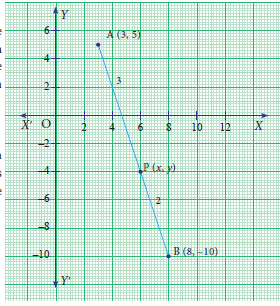
Find the coordinates of the point which divides the line segment joining the points (3, 5) and (8, −10) internally in the ratio 3:2.
5.
Without actual division, find which of the following rational numbers have terminating decimal expansion
(i) \(\frac { 7 }{ 128 } \)
(ii) \(\frac { 21 }{ 15 } \)
(iii) \(4\frac { 9 }{ 35 } \)
(iv) \(\frac { 219 }{ 2200 } \)
6.
In a party of 45 people, each one likes tea or coffee or both. 35 people like tea and 20 people like coffee. Find the number of people who
(i) like both tea and coffee.
(ii) do not like Tea.
(iii) do not like coffee
7.
Verify \(n\left( A\cup B\cup C \right) \) = n(A) + n(B) +n(C) - \(n\left( A\cap B \right) -n\left( B\cap C \right) -n\left( A\cap C \right) -n\left( A\cap C \right) +\left( A\cap B\cap C \right) \) for the following A = {1,3,5,6,8} C = {1,2,3,6}
8.
In the class, weight of students is measured for the class records. Calculate mean weight of the students using direct method.
| Weight in kg | 15-25 | 25-35 | 35-45 | 45-55 | 55-65 | 56-75 |
| No.of students | 4 | 11 | 19 | 14 | 0 | 2 |
9.
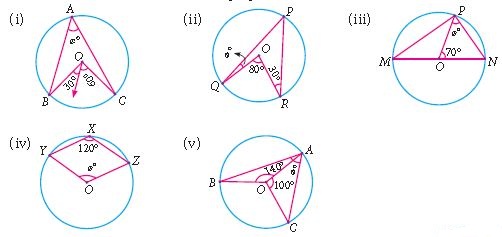
Find the value of x° in the following figures:
10.
If both (x - 2) and \(\left( x-\frac { 1 }{ 2 } \right) \) are the factors of ax2+ 5x + b, then show that a = b.
11.
Simplify the following using multiplication and division properties of surds:
(i) \(\sqrt { 3 } \times \sqrt { 5 } \times \sqrt { 2 } \)
(ii) \(\sqrt { 35 } \div \sqrt { 7 } \)
(iii) \(\sqrt [ 3 ]{ 27 } \times \sqrt [ 3 ]{ 8 } \times \sqrt [ 3 ]{ 125 } \)
(iv) \((7\sqrt { a } -5\sqrt { b } )(7\sqrt { a } +5\sqrt { b } )\)
(v) \(\left[ \sqrt { \frac { 225 }{ 729 } } -\sqrt { \frac { 25 }{ 144 } } \right] \div \sqrt { \frac { 16 }{ 81 } } \)
12.
Find the 5th root of 100000
13.
A soap company interviewed 800 people in a city. It was found out that \(\frac{3}{8}\) use brand A soap, \(\frac{1}{5}\)use brand B soap, 70 use brand A and B soap, 55 use brand B and C soap, 60 use brand A and C soap and \(\frac{1}{40}\) use all the three brands Find,
(i) Number of people who use exactly two branded soaps,
(ii) Number of people who use at least one branded soap,
(iii) Number of people who do not use any one of these brands.
14.
Verify \(n\left( A\cup B\cup C \right) =n(A)+n(B)+n(C)-n(A\cap B)-n(B\cap C)-n(A\cap C)+n(A\cap B\cap C)\)for the following sets.
(i) A = {a, c, e, f , h} , B = {c, d, e, f } and C = {a, b, c, f }
(ii) A = {1, 3, 5} , B = {2, 3, 5, 6} and C = {1, 5, 6, 7}
15.
If A, B and C are overlapping sets, then draw Venn diagram for the following sets:
(i) (A-B)\(\cap \)C
(ii) (A\(\cup \)C)-B
(iii) A-(A\(\cap \)C)
(iv) (B\(\cup \)C)-A
(v) A\(\cap \)B\(\cap \)C
16.
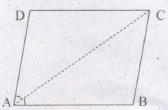
Diagonal AC of a parallelogram ABCD bisects ∠A. Show that
(i) it bisects ∠C also
(ii) ABCD is a rhombus.
17.
Show that the point A (3,7) B (6, 5) and C (15, -1) are collinear.
18.
If the polynomials f(x) = ax3 + 4x2 + 3x –4 and g(x) = x3 – 4x + a leave the same remainder when divided by x–3, find the value of a. Also find the remainder.
19.
Find any two irrational numbers between \(\sqrt { 2 } \) and \(\sqrt { 3 } \)
1.
Steps for construction:
Step 1: Draw the ΔABC with the given measures.
Step 2: Construct the perpendicular bisector of (AB and BC) any two sides and let them meet at S which is the circumcenter.
Step 3: With S as centre and SA = SB = SC as radius draw the circumcircle to passes through A, B and C.
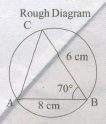
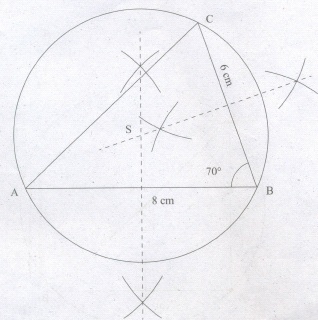
Circum radius = 4.3 cm.
2.
Let ABCD be the rhombus.
Its perimeter = 4 × side = 400 m
Therefore, each side of the rhombus = 100 m
Given the length of the diagonal AC = 120 m
In \(\triangle\)ABC, let a =100 m, b =100 m, c = 120 m
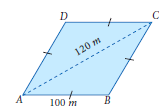
s = \(\frac{a+b+c}{2}=\frac{100+100+120}{2}\) = 160 m
Area of \(\triangle\)ABC =\(\sqrt{160(160-100)(160-100)(160-120)}\)
= \(\sqrt{160 \times 60\times 60 \times40}\)
= \(\sqrt{40 \times 2 \times \times2\times60\times60\times40}\)
= 40 × 2 × 60 = 4800 m2
Therefore, Area of the field ABCD = 2 × Area of \(\triangle\)ABC = 2 × 4800 = 9600 m2
3.
Let x be the digit at ten’s place and y be the digit at unit place.
Given that x + y = 5 …… (1)
| Tens | Ones | Value | |
| Given Number | x | y | 10x + y |
| New Number (after reversal) |
y | x | 10y + x |
Given, Original number − reversing number = 27
(10x + y) − (10y + x) = 27
10x − x + y −10y = 27
9x − 9y = 27
\(\Rightarrow\) x − y = 3 ... (2)
Also from (1), y = 5 – x ... (3)
Substitute (3) in (2) to get x − (5 − x) = 3
x − 5 + x = 3
2x = 8
x = 4
Substituting x = 4 in (3), we get y = 5 − x = 5 − 4
y = 1
Thus, 10x + y = 10 × 4 +1 = 40 +1 = 41.
Therefore, the given two-digit number is 41.
Verification :
sum of the digits = 5
x + y = 5
4 + 1 = 5
5 = 5 true
Original number – reversed number = 27
41 - 14 = 27
27 = 27 true
4.
Let A(3,5), B(8,−10) be the given points and let the point P(x, y) divides the line segment AB internally in the ratio 3:2.
By section formula,
P(x, y) =P\(\left( \frac { m{ x }_{ 2 }+n{ x }_{ 1 } }{ m+n } ,\frac { m{ y }_{ 2 }+n{ y }_{ 1 } }{ m+n } \right) \)
Here x1 = 3, y1 = 5, x2 = 8, y2 = −10 and m = 3, n = 2
Therefore P(x, y) = P\(\left( \frac { 3(8)+2(3) }{ 3+2 } ,\frac { 3(-10)+2(5) }{ 3+2 } \right) \) = P(6, -4)
5.
(i) \({7\over 128}={7\over 2^7}\)
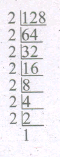
\(\therefore \frac{7}{128}\) has terminating decimal expansion.
(ii) \({21\over 15}={7\over 5}={7\over 5^1}\)
\(\therefore {21\over 15}\) has terminating decimal expansion.
(iii) \(4{9\over 35}={149\over 35}\)
\(={149\over 5\times 7}\) (It is not in the form of \(\frac{P}{2^m\times 5^n}\))
\(\therefore 4\frac{9}{35}\) has a non-terminating recurring decimal expansion.
(iv) \({219\over 2200}={219\over 2^3\times 5^2\times 11}\) (It is not in the form of \({P\over 2^m\times 5^n}\))
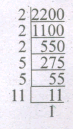
\(\therefore {219\over 2200}\) has a non-terminating recurring decimal expansion.
6.
Let the people who like tea be T.
Let the people who like coffee be C
By using formula
n(A ∪ B) = n(A) + n(B) – n(A ∩ B)
(i) n(T ∩ C) = n(T) + n(C) – n(T ∪ C) = 35 + 20 – 45 = 55 – 45 = 10
The number of people who like both coffee and tea = 10.
(ii) The number of people who do not like tea
n(T) = n(U) – n(T) = 45 – 35 = 10
(iii) The number of people who do not like coffee
n(C) = n(U) – n(C) = 45 – 20 = 25.
7.
\(\left( A\cup B\cup C \right) \) = {1,2,3,4,5,6,8}
\(\therefore \ n\left( A\cup B\cup C \right) \) =7
Also, n(A) = 5, n(B) = (C) = 4,
Further,\(A\cap B\) = {3,5,6} \(\Rightarrow \) \(n\left( A\cap B \right) \) = 3
\(B\cap C\) = {3,6} \(\Rightarrow \) \(n\left( B\cap C \right) \) = 2
\(A\cap C\) = {3,5,6} \(\Rightarrow \) \(n\left( A\cap C \right) \) = 3
Also, \(A\cap B\cap C\) = {3,6} \(\Rightarrow \)n\(\left( A\cap B\cap C \right) \) = 2
now, \(n\left( A\cup B\cup C \right) \)= n(A) + n(B) + n(C) -\(n\left( A\cap B \right) -n\left( B\cap C \right) -n\left( A\cap C \right) -n\left( A\cap C \right) +\left( A\cap B\cap C \right) \)
7 = 5 + 4 + 4 - 3 - 2 - 3 + 2
7 = 13 - 8 + 2
7 = 7
8.
| Weight in kgs(x) | Number of students(f) | Mid value of x | fx |
| 15-25 | 4 | 20 | 80 |
| 25-35 | 11 | 30 | 330 |
| 35-45 | 19 | 40 | 760 |
| 45-55 | 14 | 50 | 700 |
| 55-65 | 0 | 60 | 0 |
| 65-75 | 2 | 70 | 140 |
| \(\Sigma{f}=50\) | 2010 |

9.
(i)
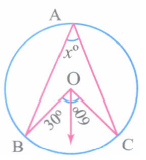
\({ x }^{ 0 }=\cfrac { 1 }{ 2 } \angle BOC=\cfrac { 1 }{ 2 } \times \left( { 30 }^{ 0 }+{ 60 }^{ 0 } \right) =\cfrac { 1 }{ 2 } \times { 90 }^{ 0 }={ 45 }^{ 0 }\)
(ii)
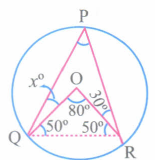
\(\angle QPR=\cfrac { 1 }{ 2 } \angle QOR=\cfrac { 1 }{ 2 } \times { 80 }^{ 0 }={ 40 }^{ 0 }\)
In \(\triangle QPR\)
\(\angle R+\angle P+\angle Q={ 180 }^{ 0 }\)
\(\angle Q\) = 180o-120o= 60o
\(\angle Q\) = xo+ 50o = 60o
xo = 60o-50o = 10o
(iii)
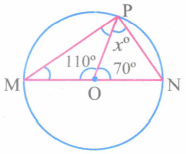
\(\angle \) MPN = 90° (Angle subtended by the diameter is 90°)
\(\angle OMP+\angle OPM={ 180 }^{ 0 }-{ 110 }^{ 0 }={ 70 }^{ 0 }\)
\(\angle MPO=\cfrac { 70 }{ 2 } =35^{ 0 }\)
But \(\angle MPN={ 90 }^{ 0 }\)
\(\therefore\) \(\angle \)OPN = 90o - 35o = 55o
(iv)
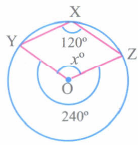
Central angle is twice that of angle subtended on the circumference
\(\angle \)YOZ = 120o\(\times\)2 = 40o
\(\therefore\) x+\(\angle\)YOZ = 360o
xo = 360o- 240o = 120o
(v)
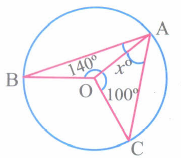
\(\angle\)BOC = 360o- 240o = 120o
\(\therefore\) \(\angle\)BAC = xo=\(\cfrac { { 120 }^{ 0 } }{ 2 } \) = 60o
10.
Let P(x) = ax2+5x+b
(x-2) is a factor of P(x), if P(2) = 0
P(2) = a(2)2+5(2)+b = 0
4a +10+b = 0
4a+b = -10...(1)
\((x-\frac{1}{2})\) is a factor of P(x), if P\((\frac{1}{2})\) = 0
P\((\frac{1}{2})\) = a\((\frac{1}{2})^2\) + 5\((\frac{1}{2})\)+ b = 0
\(\frac{a}{4}+\frac{5}{2}+b=0\)
\(\frac{a}{4}+b=\frac{-5}{2}\)
\(\frac{a+4b}{4}=\frac{-5}{2}\)
2a + 8b = -20
a + 4b = -10...(2)
From (1) and (2)
4a + b = -10...(1)
a + 4b = -10...(2)
(1) and (2) ⇒ 4a + b = a + 4b
3a = 3b
a = b
Hence it is proved.
11.
(i) \(\sqrt{3}\times\sqrt{5}\times\sqrt{2}=\sqrt{3\times5\times2}=\sqrt{30}\)
(ii) \(\sqrt{35}\div\sqrt{7}=\sqrt{\frac{35}{7}}=\sqrt{5}\)
(iii) \(\sqrt[3]{27}\times\sqrt[3]{8}\times\sqrt[3]{125}=\sqrt[3]{27\times8\times125}=\sqrt[3]{3^3\times2^3\times5^3}=3\times2\times5=30\)
(iv) \((7\sqrt{a}-5\sqrt{b})(7\sqrt{a}+5\sqrt{b})=(7\sqrt{a})^2-(5\sqrt{b})^2=49a-25b\) = 21\(\sqrt 3\)
(v) \([\sqrt{\frac{225}{729}}-\sqrt{\frac{25}{144}}]\div\sqrt{\frac{16}{81}}\)
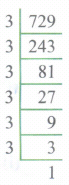
=\([\sqrt{\frac{15^2}{27^2}}-\sqrt{\frac{5^2}{12^2}}]\times\sqrt{\frac{9^2}{4^2}}\)
=\((\frac{15}{27}-\frac{5}{12})\times\frac{9}{4}=(\frac{5}{9}-\frac{5}{12})\times\frac{9}{4}\)
=\((\frac{20-15}{36})\times\frac{9}{4}=\frac{5}{ ̶3̶6̶}\times\frac{ ̶9̶}{4}=\frac{5}{16}\)
12.
\(\sqrt[5]{100000}=(100000)^{\frac{1}{5}}=(10^{ ̶5̶})^{\frac{1}{ ̶5̶}}=10\)
13.
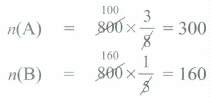
n(C) = \(800\times\frac{1}{2}=400\)
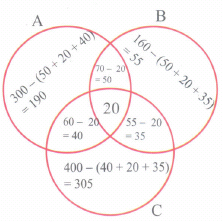
n(A∩B) = 70
n(B∩C) = 55
n(C∩A) = 60
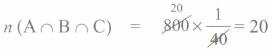
(i) Number of people who use exactly two branded soaps
= 50 + 35 + 40 = 125
(ii) Number of people who use at least one branded soaps
= 190 + 55 + 305 + 50 + 35 + 40 + 20 = 695
(iii) Number of people who do not use any of these brands
= 800 - [695] = 105
14.
\(n\left( A\cup B\cup C \right) =n(A)+n(B)+n(C)-n(A\cap B)-n(B\cap C)-n(A\cap C)+n(A\cap B\cap C)\)
(i) A = {a,c,e,f,h}, B = {c,d,e,f}, C = {a,b,c,f}
n(A) = 5, n(B) = 4, n(C) = 4
n(A⋂B) = 3
n(B⋂C) = 2
n(A∩C) = 3
n(A∩B∩C) = 2
A∩B = {c,e,f}
B∩C = {c,f}
A∩C = {a,c,f}
A∩B∩C = {c,f}
AUBUC = {a,c,d,e,f,b,h}
ஃ n(AUBUC) = 7............(1)
n(A)+n(B)+n(C)-n(A∩B)-n(B∩C)-n(A⋂C)+n(A∩B∩C).........(2)
= 5 + 4 + 4 - 3 - 2 - 3 + 2 = 15 - 8 = 7
(1) = (2)
⇒ n(AUBUC) = n(A) + n(B) + n(C) - n(A∩B) - n(B∩C) - n(A⋂C) + n(A∩B∩C)
Hence it is verified.
(ii) A = {1,3,5}, B = {2,3,5,6}, C = {1,5,6,7}
n(A) = 3, n(B) = 4, n(C) = 4
n(A∩B) = 2
n(B∩C) = 2
n(C⋂A) = 2
n(A⋂B⋂C) = 1
n(AUBUC) = 6
n(AUBUC) = n(A) + n(B) + n(C) - n(A⋂B) - n(B∩C) - n(A⋂C) + n(A∩B∩C)
6 = 3 + 4 + 4 - 2 - 2 - 2 + 1 = 12 - 6 = 6
Hence it is verified.
15.
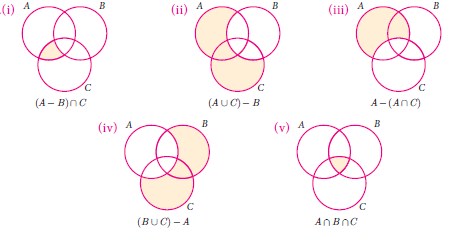
16.
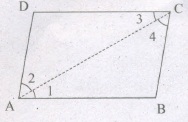
We have a parallelogram ABCD in which diagonals AC bisect ㄥA.
ㄥDAC = ㄥBAC
(i) To prove that AC bisects ∠C
∵ ABCD is a parallelogram
∴ AB II DC and AC is a transversal
∴ ㄥ1 = ㄥ3 (Alternate interior angle) .........(1)
.Also BC II AD and AC is a transversal.
∴ ㄥ2 = ㄥ4 (Alternate interior angle) ...........(2)
But AC bisects ㄥA
∴ ㄥ1 = ㄥ2
From (1), (2) and (3) we get
ㄥ3 = ㄥ4
∴ AC bisects ㄥC.
(ii) To prove that ABCD is a rhombus.
In ΔABC, we have ㄥ1 = ㄥ4 [ ∵ ㄥ1 = ㄥ2 = ㄥ4]
∴ BC = AB (side opposite to equal angles are equal) (4)
Similarly AD = DC ....... (5)
But ABCD is a parallelogram AB = DC (Opposite sides of a parallelogram) .......(6)
From (4), (5) and (6) we have AB = BC = CD = DA.
Thus ABCD is a rhombus.
17.
Distance = \(\sqrt{(x_2-x_2)^2+(y_2-y_1)^2}\)
AB =\(\sqrt{(6-3)^2+(5-7)^2}\)
\(\sqrt{3^2+(-2)^2}=\sqrt{9+4}=\sqrt{13}\)
BC=\(\sqrt{(15-6)^2+(-1-5)^2}=\sqrt{(9)^2+(-6)^2}\)
\(\sqrt{81+36}=\sqrt{117}\)
\(\sqrt{9\times 13}-3\sqrt{13}\)
AC =\(\sqrt{(15-3)^2+(-1-7)^2}\)
\(\sqrt{12^2+(-8)^2}=\sqrt{144+64}\)
\(=\sqrt{208}=\sqrt{16\times 13}=4\sqrt{13}\)

AB + BC =AC\(\Rightarrow \sqrt{13}+3\sqrt{13}=4\sqrt{13}\)
\(\therefore\)The points A,B,C are collinear.
18.
Let f(x) = ax3 + 4x2 + 3x –4 and g(x) = x3 – 4x + a, When f(x) is divided by (x–3), the remainder is f(3).
Now f(3) =a(3)3 + 4(3)2 + 3(3) - 4
= 27a + 36 + 9 – 4
f(3) = 27a + 41 (1)
When g(x) is divided by (x–3), the remainder is g(3).
Now g(3) = 33 – 4(3) + a
= 27 – 12 + a
= 15 + a (2)
Since the remainders are same, (1) = (2)
Given that, f(3) = g(3)
That is 27a + 41 = 15 + a
27a – a = 15 – 41
26a = –26
\(a={-26\over 26}=-1\)
Substituting a = –1,in f(3), we get
f(3) =
= – 27 + 41
f(3) = 14
∴ The remainder is 14.
19.
\(\sqrt{2}=1.414\)
\(\sqrt{3}=1.732\)
The two irrational numbers between \(\sqrt{2}\) and \(\sqrt{3}\) are 1.514 and 1.632

9th Standard Syllabus & Materials
9th Standard
TN 9th Tamil உள்ளத்தின் சீர் - திருக்குறள் Important Questions And Answers Study Material - QB365 Set A
NEW9th Standard
TN 9th Tamil உள்ளத்தின் சீர் - மணிமேகலை Important Questions And Answers Study Material - QB365 Set A
NEW9th Standard
TN 9th Tamil உள்ளத்தின் சீர் - ஏறு தழுவுதல் Important Questions And Answers Study Material - QB365 Set A
NEW9th Standard
TN 9th Tamil உயிருக்கு வேர் - தண்ணீர் Important Questions And Answers Study Material - QB365 Set A



Tamilnadu Stateboard 9th Standard Subjects
Tamilnadu Stateboard Standards





