
 100% FREE ACCESS
9th Standard Syllabus & Materials
9th Standard
TN 9th Tamil உள்ளத்தின் சீர் -கற்கண்டு (இலக்கணம்) - தொடர் இலக்கணம், ஆகுபெயர் Important Questions And Answers Study Material - QB365 Set A
NEW9th Standard
TN 9th Tamil உள்ளத்தின் சீர் -விரிவானம் (துணைப்பாடம்) - தாய்மைக்கு வறட்சி இல்லை! Important Questions And Answers Study Material - QB365 Set A
NEW9th Standard
TN 9th Tamil உள்ளத்தின் சீர் -கவிதை பேழை (செய்யுள்) - மார்கழி பெருவிழா Important Questions And Answers Study Material - QB365 Set A
NEW9th Standard
TN 9th Tamil உயிருக்கு வேர்-இலக்கணம் - பகுபத உறுப்பிலக்கணம் Important Questions And Answers Study Material - QB365 Set A
NEW9th Standard
TN 9th Tamil அமுதென்று பேர் - இலக்கணம்-எழுத்து -அளபெடை Important Questions And Answers Study Material - QB365 Set A
NEW9th Standard
TN 9th Tamil அமுதென்று பேர்-துணைப்பாடம் - ஆறாம்திணை Important Questions And Answers Study Material - QB365 Set A

Published on: 13/05/2022
QB365 provides detailed and simple solution for every book back questions in class 9 Maths subject.It will helps to get more idea about question pattern in every book back questions with solution.
latest Book back QuestionsDownload Tamil Nadu 9th Standard Maths question papers, model tests, one-mark questions, important questions, and public exam papers in PDF format. Free study materials and answer keys for TN State Board students.
Questions + Answers key
Take MCQ Maths Test1.
The total surface area of a cube is 864 cm2. Find its volume
2.
The dimensions of a sweet box are 22 cm × 18 cm × 10 cm. How many such boxes can be packed in a carton of dimensions 1 m × 88 cm × 63 cm?
3.
The probability that it will rain tomorrow is \(\\ \frac { 91 }{ 100 } \). What is the probability that it will not rain tomorrow?
4.
Find the value of
(i) sin 38036' + tan 12012'
(ii) tan 60025' - cos 49020'
5.
Find the value of sin 64034'.
6.
Check the value of k for which the given system of equations kx + 2y = 3; 2x − 3y = 1 has a unique solution.
7.
Find the values of
(i) tan7° tan23° tan60° tan67° tan83°
(ii) \(\frac { cos35° }{ sin55° } +\frac { sin12° }{ cos78° } -\frac { cos18° }{ sin72° } \)
8.
The lengths of sides of a triangular field are 28 m, 15 m and 41 m. Calculate the area of the field. Find the cost of levelling the field at the rate of Rs. 20 per m2
9.
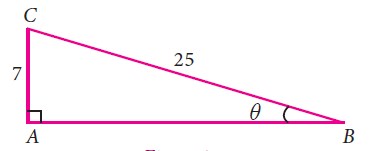
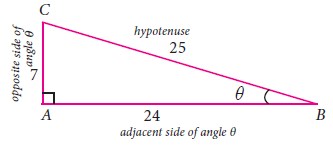
Find the six trigonometric ratios of the angle \(\theta\) using the given diagram.
10.
If A = {-2,0,1,3,5}, B = {-1,0,2,5,6} and C = {-1,2,5,6,7} then show that A-(BUC) = (A-B)∩(A-C).
11.
For the data 11, 15, 17, x+1, 19, x–2, 3 if the mean is 14 , find the value of x. Also find the mode of the data.
12.
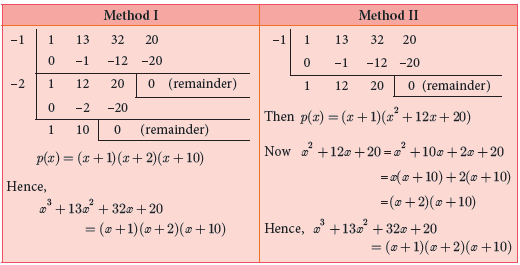
Factorise x3+13x2+ 32x + 20 into linear factors.
13.
In a group of 100 students, 85 students speak Tamil, 40 students speak English, 20 students speak French, 32 speak Tamil and English, 13 speak English and French and 10 speak Tamil and French. If each student knows atleast any one of these languages, then find the number of students who speak all these three languages.
14.
If A = {b,e,f,g} and B = {c,e,g,h}, then verify the commutative property of
(i) union of sets
(ii) intersection of sets.
15.
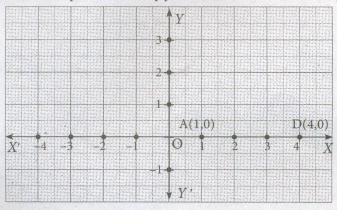
Plot the following points on a graph sheet by taking the scale as 1cm = 1 unit.
Find how far the points are from each other?
A (1,0) and D (4, 0). Find AD and also DA.
Is AD = DA?
You plot another set of points and verify your Result.
16.
Identify the type of numbers needed to solve the simple equations given here. Question 1 and 2 are solved for you, as examples. (Perhaps -the number systems developed gradually depending on the needs of 'answers' during such problem solving!)
| S.No | Equation | Solution | Type of number in the solution |
|---|---|---|---|
| 1 | x - 7 = 17 | x = 24 | Natural number |
| 2 | x + 5 = 5 | x = 0 | Whole number |
| 3 | x + 1 = 9 | ||
| 4 | x + 9 = 1 | ||
| 5 | 7x = 19 | ||
| 6 | 5x = -3 | ||
| 7 | x2 - 2 = 0 |
17.
Find the quotient and remainder of the following.
(x3 + 3x2 – 31x +12)÷(x–4)
18.
Out of 500 car owners investigated, 400 owned car A and 200 owned car B, 50 owned both A and B cars. Is this data correct?
19.
Rewrite the following polynomial in standard form.
\(7{ x }^{ 3 }-\frac { 6 }{ 5 } { x }^{ 2 }+4x-1\)
20.
Show that the points A(–4, –3), B(3, 1), C(3, 6), D(–4, 2) taken in that order form the vertices of a parallelogram.
21.
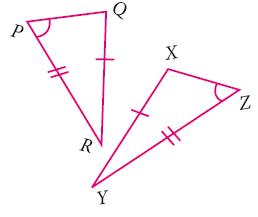
Consider the given pairs of triangles and say whether each pair is that of congruent triangles. If the triangles are congruent, say ‘how’; if they are not congruent say ‘why’ and also say if a small modification would make them congruent:
22.
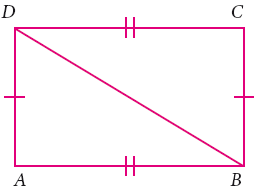
Consider the given pairs of triangles and say whether each pair is that of congruent triangles. If the triangles are congruent, say ‘how’; if they are not congruent say ‘why’ and also say if a small modification would make them congruent:
23.
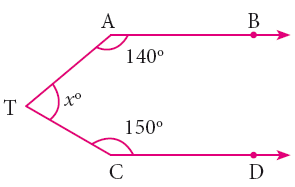
In the figure, AB is parallel to CD, find x
1.
Let ‘a’ be the side of the cube.
Given that, total surface area = 864 cm2
6a2= 864
a2 = \(\frac{864}{6}\)
a2 = 144
Therefore, side (a) = 12 cm
Now, volume of the cube = a3
= 123 = 12 ×12 ×12 = 1728 cm3
2.
Here, the dimensions of a sweet box are Length (l) = 22cm, breadth (b) = 18cm,
height (h) = 10 cm.
Volume of a sweet box = l × b × h
= 22 × 18 × 10 cm3
The dimensions of a carton are
Length (l) = 1m= 100 cm, breadth (b) = 88 cm,
height (h) = 63 cm.
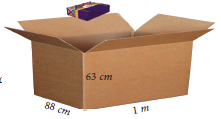
Volume of the carton = l × b × h
= 100 × 88 × 63 cm3
The number of sweet boxes packed =\(\frac{volume \ of \ the \ carton}{volume\ of \ a \ sweet \ box}\)
= \(\frac{100 \times 88\times63}{22\times18\times10}\)
= 140 boxes
3.
Let E be the event that it will rain tomorrow. Then E′ is the event that it will not rain tomorrow.
Since P(E) = 0.91, we have P(E′) = 1−0.91 (how?)
= 0.09
Therefore, the probability that it will not rain tomorrow
= 0.09
4.
(i) sin 38036' + tan 12012'
sin 38036' = 0.6239
tan12012' = 0.2162
sin 38036' + tan 12012' = 0.8401
(ii) tan 60025' - cos 49020'
tan 60025' = 1.7603 + 0.0012 = 1.7615
cos 49020' = 0.6521 - 0.0004 = 0.6517
tan 60025' - cos 49020' = 1.1098
5.
| 0' | 6' | 12' | 18' | 24' | 30' | 36' | 42' | 48' | 54' | Mean Difference | |||||
| 0.00 | 0.10 | 0.20 | 0.30 | 0.40 | 0.50 | 0.60 | 0.70 | 0.80 | 0.90 | 1 | 2 | 3 | 4 | 5 | |
| 640 | 0.9026 | 5 | |||||||||||||
write 64034' = 64030' + 4'
From the table we have, sin64030' = 0.9026

6.
Given linear equations are
kx + 2y = 3 ......(1)
2x - 3y = 1 .......(2)
\(\left[ \begin{matrix} { a }_{ 1 }x+{ b }_{ 1 }y+{ c }_{ 1 }=0 \\ { a }_{ 2 }x+{ b }_{ 2 }y+{ c }_{ 2 }=0 \end{matrix} \right] \)
Here a1 = k, b1 = 2, a2 = 2, b2 = −3 ;
For unique solution we take \(\frac { { a }_{ 1 } }{ { a }_{ 2 } } \neq \frac { { b }_{ 1 } }{ { b }_{ 2 } } \); therefore \(\frac { k }{ 2 } \neq \frac { 2 }{ -3 } \);\(k\neq \frac { 4 }{ -3 } \), that is \(k\neq -\frac { 4 }{ 3 } \)
7.
(i) tan 7°tan 23°tan 60°tan 67°tan 83°
= tan 70 tan 830 tan 230 tan 670 tan 600 (Grouping complementary angles)
= tan 70 tan(900 - 70)tan 230 tan(900 - 230)tan 600
= (tan70.cot70)(tan 230. cot 230)tan 600
= (1)\(\times\) (1)\(\times\) tan 600
= tan 600 = \(\sqrt { 3 } \)
(ii) \(\frac { cos35° }{ sin55° } +\frac { sin12° }{ cos78° } -\frac { cos18° }{ sin72° } \)
\(=\frac { cos\left( 90°-55° \right) }{ sin55° } +\frac { sin\left( 90°-78° \right) }{ cos78° } -\frac { cos\left( 90°-72° \right) }{ sin72° } \) \(\left[ \begin{matrix} { \text Since} \\cos35°=cos\left( 90°-55° \right) \\ sin12°=sin(90°-78°) \\ cos18°=cos\left( 90°-72° \right) \end{matrix} \right] \)
= \(\frac { sin55° }{ sin55° } +\frac { cos78° }{ cos78° } -\frac { sin72° }{ sin72° } \)
= 1+1 - 1 = 1
8.
Let a = 28 m, b = 15 m and c = 41 m
Then, s = \(\frac{a+b+c}{2}=\frac{28+15+41}{2}=\frac{84}{2}\) = 42m
Area of triangular field =\(\sqrt { s(s-a)(s-b)(s-c) } \)
=\(\sqrt { 42(42-28)(42-15)(42-41) } \)
=\(\sqrt { 42\times 14\times 17\times 1 } \)
=\(\sqrt { 2\times 3\times 7\times 7\times 2\times 3\times 3\times 3\times 1 } \)
\(=2 \times 3 \times 7 \times 3\)
= 126 m2
Given the cost of levelling is Rs. 20 per m2.
The total cost of levelling the field = 20 \(\times\)126 = Rs. 2520.
9.
By Pythagoras theorem,
\(AB=\sqrt { { BC }^{ 2 }{ AC }^{ 2 } } \)
= \(\sqrt { { \left( 25 \right) }^{ 2 }-{ 7 }^{ 2 } } \)
= \(\sqrt { 625-49 } =\sqrt { 576 } \) = 24
The six trignometric ratios are
\(sin\theta =\frac { opposite\ side }{ hypotenuse } =\frac { 7 }{ 25 } \)
\(tan\theta =\frac { oppositeside }{ adjacent\ side } =\frac { 7 }{ 24 } \)
\(sec\theta =\frac { hypotenuse }{ adjacent\ side } =\frac { 25 }{ 24 } \)
\(cos\theta =\frac { adjacentside }{ hypotenuse } =\frac { 24 }{ 25 } \)
\(cosec\theta =\frac { hypotenuse }{ oppositeside } =\frac { 25 }{ 7 } \)
\(cot \theta\ \frac { adjacentside }{ oppositeside } =\frac { 24 }{ 7 } \)
10.
A = {-2,0,1,3,5}, B = {-1,0,2,5,6}
C = {-1,2,5,6,7}
BUC = {-1,0,2,5,6,7}
A-(BUC) = {-2,1,3}.............(1)
(A-B) = {-2,1,3}
(A-C) = {-2,0,1,3}
(A-B)∩(A-C) = {-2,1,3}............(2)
From (1) and (2), it is verified that
A-(BUC) = (A-B)⋂(A-C)
11.
Total of the data = 11 + 15 + 17 + x + 1 + 19 + x -2 + 3
= 2x + 64
Mean of the data = \(\frac{2 x+64}{7}\)
= 14 (given)
\(\frac{2 x+64}{7}=\frac{14}{1}\)
2x + 64 = 98
2x = 98 - 64
2x = 34
\(\therefore x=\frac{34}{2}=17\)
The data = 11, 15, 17, 17+1, 19, 17- 2, 3
= 3, 11, 15, 15, 17, 18, 19
15 occurs two times
\(\therefore\) The Mode of data = 15
12.
Let, p(x) = x3+13x2+ 32x + 20
Sum of all the coefficients = 1 + 13 + 32 + 20 = 66 ≠ 0
Hence, (x -1) is not a factor.
Sum of coefficients of even powers and constant term = 13 + 20 = 33
Sum of coefficients of odd powers = 1 + 32 = 33
Hence, (x +1) is a factor of p (x)
Now we use synthetic division to find the other factors
13.
Let A, B and C represent sets of students who speak Tamil, English and French respectively.
Given, n(AUBUC) = 100, n(A) = 85, n(B) = 40, n(C) = 20
n(A⋂B) = 32, n(B⋂C) = 13, n(A⋂C) = 10
We know that,
n(A U B U C) = n(A) + n(B) + n(C) - n(A⋂B) - n(B⋂C) - n(A⋂C) + n(A⋂B⋂C)
100 = 85 + 40 +20+ -32 -13-10 + n(A⋂B⋂C)
Then, n(A⋂B⋂C) = 100 - 90 = 10
Therefore, 10 students speak all the three languages
14.
Given, A = {b,e,f,g} and B = {c,e,g,h}
(i) \(A\cup B\) = {b,c,e,f,g,h} .....(1)
\(B\cup A\) = {b,c,e,f,g,h} ......(2)
From (1) and (2) we have \(A\cup B\) = \(B\cup A\)
It is verified that union of sets is commutative.
(ii) \(A\cap B\) = {e,g} .....(3)
\(B\cap A\) = {e,g} .....(4)
From (3) and (4) we get, \(A\cap B\) = \(B\cap A\)
It is verified that intersection of sets is commutative.
15.
AD = 3 units
DA = 3 units (From graph)
Yes, Distance AD = Distance DA
The students are asked to do the activity with different points and verify the result.
16.
| S.No | Equation | Solution | Type of number in the solution |
|---|---|---|---|
| 1 | x - 7 = 17 | x = 24 | Natural number |
| 2 | x + 5 = 5 | x = 0 | Whole number |
| 3 | x + 1 = 9 | x = 8 | Natural number |
| 4 | x + 9 = 1 | x = -8 | Negative integer |
| 5 | 7x = 19 | x = 19/7 | Rational number |
| 6 | 5x = -3 | x = -3/5 | Rational number |
| 7 | x2 - 2 = 0 | x = \(\sqrt{2}\) | Irrational number |
17.
.png)
\(\therefore\) The Quotient : x2+7x–3
The Remainder : 0
18.
Let A be the set of people owned car A
Let B be the set of people owned car B
n( A) = 400, n(B) = 200, n(A \(\cap\) B) = 50
n(A \(\cup\) B) = 500 .........(1)
n(A) + n(B) - n(A \(\cap\) B) = 400 + 200 - 50
= 600 - 50
= 550 ...........(2)
From (1) and (2) we get
\(n(A\cup B)\ne n(A) +n(B)-n(A\cap B)\)
\(\therefore\) The given data is incorrect.
19.
The given polynomial is in standard form or \(-1+4x-\frac { 6 }{ 5 } { x }^{ 2 }{ +7x }^{ 3 }\)
20.
Let A(–4, –3), B(3, 1), C(3, 6), D(–4, 2) be the four vertices of any quadrilateral ABCD. Using the distance formula.
Let \(d=\sqrt { \left( { x }_{ 2 }-{ x }_{ 1 } \right) ^{ 2 }+\left( y_{ 2 }-y_{ 1 } \right) ^{ 2 } } \)
\(AB=\sqrt { \left( 3+4 \right) ^{ 2 }+\left( 1+3 \right) ^{ 2 } } =\sqrt { 49+16 } =\sqrt { 65 } \)
\(BC=\sqrt { \left( 3-3 \right) ^{ 2 }+\left( 6-1 \right) ^{ 2 } } =\sqrt { 0+25 } =\sqrt { 25 } =5\)
\(CD=\sqrt { \left( -4-3 \right) ^{ 2 }+\left( 2-6 \right) ^{ 2 } } =\sqrt { 49+16 } =\sqrt { 65 } \)
\(AD=\sqrt { \left( -4+4 \right) ^{ 2 }+\left( 2+3 \right) ^{ 2 } } =\sqrt { \left( { 0 }^{ 2 } \right) +\left( { 5 }^{ 2 } \right) } =\sqrt { 25 } =5\)
\(AB=CD=\sqrt { 65 } \) and BC = AD = 5
Here, the opposite sides are equal. Hence ABCD is a parallelogram.
21.
In \(\triangle PQR\ and \triangle XYZ\)
PR = YZ (Given)
QR = XY (Given)
\(\angle QPR=\angle XYZ\) (Given)
By SAS congruency
\(\triangle PQR\cong\triangle XYZ\)
22.
In \(\triangle ABD\ and\ \triangle CDB\)
AB = CD (Given)
AD = BC (Given)
BD is common
By SSS congruency
\(\triangle ABD\cong\triangle CDB\)
23.
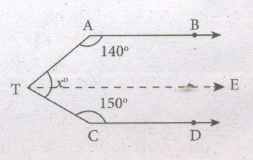
Through T draw TE|| AB.
\(\therefore \angle BAT+\angle ATE=180^0(AB||TE)\)
\(140^0+\angle ATE=180^0\)
\(\angle ATE=180^0-140^0=40^0\)
Similarly \(\angle ETC+\angle TCD=180^0(TE||CD)\)
\(\angle ETC+150^0=180^0\)
\(\angle ETC=180^0-150^0=30^0\)
\(x=\angle ATE+\angle ETC\)
= 40° + 30° = 70°
x = 70°

9th Standard Syllabus & Materials
9th Standard
TN 9th Tamil உள்ளத்தின் சீர் - திருக்குறள் Important Questions And Answers Study Material - QB365 Set A
NEW9th Standard
TN 9th Tamil உள்ளத்தின் சீர் - மணிமேகலை Important Questions And Answers Study Material - QB365 Set A
NEW9th Standard
TN 9th Tamil உள்ளத்தின் சீர் - ஏறு தழுவுதல் Important Questions And Answers Study Material - QB365 Set A
NEW9th Standard
TN 9th Tamil உயிருக்கு வேர் - தண்ணீர் Important Questions And Answers Study Material - QB365 Set A



Tamilnadu Stateboard 9th Standard Subjects
Tamilnadu Stateboard Standards





