
 100% FREE ACCESS
9th Standard Syllabus & Materials
9th Standard
TN 9th Tamil உள்ளத்தின் சீர் -கற்கண்டு (இலக்கணம்) - தொடர் இலக்கணம், ஆகுபெயர் Important Questions And Answers Study Material - QB365 Set A
NEW9th Standard
TN 9th Tamil உள்ளத்தின் சீர் -விரிவானம் (துணைப்பாடம்) - தாய்மைக்கு வறட்சி இல்லை! Important Questions And Answers Study Material - QB365 Set A
NEW9th Standard
TN 9th Tamil உள்ளத்தின் சீர் -கவிதை பேழை (செய்யுள்) - மார்கழி பெருவிழா Important Questions And Answers Study Material - QB365 Set A
NEW9th Standard
TN 9th Tamil உயிருக்கு வேர்-இலக்கணம் - பகுபத உறுப்பிலக்கணம் Important Questions And Answers Study Material - QB365 Set A
NEW9th Standard
TN 9th Tamil அமுதென்று பேர் - இலக்கணம்-எழுத்து -அளபெடை Important Questions And Answers Study Material - QB365 Set A
NEW9th Standard
TN 9th Tamil அமுதென்று பேர்-துணைப்பாடம் - ஆறாம்திணை Important Questions And Answers Study Material - QB365 Set A

Published on: 12/02/2020
9th Standard Mathematics All Chapter Important Creative Questions-II-2019-2020
Download Tamil Nadu 9th Standard Maths question papers, model tests, one-mark questions, important questions, and public exam papers in PDF format. Free study materials and answer keys for TN State Board students.
Questions + Answers key
Take MCQ Maths Test1.
When a dice is rolled, find the probability to get the number greater than 4?
2.
(i) If cosec A = sec 340, then find A
(ii) If tan B = cot 470, then find B.
3.
The sides of a triangular park are in the ratio 9:10:11 and its perimeter is 300 m. Find the area of the triangular park.
4.
Verify A -(BUC) = (A-B)∩(A-C) using Venn diagrams.
5.
If A = {2,5,6,7} and B = {3,5,7,8}, then verify the commutative property of union sets
6.
Is (5x+4) a factor of 5x3 + 14x2 - 32x -32
7.
Express the following surds in its simple form \(\sqrt [ 4 ]{ 324 } \)
8.
Find the Median of the given data: 36, 44, 86, 31, 37, 44, 86, 35, 60, 51
9.
Express in scientific notation:
(i) 9768854
(ii) 0.04567891
(iii) 72006865.48
10.
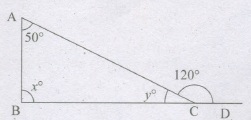
In the figure find x0 and y0.
11.
Three vertices of a rectangle are (3, 2), (-4, 2) and (-4, 5). Plot the points and find the coordinates of the fourth vertex.
12.
Show that the following points taken in order form the vertices of a parallelogram.
A(–3, 1), B(–6, –7), C (3, –9) and D(6, –1)
13.
Subtract the second polynomial from the first polynomial and find the degree of the resultant polynomial
p(x) = 7x2+ 6x -1 q(x) = 6x - 9
14.
Consider the given pairs of triangles and say whether each pair is that of congruent triangles. If the triangles are congruent, say ‘how’; if they are not congruent say ‘why’ and also say if a small modification would make them congruent:
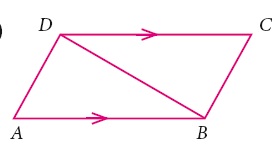
15.
Two unbiased coins are tossed simultaneously find the probability of getting
(i) two heads
(ii) one head
(iii) at least one head
(iv) at most one head
16.
From the given figure, find all the trigonometric ratios of angle \(\theta\).
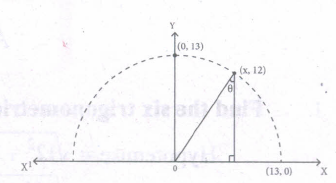
17.
Find the surface area of a cube whose edge is
(i) 27 cm
(ii) 3 cm
(iii) 6 cm
(iv) 2.1 cm
18.
A car travels, at a uniform speed. At 2 pm it is at a distance of 5 km at 6 pm it is at a distance of 120 km. Using section formula, find at what distance it will reach 2 midnight.
19.
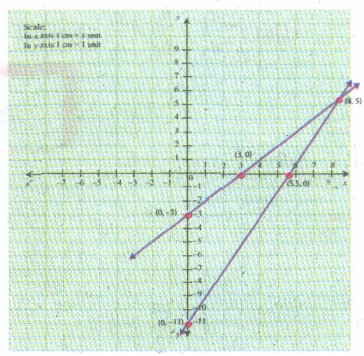
Solve using the method of substitution.
5x - y = 5, 3x +y = 11
20.
The dimensions of a match box are 6 cm × 3.5 cm × 2.5 cm. Find the volume of a packet containing 12 such match boxes.
21.
Frame two problems in calculating probability, based on the spinner shown here.
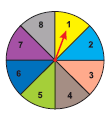
22.
Find the value of the following:
\(\left( \frac { cos47° }{ sin43° } \right) +\left( \frac { sin72° }{ cos18° } \right) -2\cos^{ 2 }45°\)
23.
Find the coordinates of the point which divides the line segment joining the points A(4,−3) and B(9,7) in the ratio 3:2.
24.
Find any 3 irrational numbers between 0.12 and 0.13.
25.
Express the following in the form 3n: \(\sqrt { 27 } \)
26.
Find the value of Xo
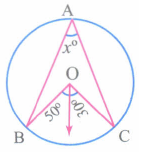
27.
The radius of a circle 15 cm and the length of one of its chord is 24 cm. Find the distance of the chord from the centre.
28.
In a week, temperature of a certain place is measured during winter are as follows 26oC, 24oC, 28oC, 31oC, 30oC, 26oC, 24oC. Find the mean temperature of the week.
29.
Find the mode for the set of values 17, 18, 20, 20, 21, 21, 22, 22.
30.
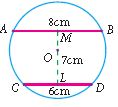
In the given figure, AB and CD are the parallel chords of a circle with centre O. Such that AB = 8cm and CD = 6cm. If OM ⊥ AB and OL⊥CD distance between LM is 7cm. Find the radius of the circle?
31.
In the given figure, ABCD is a cyclic quadrilateral where diagonals intersect at P such that ㄥDBC = 40° and ㄥBAC = 60°
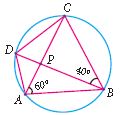
find (i) ㄥCAD (ii) ㄥBCD
32.
Expand the following: (x+2y+3z)2
33.
Express the following in the form 2n:
\(\sqrt{8}\)
34.
Without actual division classify the decimal expansion of the following numbers as terminating or non-terminating and recurring.
\({17\over 200}\)
35.
Let U= {x : -3 : < x < 4} A = {-1,2,3} B = {0,1,2,3} C = {-3,-2,-1,0,1,2}. Find (i) A' UB' (ii) (A ∩ B)' (iii) (A ⋂ C)'
36.
Write the following in "Roster" form?
(a) A = set of the months having 31 days.
(b) B = {x : x is a natural number of 2 digits divisible by 13}
(c) C = {set of vowels in the word "father"}
(d) D = {x : 5 < x < 10 ; x ∈ N}
(e) E = {x: x is a square natural number less than 16}
37.
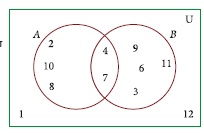
Using the given Venn diagram, write the elements of A∪B
38.
If S = {square, rectangle, circle, rhombus, triangle}, list the elements of the following subset of S.
The set of shapes in which the sum of all interior angles is 1800.
39.
Write the coefficient of x2 and x in each of the following polynomials \(6-{ 2x }^{ 2 }+3x^{ 3 }-\sqrt { 7 } x\)
40.
The total surface area of a cuboid with dimension 10 cm × 6 cm × 5 cm is _______.
280 cm2
300 cm2
360 cm2
600 cm2
41.
If the lateral surface area of a cube is 600 cm2, then the total surface area is _______.
150 cm2
400 cm2
900 cm2
1350 cm2
42.
If A is any event in S and its complement is A' then, P(A′) is equal to _______.
1
0
1-A
1-P(A)
43.
The probability of an event cannot be _______.
Equal to zero
Greater than zero
Equal to one
Less than zero
44.
The value of \(\frac { sin{ 29 }^{ 0 }31' }{ cos{ 60 }^{ 0 }29' } \) is
0
2
1
-1
45.
The value of tan72° tan18° is ________.
0
1
180
720
46.
Which of the following is a linear equation.
\(x+\frac { 1 }{ x } =2\)
x(x −1) = 2
3x+5=\(\frac { 2 }{ 3 } \)
x3 - x =5
47.
In what ratio does the y-axis divide the line joining the points (−5, 1) and (2, 3) internally ______.
1 : 3
2 : 5
3 : 1
5 : 2
48.
\(n(A\cup B\cup C)\)=________
n(A) + n(B) + n(C)
n(A) + n(b) + n(C) -\(n\left( A\cap B\cap C \right) \)
\(n\left( A\cap B\cap C \right) \)
n(A) + n(B) + n(C) -\(n\left( A\cap B \right) \)-\(n\left( B\cap A \right) -n\left( A\cap C \right) +n\left( A\cap B\cap C \right) \)
49.
\(\left[ n\left( A\cup B\cup C \right) ^{ ' } \right] \)=_______
\(n\left( A\cap B\cap C \right) \)
\(n\left( U \right) -n\left( A\cup B\cup C \right) \)
n(U)
\(\Phi \)
50.
Degree of the linear polynomial is ________
1
2
3
4
51.
The polynomial whose factors are (x+2)(x+3) is_____
x2 + 5x + 6
x2 - 4
x2 - 9
x2 + 6x + 5
52.
If x - 2 is a factor of q(x), then the remainder is___________
q(-2)
x - 2
0
-2
53.
Rationalising the denominator \(\cfrac { 1 }{ \sqrt [ 3 ]{ 3 } } \) ___________
3
\(\cfrac { { 3 }^{ \frac { 2 }{ 3 } } }{ 3 } \)
\(\sqrt { 3 } \)
\(\sqrt [ 3 ]{ 3 } \)
54.
\(\sqrt [ 4 ]{ 405 } =h\sqrt [ 4 ]{ 5 } \), then h = ____________
5
4
2
3
55.
The angle subtended by equal chords of a circle at the centre is________
Complementary
Supplementary
Equal
unequal
56.
The mean of the square of first 11 natural numbers is ___________
26
46
48
52
57.
The mean of a, b, c, d and e is 28. If the mean of a, c and e is 24, then mean of b and d is _______________
24
36
26
34
58.
The algebraic sum of the deviations of a set of n values from their mean is ___________
0
n-1
n
n+1
59.
The mean of set of seven numbers is 81. If one of the numbers is discarded, the mean of remaining numbers is 78. The value of discarded numbers is
101
100
99
98
60.
Find the mean of the prime factors of 165.
5
11
13
55
61.
The median of the first 10 whole numbers is ______________
4
4.5
5
5.5
62.
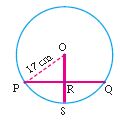
In the given figure, If OP = 17cm PQ = 30 cm and OS is perpendicular to PQ, then RS is ________.
10 cm
6 cm
7 cm
9 cm
63.
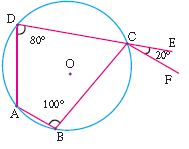
In the figure, ABCD is a cyclic quadrilateral in which DC produced to E and CF is drawn parallel to AB such that ㄥADC = 80° and ㄥECF = 20°, then ㄥBAD = ?
100°
20°
120°
110°
64.
The roots of the polynomial equation \({ x }^{ 2 }+2x=0\) are_______________
x = 0, 2
x = 1, 2
x = 1, -2
x = 0, -2
65.
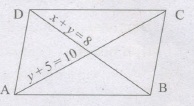
ABCD is a parallelogram as shown. Find x and y.
1, 7
2, 6
3, 5
4, 4
66.
In a parallelogram \(\angle{A}:\angle{B}=1:2\) Then ∠A ............
30°
60°
45°
90°
67.
What is the name of a regular polygon of six sides?
Square
Equilateral triangle
Regular hexagon
Regular octagon
68.
The set does not have a proper subset is __________
Finite set
Infinite set
Null set
Singleton set
69.
The rational number lying between \(\frac { 1 }{ 5 } \) and \(\frac { 1 }{ 2 } \) is___________.
\(\frac { 7 }{ 20 } \)
\(\frac { 2 }{ 10 } \)
\(\frac { 2 }{ 7 } \)
\(\frac { 3 }{ 10 } \)
70.
The centre of a circle is (0, 0). One end point of a diameter is (5, -1), then ______________
\(\sqrt{24}\)
\(\sqrt{37}\)
\(\sqrt{26}\)
\(\sqrt{17}\)
71.
The distance between the points (a, 0) and (0, b) is____________
a unit
b unit
\(\sqrt{a^2+{b^2}}\ unit\)
\(\sqrt{a^2-{b^2}}\ unit\)
72.
A point which lies in the III quadrant is__________________
(5, 4)
(5, -4)
(-5, -4)
(-5, 4)
73.
On which quadrant does the point (-4, 3) lie?
I
II
III
IV
74.
The distance between the point ( 5, –1 ) and the origin is _______.
\(\sqrt { 24 } \)
\(\sqrt { 37 } \)
\(\sqrt { 26 } \)
\(\sqrt { 17 } \)
75.
An irrational number between 2 and 2.5 is ________.
\(\sqrt { 11 } \)
\(\sqrt { 5 } \)
\(\sqrt { 2.5 } \)
\(\sqrt { 8 } \)
76.
Which one of the following has a terminating decimal expansion?
\(\frac { 5 }{ 64 } \)
\(\frac { 8 }{ 9 } \)
\(\frac { 14 }{ 15 } \)
\(\frac { 1 }{ 12 } \)
77.
The root of the polynomial equation 2x + 3 = 0 is ________.
\(\frac{1}{3}\)
\(-\frac{1}{3}\)
\(-\frac{3}{2}\)
\(-\frac{2}{3}\)
78.
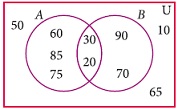
From the adjacent diagram n[P(AΔB)] is ________.
8
16
32
64
79.
If A∪B = A∩B, then ________.
A ≠ B
A = B
A ⊂ B
B ⊂ A
80.
A farmer has a field in the shape of a rhombus. The perimeter of the field is 400 m and one of its diagonal is 120 m. He wants to divide the field into two equal parts to grow two different types of vegetables. Find the area of the field.
81.
In a school, 80 students like Maths,90 students like Science 82 students like History, 21 like both Maths and Science 19 like both science and History 20 like both Maths and History and 8 liked all the three subjects. If each student like at least one subject, then find
(i) the number of students in the school
(ii) the number of students who like only one subject.
82.
Factorise 2x3- x2 - 12x - 9 into linear factors
83.
The following are the scored by the students in the Summative Assessment exam
| Class | 0-10 | 10-20 | 20-30 | 30-40 | 40-50 | 50-60 |
| No. of students | 2 | 7 | 15 | 10 | 11 | 5 |
84.
In the class, weight of students is measured for the class records. Calculate mean weight of the students using direct method.
| Weight in kg | 15-25 | 25-35 | 35-45 | 45-55 | 55-65 | 56-75 |
| No.of students | 4 | 11 | 19 | 14 | 0 | 2 |
85.
Represent \(-\frac { 2 }{ 11 } ,-\frac { 5 }{ 11 } and-\frac { 9 }{ 11 } \)on the number line.
86.
Find any three rational numbers between \(\frac { 1 }{ 2 } \) and \(\frac { 1 }{ 5 } \)
87.
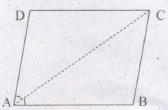
Diagonal AC of a parallelogram ABCD bisects ∠A. Show that
(i) it bisects ∠C also
(ii) ABCD is a rhombus.
88.
Show that the point A (3,7) B (6, 5) and C (15, -1) are collinear.
89.
Construct the centroid of \(\triangle\)PQR such that PQ = 9 cm, QR = 7 cm, RP = 8 cm.
1.
Sample space S = {1, 2, 3, 4, 5, 6}
Let E be the event of getting a number greater than 4
E = {5, 6}
\(P(E)=\frac { Number\ of\ favourable\ outcomes }{ Total\ number\ of\ outcomes } \)
\(P(E)=\frac { n(E) }{ n(S) } =\frac { 2 }{ 6 } =0.333...\)
2.
(i) We know that cosec A = sec(900 A)
sec(900 - A) sec(340)
900 - A =340
We get A = 90° − 34°
A = 560
(ii) We know that tan B = cot(900 - B)
cot(900 - B) = cot 470
900 - B = 470
We get B = 90° − 47°
B = 430
3.
Given the sides are in the ratio 9:10:11, let the sides be 9k, 10k, 11k
The perimeter of the triangular park = 300 m
9k +10k +11k = 300 m
30k = 300
k = 10 m
Therefore, the sides are a = 90 m, b = 100 m, c = 110 m
s=\(\frac{1+b+c}{2}=\frac{90+100+110}{2}=\frac{300}{2}\)= 150 m
Hence, Area of triangular park = \(\sqrt { s(s-a)(s-b)(s-c) } \)
= \(\sqrt { 150\times (150-90)(150-100)(150-110) } \)
= \(\sqrt { 150\times 60\times 50\times 40 } \)
= \(\sqrt { 3\times 50\times 20\times 3\times 50\times 2\times 20 } \)
= 50 \(\times\) 20 \(\times\) 3\(\sqrt{2}\)
= 3000 \(\times\)1.414 = 4242 m2
4.
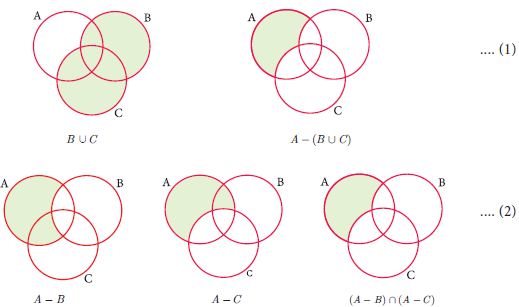
From (1) and (2), we get A -(BUC) = (A-B)∩(A-C). Hence it is verified.
5.
Given, A = {2,5,6,7} and B = {3,5,7,8}
\(A\cup B\) = {2,3,5,6,7,8} ...........(1)
\(B\cup A\) = {2,3,5,6,7,8} ..............(2)
6.
Let p(x) = 5x3 + 14x2 - 32x - 32
By factor theorem, 5x + 4 is a factor, if \(p\left( \cfrac { -4 }{ 5 } \right) \)= 0
\(p\left( \cfrac { -4 }{ 5 } \right) =5\left( \cfrac { -4 }{ 5 } \right) ^{ 3 }+14\left( \cfrac { -4 }{ 5 } \right) ^{ 2 }-\left( 32\left( \cfrac { -4 }{ 5 } \right) \right) -32\)
= \(5\left( \cfrac { -64 }{ 125 } \right) +14\left( \cfrac { 16 }{ 25 } \right) +32\left( \cfrac { 4 }{ 5 } \right) -32\)
=\(\cfrac { -64 }{ 25 } +\cfrac { 224 }{ 25 } +\cfrac { 128 }{ 5 } -32\) = \(\cfrac { -65 }{ 25 } +\cfrac { 224 }{ 25 } +\cfrac { 640 }{ 25 } -\cfrac { 800 }{ 25 } \)
=\(\cfrac { -65+224+640-800 }{ 25 } \) = 0
\(p\left( \cfrac { -4 }{ 5 } \right) \) = 0
Therefore,5x+4 is a factor 5x3 + 14x2 - 32x - 32
7.
\(\sqrt [ 4 ]{ 324 } \) =\(\sqrt [ 4 ]{ 81\times 4 } =\sqrt [ 4 ]{ { 3 }^{ 4 }\times 4 } =\sqrt [ 4 ]{ { 3 }^{ 4 } } \times \sqrt [ 4 ]{ 4 } \) \(\left[ \because \sqrt [ n ]{ a^{ n } } \times \sqrt [ n ]{ b } =\sqrt [ n ]{ ab } \right] \)
= \(3\times \sqrt [ 4 ]{ 4 } \) \(\left[ \because \sqrt [ n ]{ a^{ n } } =a \right] \)
order = 4; radicand = 4; Coefficient = 3
8.
Values in ascending order
31, 35, 36, 37, 44, 44, 51, 60, 86, 86
Number of terms = 10 which is even
Median = Average of \(\left[\frac{N}{2}\right]^{\text {th }} \text { term }+\left(\frac{n}{2}+1\right)^{\text {th }} \text { term }\)
= Average of [5th term + 6th term]
\(=\frac{44+44}{2}=44\)
Median = 44
9.
(i) 
The decimal point is to be moved six places to the left. Therefore n = 6.
(ii) 
The decimal point is to be moved two places to the right. Therefore n = −2
(iii) 
The decimal point is to be moved seven places to the left. Therefore n = 7
10.
∠ACD = ∠A + ∠B
(An exterior angle of a triangle is sum of its interior opposite angles)
120° = 50° + x0
x0 = 120° - 50°
= 70°
In the triangle ABC
∠A + ∠B + ∠ACB = 180° (Sum of the angles of a Δ)
50° +x + ∠ACB = 180°
50° + 70° + ∠ACB = 180°
∠ACB = 180° - 120°
y = 60° (OR)
∠ACD + ∠ACB = 1800(Angles of a linear pair)
∠ACB = 180° - 120°
= 60°
The value of x = 70° and y = 60°.
11.
(3, 5)
12.
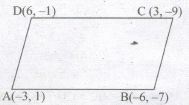
Distance =\(\sqrt { ({ x }_{ 2 }-{ x }_{ 1 })^{ 2 }+(y_{ 2 }-y_{ 1 })^{ 2 } } \)
AB =\(\sqrt { (-6+3)^{ 2 }+(-7-1)^{ 2 } } \)
= \(\sqrt { (-3)^{ 2 }+(-8)^{ 2 } } =\sqrt { 9+64 } =\sqrt { 73 } \)
BC = \(\sqrt { (3+6)^{ 2 }+(-9+7)^{ 2 } } \)
= \(\sqrt { { 9 }^{ 2 }+(-2)^{ 2 } } =\sqrt { 81+4 } =\sqrt { 85 } \)
CD = \(\sqrt { (6-3)^{ 2 }+(-1+9)^{ 2 } } \)
= \(\sqrt { (3)^{ 2 }+({ 8 })^{ 2 } } =\sqrt { 9+64 } =\sqrt { 73 } \)
AD = \(\sqrt { (6+3)^{ 2 }+(-1-1)^{ 2 } } \)
= \(\sqrt { (9)^{ 2 }+(-2)^{ 2 } } =\sqrt { 81+4 } =\sqrt { 85 } \)
AB = CD =\(\sqrt { 73 } \) and BC = AD = \(\sqrt { 85 } \)(Opposite sides are equal)
∴ ABCD is a parallelogram.
13.
p(x) - q(x) = 7x2 + 6x - 1 - (6x - 9)
= 7x2 + 6x - 1 - 6x + 9
= 7x2 + 6x - 6x - 1 + 9
= 7x2+8
The degree of the polynomial is 2
14.
In the given diagram
AB = CD (Given)
BD is common.
\(\angle ABD=\angle BDC\) (alternate angles)
(Since AC and CD are parallel and BD is the transversal)
By SAS congruency
\(\therefore\triangle ABD\cong\triangle CDB\)
15.
S = {HH, HT, TH, TT}
(i) probability of two heads = \(\frac { 1 }{ 4 } \)
(ii) probability of one head = \(\frac { 1 }{ 2 } \)
(iii) probability of at least one head = \(\frac { 3 }{ 4 } \)
(iv) probability of at most one head = \(\frac { 3 }{ 4 } \).
16.
\(x=\sqrt { { 13 }^{ 2 }-{ 12 }^{ 2 } } \)
\(\sqrt { 169-144 } =\sqrt { 25 } =5\)
\(sin\theta =\cfrac { 5 }{ 13 } ;cos\theta =\cfrac { 12 }{ 13 } ;tan\cfrac { 5 }{ 12 } ;cosec\theta =\cfrac { 13 }{ 5 } ;\)
\(sec\theta =\cfrac { 13 }{ 12 } ;cot\theta =\cfrac { 12 }{ 5 } \)
17.
(i) TSA = 6a2 = 6 \(\times\) 272 = 6 \(\times\) 729 = 4374 cm2
(ii) TSA = 6a2 = 6 \(\times\)32 = 54 cm2
(iii) TSA = 6a2 = 6 \(\times\) 62 = 6 \(\times\) 36 = 216 cm2
(iv) TSA = 6a2 = 6 \(\times\) 2.12 = 6 \(\times\) 4.41 = 26.46 cm2
18.
\(120=\frac { 8(50)+4(y) }{ 12 } \)
1440 = 400 + 4y
4y = 1040
\(y=\frac { 1040 }{ 4 } =260\ km\)
19.
5x - y = 5 -------------(1)
3x +y = 11 ----------(2)
(1) \(\Rightarrow\) y = 5x-5
(2) \(\Rightarrow\) 3x + 5x - 5 = 11
8x = 11+5
8x = 16
\(x=\cfrac { 16 }{ 8 } =2\)
(1) \(\Rightarrow\) 5 (2) - y = 5 \(\Rightarrow\) 10 - 5 =y \(\Rightarrow\) y = 5
\(\therefore\) Solution is x = 2, y = 5
20.
Dimensions of a match box = 6 cm \(\times\) 3.5 cm \(\times\) 2.5 cm
V = (6 \(\times\) 3.5 \(\times\) 2.5) cm3 = 52.5 cm3
Volume of 12 such boxes = 12 \(\times\) 52.5 cm3 = 630 cm3.
21.
(i) What is the probability that the spinner will not land on a multiple of 2?
(ii) What is the probability that the spinner will land on an odd number?
22.
\(\left( \frac { cos47° }{ sin43° } \right) +\left( \frac { sin72° }{ cos18° } \right) -2cos^{ 2 }45°\)
= \(\left( \cfrac { cos\left( { 90 }^{ 0 }-{ 43 }^{ 0 } \right) }{ { sin43 }^{ 0 } } \right) ^{ 2 }+\left( \cfrac { sin\left( { 90 }^{ 0 }-{ 18 }^{ 0 } \right) }{ cos18 } \right) ^{ 2 }-2{ cos }^{ 0 }{ 45 }^{ 0 }\)
= \(\left( \cfrac { sin43 }{ sin43 } \right) ^{ 2 }+\left( \cfrac { cos18 }{ cos18 } \right) ^{ 2 }-2\left( \cfrac { 1 }{ \sqrt { 2 } } \right) ^{ 2 }\)

23.
x1 y1 x2 y2 m : n
A (4, -3), B (9, 7), 3 : 2
By section formula \(P\left( \frac { { mx }_{ 2 }+{ nx }_{ 1 } }{ m+n } ,\frac { { my }_{ 2 }+{ ny }_{ 1 } }{ m+n } \right) =P(x,y) \)

\(P(x,y)=\left( \frac { 3(9)+2(4) }{ 3+2 } ,\frac { 3(7)+2(-3) }{ 3+2 } \right) \)
\(=\left( \frac { 27+8 }{ 5 } ,\frac { 21-6 }{ 5 } \right) =\left( \frac { 35 }{ 5 } ,\frac { 15 }{ 5 } \right) =(7,3)\)
24.
Three irrational numbers between 0.12 and 0.13 are 0.12010010001…, 0.12040040004…, 0.12070070007…
25.
\(\sqrt { 27 } \) =\(\sqrt { 3 } \times \sqrt { 3 } \times \sqrt { 3 } =\left( { 3 }^{ \cfrac { 1 }{ 2 } } \right) ^{ 3 }=\left( 3 \right) ^{ \left( \cfrac { 3 }{ 2 } \right) }\)
26.
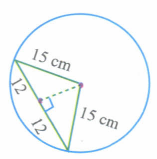
xo=\(\cfrac { 1 }{ 2 } \angle BOC\)
=\(\cfrac { 1 }{ 2 } \) (50o+30o)
=\(\cfrac { 1 }{ 2 } \) \(\times\) 80 =40o
27.
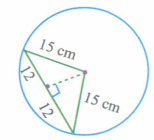
Distance of the chord from the centre
= \(\sqrt { { 15 }^{ 2 }-{ 12 }^{ 2 } } \)
= \(\sqrt { 225-144 } \)
= \(\sqrt { 89 } \)
= 9 cm
28.
Mean \(\bar { x } =\cfrac { \Sigma x }{ n } \)
= \(\cfrac { 26+24+28+31+30+26+24 }{ 7 } =\cfrac { 189 }{ 7 } \)
Mean temperature of the week = 270C
29.
In this example, three values 20, 21, 22 occur two times each. There are three modes for the given data!
30.
In the figure
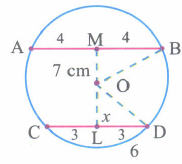
LM = 7 cm
Let OM = (7-x) cm
MB = \(\cfrac { 8 }{ 2 } \) = 4cm
OB =\(\sqrt { { 4 }^{ 2 }+\left( 7-x \right) ^{ 2 } } \)
OD =\(\sqrt { { 3 }^{ 2 }+{ x }^{ 2 } } \)
\(\sqrt { 16+\left( 7-x \right) ^{ 2 } } =\sqrt { { 3 }^{ 2 }+{ x }^{ 2 } } \)
Squaring both sides
16 + (7-x)2 = 9 + x2

14x = 65 - 9
14x = 56 = x\(\cfrac { 54 }{ 14 } \)= 4
\(\therefore\) Radius OD =\(\sqrt { { 3 }^{ 2 }+{ 4 }^{ 2 } } =\sqrt { 9+16 } =\sqrt { 25 } =5cm\)
31.
\(\angle\)DBC = 400
\(\angle\)BAC = 600
(i) \(\angle\)CAD = 600
(\(\therefore \) angles in the same segment are equal)
(ii) \(\angle\)BCD+\(\angle\)BAD = 1800
(\(\therefore\) In cyclic quadrilateral opposite angles are supplementary)
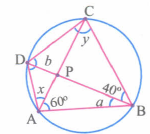
\(\angle\)BCD+ (\(\angle\)BAD +\(\angle\)CAD) =1800
\(\angle\)BCD+ (600 + 400) = 1800
\(\angle\)BCD = 1800-1000 = 800
32.
(a+b+c)2= a2+ b2+ c2+ 2ab + 2bc + 2ca
(x + 2y + 3z)2= (x)2+(2y)2+(3z)2+2(x)(2y)+2(2y)(3z)+2(3z)(x)
= x2 + 4y2 + 9z2 + 4xy + 12yz + 6xz
33.
\(\sqrt { 8 } =\sqrt { 2 } \times \sqrt { 2 } \times \sqrt { 2 } =\left( 2^{ \frac { 1 }{ 2 } } \right) ^{ 3 }\)
which may be written as \({ 2 }^{ \frac { 3 }{ 2 } }\).
34.
\({17\over 200}={17\over 2^3\times 5^2}\)
\(\therefore {17\over 200}\) has a terminating decimal expansion.
35.
(i) {-3,-2,-1,0,1,4} (ii) {-3,-2,-1,0,1,4} (iii) {-3,-2,0,1,3,4}
36.
(a) A = {Jan, March, May, July, Aug, Oct, Dec}
(b) B = {13,26,39,52,65,78,91}
(c) C = {a,e}
(d) D = {6,7,8,9,10}
(e) E = {1,4,9}
37.
{2, 3, 4, 6, 7, 8, 9, 10, 11}
38.
{triangle}
39.
Coefficient of x2 is -2 and Coefficient of x is -\(\sqrt 7\)
40.
(a)
280 cm2
41.
(c)
900 cm2
42.
(d)
1-P(A)
43.
(d)
Less than zero
44.
(c)
1
45.
(b)
1
46.
(c)
3x+5=\(\frac { 2 }{ 3 } \)
47.
(d)
5 : 2
48.
(d)
n(A) + n(B) + n(C) -\(n\left( A\cap B \right) \)-\(n\left( B\cap A \right) -n\left( A\cap C \right) +n\left( A\cap B\cap C \right) \)
49.
(b)
\(n\left( U \right) -n\left( A\cup B\cup C \right) \)
50.
(a)
1
51.
(a)
x2 + 5x + 6
52.
(c)
0
53.
(b)
\(\cfrac { { 3 }^{ \frac { 2 }{ 3 } } }{ 3 } \)
54.
(d)
3
55.
(c)
Equal
56.
(b)
46
57.
(d)
34
58.
(a)
0
59.
(b)
100
60.
(d)
55
61.
(b)
4.5
62.
(d)
9 cm
63.
(c)
120°
64.
(d)
x = 0, -2
65.
(c)
3, 5
66.
(b)
60°
67.
(c)
Regular hexagon
68.
(c)
Null set
69.
(a)
\(\frac { 7 }{ 20 } \)
70.
(c)
\(\sqrt{26}\)
71.
(c)
\(\sqrt{a^2+{b^2}}\ unit\)
72.
(c)
(-5, -4)
73.
(b)
II
74.
(c)
\(\sqrt { 26 } \)
75.
(b)
\(\sqrt { 5 } \)
76.
(a)
\(\frac { 5 }{ 64 } \)
77.
(c)
\(-\frac{3}{2}\)
78.
(c)
32
79.
(b)
A = B
80.
Let ABCD be the rhombus.
Its perimeter = 4 × side = 400 m
Therefore, each side of the rhombus = 100 m
Given the length of the diagonal AC = 120 m
In \(\triangle\)ABC, let a =100 m, b =100 m, c = 120 m
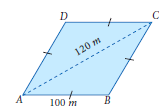
s = \(\frac{a+b+c}{2}=\frac{100+100+120}{2}\) = 160 m
Area of \(\triangle\)ABC =\(\sqrt{160(160-100)(160-100)(160-120)}\)
= \(\sqrt{160 \times 60\times 60 \times40}\)
= \(\sqrt{40 \times 2 \times \times2\times60\times60\times40}\)
= 40 × 2 × 60 = 4800 m2
Therefore, Area of the field ABCD = 2 × Area of \(\triangle\)ABC = 2 × 4800 = 9600 m2
81.
Let M.S and H represent sets students who like Maths,Science and history respectively.
Then, n(M) = 80,n(S) = 90,n(H) = 82,\(n\left( M\cap S \right) \) = 21,\(n\left( S\cap H \right) \) = 19,\(n\left( M\cap H \right) \) = 20,\(n\left( M\cap S\cap H \right) \)= 8
Let us represents the given data in a venn diagram
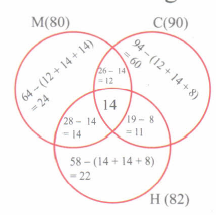
(i) The number of student in the school = 52 + 59 + 55 + 12 + 11 + 8 + 8 = 205
(ii) The number of students who like only one subject = 52 + 59 + 55 = 166
82.
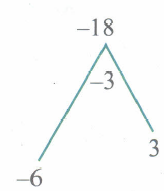
Let p (x) 2x3 - x2 - 12x - 9
Sum of the co-efficients = 2 - 1- 12- 9 = -20 \(\neq \) 0
Hence x-1 is not a factor
Sum of co-efficients of even powers with constant = -1 - 9 = -10
Sum of co-efficients of odd powers = 2 - 12= -10
Hence x + 1 is a factor of x.
Now we use synthetic division to find the other factors.
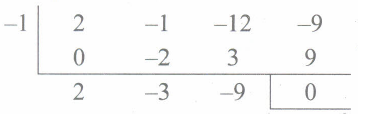
Then p (x) = (x + 1)(2x2 - 3x - 9)
Now 2x2 - 3x - 9 = 2x2 - 6x + 3x - 9 = 2x (x - 3) + 3 (x - 3)
= (x - 3)(2x + 3)
Hence 2x3 - x2 - 12x - 9 (x + 1) (x - 3) (2x + 3)
83.
Calculate the median
| Class | Number of students | Cumulative frequency(cf) |
| 0-10 | 2 | 2 |
| 10-20 | 7 | 9 |
| 20-30 | 15 | 24 |
| 30-40 | 10 | 34 |
| 40-50 | 11 | 45 |
| 50-60 | 5 | 50 |
N = 50
Median Class = \(\left(\cfrac{N}{2}\right)^{th}\)Value
=\(\left(\cfrac{50}{2}\right)^{th}\) Value = 25th Value
Median value = 30 - 40
\(\cfrac{N}{2}\)=25, l = 30
m = 24, c =10, f =10
\(\therefore\) Median = \(\cfrac{l+\left(\cfrac{N}{2}-m\right)}{f}\times{c} \)
=\(\cfrac{30+25-24}{10}\times{10}=31\)
84.
| Weight in kgs(x) | Number of students(f) | Mid value of x | fx |
| 15-25 | 4 | 20 | 80 |
| 25-35 | 11 | 30 | 330 |
| 35-45 | 19 | 40 | 760 |
| 45-55 | 14 | 50 | 700 |
| 55-65 | 0 | 60 | 0 |
| 65-75 | 2 | 70 | 140 |
| \(\Sigma{f}=50\) | 2010 |

85.

To represent \(-\frac { 2 }{ 11 } ,-\frac { 5 }{ 11 } and-\frac { 9 }{ 11 } \)on the number line we make 11 markings each being equal distance \(\frac { 1 }{ 11 } \) on the left of 0.
The point A represents \(\left( -\frac { 2 }{ 11 } \right) \) , the point B represents\(\left( -\frac { 2 }{ 11 } \right) \) and the point C represents \(\left( -\frac { 9 }{ 11 } \right) \)
86.
Rational between \(\frac { 1 }{ 2 } \) and \(\frac { 1 }{ 5 } \) = \(\frac { 1 }{ 2 } \left( \frac { 1 }{ 2 } +\frac { 1 }{ 5 } \right) \)
=\(\frac { 1 }{ 2 } \left( \frac { 1 }{ 2 } +\frac { 1 }{ 5 } \right) \)
= \(\frac { 1 }{ 2 } \left( \frac { 1 }{ 2 } +\frac { 1 }{ 5 } \right) \)
Rational numbers between\(\frac { 1 }{ 2 } \) and \(\frac { 7 }{ 20 } \)
=\(\frac { 1 }{ 2 } \left( \frac { 10+7 }{ 20 } \right) \)
=\(\frac { 17 }{ 40 } \)
Rational number between \(\frac { 1 }{ 2 } \) and \(\frac { 7 }{ 20 } \) =\(\frac { 1 }{ 2 } \left( \frac { 1 }{ 2 } \times \frac { 17 }{ 40 } \right) \)
=\(\frac { 1 }{ 2 } \left( \frac { 20+17 }{ 40 } \right) \)
=\(\frac { 37 }{ 80 } \)
Thus the rational numbers are \(\frac { 7 }{ 20 } ,\frac { 17 }{ 40 } and\frac { 37 }{ 80 } \)
87.
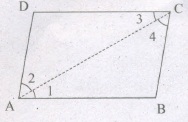
We have a parallelogram ABCD in which diagonals AC bisect ㄥA.
ㄥDAC = ㄥBAC
(i) To prove that AC bisects ∠C
∵ ABCD is a parallelogram
∴ AB II DC and AC is a transversal
∴ ㄥ1 = ㄥ3 (Alternate interior angle) .........(1)
.Also BC II AD and AC is a transversal.
∴ ㄥ2 = ㄥ4 (Alternate interior angle) ...........(2)
But AC bisects ㄥA
∴ ㄥ1 = ㄥ2
From (1), (2) and (3) we get
ㄥ3 = ㄥ4
∴ AC bisects ㄥC.
(ii) To prove that ABCD is a rhombus.
In ΔABC, we have ㄥ1 = ㄥ4 [ ∵ ㄥ1 = ㄥ2 = ㄥ4]
∴ BC = AB (side opposite to equal angles are equal) (4)
Similarly AD = DC ....... (5)
But ABCD is a parallelogram AB = DC (Opposite sides of a parallelogram) .......(6)
From (4), (5) and (6) we have AB = BC = CD = DA.
Thus ABCD is a rhombus.
88.
Distance = \(\sqrt{(x_2-x_2)^2+(y_2-y_1)^2}\)
AB =\(\sqrt{(6-3)^2+(5-7)^2}\)
\(\sqrt{3^2+(-2)^2}=\sqrt{9+4}=\sqrt{13}\)
BC=\(\sqrt{(15-6)^2+(-1-5)^2}=\sqrt{(9)^2+(-6)^2}\)
\(\sqrt{81+36}=\sqrt{117}\)
\(\sqrt{9\times 13}-3\sqrt{13}\)
AC =\(\sqrt{(15-3)^2+(-1-7)^2}\)
\(\sqrt{12^2+(-8)^2}=\sqrt{144+64}\)
\(=\sqrt{208}=\sqrt{16\times 13}=4\sqrt{13}\)

AB + BC =AC\(\Rightarrow \sqrt{13}+3\sqrt{13}=4\sqrt{13}\)
\(\therefore\)The points A,B,C are collinear.
89.
In \(\triangle\)PQR, PQ = 5 cm, PR = 6 cm, \(\angle\)QPR = 60°
Construction:
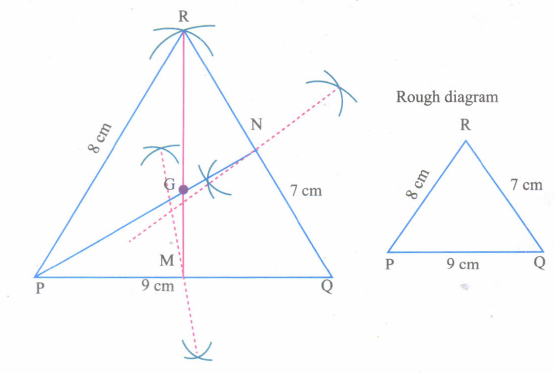
Step 1: Draw \(\triangle\) PQR using the given measurements PQ = 9 cm, QR = 7 cm and RP = 8 cm and construct the perpendicular bisector of any two sides (PQ and QR) to find the mid-points M and N of PQ and QR respectively.
Step 2: Draw the medians PN and RM and let them meet at G. The point G is the centroid of the given \(\triangle\)PQR.

9th Standard Syllabus & Materials
9th Standard
TN 9th Tamil உள்ளத்தின் சீர் - திருக்குறள் Important Questions And Answers Study Material - QB365 Set A
NEW9th Standard
TN 9th Tamil உள்ளத்தின் சீர் - மணிமேகலை Important Questions And Answers Study Material - QB365 Set A
NEW9th Standard
TN 9th Tamil உள்ளத்தின் சீர் - ஏறு தழுவுதல் Important Questions And Answers Study Material - QB365 Set A
NEW9th Standard
TN 9th Tamil உயிருக்கு வேர் - தண்ணீர் Important Questions And Answers Study Material - QB365 Set A



Tamilnadu Stateboard 9th Standard Subjects
Tamilnadu Stateboard Standards





