
 100% FREE ACCESS
9th Standard Syllabus & Materials
9th Standard
TN 9th Tamil உள்ளத்தின் சீர் -கற்கண்டு (இலக்கணம்) - தொடர் இலக்கணம், ஆகுபெயர் Important Questions And Answers Study Material - QB365 Set A
NEW9th Standard
TN 9th Tamil உள்ளத்தின் சீர் -விரிவானம் (துணைப்பாடம்) - தாய்மைக்கு வறட்சி இல்லை! Important Questions And Answers Study Material - QB365 Set A
NEW9th Standard
TN 9th Tamil உள்ளத்தின் சீர் -கவிதை பேழை (செய்யுள்) - மார்கழி பெருவிழா Important Questions And Answers Study Material - QB365 Set A
NEW9th Standard
TN 9th Tamil உயிருக்கு வேர்-இலக்கணம் - பகுபத உறுப்பிலக்கணம் Important Questions And Answers Study Material - QB365 Set A
NEW9th Standard
TN 9th Tamil அமுதென்று பேர் - இலக்கணம்-எழுத்து -அளபெடை Important Questions And Answers Study Material - QB365 Set A
NEW9th Standard
TN 9th Tamil அமுதென்று பேர்-துணைப்பாடம் - ஆறாம்திணை Important Questions And Answers Study Material - QB365 Set A

Published on: 12/02/2020
9th Standard Mathematics All Chapter Creative Questions-II-2020
Download Tamil Nadu 9th Standard Maths question papers, model tests, one-mark questions, important questions, and public exam papers in PDF format. Free study materials and answer keys for TN State Board students.
Questions + Answers key
Take MCQ Maths Test1.
Two unbiased coins are tossed simultaneously find the probability of getting
(i) two heads
(ii) one head
(iii) at least one head
(iv) at most one head
2.
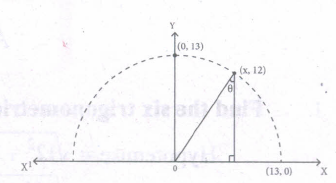
From the given figure, find all the trigonometric ratios of angle \(\theta\).
3.
Find the area of an equilateral triangle whose perimeter is 150 m.
4.
If A (10, 11) and B (2 ,3) are the coordinates of end points of diameter of circle. Then find the centre of the circle.
5.
Solve \(\cfrac { 1 }{ 3 } x-\cfrac { 5 }{ 2 } =6\)
6.
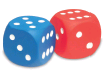
Two dice are rolled, find the probability that the sum is
(i) equal to 1
(ii) equal to 4
(iii) less than 13
7.
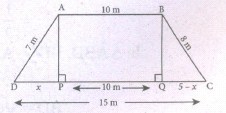
The parallel sides of a trapezium are 15 m and 10 m long and its non-parallel sides are 8 m and 7 m long. Find the area of the trapezium.
8.
If sin \(\theta\) = \(\frac { a }{ \sqrt { { a }^{ 2 }+{ b }^{ 2 } } } \) then show that b sin \(\theta\) = a cos \(\theta\)
9.
Which arrow best shows the position of \(\frac { 11 }{ 3 } \) on the number line?

10.
Express the following in the form 3n: 27
11.
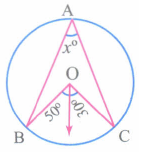
Find the value of Xo
12.
In a circle, AB and CD are two parallel chords with centre 0 and radius 5 cm such that AB = 8 cm and CD = 6 cm determine the distance between the chords?
13.
In a research laboratory scientists treated 6 mice with lung cancer using medicine. Ten days, they measured the volume of the tumor of the tumor in each mouse given the results in the table
| Mouse marking | 1 | 2 | 3 | 4 | 5 | 6 |
| Tumor Volume(mm)3 | 145 | 148 | 142 | 141 | 139 | 140 |
Find the mean
14.
In a rice mill, seven labours are receiving the daily wages of Rs. 500, Rs. 600, Rs. 600, Rs. 800, Rs. 800, Rs. 800 and Rs. 1000, find the modal wage
15.
Expand: (2a + 3b)3
16.
Evaluate: (0.1)-4
17.
Express the following in the form of \(\frac { p }{ q } \) where p and q are integers and q \(\neq \)0.
(a)\(\overline { 0.6 } \)
(b) \(\overline { 0.47 } \)
(c) \(\overline { 0.001 } \)
18.
Represent U= {1,2,3,4,5,6,7,8,9,10} A = {1,2,4,6,8,10} and B = {3,6,1,10} in venn-diagram, then find
(i) (A U B)'
(ii) (A ∩ B)'
19.
In a class of 50 students, each of the students passed either in mathematics or in science or in both. 10 students passed in both and 28 passed in science. Find how many students passed in mathematics only
20.
Represent the following sets in set builder form.
E = The set of odd Whole numbers less than 9.
21.
By remainder theorem, find the remainder when, p(x) is divided by g(x) where
p(x) = x3- 3x2+ 4x + 50 g(x) = x - 3
22.
Which of the following are sets?
The Collection of rich people in India
23.
Identify which ones are trapeziums and which are not.

24.
Plot the following points in the coordinate plane. Join them in order. What type of geometrical shape is formed?
(–3, 3) (2, 3) (–6, –1) (5, –1)
25.
If the lateral surface area of a cube is 600 cm2, then the total surface area is _______.
150 cm2
400 cm2
900 cm2
1350 cm2
26.
The six faces of the dice are called equally likely if the dice is _______.
Small
Fair
Six-faced
Round
27.
A collection of one or more outcomes of an experiment is called _______.
Event
Outcome
Sample point
None of the above
28.
The perimeter of an equilateral triangle is 30 cm. The area is _______.
\(10\sqrt { 3 } \) cm2
\(12\sqrt { 3 } \) cm2
\(15\sqrt { 3 } \) cm2
\(25\sqrt { 3 } \) cm 2
29.
If cos A = \(\frac { 3 }{ 5 } \), then the value of tan A is
\(\frac { 4 }{ 5 } \)
\(\frac { 3 }{ 4 } \)
\(\frac { 5 }{ 3 } \)
\(\frac { 4 }{ 3 } \)
30.
If tan \(\theta\) cot 370 , then the value of \(\theta\) is ________.
370
530
900
10
31.
Which of the following has a factor?
x2 + 2x
(x - 1)2
(x + 1)2
(x2 - 22)
32.
\(\cfrac { \sqrt [ 3 ]{ 27 } }{ \sqrt [ 5 ]{ 3 } } \) is equal to_______
\(5\sqrt { 9 } \)
\(5\sqrt { 6 } \)
\(5\sqrt { 24 } \)
\(\sqrt [ 5 ]{ 30 } \)
33.
Which of the following is not an irrational number?
\(\sqrt { 2 } \)
\(\sqrt { 5 } \)
\(\sqrt { 3 } \)
\(\sqrt { 25 } \)
34.
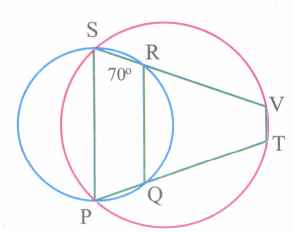
In the figure, PQRS and PTVS are two cyclic quadrilaterals, If \(\angle\)QRS = 70°, then \(\angle\)TVS= __________
70°
110°
80°
90°
35.
The mean of the first 10 whole numbers is
4
4.5
5
5.5
36.
A particular observation which occurs maximum number of times in a given data is called is
Frequency
range
mode
median
37.
The mean of set of seven numbers is 81. If one of the numbers is discarded, the mean of remaining numbers is 78. The value of discarded numbers is
101
100
99
98
38.
Which one of the following is not a measure of central tendency?
Mean
Range
Median
Mode
39.
The mean of a set of numbers is \(\bar X\). If each number is multiplied by z, the mean is _______.
\(\bar X + z\)
\(\bar X-z\)
z\(\bar X\)
\(\bar X\)
40.
The median of the first 10 whole numbers is ______________
4
4.5
5
5.5
41.
In the figure, PQRS and PTVS are two cyclic quadrilaterals, If ㄥQRS = 100°, then ㄥTVS = ______.
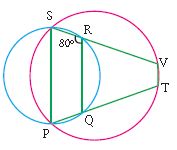
80°
100°
70°
90°
42.
In the figure, O is the centre of the circle and ㄥACB = 40° then ㄥAOB = ________.
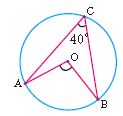
80°
85°
70°
65°
43.
If x - 3 is a factor of p(x), then the remainder is _______.
3
-3
p(3)
p(-3)
44.
\(\sqrt{27}\)+\(\sqrt{12}\) = ________.
\(\sqrt{39}\)
5\(\sqrt{6}\)
5\(\sqrt{3}\)
3\(\sqrt{5}\)
45.
For any three sets A, B and C, (A−B)∩(B −C) is equal to ________.
A only
B only
C only
ф
46.
The degree of the polynomial \( \sqrt { 2 } { x }^{ 2 }-\frac { 7 }{ 2 } { x }^{ 4 }+x-5x^{ 3 }\) is _______________
2
3
4
5
47.
The roots of the polynomial equation \({ x }^{ 2 }+2x=0\) are_______________
x = 0, 2
x = 1, 2
x = 1, -2
x = 0, -2
48.
Which of the following is trinomial?
-7z
\({ z }^{ 2 }-{ 4y }^{ 2 }\)
\({ x }^{ 2 }y-{ xy }^{ 2 }+y\)
\(12a=9ab+5b-3\)
49.
ABCD is a parallelogram as shown. Find x and y.
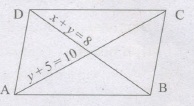
1, 7
2, 6
3, 5
4, 4
50.
Diagonal of which of the following quadrilaterals do not bisect it into two congruent triangles?
rhombus
trapezium
square
rectangle
51.
If all the four sides of a parallelogram are equal and the adjacent angles are of 120° and 60°, then the name of the quadrilateral is ______
rectangle
square
rhombus
kite
52.
The number of elements of the set {x : x ∈ Z, x2 = 1} is ________
0
1
2
3
53.
Sets having the same number of elements are called ___________
overlapping sets
disjoint sets
equivalent sets
equal sets
54.
A = {set of odd natural numbers}, B = {set of even natural numbers}, then A and B are ___________
equal set
equivalent sets
overlapping sets
disjoint sets
55.
Which of the following are irrational numbers?
\(\sqrt { 2+\sqrt { 3 } } \)
\(\sqrt [ 3 ]{ 5+\sqrt { 7 } } \)
\(\sqrt { 8-\sqrt [ 3 ]{ 8 } } \)
\(\sqrt { 4+\sqrt { 25 } } \)
(ii), (iii) and (iv)
(i), (ii) and (iv)
(i), (ii) and (iii)
(i), (iii) and (iv)
56.
The point which is on y-axis with ordinate - 5 is _____________
(0, -5)
(-5,0)
(5,0)
(0,5)
57.
The distance between the points (a, 0) and (0, b) is____________
a unit
b unit
\(\sqrt{a^2+{b^2}}\ unit\)
\(\sqrt{a^2-{b^2}}\ unit\)
58.
A point which lies in the III quadrant is__________________
(5, 4)
(5, -4)
(-5, -4)
(-5, 4)
59.
On which quadrant does the point (-4, 3) lie?
I
II
III
IV
60.
The distance between the point ( 5, –1 ) and the origin is _______.
\(\sqrt { 24 } \)
\(\sqrt { 37 } \)
\(\sqrt { 26 } \)
\(\sqrt { 17 } \)
61.
The number \(0.\bar { 3 } \) in the form \(\frac { p }{ q } \) where p and q are integers and \(q\neq 0\)
\(\frac { 33 }{ 100 } \)
\(\frac { 3 }{ 10 } \)
\(\frac { 1 }{ 3 } \)
\(\frac { 3 }{ 100 } \)
62.
The zero of the polynomial 2x+5 is _______.
\(\frac {5}{2}\)
\(-\frac {5}{2}\)
\(\frac {2}{5}\)
\(-\frac {2}{5}\)
63.
The points (–5, 2) and (2, –5) lie in the ________.
same quadrant
II and III quadrant respectively
II and IV quadrant respectively
IV and II quadrant respectively
64.
Which of the following is correct?
{7} ∈ {1,2,3,4,5,6,7,8,9,10}
7 ∈ {1,2,3,4,5,6,7,8,9,10}
7 ∉ {1,2,3,4,5,6,7,8,9,10}
{7} \(\nsubseteq \) {1,2,3,4,5,6,7,8,9,10}
65.
The length, breadth and height of a cuboid are in the ratio 7: 5: 2. Its volume is 35840 cm3. Find its dimensions.
66.
Team I and Team II play 10 cricket matches each of 20 overs. Their total scores in each match are tabulated in the table as follows:
| Match numbers | 1 | 2 | 3 | 4 | 5 | 6 | 7 | 8 | 9 | 10 |
| Team I | 200 | 122 | 111 | 88 | 156 | 184 | 99 | 199 | 121 | 156 |
| Team II | 143 | 123 | 156 | 92 | 164 | 72 | 100 | 201 | 98 | 157 |
What is the relative frequency of Team I winning?
67.
Find the value of cos19059'
68.
Find the slopes of all the lines from the adjacent figure,
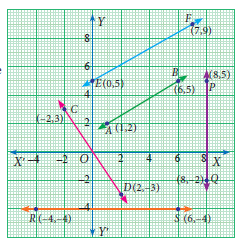
69.
Add \(\sqrt [ 5 ]{ 11 } \) and \(\sqrt [ 7 ]{ 11 } \). Check whether the sum is rational or irrational
70.
A researcher studying the behavior of mice has recorded the time (in seconds) taken by each mouse to locate its food by considering 13 different mice as 31, 33, 63, 33, 28, 29, 33, 27, 27, 34, 35, 28, 32. Find the median time that mice spent in searching its food.
71.
If A = {b,c,e,g,h}, B = {a,c,d,g,i} and C = {a,d,e,g,h}, then show that \(A-(B\cap C)=(A-B)\cup (A-C)\).
72.
The perimeter of a triangle is 8m2 - 9m+ 7. If the two sides of the triangel be m2 - m + 6 and 3m2 - 2m - 4, find the third side.
73.
The angles of quadrilateral are in the ratio 3 : 5 : 9 : 13. Find all the angles of the quadrilateral.
74.
In a class there are 40 students. 26 have opted for Mathematics and 24 have opted for Science. How many student have opted for Mathematics and Science.
75.
Three vertices of a rectangle are (3, 2), (-4, 2) and (-4, 5). Plot the points and find the coordinates of the fourth vertex.
76.
Express the following decimal expression into rational numbers \(3.1\overline { 7 } \)
77.
Let A(2, 3) and B(2, –4) be two points. If P lies on the x-axis, such that AP = \(\frac{3}{7}\) AB, find the coordinates of P.
78.
A farmer has a field in the shape of a rhombus. The perimeter of the field is 400 m and one of its diagonal is 120 m. He wants to divide the field into two equal parts to grow two different types of vegetables. Find the area of the field.
79.
Draw Venn diagram for \(A\cap B\cap C\)
80.
Prove that x -1 is a factor of x5 - 45x4 + 36x3 + 45x2 - 36x-1
81.
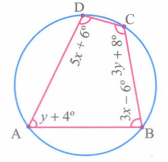
Find the angle of the given cyclic quadrilateral ABCD in the figure.
82.
Calculate the mean of the following distribution using Assumed Mean Method
| Class Interval | 0-10 | 10-20 | 20-30 | 30-40 | 40-50 |
| Frequency | 5 | 7 | 15 | 28 | 8 |
83.
Represent \(-\frac { 2 }{ 11 } ,-\frac { 5 }{ 11 } and-\frac { 9 }{ 11 } \)on the number line.
84.
Find any three rational numbers between \(\frac { 1 }{ 2 } \) and \(\frac { 1 }{ 5 } \)
85.
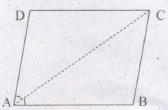
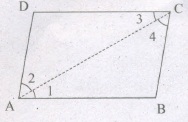
Diagonal AC of a parallelogram ABCD bisects ∠A. Show that
(i) it bisects ∠C also
(ii) ABCD is a rhombus.
86.
Show that the point (3, -2), (3, 2), (-1, 2) and (-1, -2) taken in order are the vertices of a square.
87.
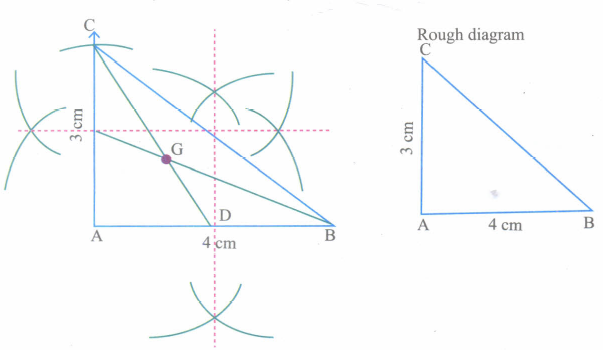
Draw and locate the centroid of the triangle ABC where right angle at A, AB = 4cm and AC = 3cm
88.
Draw ΔABC given AB = 9 cm, ㄥCAB = 115° and ΔABC = 40°. Locate its incentre and also draw the incircle. (Note: You can check from the above examples that the incentre of any triangle is always in its interior).
1.
S = {HH, HT, TH, TT}
(i) probability of two heads = \(\frac { 1 }{ 4 } \)
(ii) probability of one head = \(\frac { 1 }{ 2 } \)
(iii) probability of at least one head = \(\frac { 3 }{ 4 } \)
(iv) probability of at most one head = \(\frac { 3 }{ 4 } \).
2.
\(x=\sqrt { { 13 }^{ 2 }-{ 12 }^{ 2 } } \)
\(\sqrt { 169-144 } =\sqrt { 25 } =5\)
\(sin\theta =\cfrac { 5 }{ 13 } ;cos\theta =\cfrac { 12 }{ 13 } ;tan\cfrac { 5 }{ 12 } ;cosec\theta =\cfrac { 13 }{ 5 } ;\)
\(sec\theta =\cfrac { 13 }{ 12 } ;cot\theta =\cfrac { 12 }{ 5 } \)
3.
3a = 150
a = \(\frac { 150 }{ 3 } \) = 50 m

4.
Centre of the circle \(=\left( \frac { 10+2 }{ 2 } ,\frac { 11+3 }{ 2 } \right) =(6,7)\)
5.
\(\cfrac { 1 }{ 3 } x-\cfrac { 5 }{ 2 } =6\)
\(\cfrac { 1 }{ 3 } x=6+\cfrac { 5 }{ 2 } =\cfrac { 12+5 }{ 2 } =\cfrac { 17 }{ 2 } \)
\(x=\cfrac { 17 }{ 2 } \times 3=\cfrac { 51 }{ 2 } \)
6.
When two dice are rolled
Sample space
S = {(1,1), (1,2), (1,3), (1,4), (1,5), (1,6), (2,1), (2,2), (2,3), (2,4), (2,5), (2,6), (3,1), (3,2), (3,3), (3,4), (3,5), (3,6), (4,1), (4,2), (4,3), (4,4),(4,5),(4,6), (5,1), (5,2), (5,3), (5,4), (5,5), (5,6), (6,1), (6,2), (6,3), (6,4), (6,5), (6,6)}
n(S) = 36
(i) Event of the sum is equal to 1 = 0
∴ Probability = \(\frac { 0 }{ n(S) } \) = 0
(ii) Event of the sum is equal to 4
B = {(1, 3), (2, 2), (3, 1)}
n(B) = 3
P(B)= \(\frac { n(B) }{ n(S) } =\frac { 3 }{ 6 } =\frac { 1 }{ 12 } \)
(iii) Event of the sum is equal to less than 13
C= {(1,1), (1,2), (1,3), (1,4), (1,5), (1,6), (2,1), (2,2), (2,3), (2,4), (2,5), (2,6), (3,1), (3,2), (3,3), (3,4), (3,5), (3,6), (4,1), (4,2), (4,3), (4,4), (4,5), (4,6), (5,1), (5,2), (5,3), (5,4), (5,5), (5,6), (6,1), (6,2), (6,3), (6,4), (6,5), (6,6)}
n(C) = 36
P(C) = \(\frac { n(C) }{ n(S) } =\frac { 36 }{ 6 } \).
7.
In the figure AP 丄 CD and BQ 丄 CD
⇒ PQ = AB = 10, AP = BQ = h
Assume DP = x ⇒ QC = 15 - (10 + x)
= 15 - 10 - x = 5 - x
In Δ ADP, AP2 = 72- x2= 49 - x2
In Δ BQC, BQ2 = 82- (5 - x)2 = 64 - (25 - 10x + x2) .
= 64 - 25 + 10x - x2
=39 - x2+ 10x
Equating AP2 = BQ2
49 - x2 = 39 - x2 + 10x
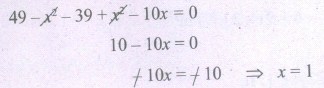
⇒ AP=\(\sqrt { { 7 }^{ 2 }-{ x }^{ 2 } } =\sqrt { 49-1^{ 2 } } =\sqrt { 48 } \)
∴ Area of the trapezium = \(\frac{1}{2}\) h(a+b) sq.units
=\(\frac { 1 }{ 2 } \times \sqrt { 48 } \times (10+15)=\frac { 1 }{ 2 } \times \sqrt { 3\times 16 } \times 25\)
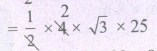
= 2 \(\times\) 25 \(\times\) 1.732 = 86.6 m2
8.
\(sin\ \theta =\cfrac { a }{ \sqrt { { a }^{ 2 }+{ b }^{ 2 } } } \)
\(cos\ \theta =\cfrac { b }{ \sqrt { { a }^{ 2 }+{ b }^{ 2 } } } \)
\(b\ sin\ \theta =b\times \cfrac { a }{ \sqrt { { a }^{ 2 }+{ b }^{ 2 } } } -\cfrac { ab }{ \sqrt { { a }^{ 2 }+{ b }^{ 2 } } } \) ... (1)
\(a\ cos\ \theta =a\times \cfrac { b }{ \sqrt { a^{ 2 }+{ b }^{ 2 } } } =\cfrac { ab }{ \sqrt { { a }^{ 2 }+{ b }^{ 2 } } } \) ...(2)
(1) = (2)\(\Rightarrow\) LHS = RHS
Hence proved
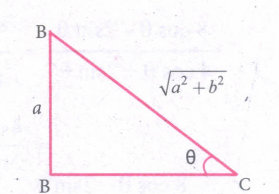
By By the Pythagoras theorem
BC2 = AC2 + AB2
= \(\left( \sqrt { { a }^{ 2 }+{ b }^{ 2 } } \right) ^{ 2 }-{ a }^{ 2 }\)
= a2+b2-a2
= b2
BC = b
9.
\(\frac { 11 }{ 3 } \) = 3.66
Arrow D best shows the position of \(\frac { 11 }{ 3 } \) on the number line.
10.
27 = 3 \(\times\) 3 \(\times\) 3;
therefore 27 = 33
11.
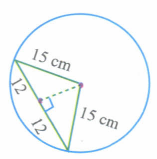
xo=\(\cfrac { 1 }{ 2 } \angle BOC\)
=\(\cfrac { 1 }{ 2 } \) (50o+30o)
=\(\cfrac { 1 }{ 2 } \) \(\times\) 80 =40o
12.
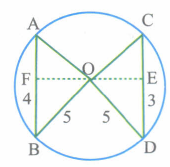
The distance between the two chord
FE = OF + OE
OE = \(\sqrt { { 5 }^{ 2 }-3^{ 2 } } =\sqrt { 25-9 } \)
= \(\sqrt { 16 } \) = 4 cm
OF = \(\sqrt { { 5 }^{ 2 }-{ 4 }^{ 2 } } =\sqrt { 25-16 } =\sqrt { 9 } \) = 3 cm
\(\therefore\) DE = 4 cm + 3 cm = 7 cm
Distance between the chord is 7 cm.
13.
\(\bar { x } =\frac { \Sigma x }{ n } =\frac { 145+148+142+141+139+140 }{ 6 } =\frac { 855 }{ 6 } \)
x = 142.5 mm2
14.
In the given data Rs. 800 occurs thrice. Hence the mode is Rs. 800
15.
We know that (a+b)3 ≡ a3+3a2b+3ab2+b3
(2a+3b)3 = (2a)3+3(2a)2(3b)+3(2a)(3b)2+(3b)3
= 8a3+36a2b+54ab2+27b3
16.
(0.1)-4 = \(\left( \frac { 1 }{ 10 } \right) ^{ -4 }=\frac { 1 }{ \left( \frac { 1 }{ 10 } \right) ^{ 4 } } =\frac { 1 }{ \left( \frac { 1 }{ 10000 } \right) } \)
17.
\((a)\frac { 2 }{ 3 }
\)
\((b)\frac { 43 }{ 90 }
\)
\((c)\frac { 1 }{ 999 } \)
18.
(i) {5,9}
(ii) {1,2,3,4,5,7,8,9}
19.
22
20.
E = {x : x is an odd whole number less than z < 9}
21.
p(x) = x3- 3x2+ 4x+ 50
g(x) = x - 3
p(3) = 33 - 3(3)2 + 4(3) + 50
= 27 - 27 + 12 + 50 = 62
\(\therefore\) The Remainder 62
22.
not a set
23.
It is not a trapezium
24.
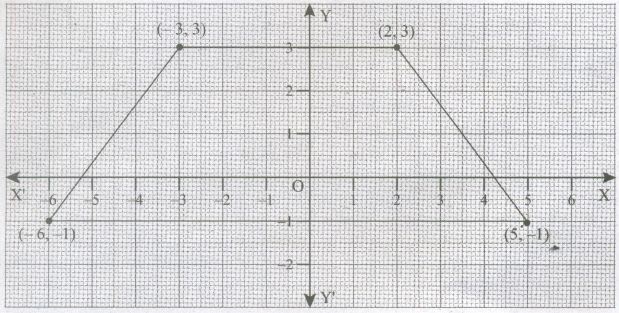
The shape of the geometrical figure Trapezium.
25.
(c)
900 cm2
26.
(b)
Fair
27.
(a)
Event
28.
(d)
\(25\sqrt { 3 } \) cm 2
29.
(d)
\(\frac { 4 }{ 3 } \)
30.
(b)
530
31.
(a)
x2 + 2x
32.
(a)
\(5\sqrt { 9 } \)
33.
(d)
\(\sqrt { 25 } \)
34.
(a)
70°
35.
(b)
4.5
36.
(c)
mode
37.
(b)
100
38.
(b)
Range
39.
(c)
z\(\bar X\)
40.
(b)
4.5
41.
(a)
80°
42.
(a)
80°
43.
(c)
p(3)
44.
(c)
5\(\sqrt{3}\)
45.
(d)
ф
46.
(c)
4
47.
(d)
x = 0, -2
48.
(c)
\({ x }^{ 2 }y-{ xy }^{ 2 }+y\)
49.
(c)
3, 5
50.
(b)
trapezium
51.
(c)
rhombus
52.
(c)
2
53.
(c)
equivalent sets
54.
(d)
disjoint sets
55.
(d)
(i), (iii) and (iv)
56.
(a)
(0, -5)
57.
(c)
\(\sqrt{a^2+{b^2}}\ unit\)
58.
(c)
(-5, -4)
59.
(b)
II
60.
(c)
\(\sqrt { 26 } \)
61.
(c)
\(\frac { 1 }{ 3 } \)
62.
(b)
\(-\frac {5}{2}\)
63.
(c)
II and IV quadrant respectively
64.
(b)
7 ∈ {1,2,3,4,5,6,7,8,9,10}
65.
Let the dimensions of the cuboid be
l = 7x, b = 5x and h = 2x.
Given that volume of cuboid = 35840 cm3
l × b × h = 35840
(7x)(5x)(2x) = 35840
70x3 = 35840
x3 = \(\frac{35840}{70}\)
x2 = 512
x =\(\sqrt [ 3 ]{ 8\times 8\times 8 } \)
x = 8 cm
Length of cuboid= 7x = 7 × 8 = 56cm
Breadth of cuboid= 5x = 5 × 8 = 40cm
Height of cuboid= 2x = 2 × 8 = 16 cm
66.
In this experiment, each trial is a match where Team I faces Team II.
We are concerned about the winning status of Team I.
There are 10 trials in total; out of which Team I wins in the 1st, 6th and 9th matches.
The relative frequency of Team I winning the matches = \(\frac { 3 }{ 10 } \)or 0.3
67.
| 0' | 6' | 12' | 18' | 24' | 30' | 36' | 42' | 48' | 54' | Mean Difference | |||||
| 0.00 | 0.10 | 0.20 | 0.30 | 0.40 | 0.50 | 0.60 | 0.70 | 0.80 | 0.90 | 1 | 2 | 3 | 4 | 5 | |
| 190 | 0.9403 | 5 | |||||||||||||
write 19059' = 19054' + 5'
From the table we have, cos19054' = 0.9403

68.
Slope of AB = \(\frac { { y }_{ 2 }-{ y }_{ 1 } }{ { x }_{ 2 }-{ x }_{ 1 } } =\frac { 3 }{ 5 } \)
Slope of CD = \(\frac { change\ in\ y }{ change\ in\ x } =-\frac { 3 }{ 2 } \)
Slope of EF = \(\frac { 4 }{ 7 } \)
Slope of PQ = Undefined Slope of RS = 0.
69.
\(\sqrt [ 5 ]{ 11 } +\sqrt [ 7 ]{ 11 } =\left( 5+7 \right) \sqrt { 11 } =12\sqrt { 11 } \)
70.
Data in ascending order 27, 27, 28, 28, 29, 31, 32, 33, 33, 33, 34, 35, 63
Number of terms = 13
If n is odd then Median = \(\left[\frac{\mathrm{N}+1}{2}\right]^{t h}\) observation
\(=\left(\frac{13+1}{2}\right)^{t h}\)observation
= 7th observation
7th observation = 32
71.
A = {b,c,e,g,h}
B = {a,c,d,g,i}
C = {a,d,e,g,h}
B ∩ C = {a,d,g}
A - (B ∩ C) = {b,c,e,g,h} - {a,d,g} = {b,c,e,h}...(1)
A-B = {b,c,e,g,h} - {a,c,d,g,i} = {b,e,h}
A-C = {b,c,e,g,h} - {a,d,e,g,h} = {b,c}
(A - B)⋃(A - C) = {b,c,e,h}...(2)
From (1) and (2) it is verified that
A-(B ⋂ C) = (A - B) U (A - C)
72.
Let the side AC be x.

Perimeter of a ∆ABC = 8m2-9m+7
AB+BC+AC = 8m2-9m+7
m2 - m + 6 + 3m2 - 2m - 4 + x = 8m2-9m+7
4m2 - 3m + 2 + x = 8m2-9m+7
x = 8m2-9m+7-(4m2-3m+2)
= 8m2-9m+7-4m2+3m-2
= 4m2-6m+5
The third side AC = 4m2-6m+5
73.
Let the angles of the quadrilateral be 3x, 5x, 9x and 13x.
Sum of all the angles of quadrilateral = 360°.
3x + 5x + 9x + 13x = 360°
30x = 360°
x = \(\frac { { 360 }^{ 0 } }{ 30 } \)
=120
3x =3 \(\times\) 12 = 36°
5x = 5 \(\times\) 12 = 60°
9x = 9 \(\times\) 12 = 108°
13x = 13 \(\times\) 12 = 156°
The required angles of quadrilateral are 36°, 60° 108° and 156°.
74.
Let M be the set of students opting for Mathematics.
Let S be the set of students opting for Science.
n (M U S) = 40, n (M) = 26, n (S) = 24
n (M U S) = n (M) + n (S) - n (M ∩ S)
40 = 26 + 24 - n (M ∩ S)
n (M ∩ S) = 26 + 24 - 40
= 50 - 40 = 10
∴ Number of students opted for Mathematics and Science = 10
75.
(3, 5)
76.
Let x = \(3.1\overline { 7 } \) = 3.1777 ....... (1)
Here period of decimal is 2, multiply equation (1) by 100
100x = 31.777 ......... (2)
(2)-(1)
.JPG)
\( =\frac{143}{45} \)
77.
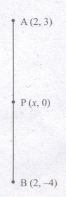
Given points are A(2, 3) and B(2, -4)
The point P lies on the x-axis.
∴ The point P is (x, 0)
AP = \(\frac { 3 }{ 7 } \) AB
\(\frac { AP }{ AB } \) = \(\frac { 3 }{ 7 } \)
\(\frac { AP }{ PB } \) = \(\frac { 3 }{ 7 } \) ........(1)
Distance =\(\sqrt { ({ x }_{ 2 }-{ x }_{ 1 })^{ 2 }+(y_{ 2 }-y_{ 1 })^{ 2 } } \)
AP = \(\sqrt { (x-2)^{ 2 }+(0-3)^{ 2 } } \)
= \(\sqrt { { x }^{ 2 }-4x+4+9 } \)
= \(\sqrt { { x }^{ 2 }-4x+13 } \)
BP =\(\sqrt { (x-2)^{ 2 }+(0+4)^{ 2 } } \)
= \(\sqrt { x^{ 2 }-4x+4+16 } \)
= \(\sqrt { x^{ 2 }-4x+20 } \)
From (1) we get
\(\frac { AP }{ PB } \) = \(\frac { 3 }{4 } \)
\(\frac { \sqrt { { x }^{ 2 }-4x+13 } }{ \sqrt { { x }^{ 2 }-4x+20 } } =\frac { 3 }{ 4 } \) (Squaring on both sides)
\(\frac { { x }^{ 2 }-4x+13 }{ { x }^{ 2 }-4x+20 } =\frac { 9 }{ 16 } \)
16x2- 64x + 208 = 9x2 - 36x + 180
7x2 - 28x + 28 = 0
x2- 4x + 4 = 0
(x-2)2= 0
x-2 =0
x = 2
∴ The point P is (2, 0)
78.
Let ABCD be the rhombus.
Its perimeter = 4 × side = 400 m
Therefore, each side of the rhombus = 100 m
Given the length of the diagonal AC = 120 m
In \(\triangle\)ABC, let a =100 m, b =100 m, c = 120 m
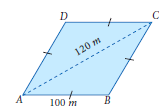
s = \(\frac{a+b+c}{2}=\frac{100+100+120}{2}\) = 160 m
Area of \(\triangle\)ABC =\(\sqrt{160(160-100)(160-100)(160-120)}\)
= \(\sqrt{160 \times 60\times 60 \times40}\)
= \(\sqrt{40 \times 2 \times \times2\times60\times60\times40}\)
= 40 × 2 × 60 = 4800 m2
Therefore, Area of the field ABCD = 2 × Area of \(\triangle\)ABC = 2 × 4800 = 9600 m2
79.
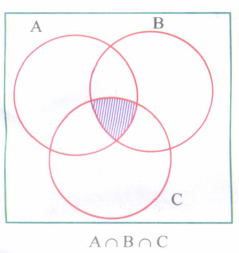
80.
Let p (x) x5 - 45x4 + 36x3 + 45x2 - 36x- 1
Sum of co-efficients = 1 - 45 + 36 + 45 - 36 - 1 = 0
Thus x -1 is a factor of p (x)
81.
\(\angle\)In the cyclic quadrilateral \(\angle\) A+\(\angle\)C = 180o
y + 4o + 3yo + 8o = 180o
4yo + 12o = 80o
4yo = 180o -12o = 168
y =\(\cfrac { 168 }{ 4 } \) = 42
\(\angle\)B + \(\angle\)D = 180o
8x + 12 = 180o
8x = 180o - 12o = 168
x = \(\cfrac { 168 }{ 8 } \) = 21o
\(\therefore\) \(\angle\)A = y + 4o = 42o + 4o = 46o
\(\angle\)C = 3y + 8 = 3 \(\times\) 42 + 8 = 126 + 8 = 134o
\(\angle\)B = 3x + 6 = 3 \(\times\) 21 + 6 = 63 + 6 = 69o
\(\angle\)D = 5x + 6 = 5 \(\times\) 21 + 6
= 105 + 6 = 111o
82.
Let Assumed mean be 25
| Class Interval x | Frequency f | Mid x | A = 25 d = x -A |
fd |
| 0-10 | 5 | 5 | -20 | -100 |
| 10-20 | 7 | 15 | -10 | -70 |
| 20-30 | 15 | 25 | 0 | 0 |
| 30-40 | 28 | 35 | 10 | 280 |
| 40-50 | 8 | 45 | 20 | 160 |
| \(\Sigma f=63\) | \(\Sigma fd=270\) |
Mean \(\bar{x}=A+\frac{\Sigma fd}{\Sigma f}\)
= \(25+\frac{270}{63}\)
= 25 + 4.29 = 29.29
83.

To represent \(-\frac { 2 }{ 11 } ,-\frac { 5 }{ 11 } and-\frac { 9 }{ 11 } \)on the number line we make 11 markings each being equal distance \(\frac { 1 }{ 11 } \) on the left of 0.
The point A represents \(\left( -\frac { 2 }{ 11 } \right) \) , the point B represents\(\left( -\frac { 2 }{ 11 } \right) \) and the point C represents \(\left( -\frac { 9 }{ 11 } \right) \)
84.
Rational between \(\frac { 1 }{ 2 } \) and \(\frac { 1 }{ 5 } \) = \(\frac { 1 }{ 2 } \left( \frac { 1 }{ 2 } +\frac { 1 }{ 5 } \right) \)
=\(\frac { 1 }{ 2 } \left( \frac { 1 }{ 2 } +\frac { 1 }{ 5 } \right) \)
= \(\frac { 1 }{ 2 } \left( \frac { 1 }{ 2 } +\frac { 1 }{ 5 } \right) \)
Rational numbers between\(\frac { 1 }{ 2 } \) and \(\frac { 7 }{ 20 } \)
=\(\frac { 1 }{ 2 } \left( \frac { 10+7 }{ 20 } \right) \)
=\(\frac { 17 }{ 40 } \)
Rational number between \(\frac { 1 }{ 2 } \) and \(\frac { 7 }{ 20 } \) =\(\frac { 1 }{ 2 } \left( \frac { 1 }{ 2 } \times \frac { 17 }{ 40 } \right) \)
=\(\frac { 1 }{ 2 } \left( \frac { 20+17 }{ 40 } \right) \)
=\(\frac { 37 }{ 80 } \)
Thus the rational numbers are \(\frac { 7 }{ 20 } ,\frac { 17 }{ 40 } and\frac { 37 }{ 80 } \)
85.
We have a parallelogram ABCD in which diagonals AC bisect ㄥA.
ㄥDAC = ㄥBAC
(i) To prove that AC bisects ∠C
∵ ABCD is a parallelogram
∴ AB II DC and AC is a transversal
∴ ㄥ1 = ㄥ3 (Alternate interior angle) .........(1)
.Also BC II AD and AC is a transversal.
∴ ㄥ2 = ㄥ4 (Alternate interior angle) ...........(2)
But AC bisects ㄥA
∴ ㄥ1 = ㄥ2
From (1), (2) and (3) we get
ㄥ3 = ㄥ4
∴ AC bisects ㄥC.
(ii) To prove that ABCD is a rhombus.
In ΔABC, we have ㄥ1 = ㄥ4 [ ∵ ㄥ1 = ㄥ2 = ㄥ4]
∴ BC = AB (side opposite to equal angles are equal) (4)
Similarly AD = DC ....... (5)
But ABCD is a parallelogram AB = DC (Opposite sides of a parallelogram) .......(6)
From (4), (5) and (6) we have AB = BC = CD = DA.
Thus ABCD is a rhombus.
86.
Distance = \(\sqrt{(x_2+x_1)^2+(y_2-y_1)^2}\)
AB =\(\sqrt{(3-3)^2+(2+2)^2}\)
=\(\sqrt{0+4^2}=\sqrt{16}=4\)
BC =\(\sqrt{(-1-3)^2+(2-2)^2}\)
\(\sqrt{(-4)^2+0}=\sqrt{16}=4\)
CD =\(\sqrt{(-1-1)^2+(2-2)^2}\)
\(\sqrt{0+(-4)^2}=\sqrt{16}=4\)
AD =\(\sqrt{(-1-3)^2+(-2+2)^2}\)
\(\sqrt{(-4)^2+0}=\sqrt{16}=4\)
AB = BC = CD = DA = 4. All the four sides are equal.
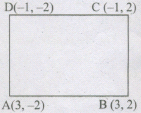
\(\therefore \)ABCD is a Rhombus .................(1)
Diagonal AC =\(\sqrt{(3+1)^2+(-2-2)^2}\)
\(=\sqrt{4^2+(-4)^2}=\sqrt{16+16}=\sqrt{32}\)
Diagonal BD =\(\sqrt{(3+1)^2+(2+2)^2}\)
\(=\sqrt{4^2+4^2}=\sqrt{16+16}=\sqrt{32}\)
Diagonal AC = Diagonal BD =\(\sqrt{32}\) ................ (2)
From (1) and (2) we get ABCD is a square.
87.
In \(\triangle \)ABC,
AB = 4 cm, AC = 3 cm, \(\angle\)A = 90°
Construction :
Step 1: Draw \(\triangle \)ABC with AB = 4 cm, AC = 3 cm, \(\angle\)A = 90°
Step 2: Draw perpendicular bisectors of any two sides (AB and AC) to find the midpoints of AB and AC.
Step 3: Draw the medians CD and BE. Let them meet at G.
Step 4: G is the centroid of the given triangle.
88.
Construction :
Step 1: Draw\(\triangle \)ABC with AB = 9 cm. ㄥA = 115°,ㄥB = 40°.
Step 2: Construct angle bisectors of any two angles (B and C). Let them meet at I. I is the incentre of \(\triangle \)ABC.
Step 3: Draw perpendicular from I to any side (BC) to meet BC at D.
Step 4: Draw incircle, with I as centre and ID a radius. Measure the inradius.

9th Standard Syllabus & Materials
9th Standard
TN 9th Tamil உள்ளத்தின் சீர் - திருக்குறள் Important Questions And Answers Study Material - QB365 Set A
NEW9th Standard
TN 9th Tamil உள்ளத்தின் சீர் - மணிமேகலை Important Questions And Answers Study Material - QB365 Set A
NEW9th Standard
TN 9th Tamil உள்ளத்தின் சீர் - ஏறு தழுவுதல் Important Questions And Answers Study Material - QB365 Set A
NEW9th Standard
TN 9th Tamil உயிருக்கு வேர் - தண்ணீர் Important Questions And Answers Study Material - QB365 Set A



Tamilnadu Stateboard 9th Standard Subjects
Tamilnadu Stateboard Standards





