
 100% FREE ACCESS
9th Standard Syllabus & Materials
9th Standard
TN 9th Tamil உள்ளத்தின் சீர் -கற்கண்டு (இலக்கணம்) - தொடர் இலக்கணம், ஆகுபெயர் Important Questions And Answers Study Material - QB365 Set A
NEW9th Standard
TN 9th Tamil உள்ளத்தின் சீர் -விரிவானம் (துணைப்பாடம்) - தாய்மைக்கு வறட்சி இல்லை! Important Questions And Answers Study Material - QB365 Set A
NEW9th Standard
TN 9th Tamil உள்ளத்தின் சீர் -கவிதை பேழை (செய்யுள்) - மார்கழி பெருவிழா Important Questions And Answers Study Material - QB365 Set A
NEW9th Standard
TN 9th Tamil உயிருக்கு வேர்-இலக்கணம் - பகுபத உறுப்பிலக்கணம் Important Questions And Answers Study Material - QB365 Set A
NEW9th Standard
TN 9th Tamil அமுதென்று பேர் - இலக்கணம்-எழுத்து -அளபெடை Important Questions And Answers Study Material - QB365 Set A
NEW9th Standard
TN 9th Tamil அமுதென்று பேர்-துணைப்பாடம் - ஆறாம்திணை Important Questions And Answers Study Material - QB365 Set A

Published on: 12/02/2020
9th Standard Mathematics All Chapter Important Creative Questions-II-2020
Download Tamil Nadu 9th Standard Maths question papers, model tests, one-mark questions, important questions, and public exam papers in PDF format. Free study materials and answer keys for TN State Board students.
Questions + Answers key
Take MCQ Maths Test1.
What is the probability that a number selected from the numbers 1, 2, 3, ..., 25 is prime number when each of the given numbers is equally likely to be selected?
2.
Find the value of cot 15°. cot 30°. cot 45°. cot 60°. cot 75°
3.
Find the area of a quadrilateral whose sides are PQ = 15 cm, QR = 8 cm, RS = 25 m.
4.
If the centroid of a triangle is at (10, -1) and two vertices are (3, 2) and (5, -11). Find the third vertex of a triangle.
5.
The probability of guessing the correct answer to a certain question is \(\frac { x }{ 3 } \). If the probability of not guessing the correct answer is \(\frac { x }{ 5 } \), then find the value of x.
6.
The dimensions of a cuboidal box are 6 m × 400 cm × 1.5 m. Find the cost of painting its entire outer surface at the rate of Rs. 22 per cm2.
7.
Find the value of the following:
\(\left( \frac { cos47° }{ sin43° } \right) +\left( \frac { sin72° }{ cos18° } \right) -2\cos^{ 2 }45°\)
8.
Using section formula, show that the points A(7, −5), B(9, −3) and C(13, 1) are collinear.
9.
We used to write \(\pi\) as \(\frac{22}{7}.\) Can we say \(\pi\) is a rational number?
10.
Find the value of \({ 729 }^{ \frac { -5 }{ 6 } }\)
11.
In a circle, AB and CD are two parallel chords with centre 0 and radius 5 cm such that AB = 8 cm and CD = 6 cm determine the distance between the chords?
12.
The chord of length 32 cm is drawn at the distance of 12 cm from the centre of the circle. Find the radius of the circle
13.
In a week, temperature of a certain place is measured during winter are as follows 26oC, 24oC, 28oC, 31oC, 30oC, 26oC, 24oC. Find the mean temperature of the week.
14.
Find the mode for the set of values 17, 18, 20, 20, 21, 21, 22, 22.
15.
Expand the following using identities: (2x - 3b)2
16.
Find the value of \(\left( 49 \right) ^{ \frac { 1 }{ 2 } }\)
17.
Twice the area of a right angled triangle 15x2 + 19x + 6 sq. units. If its altitude is 5x + 3 units, find its base in terms of x.
18.
Express the following in the form \({p\over q},\) where p and q are integers and q \(\ne\) 0.
\(0.5\overline {7}\)
19.
Let U= {x : -3 : < x < 4} A = {-1,2,3} B = {0,1,2,3} C = {-3,-2,-1,0,1,2}. Find (i) A' UB' (ii) (A ∩ B)' (iii) (A ⋂ C)'
20.
In a class there are 50 students who are offered either History, Geography or both. 35 were offered History and 10 were offered History and Geography both. How many students were offered Geography?
21.
If U = {a, b, c, d, e, f, g, h}, A = {b, d, f, h} and B = {a, d, e, h}, find the following sets. (A′)′
22.
If U = {a, b, c, d, e, f, g, h}, A = {b, d, f, h} and B = {a, d, e, h}, find the following sets. (A\(\cap \)B)′
23.
Verify whether the following are zeros of the polynomial indicated against them, or not.
p(x) = x3 - 1, x = 1
24.
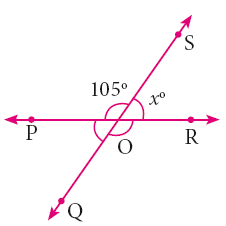
Find the value of x
25.
The total surface area of a cuboid with dimension 10 cm × 6 cm × 5 cm is _______.
280 cm2
300 cm2
360 cm2
600 cm2
26.
If the sides of a triangle are 3 cm, 4 cm and 5 cm, then the area is _______.
3 cm2
6 cm2
9 cm2
12 cm2
27.
The probability of an event cannot be _______.
Equal to zero
Greater than zero
Equal to one
Less than zero
28.
A number between 0 and 1 that is used to measure uncertainty is called _______.
Random variable
Trial
Simple event
Probability
29.
The value of \(\frac { sin{ 29 }^{ 0 }31' }{ cos{ 60 }^{ 0 }29' } \) is
0
2
1
-1
30.
The value of 3 sin 700sec 200 + 2 sin 490sec 510 is ________.
2
3
5
6
31.
If \(P(\frac{a}{3},\frac{b}{2})\)is the mid-point of the line segment joining A(−4, 3) and B(−2, 4) then (a, b) is ______.
(-9, 7)
\((-3, \frac{7}{2})\)
(9, -7)
\((3, -\frac{7}{2})\)
32.
For any three sets, P,Q,R\(\left( P\cap Q \right) ^{ ' }\)
\({ P }^{ ' }\cup { Q }^{ ' }\)
\(P\cup Q\)
\({ P }^{ ' }\)
\({ Q }^{ ' }\)
33.
\(\left( A\cup B\cup C \right) \cup \left( A\cup BC \right) ^{ ' }\)=_______
\(\Phi \)
A
U
\(A\cap B\cap C\)
34.
In a town 30% like only coffee, 20% like only tea,10% like only like,15% like only any two of them, 5% only like all the three. What is the percentage of people who like none them.
15%
20%
10%
5%
35.
If one of the factor of x2-9x+18 is (x-3) then the other factor is_________
x-9
x+6
(x-6)
x-18
36.
(a-b) (a2+ab+b2)=_________
a2 + b3 + c3 - 3abc
a2 - b2
a3 + b3
a3 - b3
37.
Zero of (7+4x) is_______
\(\cfrac { 4 }{ 7 } \)
\(\cfrac { -7 }{ 4 } \)
7
4
38.
Rationalising the denominator \(\cfrac { 1 }{ \sqrt [ 3 ]{ 3 } } \) ___________
3
\(\cfrac { { 3 }^{ \frac { 2 }{ 3 } } }{ 3 } \)
\(\sqrt { 3 } \)
\(\sqrt [ 3 ]{ 3 } \)
39.
The angle subtended by a semicircle at the centre is_________
60o
90°
120o
180o
40.
The angle subtended by equal chords of a circle at the centre is________
Complementary
Supplementary
Equal
unequal
41.
Find the mean of the prime factors of 165 _____________
5
11
13
55
42.
The mean of the first 10 prime numbers is _______________
12.6
12.7
12.8
12.9
43.
A particular observation which occurs maximum number of times in a given data is called is
Frequency
range
mode
median
44.
The mean of set of seven numbers is 81. If one of the numbers is discarded, the mean of remaining numbers is 78. The value of discarded numbers is
101
100
99
98
45.
The mean of the first 10 prime numbers is ___________
12.6
12.7
12.8
12.9
46.
The mean of the square of first 11 natural numbers is _______.
26
46
48
52
47.
If there are 36 students of class 9 and 48 students of class 10, what is the minimum number of rows to arrange them in which each row consists of same class with same number of students ?
12
144
7
72
48.
The remainder when (x2-2x+7) is divided by (x + 4) is __________
28
31
30
20
49.
Which is the best example of a number written in scientific notation?
0.5 \(\times\) 105
0.1254
5.367 \(\times\) 10-6
12.5 \(\times\) 102
50.
The degree of the polynomial \( \sqrt { 2 } { x }^{ 2 }-\frac { 7 }{ 2 } { x }^{ 4 }+x-5x^{ 3 }\) is _______________
2
3
4
5
51.
In a parallelogram \(\angle{A}:\angle{B}=1:2\) Then ∠A ............
30°
60°
45°
90°
52.
The angle sum of a convex polygon with number of sides 7 is ________
900°
1080°
1444°
720°
53.
Which one of the following has terminating decimal expansion?
\(\frac { 7 }{ 9 } \)
\(\frac { 8 }{ 15 } \)
\(\frac { 1 }{ 2 } \)
\(\frac { 5 }{ 32 } \)
54.
If a number has a non-terminating and non-recurring decimal expansion, then it is______________ .
a rational number
a natural number
an irrational number
an integer
55.
The distance between the points (a, 0) and (0, b) is____________
a unit
b unit
\(\sqrt{a^2+{b^2}}\ unit\)
\(\sqrt{a^2-{b^2}}\ unit\)
56.
The distance between the points (4, -1) and the origin is___________
\(\sqrt{24}\)
\(\sqrt{37}\)
\(\sqrt{26}\)
\(\sqrt{17}\)
57.
A point which lies in the III quadrant is__________________
(5, 4)
(5, -4)
(-5, -4)
(-5, 4)
58.
The point whose abscissa is 5 and lies on the x-axis is__________
(-5, 0)
(5,5)
(0,5)
(5,0)
59.
Which one of the following has a terminating decimal expansion?
\(\frac { 5 }{ 64 } \)
\(\frac { 8 }{ 9 } \)
\(\frac { 14 }{ 15 } \)
\(\frac { 1 }{ 12 } \)
60.
Point (–3, 5) lie in the ________ quadrant
I
II
III
IV
61.
If X = {x : x = 4(n – 1), n ∈ N} and Y = {y : y = 3n – 2n – 1, n ∈ N}, then X∪Y is ______________
W
X
Y
N
62.
If U = {x | x ∈ N, x < 10} and A = {x | x ∈ N, 2 ≤ x < 6} then (A′)′ is –––––––––.
{1, 6, 7, 8, 9}
{1, 2, 3, 4}
{2, 3, 4, 5}
{ }
63.
If bisectors of ∠A and ∠B of a quadrilateral ABCD meet at O, then ∠AOB is ________.
∠C + ∠D
\(\frac { 1 }{ 2 } (\angle C+\angle D)\)
\(\frac { 1 }{ 2 } \angle C+\frac { 1 }{ 3 } \angle D\)
\(\frac { 1 }{ 3 } \angle C+\frac { 1 }{ 2 } \angle D\).
64.
ABCD is a square, diagonals AC and BD meet at O. The number of pairs of congruent triangles with vertex O are ________.

6
8
4
12
65.
In an office, where 42 staff members work, 7 staff members use cars, 20 staff members use two-wheelers and the remaining 15 staff members use cycles. Find the relative frequencies.
66.
A cube has the Total Surface Area of 486 cm2. Find its lateral surface area.
67.
Find the value of k, for the following system of equation has infinitely many solutions. 2x − 3y = 7;(k + 2)x − (2k +1)y = 3(2k −1)
68.
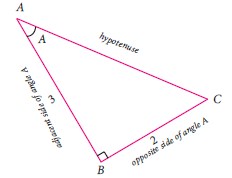
If tan A = \(\frac { 2 }{ 3 } \) , then find all the other trigonometric ratios.
69.
If A = {2,5,6,7} and B = {3,5,7,8}, then verify the commutative property of union sets
70.
Show that (x-3) is a factor of x3 + 9x2 - x - 105
71.
Multiply \(\sqrt [ 4 ]{ 400 } \) and \(\sqrt [ 4 ]{ 567 } \)
72.
In a class test in mathematics, 10 students scored 75 marks, 12 students scored 60 marks, 8 students scored 40 marks and 3 students scored 30 marks. Find the mean of their score
73.
The arithmetic mean of 6 values is 45 and if each value is increased by 4, then find the arithmetic mean of new set of values
74.
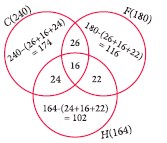
In a college, 240 students play cricket, 180 students play football, 164 students play hockey, 42 play both cricket and football, 38 play both football and hockey, 40 play both cricket and hockey and 16 play all the three games. If each student participate in at least one game, then find
(i) the number of students in the college
(ii) the number of students who play only one game.
75.
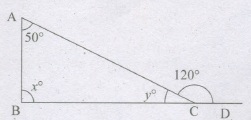
In the figure find x0 and y0.
76.
(i) Where do the following points lie?
P (-2, 0), Q (2, 0), and R(3, 0)
(ii) Find the distance between the following points using coordinates given in question
(a) P and R (b) Q and R.
77.
Three vertices of a rectangle are (3, 2), (-4, 2) and (-4, 5). Plot the points and find the coordinates of the fourth vertex.
78.
Express the following decimal expression into rational numbers. \(2.\overline { 327 } \)
79.
Find the area of a quadrilateral ABCD whose sides are AB = 8cm, BC = 15 cm, CD = 12 cm, AD = 25 cm and  = 90°.
80.
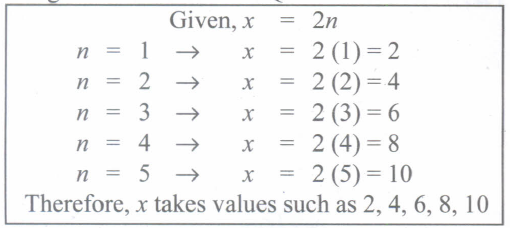
If P = {x : x\(\in \) N and 1
81.
Find the quotient and remainder when 4x3 + 6x2 + 7x + 2 is divided by x - 2
82.
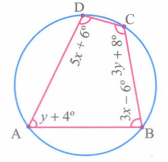
Find the angle of the given cyclic quadrilateral ABCD in the figure.
83.
The following are the scored by the students in the Summative Assessment exam
| Class | 0-10 | 10-20 | 20-30 | 30-40 | 40-50 | 50-60 |
| No. of students | 2 | 7 | 15 | 10 | 11 | 5 |
84.
Find any three rational numbers between \(\frac { 1 }{ 2 } \) and \(\frac { 1 }{ 5 } \)
85.
Find any seven rational numbers between \(\frac { 5 }{ 8 } \) and \(\frac { 5 }{ 6 } \)
86.
Show that the given points (1, 1), (5, 4), (-2, 5) are the vertices of an isosceles right angled triangle.
87.
Construct the centroid of \(\triangle\)PQR such that PQ = 9 cm, QR = 7 cm, RP = 8 cm.
88.
Draw and locate the centroid of the triangle ABC where right angle at A, AB = 4cm and AC = 3cm
89.
Draw a right triangle whose hypotenuse is 10 cm and one of the legs is 8 cm. Locate its incentre and also draw the incircle.
1.
A = {2, 3, 5, 7, 11, 13, 17, 19, 23}
P(A) = \(\frac{9}{25}\).
2.
cot (90° - 75) cot (90° - 60°) cot 45° cot 60° cot 75°
= tan 75° tan 6.0° (1) cot 60° cot 75° = 1
3.
PR =\(\sqrt { 225+64 } =\sqrt { 289 } \) = 17 cm
s = \(\frac { 15+17+18 }{ 2 } \) = 20 cm
Area of Δ PQR = \(\\ \sqrt { 20\times 5\times 12\times 3 } =\sqrt { 5\times 4\times 5\times 4\times 3\times 3 } \)=60
ΔPRS
Area = \(\sqrt { 27(27-17)(27-25)(27-12) } =\sqrt { 27\times 10\times 2\times 15 } \)
=\(\sqrt { 3\times 3\times 3\times 5\times 2\times 2\times 5\times 3 } \)=9 x 5 x 2 =90
Total area = 90 + 60 =150 cm2.
4.
\((10,-1)=\left( \frac { 3+5+x }{ 3 } ,\frac { 2-11+y }{ 3 } \right) \)
\(10=\frac { 3+5+x }{ 3 } ,\)
30 = 3 + 5 + x
22 = x
\(-1=\frac { 2-11+y }{ 3 } \)
-3 = 2 - 11 + y
-3 + 9 = y
y = 6
(22, 6)
5.
\(\frac { x }{ 3 } +\frac { x }{ 5 } \) = 1
\(\frac { 5x+3x }{ 15 } \) = 1
\(\frac { 8x }{ 15 } \) = 1
8x = 15
x = \(\frac { 15 }{ 8 } \)
6.
l \(\times\) b \(\times\) h = 6 m \(\times\) 400 cm \(\times\) 1.5 m
l = 6m, b = 4 m, h = 1.5 m
Total surface area of the cuboid = Outer surface area
= 2 (lb + bh + hl)
= 2 ((6 \(\times\) 4) + (4 \(\times\) 1.5) + (1.5 \(\times\) 6))
= 2 (24 + 6 + 9) = 2 (39) m2
Cost of painting 1 m2 = Rs. 22
Cost of painting 78 m2= 78 \(\times\) 22 = Rs. 1716
7.
\(\left( \frac { cos47° }{ sin43° } \right) +\left( \frac { sin72° }{ cos18° } \right) -2cos^{ 2 }45°\)
= \(\left( \cfrac { cos\left( { 90 }^{ 0 }-{ 43 }^{ 0 } \right) }{ { sin43 }^{ 0 } } \right) ^{ 2 }+\left( \cfrac { sin\left( { 90 }^{ 0 }-{ 18 }^{ 0 } \right) }{ cos18 } \right) ^{ 2 }-2{ cos }^{ 0 }{ 45 }^{ 0 }\)
= \(\left( \cfrac { sin43 }{ sin43 } \right) ^{ 2 }+\left( \cfrac { cos18 }{ cos18 } \right) ^{ 2 }-2\left( \cfrac { 1 }{ \sqrt { 2 } } \right) ^{ 2 }\)

8.
x1 y1 x2 y2
A(7, -5) B(9, -3)
\(\bar { AB } =\sqrt { { ({ x }_{ 2 }-{ x }_{ 1 }) }^{ 2 }+{ ({ y }_{ 2 }-{ y }_{ 1 }) }^{ 2 } } \)
\(=\sqrt { { (9-7) }^{ 2 }+{ (-3-(-5)) }^{ 2 } } =\sqrt { { 2 }^{ 2 }+{ (-3+5) }^{ 2 } } =\sqrt { 4+4 } \)
\(=\sqrt { 8 } =\sqrt { 4\times 2 } =2\sqrt { 2 } \)
\(\bar { BC } =\sqrt { { (13-7 })^{ 2 }+{ (1-(-5)) }^{ 2 } } =\sqrt { { 4 }^{ 2 }+{ 4 }^{ 2 } } =\sqrt { 16+16 } \)
\(=\sqrt { 32 } =\sqrt { 16\times 2 } =4\sqrt { 2 } \)
\(\bar { AC } =\sqrt { { (13-7) }^{ 2 }+{ (1-(-5)) }^{ 2 } } \)
\(=\sqrt { { 6 }^{ 2 }+{ 6 }^{ 2 } } =\sqrt { 36+36 } \)
\(=\sqrt { { 6 }^{ 2 }+{ 6 }^{ 2 } } =\sqrt { 36+36 } \)
\(2\sqrt { 2 } +4\sqrt { 2 } =6\sqrt { 2 } \)
∴ AB + BC = AC, Here B is the common Point
∴ A, B, C are collinear
9.
\(\frac{22}{7}\) = 3.142857142 ...... and \(\pi\) = 3.141592653289 ........
It is an irrational number.
We usually take \(\pi\) as \(\frac{22}{7}\) (a rational number only But up to 2 decimal places).
But it is not exactly equal to \(\frac{22}{7},\) it is approximate value.
10.
\({ 729 }^{ \frac { -5 }{ 6 } }\) =\(\cfrac { 1 }{ { 729 }^{ \cfrac { 5 }{ 6 } } } =\cfrac { 1 }{ \left( \sqrt [ 6 ]{ 729 } \right) ^{ 5 } } =\cfrac { 1 }{ \left( \sqrt [ 6 ]{ { 3 }^{ 6 } } \right) } =\cfrac { 1 }{ { 3 }^{ 5 } } =\cfrac { 1 }{ 243 } \)
11.
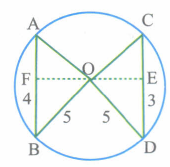
The distance between the two chord
FE = OF + OE
OE = \(\sqrt { { 5 }^{ 2 }-3^{ 2 } } =\sqrt { 25-9 } \)
= \(\sqrt { 16 } \) = 4 cm
OF = \(\sqrt { { 5 }^{ 2 }-{ 4 }^{ 2 } } =\sqrt { 25-16 } =\sqrt { 9 } \) = 3 cm
\(\therefore\) DE = 4 cm + 3 cm = 7 cm
Distance between the chord is 7 cm.
12.
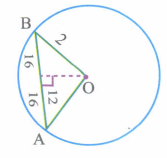
Radius of the circle =\(\sqrt { { 16 }^{ 2 }+{ 12 }^{ 2 } } \)
=\(\sqrt { 256+144 } \)
=\(\sqrt { 400 } =\sqrt { 20\times 20 } =20\)
13.
Mean \(\bar { x } =\cfrac { \Sigma x }{ n } \)
= \(\cfrac { 26+24+28+31+30+26+24 }{ 7 } =\cfrac { 189 }{ 7 } \)
Mean temperature of the week = 270C
14.
In this example, three values 20, 21, 22 occur two times each. There are three modes for the given data!
15.
(2x - 3b)2 [we have (a - b)2 = a2- 2ab + b2]
(2a - 3b)2= (2a)2-2(2a)(3b)+(3b)2 put [a = 2a, b = 3b]
= 4a2-12ab + 9b2
16.
\(\left( 49 \right) ^{ \frac { 1 }{ 2 } }=(7\times7)^{\frac{1}{2}}=7\)
17.
(3x + 2) units
18.
Let x = 0.57777 ......... \(\rightarrow\) (1)
10x = 5.77777 ............ \(\rightarrow\) (2)
100x = 57.7777 ........... \(\rightarrow\) (3)
| (3) - (2) \(\Rightarrow\) 100x - 10x | = 57.7777 .......... |
| = 57.7777 ........ | |
| 99x | = 52.0000 ....... |
\(x={52\over 90}={26\over 45}\)
\(\therefore 0.5\overline{7}={26\over 45}\)
19.
(i) {-3,-2,-1,0,1,4} (ii) {-3,-2,-1,0,1,4} (iii) {-3,-2,0,1,3,4}
20.
Ø
21.
A' = {a, c, e, g}
(A')' = U - A'
= {a, b, c, d, e, f, g, h} - {a, c, e, g}
= {b, d, f, h}
22.
(A\(\cap\)B) = {b, d, f, h} \(\cap\) {a, d, e, h}
= {d, h}
(A\(\cap\)B)' = U-(A\(\cap\)B)
= {a, b, c, d, e, f, g, h}-{d, h}
= {a, b, c, e, f, g}
23.
p(x) = x3 - 1 ; x = 1
p(1) = 13 - 1
= 1 - 1
= 0
\(\therefore\) 1 is the zero of the polynomial
24.
\(\angle POS+\angle SOR=180^0\) (angle of a straight line)
105° + x°= 180°
x°=180°-105°
=75°
The value of x = 75°.
25.
(a)
280 cm2
26.
(b)
6 cm2
27.
(d)
Less than zero
28.
(d)
Probability
29.
(c)
1
30.
(c)
5
31.
(a)
(-9, 7)
32.
(a)
\({ P }^{ ' }\cup { Q }^{ ' }\)
33.
(c)
U
34.
(b)
20%
35.
(c)
(x-6)
36.
(d)
a3 - b3
37.
(b)
\(\cfrac { -7 }{ 4 } \)
38.
(b)
\(\cfrac { { 3 }^{ \frac { 2 }{ 3 } } }{ 3 } \)
39.
(d)
180o
40.
(c)
Equal
41.
(c)
13
42.
(d)
12.9
43.
(c)
mode
44.
(b)
100
45.
(d)
12.9
46.
(b)
46
47.
(c)
7
48.
(b)
31
49.
(c)
5.367 \(\times\) 10-6
50.
(c)
4
51.
(b)
60°
52.
(a)
900°
53.
(d)
\(\frac { 5 }{ 32 } \)
54.
(c)
an irrational number
55.
(c)
\(\sqrt{a^2+{b^2}}\ unit\)
56.
(d)
\(\sqrt{17}\)
57.
(c)
(-5, -4)
58.
(d)
(5,0)
59.
(a)
\(\frac { 5 }{ 64 } \)
60.
(b)
II
61.
(b)
X
62.
(c)
{2, 3, 4, 5}
63.
(b)
\(\frac { 1 }{ 2 } (\angle C+\angle D)\)
64.
(a)
6
65.
Total number of staff members = 42
The relative frequencies:
Car users \(=\frac { 7 }{ 42 } =\frac { 1 }{ 6 } \)
Two-wheeler users \(=\frac { 20 }{ 42 } =\frac { 10 }{ 21 } \)
Cycle users \(=\frac { 15 }{ 42 } =\frac { 5 }{ 14 } \)
66.
Here, Total Surface Area of the cube = 486 cm2
6a2 = 486 \(\Rightarrow\) a2 = \(\frac{486}{6}\) and so, a2 = 81 . This gives a = 9.
The side of the cube = 9 cm
Lateral Surface Area = 4a2 = 4 × 92 = 4 × 81 = 324 cm2
67.
Given two linear equations are
2x - 3y = 7;
(k + 2)x - (2k + 1)y = 3(2k - 1)
\(\left[ \begin{matrix} { a }_{ 1 }x+{ b }_{ 1 }y+{ c }_{ 1 }=0 \\ { a }_{ 2 }x+{ b }_{ 2 }y+{ c }_{ 2 }=0 \end{matrix} \right] \)
Here a1 = 2, b1 = −3, a2 = (k + 2), b2 = −(2k +1), c1 = 7, c2 = 3(2k −1)
For infinite number of solution we consider \(\frac { { a }_{ 1 } }{ { a }_{ 2 } } =\frac { { b }_{ 1 } }{ { b }_{ 2 } } =\frac { { c }_{ 1 } }{ { c }_{ 2 } } \)
\(\frac { 2 }{ k+2 } =\frac { -3 }{ -(2k+1) } =\frac { 7 }{ 3(2k-1) } \)
\(\frac { 2 }{ k+2 } =\frac { -3 }{ -(2k+1) } \)
2(2k +1) = 3(k + 2)
4k + 2 = 3k + 6
k = 4
\(\frac { -3 }{ -(2k+1) } =\frac { 7 }{ 392k-1) } \)
9(2k −1) = 7(2k +1)
18k − 9 = 14k + 7
4k = 16
k = 4
68.
tan A = \(\frac { opposite\ side }{ adjacent\ side } =\frac { 2 }{ 3 } \)
By Pythagoras theorem,
\(AC=\sqrt { { AB }^{ 2 }+{ BC }^{ 2 } } \)
= \(\sqrt { { 3 }^{ 2 }+{ 2 }^{ 2 } } =\sqrt { 9+4 } =\sqrt { 13 } \)
AC = \(\sqrt { 13 } \)
\(sin\ A=\frac { opposite\ side }{ hypotenuse } =\frac { 2 }{ \sqrt { 13 } } \)
\(cosec\ A=\frac { hypotenuse }{ opposite\ side } =\frac { \sqrt { 13 } }{ 2 } \)
\(cos\ A=\frac { adjacent\ side }{ hypotenuse } =\frac { 3 }{ \sqrt { 13 } } \)
\(sec\ A=\frac { hypotenuse }{ adjacent\ side } =\frac { \sqrt { 13 } }{ 3 } \)
\(cot\ A=\frac { adjacent\ side }{ opposite\ side }= \frac { 3 }{ 2 } \)
69.
Given, A = {2,5,6,7} and B = {3,5,7,8}
\(A\cup B\) = {2,3,5,6,7,8} ...........(1)
\(B\cup A\) = {2,3,5,6,7,8} ..............(2)
70.
Let p(x)= x3 + 9x2 - x - 105
By factor theorem,x-3 is a factor of p(x),if p(3) = 0
p(3) = 33 + 9(3)3 - 3 - 105
= 27 + 81 - 3 -105
= 108-108
p(3) = 0
Therefore,x-3 is a factor of x3 + 9x2 - x - 105
71.
\(\sqrt [ 4 ]{ 400 } \times \sqrt [ 4 ]{ 567 } \) =\(\left( \sqrt [ 4 ]{ 2\times 2\times 2\times 2\times 5\times 5 } \right) \left( \sqrt [ 3 ]{ 3\times 3\times 3\times 3\times 7 } \right) \)
= \(\left( 2\times \sqrt [ 4 ]{ 25 } \right) \times \left( 3\times \sqrt [ 4 ]{ 7 } \right) =6\times \left( \sqrt [ 4 ]{ 25 } \times \sqrt [ 4 ]{ 7 } \right) \)
= \(6\times \left( \sqrt [ 4 ]{ 25 } \times \sqrt [ 4 ]{ 7 } \right) =6\times \sqrt [ 4 ]{ 25\times 7 } =6\sqrt [ 4 ]{ 175 } \)
72.
56.96 (or) 57 (approximately)
73.
Let x1, x2, x3, x4, x5, x6 be the given set of values then \({\sum^6_{i=1}\over6}=45\)
If each value is increased by 4, then the mean of new set of values is
New A.M \(\bar X={\sum^6_{i=1}(x_i+4)\over6} \)
\(={(x_1+4)+(x_2+4)+(x_3+4)+(x_4+4)+(x_5+4)+(x_6+4)\over6}\)
\(={\sum^6_{i=1}(x_i+24)\over6}={\sum_{i=1}^6x_i\over6}+4\)
\(\bar X=45+4=49\)
74.
Let C, F and H represent sets of students who play Cricket, Football and Hockey respectively.
Then , n(C) = 240, n(F) = 180, n(H) = 164, n(C ∩ F) = 42,
n(F ∩ H) = 38, n(C ∩ H) = 40, n(C ∩ F ∩ H) = 16.
Let us represent the given data in a Venn diagram.
(i) The number of students in the college = 174 + 26 + 116 + 22 + 102 + 24 + 16 = 480
(ii) The number of students who play only one game = 174 + 116 + 102 = 392
75.
∠ACD = ∠A + ∠B
(An exterior angle of a triangle is sum of its interior opposite angles)
120° = 50° + x0
x0 = 120° - 50°
= 70°
In the triangle ABC
∠A + ∠B + ∠ACB = 180° (Sum of the angles of a Δ)
50° +x + ∠ACB = 180°
50° + 70° + ∠ACB = 180°
∠ACB = 180° - 120°
y = 60° (OR)
∠ACD + ∠ACB = 1800(Angles of a linear pair)
∠ACB = 180° - 120°
= 60°
The value of x = 70° and y = 60°.
76.
(i) The point P (-2, 0) , Q (2, 0), and R (3, 0) lies on the x-axis,
(ii) Distance =\(\sqrt{(x_2-x_1)^2+(y_2-y_1)^2}\)
(a) PR =\(\sqrt{(3+2)^2+(0-0)^2}\)
\(=\sqrt{5^2+0}=\sqrt{25}=5units\)
(b) QR =\(\sqrt{(3-2)^2+(0-0)^2}\)
\(=\sqrt{1^2+0}=\sqrt{1}=1 \ units\)
77.
(3, 5)
78.
Let \(2.\overline { 327 } \) = 2.327327327 ..... \(\rightarrow\) (1)
Here period of decimal is 3, multiply equation (1) by 1000
1000 x = 2327.327327 ..... \(\rightarrow\) (2)
(2) - (1) \(\Rightarrow\) 1000x - x = 999x = 2325
\(x=\frac{2325}{999}\) (or) \(775\over 333\)
79.
In the quadrilateral ABCD, join one of the diagonals, say AC.
Area of \(\triangle\)ABC = \(\frac{1}{2}\)\(\times\) base \(\times\) height
=\(\frac{1}{2}\)\(\times\)8\(\times\)15\(\times\) 60 cm2
By Pythagoras theorem, in right angled triangle ABC,
AC2 = AB2 + BC2
= 82 +152 = 64 + 225 = 289 cm
Therefore, AC =\(\sqrt{289}\) =17cm
Now, for\(\triangle\)ACD, let us consider a = 17 cm, b =12 cm, c =25 cm
then, s = \(\frac{a+b+c}{2}=\frac{17+12+25}{2}=\frac{54}{2}\) = 27cm
.PNG)
Area of \(\triangle\)ACD =\(\sqrt { s(s-a)(s-b)(s-c) } \)
=\(\sqrt{27(27-17)(27-12)(27-25)}\)
=\(\sqrt{27\times10\times15\times2}\)
=\(\sqrt{3\times3\times3\times2\times5\times5\times3\times2}\)
= 3 × 3 × 2 × 5 = 90cm2
Therefore, Area of quadrilateral ABCD
=Area of \(\triangle\)ABC + Area of \(\triangle\)ACD
= 60 + 90 = 150 cm2
80.
The roster form of sets P,Q and R are P = {2,3,4,5,6,7,8,9,10}, Q = {2,4,6,8,10} and R = {4,6,8,9,1,12}
First,we find \(Q\cap R\) = {4,6,8,10}
Then, \(P-\left( Q\cap R \right) \) = {4, 6 ,8 ,10}
Next, P - Q = {3, 5, 7, ,9} ..........(1)
and P - R = {2, 3, 5, 7}
and so,\(\left( P-Q \right) \cup \left( P-Q \right) \)
= {2, 3, 5, 7, 9} ...............(2)
Hence from (1) and (2), it verified that \(P-\left( Q\cap R \right) =\left( P-Q \right) \cup \left( P-R \right) \)
Finding the elements of set Q
81.
P (x) = 4x3 + 6x2 + 7x + 2
d(x) = x - 2
Standard form of p (x) 4x3 + 6x2 + 7x + 2 and
d(x) x - 2
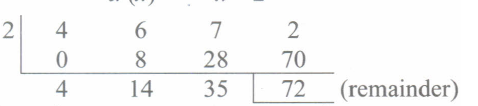
4x2 + 6x2 + 7x + 2 = (x - 2)(4x3 + 14x + 35) + 72
Hence the quotient is 4x3 + 14x + 35 and remainder is 72
82.
\(\angle\)In the cyclic quadrilateral \(\angle\) A+\(\angle\)C = 180o
y + 4o + 3yo + 8o = 180o
4yo + 12o = 80o
4yo = 180o -12o = 168
y =\(\cfrac { 168 }{ 4 } \) = 42
\(\angle\)B + \(\angle\)D = 180o
8x + 12 = 180o
8x = 180o - 12o = 168
x = \(\cfrac { 168 }{ 8 } \) = 21o
\(\therefore\) \(\angle\)A = y + 4o = 42o + 4o = 46o
\(\angle\)C = 3y + 8 = 3 \(\times\) 42 + 8 = 126 + 8 = 134o
\(\angle\)B = 3x + 6 = 3 \(\times\) 21 + 6 = 63 + 6 = 69o
\(\angle\)D = 5x + 6 = 5 \(\times\) 21 + 6
= 105 + 6 = 111o
83.
Calculate the median
| Class | Number of students | Cumulative frequency(cf) |
| 0-10 | 2 | 2 |
| 10-20 | 7 | 9 |
| 20-30 | 15 | 24 |
| 30-40 | 10 | 34 |
| 40-50 | 11 | 45 |
| 50-60 | 5 | 50 |
N = 50
Median Class = \(\left(\cfrac{N}{2}\right)^{th}\)Value
=\(\left(\cfrac{50}{2}\right)^{th}\) Value = 25th Value
Median value = 30 - 40
\(\cfrac{N}{2}\)=25, l = 30
m = 24, c =10, f =10
\(\therefore\) Median = \(\cfrac{l+\left(\cfrac{N}{2}-m\right)}{f}\times{c} \)
=\(\cfrac{30+25-24}{10}\times{10}=31\)
84.
Rational between \(\frac { 1 }{ 2 } \) and \(\frac { 1 }{ 5 } \) = \(\frac { 1 }{ 2 } \left( \frac { 1 }{ 2 } +\frac { 1 }{ 5 } \right) \)
=\(\frac { 1 }{ 2 } \left( \frac { 1 }{ 2 } +\frac { 1 }{ 5 } \right) \)
= \(\frac { 1 }{ 2 } \left( \frac { 1 }{ 2 } +\frac { 1 }{ 5 } \right) \)
Rational numbers between\(\frac { 1 }{ 2 } \) and \(\frac { 7 }{ 20 } \)
=\(\frac { 1 }{ 2 } \left( \frac { 10+7 }{ 20 } \right) \)
=\(\frac { 17 }{ 40 } \)
Rational number between \(\frac { 1 }{ 2 } \) and \(\frac { 7 }{ 20 } \) =\(\frac { 1 }{ 2 } \left( \frac { 1 }{ 2 } \times \frac { 17 }{ 40 } \right) \)
=\(\frac { 1 }{ 2 } \left( \frac { 20+17 }{ 40 } \right) \)
=\(\frac { 37 }{ 80 } \)
Thus the rational numbers are \(\frac { 7 }{ 20 } ,\frac { 17 }{ 40 } and\frac { 37 }{ 80 } \)
85.
Let us convert the given rational numbers having the same denominators.
L.C.M of 8 and 6 is 24.
\(\frac { 5 }{ 8 } \times \frac { 5\times 3 }{ 8\times 3 } =\frac { 15 }{ 24 } \)
\(\frac { 5 }{ 8 } \times \frac { 5\times 3 }{ 8\times 3 } =\frac { 15 }{ 24 } \)
Now the rational numbers between \(-\frac { 202 }{ 24 } and\frac { 15 }{ 24 } are-\frac { 19 }{ 24 } ,-\frac { 18 }{ 24 } ,-\frac { 17 }{ 24 } ,....,\frac { 0 }{ 24 } ,\frac { 1 }{ 24 } ,\frac { 22 }{ 24 } ,...,\frac { 14 }{ 24 } \)
we can take any seven of them \(\frac { 1 }{ 24 } ,\frac { 2 }{ 24 } ,\frac { 3 }{ 24 } ,\frac { 4 }{ 24 } ,\frac { 5 }{ 24 } ,\frac { 6 }{ 24 } ,\frac { 7 }{ 24 } \)
86.
Let A(1, 1), B(5, 4) and C(-2, 5)
Distance =\(\sqrt{(x_2-x_1)^2+(y_2-y_1)^2}\)
AB =\(\sqrt{(5-1)^2+(4-1)^2}\)
\(=\sqrt{4^2+3^2}=\sqrt{16+9}=\sqrt{25}=5\)
BC =\(\sqrt{(-2-5)^2+(5-4)^2}\)
\(=\sqrt{(-7)^2+1^2}=\sqrt{49+1}=\sqrt{50}\)
AC =\(\sqrt{(-2-1)^2+(5-1)^2}\)
\(=\sqrt{(-3)^2+4^2}=\sqrt{9+16}=\sqrt{25}=5\)
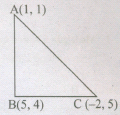
AB = 5, AC = 5,
\(\therefore\) ABC is an isosceles triangle .................(1)
BC2 = AB2 + AC2
50 = 25 + 25\(\Rightarrow\) 50 = 50
\(\therefore\) \(\angle\)A = 90° ...................(2)
From (1) and (2) we get ABC is an isosceles right angle triangle.
87.
In \(\triangle\)PQR, PQ = 5 cm, PR = 6 cm, \(\angle\)QPR = 60°
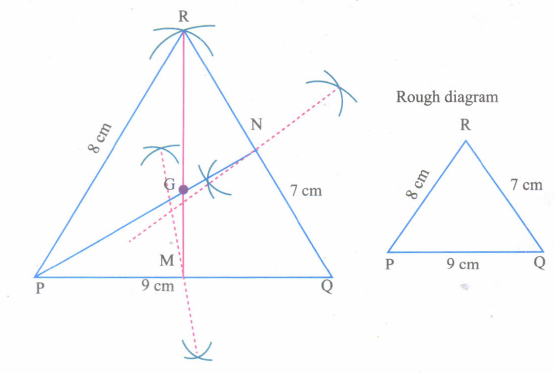
Construction:
Step 1: Draw \(\triangle\) PQR using the given measurements PQ = 9 cm, QR = 7 cm and RP = 8 cm and construct the perpendicular bisector of any two sides (PQ and QR) to find the mid-points M and N of PQ and QR respectively.
Step 2: Draw the medians PN and RM and let them meet at G. The point G is the centroid of the given \(\triangle\)PQR.
88.
In \(\triangle \)ABC,
AB = 4 cm, AC = 3 cm, \(\angle\)A = 90°
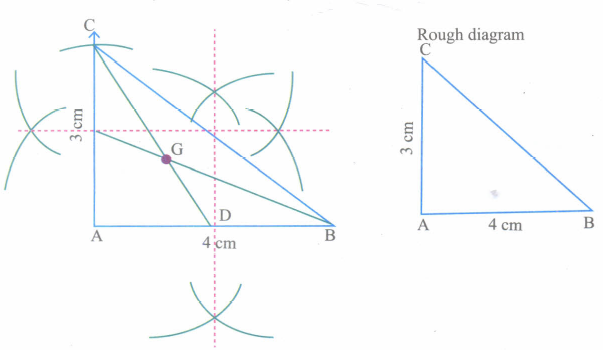
Construction :
Step 1: Draw \(\triangle \)ABC with AB = 4 cm, AC = 3 cm, \(\angle\)A = 90°
Step 2: Draw perpendicular bisectors of any two sides (AB and AC) to find the midpoints of AB and AC.
Step 3: Draw the medians CD and BE. Let them meet at G.
Step 4: G is the centroid of the given triangle.
89.
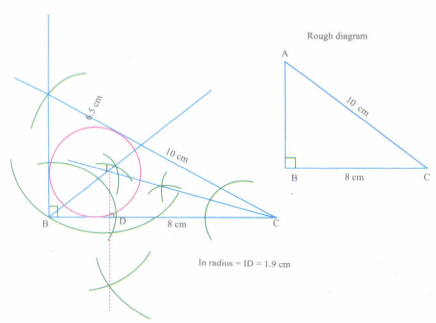
Construction :
Step 1: Draw \(\triangle \)ABC with BC = 8 cm. AC = 10 cm with right angle at B.
Step 2: Construct angle bisectors of any two angles (B and C) and let them meet at I. I is the incentre.
Step 3: Draw perpendicular from I to any side of the triangle to meet BC at D.
Step 4: With I as centre, ID as radius draw the incircle, which touches all the three sides of the triangle internally. Inradius = 1.9 cm.

9th Standard Syllabus & Materials
9th Standard
TN 9th Tamil உள்ளத்தின் சீர் - திருக்குறள் Important Questions And Answers Study Material - QB365 Set A
NEW9th Standard
TN 9th Tamil உள்ளத்தின் சீர் - மணிமேகலை Important Questions And Answers Study Material - QB365 Set A
NEW9th Standard
TN 9th Tamil உள்ளத்தின் சீர் - ஏறு தழுவுதல் Important Questions And Answers Study Material - QB365 Set A
NEW9th Standard
TN 9th Tamil உயிருக்கு வேர் - தண்ணீர் Important Questions And Answers Study Material - QB365 Set A



Tamilnadu Stateboard 9th Standard Subjects
Tamilnadu Stateboard Standards





