
 100% FREE ACCESS
9th Standard Syllabus & Materials
9th Standard
TN 9th Tamil உள்ளத்தின் சீர் -கற்கண்டு (இலக்கணம்) - தொடர் இலக்கணம், ஆகுபெயர் Important Questions And Answers Study Material - QB365 Set A
NEW9th Standard
TN 9th Tamil உள்ளத்தின் சீர் -விரிவானம் (துணைப்பாடம்) - தாய்மைக்கு வறட்சி இல்லை! Important Questions And Answers Study Material - QB365 Set A
NEW9th Standard
TN 9th Tamil உள்ளத்தின் சீர் -கவிதை பேழை (செய்யுள்) - மார்கழி பெருவிழா Important Questions And Answers Study Material - QB365 Set A
NEW9th Standard
TN 9th Tamil உயிருக்கு வேர்-இலக்கணம் - பகுபத உறுப்பிலக்கணம் Important Questions And Answers Study Material - QB365 Set A
NEW9th Standard
TN 9th Tamil அமுதென்று பேர் - இலக்கணம்-எழுத்து -அளபெடை Important Questions And Answers Study Material - QB365 Set A
NEW9th Standard
TN 9th Tamil அமுதென்று பேர்-துணைப்பாடம் - ஆறாம்திணை Important Questions And Answers Study Material - QB365 Set A

Published on: 12/02/2020
9th Standard Mathematics All Chapter Annual Questions-I-2020
Download Tamil Nadu 9th Standard Maths question papers, model tests, one-mark questions, important questions, and public exam papers in PDF format. Free study materials and answer keys for TN State Board students.
Questions + Answers key
Take MCQ Maths Test1.
Find the value of sin 3x. sin 6x. sin 9x when x = 10°
2.
If 3 cot\(\theta\) = 1, then find the value of \(\cfrac { 3cos\theta -4sin\theta }{ 5sin\theta +4cos\theta } \)
3.
Find the area of an equilateral triangle whose perimeter is 150 m.
4.
Using section formula, show that the points A (7, -5), B (9, -3) and C (13, 1), are collinear.
5.
A, B and C are vertices of \(\Delta\)ABC. D, E and F are mid points of sides AB, BC and AC respectively. If the coordinates of A, D and F are (-3, 5), (5, 1) and (-5, -1) respectively. Find the coordinates of B, C and E.
6.
In a football match, a goalkeeper of a team can stop the goal, 32 times out of 40 attempts tried by a team. Find the probability that the opponent team can convert the attempt into a goal.
7.
A line segment AB is increased along its length by 25% by producing it to C on the side of B. If A and B have the coordinates (−2,−3) and (2,1) respectively, then find the coordinates of C.
8.
Can you reduce the following to surds of same order \(\sqrt [ 4 ]{ 5 } \)
9.
A set of numbers consists of five 4’s, four 5’s, nine 6’s, and six 9’s. What is the mode.
10.
Multiply \(\sqrt [ 3 ]{ 40 } \) and \(\sqrt [ 3 ]{ 16 } \) .
11.
Write the following in the form of 5n:
\(\frac{1}{5}\)
12.
If n(A) = 300, n(A∪B) = 500, n(A∩B) = 50 and n(B′) = 350, find n(B) and n(U).
13.
If f(x) = x2 - 4x + 3, find the values of f(1), f(-1), f(2), f(3). Also find the zeros of the polynomial f(x).
14.
Find the supplement of the following angles.
Right angle
15.
If A is any event in S and its complement is A' then, P(A′) is equal to _______.
1
0
1-A
1-P(A)
16.
The total surface area of a cuboid is ______________
4a2 sq. units
6a2 sq. units
2(l + b)h sq. units
2(lb + bh + lh) sq. units
17.
If cos A = \(\frac { 3 }{ 5 } \), then the value of tan A is
\(\frac { 4 }{ 5 } \)
\(\frac { 3 }{ 4 } \)
\(\frac { 5 }{ 3 } \)
\(\frac { 4 }{ 3 } \)
18.
If (1,−2), (3, 6), (x, 10) and (3, 2) are the vertices of the parallelogram taken in order, then the value of x is ______.
6
5
4
3
19.
Rationalising the denominator \(\cfrac { 1 }{ \sqrt [ 3 ]{ 3 } } \) ___________
3
\(\cfrac { { 3 }^{ \frac { 2 }{ 3 } } }{ 3 } \)
\(\sqrt { 3 } \)
\(\sqrt [ 3 ]{ 3 } \)
20.
Let m be the mid point and b be the upper limit of a class in a continuous frequency distribution. The lower limit of the class is
2m-b
2m+b
m-b
m-2b
21.
Find the mean of the prime factors of 165.
5
11
13
55
22.
Divide x3-4x2+6x by "x" the result is _____________________
\(x^{ 2 }+4x-6\)
\(x^{ 2 }-4x-6\)
\(x^{ 2 }-4x+6\)
\(x^{ 2 }+4x+6\)
23.
Orthocentre of a triangle is the point of concurrency of _______
medians
altitudes
angle bisectors
perpendicular bisectors of side
24.
Sets having the same number of elements are called ___________
overlapping sets
disjoint sets
equivalent sets
equal sets
25.
The distance between the points (a, 0) and (0, b) is____________
a unit
b unit
\(\sqrt{a^2+{b^2}}\ unit\)
\(\sqrt{a^2-{b^2}}\ unit\)
26.
Which one of the following is an irrational number.
\(\sqrt { 25 } \)
\(\sqrt { \frac { 9 }{ 4 } } \)
\(\frac { 7 }{ 11 } \)
\(\pi\)
27.
The Auto fare is found as minimum Rs. 25 for 3 kilometer and thereafter Rs. 12 for per kilometer. Which of the following equations represents the relationship between the total cost ‘c’ in rupees and the number of kilometers n?
c = 25 + n
c = 25 + 12n
c = 25 + (n–3)12
c = (n–3)12
28.
The shaded region in the adjacent diagram represents ______________
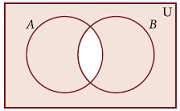
(A∪B)′
(A∩B)′
A′∩B′
A∩B
29.
Factorise 2x3- x2 - 12x - 9 into linear factors
30.
If two polynomials 2x3 + ax2 + 4x – 12 and x3 + x2 –2x+ a leave the same remainder when divided by (x – 3), find the value of a and also find the remainder.
31.
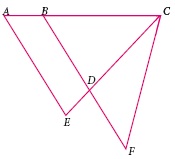
In the given Fig. if AB = 2, BC = 6, AE = 6, BF = 8, CE = 7, and CF = 7, compute the ratio of the area of quadrilateral ABDE to the area of ΔCDF(Use congruent property of triangles).
32.
In an office, where 42 staff members work, 7 staff members use cars, 20 staff members use two-wheelers and the remaining 15 staff members use cycles. Find the relative frequencies.
33.
A cube has the Total Surface Area of 486 cm2. Find its lateral surface area.
34.
(i) If cosec A = sec 340, then find A
(ii) If tan B = cot 470, then find B.
35.
Solve by cross-multiplication method
(i) 8x − 3y = 12 ; 5x = 2y + 7
(ii) 6x + 7y −11 = 0 ; 5x + 2y = 13
(iii) \(\frac { 2 }{ x } +\frac { 3 }{ y } =5;\frac { 3 }{ x } -\frac { 1 }{ y } +9=0\)
36.
the mid-point formula to show that the mid-point of the hypotenuse of a right angled triangle is equidistant from the vertices (with suitable points).
37.
If A = {2,5,6,7} and B = {3,5,7,8}, then verify the commutative property of intersection of sets
38.
Show that (x-3) is a factor of x3 + 9x2 - x - 105
39.
Simplify;\(\sqrt { 44 } +\sqrt { 99 } -\sqrt { 275 } \)
40.
If the mean of the following data is 20.2, then find the value of p
| Marks | 10 | 15 | 20 | 25 | 30 |
| No.of students | 6 | 8 | p | 10 | 6 |
41.
Rationalise the denominator and simplify \(\frac { \sqrt { 5 } }{ \sqrt { 6 } +2 } -\frac { \sqrt { 5 } }{ \sqrt { 6 } -2 } \)
42.
If A = {b,c,e,g,h}, B = {a,c,d,g,i} and C = {a,d,e,g,h}, then show that \(A-(B\cap C)=(A-B)\cup (A-C)\).
43.
Express the following decimal expression into rational numbers \(3.1\overline { 7 } \)
44.
Show that the point (11, 2) is the centre of the circle passing through the points (1, 2), (3, –4) and (5, -6)
45.
Draw an equilateral triangle of side 8 cm and locate its incentre. Also draw the incircle.
46.
Draw and locate the centroid of the triangle ABC where right angle at A, AB = 4cm and AC = 3cm
1.
sin 3 (10°) sin 6 (10°) sin 9 (10°)
= \(\cfrac { 1 }{ 2 } \times \cfrac { \sqrt { 3 } }{ 2 } \times 1=\cfrac { \sqrt { 3 } }{4 } \)
2.
\(cot\theta =1\)
\(cot\theta =\cfrac { 1 }{ 3 } \)
\(\cfrac { adjacent }{ opposite } =\cfrac { 1 }{ 3 } \)
\(\sqrt { { 3 }^{ 2 }+1 } =\sqrt { 10 } \)
\(\cfrac { 3cos\theta -4sin\theta }{ 5sin\theta +4cos\theta } =\cfrac { 3\times \cfrac { 1 }{ \sqrt { 10 } } -4\times \cfrac { 3 }{ \sqrt { 10 } } }{ 5\times \cfrac { 3 }{ \sqrt { 10 } } +4\times \cfrac { 1 }{ \sqrt { 10 } } } =\cfrac { 3-12 }{ 15+4 } =\cfrac { -9 }{ 19 } \)
3.
3a = 150
a = \(\frac { 150 }{ 3 } \) = 50 m

4.
\((9,-3)=\left( \frac { m(12+n(7) }{ m+n } ,\frac { m(1)+n(-5) }{ m+n } \right) \)
\(\frac {13m+37n}{ m+n } =9\)
13m + 7n = 9m + 9n
4m = 2n
\(\frac { m }{ n } =\frac { 2 }{ 4 } =\frac { 1 }{ 2 } \)
\(\frac{m-5n}{m+nn}=-3\)
m -5n = -3m -3n
m + 3m= 5n-3n
4m=2n
\(\frac { m }{ n } =\frac { 2 }{ 4 } =\frac { 1 }{ 2 } \)
5.
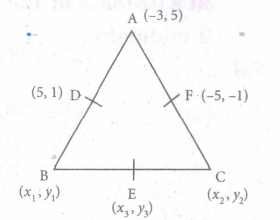
\((5,1)=\left( \frac { { x }_{ 1 }-3 }{ 2 } ,\frac { { y }_{ 1 }+5 }{ 2 } \right) \)
\(\frac { { x }_{ 1 }-3 }{ 2 } =5,\quad \frac { { y }_{ 1 }+5 }{ 2 } \)
x1- 3 = 10, y1+ 5 = 2
x1 = 13, y1 = -3
B(13, -3)
\((-5,-1)=\left( \frac { -3+{ x }_{ 2 } }{ 2 } ,\frac { 5+{ y }_{ 2 } }{ 2 } \right) \)
\(\frac { -3+{ x }_{ 2 } }{ 2 } -5,\)
-3 + x2 = - 10
X2 = -7,
C (-7, -7)
\(\frac { 5+{ y }_{ 2 } }{ 2 } =-1\)
5+ y2 = -2
y2 = -7
\(\left( { x }_{ 3 },{ y }_{ 3 } \right) =\left( \frac { 13+(-7) }{ 2 } ,\frac { -3+(-7) }{ 2 } \right) =(3,-5)\)
6.
Total no. of attempts n(S) = 40
Total no. of attempts by A team n(A) = 32
Total no. of attempts by the opponent team B = n(B) = 40 - 32 = 8
P(B) = \(\frac { n(B) }{ n(S) } =\frac { 8 }{ 40 } =\frac { 1 }{ 5 } \).
7.
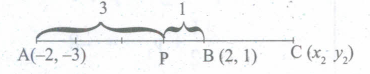
x1 y1 x2 y2
A(-2, -3) B(2, 1)
m : n = 3 : 1
The point P divides AB in the ratio 3 : 1
\(P(x,y)=\left( \frac { { mx }_{ 2 }+{ nx }_{ 1 } }{ m+n } ,\frac { { my }_{ 2 }+{ ny }_{ 1 } }{ m+n } \right) \)
\(=\left( \frac { 3\times 2+1\times -2 }{ 3+1 } ,\frac { 3\times 1+1\times -3) }{ 3+1 } \right) \)
\(=\left( \frac { 6-2 }{ 4 } ,\frac { 3-3 }{ 4 } \right) =\left( \frac { 4 }{ 4 } ,\frac { 0 }{ 4 } \right) =(1,0)\)
P is at 25% distance from B on its left and C is at 25% distance from B on its right
\(\therefore\) B is the mid point of PC
Mid point of \(\bar { PC } =\left( \frac { { x }_{ 1 }+{ x }_{ 2 } }{ 2 } ,\frac { { y }_{ 1 }+{ y }_{ 2 } }{ 2 } \right) \)
\((2,1)=\left( \frac { 1+{ x }_{ 2 } }{ 2 } ,\frac { 0+{ y }_{ 2 } }{ 2 } \right) \)
\(\frac { 1+{ x }_{ 2 } }{ 2 } =2\quad \frac { { y }_{ 2 } }{ 2 } =1\)
1 + x2 = 4 y2 = 2
⇒ x2 = 3, y2 = 2
∴ C(x2, y2) = (3, 2) is the solutions.
8.
\(\sqrt [ 4 ]{ 5 } \) = \({ 5 }^{ \frac { 1 }{ 2 } }={ 5 }^{ \frac { 3 }{ 12 } }=\sqrt [ 12 ]{ { 5 }^{ 3 } } =\sqrt [ 12 ]{ 125 } \)
9.
| Size of item | 4 | 5 | 6 | 9 |
|---|---|---|---|---|
| Frequency | 5 | 4 | 9 | 6 |
6 has the maximum frequency 9. Therefore 6 is the mode.
10.
\(\sqrt [ 3 ]{ 40 } \times \sqrt [ 3 ]{ 16 } =\left( \sqrt [ 3 ]{ 2\times 2\times 2\times 5 } \right) \times \left( \sqrt [ 3 ]{ 2\times 2\times 2\times 2 } \right) \)
=\(\left( 2\times \sqrt [ 3 ]{ 5 } \right) \times \left( 2\times \sqrt [ 3 ]{ 2 } \right) =4\times \left( \sqrt [ 3 ]{ 2 } \times \sqrt [ 3 ]{ 5 } \right) =4\times \sqrt [ 3 ]{ 2\times 5 } \)
= \(4\sqrt [ 3 ]{ 10 } \) .
11.
\(\frac{1}{5}\) = 5-1
12.
n(A) = 300, n(A∪B) = 500, n(A∩B) = 50 and n(B') = 350
n(A∪B) = n(A) + n(B) - n(A∩B)
500 = 300 + n(B) - 50
500 = 250 + n(B)
500 - 250 = n(B)
250 = n(B)
\(\therefore\) n(B) = 250
n(U) = n(B) + n(B)'
= 250 + 350
= 600
\(\therefore\) n(B) = 250 and n(U) = 600
13.
f(x) = x2 - 4x + 3
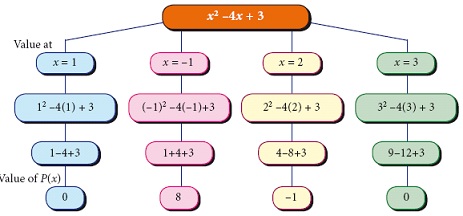
Since the value of the polynomial f(x) at x = 1 and x = 3 is zero, as the zeros of polynomial f(x) are 1 and 3.
14.
Supplement of Right angle (90°) = 180° - 90°
= 90°
15.
(d)
1-P(A)
16.
(d)
2(lb + bh + lh) sq. units
17.
(d)
\(\frac { 4 }{ 3 } \)
18.
(b)
5
19.
(b)
\(\cfrac { { 3 }^{ \frac { 2 }{ 3 } } }{ 3 } \)
20.
(a)
2m-b
21.
(d)
55
22.
(c)
\(x^{ 2 }-4x+6\)
23.
(b)
altitudes
24.
(c)
equivalent sets
25.
(c)
\(\sqrt{a^2+{b^2}}\ unit\)
26.
(d)
\(\pi\)
27.
(c)
c = 25 + (n–3)12
28.
(b)
(A∩B)′
29.
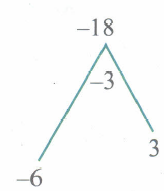
Let p (x) 2x3 - x2 - 12x - 9
Sum of the co-efficients = 2 - 1- 12- 9 = -20 \(\neq \) 0
Hence x-1 is not a factor
Sum of co-efficients of even powers with constant = -1 - 9 = -10
Sum of co-efficients of odd powers = 2 - 12= -10
Hence x + 1 is a factor of x.
Now we use synthetic division to find the other factors.
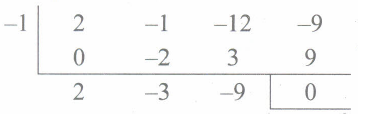
Then p (x) = (x + 1)(2x2 - 3x - 9)
Now 2x2 - 3x - 9 = 2x2 - 6x + 3x - 9 = 2x (x - 3) + 3 (x - 3)
= (x - 3)(2x + 3)
Hence 2x3 - x2 - 12x - 9 (x + 1) (x - 3) (2x + 3)
30.
p(x1) = 2x3 + ax2 + 4x - 12
When it is divided by x - 3,
p(3) = 2(3)3 + a(3)2 + 4(3) - 12
= 54 + 9a + 12 - 12
= 54 + 9a .....(R1)
p(x2) = x3 + x2 - 2x + a
When it is divided by x - 3,
p(3) = 33 + 32 - 2(3) + a
= 27 + 9 -6 +a
= 30 + a ......(R2)
The given remainders are same (R1 = R2)
\(\therefore\) 54 + 9a = 30 + a
9a - a = 30 - 54
8a = -24
\(\therefore\) a = - 24/8 = - 3
Consider R2,
Remainder = 30 - 3
= 27
31.
Given: AB = 2, BC = 6, AE = 6, BF = 8, CE = 7 and CF = 7
Consider ΔAEC and ΔBCF.
In ΔAEC, AE = 6, EC = 7 and AC = 8 (2 + 6 = 8)
In ΔBCF, BC = 6, CF = 1 and BF = 8
∴ ΔAEC ≅ BCF
∴ Area of ΔAEC = Area of ΔBCF (Two triangles are similar areas are equal)
Subtract area of ΔBDC on both sides we get,
Area of ΔAEC - Area of ΔBDC = Area of ΔBCF - Area of ΔBDC
Area of quadrilateral ABDE = Area of ΔCDF.
The answer is 1 : 1.
32.
Total number of staff members = 42
The relative frequencies:
Car users \(=\frac { 7 }{ 42 } =\frac { 1 }{ 6 } \)
Two-wheeler users \(=\frac { 20 }{ 42 } =\frac { 10 }{ 21 } \)
Cycle users \(=\frac { 15 }{ 42 } =\frac { 5 }{ 14 } \)
33.
Here, Total Surface Area of the cube = 486 cm2
6a2 = 486 \(\Rightarrow\) a2 = \(\frac{486}{6}\) and so, a2 = 81 . This gives a = 9.
The side of the cube = 9 cm
Lateral Surface Area = 4a2 = 4 × 92 = 4 × 81 = 324 cm2
34.
(i) We know that cosec A = sec(900 A)
sec(900 - A) sec(340)
900 - A =340
We get A = 90° − 34°
A = 560
(ii) We know that tan B = cot(900 - B)
cot(900 - B) = cot 470
900 - B = 470
We get B = 90° − 47°
B = 430
35.
(i) 8x- 3y = 12 ...(1)
5x-2y = 7 ..(2)
8x- 3y-12 = 0
5x-2y- 7 = 0
For cross multiplication method, we write the co-efficients as

\(\cfrac { x }{ (-3)(-7)(-2)(-12) } =\cfrac { y }{ (-12)(5)-(-7)(8) } =\cfrac { 1 }{ (8)(-2)-(5)(-3) } \)
\(\cfrac { x }{ 21-24 } =\cfrac { y }{ -60+56 } =\cfrac { 1 }{ -16+15 } \)
\(\cfrac { x }{ -3 } =\cfrac { y }{ -60+56 } =\cfrac { 1 }{ -16+15 } \)
\(\therefore \ \cfrac { x }{ 3 } =\cfrac { 1 }{ -1 } \ \cfrac { y }{ -4 } =\cfrac { 1 }{ -1 } \)
x = 3 , y = 4
\(\therefore\) Solutions: x = 3; y = 4
(ii) 6x+ 7y-11 = 0
5x+ 2y-13 = 0
For cross multiplication method, we write the co-efficients as
\(\cfrac { x }{ -91-(-22) } =\cfrac { y }{ -55-(-68) } =\cfrac { 1 }{ 12-35 } \)
\(\cfrac { x }{ -91+22 } =\cfrac { y }{ -55+78 } =\cfrac { 1 }{ -23 } \)
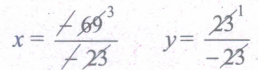
\(\cfrac { x }{ -69 } =\cfrac { y }{ 23 } =\cfrac { 1 }{ -23 } \)
\(\cfrac { x }{ -69 } =\cfrac { 1 }{ -23 } \quad \cfrac { y }{ 23 } =\cfrac { 1 }{ -23 } \)
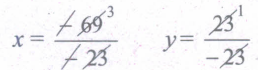
x = 3, y= -1
\(\therefore\) x = 3; y= -1
(iii)
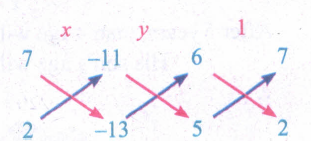
\(\cfrac { 2 }{ x } +\cfrac { 3 }{ y } -5=0\)
\(\cfrac { 3 }{ x } -\cfrac { 1 }{ y } +9=0\)
In (1), (2) Put \(\cfrac { 1 }{ x } =a,\cfrac { 1 }{ y } =b\)
(1) \(\Rightarrow\) 2a + 3b - 5 = 0
(2) \(\Rightarrow\) 3a - b + 9 = 0
For cross multiplication method, we write the co-efficients as
\(\cfrac { a }{ (3)(9)-(-1)(-5) } =\cfrac { b }{ (-5)(3)-(9)(2) } =\cfrac { 1 }{ (2)(-1)-(3)(3) } \)
\(\cfrac { a }{ 27-5 } =\cfrac { b }{ -15-18 } =\cfrac { 1 }{ -2-9 } \)
\(\cfrac { a }{ 22 } =\cfrac { b }{ -33 } =\cfrac { 1 }{ -11 } \)
\(\therefore \ \cfrac { a }{ 22 } =\cfrac { 1 }{ -11 } \cfrac { b }{ -33 } =\cfrac { 1 }{ -11 } \)
a = -2 b = 3
\(a=\cfrac { 1 }{ x } =-2\quad b=\cfrac { 1 }{ y } =3\)
\(\therefore \ x=\cfrac { -1 }{ 2 } \ \ y=\cfrac { 1 }{ 3 } \)
solution \(\ x=\cfrac { -1 }{ 2 } \ \ y=\cfrac { 1 }{ 3 } \)
36.
Let POQ be the right angled triangle and O be placed at the origin. Let OQ = a units and OP be b units. Let us name the coordinates of P as (0,b) and Q as (a,0).
By mid-point formula, if M is the mid-point of the hypotenuse PQ [PM=MQ], then M is
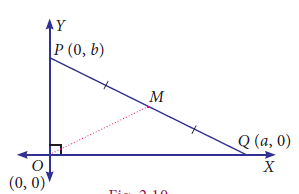
\(\left( \frac { a+0 }{ 2 } ,\frac { b+0 }{ 2 } \right) =\left( \frac { a }{ 2 } ,\frac { b }{ 2 } \right) \)
We now use the distance formula and find that
OM=\(\sqrt { { \left( \frac { a }{ 2 } -0 \right) }^{ 2 }{ +\left( \frac { b }{ 2 } -0 \right) }^{ 2 } } =\sqrt { \frac { { a }^{ 2 } }{ 4 } +\frac { { b }^{ 2 } }{ 4 } } \) which is the same value as
QM=\(\sqrt { { \left( a-\frac { a }{ 2 } \right) }^{ 2 }{ +\left( 0-\frac { b }{ 2 } \right) }^{ 2 } } =\sqrt { \frac { { a }^{ 2 } }{ 4 } +\frac { { b }^{ 2 } }{ 4 } } \) and similarly PM=\(\sqrt { \frac { { a }^{ 2 } }{ 4 } +\frac { { b }^{ 2 } }{ 4 } } \)
This shows OM = QM = PM, which we desired to prove.
37.
\(A\cap B\) = {5,7}
\(B\cap A\)= {5,7}
From (3) and (4) we get, \(A\cap B=B\cap C\)
It is verified that intersection of sets is commutative.
38.
Let p(x)= x3 + 9x2 - x - 105
By factor theorem,x-3 is a factor of p(x),if p(3) = 0
p(3) = 33 + 9(3)3 - 3 - 105
= 27 + 81 - 3 -105
= 108-108
p(3) = 0
Therefore,x-3 is a factor of x3 + 9x2 - x - 105
39.
\(\sqrt { 44 } +\sqrt { 99 } -\sqrt { 275 } \) = \(\sqrt { 4\times 11 } +\sqrt { 9\times 11 } -\sqrt { 11\times 25 } \)
= \(\left( 2\sqrt { 11 } +3\sqrt { 11 } \right) -5\sqrt { 11 } =5\sqrt { 11 } -5\sqrt { 11 } =0\)
40.
\(\bar { x } =20.2\)
\( \bar{x}=\cfrac{\Sigma fx}{\Sigma f}\)
\(=\cfrac { 10\times 6+15\times 8+20p+25\times 10+30\times 6 }{ 6+8+p+10+6 } \)
\(20.2=\cfrac { 60+120+20p+250+180 }{ 30+p } \)
(30+p)20.2 = 610+20 p
606+20.2p = 610+20 p
20.2 p-20 p = 610-606 = 4
0.2 p = 4
\(\Rightarrow \) \(p=\cfrac { 4\times 10 }{ 0.2\times 10 } =\cfrac { 40 }{ 2 } =20\)
41.
\(\frac { \sqrt { 5 } }{ \sqrt { 6 } +2 } -\frac { \sqrt { 5 } }{ \sqrt { 6 } -2 } =\frac{\sqrt{5}(\sqrt{6}-2)-\sqrt{5}(\sqrt{6}+2)}{(\sqrt{6}+2)(\sqrt{6}-2)}\)
\(\frac{ ̶̶̶̶̶̶̶̶√̶3̶0̶-2\sqrt{5}- ̶̶̶̶̶̶̶̶√̶3̶0̶-2\sqrt{5}}{\sqrt{6}^2-2^2}=\frac{-4\sqrt{5}}{6-4}=\frac{ ̶4̶\sqrt{5}}{ ̶2̶}=-2\sqrt{5}\)
42.
A = {b,c,e,g,h}
B = {a,c,d,g,i}
C = {a,d,e,g,h}
B ∩ C = {a,d,g}
A - (B ∩ C) = {b,c,e,g,h} - {a,d,g} = {b,c,e,h}...(1)
A-B = {b,c,e,g,h} - {a,c,d,g,i} = {b,e,h}
A-C = {b,c,e,g,h} - {a,d,e,g,h} = {b,c}
(A - B)⋃(A - C) = {b,c,e,h}...(2)
From (1) and (2) it is verified that
A-(B ⋂ C) = (A - B) U (A - C)
43.
Let x = \(3.1\overline { 7 } \) = 3.1777 ....... (1)
Here period of decimal is 2, multiply equation (1) by 100
100x = 31.777 ......... (2)
(2)-(1)
.JPG)
\( =\frac{143}{45} \)
44.
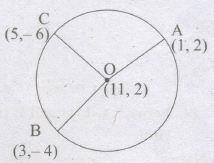
Distance =\(\sqrt { ({ x }_{ 2 }-{ x }_{ 1 })^{ 2 }+(y_{ 2 }-y_{ 1 })^{ 2 } } \)
OA = \(\sqrt { (11-1)^{ 2 }+(2-2)^{ 2 } } \)
= \(\sqrt { { 10 }^{ 2 }+{ 0 }^{ 2 } } \)
= \(\sqrt { 100 } \) = 10
OB =\(\sqrt { (11-3)^{ 2 }+(2+4)^{ 2 } } \)
= \(\sqrt { { 8 }^{ 2 }+6^{ 2 } } =\sqrt { 64+36 } \)
= \(\sqrt { 100 } \) = 10
OC = \(\sqrt { (11-5)^{ 2 }+(2+6)^{ 2 } } \)
= \(\sqrt { { 6 }^{ 2 }+8^{ 2 } } =\sqrt { 36+64 } \)
= \(\sqrt { 100 } \) = 10
OA = OB = OC = 10 units
O is the centre of the circle passing through A, B and C.
45.
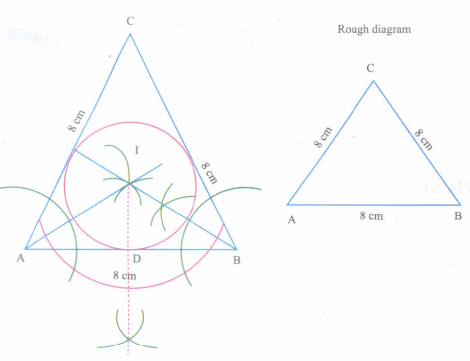
Construction :
Step 1: Draw \(\triangle\)ABC with AB = BC = CA = 8 cm
Step 2: Construct angle bisectors of any two angles (A and B) and let them meet at I. I is the incentre of \(\triangle\)ABC.
Step 3: Draw perpendicular from I to any one of the sides (AB) to meet AB at D.
Step 4: With I as centre, ID as radius draw the circle. This circle touches all the sides of triangle internally.
46.
In \(\triangle \)ABC,
AB = 4 cm, AC = 3 cm, \(\angle\)A = 90°
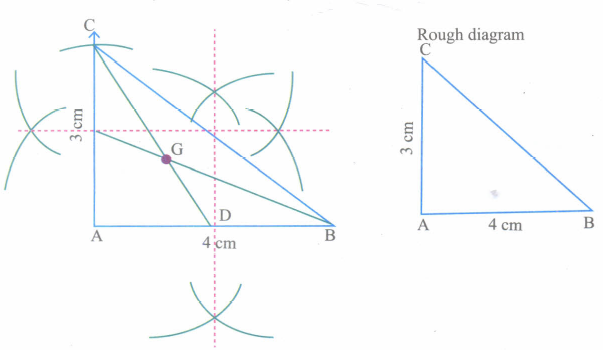
Construction :
Step 1: Draw \(\triangle \)ABC with AB = 4 cm, AC = 3 cm, \(\angle\)A = 90°
Step 2: Draw perpendicular bisectors of any two sides (AB and AC) to find the midpoints of AB and AC.
Step 3: Draw the medians CD and BE. Let them meet at G.
Step 4: G is the centroid of the given triangle.

9th Standard Syllabus & Materials
9th Standard
TN 9th Tamil உள்ளத்தின் சீர் - திருக்குறள் Important Questions And Answers Study Material - QB365 Set A
NEW9th Standard
TN 9th Tamil உள்ளத்தின் சீர் - மணிமேகலை Important Questions And Answers Study Material - QB365 Set A
NEW9th Standard
TN 9th Tamil உள்ளத்தின் சீர் - ஏறு தழுவுதல் Important Questions And Answers Study Material - QB365 Set A
NEW9th Standard
TN 9th Tamil உயிருக்கு வேர் - தண்ணீர் Important Questions And Answers Study Material - QB365 Set A



Tamilnadu Stateboard 9th Standard Subjects
Tamilnadu Stateboard Standards





