
 100% FREE ACCESS
9th Standard Syllabus & Materials
9th Standard
TN 9th Tamil உள்ளத்தின் சீர் -கற்கண்டு (இலக்கணம்) - தொடர் இலக்கணம், ஆகுபெயர் Important Questions And Answers Study Material - QB365 Set A
NEW9th Standard
TN 9th Tamil உள்ளத்தின் சீர் -விரிவானம் (துணைப்பாடம்) - தாய்மைக்கு வறட்சி இல்லை! Important Questions And Answers Study Material - QB365 Set A
NEW9th Standard
TN 9th Tamil உள்ளத்தின் சீர் -கவிதை பேழை (செய்யுள்) - மார்கழி பெருவிழா Important Questions And Answers Study Material - QB365 Set A
NEW9th Standard
TN 9th Tamil உயிருக்கு வேர்-இலக்கணம் - பகுபத உறுப்பிலக்கணம் Important Questions And Answers Study Material - QB365 Set A
NEW9th Standard
TN 9th Tamil அமுதென்று பேர் - இலக்கணம்-எழுத்து -அளபெடை Important Questions And Answers Study Material - QB365 Set A
NEW9th Standard
TN 9th Tamil அமுதென்று பேர்-துணைப்பாடம் - ஆறாம்திணை Important Questions And Answers Study Material - QB365 Set A

Published on: 04/10/2019
Algebra
Download Tamil Nadu 9th Standard Maths question papers, model tests, one-mark questions, important questions, and public exam papers in PDF format. Free study materials and answer keys for TN State Board students.
Questions + Answers key
Take MCQ Maths Test1.
4 Indians and 4 Chinese can do a piece of work in 3 days. While 2 Indians and 5 Chinese can finish it in 4 days. How long would it take for 1 Indian to do it? How long would it take for 1 Chinese to do it?
2.
The taxi charges in a city comprise of a fixed charge together with the charge for the distance covered. For a journey of 10 km the charge paid is Rs 75 and for a journey of 15 km the charge paid is Rs 110. What will a person have to pay for travelling a distance of 25 km? (You may also try to illustrate through a graph).
3.
Two numbers are in the ratio 5:6. If 8 is subtracted from each of the numbers, the ratio becomes 4:5. Find the numbers.
4.
The sum of a two digit number and the number formed by interchanging the digits is 110. If 10 is subtracted from the first number, the new number is 4 more than 5 times the sums of the digits of the first number. Find the first number.
5.
Five years ago, a man was seven times as old as his son, while five years hence, the man will be four times as old as his son. Find their present age.
6.
Two cars are 100 miles apart. If they drive towards each other they will meet in 1 hour. If they drive in the same direction they will meet in 2 hours. Find their speed by using graphical method.
7.
Solve the following linear equations
(i) \(\frac { 2(x+1) }{ 3 } =\frac { 3(x-2) }{ 5 } \)
(ii) \(\frac { 2 }{ x+1 } =4-\frac { x }{ x+1 } ,(x\neq -)\)
8.
Check whether \(\frac { 1 }{ 4 } \) is a solution of the equation 3(x + 1) = 3( 5–x) – 2( 5 + x).
9.
Solve by cross-multiplication method
(i) 8x − 3y = 12 ; 5x = 2y + 7
(ii) 6x + 7y −11 = 0 ; 5x + 2y = 13
(iii) \(\frac { 2 }{ x } +\frac { 3 }{ y } =5;\frac { 3 }{ x } -\frac { 1 }{ y } +9=0\)
10.
Given 4a + 3b = 65 and a + 2b = 35 solve by elimination method.
11.
(Computing slope made easier!) Find the slope and y-intercept of the line given by the equation 2y – 3x = 12.
12.
Solve 2x = −7y + 5; −3x = −8y −11 by cross multiplication method.
13.
Solve for x and y: 8x − 3y = 5xy, 6x − 5y = −2xy by the method of elimination.
14.
The sum of the digits of a given two digit number is 5. If the digits are reversed, the new number is reduced by 27. Find the given number.
15.
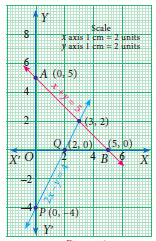
Use graphical method to solve the following system of equations x + y = 5; 2x – y = 4.
16.
If \(\frac { { a }_{ 1 } }{ { a }_{ 2 } } =\frac { { b }_{ 1 } }{ { b }_{ 2 } } \neq \frac { { c }_{ 1 } }{ { c }_{ 2 } } \) where a1x + b1y + c1 = 0 and a2x + b2y + c2 = 0 then the given pair of linear equation has _________ solution(s)
no solution
two solutions
infinite
unique
17.
The value of k for which the pair of linear equations 4x + 6y −1 = 0 and 2x + ky − 7 = 0 represents parallel lines is _______.
k = 3
k = 2
k = 4
k = -3
18.
Which condition does not satisfy the linear equation ax + by + c = 0.
a \(\neq \) 0 , b = 0
a = 0 , b \(\neq \) 0
a = 0 , b = 0 , c \(\neq \) 0
a \(\neq \)0, b \(\neq \) 0
19.
Which of the following is a solution of the equation 2x − y = 6.
(2,4)
(4,2)
(3, −1)
(0,6)
20.
Which of the following statement is true for the equation 2x + 3y = 15
the equation has unique solution
the equation has two solution
the equation has no solution
the equation has infinite solutions
1.
Let for one Indians the' rate of working be \(\frac { 1 }{ x } \)
Let for one Chinese the rate of working be \(\frac { 1 }{ y } \)
\(\therefore \ \cfrac { 4 }{ x } +\cfrac { 4 }{ y } =\cfrac { 1 }{ 3 } \)
\(\cfrac { 2 }{ x } +\cfrac { 5 }{ y } =\cfrac { 1 }{ 4 } \)
put \(\cfrac { 1 }{ x } =a,\cfrac { 1 }{ y } =b\)
\(4a+4b=\cfrac { 1 }{ 3 } \)
\(4a+4b-\cfrac { 1 }{ 3 } =0\)
\(2a+5b=\cfrac { 1 }{ 4 } \)
\(2a+5b-\cfrac { 1 }{ 4 } =0\)
For cross multiplication method, we write the co-efficients as
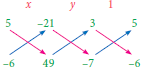
\(\cfrac { a }{ 5 } =\cfrac { b }{ 2 } =\cfrac { 1 }{ 20-8 } \)
\(\cfrac { 3a }{ 2 } =3b={ \cfrac { 1 }{ 12 } }\)
\(\therefore \ \cfrac { 3a }{ 2 } =\cfrac { 1 }{ 12 } \quad 3b=\cfrac { 1 }{ 36 } \)
\(a=\cfrac { 1 }{ 12 } \times \cfrac { 2 }{ 3 } =\cfrac { 1 }{ 18 } \quad b=\cfrac { 1 }{ 36 } \)
\(\therefore\) 1boy can do the same piece of work = \(\cfrac { 1 }{ y } =b=\cfrac { 1 }{ 36 } =36days\)
1 Indians can do the piece of work = \(\cfrac { 1 }{ x } =a=\cfrac { 1 }{ 18 } =18days\)
2.
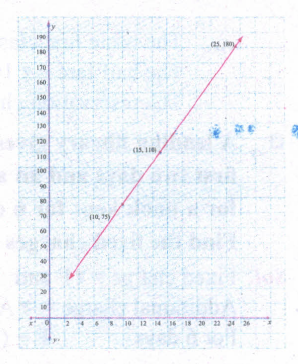
Let the fixed charge of a taxi be x and the charge per km be Rs. y
According to the given conditions,
\(\therefore\) x + 10y = 75 ---------- (1)
x + 15y = 110 ---------- (2)
(1) \(\Rightarrow\) x+10y = 75
(2) \(\Rightarrow\) \(\cfrac { x+15y=110 }{ -5y=-35 } \)
y = 7
Substitute y = 7 in (1)
x + 10(7) = 75
x+ 70 = 75
x = 75 -70 = 5
\(\therefore\) Amount that a person will have to pay for travelling a distance of 25 km
x + 25y = 5 + 25 (7)
= 5 + 175
= Rs. 180
\(\therefore\) Amount that a person will have to pay for travelling a distance of 25 km is Rs. 180.
3.
\(\cfrac { x }{ y } =\cfrac { 5 }{ 6 } \)
\(\Rightarrow\) 6x = 5y
6x - 5y = 0 .......(1)
\(\cfrac { x-8 }{ y-8 } =\cfrac { 4 }{ 5 } \)
\(\Rightarrow\) 5(x - 8) = 4(y - 8)
5x-40 = 4y-32
5x -4y = 40 - 32
5x - 4y = 8 ------ (2)
(1) x 5 \(\Rightarrow\) 30x-25y = 0
(2) x 6 \(\Rightarrow\) \(\cfrac { 30x-24y=48 }{ -y=-48 } \) ...(2)
Substitute y = 48 in (1)
6x- 5(48) = 0
6x-240 = 0
6x = 240
\(x=\cfrac { 240 }{ 6 } =40\)
y = 48
\(\cfrac { x }{ y } =\cfrac { 40 }{ 48 } =\cfrac { 5 }{ 6 } \)
\(\therefore\) The number are in the Ratio 5 : 6
4.
Let the two digit number be x y
Its place value = 10x +y
After interchanging the digits the number will be y x
Its place value = 10y + x
Their sum = 10x +y + 10y + x = 110
11x + 11y = 110
x +y = 10 ----- (1)
If 10 is subtracted from the first number, the new number is 10x +y - 10
The sums of the digits of the first number is x +y.
Its 4 more than 5 times is = 5(x +y) + 4
10x + y -10 = 5x + 5y + 4
10x + y - 5x - 5y = 4 + 10
5x - 4y = 14 ....(2)
(10x 5 \(\Rightarrow\) 5x + 5y = 50
(2)\(\Rightarrow\) \(\cfrac { 5x-4y=14 }{ 9y=36 } \)
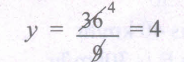
Substitute y = 4 in (1)
x + 4 = 10
x = 10 - 4
x = 6
\(\therefore\) The first number is 64
5.
Let the man's present age = x
Five years ago his age is = x - 5
Let his son's age be = y
5 years ago his son's age = y - 5
\(\therefore\) x - 5 = 7(y- 5)
x - 5 = 7y-35
x - 7y = -35 + 5
x - 7y = -30 ....(1)
After 5 years, man's age will be = x + 5
His son's age will be = y + 5
\(\therefore\) x + 5 = 4(y + 5)
x+ 5 = 4y+ 20
x-4y = 20-5
\(\Rightarrow\) x-4y = 15
(1) \(\Rightarrow\) x-7y = -30
(2) \(\Rightarrow\) \(\cfrac { x-4y=15 }{ 3y\quad =\quad 45 } \)
y= 15
Substitute y = 15 in (1)
x -7 (15) = -30
x-105 =- 30
x = -30 + 105
x = 75
\(\therefore\) Man's Age = 75, His son's Age = 15
6.
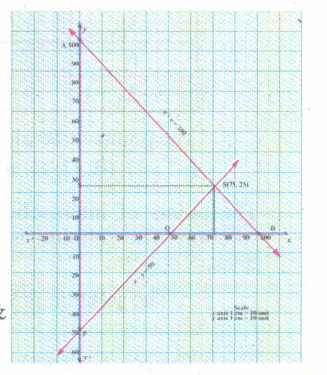
Let x, y be the speed of the two cars. If the two cars travel toward's each other they will meet in 1 hr. The distance between them d = 100; \(\frac { d }{ s } \) =t
i.e.,\(\cfrac { 100 }{ x+y } =1\Rightarrow x+y=100\) .....(1)
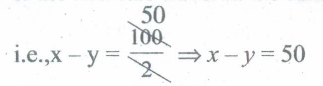
If the two cars travel in the same direction they will meet in 2 hrs.
 ...(2)
(1) \(\Rightarrow\) x + y = 100
y = -x + 100
| x | 100 | 0 |
| -x | -100 | 0 |
| 100 | 100 | 100 |
| y = -x +100 | 0 | 100 |
(2) \(\Rightarrow\) x - y = 50
-y = -x + 50
y = x - 50
| x | 100 | 0 | 1 |
| -50 | -50 | -50 | 0 |
| y = x - 50 | 50 | -50 | 0 |
The points to be plotted
(-100, -50), (0, -50),
x + y =100 ...(1)
Put x = 0 in (1), then 0 + y = 100 \(\Rightarrow\)y = 100
A (0, 100) is a point on (1)
Put y = 0 in(1), then x + 0 = 100 \(\Rightarrow\) x = 100
B (100, 0) is another point on (1)
Plot A & B Join them to produce the line (1)
Similarly by x - y = 50
Put x = 0 in (2), then 0 - y = 50
\(\Rightarrow\)y = 50
P (0, -50) is a point on (2)
Put y = 0 in (2), then x - 0 = 5
\(\Rightarrow\) x = 50
Q (50, 0) is another point on (2)
Plot P & Q Join them to produce the line (2)
The point of intersection (75, 25) of the two lines (1)& (2) is the solution.
\(\therefore\)The solution i.e., the speed of the two cars x and y is given by x = 75 km and y = 25 km
7.
(i) \(\cfrac { 2x+2 }{ 3 } =\cfrac { 3x-6 }{ 5 } \)
5(2x+2) = 3(3x - 6) [By cross multiplication]
10x + 10 = 9x - 18
10x = 9x - 18 - 10
10x = 9x-28
10x- 9x = -28
x = -28
(ii)
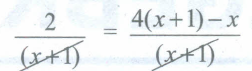
2 = 4 (x + 1)-x
2 = 4x+4-x
3x + 4 = 2'
3x+4-4 = 2-4
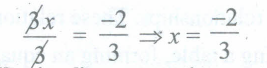
3x =-2
8.
\(3\left( \cfrac { 1 }{ 4 } +1 \right) =3\left( 5-\cfrac { 1 }{ 4 } \right) -2\left( 5+\cfrac { 1 }{ 4 } \right) \)
\(3\left( \cfrac { 5 }{ 4 } \right) =3\left( \cfrac { 20-1 }{ 4 } \right) -2\left( \cfrac { 20+1 }{ 4 } \right) \)
\(\cfrac { 15 }{ 4 } =\cfrac { 57 }{ 4 } -\cfrac { 42 }{ 4 } \)
\(\cfrac { 15 }{ 4 } =\cfrac { 15 }{ 4 } \)
Yes \(\cfrac { 1 }{ 4 } \) is a solution of the given equation
9.
(i) 8x- 3y = 12 ...(1)
5x-2y = 7 ..(2)
8x- 3y-12 = 0
5x-2y- 7 = 0
For cross multiplication method, we write the co-efficients as

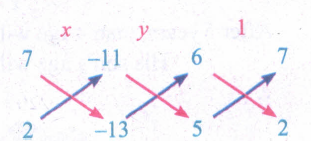
\(\cfrac { x }{ (-3)(-7)(-2)(-12) } =\cfrac { y }{ (-12)(5)-(-7)(8) } =\cfrac { 1 }{ (8)(-2)-(5)(-3) } \)
\(\cfrac { x }{ 21-24 } =\cfrac { y }{ -60+56 } =\cfrac { 1 }{ -16+15 } \)
\(\cfrac { x }{ -3 } =\cfrac { y }{ -60+56 } =\cfrac { 1 }{ -16+15 } \)
\(\therefore \ \cfrac { x }{ 3 } =\cfrac { 1 }{ -1 } \ \cfrac { y }{ -4 } =\cfrac { 1 }{ -1 } \)
x = 3 , y = 4
\(\therefore\) Solutions: x = 3; y = 4
(ii) 6x+ 7y-11 = 0
5x+ 2y-13 = 0
For cross multiplication method, we write the co-efficients as
\(\cfrac { x }{ -91-(-22) } =\cfrac { y }{ -55-(-68) } =\cfrac { 1 }{ 12-35 } \)
\(\cfrac { x }{ -91+22 } =\cfrac { y }{ -55+78 } =\cfrac { 1 }{ -23 } \)
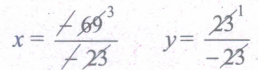
\(\cfrac { x }{ -69 } =\cfrac { y }{ 23 } =\cfrac { 1 }{ -23 } \)
\(\cfrac { x }{ -69 } =\cfrac { 1 }{ -23 } \quad \cfrac { y }{ 23 } =\cfrac { 1 }{ -23 } \)
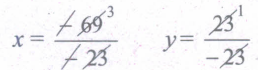
x = 3, y= -1
\(\therefore\) x = 3; y= -1
(iii)
\(\cfrac { 2 }{ x } +\cfrac { 3 }{ y } -5=0\)
\(\cfrac { 3 }{ x } -\cfrac { 1 }{ y } +9=0\)
In (1), (2) Put \(\cfrac { 1 }{ x } =a,\cfrac { 1 }{ y } =b\)
(1) \(\Rightarrow\) 2a + 3b - 5 = 0
(2) \(\Rightarrow\) 3a - b + 9 = 0
For cross multiplication method, we write the co-efficients as
\(\cfrac { a }{ (3)(9)-(-1)(-5) } =\cfrac { b }{ (-5)(3)-(9)(2) } =\cfrac { 1 }{ (2)(-1)-(3)(3) } \)
\(\cfrac { a }{ 27-5 } =\cfrac { b }{ -15-18 } =\cfrac { 1 }{ -2-9 } \)
\(\cfrac { a }{ 22 } =\cfrac { b }{ -33 } =\cfrac { 1 }{ -11 } \)
\(\therefore \ \cfrac { a }{ 22 } =\cfrac { 1 }{ -11 } \cfrac { b }{ -33 } =\cfrac { 1 }{ -11 } \)
a = -2 b = 3
\(a=\cfrac { 1 }{ x } =-2\quad b=\cfrac { 1 }{ y } =3\)
\(\therefore \ x=\cfrac { -1 }{ 2 } \ \ y=\cfrac { 1 }{ 3 } \)
solution \(\ x=\cfrac { -1 }{ 2 } \ \ y=\cfrac { 1 }{ 3 } \)
10.
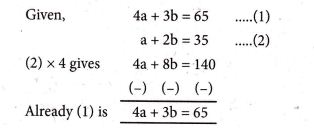
5b = 75 which gives b = 15
Put b = 15 in (2):
a + 2(15) = 35 which simplifies to a = 5
Thus the solution is a = 5, b = 15.
Verification :
4a+3b = 65 ...(1)
4(5)+3(15) = 65
20 + 45 = 65
65 = 65 True
a + 2b = 35 ...(2)
5 + 2(15) = 35
5+30 = 35
35 = 35 True
11.
The given equation is 2y – 3x = 12
\(\Rightarrow\) 2y = +3x + 12
\(\Rightarrow \ \frac { 2y }{ 2 } =\frac { 3x+12 }{ 2 } \)
\(\Rightarrow \ y=\frac { 3x }{ 2 } +\frac { 12 }{ 2 } \)
\(\Rightarrow \ y=\frac { 3 }{ 2 } x+6\)
compare with, y=mx + c
Slope m = \(\frac { 3 }{ 2 } \), y-intercept c = 6
12.
The given system of equations can be written as
2x + 7y − 5 = 0
−3x + 8y +11 = 0
For the cross multiplication method, we write the coefficients as
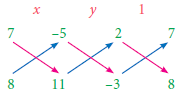
\(\frac { x }{ (7)(11)-(8)(-5) } =\frac { y }{ (-5)(-3)-(11)(2) } =\frac { 1 }{ (2)(8)-(-3)(7) } \)
\(\frac { x }{ 77+40 } =\frac { y }{ 15-22 } =\frac { 1 }{ 16+21 } \)
\(\frac { x }{ 117 } =\frac { y }{ -7 } =\frac { 1 }{ 37 } \)
\(\frac { x }{ 117 } =\frac { 1 }{ 37 } ,\frac { y }{ -7 } =\frac { 1 }{ 37 } \)
Hence the solution is \(\left( \frac { 117 }{ 37 } ,\frac { -7 }{ 37 } \right) \)
Verification:
2x + 7y -5 = 0 .....(1)
\(2\left( \frac { 117 }{ 37 } \right) +7\left( \frac { -7 }{ 37 } \right) -5=0\)
\(\frac { 234 }{ 57 } -\frac { 49 }{ 37 } -5=0\)
\(\frac { 185 }{ 37 } -5=0\)
5 - 5 =0 True
3x+8y+11 = 0 ...(2)
\(3\left( \frac { 117 }{ 37 } \right) +8\left( \frac { -7 }{ 37 } \right) +11=0\)
\(\frac { -351 }{ 37 } -\frac { 56 }{ 37 } +11=0\)
\(\frac { -407 }{ 37 } +11=0\)
-11 + 11 = 0 True
13.
The given system of equations are 8x − 3y = 5xy ...(1)
6x − 5y = −2xy ...(2)
Observe that the given system is not linear because of the occurrence of xy term. Also note that if x =0, then y =0 and vice versa. So, (0,0) is a solution for the system and any other solution would have both x \(\neq \) 0 and y \(\neq \) 0
Let us take up the case where x \(\neq \) 0 and y \(\neq \) 0
Dividing both sides of each equation by xy,
\(\frac { 8x }{ xy } -\frac { 3y }{ xy } =\frac { 5xy }{ xy } \)
\(\frac { 6x }{ xy } -\frac { 5y }{ xy } =\frac { -2xy }{ xy } \)
Let \(a=\frac { 1 }{ x } ,b=\frac { 1 }{ y } \)
We get, \(\frac { 8 }{ y } -\frac { 3 }{ x } =5\) .....(3)
\(\frac { 6 }{ y } -\frac { 5 }{ x } =-2\) .......(4)
(3)&(4) respectively become, 8b − 3a = 5 ...(5)
b − 5a = −2 ...(6)
which are linear equations in a and b.
To eliminate a, we have, (5) \(\times\) 5\(\Rightarrow\) 40b −15a = 25 .....(7)
(6) × 3\(\Rightarrow\) 18b −15a = −6 .....(8)
Now proceed as in the previous example to get the solution\(\left( \frac { 11 }{ 23 } ,\frac { 22 }{ 31 } \right) \).
Thus, the system have two solutions \(\left( \frac { 11 }{ 23 } ,\frac { 22 }{ 31 } \right) \) and (0,0).
14.
Let x be the digit at ten’s place and y be the digit at unit place.
Given that x + y = 5 …… (1)
| Tens | Ones | Value | |
| Given Number | x | y | 10x + y |
| New Number (after reversal) |
y | x | 10y + x |
Given, Original number − reversing number = 27
(10x + y) − (10y + x) = 27
10x − x + y −10y = 27
9x − 9y = 27
\(\Rightarrow\) x − y = 3 ... (2)
Also from (1), y = 5 – x ... (3)
Substitute (3) in (2) to get x − (5 − x) = 3
x − 5 + x = 3
2x = 8
x = 4
Substituting x = 4 in (3), we get y = 5 − x = 5 − 4
y = 1
Thus, 10x + y = 10 × 4 +1 = 40 +1 = 41.
Therefore, the given two-digit number is 41.
Verification :
sum of the digits = 5
x + y = 5
4 + 1 = 5
5 = 5 true
Original number – reversed number = 27
41 - 14 = 27
27 = 27 true
15.
Given x + y = 5 ...(1)
2x – y = 4 ...(2)
To draw the graph (1) is very easy. We can find the x and y intercepts and thus two of the points on the line (1).
When x = 0, (1) gives y = 5.
Thus A(0,5) is a point on the line.
When y = 0, (1) gives x = 5.
Thus B(5,0) is another point on the line.
Plot A and B; join them to produce the line (1).
To draw the graph of (2), we can adopt the same procedure.
When x = 0, (2) gives y = −4.
Thus P(0,−4) is a point on the line.
When y = 0, (2) gives x = 2.
Thus Q(2,0) is another point on the line.
Plot P and Q; join them to produce the line (2).
The point of intersection (3, 2) of lines (1) and (2) is a solution.
The solution is the point that is common to both the lines. Here we find it to be (3,2). We can give the solution as x = 3 and y = 2.
16.
(a)
no solution
17.
(a)
k = 3
18.
(c)
a = 0 , b = 0 , c \(\neq \) 0
19.
(b)
(4,2)
20.
(d)
the equation has infinite solutions

9th Standard Syllabus & Materials
9th Standard
TN 9th Tamil உள்ளத்தின் சீர் - திருக்குறள் Important Questions And Answers Study Material - QB365 Set A
NEW9th Standard
TN 9th Tamil உள்ளத்தின் சீர் - மணிமேகலை Important Questions And Answers Study Material - QB365 Set A
NEW9th Standard
TN 9th Tamil உள்ளத்தின் சீர் - ஏறு தழுவுதல் Important Questions And Answers Study Material - QB365 Set A
NEW9th Standard
TN 9th Tamil உயிருக்கு வேர் - தண்ணீர் Important Questions And Answers Study Material - QB365 Set A



Tamilnadu Stateboard 9th Standard Subjects
Tamilnadu Stateboard Standards





