
 100% FREE ACCESS
9th Standard Syllabus & Materials
9th Standard
TN 9th Tamil உள்ளத்தின் சீர் -கற்கண்டு (இலக்கணம்) - தொடர் இலக்கணம், ஆகுபெயர் Important Questions And Answers Study Material - QB365 Set A
NEW9th Standard
TN 9th Tamil உள்ளத்தின் சீர் -விரிவானம் (துணைப்பாடம்) - தாய்மைக்கு வறட்சி இல்லை! Important Questions And Answers Study Material - QB365 Set A
NEW9th Standard
TN 9th Tamil உள்ளத்தின் சீர் -கவிதை பேழை (செய்யுள்) - மார்கழி பெருவிழா Important Questions And Answers Study Material - QB365 Set A
NEW9th Standard
TN 9th Tamil உயிருக்கு வேர்-இலக்கணம் - பகுபத உறுப்பிலக்கணம் Important Questions And Answers Study Material - QB365 Set A
NEW9th Standard
TN 9th Tamil அமுதென்று பேர் - இலக்கணம்-எழுத்து -அளபெடை Important Questions And Answers Study Material - QB365 Set A
NEW9th Standard
TN 9th Tamil அமுதென்று பேர்-துணைப்பாடம் - ஆறாம்திணை Important Questions And Answers Study Material - QB365 Set A

Published on: 18/01/2019
9th Maths Algebra Solutions
Download Tamil Nadu 9th Standard Maths question papers, model tests, one-mark questions, important questions, and public exam papers in PDF format. Free study materials and answer keys for TN State Board students.
Questions + Answers key
Take MCQ Maths Test1.
A railway half ticket costs half the full fare and the reservation charge is the same on half ticket as on full ticket. One reserved first class ticket from Mumbai to Ahmadabad costs Rs. 216 and one full and one half reserved first class ticket costs Rs. 327. What is the basic first class full fare and what is the reservation charge?
2.
Two numbers are in the ratio 5:6. If 8 is subtracted from each of the numbers, the ratio becomes 4:5. Find the numbers.
3.
On selling a T.V. at 5% gain and a fridge at 10% gain, a shopkeeper gains Rs. 2000. But if he sells the T.V. at 10% gain and the fridge at 5% loss, he gains Rs. 1500 on the transaction. Find the actual price of the T.V. and the fridge.
4.
Points A and B are 70 km apart on a highway. A car starts from A and another car starts from B simultaneously. If they travel in the same direction, they meet in 7 hours, but if they travel towards each other, they meet in one hour. Find the speed of the two cars.
5.
The sum of the numerator and denominator of a fraction is 12. If the denominator is increased by 3, the fraction becomes \(\frac { 1 }{ 2 } \). Find the fraction.
6.
It takes 24 hours to fill a swimming pool using two pipes. If the pipe of larger diameter is used for 8 hours and the pipe of the smaller diameter is used for 18 hours. Only half of the pool is filled. How long would each pipe take to fill the swimming pool.
7.
The monthly income of A and B are in the ratio 3 : 4 and their monthly expenditures are in the ratio 5 : 7. If each saves Rs. 5,000 per month, find the monthly income of each.
8.
Raman’s age is three times the sum of the ages of his two sons. After 5 years his age will be twice the sum of the ages of his two sons. Find the age of Raman.
9.
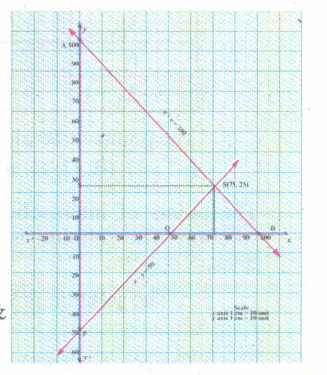
Two cars are 100 miles apart. If they drive towards each other they will meet in 1 hour. If they drive in the same direction they will meet in 2 hours. Find their speed by using graphical method.
10.
Give any two examples for linear equations in one variable.
11.
Find the value of k for which the system of linear equations 8x + 5y = 9; kx +10y = 15 has no solution.
12.
Find the value of k, for the following system of equation has infinitely many solutions. 2x − 3y = 7;(k + 2)x − (2k +1)y = 3(2k −1)
13.
Check the value of k for which the given system of equations kx + 2y = 3; 2x − 3y = 1 has a unique solution.
14.
Solve by cross multiplication method : 3x + 5y = 21; −7x − 6y = −49
15.
Solve 2x + 3y = 14 and 3x − 4y = 4 by the method of elimination.
16.
Given 4a + 3b = 65 and a + 2b = 35 solve by elimination method.
17.
Solve the system of linear equations x + 3y = 16 and 2x − y = 4 by substitution method.
18.
Check whether (5, −1) is a solution of the simultaneous equations x – 2y = 7 and 2x + 3y = 7.
19.
(Computing slope made easier!) Find the slope and y-intercept of the line given by the equation 2y – 3x = 12.
20.
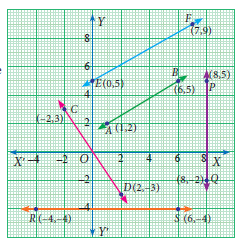
Find the slopes of all the lines from the adjacent figure,
21.
Check whether the following system of equation is consistent or inconsistent and say how many solutions we can have if it is consistent.
(i) 2x – 4y = 7
x – 3y = –2
(ii) 4x + y = 3
8x + 2y = 6
(iii) 4x +7 = 2 y
2x + 9 = y
22.
Solve 3x − 4y = 10 and 4x + 3y = 5 by the method of cross multiplication.
23.
Solve for x and y: 8x − 3y = 5xy, 6x − 5y = −2xy by the method of elimination.
24.
The sum of the digits of a given two digit number is 5. If the digits are reversed, the new number is reduced by 27. Find the given number.
25.
The perimeter of a rectangle is 36 metres and the length is 2 metres more than three times the width. Find the dimension of rectangle by using the method of graph.
26.
Use graphical method to solve the following system of equations 3x + 2y = 6; 6x + 4y = 8
27.
Use graphical method to solve the following system of equations x + y = 5; 2x – y = 4.
28.
(Graphing made easier!) Draw the graph of the line given by the equation y = 4x – 3.
1.
Let basic fare = Rs. B and
Let reservation charge =Rs. R
\(\cfrac { B }{ 2 } +R=half\ ticket\)
B + R = full ticket
B + R = 216 ....(1)
\(\left( \cfrac { B }{ 2 } +R \right) +\left( B+R \right) =327\)
\(\cfrac { B }{ 2 } +R+216=327\)
\(\cfrac { B }{ 2 } +R=111\)
B+2R = 222
B+2R = 222 ...(1)
(1) \(\Rightarrow\) B+R = 216
(2) \(\Rightarrow\) \(\cfrac { B+2R=222 }{ -R=-6 } \)
R = 6
Substitute R = 6 in (1)
B+6 = 216
B = 216 - 6
B = 210
\(\therefore\) The basic first class full fare = Rs. 210
The half fare = Rs. 105
The reservation charge = Rs. 6
2.
\(\cfrac { x }{ y } =\cfrac { 5 }{ 6 } \)
\(\Rightarrow\) 6x = 5y
6x - 5y = 0 .......(1)
\(\cfrac { x-8 }{ y-8 } =\cfrac { 4 }{ 5 } \)
\(\Rightarrow\) 5(x - 8) = 4(y - 8)
5x-40 = 4y-32
5x -4y = 40 - 32
5x - 4y = 8 ------ (2)
(1) x 5 \(\Rightarrow\) 30x-25y = 0
(2) x 6 \(\Rightarrow\) \(\cfrac { 30x-24y=48 }{ -y=-48 } \) ...(2)
Substitute y = 48 in (1)
6x- 5(48) = 0
6x-240 = 0
6x = 240
\(x=\cfrac { 240 }{ 6 } =40\)
y = 48
\(\cfrac { x }{ y } =\cfrac { 40 }{ 48 } =\cfrac { 5 }{ 6 } \)
\(\therefore\) The number are in the Ratio 5 : 6
3.
Let the actual price of a T.V. = x
Let the actual price of a Fridge = y
\(\cfrac { 5 }{ 100 } x+\cfrac { 10 }{ 100 } y=2000\)
\(\cfrac { 5 }{ 100 } (x+2y)=2000\)
\(x+2y=2000\times \cfrac { 100 }{ 5 } \)
x+2y = 40000 ...(1)
\(\cfrac { 10 }{ 100 } x-\cfrac { 5 }{ 100 } y=1500\)
\(\cfrac { 5 }{ 100 } (2x-y)=1500\)
\(2x-y=1500\times \cfrac { 100 }{ 5 } \)
2x -y = 30000
(1) X 2 \(\Rightarrow\) 2x + 4y = 80000
(2) \(\Rightarrow\) \(\cfrac { 2x-y=30000 }{ 5y=50000 } \)
y = 10000
Substitute y = 10000 in (1)
x + 2(10000) = 40000
x + 20000 = 40000
x = 40000 - 20000
x = 20000
\(\therefore\) Actual price of T.V = Rs. 20000
Actual price of Fridge = Rs. 10000
4.
Let the speed of ihe car starts from A is x
Let the speed of the car starts from B is y
When they are moving in same direction, the speed is x - y
7(x - y) = 70· [\(\because \) Speed x Time = Distance]
x - y = 10 ---------- (1)
When they are moving towards each other,the speed is x + y
1(x+y) = 70
x +Y = 70 ---------- (2)
(I) \(\Rightarrow\) x-y = 10
(2) \(\Rightarrow\) \(\cfrac { x+y=70 }{ 2x=80 } \)
x = 40
Substitute x = 40 in (I)
40 - y = 10
y = 40 -10
y = 30
\(\therefore\) The speed of the car from A is 40 km/hr and the speed of the car from B is 30km/hr
5.
Let the numerator be x
Denominator be y
x +y = 12 ...(1)
\(\cfrac { x }{ y+3 } =\cfrac { 1 }{ 2 } \)
2x = y+3
2x-y = 3 ...(2)
(1) X 2 \(\Rightarrow\) 2x +2y = 24
(2) \(\Rightarrow\) \(\cfrac { 2x-y=3 }{ 3y=21 } \) ...(2)
y = 7
Substitute y = 7 in (1) .
x + 7 = 12
x = 12-7
x = 5
\(\therefore\) The fraction \(\cfrac { x }{ y } =\cfrac { 5 }{ 7 } \)
6.
Let the time taken by the larger pipe be x hours
and Set the time taken by the smaller pipe be y hours.
\(\cfrac { 1 }{ x } +\cfrac { 1 }{ y } =\cfrac { 1 }{ 24 } \)
In 1 hour the larger pipe can fill it = \(\cfrac { 1 }{ x } \)
In 1 hour the smaller pipe can fill it = \(\cfrac { 1 }{ y } \)
\(\cfrac { 8 }{ x } +\cfrac { 18 }{ y } =\cfrac { 1 }{ 2 } \)
Put \(\cfrac { 1 }{ x } =a,\cfrac { 1 }{ y } =b\)
\(a+b\ =\cfrac { 1 }{ 24 } \)
24a + 24b = 1
24a + 24b - 1 = 0 ...(1)
8a + 18b = \(\cfrac { 1 }{ 2 } \)
16a+36b = 1
16a + 36b - 1 = 0 ..(2)
For cross multiplication method, we write the co-efficients as
\(\cfrac { a }{ -24+36 } =\cfrac { b }{ -16+24 } =\cfrac { 1 }{ 864-384 } \)
\(\cfrac { a }{ 12 } =\cfrac { b }{ 8 } =\cfrac { 1 }{ 480 } \)
\(\cfrac { a }{ 12 } =\cfrac { 1 }{ 480 } \ \) \( \cfrac { b }{ 8 } =\cfrac { 1 }{ 480 } \\ \)

\(\therefore\) x = 40, y = 60
7.
Let the monthly income of A and B be 3x and 4x respectively.
Let the monthly expenditure of A and B be 5y and 7y respectively.
\(\therefore\) 3x - 5y = 5000 --------- (1)
4x - 7y = 5000 --------- (2)
(1) \(\times\)4 \(\Rightarrow\) 12x - 20y = 20000
(2) \(\times\) 37 \(\Rightarrow\) \(\cfrac { 12-21y=15000 }{ 1y\quad =\quad 5000 } \)
Substitute y = 5000 in (1)
3x - 5 (5000) = 5000
3x - 25000 = 5000
3x = 5000 + 25000
3x = 30000
x = 10000
\(\therefore\) Monthly income of A is 3x = 3\(\times\)1 0000 = Rs. 30000
Monthly income of B is 4x = 4 \(\times\) 10000 = Rs. 40000
8.
Let Raman's age = x
Let the sum of his two sons age = y
now x = 3y \(\Rightarrow\)x - 3y = 0 .........(1)
After 5 years, x + 5 = 2(y + 10)
x + 5 = 2y+ 20
x - 2y = 20 - 5
x - 2y = 15 ...(2)
Step (1): From equation (1) x = 3y
Step (2): Substitute x = 3y in (2)
3y- 2y = 15
y = 15
Step (3): Substitute y = 15 in (1)
x = 3y = 3 \(\times\) 15
x = 45
\(\therefore\) Raman's age is 45 years.
9.
Let x, y be the speed of the two cars. If the two cars travel toward's each other they will meet in 1 hr. The distance between them d = 100; \(\frac { d }{ s } \) =t
i.e.,\(\cfrac { 100 }{ x+y } =1\Rightarrow x+y=100\) .....(1)
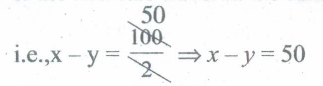
If the two cars travel in the same direction they will meet in 2 hrs.
 ...(2)
(1) \(\Rightarrow\) x + y = 100
y = -x + 100
| x | 100 | 0 |
| -x | -100 | 0 |
| 100 | 100 | 100 |
| y = -x +100 | 0 | 100 |
(2) \(\Rightarrow\) x - y = 50
-y = -x + 50
y = x - 50
| x | 100 | 0 | 1 |
| -50 | -50 | -50 | 0 |
| y = x - 50 | 50 | -50 | 0 |
The points to be plotted
(-100, -50), (0, -50),
x + y =100 ...(1)
Put x = 0 in (1), then 0 + y = 100 \(\Rightarrow\)y = 100
A (0, 100) is a point on (1)
Put y = 0 in(1), then x + 0 = 100 \(\Rightarrow\) x = 100
B (100, 0) is another point on (1)
Plot A & B Join them to produce the line (1)
Similarly by x - y = 50
Put x = 0 in (2), then 0 - y = 50
\(\Rightarrow\)y = 50
P (0, -50) is a point on (2)
Put y = 0 in (2), then x - 0 = 5
\(\Rightarrow\) x = 50
Q (50, 0) is another point on (2)
Plot P & Q Join them to produce the line (2)
The point of intersection (75, 25) of the two lines (1)& (2) is the solution.
\(\therefore\)The solution i.e., the speed of the two cars x and y is given by x = 75 km and y = 25 km
10.
y = 5x + 2, y = 10 +2x
11.
Given linear equations are
8x + 5y = 9
kx + 10y = 15
\(\left[ \begin{matrix} { a }_{ 1 }x+{ b }_{ 1 }y+{ c }_{ 1 }=0 \\ { a }_{ 2 }x+{ b }_{ 2 }y+{ c }_{ 2 }=0 \end{matrix} \right] \)
Here a1 = 8, b1 = 5, c1 = 9, a2 = k, b2 = 10, c2 = 15
For no solution, we know that \(\frac { { a }_{ 1 } }{ { a }_{ 2 } } =\frac { { b }_{ 1 } }{ { b }_{ 2 } } \neq \frac { { c }_{ 1 } }{ { c }_{ 2 } } \) and so, \(\frac { 8 }{ k } =\frac { 5 }{ 10 } \neq \frac { 9 }{ 15 } \)
80 = 5k
k = 16
12.
Given two linear equations are
2x - 3y = 7;
(k + 2)x - (2k + 1)y = 3(2k - 1)
\(\left[ \begin{matrix} { a }_{ 1 }x+{ b }_{ 1 }y+{ c }_{ 1 }=0 \\ { a }_{ 2 }x+{ b }_{ 2 }y+{ c }_{ 2 }=0 \end{matrix} \right] \)
Here a1 = 2, b1 = −3, a2 = (k + 2), b2 = −(2k +1), c1 = 7, c2 = 3(2k −1)
For infinite number of solution we consider \(\frac { { a }_{ 1 } }{ { a }_{ 2 } } =\frac { { b }_{ 1 } }{ { b }_{ 2 } } =\frac { { c }_{ 1 } }{ { c }_{ 2 } } \)
\(\frac { 2 }{ k+2 } =\frac { -3 }{ -(2k+1) } =\frac { 7 }{ 3(2k-1) } \)
\(\frac { 2 }{ k+2 } =\frac { -3 }{ -(2k+1) } \)
2(2k +1) = 3(k + 2)
4k + 2 = 3k + 6
k = 4
\(\frac { -3 }{ -(2k+1) } =\frac { 7 }{ 392k-1) } \)
9(2k −1) = 7(2k +1)
18k − 9 = 14k + 7
4k = 16
k = 4
13.
Given linear equations are
kx + 2y = 3 ......(1)
2x - 3y = 1 .......(2)
\(\left[ \begin{matrix} { a }_{ 1 }x+{ b }_{ 1 }y+{ c }_{ 1 }=0 \\ { a }_{ 2 }x+{ b }_{ 2 }y+{ c }_{ 2 }=0 \end{matrix} \right] \)
Here a1 = k, b1 = 2, a2 = 2, b2 = −3 ;
For unique solution we take \(\frac { { a }_{ 1 } }{ { a }_{ 2 } } \neq \frac { { b }_{ 1 } }{ { b }_{ 2 } } \); therefore \(\frac { k }{ 2 } \neq \frac { 2 }{ -3 } \);\(k\neq \frac { 4 }{ -3 } \), that is \(k\neq -\frac { 4 }{ 3 } \)
14.
The given system of equations are 3x + 5y − 21 = 0; −7x − 6y + 49 = 0
Now using the coefficients for cross multiplication, we get,
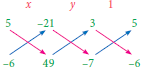
\(\Rightarrow \frac { x }{ (5)(49)-(-6)(-21) } =\frac { y }{ (-21)(-7)-(49)(3) } =\frac { 1 }{ (3)(-6)-(-7)(5) } \)
\(\frac { x }{ 119 } =\frac { y }{ 0 } =\frac { 1 }{ 17 } \)
\(\Rightarrow \frac { x }{ 119 } =\frac { 1 }{ 17 } ,\frac { y }{ 0 } =\frac { 1 }{ 17 } \)
\(\Rightarrow x=\frac { 119 }{ 17 } ,y=\frac { 0 }{ 17 } \)
\(\Rightarrow\) x = 7, y = 0
Verification :
3x + 5y = 21 ...(1)
3(7) + 5(0) = 21
21 + 0 = 21
21 = 21 True
-7x - 6y = -49 ...(2)
-7(7) - 6(0) = - 49
-49 = -49
-49 = -49 True
15.
Given, 2x + 3y = 14 ...(1)
3x − 4y = 4 ...(2)
To eliminate y:
| Multiply (1) by 4, to get | 8x + 12y = 56 |
| Multiply (2) by 3, to get | 9x –12y = 12 |
| Adding, we get | 17x = 68 |
Therefore, x = 4
Substitute x = 4 in (1) to get 2x + 3y = 14
2(4) + 3y = 14
8 + 3y = 14
y = 2
Thus the solution is x = 4, y = 2.
Verification :
2x+3y = 14 ...(1)
2(4)+3(2) = 14
8 + 6 = 14
14 = 14 True
3x – 4y = 4 ...(2)
3(4) – 4(2) = 4
12 – 8 = 4
4 = 4 True
16.
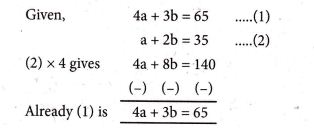
5b = 75 which gives b = 15
Put b = 15 in (2):
a + 2(15) = 35 which simplifies to a = 5
Thus the solution is a = 5, b = 15.
Verification :
4a+3b = 65 ...(1)
4(5)+3(15) = 65
20 + 45 = 65
65 = 65 True
a + 2b = 35 ...(2)
5 + 2(15) = 35
5+30 = 35
35 = 35 True
17.
Given x + 3y = 16 ... (1)
2x – y = 4 ... (2)
| Step 1 | Step 2 | Step 3 | Solution |
|---|---|---|---|
| From equation (2) 2x −y = 4 –y = 4–2x y = 2x − 4 ...(3) |
Substitute (3) in (1) x + 3y = 16 x + 3(2x − 4) = 16 x + 6x −12 = 16 7x = 28 x = 4 |
Substitute x = 4 in (3) y = 2x − 4 y = 2(4) − 4 y = 4 |
x = 4 and y = 4 |
18.
Given x – 2y = 7 …(1)
2x + 3y = 7 …(2)
When x = 5, y = −1 we get
From (1) x – 2y = 5 – 2(−1) = 5 + 2 = 7 which is RHS of (1)
From (2) 2x + 3y = 2(5) + 3(−1) = 10−3 = 7 which is RHS of (2)
Thus the values x = 5, y = −1 satisfy both (1) and (2) simultaneously. Therefore (5,−1) is a solution of the given equations.
19.
The given equation is 2y – 3x = 12
\(\Rightarrow\) 2y = +3x + 12
\(\Rightarrow \ \frac { 2y }{ 2 } =\frac { 3x+12 }{ 2 } \)
\(\Rightarrow \ y=\frac { 3x }{ 2 } +\frac { 12 }{ 2 } \)
\(\Rightarrow \ y=\frac { 3 }{ 2 } x+6\)
compare with, y=mx + c
Slope m = \(\frac { 3 }{ 2 } \), y-intercept c = 6
20.
Slope of AB = \(\frac { { y }_{ 2 }-{ y }_{ 1 } }{ { x }_{ 2 }-{ x }_{ 1 } } =\frac { 3 }{ 5 } \)
Slope of CD = \(\frac { change\ in\ y }{ change\ in\ x } =-\frac { 3 }{ 2 } \)
Slope of EF = \(\frac { 4 }{ 7 } \)
Slope of PQ = Undefined Slope of RS = 0.
21.
| SI.No | Pair of lines | \(\frac { { a }_{ 1 } }{ { a }_{ 2 } } \) | \(\frac { { b }_{ 1 } }{ { b }_{ 2 } } \) | \(\frac { { c }_{ 1 } }{ { c }_{ 2 } } \) | Compare the ratios | Graphical representation | Algebraic interpretation |
| (i) | 2x–4y = 7 x – 3y = –2 |
\(\frac { 2 }{ 1 } =2\) | \(\frac { -4 }{ -3 } =\frac { 4 }{ 3 } \) | \(\frac { 7 }{ -2 } =\frac { -4 }{ 2 } \) | \(\frac { { a }_{ 1 } }{ { a }_{ 2 } } \neq \frac { { b }_{ 1 } }{ { b }_{ 2 } } \) | Intersecting lines | Unique solution |
| (ii) | 4x + y = 3 8x + 2y = 6 |
\(\frac { 4 }{ 8 } =\frac { 1 }{ 2 } \) | \(\frac { 1 }{ 2 } \) | \(\frac { 3 }{ 6 } =\frac { 1 }{ 2 } \) | \(\frac { { a }_{ 1 } }{ { a }_{ 2 } } =\frac { { b }_{ 1 } }{ { b }_{ 2 } } =\frac { { c }_{ 1 } }{ { c }_{ 2 } } \) | Coinciding lines | Infinite many solutions |
| (iii) | 4x + 7= 2y 2x + 9 = y |
\(\frac { 4 }{ 2 } =2\) | \(\frac { 2 }{ 1 } =2\) | \(\frac { 7 }{ 9 } \) | \(\frac { { a }_{ 1 } }{ { a }_{ 2 } } =\frac { { b }_{ 1 } }{ { b }_{ 2 } } \neq \frac { { c }_{ 1 } }{ { c }_{ 2 } } \) | Parallel lines | No solution |
22.
The given system of equations are
3x − 4y = 10 \(\Rightarrow\) 3x − 4y −10 = 0 .....(1)
4x + 3y = 5 \(\Rightarrow\) 4x + 3y − 5 = 0 .....(2)
For the cross multiplication method, we write the coefficients as
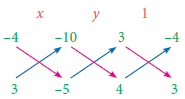
\(\frac { x }{ (-4)(-5)-(3)(-10) } =\frac { y }{ (-10)(4)-(-5)(3) } =\frac { 1 }{ (3)(3)-(4)(-4) } \)
\(\frac { x }{ (20)-(-30) } =\frac { y }{ (-40)-(-15) } =\frac { 1 }{ (9)-(-16) } \)
\(\frac { x }{ 20+30 } =\frac { y }{ -40+15 } =\frac { 1 }{ 9+16 } \)
\(\frac { x }{ 50 } =\frac { y }{ -25 } =\frac { 1 }{ 25 } \)
Therefore, we get \(x=\frac { 50 }{ 25 } ;y=\frac { -25 }{ 25 } \)
x = 2; y = -1
Thus the solution is x = 2, y = –1.
Verification:
3x–4y = 10 ...(1)
3(2)–4(–1) = 10
6 + 4 = 10
10 = 10 True
4x + 3y = 5 ...(2)
4(2) + 3(–1) = 5
8–3 = 5
5 = 5 True
23.
The given system of equations are 8x − 3y = 5xy ...(1)
6x − 5y = −2xy ...(2)
Observe that the given system is not linear because of the occurrence of xy term. Also note that if x =0, then y =0 and vice versa. So, (0,0) is a solution for the system and any other solution would have both x \(\neq \) 0 and y \(\neq \) 0
Let us take up the case where x \(\neq \) 0 and y \(\neq \) 0
Dividing both sides of each equation by xy,
\(\frac { 8x }{ xy } -\frac { 3y }{ xy } =\frac { 5xy }{ xy } \)
\(\frac { 6x }{ xy } -\frac { 5y }{ xy } =\frac { -2xy }{ xy } \)
Let \(a=\frac { 1 }{ x } ,b=\frac { 1 }{ y } \)
We get, \(\frac { 8 }{ y } -\frac { 3 }{ x } =5\) .....(3)
\(\frac { 6 }{ y } -\frac { 5 }{ x } =-2\) .......(4)
(3)&(4) respectively become, 8b − 3a = 5 ...(5)
b − 5a = −2 ...(6)
which are linear equations in a and b.
To eliminate a, we have, (5) \(\times\) 5\(\Rightarrow\) 40b −15a = 25 .....(7)
(6) × 3\(\Rightarrow\) 18b −15a = −6 .....(8)
Now proceed as in the previous example to get the solution\(\left( \frac { 11 }{ 23 } ,\frac { 22 }{ 31 } \right) \).
Thus, the system have two solutions \(\left( \frac { 11 }{ 23 } ,\frac { 22 }{ 31 } \right) \) and (0,0).
24.
Let x be the digit at ten’s place and y be the digit at unit place.
Given that x + y = 5 …… (1)
| Tens | Ones | Value | |
| Given Number | x | y | 10x + y |
| New Number (after reversal) |
y | x | 10y + x |
Given, Original number − reversing number = 27
(10x + y) − (10y + x) = 27
10x − x + y −10y = 27
9x − 9y = 27
\(\Rightarrow\) x − y = 3 ... (2)
Also from (1), y = 5 – x ... (3)
Substitute (3) in (2) to get x − (5 − x) = 3
x − 5 + x = 3
2x = 8
x = 4
Substituting x = 4 in (3), we get y = 5 − x = 5 − 4
y = 1
Thus, 10x + y = 10 × 4 +1 = 40 +1 = 41.
Therefore, the given two-digit number is 41.
Verification :
sum of the digits = 5
x + y = 5
4 + 1 = 5
5 = 5 true
Original number – reversed number = 27
41 - 14 = 27
27 = 27 true
25.
Let us form equations for the given statement.
Let us consider l and b as the length and breadth of the rectangle respectively.
Now let us frame the equation for the first statement
Perimeter of rectangle = 36
2(l+b) = 36
\(l+b=\frac { 36 }{ 2 } \)
l = 18 - b .....(1)
| b | 2 | 4 | 5 | 8 |
| 18 | 18 | 18 | 18 | 18 |
| -b | -2 | -4 | -5 | -8 |
| l =18 - b | 16 | 14 | 13 | 10 |
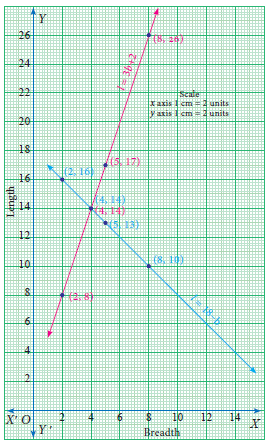
Points: (2,16), (4,14), (5,13), (8,10)
The second statement states that the length is 2 metres more than three times the width which is a straight line written as l = 3b + 2 ... (2)
Now we shall form table for the above equation (2).
| b | 2 | 4 | 5 | 8 |
| 3b | 6 | 12 | 15 | 24 |
| 2 | 2 | 2 | 2 | 2 |
| l = 3b + 2 | 8 | 14 | 17 | 26 |
Points: (2, 8), (4, 14), (5,17), (8, 26)
The solution is the point that is common to both the lines. Here we find it to be (4,14).
We can give the solution to be b = 4, l = 14.
Verification :
2(l + b) = 36 ...(1)
2(14 + 4) = 36
2 \(\times\) 18 = 36
36 = 36 true
l = 3b + 2 ...(2)
14 = 3(4) +2
14 = 12 + 2
14 = 14 true
26.
Let us form table of values for each line and then fix the ordered pairs to be plotted.
Graph of 3x + 2y = 6
| x | -2 | 0 | 2 |
| y | 6 | 3 | 0 |
Points to be plotted:
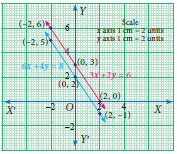
(−2,6), (0,3), (2,0)
Graph of 6x + 4y = 8
| x | -2 | 0 | 2 |
| y | 5 | 2 | -1 |
Points to be plotted:
(-2, 5), (0, 2), (2, -1)
When we draw the graphs of these two equations, we find that they are parallel and they fail to meet to give a point of intersection. As a result there is no ordered pair that can be common to both the equations. In this case there is no solution to the system.
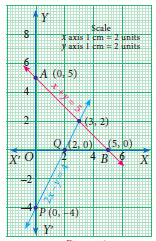
27.
Given x + y = 5 ...(1)
2x – y = 4 ...(2)
To draw the graph (1) is very easy. We can find the x and y intercepts and thus two of the points on the line (1).
When x = 0, (1) gives y = 5.
Thus A(0,5) is a point on the line.
When y = 0, (1) gives x = 5.
Thus B(5,0) is another point on the line.
Plot A and B; join them to produce the line (1).
To draw the graph of (2), we can adopt the same procedure.
When x = 0, (2) gives y = −4.
Thus P(0,−4) is a point on the line.
When y = 0, (2) gives x = 2.
Thus Q(2,0) is another point on the line.
Plot P and Q; join them to produce the line (2).
The point of intersection (3, 2) of lines (1) and (2) is a solution.
The solution is the point that is common to both the lines. Here we find it to be (3,2). We can give the solution as x = 3 and y = 2.
28.
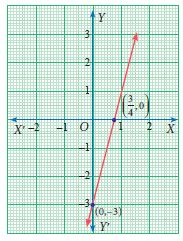
We have already come across one method: forming a table of values, listing and plotting ordered pairs and joining the points.
But, to fix a line, after all, how many points do we need? Just two! These can easily be obtained when a line is given in the form y = mx + c.
The given line y = 4x – 3
put x = 0 to get y-intercept
y = 4(0)–3
y = –3
point is (0, –3) and y-intercept = – 3
put y = 0 to get x-intercept
0 = 4x – 3
3 = 4x
\(\frac { 3 }{ 4 } =x\)
point is \(\left( \frac { 3 }{ 4 } ,0 \right) \) and x-intercept = \(\frac { 3 }{ 4 } \)
The graph may be drawn through two points (0,−3) and \(\left( \frac { 3 }{ 4 } ,0 \right) \)

9th Standard Syllabus & Materials
9th Standard
TN 9th Tamil உள்ளத்தின் சீர் - திருக்குறள் Important Questions And Answers Study Material - QB365 Set A
NEW9th Standard
TN 9th Tamil உள்ளத்தின் சீர் - மணிமேகலை Important Questions And Answers Study Material - QB365 Set A
NEW9th Standard
TN 9th Tamil உள்ளத்தின் சீர் - ஏறு தழுவுதல் Important Questions And Answers Study Material - QB365 Set A
NEW9th Standard
TN 9th Tamil உயிருக்கு வேர் - தண்ணீர் Important Questions And Answers Study Material - QB365 Set A



Tamilnadu Stateboard 9th Standard Subjects
Tamilnadu Stateboard Standards





