
 100% FREE ACCESS
9th Standard Syllabus & Materials
9th Standard
TN 9th Tamil உள்ளத்தின் சீர் -கற்கண்டு (இலக்கணம்) - தொடர் இலக்கணம், ஆகுபெயர் Important Questions And Answers Study Material - QB365 Set A
NEW9th Standard
TN 9th Tamil உள்ளத்தின் சீர் -விரிவானம் (துணைப்பாடம்) - தாய்மைக்கு வறட்சி இல்லை! Important Questions And Answers Study Material - QB365 Set A
NEW9th Standard
TN 9th Tamil உள்ளத்தின் சீர் -கவிதை பேழை (செய்யுள்) - மார்கழி பெருவிழா Important Questions And Answers Study Material - QB365 Set A
NEW9th Standard
TN 9th Tamil உயிருக்கு வேர்-இலக்கணம் - பகுபத உறுப்பிலக்கணம் Important Questions And Answers Study Material - QB365 Set A
NEW9th Standard
TN 9th Tamil அமுதென்று பேர் - இலக்கணம்-எழுத்து -அளபெடை Important Questions And Answers Study Material - QB365 Set A
NEW9th Standard
TN 9th Tamil அமுதென்று பேர்-துணைப்பாடம் - ஆறாம்திணை Important Questions And Answers Study Material - QB365 Set A

Published on: 18/01/2019
Term 3 Trigonometry Study Material
Download Tamil Nadu 9th Standard Maths question papers, model tests, one-mark questions, important questions, and public exam papers in PDF format. Free study materials and answer keys for TN State Board students.
Questions + Answers key
Take MCQ Maths Test1.
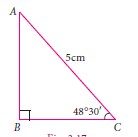
Find the area of the right angled triangle with hypotenuse 5 cm and one of the acute angle is 48030'
2.
Find the value of
(i) sin 38036' + tan 12012'
(ii) tan 60025' - cos 49020'
3.
Find the value of tan70013'
4.
(i) If cosec A = sec 340, then find A
(ii) If tan B = cot 470, then find B.
5.
Find the values of
(i) tan7° tan23° tan60° tan67° tan83°
(ii) \(\frac { cos35° }{ sin55° } +\frac { sin12° }{ cos78° } -\frac { cos18° }{ sin72° } \)
6.
Evaluate:
(i) \(\frac { sin\ 49° }{ cos\ 41° } \)
(ii) \(\frac { sec\ 63° }{ cosec\ 27° } \)
7.
Express
(i) sin 74° in terms of cosine
(ii) tan 12° in terms of cotangent
(iii) cosec 39° in terms of secant
8.
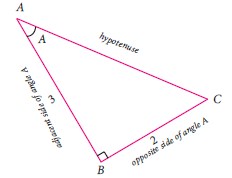
If tan A = \(\frac { 2 }{ 3 } \) , then find all the other trigonometric ratios.
9.
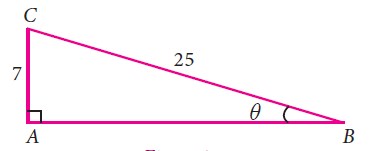
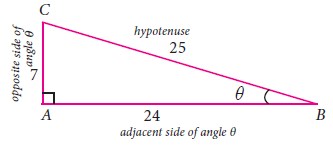
Find the six trigonometric ratios of the angle \(\theta\) using the given diagram.
10.
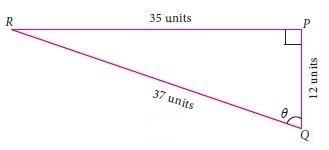
For the measures in the figure, compute sine, cosine and tangent ratios of the angle \(\theta \)
11.
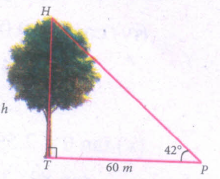
In the given figure, HT shows the height of a tree standing vertically. From a point P, the angle of elevation of the top of the tree
12.
Find the angle made by a ladder of length 5 m with the ground, if one of its end is 4 m away from the wall and the other end is on the wall.
13.
Find the area of a right triangle whose hypotenuse is 10 cm and one of the acute angle is 24024'
14.
Find the value of the following:
(i) sin65039' + cos24057' + tan10010'
(ii) tan70058' + cos15026' - sin84059'
15.
Find the value of \(\theta\) if
(i) sin \(\theta\) = 0.9975
(ii) cos \(\theta\) = 0.6763
(iii) tan \(\theta\) = 0.0720
(iv) cos \(\theta\) = 0.0410
(v) tan \(\theta\) = 7.5958
16.
Find the value of the following:
(i) sin 49°
(ii) cos 74039'
(iii) tan 54026'
(iv) sin 21021'
(v) cos 33053'
(vi) tan 70017'
17.
Find the value of 8 sin 2x cos 4x sin 6x , when x =150
18.
Verify 3 cos A = 4 cos3 A - 3 cosA , when A = 300
19.
Find the value of the following:
(i) \(\frac { tan45° }{ cosec30° } +\frac { sec60° }{ cot45° } -\frac { 5sin90° }{ 2cos0° } \)
(ii) (sin 900 + cos 600 + cos 450) \(\times\) (sin 300 - cos 00 +cos 450)
(iii) sin2300 - 2cos3600 + 3tan4450
20.
Verify the following equalities :
sin2600 + cos2600 = 1
21.
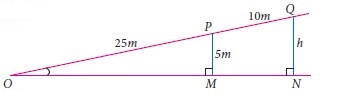
A boy standing at a point O finds his kite flying at a point P with distance OP = 25 m. It is at a height of 5m from the ground. When the thread is extended by 10 m from P, it reaches a point Q. What will be the height QN of the kite from the ground? (use trigonometric ratios)
22.
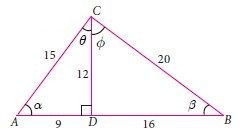
From the given figure, prove that \(\theta +\phi =90°\) Also prove that there are two other right angled triangles. Find sin \(\alpha\), cos\(\beta\) and tan\(\phi \)
23.
If cos \(\theta\) : sin\(\theta\) =1: 2, then find the value of = \(\frac { 8cos\theta -2sin\theta }{ 4cos\theta +2sin\theta } \)
24.
If sin \(\theta\) = \(\frac { a }{ \sqrt { { a }^{ 2 }+{ b }^{ 2 } } } \) then show that b sin \(\theta\) = a cos \(\theta\)
25.
If cos A = \(\frac { 2x }{ 1+{ x }^{ 2 } } \) then find the values of sinA and tan A in terms of x.
26.
If cos A = \(\frac { 3 }{ 5 } \), then find the value of \(\frac { sinA-cosA }{ 2tanA } \)
27.
If 2cos \(\theta\) = \(\sqrt { 3 } \), then find all the trigonometric ratios of angle \(\theta\)
28.
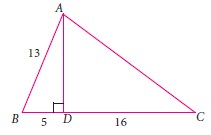
From the given figure, find the values of
(i) sin B
(ii) sec B
(iii) cot B
(iv) cos C
(v) tan C
(vi) cosec C
29.
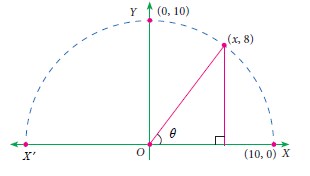
From the given figure, find all the trigonometric ratios of angle \(\theta\)
30.
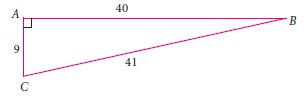
From the given figure, find all the trigonometric ratios of angle B.
31.
Find the value of \(\theta\) if
(i) sin \(\theta\) = 0.9858
(ii) cos\(\theta\) = 07656
32.
Find the values of the following:
(i) (cos 00 + sin 450 + sin 300)(sin 900 - cos 450 + cos 600)
(ii) tan2600 - 2tan2450 - cot2300 +2sin2300 + \(\frac { 3 }{ 4 } \) cosec2 450
33.
The value of \(\frac { sin{ 29 }^{ 0 }31' }{ cos{ 60 }^{ 0 }29' } \) is
0
2
1
-1
34.
Given that sin \(\alpha\) = \(\frac { 1 }{ 2 } \) and cos \(\beta\) = \(\frac { 1 }{ 2 } \), then the value of \(\alpha\) + \(\beta\) is ________.
00
900
300
600
35.
The value of tan 1° tan 2° tan 3°...tan 89° is ________.
0
1
2
\(\frac { \sqrt { 3 } }{ 2 } \)
36.
The value of cosec(700 + \(\theta\)) - sec(200 - \(\theta\)) + tan(650 + \(\theta\)) - cot(250 - \(\theta\)) is ________.
0
1
2
3
37.
If cos A = \(\frac { 3 }{ 5 } \), then the value of tan A is
\(\frac { 4 }{ 5 } \)
\(\frac { 3 }{ 4 } \)
\(\frac { 5 }{ 3 } \)
\(\frac { 4 }{ 3 } \)
38.
The value of \(\frac { 1-{ tan }^{ 2 }{ 45 }^{ 0 } }{ 1+{ tan }^{ 2 }{ 45 }^{ 0 } } \) is ________.
2
1
0
\(\frac { 1 }{ 2 } \)
39.
The value of 2tan30° tan60° is
1
2
\(2\sqrt { 3 } \)
6
40.
The value of 3 sin 700sec 200 + 2 sin 490sec 510 is ________.
2
3
5
6
41.
If 2 sin 2\(\theta\) = \(\sqrt { 3 } \) , then the value of \(\theta\) is ________.
900
300
450
600
42.
If sin \(\alpha\) = \(\frac { 1 }{ 2 } \) and \(\alpha\) is acute, then (3 cos\(\alpha\) - 4cos3 \(\alpha\)) is equal to
0
\(\frac { 1 }{ 2 } \)
\(\frac { 1 }{ 6 } \)
-1
43.
The value of \(\frac { 2tan\ 30° }{ 1-{ tan }^{ 2 }30° } \) is equal to ________.
cos 600
sin 600
tan 600
sin 300
44.
The value of \(\frac { tan15° }{ cot75° } \) is
cos 900
sin 300
tan 450
cos 300
45.
The value of tan72° tan18° is ________.
0
1
180
720
46.
If tan \(\theta\) cot 370 , then the value of \(\theta\) is ________.
370
530
900
10
47.
If sin 300 = x and cos 600 = y, then x2 + y2 is________.
\(\frac { 1 }{ 2 } \)
0
sin90°
cos90°
1.
From the figure,
sin \(\theta\) = \(\frac { AB }{ AC } \)
sin 48030' = \(\frac { AB }{ 5 } \)
0.7490 = \(\frac { AB }{ 5 } \)
5 \(\times\) 0.7490 = AB
AB = 3.7450 cm
cos \(\theta\) = \(\frac { BC }{ AC } \)
cos 48030' = \(\frac { BC }{ 5 } \)
0.6626 = \(\frac { BC }{ 5 } \)
0.6626 \(\times\) 5 = BC
BC = 3.313 cm
Area of right triangle = \(\frac { 1 }{ 2 } \) bh
\( =\frac{1}{2} \times B C \times A B \)
\( =\frac{1}{2} \times 3.3130 \times 3.7450 \)
\( =1.6565 \times 3.7450 \) = 6.2035925 cm2
2.
(i) sin 38036' + tan 12012'
sin 38036' = 0.6239
tan12012' = 0.2162
sin 38036' + tan 12012' = 0.8401
(ii) tan 60025' - cos 49020'
tan 60025' = 1.7603 + 0.0012 = 1.7615
cos 49020' = 0.6521 - 0.0004 = 0.6517
tan 60025' - cos 49020' = 1.1098
3.
| 0' | 6' | 12' | 18' | 24' | 30' | 36' | 42' | 48' | 54' | Mean Difference | |||||
| 0.00 | 0.10 | 0.20 | 0.30 | 0.40 | 0.50 | 0.60 | 0.70 | 0.80 | 0.90 | 1 | 2 | 3 | 4 | 5 | |
| 700 | 2.7776 | 26 | |||||||||||||
write 70013' = 70012' + 1'
From the table we have, tan70012' = 2.7776

4.
(i) We know that cosec A = sec(900 A)
sec(900 - A) sec(340)
900 - A =340
We get A = 90° − 34°
A = 560
(ii) We know that tan B = cot(900 - B)
cot(900 - B) = cot 470
900 - B = 470
We get B = 90° − 47°
B = 430
5.
(i) tan 7°tan 23°tan 60°tan 67°tan 83°
= tan 70 tan 830 tan 230 tan 670 tan 600 (Grouping complementary angles)
= tan 70 tan(900 - 70)tan 230 tan(900 - 230)tan 600
= (tan70.cot70)(tan 230. cot 230)tan 600
= (1)\(\times\) (1)\(\times\) tan 600
= tan 600 = \(\sqrt { 3 } \)
(ii) \(\frac { cos35° }{ sin55° } +\frac { sin12° }{ cos78° } -\frac { cos18° }{ sin72° } \)
\(=\frac { cos\left( 90°-55° \right) }{ sin55° } +\frac { sin\left( 90°-78° \right) }{ cos78° } -\frac { cos\left( 90°-72° \right) }{ sin72° } \) \(\left[ \begin{matrix} { \text Since} \\cos35°=cos\left( 90°-55° \right) \\ sin12°=sin(90°-78°) \\ cos18°=cos\left( 90°-72° \right) \end{matrix} \right] \)
= \(\frac { sin55° }{ sin55° } +\frac { cos78° }{ cos78° } -\frac { sin72° }{ sin72° } \)
= 1+1 - 1 = 1
6.
(i) \(\frac { sin\ 49° }{ cos\ 41° } \)
sin 490 = sin(900 - 410) = cos 410, since 490 + 410 = 900 (complementary),
Hence on substituting sin 49o = cos41o we get, \( \frac { cos\ 41° }{ cos\ 41° } \)= 1
(ii) \(\frac { sec\ 63° }{ cosec\ 27° } \)
sec63o = sec (90o- 27o) = cosec27o, here, 63o and 27o are complementary angles
we have \(\frac { sec\ 63° }{ cosec\ 27° } =\frac { cosec\ 27° }{ cosec\ 27° } =1\)
7.
(i) sin74° = sin(900 -160) (since, 900 -160 = 740 )
RHS is of the form sin(900 - \(\theta\)) = cos\(\theta\)
Therefore sin74° = cos160
(ii) tan12° = tan(900 - 780) (since, 120= 900 = 780 )
RHS is of the form tan(900- \(\theta\)) = cot \(\theta\)
Therefore tan12° = cot 780
(iii) cosec 39° = cosec(900 - 510) (since, 390 = 900 - 510 )
RHS is of the form cosec(900 - \(\theta\)) = sec\(\theta\)
Therefore cosec39° = sec510
8.
tan A = \(\frac { opposite\ side }{ adjacent\ side } =\frac { 2 }{ 3 } \)
By Pythagoras theorem,
\(AC=\sqrt { { AB }^{ 2 }+{ BC }^{ 2 } } \)
= \(\sqrt { { 3 }^{ 2 }+{ 2 }^{ 2 } } =\sqrt { 9+4 } =\sqrt { 13 } \)
AC = \(\sqrt { 13 } \)
\(sin\ A=\frac { opposite\ side }{ hypotenuse } =\frac { 2 }{ \sqrt { 13 } } \)
\(cosec\ A=\frac { hypotenuse }{ opposite\ side } =\frac { \sqrt { 13 } }{ 2 } \)
\(cos\ A=\frac { adjacent\ side }{ hypotenuse } =\frac { 3 }{ \sqrt { 13 } } \)
\(sec\ A=\frac { hypotenuse }{ adjacent\ side } =\frac { \sqrt { 13 } }{ 3 } \)
\(cot\ A=\frac { adjacent\ side }{ opposite\ side }= \frac { 3 }{ 2 } \)
9.
By Pythagoras theorem,
\(AB=\sqrt { { BC }^{ 2 }{ AC }^{ 2 } } \)
= \(\sqrt { { \left( 25 \right) }^{ 2 }-{ 7 }^{ 2 } } \)
= \(\sqrt { 625-49 } =\sqrt { 576 } \) = 24
The six trigonometric ratios are
\(sin\theta =\frac { opposite\ side }{ hypotenuse } =\frac { 7 }{ 25 } \)
\(tan\theta =\frac { oppositeside }{ adjacent\ side } =\frac { 7 }{ 24 } \)
\(sec\theta =\frac { hypotenuse }{ adjacent\ side } =\frac { 25 }{ 24 } \)
\(cos\theta =\frac { adjacentside }{ hypotenuse } =\frac { 24 }{ 25 } \)
\(cosec\theta =\frac { hypotenuse }{ oppositeside } =\frac { 25 }{ 7 } \)
\(cot \theta\ \frac { adjacentside }{ oppositeside } =\frac { 24 }{ 7 } \)
10.
In the given right angled triangle, note that for the given angle \(\theta \), PR is the ‘opposite’ side and PQ is the ‘adjacent’ side.
\(sin\theta =\frac { opposite\ side }{ hypotenuse } =\frac { PR }{ QR } =\frac { 35 }{ 37 } \)
\(cos\theta =\frac { adjacent\ side }{ hypotenuse } =\frac { PQ }{ QR } =\frac { 12 }{ 37 } \)
\(tan\theta =\frac { opposite\ side }{ adjacent\ side } =\frac { PR }{ PQ } =\frac { 35 }{ 12 } \)
It is enough to leave the ratios as fractions. In case, if you want to simplify each ratio neatly in a terminating decimal form, you may opt for it, but that is not obligatory.
11.
\(tan\ {42 }^{ 0 }=\cfrac { h }{ 60 } =0.9004\)
h = 0.9004 \(\times\) 60 = 54.024 m
12.
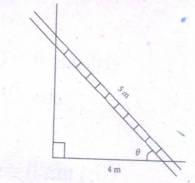
\(cos\theta =\cfrac { 4 }{ 5 } =0.8\)
cos 36° 48' = 0.8
\(\therefore\) \(\theta\) = 36048'
13.
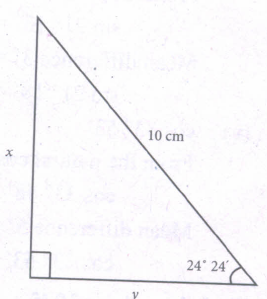
Hypotenuse = 10 cm
One of the acute angle = 24° 24'
sin 24° 24' = 0.4131'
\(\cfrac { x }{ 10 } =0.4131\)
x = 0.4131 \(\times\) 10
x = 4.131
cos 24° 24' = 0.9107
\(\cfrac { y }{ 10 } =0.9107\)
y = 9.107
\(\therefore\) Area of the triangle = \(\cfrac { 1 }{ 2 } bh\)
= \(\cfrac { 1 }{ 2 } \times y\times x\)
\(=\cfrac { 1 }{ 2 } \times 9.107\times 4.131=18.81sq.cm\)
14.
(i) = 0.9111 + 0.9066 + 0.1793
= 1.9970
(ii) = 2.8982 + 0.9639 - 0.9962
= 3.8625 - 0.9962
= 2.8659
15.
(i) From the natural sines table
sin 85° 57' = 0.9975
\(\therefore\) \(\theta \) = 85° 57'
(ii) cos\(\theta \) = 0.6763
cos 47° 33' = 0.6762
\(\therefore\) \(\theta \) = 47° 33'
(iii) tan \(\theta \) = 0.0720
tan 4° 7' = 0.0720
\(\therefore\)\(\theta \) = 4°7'
(iv) cos \(\theta \) = 0.0410
cos 87° 45° = 0.0410
:\(\therefore\)\(\theta \) = 87°39'
(v) tan \(\theta \) = 7.5958
tan 82° 30' = 7.5958
\(\therefore\) \(\theta \) = 82° 30'
16.
| 0 | 6' | 12' | 18' | 24' | 30' | 36' | 42' | 48' | 54' | Mean difference | |||||||||||||||
| 0.00 | 0.10 | 0.20 | 0.30 | 0.40 | 0.50 | 0.60 | 0.70 | 0.80 | 0.90 | 1 | 2 | 3 | 4 | 5 | 6 | 7 | 8 | ||||||||
| 49 | 0.7547 | ||||||||||||||||||||||||
(i) sin 49° = 0.7547
(ii) cos 74° 39'
cos 74° 36' = 0.2656 (From the natural cosines table)
Mean difference 3' = 8
cos 74° 39'= 0.2648
(iii) tan 54° 26'
From the natural tangents table
tan 54° 24' = 1.3968
Mean difference 2' = 17
tan 54° 26' = 1.3985
(iv) sin 21°21'
From the natural sines table
sin 21° 18' = 0.3633
Mean difference 3' = 8
sin 21° 18' = 0.3641
(v) cos 33° 53'
From the natural cosines table
cos 33° 48' = 0.8310
Mean difference 5' = 8
cos 33° 53' = 0.8318
(vi) tan70o12' = 2.7776
Mean difference for 5'= 131 (Mean difference is to be added)
= 2.7907
17.
8 sin 2(15°). cos 4 (15°). sin 6(15°)
= 8 sin 30° cos 60° sin 90°
= \(8\times \cfrac { 1 }{ 2 } \times \cfrac { 1 }{ 2 } \times 1=2\)
18.
L.H.S = cos 3A= cos 3 (30°)
= cos 90°
=0 ---- (1)
R.H.S = 4 cos3 A- 3 cosA
= 4 cos3 30° - 3 cos 30°
= \(4\left( \cfrac { \sqrt { 3 } }{ 2 } \right) ^{ 3 }-3\times \cfrac { \sqrt { 3 } }{ 2 } \)

(1) = (2). Hence it is verified
19.
(i) \(\frac { tan45° }{ cosec30° } +\frac { sec60° }{ cot45° } -\frac { 5sin90° }{ 2cos0° } \)
= \(\cfrac { 1 }{ 2 } +\cfrac { 2 }{ 1 } -\cfrac { 5\times 1 }{ 2\times 1 } \)
= \(\cfrac { 1 }{ 2 } +\cfrac { 2 }{ 1 } -\cfrac { 5\times 1 }{ 2\times 1 } \)
= \(\cfrac { 1 }{ 2 } +\cfrac { 2 }{ 1 } -\cfrac { 5 }{ 2 } =\cfrac { 1+4-5 }{ 2 } =\cfrac { 5-5 }{ 2 } =\cfrac { 0 }{ 2 } =0\)
(ii) (sin 90° + cos 60° + cos 45°) \(\times\) (sin 30° - cos 0° + cos 450)
= \(\left( 1+\cfrac { 1 }{ 2 } +\cfrac { 1 }{ \sqrt { 2 } } \right) \times \left( \cfrac { 1 }{ 2 } -1+\cfrac { 1 }{ \sqrt { 2 } } \right) \)
= \(\cfrac { 2+1+\sqrt { 2 } }{ 2 } \times \cfrac { 1-2+\sqrt { 2 } }{ 2 } \)
= \(\cfrac { 3+\sqrt { 2 } }{ 2 } \times \cfrac { \sqrt { 2 } -1 }{ 2 } =\cfrac { 3\sqrt { 2 } +2-3-\sqrt { 2 } }{ 4 } \)
= \(\cfrac { 3\sqrt { 2 } -1-\sqrt { 2 } }{ 4 } =\cfrac { 2\sqrt { 2 } -1 }{ 4 } \) \(=\frac{18-4}{8}=\frac{7}{4}\)
(iii) sin2300 - 2 cos3600 + 3 tan4450

20.
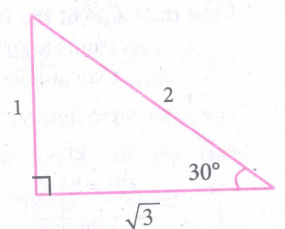
\({ \sin }^{ 2 }{ \tan }^{ 2 }+{ \cos }^{ 2 }{ 60 }^{ o }=\left( \cfrac { \sqrt { 3 } }{ 2 } \right) +\left( \cfrac { 1 }{ 2 } \right) ^{ 2 }=\cfrac { 3 }{ 4 } +\cfrac { 1 }{ 4 } =\cfrac { 4 }{ 4 } =1\)
21.
In the figure,
\(\triangle\)OPM, \(\triangle\)OQN are similar triangles. In similar triangles the sides are in the same proportion.
\(\cfrac { QN }{ PM } =\cfrac { QO }{ PO } \)
\(\cfrac { h }{ 5 } =\cfrac { 35 }{ 25 } \)
\(h=\cfrac { 5\times 35 }{ 25 } \)
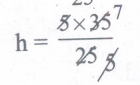
h = 7m
22.
In\(\triangle\)ABC
AC2 = 152= 225- - - - - (1)
BC2 = 202 = 400 - - - - (2)
AB2= (9 + 16)2
From (1), (2), (3)
AB2 = AC2 + BC2
625 = 225 + 400 = 625
\(\therefore \angle C=\theta +\Phi ={ 90 }^{ 0 }\)
( \(\therefore\) By Pythagoras theorem, in a right angled triangle square of hypotenuse is equal to sum of the squares of other two sides)
And also in the figure. \(\triangle\)ADC, \(\triangle\)DBC are two other triangles.
As per the data given,
92+ 122= 81 + 144 = 225 = 152
\(\therefore\) \(\triangle\)ADC is a right angled triangle.
then 122+ 162 = 144 + 256 = 400 = 202
\(\therefore\) \(\triangle\)DBC is also a right angled triangle.
\(sin\alpha =\cfrac { 12 }{ 15 } =\cfrac { 4 }{ 5 } ,cos\beta =\cfrac { 16 }{ 20 } =\cfrac { 4 }{ 5 } ,tan\phi =\cfrac { 16 }{ 12 } =\cfrac { 4 }{ 3 } \)
23.
\(cos\theta :sin\theta =1:2\)
\(\cfrac { cos\theta }{ sin\theta } =\cfrac { 1 }{ 2 } \)
\(cos\theta =\cfrac { 1 }{ 2 } sin\theta \)
\(\sin\theta =2 \cos\theta \)
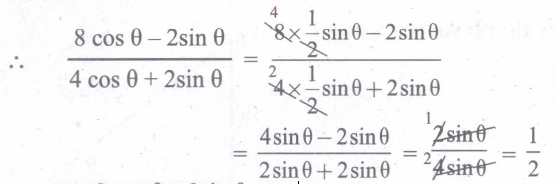
\(\therefore \cfrac { 8cos\theta -2sin\theta }{ 4cos\theta +2sin\theta } =\cfrac { 1 }{ 2 } \)
24.
\(sin\ \theta =\cfrac { a }{ \sqrt { { a }^{ 2 }+{ b }^{ 2 } } } \)
\(cos\ \theta =\cfrac { b }{ \sqrt { { a }^{ 2 }+{ b }^{ 2 } } } \)
\(b\ sin\ \theta =b\times \cfrac { a }{ \sqrt { { a }^{ 2 }+{ b }^{ 2 } } } -\cfrac { ab }{ \sqrt { { a }^{ 2 }+{ b }^{ 2 } } } \) ... (1)
\(a\ cos\ \theta =a\times \cfrac { b }{ \sqrt { a^{ 2 }+{ b }^{ 2 } } } =\cfrac { ab }{ \sqrt { { a }^{ 2 }+{ b }^{ 2 } } } \) ...(2)
(1) = (2)\(\Rightarrow\) LHS = RHS
Hence proved
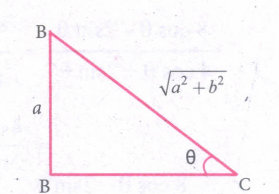
By By the Pythagoras theorem
BC2 = AC2 + AB2
= \(\left( \sqrt { { a }^{ 2 }+{ b }^{ 2 } } \right) ^{ 2 }-{ a }^{ 2 }\)
= a2+b2-a2
= b2
BC = b
25.
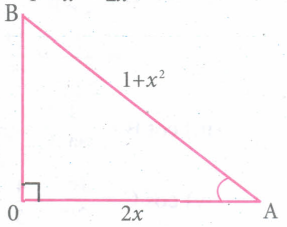
By the pythagoras theorem,
AB2 = OA2 + OB2
(1 + x2)2 = (2x)2 + OB2
OB2 = (1 +x2)2 - (2x)2 = 1+ x4 + 2x2 - 4x2 = 1+x4 - 2x2
OB2 = (1-x2)2 B
OB = (1-x2)
\(\therefore sin\ A=\cfrac { 1-{ x }^{ 2 } }{ 1+{ x }^{ 2 } } \)
\(tan\ A=\cfrac { 1-{ x }^{ 2 } }{ 2x } \)
26.
\(sinA=\cfrac { 4 }{ 5 } \)
\(tanA=\cfrac { 4 }{ 3 } \)
\(\therefore \cfrac { sinA-cosA }{ 2tanA } =\cfrac { \frac { 4 }{ 5 } -\frac { 3 }{ 5 } }{ 2\times \frac { 4 }{ 3 } } =\cfrac { \frac { 1 }{ 5 } }{ 2\times \frac { 4 }{ 3 } } =\cfrac { 1 }{ 4 } \times \cfrac { 1 }{ 5 } \times \cfrac { 3 }{ 4 } =\cfrac { 3 }{ 40 } \)
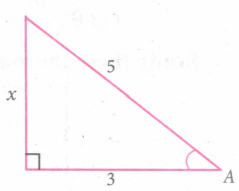
By the Pythagoras theorem
x=\(\sqrt { { 5 }^{ 2 }-{ 3 }^{ 2 } } \)
= \(\sqrt { 25-9 } \)
= \(\sqrt { 16 } =4\)
27.
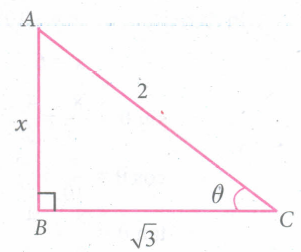
If \(2cos\theta =\sqrt { 3 } \)
\(cos\theta =\cfrac { \sqrt { 3 } }{ 2 } \)
\(x=\sqrt { { 2 }^{ 2 }-\sqrt { { 3 }^{ 2 } } } =\sqrt { 4-3 } =\sqrt { 1 } =1\)
\(\therefore sin\theta =\cfrac { 1 }{ 2 } \)
\(cos\theta =\cfrac { \sqrt { 3 } }{ 2 } \)
\(tan\theta =\cfrac { 1 }{ \sqrt { 3 } } \)
\(coseec\theta =2\)
\(sec\theta =\cfrac { 2 }{ \sqrt { 3 } } \)
\(cot\theta =\sqrt { 3 } \)
28.
(i) \(sinB=\cfrac { 12 }{ 13 } \)
(ii) \(secB=\cfrac { 1 }{ cosB } \)
= \(\cfrac { 1 }{ 5/3 } =\cfrac { 13 }{ 5 } \)
(iii) \(cotB=\cfrac { 1 }{ tanB } =\cfrac { 1 }{ 12/5 } =\cfrac { 5 }{ 2 } \)
(iv)
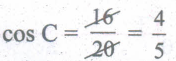
(v) \(\tan C=\cfrac { 12 }{ 16 } =\cfrac { 3 }{ 4 } \)
(vi) \(cosecC=\cfrac { 1 }{ sinC } =\cfrac { 1 }{ 12/20 } =\cfrac { 20 }{ 12 } =\cfrac { 5 }{ 3 } \)
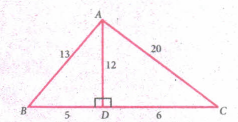
By the pythagoras theorem,
\(AD=\sqrt { { 13 }^{ 2 }-{ 5 }^{ 2 } } \)
= \(\sqrt { 169-25 } \)
= \(\sqrt { 144 } =12\)
AC =\(\sqrt { { 12 }^{ 2 }+{ 16 }^{ 2 } } \)
= \(\sqrt { { 144 }+{ 256 } } \)
= \(\sqrt { 400 } =20\)
29.
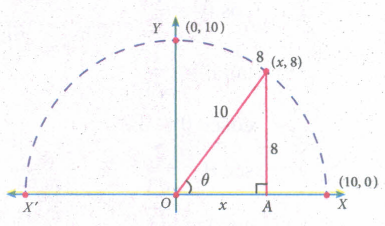
By the Pythagoras theorem
In \(\triangle\)OAB, \(x=\sqrt { { 10 }^{ 2 }-{ 8 }^{ 2 } } =\sqrt { 100-64 } =\sqrt { 36 } \)
\(sin\theta =\cfrac { 8 }{ 10 } =\cfrac { 4 }{ 5 } \)
\(cos\theta =\cfrac { 6 }{ 10 } =\cfrac { 3 }{ 5 } \)
\(tan\theta =\cfrac { 8 }{ 6 } =\cfrac { 4 }{ 3 } \)
\(cosec\theta =\cfrac { 10 }{ 8 } =\cfrac { 5 }{ 4 } \)
\(sec\theta =\cfrac { 10 }{ 6 } =\cfrac { 5 }{ 3 } \)
\(cot\theta =\cfrac { 6 }{ 8 } =\cfrac { 3 }{ 4 } \)
Study these thoroughly
\(sin\theta =\cfrac { Opp.side }{ Hypotenuse } \)
\(cos\theta =\cfrac { Adj.side }{ Hypotenuse } \)
\(tan\theta =\cfrac { Opp.side }{ Adj.side } \)
\(cosec\theta =\cfrac { Hypotenuse }{ Opp.side } \)
\(sec\theta =\cfrac { Hypotenuse }{ Opp.side } \)
\(cot\theta =\cfrac { Adj.side }{ Opp.side } \)
30.
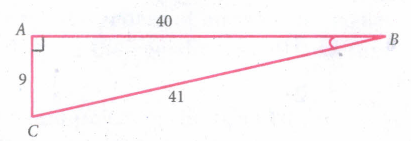
sin B = \(\frac { 9 }{ 41 } \);
cos B = \(\frac { 40 }{ 41 } \);
tan B =\(\frac { 9 }{ 40 } \) ;
cosec B = \(\frac { 1 }{ sinB } \) = \(\frac { 41 }{ 9 } \);
sec B =\(\frac { 1 }{ cotB } \) = \(\frac { 41 }{ 40 } \);
cot B =\(\frac { 1 }{ tanB } \) = \(\frac { 40 }{ 9 } \)
31.
(i) sin \(\theta\) = 0.9858 = 0.9857 + 0.0001
From the sine table 0.9857 = 80o 18'
Mean difference 1 = 2′
0.9858 = sin 80020'
sin\(\theta\) = 0.9858 = sin 80020'
\(\theta\) = 80020'
(ii) cos \(\theta\) = 0.7656 = 0.7660 - 0.0004
From the natural cosine table
0.7660 = 40°0′
Mean difference 4 = 2′
0.7656 = 40°0′
cos \(\theta\) = 0.7656 = cos 40°2'
\(\theta\) = 40°2'
32.
(i) (cos00 + sin 450 + sin 300) (sin 900 - cos 450 + cos 600)
= \(\left[ 1+\frac { 1 }{ \sqrt { 2 } } +\frac { 1 }{ 2 } \right] \left[ 1-\frac { 1 }{ \sqrt { 2 } } +\frac { 1 }{ 2 } \right] \)
= \(\left[ \frac { 2\sqrt { 2 } +2+\sqrt { 2 } }{ 2\sqrt { 2 } } \right] \left[ \frac { 2\sqrt { 2 } -2+\sqrt { 2 } }{ 2\sqrt { 2 } } \right] =\left[ \frac { 3\sqrt { 2 } +2 }{ 2\sqrt { 2 } } \right] \left[ \frac { 3\sqrt { 2 } -2 }{ 2\sqrt { 2 } } \right] \)
= \(\frac { 18-4 }{ 4\left( \sqrt { 2 } \right) ^{ 2 } } =\frac { 14 }{ 4\times 2 } =\frac { 7 }{ 4 } \)
(ii) tan2600 - 2tan2450 - cot2300 +2sin2300 + \(\frac { 3 }{ 4 } \) cosec2450
= \(\left( \sqrt { 3 } \right) ^{ 2 }-2(1)^{ 2 }-\left( \sqrt { 3 } \right) ^{ 2 }+2\left( \frac { 1 }{ 2 } \right) ^{ 2 }+\frac { 3 }{ 4 } \left( \sqrt { 2 } \right) ^{ 2 }\)
= \(3-2-3+\frac { 1 }{ 2 } +\frac { 3 }{ 2 } \)
= -2 + \(\frac { 4 }{ 2 } \) = -2 + 2 = 0
33.
(c)
1
34.
(b)
900
35.
(b)
1
36.
(a)
0
37.
(d)
\(\frac { 4 }{ 3 } \)
38.
(c)
0
39.
(b)
2
40.
(c)
5
41.
(b)
300
42.
(a)
0
43.
(c)
tan 600
44.
(c)
tan 450
45.
(b)
1
46.
(b)
530
47.
(a)
\(\frac { 1 }{ 2 } \)

9th Standard Syllabus & Materials
9th Standard
TN 9th Tamil உள்ளத்தின் சீர் - திருக்குறள் Important Questions And Answers Study Material - QB365 Set A
NEW9th Standard
TN 9th Tamil உள்ளத்தின் சீர் - மணிமேகலை Important Questions And Answers Study Material - QB365 Set A
NEW9th Standard
TN 9th Tamil உள்ளத்தின் சீர் - ஏறு தழுவுதல் Important Questions And Answers Study Material - QB365 Set A
NEW9th Standard
TN 9th Tamil உயிருக்கு வேர் - தண்ணீர் Important Questions And Answers Study Material - QB365 Set A



Tamilnadu Stateboard 9th Standard Subjects
Tamilnadu Stateboard Standards





