
 100% FREE ACCESS
9th Standard Syllabus & Materials
9th Standard
TN 9th Tamil உள்ளத்தின் சீர் -கற்கண்டு (இலக்கணம்) - தொடர் இலக்கணம், ஆகுபெயர் Important Questions And Answers Study Material - QB365 Set A
NEW9th Standard
TN 9th Tamil உள்ளத்தின் சீர் -விரிவானம் (துணைப்பாடம்) - தாய்மைக்கு வறட்சி இல்லை! Important Questions And Answers Study Material - QB365 Set A
NEW9th Standard
TN 9th Tamil உள்ளத்தின் சீர் -கவிதை பேழை (செய்யுள்) - மார்கழி பெருவிழா Important Questions And Answers Study Material - QB365 Set A
NEW9th Standard
TN 9th Tamil உயிருக்கு வேர்-இலக்கணம் - பகுபத உறுப்பிலக்கணம் Important Questions And Answers Study Material - QB365 Set A
NEW9th Standard
TN 9th Tamil அமுதென்று பேர் - இலக்கணம்-எழுத்து -அளபெடை Important Questions And Answers Study Material - QB365 Set A
NEW9th Standard
TN 9th Tamil அமுதென்று பேர்-துணைப்பாடம் - ஆறாம்திணை Important Questions And Answers Study Material - QB365 Set A

Published on: 15/10/2019
Term 3 Algebra
Download Tamil Nadu 9th Standard Maths question papers, model tests, one-mark questions, important questions, and public exam papers in PDF format. Free study materials and answer keys for TN State Board students.
Questions + Answers key
Take MCQ Maths Test1.
Check whether the following system of equation is consistent or inconsistent and say how many solutions we can have if it is consistent.
(i) 2x – 4y = 7
x – 3y = –2
(ii) 4x + y = 3
8x + 2y = 6
(iii) 4x +7 = 2 y
2x + 9 = y
2.
Solve 3x − 4y = 10 and 4x + 3y = 5 by the method of cross multiplication.
3.
Solve by the method of elimination
(i) 2x–y = 3; 3x + y = 7
(ii) x–y = 5; 3x + 2y = 25
(iii) \(\frac { x }{ 10 } +\frac { y }{ 5 } =14;\frac { x }{ 8 } +\frac { y }{ 6 } =15\)
(iv) 3(2x + y) =7xy; 3(x + 3y) = 11xy
(v) \(\frac { 4 }{ x } +5y=7;\frac { 3 }{ x } +4y=5\)
(vi) 13x +11y = 70; 11x +13y = 74
4.
Solve, using the method of substitution
(i) 2x − 3y = 7; 5x + y = 9
(ii) 1.5x + 0.1y = 6.2; 3x − 0.4y = 11.2
(iii) 10% of x + 20% of y = 24; 3x − y = 20
(iv) \(\sqrt { 2 } \)x - \(\sqrt { 3 } \)y = 1; \(\sqrt { 3 } \)x -\(\sqrt { 8 } \)y = 0
5.
The sum of the digits of a given two digit number is 5. If the digits are reversed, the new number is reduced by 27. Find the given number.
6.
Solve graphically
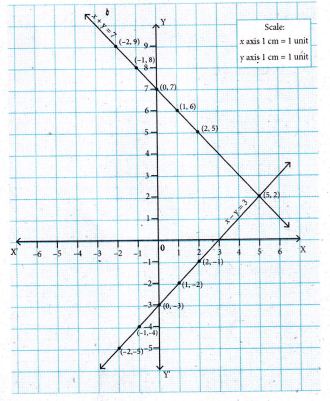
x + y = 7; x − y = 3
7.
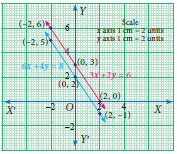
Use graphical method to solve the following system of equations 3x + 2y = 6; 6x + 4y = 8
8.
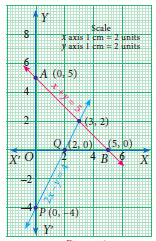
Use graphical method to solve the following system of equations x + y = 5; 2x – y = 4.
9.
Draw the graph for the following
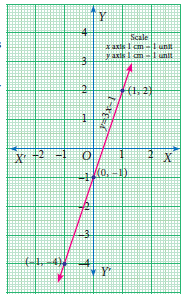
(i) y = 3x - 1
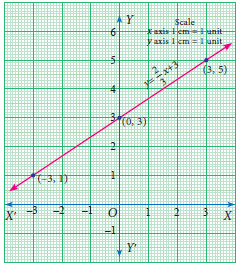
(ii) \(y=\left( \frac { 2 }{ 3 } \right) x+3\)
10.
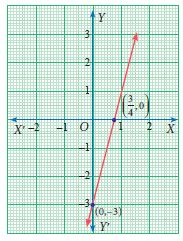
(Graphing made easier!) Draw the graph of the line given by the equation y = 4x – 3.
1.
| SI.No | Pair of lines | \(\frac { { a }_{ 1 } }{ { a }_{ 2 } } \) | \(\frac { { b }_{ 1 } }{ { b }_{ 2 } } \) | \(\frac { { c }_{ 1 } }{ { c }_{ 2 } } \) | Compare the ratios | Graphical representation | Algebraic interpretation |
| (i) | 2x–4y = 7 x – 3y = –2 |
\(\frac { 2 }{ 1 } =2\) | \(\frac { -4 }{ -3 } =\frac { 4 }{ 3 } \) | \(\frac { 7 }{ -2 } =\frac { -4 }{ 2 } \) | \(\frac { { a }_{ 1 } }{ { a }_{ 2 } } \neq \frac { { b }_{ 1 } }{ { b }_{ 2 } } \) | Intersecting lines | Unique solution |
| (ii) | 4x + y = 3 8x + 2y = 6 |
\(\frac { 4 }{ 8 } =\frac { 1 }{ 2 } \) | \(\frac { 1 }{ 2 } \) | \(\frac { 3 }{ 6 } =\frac { 1 }{ 2 } \) | \(\frac { { a }_{ 1 } }{ { a }_{ 2 } } =\frac { { b }_{ 1 } }{ { b }_{ 2 } } =\frac { { c }_{ 1 } }{ { c }_{ 2 } } \) | Coinciding lines | Infinite many solutions |
| (iii) | 4x + 7= 2y 2x + 9 = y |
\(\frac { 4 }{ 2 } =2\) | \(\frac { 2 }{ 1 } =2\) | \(\frac { 7 }{ 9 } \) | \(\frac { { a }_{ 1 } }{ { a }_{ 2 } } =\frac { { b }_{ 1 } }{ { b }_{ 2 } } \neq \frac { { c }_{ 1 } }{ { c }_{ 2 } } \) | Parallel lines | No solution |
2.
The given system of equations are
3x − 4y = 10 \(\Rightarrow\) 3x − 4y −10 = 0 .....(1)
4x + 3y = 5 \(\Rightarrow\) 4x + 3y − 5 = 0 .....(2)
For the cross multiplication method, we write the coefficients as
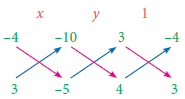
\(\frac { x }{ (-4)(-5)-(3)(-10) } =\frac { y }{ (-10)(4)-(-5)(3) } =\frac { 1 }{ (3)(3)-(4)(-4) } \)
\(\frac { x }{ (20)-(-30) } =\frac { y }{ (-40)-(-15) } =\frac { 1 }{ (9)-(-16) } \)
\(\frac { x }{ 20+30 } =\frac { y }{ -40+15 } =\frac { 1 }{ 9+16 } \)
\(\frac { x }{ 50 } =\frac { y }{ -25 } =\frac { 1 }{ 25 } \)
Therefore, we get \(x=\frac { 50 }{ 25 } ;y=\frac { -25 }{ 25 } \)
x = 2; y = -1
Thus the solution is x = 2, y = –1.
Verification:
3x–4y = 10 ...(1)
3(2)–4(–1) = 10
6 + 4 = 10
10 = 10 True
4x + 3y = 5 ...(2)
4(2) + 3(–1) = 5
8–3 = 5
5 = 5 True
3.
(i) 2x - y = 3 ....(1)
3x + y = 7 ...(2)
(1)+(2) \(\Rightarrow\) 2x - y = 3
\(\cfrac { 3x+y=7 }{ 5x=10 } \)
\(x=\cfrac { 10 }{ 5 } =2\)
Substitute x = 2 in (1)
2(2) -y = 3
4-y = 3
-y = 3 - 4
-y = -1
\(\therefore\) x = 2; y = 1
(ii) x - y = 5 ....(1)
3x + 2y = 25 ...(2)
(1) \(\times\) 3 \(\Rightarrow\) 3x - 3y = 15 ...(3)
(2) \(\Rightarrow \cfrac { 3x+2y=25 }{ -5y=-10 } \)
(3) - (2)
y = 2
Substitute y = 2 in (1)
x - 2 = 5
x = 5 + 2
x = 7
\(\therefore\) x = 7, y = 2
(iii) \(\cfrac { x }{ 10 } +\cfrac { y }{ 5 } =14\Rightarrow \cfrac { x+2y }{ 10 } =14\)
x + 2y = 140 .......(1)
\(\cfrac { x }{ 10 } +\cfrac { y }{ 6 } =15\Rightarrow \cfrac { 3x+4y }{ 24 } =15\)
3x + 4y = 360 ......... (2)

Substitute y = 30 in (1)
x + 2 (30) = 140
x + 60 = 140
x = 140 - 60
x = 80
\(\therefore\) x = 80; y = 30
(iv) 3(2x + y) = 7xy \(\Rightarrow\) 6x + 3y = 7xy
3(x + 3y) = 11xy \(\Rightarrow\) 3x + 9y = 11xy
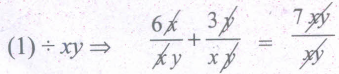
\(\cfrac { 6 }{ y } +\cfrac { 3 }{ x } =7\)

\(\cfrac { 3 }{ y } +\cfrac { 9 }{ x } =11\) ....(4)
In (3), (4) Put \(\cfrac { 1 }{ x } =a,\cfrac { 1 }{ y } =b\)
(3) \(\Rightarrow\) 36b + 3a = 7
(4) \(\Rightarrow\) 3b +9a = 11
(6) X (2) \(\Rightarrow\) 6b + 18a = 22
(5) \(\Rightarrow\) \(\cfrac { 6b+3a=7 }{ 15a=15 } \)
(3)-(2)
\(a=\cfrac { 15 }{ 15 } \)
Substitute a = 1 in (5)
6b + 3 (1) = 7
6b + 3 = 7
6b = 7 - 3
\(b=\cfrac { 4 }{ 6 } =\cfrac { 2 }{ 3 } \)
\(\therefore \ a=\cfrac { 1 }{ x } =1\Rightarrow x=1\)
\(b=\cfrac { 1 }{ y } =\cfrac { 2 }{ 3 } \Rightarrow y=\cfrac { 3 }{ 2 } \)
\(\therefore\) Solution x = 1; \(y=\cfrac { 3 }{ 2 } \)
(iv) Put \(\cfrac { 1 }{ x } =a\)
\(\cfrac { 4 }{ x } +5y=7\Rightarrow 4a+5y=7\) ....(1)
\(\cfrac { 3 }{ x } +4y=5\Rightarrow 3a+4y=5\) ...(2)
(1) \(\times\) 3 \(\Rightarrow\) 12a +15y = 21
(2) 4 \(\Rightarrow\) \(\cfrac { 12a+16y=20 }{ -1y=1 } \)
y = 1
Substitute y = -1 in (1)
4a + 5 (-1)=7
4a - 5 = 7
4a = 7 + 5
\(a=\cfrac { 12 }{ 4 } =3\)
\(a=\cfrac { 1 }{ x } =3\Rightarrow x=\cfrac { 1 }{ 3 } \)
\(\therefore\) y = -1
\(\therefore\) \(x=\cfrac { 1 }{ 3 } \) ; y = -1
(vi) 13x + 11y = 70 --------- (1)
11x + 13y = 74 --------- (2)
(1) \(\times\) 11 \(\Rightarrow\) 143x+121y = 770 .... (3)
(2) \(\times\) 13 \(\Rightarrow\) \(\cfrac { 143x+169y=962 }{ -48y=-192 } \) ....(4)
(3) - (4)
\(y=\cfrac { 192 }{ 48 } =4\)
Substitute y = 4 in (1) 48
13x + 11 (4) = 70
13x + 44 = 70
13x = 70 - 44 = 26
\(x=\cfrac { 26 }{ 13 } =2\)
\(\therefore\) x = 2; y = 4
4.
(i) 2x- 3y = 7 ...(1)
5x + y = 9
Step (1): From the equation (2)
5x + y = 9
y = -5x + 9 ..(3)
Step (2): substitute (3) in (1)
2x - 3(-5x + 9) = 7
2x + 15x -27 = 7
17x = 7 + 27
17x = 34
\(x=\cfrac { 34 }{ 17 } =2;x=2\)
Step (3): substitute x = 2 in (3)
y = -5(2) + 9
= 10 + 9 = -1
x = 2
y = -1
(ii) 1.5x + 0.1y = 6.2 ...(1)
3x - 0.4y = 11.2 ...(2)
Multiply (1)\(\times\) 10 \(\Rightarrow\)15x + y = 62 ...(1)
(2) \(\times\) 10 \(\Rightarrow\)30x - 4y = 112 ....(4)
Step (1): From equation (3)
15x+ y = 62
y = -15x + 62 ...(5)
Step (2): substitute (5) in (4)
30x - 4 (-15x + 62) =112
30x + 60x -248 = 112
90x = 112 + 248
90x = 360
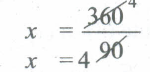
Step (3): substitute x = 4 in (5)
y = -15(4) + 62
= -60 + 62 = 2
x = 4
y = 2
(iii) 10% of x + 20% of y = 24; 3x - y = 20
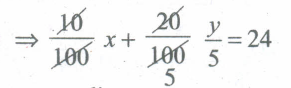
\(\cfrac { x }{ 10 } +\cfrac { y }{ 5 } =24\)
\(\cfrac { x+2y }{ 10 } =24\)
x + 2y = 240 ....(1)
3x-y = 20 ....(2)
Step (1): From equation (2)
Step (2): substitute (3) in (1)
x + 2 (3x - 20) = 240
x + 6x - 40 = 240
7x = 240 + 40
\(x=\cfrac { 280 }{ 7 } \)
x = 40
Step (3): substitute x = 40 in (3)
y = 3 (40) - 20
= 120 - 20 = 100
x = 40
y = 100
(iv) \(\sqrt { 2x } -\sqrt { 3y } =1\) ...(1)
\(\sqrt { 3x } -\sqrt { 8y } =0\) ..(2)
From the equation (2)
\(\sqrt { 3x } -\sqrt { 8y } =0\)
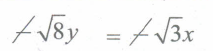
\(y=\ \cfrac { \sqrt { 3 } }{ \sqrt { 8 } } x\) ...(3)
Step (2): substitute (3) in (1)
\(\sqrt { 2x } -\sqrt { 3y } =1\)
\(\sqrt { 2x } -\sqrt { 3 } \left( \cfrac { \sqrt { 3 } }{ \sqrt { 8 } } \right) x=1\)
\(\cfrac { \sqrt { 2x } }{ 1 } -\cfrac { 3 }{ \sqrt { 8 } } x=1\)
\(\cfrac { \sqrt { 16x } -3x }{ \sqrt { 8 } } =\cfrac { 4x-3x }{ \sqrt { 8 } } =1\quad x=\sqrt { 8 } \)
Step (3): substitute x = \(\sqrt { 8 } \) in (1)
\(\sqrt { 2 } \left( \sqrt { 8 } \right) -\sqrt { 3y } =1\)
\(\sqrt { 16 } -\sqrt { 3y } =1\)
\(4-\sqrt { 3y } =1\)
\(-\sqrt { 3y } =1-4\)

\(x=\sqrt { 8 } \)
\(y=\sqrt { 3 } \)
5.
Let x be the digit at ten’s place and y be the digit at unit place.
Given that x + y = 5 …… (1)
| Tens | Ones | Value | |
| Given Number | x | y | 10x + y |
| New Number (after reversal) |
y | x | 10y + x |
Given, Original number − reversing number = 27
(10x + y) − (10y + x) = 27
10x − x + y −10y = 27
9x − 9y = 27
\(\Rightarrow\) x − y = 3 ... (2)
Also from (1), y = 5 – x ... (3)
Substitute (3) in (2) to get x − (5 − x) = 3
x − 5 + x = 3
2x = 8
x = 4
Substituting x = 4 in (3), we get y = 5 − x = 5 − 4
y = 1
Thus, 10x + y = 10 × 4 +1 = 40 +1 = 41.
Therefore, the given two-digit number is 41.
Verification :
sum of the digits = 5
x + y = 5
4 + 1 = 5
5 = 5 true
Original number – reversed number = 27
41 - 14 = 27
27 = 27 true
6.
Let us form table of values for each line and then fix the ordered pairs to be Plotted.
Graph of y = 7 - x
| x | -2 | -1 | 0 | 1 | 2 |
| y = 7 - x | 9 | 8 | 7 | 6 | 5 |
Points to be plotted : (-2, 9), (-1, 8), (0, 7), (1, 6), (2, 5)
Graph of y = x - 3
| x | -2 | -1 | 0 | 1 | 2 |
| y = x - 3 | -5 | -4 | -3 | -2 | -1 |
Points to be plotted (-2, -5), (-1, -4), (0, -3), (1, -2), (2, -1)
7.
Let us form table of values for each line and then fix the ordered pairs to be plotted.
Graph of 3x + 2y = 6
| x | -2 | 0 | 2 |
| y | 6 | 3 | 0 |
Points to be plotted:
(−2,6), (0,3), (2,0)
Graph of 6x + 4y = 8
| x | -2 | 0 | 2 |
| y | 5 | 2 | -1 |
Points to be plotted:
(-2, 5), (0, 2), (2, -1)
When we draw the graphs of these two equations, we find that they are parallel and they fail to meet to give a point of intersection. As a result there is no ordered pair that can be common to both the equations. In this case there is no solution to the system.
8.
Given x + y = 5 ...(1)
2x – y = 4 ...(2)
To draw the graph (1) is very easy. We can find the x and y intercepts and thus two of the points on the line (1).
When x = 0, (1) gives y = 5.
Thus A(0,5) is a point on the line.
When y = 0, (1) gives x = 5.
Thus B(5,0) is another point on the line.
Plot A and B; join them to produce the line (1).
To draw the graph of (2), we can adopt the same procedure.
When x = 0, (2) gives y = −4.
Thus P(0,−4) is a point on the line.
When y = 0, (2) gives x = 2.
Thus Q(2,0) is another point on the line.
Plot P and Q; join them to produce the line (2).
The point of intersection (3, 2) of lines (1) and (2) is a solution.
The solution is the point that is common to both the lines. Here we find it to be (3,2). We can give the solution as x = 3 and y = 2.
9.
(i) Let us prepare a table to find the ordered pairs of points for the line y = 3x −1.
We shall assume any value for x, for our convenience let us take −1, 0 and 1.
When x = −1, y = 3(–1)–1 = –4
When x = 0, y = 3(0)–1 = –1
When x = 1, y = 3(1)–1 = 2
| x | -1 | 0 | 1 |
| y | -4 | -1 | 2 |
The points (x,y) to be plotted :
(−1, −4), (0, −1) and (1, 2).
(ii) Let us prepare a table to find the ordered pairs of points for the line y =\(\left( \frac { 2 }{ 3 } \right) x+3\)
Let us assume −3, 0, 3 as x values.
(why?)
When x = -3, \(y=\frac { 2 }{ 3 } (-3)+3=1\)
When x = 0, \(y=\frac { 2 }{ 3 } (0)+3=3\)
When x =3, \(y=\frac { 2 }{ 3 } (3)+3=5\)
| x | -3 | 0 | 3 |
| y | 1 | 3 | 5 |
The points (x, y) to be plotted: (-3, 1), (0, 3) and (3, 5).
10.
We have already come across one method: forming a table of values, listing and plotting ordered pairs and joining the points.
But, to fix a line, after all, how many points do we need? Just two! These can easily be obtained when a line is given in the form y = mx + c.
The given line y = 4x – 3
put x = 0 to get y-intercept
y = 4(0)–3
y = –3
point is (0, –3) and y-intercept = – 3
put y = 0 to get x-intercept
0 = 4x – 3
3 = 4x
\(\frac { 3 }{ 4 } =x\)
point is \(\left( \frac { 3 }{ 4 } ,0 \right) \) and x-intercept = \(\frac { 3 }{ 4 } \)
The graph may be drawn through two points (0,−3) and \(\left( \frac { 3 }{ 4 } ,0 \right) \)

9th Standard Syllabus & Materials
9th Standard
TN 9th Tamil உள்ளத்தின் சீர் - திருக்குறள் Important Questions And Answers Study Material - QB365 Set A
NEW9th Standard
TN 9th Tamil உள்ளத்தின் சீர் - மணிமேகலை Important Questions And Answers Study Material - QB365 Set A
NEW9th Standard
TN 9th Tamil உள்ளத்தின் சீர் - ஏறு தழுவுதல் Important Questions And Answers Study Material - QB365 Set A
NEW9th Standard
TN 9th Tamil உயிருக்கு வேர் - தண்ணீர் Important Questions And Answers Study Material - QB365 Set A



Tamilnadu Stateboard 9th Standard Subjects
Tamilnadu Stateboard Standards





