
 100% FREE ACCESS
8th Standard Syllabus & Materials
8th Standard
TN 8th Tamil இயல் 3 - கல்வி கரையில - வினைமுற்று Important Questions And Answers Study Material - QB365 Set A
NEW8th Standard
TN 8th Tamil இயல் 2 - ஈடில்லா இயற்கை - மயங்கொலிகள் Important Questions And Answers Study Material - QB365 Set A
NEW8th Standard
TN 8th Tamil இயல் 2 - ஈடில்லா இயற்கை -பட்டமரம் Important Questions And Answers Study Material - QB365 Set A
NEW8th Standard
TN 8th Tamil இயல் 2 - ஈடில்லா இயற்கை - இயற்கையை போற்றுவோம் Important Questions And Answers Study Material - QB365 Set A
NEW8th Standard
TN 8th Tamil இயல் 1 - தமிழ் இன்பம் - ஆழிக்கு இணை Important Questions And Answers Study Material - QB365 Set A
NEW8th Standard
TN 8th Tamil இயல் 2-ஈடில்லா இயற்கை - திருக்குறள் Important Questions And Answers Study Material - QB365 Set A

Published on: 29/06/2019
Class 8th Standard New Syllabus Creative Question In Measurements Chapter
Download Tamil Nadu 8th Standard Maths question papers, model tests, one-mark questions, important questions, and public exam papers in PDF format. Free study materials and answer keys for TN State Board students.
Questions + Answers key
Take MCQ Maths Test1.
Using Euler’s formula, find the unknowns.
| S.No. | Faces | Vertices | Edges |
| (i) | ? | 6 | 14 |
| (ii) | 8 | ? | 10 |
| (iii) | 20 | 10 | ? |
2.
Guna has fixed a single door of 3 feet wide in his room where as Nathan has fixed a double door, each 1\(\frac{1}{2}\) feet wide in his room. From the closed state, if each of the single and double doors can open up to 1200, whose door requires a minimum area?
3.
Find the central angle of the shaded sectors (each circle is divided into equal sectors).
| Sectors |  |
 |
 |
 |
| Central angle of each sector (θ°) |
4.
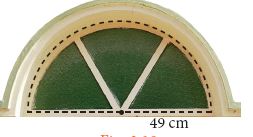
Pradeep wants to make a semicircular arch design at the entrance of his house with three equal sectors, as shown in the Fig.2.19 to be fitted in the iron frame. Find the length of the iron frame required and also the area of each of the sectors for which the mirrors to be fixed.
5.
Using graph sheet, draw the net for the cuboid whose length is 5 cm, breadth is 4 cm and height is 3 cm and also find its area.
6.
Draw the net for the cube of side 4 cm in a graph sheet.
7.
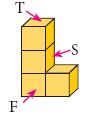
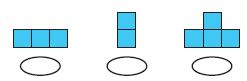
Draw the top, front and side view of the following solid shapes
8.
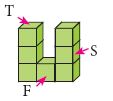
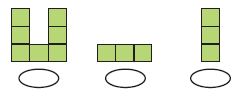
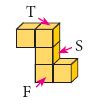
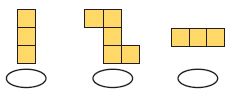
For each solid, three views are given. Identify for each solid, the corresponding top, front and side (T, F and S) views.
| Solid | Three views |
 |
 |
 |
 |
 |
 |
9.
Find the area of the combined figure given, which has two triangles attached to a rectangle.
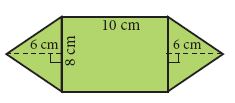
10.
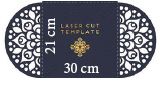
Find the area of an invitation card which has two semicircles attached to a rectangle as in the figure given. \(\left( \pi =\frac { 22 }{ 7 } \right) \)
11.
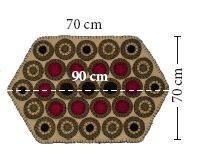
The door mat which is in a hexagonal shape has the following measures as given in the figure. Find its area.
12.
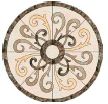
A circle is formed with 8 equal granite stones as shown in the figure each of radius 56 cm and whose central angle is 45º. Find the area of each of the granite\(\left( \pi =\frac { 22 }{ 7 } \right) \)
13.
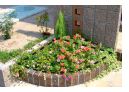
Infront of a house, flower plants are grown in a circular quardant shaped pot whose radius is 2 feet. Find the area of the pot in which the plants grow.( ㅠ = 3.14)
14.
Find the central angle of each of the sectors whose measures are given below. \(\left( \pi =\frac { 22 }{ 7 } \right) \)
| S.No | area (A) | length of the arc (l) | radius (r) |
| (i) | 462 cm2 | - | 21 cm |
| (iii) | 44 m | 35 m |
15.
From the measures given below, find the area of the sectors.
| S.No | length of the arc (l) | radius (r) |
| (i) | 48 m | 10 m |
| (ii) | 50 cm | 13.5 cm |
16.
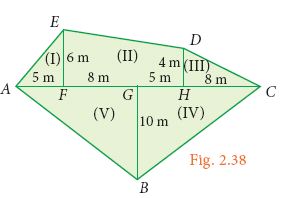
Find the area of the irregular polygon field whose measures are as given in the figure.
17.
Find the area of the shaded region in the square of side 10 cm as given in the figure. \(\left(\pi=\frac{22}{7}\right)\)
18.
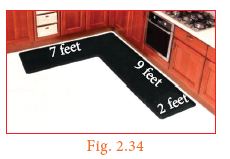
Seenu wants to buy a floor mat for his kitchen at home as given in the figure. If the cost of the mat is Rs. 20 per square foot, what will be the cost of the entire mat?
19.
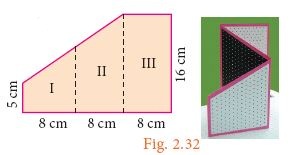
A 3- fold invitation card is given with measures as in the Figure. Find its area.
20.
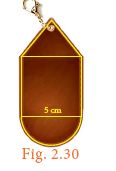
Nishanth has a key-chain which is in the form of an equilateral triangle and a semicircle attached to a square of side 5 cm as shown in the Figure. Find its area.(π = 3.14, √3 = 1.732)
21.
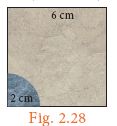
Find the area of the blue shaded and the grey shaded part of the given Figure. (π = 3.14)
1.
(i) Euler's formula is given by F + V - E = 2
(i) V = 6, E = 14
By Euler's formula = F + 6 -14 = 2
F = 2 + 14 - 6
F = 10
(ii) F = 8, E = 10
By Euler's formula 8 + V -10 = 2
V = 2- 8 + 10
V = 4
(iii) F = 20, y.= 10
By Euler's formula = 20 + 10 - E = 2
30-E = 2
E = 30- 2
E = 28
Tabulating the required unknowns
| S.No. | Faces | Vertices | Edges |
| (i) | 10 | 6 | 14 |
| (ii) | 8 | 4 | 10 |
| (iii) | 20 | 10 | 28 |
2.
Guna fixed a single door of 3 feet wide.
Radius of this single door = 3 feet.
Nathan fixed a double door each of 1 1/2 feet wide.
Radius of each of this double door
\(=\frac{3}{2} \text { feet. } \)
The area required for the single door
\(=\frac{\theta}{360} \times \pi r^{2} \)
\(=\frac{120}{360} \times 3.14 \times 3 \times 3 \)
= 9.42 m2 ............(i)
The area required for the double door
\(=2 \times \frac{\theta}{360} \times \pi r^{2} \)
\(=2 \times \frac{120}{360} \times 3.14 \times \frac{3}{2} \times \frac{3}{2} \)
= 4.71 m2 ........................(ii)
From (i) and (ii), the double door requires minimum area.
3.
| Sectors | |
|
|
|
| Central angle of each sector (θ°) | Number of equal parts n = 2; θ° = \(\frac{360^o}{n}=\frac{360^o}{2}\) θ° = 1800 |
n = 5 θ° = \( \frac{360^o}{n}\) θ° = \(\frac{360^o}{5 }\) θ° = 720 |
n = 8 θ° = \( \frac{360^o}{n}\) θ° = \( \frac{360^o}{8}\) θ° = 450 |
n = 10 θ° = \( \frac{360^o}{n}\) θ° = \( \frac{360^o}{10}\) θ° = 360 |
4.
(i) The length of the iron frame required = length of the arc + 4r
= πr + 4r
\(=\left( \frac { 22 }{ 7 } \times 49 \right) +(\times 49)\)
= 154 + 196
= 350 cm (approximately)
(ii) Area of each of the mirror sectors
\(=\frac { { \theta }^{ 0 } }{ { 360 }^{ 0 } } \times { \pi r }^{ 2 }\)
\(=\frac { { 60 }^{ 0 } }{ { 360 }^{ 0 } } \times \frac { 22 }{ 7 } \times 49\times 49\)
= 1257.67 sq.cm (approximately)
5.
Net for the cuboid is:
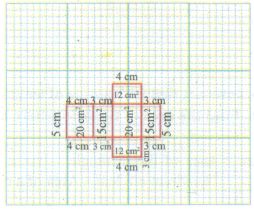
One of the possible nets for a cuboid of length = 5 cm, breadth = 4 cm, height = 3 cm is given above
Area of the cuboid = 20 cm2 + 15 cm2 + 20 cm2 + 15cm2 + 12cm2 + 12cm2
= 94cm2
Using formula,
Surface area of a cuboid = 2 (lb + bh + lh) unit2
= 2(5 x 4 + 4 x 3 + 5 x 3) cm2 = 2 (20 + 12 + 15) cm2
= 94cm2
6.
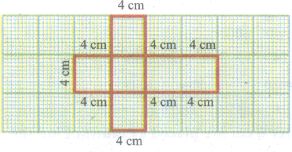
7.
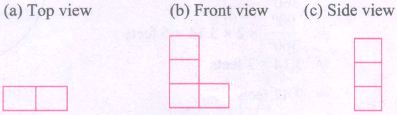
8.
(i) F, T, S
(ii) T, S,F
(iii) S, F, T
9.
Area of the combined shape = Area of the rectangle + Area of 2 triangles
Length of the rectangle I = 10cm
Breadth b = 8cm
Base of the triangle = 8cm
Height h = 6cm
∴ Area of the shape = (l x b) + (2 x \(\frac12\) x base x h) cm2
= (10 x 8) + (8 x 6) cm2 = 80 + 48 cm2 = 128 cm2
Area of the given shape = 128 cm2
10.
Area of the card = Area of the rectangle + area of 2 semicircles
Length of the rectangle I = 30 cm
Breadth b = 21 cm
Radius of the semicircle = \(\frac{21}{2}
\) cm
∴ Area of the card = (l x b) + \(\frac { 1 }{ 2 } \times 2\pi { r }^{ 2 }\)
= 30 x 21 + \(\frac { 22 }{ 7 } \times \frac { 21 }{ 2 } \times \frac { 21 }{ 2 } \) cm2 = 630 + 346.5
= 976.5cm2 (approximately)
∴ Area of the Invitation card = 976.5 cm2
11.
The given figure is the combination of the square and two triangle
b = 7cm, b = 70cm ,h = 10cm
The area of the shaded part
= Area of the square + Area of the two triangle
\(=\mathrm{b}^{2}+2 \times \frac{1}{2} \mathrm{bh}
\)
\(=(70 \times 70)+2 \times \frac{1}{2} \times 70 \times 10
\)
= 4900 + 700
= 5600 cm2
12.
From the given data the circle is divided into 8 equal sectors.
The central angle is 45o and radius = 56 cm
Area of each of the sectors
\(=\frac{\theta}{360} \times \pi \mathrm{r}^{2}
\)
\(=\frac{45}{360} \times \frac{22}{7} \times 56 \times 56
\)
= 1232 cm2
13.
Central angle of the quadrant = 90°
Radius of the circle = 2 feet
Area of the quadrant = \(\frac { { \theta }^{ o } }{ { 360 }^{ o } } \times { \pi r }^{ 2 }sq.units=\frac { { 90 }^{ o } }{ { 360 }^{ o } } \times \pi \times 2\times 2\times \)sq. feet
= \(\frac14\) x 3.14 x 4 = 3.14 sq. feet
Area of the quadrant = 3.14 sq. feet (approximately)
14.
i) Radius of the sector = 21 cm
Area of the sector = 462 cm2
\(\frac { lr }{ 2 } =462\)
\(\frac { l\times 21 }{ 2 } =\) 462
l = \(\frac { 462\times 2 }{ 21 } \)
l = 22 x 2
Length of the arc I = 44 cm
\(\frac { { \theta }^{ o } }{ { 360 }^{ o } } \times 2\pi r=44cm\)
\(\frac { { \theta }^{ o } }{ { 360 }^{ o } } \times 2\times \frac { 22 }{ 7 } \times 21\) = 44 cm
θo = \(\frac { 44\times 360\times 7 }{ 2\times 22\times 21 } \)
θo = 120o
(ii) Radius of the sector = 35 m
Length of the arc I = 44 m
\(\frac { { \theta }^{ o } }{ { 360 }^{ o } } \times 2\pi r=44cm\)
\(\frac { { \theta }^{ o } }{ { 360 }^{ o } } \times 2\times \frac { 22 }{ 7 } \times 35=44cm\)
θo = \(\frac { 44\times 360\times 7 }{ 2\times 22\times 35 } \)
θo = 72o
15.
(i) Area of the sector A = \(\frac { lr }{ 2 } \) sq. units
I = 48m
r = 10m
= \(\frac { 48\times 10 }{ 2 } \) m2
= 24 x 10 m2
= 240m2
Area of the sector = 240m2
(ii) Length ofthe arc l = 50 cm
Radius r = 13.5 cm
Area of the sector A = \(\frac { lr }{ 2 } \) sq. units
= \(\frac { 50\times 13.5 }{ 2 } \) cm2 = 25 x 13.5 cm2
= 337.5 cm2
Area of the sector = 337.5 cm2
16.
The given field has four triangles (I, III, IV & V) and a trapezium (II).
Area of the triangle (I) \(=\frac { 1 }{ 2 } \times b\times h=\frac { 1 }{ 2 } \times 5\times 6=15{ m }^{ 2 }\)
Area of the trapezium (II) \(=\frac { 1 }{ 2 } h(a+b)=\frac { 1 }{ 2 } \times 13\times (6+4)=65{ m }^{ 2 }\)
Area of the triangle (III) \(=\frac { 1 }{ 2 } \times b\times h=\frac { 1 }{ 2 } \times 8\times 4=\frac { 32 }{ 2 } =16{ m }^{ 2 }\)
Area of the triangle (IV) \(=\frac { 1 }{ 2 } \times b\times h=\frac { 1 }{ 2 } \times 13\times 10=65{ m }^{ 2 }\)
Area of the triangle (V) \(=\frac { 1 }{ 2 } \times b\times h=\frac { 1 }{ 2 } \times 13\times 10=65{ m }^{ 2 }\)
∴ The total area of the field = 15 + 65 + 16 + 65 + 65 = 226 m2
17.
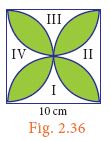
Mark the unshaded parts of the given figure as I, II, III and IV
Area of the I and III parts = Area of the square – Area of 2 semicircles
\(={ a }^{ 2 }-\left( 2\times \frac { 1 }{ 2 } { \pi r }^{ 2 } \right) \)
\(=(10\times 10)-\left( \frac { 22 }{ 7 } \times 5\times 5 \right) \) = 100 - 78.57 = 21.43 cm2
Similarly, the area of the II and IV parts = 21.43 cm2
∴ Area of the unshaded parts (I, II, III and IV)
= 21.43 x 2 = 42.86 cm2
∴ Area of the shaded part = area of the square – area of the unshaded parts
= 100 – 42.86 = 57.14 cm2
18.
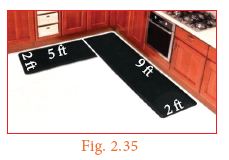
The mat given in the figure can be split into two rectangles as follows
∴ Area of the entire mat
= area of the I rectangle + area of the II rectangle
= (l1 x b1) + (l2 x b2)
= 5 x 2 + 9 x 2 = 10 + 18 = 28 sq.feet
Cost per sq. foot = Rs. 20
∴ The total cost of the entire mat = 28 x Rs. 20 = Rs. 560.
19.
Figures I and II are trapeziums separately as well as combinedly.
The parallel sides of the combined trapezium (I and II) are 5 cm and 16 cm. Its height, h = 8 + 8 = 16cm
Length of the rectangle = 16 cm
Breadth of the rectangle = 8 cm
∴ Area of the combined invitation card
= area of the combined trapezium + area of the rectangle
\(=\left( \frac { 1 }{ 2 } h\times (a+b) \right) +(l\times b)\)
\(\left( \frac { 1 }{ 2 } \times 16\times (5+16) \right) +(16\times 8)\)
= 168 + 128 = 296cm2
Aliter:
Area of the invitation card = area of the outer rectangle – area of the right angled triangle
\(= l\times b - \frac { 1 }{ 2 } \times h \times b \)
= \(24 \times16 \frac{1}{ 2} \times11 \times16\)
= − 384 88 296 = cm2
20.
Side of the square = 5 cm
Diameter of the semi-circle = 5 cm
∴ Radius = 2.5 cm
Side of the equilateral triangle = 5 cm
∴ Area of the keychain = area of the semi circle + area of the square + area of the equilateral triangle
\(=\frac { 1 }{ 2 } { \pi r }^{ 2 }+{ a }^{ 2 }+\frac { \sqrt { 3 } }{ 4 } { a }^{ 2 }\)
\(=\left( \frac { 1 }{ 2 } \times 3.14\times 2.5\times 2.5 \right) +\left( 5\times 5 \right) +\left( \frac { \sqrt { 3 } }{ 4 } \times 5\times 6 \right) \)
= 9.81 + 25 + 10.83
= 45.64cm2 (approx.)
21.
(i) Area of the blue shaded part = Area of the quadrant of a circle
\(=\frac { 1 }{ 4 } \times { \pi r }^{ 2 }\)
\(=\frac { 1 }{ 4 } \times 3.14\times 2\times 2\)
= 3.14 cm2 (approximately)
(ii) Area of the grey shaded part = Area of the square – Area of the blue shaded part
a2 - \(\frac{1}{4}\pi r^2\)
= 6 x 6 - 3.14
= 36 - 3.14
= 32.86 cm2 (approximately)

8th Standard Syllabus & Materials
8th Standard
TN 8th Tamil இயல் 3 - கல்வி கரையில - பாடறிந்து ஒழுகுதல் Important Questions And Answers Study Material - QB365 Set A
NEW8th Standard
TN 8th Tamil இயல் 3-கல்வி கரையில - பல்துறைக் கல்வி Important Questions And Answers Study Material - QB365 Set A
NEW8th Standard
TN 8th Tamil இயல் 3-கல்வி கரையில - புத்தியைத் தீட்டு Important Questions And Answers Study Material - QB365 Set A
NEW8th Standard
TN 8th Tamil இயல் 2 - ஈடில்லா இயற்கை - தமிழர் மருத்துவம் ( நேர்காணல்) Important Questions And Answers Study Material - QB365 Set A



Tamilnadu Stateboard 8th Standard Subjects
Tamilnadu Stateboard Standards




