
 100% FREE ACCESS
10th Standard Syllabus & Materials
10th Standard
TN 10th English Prose - 4 - The Attic Important Questions And Answers Study Material - QB365 Set A
NEW10th Standard
TN 10th English Supplementary - 3 - The Story of Mulan Important Questions And Answers Study Material - QB365 Set A
NEW10th Standard
TN 10th English Poem - 3 - I am Every Woman Important Questions And Answers Study Material - QB365 Set A
NEW10th Standard
TN 10th English Prose - 3 - Empowered Women Navigating The World Important Questions And Answers Study Material - QB365 Set A
NEW10th Standard
TN 10th English Supplementary - 2 - Zigzag Important Questions And Answers Study Material - QB365 Set A
NEW10th Standard
TN 10th English Poem - 2 - The Grumble Family Important Questions And Answers Study Material - QB365 Set A

Published on: 21/10/2019
Download Tamil Nadu 10th Standard Maths question papers, model tests, one-mark questions, important questions, and public exam papers in PDF format. Free study materials and answer keys for TN State Board students.
Questions + Answers key
Take MCQ Maths Test1.
Find the standard deviation for the following data. 5, 10, 15, 20, 25. And also find the new S.D. if three is added to each value.
2.
A and B are two events such that, P(A) = 0.42, P(B) = 0.48, P(A ∩ B) = 0.16. Find (i) P(not A) (ii) P(not B) (iii) P(A or B)
3.
A card is drawn from a pack of 52 cards. Find the probability of getting a king or a heart or a red card.
4.
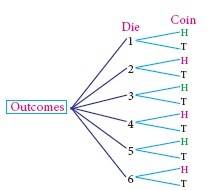
A die is rolled and a coin is tossed simultaneously. Find the probability that the die shows an odd number and the coin shows a head.
5.
What is the probability that a leap year selected at random will contain 53 saturdays. (Hint: 366 = 52 x 7 + 2)
6.
Two coins are tossed together. What is the probability of getting different faces on the coins?
7.
The mean of a data is 25.6 and its coefficient of variation is 18.75. Find the standard deviation.
8.
The range of a set of data is 13.67 and the largest value is 70.08. Find the smallest value.
9.
10.
C.V. of a data is 69%, S.D. is 15.6, then find its mean.
11.
In a class of 50 students, 28 opted for NCC, 30 opted for NSS and 18 opted both NCC and NSS. One of the students is selected at random. Find the probability that
(i) The student opted for NCC but not NSS.
(ii) The student opted for NSS but not NCC.
(iii) The student opted for exactly one of them.
12.
If A and B are two events such P(A) = \(\frac{1}{4}\), P(B) = \(\frac{1}{2}\) and P(A and B) = \(\frac{1}{8}\), find (i) P(A or B) (ii) P(not A and not B)
13.
Two dice are rolled together. Find the probability of getting a doublet or sum of faces as 4.
14.
The king and queen of diamonds, queen and jack of hearts, jack and king of spades are removed from a deck of 52 playing cards and then well shuffled. Now one card is drawn at random from the remaining cards. Determine the probability that the card is
(i) a clavor
(ii) a queen of red card
(iii) a king of black card.
15.
In a box there are 20 non-defective and some defective bulbs. If the probability that a bulb selected at random from the box found to be defective is \(\frac{3}{8}\) then, find the number of defective bulbs.
16.
Three fair coins are tossed together. Find the probability of getting
(i) all heads
(ii) atleast one tail
(iii) at most one head
(iv) at most two tails
17.
A bag contains 12 blue balls and x red balls. If one ball is drawn at random (i) what is the probability that it will be a red ball? (ii) If 8 more red balls are put in the bag, and if the probability of drawing a red ball will be twice that of the probability in (i), then find x.
18.
A bag contains 6 green balls, some black and red balls. Number of black balls is as twice as the number of red balls. Probability of getting a green ball is thrice the probability of getting a red ball. Find (i) number of black balls (ii) total number of balls.
19.
A bag contains 5 blue balls and 4 green balls. A ball is drawn at random from the bag. Find the probability that the ball drawn is (i) blue (ii) not blue.
20.
The temperature of two cities A and B in a winter season are given below.
| Temperature of city A (in degree Celsius) | 18 | 20 | 22 | 24 | 26 |
| Temperature of city B (in degree Celsius) | 11 | 14 | 15 | 17 | 18 |
Find which city is more consistent in temperature changes?
21.
The consumption of number of guava and orange on a particular week by a family are given below.
| Number of Guavas | 3 | 5 | 6 | 4 | 3 | 5 | 4 |
| Number of Oranges | 1 | 3 | 7 | 9 | 2 | 6 | 2 |
Which fruit is consistently consumed by the family?
22.
The mean and variance of seven observations are 8 and 16 respectively. If five of these are 2, 4, 10, 12 and 14, then find the remaining two observations.
23.
The rainfall recorded in various places of five districts in a week are given below..
| Rainfall (in mm) | 45 | 50 | 55 | 60 | 65 | 70 |
| Number of places | 5 | 13 | 4 | 9 | 5 | 4 |
Find its standard deviation.
24.
Find the variance and standard deviation of the wages of 9 workers given below: Rs.310, Rs.290, Rs.320, Rs.280, Rs.300, Rs.290, Rs.320, Rs.310, Rs.280.
25.
Find the mean and variance of the first n natural numbers.
26.
The amount of rainfall in a particular season for 6 days are given as 17.8 cm, 19.2 cm, 16.3 cm, 12.5 cm, 12.8 cm and 11.4 cm. Find its standard deviation.
1.
| x | d' = \(\frac { x-15 }{ 5 } \) | d'2 |
| 5 | -2 | 4 |
| 10 | -1 | 1 |
| 15 | 0 | 0 |
| 20 | 1 | 1 |
| 25 | 2 | 4 |
| Σd = 0 | Σd'2 = 10 |
\(\bar { x } =\frac { \Sigma x }{ n } =\frac { 75 }{ 5 } \)=15
d'=\(\frac { x-\bar { x } }{ c } =\frac { x-A }{ c } \)
A is assumed mean c is common factor.
Here A= 15, C = 5
σ =\(\sqrt { \left( \frac { \Sigma d'^{ 2 } }{ n } \right) -\left( \frac { \Sigma d' }{ n } \right) ^{ 2 } } \) x c
=\(\sqrt { \frac { 10 }{ 5 } -0 } \) x c
=\(\sqrt { 2 } \) x 5
= 5\(\sqrt { 2 } \)
If 3 is added to each value, we get 8, 13, 18,23, 28 as new values.
| x | d' = \(\frac { x-18 }{ 5 } \) | d'2 |
| 8 | -2 | 4 |
| 13 | -1 | 1 |
| 18 | 0 | 0 |
| 23 | 1 | 1 |
| 28 | 2 | 4 |
| Σd' = 10 | Σd'2 = 10 |
∴ σ =\(\sqrt { \left( \frac { \Sigma d'^{ 2 } }{ n } \right) -\left( \frac { \Sigma d' }{ n } \right) ^{ 2 } } \) x c
=\(\sqrt { \frac { 10 }{ 5 } -0 } \) x 5
=\(\sqrt { 2 } \) x 5
= 5\(\sqrt { 2 } \)
S.D. doesn't change when a number is added or subtracted to the values.
2.
(i) Given P(A) = 0.42
P(not A) = 1 - P(A)
\(\mathrm{P}(\bar{A})=1-0.42=0.58\)
(ii) Given P(B) = 0.48
P(not B) = 1 - P(B)
\(\mathrm{P}(\bar{B})=1-0.48=0.52\)
(iii) P(A or B) = \(P(A \cup B)\)
\(=\mathrm{P}(\mathrm{A})+\mathrm{P}(\mathrm{B})-\mathrm{P}(A \cap B)\)
= 0.42 + 0.48 - 015
= 0.90 - 0.16
P(A or B) = 0.74
3.
Total number of cards = 52; n(S) = 52
Let A be the event of getting a king card, n(A) = 4
P(A) = \(\frac { n(A) }{ n(S) } =\frac { 4 }{ 52 } \)
Let B be the event of getting a heart card. n(B) = 13
P(B) = \(\\ \frac { n(B) }{ n(S) } =\frac { 15 }{ 52 } \)
Let C be the event of getting a red card. n(C) = 26
P(C) = \(\frac { n(C) }{ n(S) } =\frac { 26 }{ 52 } \)
P(A ∩ B) = P (getting heart king) = \(\frac{1}{52}\)
P(B ∩ C) = P (getting red and heart)) = \(\frac{13}{52}\)
P(A ∩ C) = P (getting red king) = \(\frac{2}{52}\)
P(A ∩ B ∩ C) = (getting heart, king which is red = \(\frac{1}{52}\)
Therefore, required probability is
P(A U B U C) = P(A) + P(B) + P(C) - P(A ∩ B) - P(B ∩ C) - P(C ∩ A) + P(A ∩ B ∩ C)
=\(\frac { 4 }{ 52 } +\frac { 13 }{ 52 } +\frac { 26 }{ 52 } -\frac { 1 }{ 52 } -\frac { 13 }{ 52 } -\frac { 2 }{ 52 } +\frac { 1 }{ 52 } =\frac { 28 }{ 52 } =\frac { 7 }{ 13 } \).
4.
Sample space
S = {1H,1T,2H,2T,3H,3T,4H,4T,5H,5T,6H,6T};
n(S) = 12
Let A be the event of getting an odd number and a head.
A = {1H, 3H, 5H}; n(A) = 3
P(A) = \(\frac { n(A) }{ n(S) } =\frac { 3 }{ 12 } =\frac { 1 }{ 4 } \)
5.
leap year has 366 days. So it has 52 full weeks and 2 days. 52 Saturdays must be in 52 full weeks.
The possible chances for the remaining two days will be the sample space.
S = {(Sun-Mon, Mon-Tue, Tue-Wed, Wed-Thu, Thu-Fri, Fri-Sat, Sat-Sun)}
n(S) = 7
Let A be the event of getting 53rd Saturday.
Then A = {Fri-Sat, Sat-Sun}; n(A) = 2
Probability of getting 53 Saturdays in a leap year is P(A0 = \(\frac { n(A) }{ n(S) } =\frac { 2 }{ 7 } \).
6.
When two coins are tossed together, the sample space is
S = {HH, HT, TH, TT} n(S) = 4
Let A be the event of getting different faces on the coins.
A = {HT, TH}; n(A) = 2
Probability of getting different faces on the coins is P(A) = \(\frac { n(A) }{ n(S) } =\frac { 2 }{ 4 } =\frac { 1 }{ 2 } \).
7.
Mean \(\bar { x } \) = 25.6, Coefficient of variation, C.V. = 18.75
Coefficient of variation, C.V. = \(\frac { \sigma }{ \bar { x } } \) x 100%
18.75 = \(\frac { \sigma }{ 25.6 } \) x 100; σ = 4.8
8.
Range R = 13.67
Largest value L = 70.08
Range R = L - S
13.67 = 70.08-S
S = 70.08 - 13.67 = 56.41
Therefore, the smallest value is 56.41
9.
10.
CV =\(\frac { \sigma }{ \bar { x } } \) x 100 ⇒ \(\bar { x } =\frac { \sigma }{ CV } \) x 100
\(\bar { x } =\frac { 15.6 }{ 6.9 } \) x 100 = 22.6
11.
Total number of students n(S) = 50.
Let A and B be the events of students opted for NCC and NSS respectively.
n(A) = 28, n(B) = 30, n(A⋂B) = 18
P(A) = \(\frac { n(A) }{ n(S) } =\frac { 28 }{ 50 } \)
P(B) = \(\frac { n(B) }{ n(S) } =\frac { 30 }{ 50 } \)
P(A∩B) = \(\frac { n(A\cap B) }{ n(S) } =\frac { 18 }{ 50 } \)
(i) Probability of the students opted for NCC but not NSS
P(A ∩ \(\bar { B } \)) = P(A) - P(A ∩ B) = \(\frac { 28 }{ 50 } -\frac { 18 }{ 50 } =\frac { 1 }{ 5 } \)
(ii) Probability of the students opted for NSS but not NCC.
P(A ∩ \(\bar { B } \)) = P(B) - P(A ∩ B) = \(\frac { 30 }{ 50 } -\frac { 18 }{ 50 } =\frac { 6 }{ 25 } \)
(iii) Probability of the students opted for exactly one of them
= P[(A ∩ \(\bar { B } \)) U (\(\bar { A } \) ∩ B)]
= P(A ∩ \(\bar { B } \)) + P(\(\bar { A } \) ∩ B) =\(\frac { 1 }{ 5 } +\frac { 6 }{ 25 } =\frac { 11 }{ 25 } \)
(Note that (A ∩ \(\bar { B } \)),(\(\bar { A } \) ∩ B) are mutually exclusive events)
12.
(i) P(A or B) = P(AUB)
= P(A) + P(B) - P(A∩B)
P(A or B) = \(\frac { 1 }{ 4 } +\frac { 1 }{ 2 } -\frac { 1 }{ 8 } =\frac { 5 }{ 8 } \)
(ii) P(not A and not B) = \(P(\bar { A } \cap \bar { B } )\)
=\(P(\overline { A\cup B) } \)
= 1 - P(AUB)
P(not A and not B) = 1-\(\frac { 5 }{ 8 } =\frac { 3 }{ 8 } \).
13.
When two dice are rolled together, there will be 6 x 6 = 36 outcomes. Let S be the sample space. Then n(S) = 36.
Let A be the event of getting a doublet and B be the event of getting face sum 4.
Then A = {(1,1),(2,2),(3,3),(4,4),(5,5),(6,6)}
B = {(1,3),(2,2),(3,1)
Therefore, A∩B = {(2,2)}
Then, n(A) = 6, n(B) = 3, n(A∩B) = 1
P(A) = \(\frac { n(A) }{ n(S) } =\frac { 6 }{ 36 } \)
P(B) = \(\frac { n(B) }{ n(S) } =\frac { 3 }{ 36 } \)
P(A∩B) = \(\frac { n(A\cap B) }{ n(S) } =\frac { 1 }{ 36 } \)
Therefore, P (getting a doublet or a total of 4) = P(AUB)
P(AUB) = P(A) + P(B) - P(A∩B)
=\(\frac { 6 }{ 36 } +\frac { 3 }{ 36 } -\frac { 1 }{ 36 } =\frac { 8 }{ 36 } =\frac { 2 }{ 9 } \)
Hence, the required probability is \(\frac { 2 }{ 9 } \).
14.
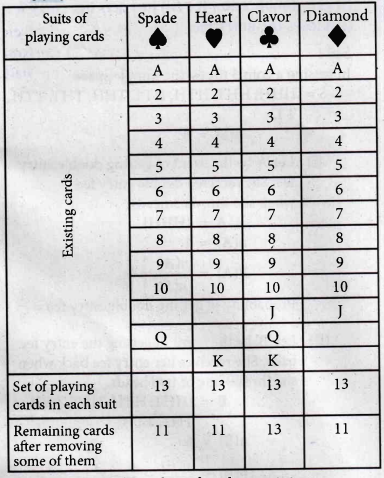
Total number of cards remaining
= 11 + 11 + 13 + 11 = 46
n(S) = 46
(i) Let A be the event of getting a clavor card
n(A) = 13
\(\mathrm{P}(\mathrm{A})=\frac{n(A)}{n(S)}=\frac{13}{46}\)
(ii) Let B be the event of getting queen of red card
n(B) = 0 (Removed red queens)
\(\mathrm{P}(\mathrm{B})=\frac{n(B)}{n(S)}=0\)
(iii) Let C be the event of getting a king of black card
n(C) = 1
\(\mathrm{P}(\mathrm{C})=\frac{n(C)}{n(S)}=\frac{1}{46}\)
15.
Number of non defective bulbs = 20.
Let x be the number of defective bulbs
Then total number of bulbs n(s) = 20 + x
Let 'A' be the event of getting defective bulbs
\(\mathrm{P}(\mathrm{A})=\frac{x}{20+x}=\frac{3}{8}\)
8x = 3 (20 + x)
8x = 60 + 3x
8x - 3x = 60
5x = 60
\(x=\frac{60}{5}\)
x = 12
Number of defective bulbs = 12
16.
When three fair coins are tossed together, the sample space
S = {(HHH), (THH), (HTH),(HHT), (TTH), (THT), (HTT), (TTT)}
N(s) = 8
(i) Let A be the event of getting all heads
A = {HHH}
n(A) = 1
\(P(A)=\frac{n(A)}{n(S)}=\frac{1}{8}\)
(ii) Let B be the event of getting atleast one tail
B = {HHT, HTH, HTT, THH, THT, TTH, TTT}
n(B) = 7
\(\mathrm{P}(\mathrm{B})=\frac{n(B)}{n(S)}=\frac{7}{8}\)
(iii) Let C be the event of getting at most one head
C = {HTT, THT, TTH, TTT}
n(C) = 4
\(\mathrm{P}(\mathrm{C})=\frac{n(C)}{n(S)}=\frac{4}{8}=\frac{1}{2}\)
(iv) Let D be the event of getting at most two tails
P = {HHH, HHT, HTH, HTT, THH, THT, TTH}
n(D) = 7
\(\mathrm{P}(\mathrm{D})=\frac{n(D)}{n(S)}=\frac{7}{8}\)
17.
Total number of balls = blue balls + red balls
n(S) = 12 + x
(i) The probability that it will be a red ball:
Let A be the event of selecting a red ball
n(A) = x
\(\mathrm{P}(\mathrm{A})=\frac{n(A)}{n(S)} \)
\(\mathrm{P}(\mathrm{A})=\frac{x}{12+x} \)
(ii) If 8 more red balls are put in the bag then the number of red balls = x + 8
Total number of balls = 12 + x + 8
Probability of drawing a red ball
\(\mathrm{P}(\mathrm{B}) =\frac{n(B)}{n(S)} \)
\(=\frac{x+8}{12+x+8}=\frac{x+8}{x+20} \)
If the probability of drawing a red ball will be twice that of the probability (i), then
\(\frac{x+8}{x+20}=2 \times\left[\frac{x}{12+x}\right]\)
(x + 8)(12 + x) = 2x (x + 20)
12x + 96 + x2 + 8x = 2x2 + 40x
2x2 - x2 + 40x - 12x - 8x - 96 = 0
x2 + 20x - 96 = 0
(x - 4) (x + 24) = 0
x = 4 and x = - 24 (not possible)
By applying the value of x in P(A)
we get P(A) \(=\frac{4}{12+4}=\frac{4}{16}\)
\(P(A)=\frac{1}{4}\)
x = 4
18.
Number of green balls is n(G) = 6
Let number of red balls is n(R) = x
Therefore, number of black balls is n(B) = 2x
Total number of balls n(S) = 6 + x + 2x = 6 + 3x
It is given that, P(G) = 3 x P(R)
\(\frac { 6 }{ 6+3x } =3\times \frac { x }{ 6+3x } \)
3x = 6 gives, x = 2
(i) Number of black balls = 2 x 2 = 4
(ii) Total number of balls = 6 + (3 x 2) = 12
19.
Total number of possible outcomes n(S) = 5 + 4 = 9
(i) Let A be the event of getting a blue ball.
Number of favourable outcomes for the event A. Therefore, n(A) = 5
Probability that the ball drawn is blue. Therefore, P(A) = \(\frac { n(A) }{ n(S) } =\frac { 5 }{ 9 } \)
(ii) \(\bar { A } \) will be the event of not getting a blue ball. So P(\(\bar { A } \)) = 1 - P(A) = \(1-\frac { 5 }{ 9 } =\frac { 4 }{ 9 } \).
20.
| City A | City B | ||||
|---|---|---|---|---|---|
| x1 | \({ d }_{ 1 }=x-\bar { x } \) | \({ d }_{ 1 }^{ 2 }\) | x1 | \(d=x-\bar { x } \) | \({ d }_{ 1 }^{ 2 }\) |
| 18 | -4 | 16 | 11 | -4 | 16 |
| 20 | -2 | 4 | 14 | -1 | 1 |
| 22 | 0 | 0 | 15 | 0 | 0 |
| 24 | 2 | 4 | 16 | 3 | 4 |
| 26 | 4 | 16 | 18 | 3 | 9 |
| 110 | 0 | 40 | 75 | 20 | |
\(\bar { { x }_{ 1 } } =\frac { { \Sigma x }_{ 1 } }{ n } \)
= \(\frac { 110 }{ 5 } \)
= 22
\({ \sigma }_{ 1 }=\sqrt { \frac { { \Sigma d }_{ 1 }^{ 2 } }{ n } } \)
= \(\sqrt { \frac { 40 }{ 5 } } \)
= \(\sqrt { 8 } \)
\(\bar { { x }_{ 2 } } =\frac { { \Sigma x }_{ 1 } }{ n } \)
= \(\frac { 75 }{ 5 } \)
= 15
\({ \sigma }_{ 2 }=\sqrt { \frac { { \Sigma d }_{ 2 }^{ 2 } }{ n } } \)
= \(\sqrt { \frac { 20 }{ 5 } } \)
= \(\sqrt { 4 } \)
= \(2\sqrt { 2 } \)
\(CV_{ 1 }=\frac { { { \sigma }_{ 1 } } }{ { x }_{ 1 } } \times 100\)
= \(\frac { 2.83 }{ 22 } \times 100\)
= 12.86
\({ CV }_{ 2 }=\frac { { \sigma }_{ 2 } }{ \bar { { x }_{ 2 } } } \times 100\)
= \(\frac { 2 }{ 15 } \times 100\)
= 13.33
\(\therefore\)Co-efficient of variation of City A is less than C.V of City B.
\(\therefore\) City A is more consistent.
21.
First we find the coefficient of variation for guavas and oranges separately.
Number of guavas, n=7
| xi | xi2 |
| 3 | 9 |
| 5 | 25 |
| 6 | 36 |
| 4 | 16 |
| 3 | 9 |
| 5 | 25 |
| 4 | 16 |
| Σxi=30 | Σxi2=136 |
Mean \(\bar { { x }_{ 1 } } \)=\(\frac { 30 }{ 7 } \)=4.29
Standard deviation σ1=\(\sqrt { \frac { \Sigma { x }_{ i }^{ 2 } }{ n } -\left( \frac { { \Sigma x }_{ i } }{ n } \right) ^{ 2 } } \)
σ1=\(\sqrt { \frac { 136 }{ 7 } -\left( \frac { 30 }{ 7 } \right) ^{ 2 } } =\sqrt { 19.43-18.40 } \) ≃ 1.01
Coefficient of variation for guavas
C.V1=\(\frac { { \sigma }_{ 1 } }{ \bar { { x }_{ 1 } } } \times 100\)% = \(\frac { 1.01 }{ 4.29 } \) x 100% =23.54%
| xi | xi2 |
| 1 | 1 |
| 3 | 9 |
| 7 | 49 |
| 9 | 81 |
| 2 | 4 |
| 6 | 36 |
| 2 | 4 |
| Σxi=30 | Σxi2=184 |
Number of oranges n=7
Mean \(\bar { { x }_{ 2 } } \)=\(\frac { 30 }{ 7 } \)=4.29
Standard deviation σ1=\(\sqrt { \frac { \Sigma { x }_{ i }^{ 2 } }{ n } -\left( \frac { { \Sigma x }_{ i } }{ n } \right) ^{ 2 } } \)
σ2=\(\\ \sqrt { \frac { 184 }{ 7 } -\left( \frac { 30 }{ 7 } \right) ^{ 2 } } =\sqrt { 26.29-18.40 } \)=2.81
Coefficient of variation for oranges
C.V1=\(\frac { { \sigma }_{ 2 } }{ \bar { { x }_{ 2 } } } \) x 100% = \(\frac { 2.81 }{ 4.29 } \) x 100% = 65.50%
CV1=23.54%, CV2=65.50%. Since, C.V1 < C.V2, we can conclude that the consumption of guavas is more consistent than oranges.
22.
Mean = 8
Variance = 16.
Let a and b be the missing observations
\(\frac{\text { Sum of observations }}{\text { Number of observations }}=\text { Mean }\)
\(\frac{2+4+10+12+14+a+b}{7}=8\)
42 + a + b = 56
a + b = 56 - 42 = 14
b = 14 - a
Variance \(=\frac{\sum_{i=1}^{n}\left(x_{i}-\bar{x}\right)^{2}}{n}
\)
\(= \frac{\sum_{i=1}^{7}\left(x_{i}-\bar{x}\right)^{2}}{7}
\)
\(=\frac{(2-8)^{2}+(4-8)^{2}+(10-8)^{2}+(12-8)^{2}+(14-8)^{2}+(a-8)^{2}+(b-8)^{2}}{7}\)
\(16=\frac{36+16+4+16+36+(a-8)^{2}+(b-8)^{2}}{7}\)
108 + (a - 8)2 + (b - 8)2 = 112
(a - 8)2 + (b - 8)2 = 4 ..(2)
Put b = 14 - a in (2)
(a - 8)2 + (b - 8)2 = 4
(a - 8)2 + (14 - a ) - 8)2 = 4
(a - 8 )2 + (6 - a)2 = 4
a2 + 64 - 16a + 36 + a2 - 12a - 4 = 0
2a2 - 28a + 96 = 0
Divided by 2,
a2 - 14a + 48 = 0
(a - 6) (a - 8) = 0
a = 6 or a = 8
a = 6 , b = 14, a = 14 - 6 = 8
a = 6 and b = 8
Remaining numbers are 6 and 8.
23.
| x1 | f1 | di = xi - A di = xi - 55 |
fidi | \({ d }_{ i }^{ 2 }\) | \({ f }_{ i }{ d }_{ i }^{ 2 }\) |
|---|---|---|---|---|---|
| 45 | 5 | -10 | -50 | 100 | 500 |
| 50 | 13 | -5 | -65 | 25 | 325 |
| 55 | 4 | 0 | 0 | 0 | 0 |
| 60 | 9 | 5 | 45 | 25 | 225 |
| 65 | 5 | 10 | 50 | 100 | 500 |
| 70 | 4 | 15 | 60 | 225 | 900 |
| \(\Sigma f_{i}\) = 40 | \(\Sigma f_{i} d_{i}\) = 40 | \(\Sigma f_{i} d_{i}^{2}\) = 2450 |
N = 40
Standard deviation \(\sigma=\sqrt{\frac{\sum f_{i} d_{i}^{2}}{N}-\left(\frac{\sum f_{i} d_{i}}{N}\right)^{2}}\)
\(=\sqrt{\frac{2450}{40}-\left(\frac{40}{40}\right)^{2}}=\sqrt{61.25-1^{2}} \)
\(=\sqrt{61.25-1}=\sqrt{60.25} \)
Standard deviation \(\sigma=7.76\)
24.
Arranging the numbers in ascending order
Rs. 280, Rs. 280, Rs. 290,Rs. 290, Rs. 300, Rs. 310, Rs. 310, Rs. 320, Rs. 320
\(
\text { Mean } =\frac{280+280+290+290+300+310+310+320+320}{9}
\)
\(\bar{x} =\frac{2700}{9}=300\)
| x | \(d=x-\bar { x } \) \(=x_{i}-300\) | d2 |
|---|---|---|
| 310 | 10 | 100 |
| 290 | -10 | 100 |
| 320 | 20 | 400 |
| 280 | -20 | 400 |
| 300 | 0 | 0 |
| 290 | -10 | 100 |
| 320 | 20 | 400 |
| 310 | 10 | 100 |
| 280 | -20 | 400 |
| \(\Sigma x=2700\) | 0 | 2000 |
Standard Deviation
\(
\sigma =\sqrt{\frac{\Sigma d_{i}^{2}}{n}}
\)
\(\sigma =\sqrt{\frac{2000}{9}}
\)
\(\sigma=\sqrt{222.222 \ldots} =14.907=14.91
\)
\(\text { We have } \sigma =\sqrt{222.222}
\)
\(\text { Variance } \sigma^{2} =222.22\)
Variance = 222.22;
Standard deviation = 14.91
25.
Mean \(\bar { x } \) = \(\frac { Sum\ of\ all\ observations }{ Number\ of\ observation } \)
= \(\frac { \Sigma x_{ i } }{ n } =\frac { 1+2+3+...+n }{ n } =\frac { n(n+1) }{ 2\times n } \)
Mean \(\bar { x } \) = \(\frac { n+1 }{ 2 } \)
Variance σ2 = \(\frac { \Sigma x_{ i }^{ 2 } }{ n } -\left( \frac { \Sigma x_{ i } }{ n } \right) ^{ 2 }\left[ \begin{matrix} \Sigma x_{ i }^{ 2 }={ 1 }^{ 2 }+{ 2 }^{ 2 }+{ 3 }^{ 2 }+...+{ n }^{ 2 } \\ (\Sigma x_{ i })^{ 2 }=(1+2+3+...+n)2 \end{matrix} \right] \)
= \(\frac { n(n+1)(2n+1) }{ 6\times n } -\left[ \frac { n(n+1) }{ 2\times n } \right] ^{ 2 }\)
= \(\frac { 2n^{ 2 }+3n+1 }{ 6 } -\frac { { n }^{ 2 }+2n+1 }{ 4 } \)
Variance σ2 = \(\frac { 4n^{ 2 }+6n+2-3n^{ 2 }-6n-3 }{ 12 } =\frac { { n }^{ 2 }-1 }{ 12 } \).
26.
Arranging the numbers in ascending order we get, 11.4, 12.5, 12.8, 16.3, 17.8, 19.2 Number of observations
n = 6
Mean = \(\frac { 11.4+12.5+12.8+16.3+17.8+19.2 }{ 6 } =\frac { 90 }{ 6 } \)=15
| xi | di = xi - \(\bar { x } \) = x - 15 | \({ \Sigma d }_{ i }^{ 2 }\) |
| 11.4 | -3.6 | 12.96 |
| 12.5 | -2.5 | 6.25 |
| 12.8 | -2.2 | 4.84 |
| 16.3 | 1.3 | 1.69 |
| 17.8 | 2.8 | 7.84 |
| 19.2 | 4.2 | 17.64 |
| \({ \Sigma d }_{ i }^{ 2 }\) = 51.22 |
Standard deviation σ = \(\sqrt { \frac { { \Sigma d }_{ i }^{ 2 } }{ n } } \)
=\(\sqrt { \frac { 51.22 }{ 6 } } =\sqrt { 8.53 } \)
Hence, σ ≃2.9
Assumed Mean method:
When the mean value is not an integer (since calculations are very tedious in decimal form) then it is better to use the assumed mean method to find the standard deviation.
Ler x1, x2, x3, .....xn be the given data values and let \(\bar { x } \) be their mean
Let di be the deviation of xi from the assumed mean A, which is usually the middle value or near the middle value of the given data.
di = xi - A gives, xi = di + A ...(1)
Σdi = Σ(xi - A)
= Σxi-(A + A + A + ..to n times)
Σdi = Σxi - A x n
\(\frac { \Sigma { d }_{ i } }{ n } =\frac { \Sigma { x }_{ i } }{ n } \) - A
\(\bar { d } \) = \(\bar { x } \) - A (or) \(\bar { x } \) = \(\bar { d } \)+ A ..(2)
Now, Standard deviation
σ = \(\\ \sqrt { \frac { \Sigma ({ x }_{ i }-\bar { x } )^{ 2 } }{ n } } =\sqrt { \frac { \Sigma ({ d }_{ i }+A-\bar { d } -A)^{ 2 } }{ n } } \) (using (1) and (2))
= \(\sqrt { \frac { \Sigma (d_{ i }-\bar { d } )^{ 2 } }{ n } } =\sqrt { \frac { \Sigma ({ d }_{ i }^{ 2 }+2d_{ i }-\bar { d } -\bar { d } ^{ 2 }) }{ n } } \)
= \(\sqrt { \frac { { \Sigma d }_{ i }^{ 2 } }{ n } -2\bar { d } \frac { \Sigma { d }_{ i } }{ n } +\frac { { \bar { d } }^{ 2 } }{ n } (1+1+1+...to\quad n\quad times) } \)
\(=\sqrt { \frac { { \Sigma d }_{ i }^{ 2 } }{ n } -2\bar { d } \times \bar { d } +\frac { { \bar { d } }^{ 2 } }{ n } \times n } \) (since \(\bar { d } \) is a constant)
= \(\sqrt { \frac { { \Sigma d }_{ i }^{ 2 } }{ n } -{ \bar { d } }^{ 2 } } \)
Standard deviationσ = \(\sqrt { \frac { { \Sigma d }_{ i }^{ 2 } }{ n } -\left( \frac { { \Sigma d }_{ i } }{ n } \right) ^{ 2 } } \).

10th Standard Syllabus & Materials
10th Standard
TN 10th English Prose - 2 - The Night the Ghost Got in Important Questions And Answers Study Material - QB365 Set A
NEW10th Standard
TN 10th English Supplementary - 1 - The Tempest Important Questions And Answers Study Material - QB365 Set A
NEW10th Standard
TN 10th English Poem - 1 - Life Important Questions And Answers Study Material - QB365 Set A
NEW10th Standard
TN 10th English Prose - 1 - His First Flight Important Questions And Answers Study Material - QB365 Set A



Tamilnadu Stateboard 10th Standard Subjects
Tamilnadu Stateboard Standards





