
 100% FREE ACCESS
10th Standard Syllabus & Materials
10th Standard
TN 10th English Prose - 4 - The Attic Important Questions And Answers Study Material - QB365 Set A
NEW10th Standard
TN 10th English Supplementary - 3 - The Story of Mulan Important Questions And Answers Study Material - QB365 Set A
NEW10th Standard
TN 10th English Poem - 3 - I am Every Woman Important Questions And Answers Study Material - QB365 Set A
NEW10th Standard
TN 10th English Prose - 3 - Empowered Women Navigating The World Important Questions And Answers Study Material - QB365 Set A
NEW10th Standard
TN 10th English Supplementary - 2 - Zigzag Important Questions And Answers Study Material - QB365 Set A
NEW10th Standard
TN 10th English Poem - 2 - The Grumble Family Important Questions And Answers Study Material - QB365 Set A

Published on: 26/10/2019
Download Tamil Nadu 10th Standard Maths question papers, model tests, one-mark questions, important questions, and public exam papers in PDF format. Free study materials and answer keys for TN State Board students.
Questions + Answers key
Take MCQ Maths Test1.
If A = \(\begin{pmatrix} 2 & -2\sqrt { 2 } \\ \sqrt { 2 } & 2 \end{pmatrix}\) and B = \(\begin{pmatrix} 2 & 2\sqrt { 2 } \\ -\sqrt { 2 } & 2 \end{pmatrix}\)
Show that A and B satisfy commutative property with respect to matrix multiplication.
2.
Let A = \(\left[ \begin{matrix} 1 & 2 \\ 1 & 3 \end{matrix} \right] \), B = \(\left[ \begin{matrix} 4 & 0 \\ 1 & 5 \end{matrix} \right] \), C = \(\left[ \begin{matrix} 2 & 0 \\ 1 & 2 \end{matrix} \right] \) Show that (A − B)C = AC − BC
3.
If A = \(\left[ \begin{matrix} 1 & 8 & 3 \\ 3 & 5 & 0 \\ 8 & 7 & 6 \end{matrix} \right] \), B = \(\left[ \begin{matrix} 8 & -6 & -4 \\ 2 & 11 & -3 \\ 0 & 1 & 5 \end{matrix} \right] \), C = \(\left[ \begin{matrix} 5 & 3 & 0 \\ -1 & -7 & 2 \\ 1 & 4 & 3 \end{matrix} \right] \) compute the following
\(\\ \frac { 1 }{ 2 } A-\frac { 3 }{ 2 } B\)
4.
If \(A=\left[\begin{array}{lll} 5 & 2 & 9 \\ 1 & 2 & 8 \end{array}\right], B=\left[\begin{array}{rr} 1 & 7 \\ 1 & 2 \\ 5 & -1 \end{array}\right]\) verify that (AB)T = BT A T
5.
If A = \(\left[ \begin{matrix} a & b \\ c & d \end{matrix} \right] \) and I = \(\left[ \begin{matrix} 1 & 0 \\ 0 & 1 \end{matrix} \right] \) show that A2 - (a + d) A = (bc - ad)I2
6.
If A = \(\left[ \begin{matrix} 1 & 2 & 1 \\ 2 & -1 & 1 \end{matrix} \right] \) and B = \(\left[ \begin{matrix} 2 & -1 \\ -1 & 4 \\ 0 & 2 \end{matrix} \right] \) show that (AB)T = BTAT
7.
If A = \(\left[ \begin{matrix} 2 & 1 \\ 1 & 3 \end{matrix} \right] \), B = \(\left[ \begin{matrix} 2 & 0 \\ 1 & 3 \end{matrix} \right] \) find AB and BA. Check if AB = BA
8.
Find the non-zero values of x satisfying the matrix equation \(x\left[ \begin{matrix} 2x & 2 \\ 3 & x \end{matrix} \right] +2\left[ \begin{matrix} 8 & 5x \\ 4 & 4x \end{matrix} \right] =2\left[ \begin{matrix} { x }^{ 2 }+8 & 24 \\ 10 & 6x \end{matrix} \right] \)
9.
If A = \(\left[ \begin{matrix} 1 & 8 & 3 \\ 3 & 5 & 0 \\ 8 & 7 & 6 \end{matrix} \right] \), B = \(\left[ \begin{matrix} 8 & -6 & -4 \\ 2 & 11 & -3 \\ 0 & 1 & 5 \end{matrix} \right] \), C = \(\left[ \begin{matrix} 5 & 3 & 0 \\ -1 & -7 & 2 \\ 1 & 4 & 3 \end{matrix} \right] \) compute the following
3A + 2B - C
10.
A = \(\left( \begin{matrix} 3 & 0 \\ 4 & 5 \end{matrix} \right) \), B = \(\left( \begin{matrix} 6 & 3 \\ 8 & 5 \end{matrix} \right) \), C = \(\left( \begin{matrix} 3 & 6 \\ 1 & 1 \end{matrix} \right) \) find the matrix D, such that CD – AB = 0
11.
If A = \(\left[ \begin{matrix} 1 & 3 & -2 \\ 5 & -4 & 6 \\ -3 & 2 & 9 \end{matrix} \right] \), B = \(\left[ \begin{matrix} 1 & 8 \\ 3 & 4 \\ 9 & 6 \end{matrix} \right] \), find A + B.
12.
Find the value of a, b, c, d from the equation \(\left( \begin{matrix} a-b & 2a+c \\ 2a-b & 3c+d \end{matrix} \right) =\left( \begin{matrix} 1 & 5 \\ 0 & 2 \end{matrix} \right) \)
13.
Construct a 3 x 3 matrix whose elements are aij = i2j2
1.
We have to show that AB = BA
\(LHS\quad AB=\begin{pmatrix} 2 & -2\sqrt { 2 } \\ \sqrt { 2 } & 2 \end{pmatrix}\times \begin{pmatrix} 2 & 2\sqrt { 2 } \\ -\sqrt { 2 } & 2 \end{pmatrix}\)
\(=\left( \begin{matrix} 4+4 & 4\sqrt { 2 } -4\sqrt { 2 } \\ 2\sqrt { 2 } -2\sqrt { 2 } & 4+4 \end{matrix} \right) \)
\(=\left( \begin{matrix} 8 & 0 \\ 0 & 8 \end{matrix} \right) \)
\(RHS\quad AB=\begin{pmatrix} 2 & 2\sqrt { 2 } \\ -\sqrt { 2 } & 2 \end{pmatrix}\times \begin{pmatrix} 2 & -2\sqrt { 2 } \\ \sqrt { 2 } & 2 \end{pmatrix}\)
\(=\left( \begin{matrix} 4+4 & -4\sqrt { 2 } +4\sqrt { 2 } \\ -2\sqrt { 2 } +2\sqrt { 2 } & 4+4 \end{matrix} \right) \)
\(=\left( \begin{matrix} 8 & 0 \\ 0 & 8 \end{matrix} \right) \)
Hence LHS = RHS (i.e.) AB = BA
2.
( A - B )C = AC - BC
L.H.S = (A - B)C
\(A-B=\left[ \begin{matrix} 1 & 2 \\ 1 & 3 \end{matrix} \right] -\left[ \begin{matrix} 4 & 0 \\ 1 & 5 \end{matrix} \right] =\left[ \begin{matrix} -3 & 2 \\ 0 & -2 \end{matrix} \right] \)
\((A-B)C=\left[ \begin{matrix} -3 & 2 \\ 0 & -2 \end{matrix} \right] \left[ \begin{matrix} 2 & 0 \\ 1 & 2 \end{matrix} \right] \)
\(=\left[ \begin{matrix} (-6+2) & (0+4) \\ (0-2) & (0-4) \end{matrix} \right] \)
\(=\left[ \begin{matrix} -4 & 4 \\ -2 & -4 \end{matrix} \right] ..(1)\)
R.H.S = AC - BC
\(AC=\left[ \begin{matrix} 1 & 2 \\ 1 & 3 \end{matrix} \right] \left[ \begin{matrix} 2 & 0 \\ 1 & 2 \end{matrix} \right] =\left[ \begin{matrix} (2+2) & (0+4) \\ (2+3) & (0+6) \end{matrix} \right] \)
\(=\left[ \begin{matrix} 4 & 4 \\ 5 & 0 \end{matrix} \right] \)
\(BC=\left[ \begin{matrix} 4 & 0 \\ 1 & 5 \end{matrix} \right] \left[ \begin{matrix} 2 & 0 \\ 1 & 2 \end{matrix} \right] \)
\(=\left[ \begin{matrix} (8+0) & (0+0) \\ (2+5) & (0+10) \end{matrix} \right] \)
\(=\left[ \begin{matrix} 8 & 0 \\ 7 & 10 \end{matrix} \right] \)
\(AC-BC=\left[ \begin{matrix} 4 & 4 \\ 5 & 6 \end{matrix} \right] -\left[ \begin{matrix} 8 & 0 \\ 7 & 10 \end{matrix} \right] =\left[ \begin{matrix} -4 & 4 \\ -2 & -4 \end{matrix} \right] \)
(1) = (2) ⇒ LHS = RHS. Hence verified.
3.
\(\\ \frac { 1 }{ 2 } A-\frac { 3 }{ 2 } B\) = \(\frac {1}{2}\)(A - 3B)
= \(\frac { 1 }{ 2 } \left( \left[ \begin{matrix} 1 & 8 & 3 \\ 3 & 5 & 0 \\ 8 & 7 & 6 \end{matrix} \right] -3\left[ \begin{matrix} 8 & -6 & -4 \\ 2 & 11 & -3 \\ 0 & 1 & 5 \end{matrix} \right] \right) \)
= \(\frac { 1 }{ 2 } \left[ \left[ \begin{matrix} 1 & 8 & 3 \\ 3 & 5 & 0 \\ 8 & 7 & 6 \end{matrix} \right] +\left[ \begin{matrix} -24 & 18 & 12 \\ -6 & -33 & 9 \\ 0 & -3 & -15 \end{matrix} \right] \right] =\frac { 1 }{ 2 } \left[ \begin{matrix} -23 & 26 & 15 \\ -3 & -28 & 9 \\ 8 & 4 & -9 \end{matrix} \right] \)
= \(\left[ \begin{matrix} -\frac { 23 }{ 2 } & 13 & \frac { 15 }{ 2 } \\ -\frac { 3 }{ 2 } & -14 & \frac { 9 }{ 2 } \\ 4 & 2 & -\frac { 9 }{ 2 } \end{matrix} \right] \)
4.
\(A=\left[\begin{array}{lll} 5 & 2 & 9 \\ 1 & 2 & 8 \end{array}\right], B=\left[\begin{array}{rr} 1 & 7 \\ 1 & 2 \\ 5 & -1 \end{array}\right]\)
\(A B=\left[\begin{array}{lll} 5 & 2 & 9 \\ 1 & 2 & 8 \end{array}\right]\left[\begin{array}{rr} 1 & 7 \\ 1 & 2 \\ 5 & -1 \end{array}\right]\)
\(=\left[\begin{array}{rr} 5+2+45 & 35+4-9 \\ 1+2+40 & 7+4-8 \end{array}\right]\)
\(=\left[\begin{array}{lr} 52 & 30 \\ 43 & 3 \end{array}\right]\)
\((A B)^{T}=\left[\begin{array}{rr} 52 & 43 \\ 30 & 3 \end{array}\right]\)
\(\mathrm{B}^{\mathrm{T}} \mathrm{A}^{\mathrm{T}}=\left[\begin{array}{rrr} 1 & 1 & 5 \\ 7 & 2 & -1 \end{array}\right]\left[\begin{array}{ll} 5 & 1 \\ 2 & 2 \\ 9 & 8 \end{array}\right]\)
\(=\left[\begin{array}{cc} 5+2+45 & 1+2+40 \\ 35+4-9 & 7+4-8 \end{array}\right]\)
\(=\left[\begin{array}{ll} 52 & 43 \\ 30 & 3 \end{array}\right]\)
From (1) and (2)
(AB)T = BT A T
Hence proved.
5.
\(\mathrm{A}=\left[\begin{array}{ll}
a & b \\
c & d
\end{array}\right], \mathrm{I}=\left[\begin{array}{ll}
1 & 0 \\
0 & 1
\end{array}\right]\)
\(\mathrm{A}^{2}=\mathrm{A} \cdot \mathrm{A}=\left[\begin{array}{ll}
a & b \\
c & d
\end{array}\right]\left[\begin{array}{ll}
a & b \\
c & d
\end{array}\right]\)
\(=\left[\begin{array}{ll}
a^{2}+b c & a b+b d \\
a c+c d & b c+d^{2}
\end{array}\right]\)
\((a+d) A=(a+d)\left[\begin{array}{ll}
a & b \\
c & d
\end{array}\right]\)
\(=\left[\begin{array}{ll}
a(a+d) & b(a+d) \\
c(a+d) & d(a+d)
\end{array}\right]\)
\(=\left[\begin{array}{ll}
a^{2}+a d & a b+b d \\
a c+c d & a d+d^{2}
\end{array}\right]\)
A2 - ( a + d) A
\(=\left[\begin{array}{ll}
a^{2}+b c & a b+b d \\
a c+c d & b c+d^{2}
\end{array}\right]-\left[\begin{array}{ll}
a^{2}+a d & a b+b d \\
a c+c d & a d+d^{2}
\end{array}\right]\)
\(=\left[\begin{array}{cc}
b c-a d & 0 \\
0 & b c-a d
\end{array}\right]\)
Now (bc - ad) I2 \(=(b c-a d)\left[\begin{array}{ll}
1 & 0 \\
0 & 1
\end{array}\right]\)
\(=\left[\begin{array}{cc}
b c-a d & 0 \\
0 & b c-a d
\end{array}\right]\)
From (1) and (2)
A2 - (a + d)A = (bc - ad) I2
Hence proved.
6.
LHS = (AB)T
AB = \({ \left[ \begin{matrix} 1 & 2 & 1 \\ 2 & -1 & 1 \end{matrix} \right] }_{ 2\times 3 }\times { \left[ \begin{matrix} 2 & -1 \\ -1 & 4 \\ 0 & 2 \end{matrix} \right] }_{ 3\times 2 }\)
= \(\left[ \begin{matrix} 2-2+0 & -1+8+2 \\ 4+1+0 & -2-4+2 \end{matrix} \right] =\left[ \begin{matrix} 0 & 9 \\ 5 & -4 \end{matrix} \right] \)
(AB)T = \({ \left[ \begin{matrix} 0 & 9 \\ 5 & -4 \end{matrix} \right] }^{ T }=\left[ \begin{matrix} 0 & 5 \\ 9 & -4 \end{matrix} \right] \) ....(1)
RHS = (BTAT)
BT = \(\left[ \begin{matrix} 2 & -1 & 0 \\ -1 & 4 & 2 \end{matrix} \right] \), AT = \(\left[ \begin{matrix} 1 & 2 \\ 2 & -1 \\ 1 & 1 \end{matrix} \right] \)
BTAT = \({ \left[ \begin{matrix} 2 & -1 & 0 \\ -1 & 4 & 2 \end{matrix} \right] }_{ 2\times 3 }\times { \left[ \begin{matrix} 1 & 2 \\ 2 & -1 \\ 1 & 1 \end{matrix} \right] }_{ 3\times 2 }\)
= \(\left[ \begin{matrix} 2-2+0 & 4+1+0 \\ -1+8+2 & -2-4+2 \end{matrix} \right] \)
BTAT = \(\left[ \begin{matrix} 0 & 5 \\ 9 & -4 \end{matrix} \right] \)...(2)}
From (1) and (2), (AB)T = BTAT.
Hence proved.
7.
We observe that A is a 2 x 2 matrix and B is a 2 x 2 matrix, hence AB is defined and it will be of the order 2 x 2.
AB = \(\left[ \begin{matrix} 2 & 1 \\ 1 & 3 \end{matrix} \right] \times \left[ \begin{matrix} 2 & 0 \\ 1 & 3 \end{matrix} \right] =\left[ \begin{matrix} 4+1 & 0+3 \\ 2+3 & 0+9 \end{matrix} \right] =\left[ \begin{matrix} 5 & 3 \\ 5 & 9 \end{matrix} \right] \)
BA = \(\left[ \begin{matrix} 2 & 0 \\ 1 & 3 \end{matrix} \right] \times \left[ \begin{matrix} 2 & 1 \\ 1 & 3 \end{matrix} \right] =\left[ \begin{matrix} 4+0 & 2+0 \\ 2+3 & 1+9 \end{matrix} \right] =\left[ \begin{matrix} 4 & 2 \\ 5 & 10 \end{matrix} \right] \)
Therefore, AB ≠ BA.
8.
\(\left[ \begin{matrix} 2{ x }^{ 2 } & 2x \\ 3x & { x }^{ 2 } \end{matrix} \right] +2\left[ \begin{matrix} 8 & 5x \\ 4 & 4x \end{matrix} \right] =\left[ \begin{matrix} { 2x }^{ 2 }+16 & 24 \\ 10 & 6x \end{matrix} \right] \)
12x=48 ⇒ x=4
9.
3A + 2B - C = \(3\left[ \begin{matrix} 1 & 8 & 3 \\ 3 & 5 & 0 \\ 8 & 7 & 6 \end{matrix} \right] +2\left[ \begin{matrix} 8 & -6 & -4 \\ 2 & 11 & -3 \\ 0 & 1 & 5 \end{matrix} \right] -\left[ \begin{matrix} 5 & 3 & 0 \\ -1 & -7 & 2 \\ 1 & 4 & 3 \end{matrix} \right] \)
= \(\left[ \begin{matrix} 3 & 24 & 9 \\ 9 & 15 & 0 \\ 24 & 21 & 18 \end{matrix} \right] +\left[ \begin{matrix} 16 & -12 & -8 \\ 4 & 22 & -6 \\ 0 & 2 & 10 \end{matrix} \right] +\left[ \begin{matrix} -5 & -3 & 0 \\ 1 & 7 & -2 \\ -1 & -4 & -3 \end{matrix} \right] \)
= \(\left[ \begin{matrix} 14 & 9 & 1 \\ 14 & 44 & -8 \\ 23 & 19 & 25 \end{matrix} \right] \)
10.
\(A=\left[ \begin{matrix} 3 & 0 \\ 4 & 5 \end{matrix} \right] ,B=\left[ \begin{matrix} 6 & 3 \\ 8 & 5 \end{matrix} \right] ,C=\left[ \begin{matrix} 3 & 6 \\ 1 & 1 \end{matrix} \right] \)
CD - AB = 0 ⇒ CD = AB
\(AB=\left[ \begin{matrix} 3 & 0 \\ 4 & 5 \end{matrix} \right] \left[ \begin{matrix} 6 & 3 \\ 8 & 5 \end{matrix} \right] =\left[ \begin{matrix} (18+0) & (9+0) \\ (24+40) & (12+25) \end{matrix} \right] \)
\(CD=\left[ \begin{matrix} 18 & 9 \\ 64 & 37 \end{matrix} \right] \)
\(Let\quad D=\left[ \begin{matrix} x & y \\ z & w \end{matrix} \right] \)
\(\left[ \begin{matrix} 3 & 6 \\ 1 & 1 \end{matrix} \right] \left[ \begin{matrix} x & y \\ z & w \end{matrix} \right] =\left[ \begin{matrix} 18 & 9 \\ 64 & 37 \end{matrix} \right] \)
\(\left[ \begin{matrix} 3x+6z & 3y+6w \\ x+z & y+w \end{matrix} \right] =\left[ \begin{matrix} 18 & 9 \\ 64 & 37 \end{matrix} \right] \)
3x + 6z = 18 ...(1)
x + z = 64 ...(2)
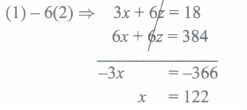
Sub. x=122 in(2)
122+z=64
z=64-122=-58
3y+6w=9 ....(3)
y+w=37 ....(4)
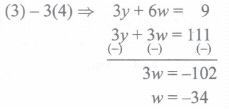
Sub. w = -34 in (4)
y-34 = 37
y = 37 + 34 = 71
∴ Solutions: x = 122
y = 71
z = -58
w = -34
\(\therefore D=\left[ \begin{matrix} 122 & 71 \\ -58 & -34 \end{matrix} \right] \)
11.
It is not possible to add A and B because they have different orders.
12.
The given matrices are equal. Thus all corresponding elements are equal.
Therefore, a - b = 1 …(1)
2a + c = 5 …(2)
2a - b = 0 …(3)
3c + d = 2 …(4)
(3) gives 2a - b = 0
2a = b …(5)
Put 2a = b in equation (1), a - 2a = 1 gives a = −1
Put a = −1 in equation (5), 2(-1) = b gives b = −2
Put a = −1 in equation (2), 2(-1) + c = 5 gives c = 7
Put c = 7 in equation (4), 3(7) + d = 2 gives d = −19
Therefore, a = −1, b = −2, c = 7, d = −19
13.
The general 3 x 3 matrix is given by A = \(\left( \begin{matrix} { a }_{ 11 } & { a }_{ 12 } & { a }_{ 13 } \\ { a }_{ 21 } & { a }_{ 22 } & { a }_{ 23 } \\ { a }_{ 31 } & { a }_{ 32 } & { a }_{ 33 } \end{matrix} \right) \) aij = i2j2
a11 = 12 x 12 = 1 x 1 = 1; a12 = 12 x 22 = 1 x 4 = 4; a13 = 12 x 32 = 1 x 9 = 9
a21 = 22 x 12 = 2 x 1 = 2; a22 = 22 x 22 = 4 x 4 = 16; a23 = 22 x 32 = 4 x 9 = 36
a31 = 32 x 12 = 3 x 1 = 3; a32 = 32 x 22 = 9 x 4 = 36; a33 = 32 x 32 = 9 x 9 = 81
Hence the required matrix is A = \(\left( \begin{matrix} 1 & 4 & 9 \\ 4 & 16 & 36 \\ 9 & 36 & 81 \end{matrix} \right) \)

10th Standard Syllabus & Materials
10th Standard
TN 10th English Prose - 2 - The Night the Ghost Got in Important Questions And Answers Study Material - QB365 Set A
NEW10th Standard
TN 10th English Supplementary - 1 - The Tempest Important Questions And Answers Study Material - QB365 Set A
NEW10th Standard
TN 10th English Poem - 1 - Life Important Questions And Answers Study Material - QB365 Set A
NEW10th Standard
TN 10th English Prose - 1 - His First Flight Important Questions And Answers Study Material - QB365 Set A



Tamilnadu Stateboard 10th Standard Subjects
Tamilnadu Stateboard Standards





