
 100% FREE ACCESS
10th Standard Syllabus & Materials
10th Standard
TN 10th English Prose - 4 - The Attic Important Questions And Answers Study Material - QB365 Set A
NEW10th Standard
TN 10th English Supplementary - 3 - The Story of Mulan Important Questions And Answers Study Material - QB365 Set A
NEW10th Standard
TN 10th English Poem - 3 - I am Every Woman Important Questions And Answers Study Material - QB365 Set A
NEW10th Standard
TN 10th English Prose - 3 - Empowered Women Navigating The World Important Questions And Answers Study Material - QB365 Set A
NEW10th Standard
TN 10th English Supplementary - 2 - Zigzag Important Questions And Answers Study Material - QB365 Set A
NEW10th Standard
TN 10th English Poem - 2 - The Grumble Family Important Questions And Answers Study Material - QB365 Set A

Published on: 07/08/2019
Download Tamil Nadu 10th Standard Maths question papers, model tests, one-mark questions, important questions, and public exam papers in PDF format. Free study materials and answer keys for TN State Board students.
Questions + Answers key
Take MCQ Maths Test1.
If A = \(\begin{pmatrix} 2 & -2\sqrt { 2 } \\ \sqrt { 2 } & 2 \end{pmatrix}\) and B = \(\begin{pmatrix} 2 & 2\sqrt { 2 } \\ -\sqrt { 2 } & 2 \end{pmatrix}\)
Show that A and B satisfy commutative property with respect to matrix multiplication.
2.
Let A = \(\left[ \begin{matrix} 1 & 2 \\ 1 & 3 \end{matrix} \right] \), B = \(\left[ \begin{matrix} 4 & 0 \\ 1 & 5 \end{matrix} \right] \), C = \(\left[ \begin{matrix} 2 & 0 \\ 1 & 2 \end{matrix} \right] \) Show that (A − B)T = AT − BT
3.
If A = \(\left[ \begin{matrix} 1 & 8 & 3 \\ 3 & 5 & 0 \\ 8 & 7 & 6 \end{matrix} \right] \), B = \(\left[ \begin{matrix} 8 & -6 & -4 \\ 2 & 11 & -3 \\ 0 & 1 & 5 \end{matrix} \right] \), C = \(\left[ \begin{matrix} 5 & 3 & 0 \\ -1 & -7 & 2 \\ 1 & 4 & 3 \end{matrix} \right] \) compute the following
\(\\ \frac { 1 }{ 2 } A-\frac { 3 }{ 2 } B\)
4.
If \(A=\left[\begin{array}{lll} 5 & 2 & 9 \\ 1 & 2 & 8 \end{array}\right], B=\left[\begin{array}{rr} 1 & 7 \\ 1 & 2 \\ 5 & -1 \end{array}\right]\) verify that (AB)T = BT A T
5.
If \(A=\left[\begin{array}{cc} \cos \theta & 0 \\ 0 & \cos \theta \end{array}\right]\) , \(B=\left[\begin{array}{cc} \sin \theta & 0 \\ 0 & \sin \theta \end{array}\right]\) then show that A2 + B2 = 1.
6.
Given that A = \(\left[ \begin{matrix} 1 & 3 \\ 5 & -1 \end{matrix} \right] \), B = \(\left[ \begin{matrix} 1 & -1 & 2 \\ 3 & 5 & 2 \end{matrix} \right] \), C = \(\left[ \begin{matrix} 1 & 3 & 2 \\ -4 & 1 & 3 \end{matrix} \right] \) verify that A(B + C) = AB + AC.
7.
If A = \(\left[ \begin{matrix} 1 & 2 & 1 \\ 2 & -1 & 1 \end{matrix} \right] \) and B = \(\left[ \begin{matrix} 2 & -1 \\ -1 & 4 \\ 0 & 2 \end{matrix} \right] \) show that (AB)T = BTAT
8.
If A = \(\left[ \begin{matrix} 1 & 1 \\ -1 & 3 \end{matrix} \right] \), B = \(\left[ \begin{matrix} 1 & 2 \\ -4 & 2 \end{matrix} \right] \), C = \(\left[ \begin{matrix} -7 & 6 \\ 3 & 2 \end{matrix} \right] \) verify that A(B + C) = AB + AC
9.
If A = \(\left[ \begin{matrix} 1 & -1 & 2 \end{matrix} \right] \), B = \(\left[ \begin{matrix} 1 & -1 \\ 2 & 1 \\ 1 & 3 \end{matrix} \right] \) and C = \(\left[ \begin{matrix} 1 & 2 \\ 2 & -1 \end{matrix} \right] \) show that (AB)C = A(BC)
10.
Solve \(\left[ \begin{matrix} 2 & 1 \\ 1 & 2 \end{matrix} \right] \left[ \begin{matrix} x \\ y \end{matrix} \right] =\left[ \begin{matrix} 4 \\ 5 \end{matrix} \right] \)
11.
If A = \(\left[ \begin{matrix} 2 & 1 \\ 1 & 3 \end{matrix} \right] \), B = \(\left[ \begin{matrix} 2 & 0 \\ 1 & 3 \end{matrix} \right] \) find AB and BA. Check if AB = BA
12.
Find the values of x, y, z if
\(\left[ \begin{matrix} x-3 & 3x-z \\ x+y+7 & x+y+z \end{matrix} \right] =\left[ \begin{matrix} 1 & 0 \\ 1 & 6 \end{matrix} \right] \)
13.
Find X and Y if X + Y = \(\left[ \begin{matrix} 7 & 0 \\ 3 & 5 \end{matrix} \right] \) and X - Y = \(\left[ \begin{matrix} 3 & 0 \\ 0 & 4 \end{matrix} \right] \)
14.
If A = \(\left[ \begin{matrix} 4 & 3 & 1 \\ 2 & 3 & -8 \\ 1 & 0 & -4 \end{matrix} \right] \), B = \(\left[ \begin{matrix} 2 & 3 & 4 \\ 1 & 9 & 2 \\ -7 & 1 & -1 \end{matrix} \right] \) and C = \(\left[ \begin{matrix} 8 & 3 & 4 \\ 1 & -2 & 3 \\ 2 & 4 & -1 \end{matrix} \right] \) then verify that A + (B + C) = (A + B) + C.
15.
If A = \(\left[ \begin{matrix} 1 & 8 & 3 \\ 3 & 5 & 0 \\ 8 & 7 & 6 \end{matrix} \right] \), B = \(\left[ \begin{matrix} 8 & -6 & -4 \\ 2 & 11 & -3 \\ 0 & 1 & 5 \end{matrix} \right] \), C = \(\left[ \begin{matrix} 5 & 3 & 0 \\ -1 & -7 & 2 \\ 1 & 4 & 3 \end{matrix} \right] \) compute the following
3A + 2B - C
16.
Construct a 3 x 3 matrix whose elements are given by
aij = |i - 2j|
17.
If a matrix has 18 elements, what are the possible orders it can have? What if it has 6 elements?
18.
A = \(\left( \begin{matrix} 3 & 0 \\ 4 & 5 \end{matrix} \right) \), B = \(\left( \begin{matrix} 6 & 3 \\ 8 & 5 \end{matrix} \right) \), C = \(\left( \begin{matrix} 3 & 6 \\ 1 & 1 \end{matrix} \right) \) find the matrix D, such that CD – AB = 0
19.
Given A = \(\left( \begin{matrix} p & 0 \\ 0 & 2 \end{matrix} \right) \), B = \(\left( \begin{matrix} 0 & -q \\ 1 & 0 \end{matrix} \right) \), C = \(\left( \begin{matrix} 2 & -2 \\ 2 & 2 \end{matrix} \right) \) and if BA = C2, find p and q.
20.
If \(\cos { \theta \left( \begin{matrix} \cos { \theta } & \sin { \theta } \\ -\sin { \theta } & \cos { \theta } \end{matrix} \right) } \times \sin { \theta \left( \begin{matrix} x & -\cos { \theta } \\ \cos { \theta } & x \end{matrix} \right) } \) = I2, find x.
21.
If A = \(\left[ \begin{matrix} 1 & 2 & 0 \\ 3 & 1 & 5 \end{matrix} \right] \), B = \(\left[ \begin{matrix} 8 & 3 & 1 \\ 2 & 4 & 1 \\ 5 & 3 & 1 \end{matrix} \right] \), find AB.
22.
If A = \(\left[ \begin{matrix} 1 & 9 \\ 3 & 4 \\ 8 & -3 \end{matrix} \right] \), B = \(\left[ \begin{matrix} 5 & 7 \\ 3 & 3 \\ 1 & 0 \end{matrix} \right] \) then verify that
A + B = B + A
23.
Find the value of a, b, c, d, from the following matrix equation.
\(\left[ \begin{matrix} d & 8 \\ 3b & a \end{matrix} \right] +\left[ \begin{matrix} 3 & a \\ -2 & -4 \end{matrix} \right] =\left[ \begin{matrix} 2 & 2a \\ b & 4c \end{matrix} \right] +\left[ \begin{matrix} 0 & 1 \\ -5 & 0 \end{matrix} \right] \)
24.
If A = \(\left[ \begin{matrix} 5 & 4 & -2 \\ \frac { 1 }{ 2 } & \frac { 3 }{ 4 } & \sqrt { 2 } \\ 1 & 9 & 4 \end{matrix} \right] \), B = \(\left[ \begin{matrix} -7 & 4 & -3 \\ \frac { 1 }{ 4 } & \frac { 7 }{ 2 } & 3 \\ 5 & -6 & 9 \end{matrix} \right] \), find 4A - 3B.
25.
If A = \(\left[ \begin{matrix} 1 & 2 & 3 \\ 4 & 5 & 6 \\ 7 & 8 & 9 \end{matrix} \right] \), B = \(\left[ \begin{matrix} 1 & 7 & 0 \\ 1 & 3 & 1 \\ 2 & 4 & 0 \end{matrix} \right] \), find A + B.
26.
If A = \(\left[ \begin{matrix} 5 & 2 & 2 \\ -\sqrt { 17 } & 0.7 & \frac { 5 }{ 2 } \\ 8 & 3 & 1 \end{matrix} \right] \) then verify (AT)T = A
27.
If A = \(\left[ \begin{matrix} \sqrt { 7 } & -3 \\ -\sqrt { 5 } & 2 \\ \sqrt { 3 } & -5 \end{matrix} \right] \) then find the transpose of -A.
28.
If A = \(\left[ \begin{matrix} 5 & 4 & 3 \\ 1 & -7 & 9 \\ 3 & 8 & 2 \end{matrix} \right] \) then find the transpose of A.
29.
In the matrix A = \(\left[ \begin{matrix} 8 \\ -1 \\ \begin{matrix} 1 \\ 6 \end{matrix} \end{matrix}\begin{matrix} 9 \\ \sqrt { 7 } \\ \begin{matrix} 4 \\ 8 \end{matrix} \end{matrix}\begin{matrix} 4 \\ \frac { \sqrt { 3 } }{ 2 } \\ \begin{matrix} 3 \\ -11 \end{matrix} \end{matrix}\begin{matrix} 3 \\ 5 \\ \begin{matrix} 0 \\ 1 \end{matrix} \end{matrix} \right] \), write The number of elements
30.
Find the value of a, b, c, d from the equation \(\left( \begin{matrix} a-b & 2a+c \\ 2a-b & 3c+d \end{matrix} \right) =\left( \begin{matrix} 1 & 5 \\ 0 & 2 \end{matrix} \right) \)
31.
Construct a 3 x 3 matrix whose elements are aij = i2j2
32.
If a matrix has 16 elements, what are the possible orders it can have?
1.
We have to show that AB = BA
\(LHS\quad AB=\begin{pmatrix} 2 & -2\sqrt { 2 } \\ \sqrt { 2 } & 2 \end{pmatrix}\times \begin{pmatrix} 2 & 2\sqrt { 2 } \\ -\sqrt { 2 } & 2 \end{pmatrix}\)
\(=\left( \begin{matrix} 4+4 & 4\sqrt { 2 } -4\sqrt { 2 } \\ 2\sqrt { 2 } -2\sqrt { 2 } & 4+4 \end{matrix} \right) \)
\(=\left( \begin{matrix} 8 & 0 \\ 0 & 8 \end{matrix} \right) \)
\(RHS\quad AB=\begin{pmatrix} 2 & 2\sqrt { 2 } \\ -\sqrt { 2 } & 2 \end{pmatrix}\times \begin{pmatrix} 2 & -2\sqrt { 2 } \\ \sqrt { 2 } & 2 \end{pmatrix}\)
\(=\left( \begin{matrix} 4+4 & -4\sqrt { 2 } +4\sqrt { 2 } \\ -2\sqrt { 2 } +2\sqrt { 2 } & 4+4 \end{matrix} \right) \)
\(=\left( \begin{matrix} 8 & 0 \\ 0 & 8 \end{matrix} \right) \)
Hence LHS = RHS (i.e.) AB = BA
2.
(A - B)T= AT-BT
L.H.S = \((A-B)=\left[ \begin{matrix} 1 & 2 \\ 1 & 3 \end{matrix} \right] -\left[ \begin{matrix} 4 & 0 \\ 1 & 5 \end{matrix} \right] =\left[ \begin{matrix} -3 & 2 \\ 0 & -2 \end{matrix} \right] ...(2)\)
\({ (A-B) }^{ T }=\left[ \begin{matrix} -3 & 0 \\ 2 & -2 \end{matrix} \right] ...(1)\)
\({ A }^{ T }=\left[ \begin{matrix} 1 & 1 \\ 2 & 3 \end{matrix} \right] ,{ B }^{ T }=\left[ \begin{matrix} 4 & 1 \\ 0 & 5 \end{matrix} \right] \)
\(=\left[\begin{array}{rr} -3 & 0 \\ 2 & -2 \end{array}\right]\)
From (1) and (2)
(A - B)T= AT-BT
Hence verified.
3.
\(\\ \frac { 1 }{ 2 } A-\frac { 3 }{ 2 } B\) = \(\frac {1}{2}\)(A - 3B)
= \(\frac { 1 }{ 2 } \left( \left[ \begin{matrix} 1 & 8 & 3 \\ 3 & 5 & 0 \\ 8 & 7 & 6 \end{matrix} \right] -3\left[ \begin{matrix} 8 & -6 & -4 \\ 2 & 11 & -3 \\ 0 & 1 & 5 \end{matrix} \right] \right) \)
= \(\frac { 1 }{ 2 } \left[ \left[ \begin{matrix} 1 & 8 & 3 \\ 3 & 5 & 0 \\ 8 & 7 & 6 \end{matrix} \right] +\left[ \begin{matrix} -24 & 18 & 12 \\ -6 & -33 & 9 \\ 0 & -3 & -15 \end{matrix} \right] \right] =\frac { 1 }{ 2 } \left[ \begin{matrix} -23 & 26 & 15 \\ -3 & -28 & 9 \\ 8 & 4 & -9 \end{matrix} \right] \)
= \(\left[ \begin{matrix} -\frac { 23 }{ 2 } & 13 & \frac { 15 }{ 2 } \\ -\frac { 3 }{ 2 } & -14 & \frac { 9 }{ 2 } \\ 4 & 2 & -\frac { 9 }{ 2 } \end{matrix} \right] \)
4.
\(A=\left[\begin{array}{lll} 5 & 2 & 9 \\ 1 & 2 & 8 \end{array}\right], B=\left[\begin{array}{rr} 1 & 7 \\ 1 & 2 \\ 5 & -1 \end{array}\right]\)
\(A B=\left[\begin{array}{lll} 5 & 2 & 9 \\ 1 & 2 & 8 \end{array}\right]\left[\begin{array}{rr} 1 & 7 \\ 1 & 2 \\ 5 & -1 \end{array}\right]\)
\(=\left[\begin{array}{rr} 5+2+45 & 35+4-9 \\ 1+2+40 & 7+4-8 \end{array}\right]\)
\(=\left[\begin{array}{lr} 52 & 30 \\ 43 & 3 \end{array}\right]\)
\((A B)^{T}=\left[\begin{array}{rr} 52 & 43 \\ 30 & 3 \end{array}\right]\)
\(\mathrm{B}^{\mathrm{T}} \mathrm{A}^{\mathrm{T}}=\left[\begin{array}{rrr} 1 & 1 & 5 \\ 7 & 2 & -1 \end{array}\right]\left[\begin{array}{ll} 5 & 1 \\ 2 & 2 \\ 9 & 8 \end{array}\right]\)
\(=\left[\begin{array}{cc} 5+2+45 & 1+2+40 \\ 35+4-9 & 7+4-8 \end{array}\right]\)
\(=\left[\begin{array}{ll} 52 & 43 \\ 30 & 3 \end{array}\right]\)
From (1) and (2)
(AB)T = BT A T
Hence proved.
5.
\(A=\left[\begin{array}{cc}
\cos \theta & 0 \\
0 & \cos \theta
\end{array}\right]\),
\(B=\left[\begin{array}{cc}
\sin \theta & 0 \\
0 & \sin \theta
\end{array}\right]\)
A2 = A.A
\(=\left[\begin{array}{cc}
\cos \theta & 0 \\
0 & \cos \theta
\end{array}\right]\left[\begin{array}{cc}
\cos \theta & 0 \\
0 & \cos \theta
\end{array}\right]\)
\(=\left[\begin{array}{cc}
\cos ^{2} \theta+0 & 0+0 \\
0+0 & 0+\cos ^{2} \theta
\end{array}\right]\)
\(=\left[\begin{array}{cc}
\cos ^{2} \theta & 0 \\
0 & \cos ^{2} \theta
\end{array}\right]\)
B2 = B.B
\(=\left[\begin{array}{cc}
\sin \theta & 0 \\
0 & \sin \theta
\end{array}\right]\left[\begin{array}{cc}
\sin \theta & 0 \\
0 & \sin \theta
\end{array}\right]\)
\(=\left[\begin{array}{cc}
\sin ^{2} \theta+0 & 0+0 \\
0+0 & \sin ^{2} \theta
\end{array}\right]\)
\(\text { Now } A^{2}+B^{2}=\left[\begin{array}{cc}
\cos ^{2} \theta & 0 \\
0 & \cos ^{2} \theta
\end{array}\right]+\left[\begin{array}{cc}
\sin ^{2} \theta & 0 \\
0 & \sin ^{2} \theta
\end{array}\right]\)
\(=\left[\begin{array}{cc}
\cos ^{2} \theta+\sin ^{2} \theta & 0+0 \\
0+0 & \cos ^{2} \theta+\sin ^{2} \theta
\end{array}\right]\)
\(=\left[\begin{array}{ll}
1 & 0 \\
0 & 1
\end{array}\right]=I\)
Hence Proved.
6.
A = \(\left[ \begin{matrix} 1 & 3 \\ 5 & -1 \end{matrix} \right] \)
B = \(\left[ \begin{matrix} 1 & -1 & 2 \\ 3 & 5 & 2 \end{matrix} \right] \)
C = \(\left[ \begin{matrix} 1 & 3 & 2 \\ -4 & 1 & 3 \end{matrix} \right] \)
\(B+C=\left[\begin{array}{rrr}
1 & -1 & 2 \\
3 & 5 & 2
\end{array}\right]+\left[\begin{array}{rrr}
1 & 3 & 2 \\
-4 & 1 & 3
\end{array}\right]\)
\(=\left[\begin{array}{rrr}
2 & 2 & 4 \\
-1 & 6 & 5
\end{array}\right]\)
\(A(B+C)=\left[\begin{array}{cc}
1 & 3 \\
5 & -1
\end{array}\right]\left[\begin{array}{rrr}
2 & 2 & 4 \\
-1 & 6 & 5
\end{array}\right]\)
\(=\left[\begin{array}{rrr}
2-3 & 2+18 & 4+15 \\
10+1 & 10-6 & 20-5
\end{array}\right]\)
\(=\left[\begin{array}{rrr}
-1 & 20 & 19 \\
11 & 4 & 15
\end{array}\right]\)
\(A B=\left[\begin{array}{cc}
1 & 3 \\
5 & -1
\end{array}\right]\left[\begin{array}{rrr}
1 & -1 & 2 \\
3 & 5 & 2
\end{array}\right]\)
\(=\left[\begin{array}{rrr}
1+9 & -1+15 & 2+6 \\
5-3 & -5-5 & 10-2
\end{array}\right]\)
\(=\left[\begin{array}{rrr}
10 & 14 & 8 \\
2 & -10 & 8
\end{array}\right]\)
\(A C=\left[\begin{array}{cc}
1 & 3 \\
5 & -1
\end{array}\right]\left[\begin{array}{rrr}
1 & 3 & 2 \\
-4 & 1 & 3
\end{array}\right]\)
\(=\left[\begin{array}{rrr}
1-12 & 3+3 & 2+9 \\
5+4 & 15-1 & 10-3
\end{array}\right]\)
\(=\left[\begin{array}{rrr}
-11 & 6 & 11 \\
9 & 14 & 7
\end{array}\right]\)
\(A B+A C=\left[\begin{array}{ccc}
10 & 14 & 8 \\
2 & -10 & 8
\end{array}\right]+\left[\begin{array}{ccc}
-11 & 6 & 11 \\
9 & 14 & 7
\end{array}\right]\)
\(=\left[\begin{array}{rrr}
-1 & 20 & 19 \\
11 & 4 & 15
\end{array}\right]\)
From (1), (2)
A (B + C) = AB + AC , Hence verified
7.
LHS = (AB)T
AB = \({ \left[ \begin{matrix} 1 & 2 & 1 \\ 2 & -1 & 1 \end{matrix} \right] }_{ 2\times 3 }\times { \left[ \begin{matrix} 2 & -1 \\ -1 & 4 \\ 0 & 2 \end{matrix} \right] }_{ 3\times 2 }\)
= \(\left[ \begin{matrix} 2-2+0 & -1+8+2 \\ 4+1+0 & -2-4+2 \end{matrix} \right] =\left[ \begin{matrix} 0 & 9 \\ 5 & -4 \end{matrix} \right] \)
(AB)T = \({ \left[ \begin{matrix} 0 & 9 \\ 5 & -4 \end{matrix} \right] }^{ T }=\left[ \begin{matrix} 0 & 5 \\ 9 & -4 \end{matrix} \right] \) ....(1)
RHS = (BTAT)
BT = \(\left[ \begin{matrix} 2 & -1 & 0 \\ -1 & 4 & 2 \end{matrix} \right] \), AT = \(\left[ \begin{matrix} 1 & 2 \\ 2 & -1 \\ 1 & 1 \end{matrix} \right] \)
BTAT = \({ \left[ \begin{matrix} 2 & -1 & 0 \\ -1 & 4 & 2 \end{matrix} \right] }_{ 2\times 3 }\times { \left[ \begin{matrix} 1 & 2 \\ 2 & -1 \\ 1 & 1 \end{matrix} \right] }_{ 3\times 2 }\)
= \(\left[ \begin{matrix} 2-2+0 & 4+1+0 \\ -1+8+2 & -2-4+2 \end{matrix} \right] \)
BTAT = \(\left[ \begin{matrix} 0 & 5 \\ 9 & -4 \end{matrix} \right] \)...(2)}
From (1) and (2), (AB)T = BTAT.
Hence proved.
8.
LHS = A(B + C)
B + C = \(\left[ \begin{matrix} 1 & 2 \\ -4 & 2 \end{matrix} \right] +\left[ \begin{matrix} -7 & 6 \\ 3 & 2 \end{matrix} \right] =\left[ \begin{matrix} -6 & 8 \\ -1 & 4 \end{matrix} \right] \)
A(B + C) = \(\left[ \begin{matrix} 1 & 1 \\ -1 & 3 \end{matrix} \right] \times \left[ \begin{matrix} -6 & 8 \\ -1 & 4 \end{matrix} \right] =\left[ \begin{matrix} -6-1 & 8+4 \\ 6-3 & -8+12 \end{matrix} \right] =\left[ \begin{matrix} -7 & 12 \\ 3 & 4 \end{matrix} \right] \) ......(1)
RHS = AB + AC
AB = \(\left[ \begin{matrix} 1 & 1 \\ -1 & 3 \end{matrix} \right] \times \left[ \begin{matrix} 1 & 2 \\ -4 & 2 \end{matrix} \right] =\left[ \begin{matrix} 1-4 & 2+2 \\ -1-12 & -2+6 \end{matrix} \right] =\left[ \begin{matrix} -3 & 4 \\ -13 & 4 \end{matrix} \right] \)
AC = \(\left[ \begin{matrix} 1 & 1 \\ -1 & 3 \end{matrix} \right] \times \left[ \begin{matrix} -7 & 6 \\ 3 & 2 \end{matrix} \right] =\left[ \begin{matrix} -7+3 & 6+2 \\ 7+9 & -6+6 \end{matrix} \right] =\left[ \begin{matrix} -4 & 8 \\ 16 & 0 \end{matrix} \right] \)
Therefore, AB + AC = \(\left[ \begin{matrix} -3 & 4 \\ -13 & 4 \end{matrix} \right] +\left[ \begin{matrix} -4 & 8 \\ 16 & 0 \end{matrix} \right] =\left[ \begin{matrix} -7 & 12 \\ 3 & 4 \end{matrix} \right] \) ....(2)
From (1) and (2), A(B + C) = AB + AC. Hence proved.
9.
LHS (AB)C
AB = \({ \left[ \begin{matrix} 1 & -1 & 2 \end{matrix} \right] }_{ 1\times 3 }{ \left[ \begin{matrix} 1 & -1 \\ 2 & 1 \\ 1 & 3 \end{matrix} \right] }_{ 3\times 2 }=\left[ \begin{matrix} 1-2+2 & -1-1+6 \end{matrix} \right] =\left[ \begin{matrix} 1 & 4 \end{matrix} \right] \)
(AB)C = \({ \left[ \begin{matrix} 1 & 4 \end{matrix} \right] }_{ 1\times 2 }\times { \left[ \begin{matrix} 1 & 2 \\ 2 & -1 \end{matrix} \right] }_{ 2\times 2 }=\left[ \begin{matrix} 1+8 & 2-4 \end{matrix} \right] =\left[ \begin{matrix} 9 & -2 \end{matrix} \right] \) ....(1)
RHS = A(BC)
BC = \({ \left[ \begin{matrix} 1 & -1 \\ 2 & 1 \\ 1 & 3 \end{matrix} \right] }_{ 3\times 2 }\times { \left[ \begin{matrix} 1 & 2 \\ 2 & -1 \end{matrix} \right] }_{ 2\times 2 }=\left[ \begin{matrix} 1-2 & 2+1 \\ 2+2 & 4-1 \\ 1+6 & 2-3 \end{matrix} \right] =\left[ \begin{matrix} -1 & 3 \\ 4 & 3 \\ 7 & -1 \end{matrix} \right] \)
A(BC) = \({ \left[ \begin{matrix} 1 & -1 & 2 \end{matrix} \right] }_{ 1\times 3 }{ \left[ \begin{matrix} -1 & 3 \\ 4 & 3 \\ 7 & -1 \end{matrix} \right] }_{ 3\times 2 }\)
A(BC) = \(\left[ \begin{matrix} -1-4+14 & 3-3-2 \end{matrix} \right] =\left[ \begin{matrix} 9 & -2 \end{matrix} \right] \) ....(2)
From (1) and (2), (AB)C = A(BC).
10.
\({ \left[ \begin{matrix} 2 & 1 \\ 1 & 2 \end{matrix} \right] }_{ 2\times 2 }{ \left[ \begin{matrix} x \\ y \end{matrix} \right] }_{ 2\times 1 }=\left[ \begin{matrix} 4 \\ 5 \end{matrix} \right] \)
By matrix multiplication \(\left[ \begin{matrix} 2x+y \\ x+2y \end{matrix} \right] =\left[ \begin{matrix} 4 \\ 5 \end{matrix} \right] \)
Rewriting 2x + y = 4 ....(1)
x + 2y = 5 ....(2)
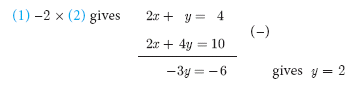
Substituting y = 2 in (1), 2x + 2 = 4 gives x = 1
Therefore, x = 1, y = 2.
11.
We observe that A is a 2 x 2 matrix and B is a 2 x 2 matrix, hence AB is defined and it will be of the order 2 x 2.
AB = \(\left[ \begin{matrix} 2 & 1 \\ 1 & 3 \end{matrix} \right] \times \left[ \begin{matrix} 2 & 0 \\ 1 & 3 \end{matrix} \right] =\left[ \begin{matrix} 4+1 & 0+3 \\ 2+3 & 0+9 \end{matrix} \right] =\left[ \begin{matrix} 5 & 3 \\ 5 & 9 \end{matrix} \right] \)
BA = \(\left[ \begin{matrix} 2 & 0 \\ 1 & 3 \end{matrix} \right] \times \left[ \begin{matrix} 2 & 1 \\ 1 & 3 \end{matrix} \right] =\left[ \begin{matrix} 4+0 & 2+0 \\ 2+3 & 1+9 \end{matrix} \right] =\left[ \begin{matrix} 4 & 2 \\ 5 & 10 \end{matrix} \right] \)
Therefore, AB ≠ BA.
12.
\(\left(\begin{matrix} x-3 & 3x-z \\ x+y+7 & x+y+z \end{matrix} \right) =\left( \begin{matrix} 1 & 0 \\ 1 & 6 \end{matrix} \right) \)
x-3 =1 ⇒ x = 4
3x-z = 0
3(4)-z = 0
-z=-12 ⇒ z = 12
x + y + 7 = 1
x + y = -6
4 + y = -6
y = -10
x = 4, y = -10, z = 12
13.
X + Y = \(\left[ \begin{matrix} 7 & 0 \\ 3 & 5 \end{matrix} \right] \) ...(1)
X - Y= \(\left[ \begin{matrix} 3 & 0 \\ 0 & 4 \end{matrix} \right] \) ...(2)
______________
\((1)+(2)\Rightarrow 2x=\left[ \begin{matrix} 10 & 0 \\ 3 & 9 \end{matrix} \right] \)
\(=\left[ \begin{matrix} 5 & 0 \\ \frac { 3 }{ 2 } & \frac { 9 }{ 2 } \end{matrix} \right] \)
\((1)-(2)\Rightarrow X+Y=\left[ \begin{matrix} 7 & 0 \\ 3 & 5 \end{matrix} \right] \)
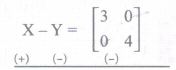
\(2Y=\left[ \begin{matrix} 4 & 0 \\ 3 & 1 \end{matrix} \right] \Rightarrow Y=\frac { 1 }{ 2 } \left[ \begin{matrix} 4 & 0 \\ 3 & 1 \end{matrix} \right] \)
\(\therefore Y=\left[ \begin{matrix} 2 & 0 \\ \frac { 3 }{ 2 } & \frac { 1 }{ 2 } \end{matrix} \right] \)
\(X=\left[ \begin{matrix} 5 & 0 \\ \frac { 3 }{ 2 } & \frac { 9 }{ 2 } \end{matrix} \right] , Y=\left[ \begin {matrix} 2 & 0 \\ \frac { 3 }{ 2 } & \frac { 1 }{ 2 } \end{matrix} \right] \)
14.
(B+C) = \(\left[ \begin{matrix} 2 & 3 & 4 \\ 1 & 9 & 2 \\ -7 & 1 & -1 \end{matrix} \right] \)+\(\left[ \begin{matrix} 8 & 3 & 4 \\ 1 & -2 & 3 \\ 2 & 4 & -1 \end{matrix} \right] \)=\(\left[ \begin{matrix} 10 & 6 & 8 \\ 2 & 7 & 5 \\ -5 & 5 & -2 \end{matrix} \right] \)
\(A+(B+C)=\left[ \begin{matrix} 4 & 3 & 1 \\ 2 & 3 & -8 \\ 1 & 0 & -4 \end{matrix} \right] +\left[ \begin{matrix} 10 & 6 & 8 \\ 2 & 7 & 5 \\ -5 & 5 & -2 \end{matrix} \right] =\left[ \begin{matrix} 14 & 9 & 9 \\ 4 & 10 & -3 \\ -4 & 5 & -6 \end{matrix} \right] .... (1)\)
R.H.S = (A+B)+C
\((A+B)=\left[ \begin{matrix} 4 & 3 & 1 \\ 2 & 3 & -8 \\ 1 & 0 & -4 \end{matrix} \right] +\left[ \begin{matrix} 2 & 3 & 4 \\ 1 & 9 & 2 \\ -7 & 1 & -1 \end{matrix} \right] =\left[ \begin{matrix} 6 & 6 & 5 \\ 3 & 12 & -6 \\ -6 & 1 & -5 \end{matrix} \right] \quad \quad \quad (1)\)
\((A+B)+C=\left[ \begin{matrix} 6 & 6 & 5 \\ 3 & 12 & -6 \\ -6 & 1 & -5 \end{matrix} \right] +\left[ \begin{matrix} 8 & 3 & 4 \\ 1 & -2 & 3 \\ 2 & 4 & -1 \end{matrix} \right] =\left[ \begin{matrix} 14 & 9 & 9 \\ 4 & 10 & -3 \\ -4 & 5 & -6 \end{matrix} \right] ...(2)\)
(1) = (2) ⇒ L.H.S. = R.H.S Hence verified.
15.
3A + 2B - C = \(3\left[ \begin{matrix} 1 & 8 & 3 \\ 3 & 5 & 0 \\ 8 & 7 & 6 \end{matrix} \right] +2\left[ \begin{matrix} 8 & -6 & -4 \\ 2 & 11 & -3 \\ 0 & 1 & 5 \end{matrix} \right] -\left[ \begin{matrix} 5 & 3 & 0 \\ -1 & -7 & 2 \\ 1 & 4 & 3 \end{matrix} \right] \)
= \(\left[ \begin{matrix} 3 & 24 & 9 \\ 9 & 15 & 0 \\ 24 & 21 & 18 \end{matrix} \right] +\left[ \begin{matrix} 16 & -12 & -8 \\ 4 & 22 & -6 \\ 0 & 2 & 10 \end{matrix} \right] +\left[ \begin{matrix} -5 & -3 & 0 \\ 1 & 7 & -2 \\ -1 & -4 & -3 \end{matrix} \right] \)
= \(\left[ \begin{matrix} 14 & 9 & 1 \\ 14 & 44 & -8 \\ 23 & 19 & 25 \end{matrix} \right] \)
16.
aij = |i - 2j|
a11 = |1-2 x 1| = |1-2| = |-1| = 1
a12 = |1-2 x 2| = |1-4| = |-3| = 3
a13 = |1-2 x 3| = |1-6| = |-5| = 5
a21 = |2-1 x 1| = |2-2| = 0
a22 = |2-2 x 2| = |-2| = 2
a23 = |2-2 x 3| = |-4| = 4
a31= |3-2 x 1| = |1| = 1
a32 = |3-2 x 2| = |-1| = 1
a33 = |3-2 x 3| = |-3| = 3
\(\therefore \left[ \begin{matrix} 1 & 3 & 5 \\ 0 & 2 & 4 \\ 1 & 1 & 6 \end{matrix} \right] \) is the required 3x3 matrix.
17.
Given that a matrix has 18 elements
1 x 18, 2 x 9, 3 x 6, 6 x 3, 9 x 2, 18 x 1
If a matrix has 6 elements, then the possible orders
1 x 6, 2 x 3, 3 x 2, 6 x 1
18.
\(A=\left[ \begin{matrix} 3 & 0 \\ 4 & 5 \end{matrix} \right] ,B=\left[ \begin{matrix} 6 & 3 \\ 8 & 5 \end{matrix} \right] ,C=\left[ \begin{matrix} 3 & 6 \\ 1 & 1 \end{matrix} \right] \)
CD - AB = 0 ⇒ CD = AB
\(AB=\left[ \begin{matrix} 3 & 0 \\ 4 & 5 \end{matrix} \right] \left[ \begin{matrix} 6 & 3 \\ 8 & 5 \end{matrix} \right] =\left[ \begin{matrix} (18+0) & (9+0) \\ (24+40) & (12+25) \end{matrix} \right] \)
\(CD=\left[ \begin{matrix} 18 & 9 \\ 64 & 37 \end{matrix} \right] \)
\(Let\quad D=\left[ \begin{matrix} x & y \\ z & w \end{matrix} \right] \)
\(\left[ \begin{matrix} 3 & 6 \\ 1 & 1 \end{matrix} \right] \left[ \begin{matrix} x & y \\ z & w \end{matrix} \right] =\left[ \begin{matrix} 18 & 9 \\ 64 & 37 \end{matrix} \right] \)
\(\left[ \begin{matrix} 3x+6z & 3y+6w \\ x+z & y+w \end{matrix} \right] =\left[ \begin{matrix} 18 & 9 \\ 64 & 37 \end{matrix} \right] \)
3x + 6z = 18 ...(1)
x + z = 64 ...(2)
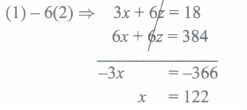
Sub. x=122 in(2)
122+z=64
z=64-122=-58
3y+6w=9 ....(3)
y+w=37 ....(4)
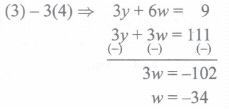
Sub. w = -34 in (4)
y-34 = 37
y = 37 + 34 = 71
∴ Solutions: x = 122
y = 71
z = -58
w = -34
\(\therefore D=\left[ \begin{matrix} 122 & 71 \\ -58 & -34 \end{matrix} \right] \)
19.
\(A=\left[ \begin{matrix} p & 0 \\ 0 & 2 \end{matrix} \right] ,B=\left[ \begin{matrix} 0 & -q \\ 1 & 0 \end{matrix} \right] ,C=\left[ \begin{matrix} 2 & -2 \\ 2 & 2 \end{matrix} \right] \)
\(BA={ C }^{ 2 }\Rightarrow \left[ \begin{matrix} 0 & -q \\ 1 & 0 \end{matrix} \right] \left[ \begin{matrix} p & 0 \\ 0 & 2 \end{matrix} \right] \)
\(=\left[ \begin{matrix} 2 & -2 \\ 2 & 2 \end{matrix} \right] \left[ \begin{matrix} 2 & -2 \\ 2 & 2 \end{matrix} \right] \)
\(\Rightarrow \left[ \begin{matrix} 0 & -2q \\ p & 0 \end{matrix} \right] =\left[ \begin{matrix} (4-4) & (-4-4) \\ (4+4) & (-4+4) \end{matrix} \right] \)
\({ -2q=-8\\ q=4 }{ | }{ p=8\\ q=4 }\)
20.
L.H.S = \(\cos { \theta \left( \begin{matrix} \cos { \theta } & \sin { \theta } \\ -\sin { \theta } & \cos { \theta } \end{matrix} \right) }+ \sin { \theta \left( \begin{matrix} x & -\cos { \theta } \\ \cos { \theta } & x \end{matrix} \right) } \)
\(=\left[ \begin{matrix} { cos }^{ 2 }\theta & cos\sin { \theta } \\ -\sin { \theta cos\theta } & { cos }^{ 2 }\theta \end{matrix} \right] +\left[ \begin{matrix} xsin\theta & -sin\theta \cos { \theta } \\ sin\theta \cos { \theta } & xsin\theta \end{matrix} \right] \)
\(\Rightarrow \left[ \begin{matrix} { cos }^{ 2 }\theta +xsin\theta & 0 \\ 0 & { cos }^{ 2 }+xsin\theta \end{matrix} \right] =\left[ \begin{matrix} 1 & 0 \\ 0 & 1 \end{matrix} \right] \)
∴ cos2θ + x sin θ = 1
x sin θ = 1-cos2θ
\(x=\frac { { sin }^{ 2 }\theta }{ sin\quad \theta } =sin\theta \)
21.
We observe that A is a 2 x 3 matrix and B is a 3 x 3 matrix, hence AB is defined and it will be of the order 2 × 3..
Given A = \({ \left[ \begin{matrix} 1 & 2 & 0 \\ 3 & 1 & 5 \end{matrix} \right] }_{ 2\times 3 }\), B = \({ \left[ \begin{matrix} 8 & 3 & 1 \\ 2 & 4 & 1 \\ 5 & 3 & 1 \end{matrix} \right] }_{ 2x3 }\)
AB = \({ \left[ \begin{matrix} 1 & 2 & 0 \\ 3 & 1 & 5 \end{matrix} \right] }\times \left[ \begin{matrix} 8 & 3 & 1 \\ 2 & 4 & 1 \\ 5 & 3 & 1 \end{matrix} \right] \)
= \(\left[ \begin{matrix} 8+4+0 & 3+8+0 & 1+2+0 \\ 24+2+25 & 9+4+15 & 3+1+5 \end{matrix} \right] =\left[ \begin{matrix} 12 & 11 & 3 \\ 51 & 28 & 9 \end{matrix} \right] \)
22.
L.H.S=A+B=\(\left[ \begin{matrix} 1 & 9 \\ 3 & 4 \\ 8 & -3 \end{matrix} \right] \)+\(\left[ \begin{matrix} 5 & 7 \\ 3 & 3 \\ 1 & 0 \end{matrix} \right] \)
\(=\left[ \begin{matrix} 6 & 16 \\ 6 & 7 \\ 9 & -3 \end{matrix} \right] \) ...(1)
R.H.S=B+A =\(\left[ \begin{matrix} 5 & 7 \\ 3 & 3 \\ 1 & 0 \end{matrix} \right] \) +\(\left[ \begin{matrix} 1 & 9 \\ 3 & 4 \\ 8 & -3 \end{matrix} \right] \)
\(=\left[ \begin{matrix} 6 & 16 \\ 6 & 7 \\ 9 & -3 \end{matrix} \right] \) ...(2)
(1)+(2) ⇒ L.H.S=R.H.S. Hence verified.
23.
First, we add the two matrices on both left, right hand sides to get
\(\left[ \begin{matrix} d+3 & 8+a \\ 3b-2 & a-4 \end{matrix} \right] =\left[ \begin{matrix} 2 & 2a+1 \\ b-5 & 4c \end{matrix} \right] \)
Equating the corresponding elements of the two matrices, we have
d + 3 = 2 gives d = –1
8 + a = 2a + 1 gives a = 7
3b - 2 = b - 5 gives b = \(\frac {-3}{2}\)
Substituting a = 7 in a - 4 = 4c gives c = \(\frac {3}{4}\)
Therefore, a = 7, b = \(\frac {-3}{2}\), c = \(\frac {3}{4}\), d = -1.
24.
Since A, B are of the same order 3 x 3, subtraction of 4A and 3B is defined.
4A - 3B = \(4\left[ \begin{matrix} 5 & 4 & -2 \\ \frac { 1 }{ 2 } & \frac { 3 }{ 4 } & \sqrt { 2 } \\ 1 & 9 & 4 \end{matrix} \right] -3\left[ \begin{matrix} -7 & 4 & -3 \\ \frac { 1 }{ 4 } & \frac { 7 }{ 2 } & 3 \\ 5 & -6 & 9 \end{matrix} \right] \)
= \(\left[ \begin{matrix} 20 & 16 & -8 \\ 2 & 3 & 4\sqrt { 2 } \\ 4 & 36 & 16 \end{matrix} \right] +\left[ \begin{matrix} 21 & -12 & 9 \\ -\frac { 3 }{ 4 } & -\frac { 21 }{ 2 } & -9 \\ -15 & 18 & -27 \end{matrix} \right] \)
= \(\left[ \begin{matrix} 41 & 4 & 1 \\ \frac { 5 }{ 4 } & -\frac { 15 }{ 2 } & 4\sqrt { 2 } -9 \\ -11 & 54 & -11 \end{matrix} \right] \)
25.
A + B = \(\left[ \begin{matrix} 1 & 2 & 3 \\ 4 & 5 & 6 \\ 7 & 8 & 9 \end{matrix} \right] +\left[ \begin{matrix} 1 & 7 & 0 \\ 1 & 3 & 1 \\ 2 & 4 & 0 \end{matrix} \right] =\left[ \begin{matrix} 1+1 & 2+7 & 3+0 \\ 4+1 & 5+3 & 6+1 \\ 7+2 & 8+4 & 9+0 \end{matrix} \right] =\left[ \begin{matrix} 2 & 9 & 3 \\ 5 & 8 & 7 \\ 9 & 12 & 9 \end{matrix} \right] \)
26.
If A=\(\left[ \begin{matrix} 5 & 2 & 2 \\ -\sqrt { 17 } & 0.7 & \frac { 5 }{ 2 } \\ 8 & 3 & 1 \end{matrix} \right] \), AT=\(\left[ \begin{matrix} 5 & -\sqrt { 17 } & 8 \\ 2 & 0.7 & 3 \\ 2 & \frac { 5 }{ 2 } & 1 \end{matrix} \right] \)
(AT)T =\(\left[ \begin{matrix} 5 & 2 & 2 \\ -\sqrt { 17 } & 0.7 & \frac { 5 }{ 2 } \\ 8 & 3 & 1 \end{matrix} \right] \)= A
∴ verified
27.
If A = \(\left[ \begin{matrix} \sqrt { 7 } & -3 \\ -\sqrt { 5 } & 2 \\ \sqrt { 3 } & -5 \end{matrix} \right] \)
-A\(\left[ \begin{matrix}- \sqrt { 7 } &3 \\ \sqrt { 5 } & -2 \\- \sqrt { 3 } & 5 \end{matrix} \right] \)
Transpose od -A = (-A)T = \(\left[ \begin{matrix} -\sqrt { 7 } & +\sqrt { 5 } & -\sqrt { 3 } \\ +3 & -2 &+ 5 \end{matrix} \right] \)
28.
If A =\(\left[ \begin{matrix} 5 & 1 & 3 \\ 4 & -7 & 8 \\ 3 & 9 & 2 \end{matrix} \right] \)
Transpose of A = AT =\(\left[ \begin{matrix} 5 & 1 & 3 \\ 4 & -7 & 8 \\ 3 & 9 & 2 \end{matrix} \right] \)
29.
16
30.
The given matrices are equal. Thus all corresponding elements are equal.
Therefore, a - b = 1 …(1)
2a + c = 5 …(2)
2a - b = 0 …(3)
3c + d = 2 …(4)
(3) gives 2a - b = 0
2a = b …(5)
Put 2a = b in equation (1), a - 2a = 1 gives a = −1
Put a = −1 in equation (5), 2(-1) = b gives b = −2
Put a = −1 in equation (2), 2(-1) + c = 5 gives c = 7
Put c = 7 in equation (4), 3(7) + d = 2 gives d = −19
Therefore, a = −1, b = −2, c = 7, d = −19
31.
The general 3 x 3 matrix is given by A = \(\left( \begin{matrix} { a }_{ 11 } & { a }_{ 12 } & { a }_{ 13 } \\ { a }_{ 21 } & { a }_{ 22 } & { a }_{ 23 } \\ { a }_{ 31 } & { a }_{ 32 } & { a }_{ 33 } \end{matrix} \right) \) aij = i2j2
a11 = 12 x 12 = 1 x 1 = 1; a12 = 12 x 22 = 1 x 4 = 4; a13 = 12 x 32 = 1 x 9 = 9
a21 = 22 x 12 = 2 x 1 = 2; a22 = 22 x 22 = 4 x 4 = 16; a23 = 22 x 32 = 4 x 9 = 36
a31 = 32 x 12 = 3 x 1 = 3; a32 = 32 x 22 = 9 x 4 = 36; a33 = 32 x 32 = 9 x 9 = 81
Hence the required matrix is A = \(\left( \begin{matrix} 1 & 4 & 9 \\ 4 & 16 & 36 \\ 9 & 36 & 81 \end{matrix} \right) \)
32.
We know that a matrix of order m x n has mn elements. Thus to find all possible orders of a matrix with 16 elements, we will find all ordered pairs of natural numbers whose product is 16.
Such ordered pairs are (1, 16), (16, 1), (4,4), (8,2), (2,8)
Hence possible orders are 1 x 16, 16 x 1, 4 x 4, 2 x 8, 8 x 2

10th Standard Syllabus & Materials
10th Standard
TN 10th English Prose - 2 - The Night the Ghost Got in Important Questions And Answers Study Material - QB365 Set A
NEW10th Standard
TN 10th English Supplementary - 1 - The Tempest Important Questions And Answers Study Material - QB365 Set A
NEW10th Standard
TN 10th English Poem - 1 - Life Important Questions And Answers Study Material - QB365 Set A
NEW10th Standard
TN 10th English Prose - 1 - His First Flight Important Questions And Answers Study Material - QB365 Set A



Tamilnadu Stateboard 10th Standard Subjects
Tamilnadu Stateboard Standards





