
 100% FREE ACCESS
12th Standard Syllabus & Materials
12th Standard
TN 12th Computer Applications மின்னணு தரவு பரிமாற்றம் Sample Question Papers Study Material - QB365 Set A
NEW12th Standard
TN 12th Computer Applications மின் - வணிக பாதுகாப்பு அமைப்புகள் Sample Question Papers Study Material - QB365 Set A
NEW12th Standard
TN 12th Computer Applications மின்னணு செலுத்தல் முறைகள் Sample Question Papers Study Material - QB365 Set A
NEW12th Standard
TN 12th Computer Applications மின் - வணிகம் Sample Question Papers Study Material - QB365 Set A
NEW12th Standard
TN 12th Computer Applications திறந்த மூல கருத்துருக்கள் Sample Question Papers Study Material - QB365 Set A
NEW12th Standard
TN 12th Computer Applications வலையமைப்பு வடமிடல் Sample Question Papers Study Material - QB365 Set A

Published on: 03/08/2019
Download Tamil Nadu 12th Standard Maths question papers, model tests, one-mark questions, important questions, and public exam papers in PDF format. Free study materials and answer keys for TN State Board students.
Questions + Answers key
Take MCQ Maths Test1.
Find the radius and centre of the circle \(z\bar { z } \)-(2+3i)z-(2-3i)\(\bar { z } \)+9 = 0 where z is a complex number.
2.
The sum of three numbers is 20. If we multiply the third number by 2 and add the first number to the result we get 23. By adding second and third numbers to 3 times the first number we get 46. Find the numbers using Cramer's rule.
3.
If the equation x2 + bx + ca = 0 and x2 + cx + ab = 0 have a comnion root and b≠c, then prove that their roots will satisfy the equation x2 + ax + bc = 0.
4.
Solve the following systems of linear equations by Cramer’s rule:
\(\frac { 3 }{ x } -\frac { 4 }{ y } -\frac { 2 }{ z } \) -1 = 0, \(\frac { 1 }{ x } +\frac { 2 }{ y } +\frac { 1 }{ z } \) - 2 = 0, \(\frac { 2 }{ x } -\frac { 5 }{ y } -\frac { 4 }{ z } \) + 1 = 0
5.
If z = x + iy and arg\(\left( \frac { z-1 }{ z+1 } \right) =\frac { \pi }{ 2 } \), then show that x2 + y2 = 1.
6.
Solve the following system:
x + 2y + 3z = 0, 3x + 4y + 4z = 0, 7x + 10y + 12z = 0.
7.
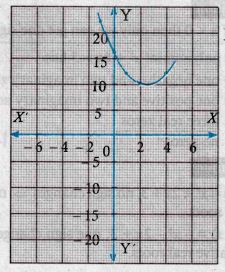
Discuss the maximum possible number of positive and negative roots of the polynomial equations x2−5x+6 and x2−5x+16 . Also draw rough sketch of the graphs
8.
9.
Find the inverse of each of the following by Gauss-Jordan method:
\(\left[ \begin{matrix} 2 & -1 \\ 5 & -2 \end{matrix} \right] \)
10.
Let z1, z2 and z3 be complex numbers such that \(\left| { z }_{ 1 } \right\| =\left| { z }_{ 2 } \right| =\left| { z }_{ 3 } \right| =r>0\) and z1+ z2+ z3 \(\neq \) 0 prove that \(\left| \frac { { z }_{ 1 }{ z }_{ 2 }+{ z }_{ 2 }{ z }_{ 3 }+{ z }_{ 3 }{ z }_{ 1 } }{ { z }_{ 1 }+{ z }_{ 2 }+{ z }_{ 3 } } \right| \) = r
11.
Find all zeros of the polynomial x6- 3x5- 5x4 + 22x3- 39x2- 39x + 135, if it is known that 1+2i and \(\sqrt{3}\) are two of its zeros.
12.
If p is real, discuss the nature of the roots of the equation 4x2+ 4px + p + 2 = 0 in terms of p.
13.
Form the equation whose roots are the squares of the roots of the cubic equation x3+ ax2+ bx + c = 0.
14.
Evaluate \(sin\left( { cos }^{ -1 }\left( \frac { 1 }{ 2 } \right) \right) \)
15.
Find x If \(x=\sqrt { 2+\sqrt { 2+\sqrt { 2+....+upto\infty } } } \)
16.
Show that the system of equations is inconsistent. 2x + 5y= 7, 6x + 15y = 13.
17.
Simplify the following:
i -1924+ i2018
18.
Find the value of \({ sin }^{ -1 }(-1)+{ cos }^{ -1 }\left( \frac { 1 }{ 2 } \right) +{ cot }^{ -1 }(2)\)
19.
Find the rank of the following matrices by minor method:
\(\left[ \begin{matrix} -1 & 3 \\ 4 & -7 \\ 3 & -4 \end{matrix} \right] \)
20.
If z1 = 3 + 4i, z2 = 5 -12i, and z3 = 6 + 8i, find |z1|, |z2|, |z3|, |z1+z2|, |z2-z3| and |z1+z3|
21.
Show that \(\left( 2+i\sqrt { 3 } \right) ^{ 10 }-\left( 2-i\sqrt { 3 } \right) ^{ 10 }\) is purely imaginary
22.
Find cos-1 \((-\frac{1}{\sqrt2})\)
23.
Find the principal value of cos−1\(\left( \frac { \sqrt { 3 } }{ 2 } \right) \)
24.
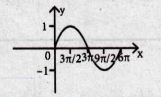
Sketch the graph of y = sin\((\frac{1}{3}x)\) for 0\(\le x <6\pi\).
25.
Find the period and amplitude of y = sin 7x
26.
If the complex number 2 + i and 1-2i are equidistant from x + iy then show that x+3y = 0.
27.
Verify that (A-1)T = (AT)-1 for A =\(\left[ \begin{matrix} -2 & -3 \\ 5 & -6 \end{matrix} \right] \).
28.
Solve: (x-1)4+(x-5)4 = 82
29.
Simplify \({ tan }^{ -1 }\left( tan\left( \frac { 3\pi }{ 4 } \right) \right) \)
30.
Write in polar form of the following complex numbers
\(3-i\sqrt { 3 } \)
31.
Find the rank of the following matrices by minor method or show that the rank of matrix is 3
\(\left[ \begin{matrix} 0 \\ \begin{matrix} 0 \\ 8 \end{matrix} \end{matrix}\begin{matrix} 1 \\ \begin{matrix} 2 \\ 1 \end{matrix} \end{matrix}\begin{matrix} 2 \\ \begin{matrix} 4 \\ 0 \end{matrix} \end{matrix}\begin{matrix} 1 \\ \begin{matrix} 3 \\ 2 \end{matrix} \end{matrix} \right] \)
32.
Simplify: (1+i)18
33.
Solve the equation x3- 5x2- 4x + 20 = 0
34.
Find the monic polynomial equation of minimum degree with real coefficients having 2 -\(\sqrt{3}\)i as a root.
35.
Verify the property (AT)-1 = (A-1)T with A = \(\left[ \begin{matrix} 2 & 9 \\ 1 & 7 \end{matrix} \right] \).
36.
If a = 3 + i and z = 2 - 3i, then the points on the Argand diagram representing az, 3az and - az are ___________
Vertices of a right angled triangle
Vertices of an equilateral triangle
Vertices of an isosceles
Collinear
37.
If \(\sqrt { a+ib } \) = x + iy, then possible value of \(\sqrt { a-ib }\) is ___________
x2+y2
\(\sqrt { { x }^{ 2 }+{ y }^{ 2 } } \)
x+iy
x-iy
38.
If \(\theta ={ sin }^{ -1 }\left( sin(-{ 60 }^{ 0 }) \right) \) then one of the possible values of \(\theta\) is _________
\(\frac { \pi }{ 3 } \)
\(\frac { \pi }{ 2 } \)
\(\frac { 2\pi }{ 3 } \)
\(\frac { -2\pi }{ 3 } \)
39.
In the system of equations with 3 unknowns, if Δ = 0, and one of Δx, Δy of Δz is non zero then the system is ______
Consistent
inconsistent
consistent with one parameter family of solutions
consistent with two parameter family of solutions
40.
The equation \(\sqrt { x+1 } -\sqrt { x-1 } =\sqrt { 4x-1 } \) has ____________
no solution
one solution
two solution
more than one solution
41.
If f(x) = 0 has n roots, then f'(x) = 0 has __________ roots
n
n -1
n+1
(n-r)
42.
If AT is the transpose of a square matrix A, then ___________
|A| ≠ |AT|
|A| = |AT|
|A| + |AT| =0
|A| = |AT| only
43.
If (AB)-1 = \(\left[ \begin{matrix} 12 & -17 \\ -19 & 27 \end{matrix} \right] \) and A-1 = \(\left[ \begin{matrix} 1 & -1 \\ -2 & 3 \end{matrix} \right] \), then B-1 =
\(\left[ \begin{matrix} 2 & -5 \\ -3 & 8 \end{matrix} \right] \)
\(\left[ \begin{matrix} 8 & 5 \\ 3 & 2 \end{matrix} \right] \)
\(\left[ \begin{matrix} 3 & 1 \\ 2 & 1 \end{matrix} \right] \)
\(\left[ \begin{matrix} 8 & -5 \\ -3 & 2 \end{matrix} \right] \)
44.
\(\sin ^{-1}\left(\tan \frac{\pi}{4}\right)-\sin ^{-1}\left(\sqrt{\frac{3}{x}}\right)=\frac{\pi}{6}\). Then x is a root of the equation
x2−x−6 = 0
x2−x−12 = 0
x2+x−12 = 0
x2+x−6 = 0
45.
If \(x = \frac{1}{5}\), the value of cos (cos-1x+2sin-1x) is
\(-\sqrt { \frac { 24 }{ 25 } } \)
\(\sqrt { \frac { 24 }{ 25 } } \)
\(\frac{1}{5}\)
\(-\frac{1}{5}\)
46.
\(\sin ^{-1}(\cos x)=\frac{\pi}{2}-x\) is valid for
\(-\pi \le x\le 0\)
\(0 \le x\le \pi\)
\(-\frac { \pi }{ 2 } \le x\le \frac { \pi }{ 2 } \)
\(-\frac { \pi }{ 4 } \le x\le \frac { 3\pi }{ 4 } \)
47.
The value of \(\left( \cfrac { 1+\sqrt { 3 } i}{ 1-\sqrt { 3}i } \right) ^{ 10 }\) is
\(cis\cfrac { 2\pi }{ 3 } \)
\(cis\cfrac { 4\pi }{ 3 } \)
\(-cis\cfrac { 2\pi }{ 3 }\)
\(-cis\cfrac { 4\pi }{ 3 }\)
48.
If \(\alpha \) and \(\beta \) are the roots of x2+x+1 = 0, then \({ \alpha }^{ 2020 }+{ \beta }^{ 2020 }\) is
-2
-1
1
2
49.
According to the rational root theorem, which number is not possible rational zero of 4x7 + 2x4 - 10x3 - 5?
-1
\(\frac { 5 }{ 4 } \)
\(\frac { 4 }{ 5 } \)
5
50.
If α, β and γ are the zeros of x3 + px2 + qx + r, then \(\Sigma \frac { 1 }{ \alpha } \) is
\(-\frac { q }{ r } \)
\(-\frac { p }{ r } \)
\(\frac { q }{ r } \)
\(-\frac { q }{ p } \)
51.
If f and g are polynomials of degrees m and n respectively, and if h(x) = (f o g)(x), then the degree of h is
mn
m+n
mn
nm
52.
A zero of x3 + 64 is
0
4
4i
-4
53.
If z is a non zero complex number, such that 2iz2 = \(\bar { z } \) then |z| is
\(\cfrac { 1 }{ 2 } \)
1
2
3
1.
Let z = x+iy be the given complex number
∴ \(\bar { z } \) = x-iy
z\(\bar { z } \) = (x+iy) (x-iy) = x2+y2
∴ z\(\bar { z } \) -(2+3i)z -(2-3i)\(\bar { z } \)+9
⇒ x2+y2-(2+3i)(x+iy)-(2-3i)(x-iy)+9 = 0
⇒ x2+y2-[2x+2iy+3ix+i2y] - [2x-2iy-3ix+3i2y]+9 = 0
\(\Rightarrow x^{2}+y^{2}-2 x -\not 2 i y-\not 3i x +3 y-2 x+\not 2 i y+\not 3 i x+3 y+9=0 \)
⇒ x2+y2-4x+6y+9 = 0
Here 2u = -4 ⇒ u = -2
2v = 6 ⇒ v = 3 and d = 9
∴ Centre of the circle is (-u, -v) = (2, -3)
Radius =\(\sqrt { { u }^{ 2 }+{ v }^{ 2 }-d } =\sqrt { 4+9-9 } \)
=\(\sqrt { 4 } \) = 2 units
Hence, the centre of the circle is (2, -3) and radius is 2 units.
2.
Let the required numbers be x, y and z
By the given data,
x + y + z = 20 ....(1)
2z + x = 23 ⇒ x + 2z = 23...(2)
y + z + 3x = 46 ⇒ 3x + y + z = 46..(3)
Δ = \(\left| \begin{matrix} 1 & 1 & 1 \\ 1 & 0 & 2 \\ 3 & 1 & 1 \end{matrix} \right| =1\left| \begin{matrix} 0 & 2 \\ 0 & 1 \end{matrix} \right| -1\left| \begin{matrix} 1 & 2 \\ 1 & 1 \end{matrix} \right| +1\left| \begin{matrix} 1 & 0 \\ 3 & 1 \end{matrix} \right| \)
= -2 + 5 + 1 =4
Δ1 = \(\left| \begin{matrix} 20 & 1 & 1 \\ 23 & 0 & 2 \\ 46 & 1 & 1 \end{matrix} \right| =20\left| \begin{matrix} 0 & 2 \\ 1 & 1 \end{matrix} \right| -1\left| \begin{matrix} 23 & 2 \\ 46 & 1 \end{matrix} \right| +1\left| \begin{matrix} 23 & 0 \\ 46 & 1 \end{matrix} \right| \)
= -40 + 69 + 23 = 52
Δ2 = \(\left| \begin{matrix} 1 & 20 & 1 \\ 1 & 23 & 2 \\ 3 & 46 & 1 \end{matrix} \right| \)
= \(1\left| \begin{matrix} 23 & 2 \\ 46 & 1 \end{matrix} \right| -20\left| \begin{matrix} 1 & 2 \\ 3 & 1 \end{matrix} \right| +1\left| \begin{matrix} 1 & 23 \\ 3 & 46 \end{matrix} \right| \)
= -69 + 100 - 23 = 8
Δ3 = \(\left| \begin{matrix} 1 & 1 & 20 \\ 1 & 2 & 23 \\ 3 & 1 & 46 \end{matrix} \right| \)
= \(1\left| \begin{matrix} 0 & 23 \\ 1 & 46 \end{matrix} \right| -1\left| \begin{matrix} 1 & 23 \\ 3 & 46 \end{matrix} \right| +20\left| \begin{matrix} 1 & 0 \\ 3 & 1 \end{matrix} \right| \)
= -23 + 23 + 20 = 20
∴ x = \(\frac { { \triangle }_{ 1 } }{ \triangle } =\frac { 52 }{ 4 } \) = 13
y = \(\frac { { \triangle }_{ 2 } }{ \triangle } =\frac { 8 }{ 4 } \) = 2 and z =\(\frac { { \triangle }_{ 3 } }{ \triangle } =\frac { 20 }{ 4 } \) = 5
Hence the required numbers are 13, 2 and 5.
3.
Let ∝, β be the roots x2+ bx + ca = 0
∝ +β = -b, ∝β = ca
and a, ૪ be the roots of x2 + cx + ab = 0
∝+૪ = -c, ∝૪ = ab
Then, a2 + b∝ + ca = 0 and
∝2+ c∝ + ab = 0
⇒ (b-c)∝+a(c-b) = 0 ⇒ ∝ = a
Also ∝β = ca and ∝૪ = ab
∴ β = c and ૪ = c
since ∝ = a is a root of x2 + bx + ca = 0,
we get a2 + ba + ca = 0 ⇒ a + b + c = 0
Thus, β+૪ = b + c = -a and β૪ = bc
Hence β, ૪ are the roots of the equation
x2 + ax + bc = 0
4.
\(\frac { 3 }{ x } -\frac { 4 }{ y } -\frac { 2 }{ z } \) - 0, \(\frac { 1 }{ x } +\frac { 2 }{ y } +\frac { 1 }{ z } \) - 2 = 0, \(\frac { 2 }{ x } -\frac { 5 }{ y } -\frac { 4 }{ z } \) + 1 = 0
Put \(\frac { 1 }{ x } =u,\frac { 1 }{ y } =v,\frac { 1 }{ z } =w\)
We get 3u - 4v - 2w = 1, u + 2v + w = 2, 2u - 5v - 4w = -1
∴ \(\left| \begin{matrix} 3 & -4 & -2 \\ 1 & 2 & 1 \\ 2 & -5 & -4 \end{matrix} \right| =3\left| \begin{matrix} 2 & 1 \\ -5 & -4 \end{matrix} \right| +4\left| \begin{matrix} 1 & 1 \\ 2 & -4 \end{matrix} \right| -2\left| \begin{matrix} 1 & 2 \\ 2 & -5 \end{matrix} \right| \)
= 3(- 8 + 5) + 4'(- 4 - 2) - 2(- 5 - 4)
= 3(- 3) + 4(- 6) - 2(- 9)
= - 9 - 24 + 18 = -15
Δ1 = \(\left| \begin{matrix} 1 & -4 & -2 \\ 2 & 2 & 1 \\ -1 & -5 & -4 \end{matrix} \right| \)
= \(1\left| \begin{matrix} 2 & 1 \\ -5 & -4 \end{matrix} \right| +4\left| \begin{matrix} 2 & 1 \\ -1 & -4 \end{matrix} \right| -2\left| \begin{matrix} 2 & 2 \\ -1 & -5 \end{matrix} \right| \)
= 1(- 8 + 5) + 4(- 8 + 11 -2(-10 + 2)
= 1(- 3) + 4(-7) - 2(- 8)
= - 3 - 28 + 16= -15
Δ2 = \(\left| \begin{matrix} 3 & 1 & -2 \\ 1 & 2 & 1 \\ 2 & -1 & -4 \end{matrix} \right| \)
\(3\left| \begin{matrix} 2 & 1 \\ -1 & -4 \end{matrix} \right| -1\left| \begin{matrix} 1 & 1 \\ 2 & -4 \end{matrix} \right| -2\left| \begin{matrix} 1 & 2 \\ 2 & -1 \end{matrix} \right| \)
= 3(- 8 + 1) - 1(- 4 - 2) - 2(- 1 - 4)
= 3(-7) - 1(- 6) - 2(- 5)
= -21 + 6 + 10 = -5
Δ3 = \(\left| \begin{matrix} 3 & -4 & 1 \\ 1 & 2 & 2 \\ 2 & -5 & -1 \end{matrix} \right| \)
\(3\left| \begin{matrix} 2 & 2 \\ -5 & -1 \end{matrix} \right| +4\left| \begin{matrix} 1 & 2 \\ 2 & -1 \end{matrix} \right| -2\left| \begin{matrix} 1 & 2 \\ 2 & -5 \end{matrix} \right| \)
= 3(-2 + 10) + 4(-1 - 4)+ 1(-5 - 4)
= 3(8) + 4(- 5) + 1(- 9)
= 24 - 20 - 9 = - 5
∴ \(\frac { { \triangle }_{ 1 } }{ \triangle } =\frac { -15 }{ -15 } =1\Rightarrow \frac { 1 }{ x } =1\Rightarrow \)x = 1
v = \(\frac { { \triangle }_{ 2 } }{ \triangle } =\frac { -5 }{ -15 } =\frac { 1 }{ 3 } \Rightarrow \frac { 1 }{ y } =\frac { 1 }{ 3 } \Rightarrow \)y = 3
w = \(\frac { { \triangle }_{ 3 } }{ \triangle } =\frac { 5 }{ -15 } =\frac { 1 }{ 3 } \Rightarrow \frac { 1 }{ z } =\frac { 1 }{ 3 } \Rightarrow \)z = 3
∴ Solution set is {1, 3, 3}
5.
Now, \(\frac { z-1 }{ z+1 } =\frac { x+iy-1 }{ x+iy+1 } =\frac { \left( x-1 \right) +iy }{ \left( x+1 \right) +iy } =\frac { \left[ \left( x-1 \right) +iy \right] \left[ \left( x+1 \right) -iy \right] }{ \left[ \left( x+1 \right) +iy \right] \left[ \left( x+1 \right) -iy \right] } \)
\(\Rightarrow \frac { z-1 }{ z+1 } =\frac { \left( { x }^{ 2 }+{ y }^{ 2 }-1 \right) +i\left( 2y \right) }{ \left( x+1 \right) ^{ 2 }+{ y }^{ 2 } } \)
Since, arg \(\left( \frac { z-1 }{ z+2 } \right) =\frac { \pi }{ 2 } \Rightarrow { tan }^{ -1 }\left( \frac { 2y }{ { x }^{ 2 }+{ y }^{ 2 }-1 } \right) \)= \(\frac { \pi }{ 2 } \)
\(\Rightarrow \frac { 2y }{ { x }^{ 2 }+{ y }^{ 2 }-1 } =tan\frac { \pi }{ 2 } \) ⇒ x2+ y2 − 1 = 0
\(\Rightarrow { x }^{ 2 }+{ y }^{ 2 }=1\)
6.
Here the number of equations is equal to the number of unknowns.
Transforming into echelon form (Gaussian elimination method), the augmented matrix becomes
\(\left[ \begin{matrix} 1 & 2 & 3 \\ 3 & 4 & 4 \\ 7 & 10 & 12 \end{matrix}|\begin{matrix} 0 \\ 0 \\ 0 \end{matrix} \right] \overset { \begin{matrix} { R }_{ 2 }\longrightarrow { R }_{ 2 }-3{ R }_{ 1 }, \\ { R }_{ 3 }\longrightarrow { R }_{ 3 }-7{ R }_{ 1 } \end{matrix} }{ \longrightarrow } \left[ \begin{matrix} 1 & 2 & 3 \\ 0 & -2 & -5 \\ 0 & -4 & -9 \end{matrix}|\begin{matrix} 0 \\ 0 \\ 0 \end{matrix} \right] \overset { \begin{matrix} { R }_{ 2 }\longrightarrow R_{ 2 }\div \left( -1 \right) , \\ { R }_{ 3 }\longrightarrow { R }_{ 3 }\div 7{ R }_{ 1 } \end{matrix} }{ \longrightarrow } \left[ \begin{matrix} 1 & 2 & 3 \\ 0 & 2 & 5 \\ 0 & 4 & 9 \end{matrix}|\begin{matrix} 0 \\ 0 \\ 0 \end{matrix} \right] \)\(\overset { { R }_{ 3 }\longrightarrow { R }_{ 3 }-2{ R }_{ 2 } }{ \longrightarrow } \left[ \begin{matrix} 1 & 2 & 3 \\ 0 & 2 & 5 \\ 0 & 0 & -1 \end{matrix}|\begin{matrix} 0 \\ 0 \\ 0 \end{matrix} \right] \overset { { R }_{ 3 }\longrightarrow { R }_{ 3 }\div \left( -1 \right) }{ { \longrightarrow } } \left[ \begin{matrix} 1 & 2 & 3 \\ 0 & 2 & 5 \\ 0 & 0 & 1 \end{matrix}|\begin{matrix} 0 \\ 0 \\ 0 \end{matrix} \right] \).
So, ρ(A) = ρ([A | O]) = 3 = Number of unknowns.
Hence, the system has a unique solution. Since x = 0, y = 0, z = 0 is always a solution of the homogeneous system, the only solution is the trivial solution x = 0, y = 0, z = 0.
Note
In the above example, we find that
|A| = \(\left| \begin{matrix} 1 & 2 & 3 \\ 3 & 4 & 4 \\ 7 & 10 & 12 \end{matrix} \right| \) = 1(48 - 40) - 2(36 - 28) + 3(30 - 28) = 8 - 16 + 6 = -2 ≠ 0.
7.
x = 1
y = x2 -5x + 6
y = 1 -5 + 6 = 2
x = 2
y = 4 -10 + 6 = 0
x = 0
y = 6
x = 3
y = 9 -15 + 6 = 12
x = -1
y = 1 + 5 + 6 = 12
x = 4
y = 16 - 20 + 6 = 2
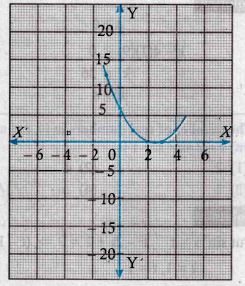
(1, 2), (0, 6), (-1, 12)
P(x) = (x2-5x + 6) (x2-5x+16)
= x4- 5x3+16x2-5x+25x2- 80x + 6x2- 30x + 96 = 0
x4-10x3+ 47x2 -110x + 96 = 0
It has two sign changes
\(\therefore\) it has two positive real roots
P(-x) = x4-10x3+ 47x2 -110x + 96
It has no sign changes, no negative real roots
y = x2- 5x + 16
| x | 0 | 1 | -1 | 2 | 4 |
| y | 16 | 12 | 23 | 10 | 12 |
8.
9.
\(\left[ \begin{matrix} 2 & -1 \\ 5 & -2 \end{matrix} \right] \)
Let A =\(\left[ \begin{matrix} 2 & -1 \\ 5 & -2 \end{matrix} \right] \)
Applying Gauss - Jordan method, we get
[A|I2] =\(\left[ \begin{matrix} 2 & -1 \\ 5 & -2 \end{matrix}|\begin{matrix} 1 & 0 \\ 0 & 1 \end{matrix} \right] \)
\(\overset { { R }_{ 1 }\rightarrow { R }_{ 1 }\div 2 }{ \longrightarrow } \left[ \begin{matrix} 1 & -\frac { 1 }{ 2 } \\ 5 & -2 \end{matrix}|\begin{matrix} \frac { 1 }{ 2 } & 0 \\ 0 & 1 \end{matrix} \right] \)
\(\overset { { R }_{ 2 }\rightarrow { R }_{ 2 }-5{ R }_{ 1 } }{ \longrightarrow } \left[ \begin{matrix} 1 & -\frac { 1 }{ 2 } \\ 5 & -2 \end{matrix}|\begin{matrix} \frac { 1 }{ 2 } & 0 \\ -\frac { 5 }{ 2 } & 1 \end{matrix} \right] \)
\(\overset { { R }_{ 2 }\rightarrow { R }_{ 2 }\times 2 }{ \longrightarrow } \left[ \begin{matrix} 1 & -\frac { 1 }{ 2 } \\ 0 & 1 \end{matrix}|\begin{matrix} \frac { 1 }{ 2 } & 0 \\ -5 & 2 \end{matrix} \right] \)
\(\overset { { R }_{ 1 }\rightarrow { R }_{ 1 }+\frac { 1 }{ 2 } { R }_{ 2 } }{ \longrightarrow } \left[ \begin{matrix} 1 & 0 \\ 0 & 1 \end{matrix}|\begin{matrix} -2 & 1 \\ -5 & 2 \end{matrix} \right] \)
∴ We get A-1=\(\left[ \begin{matrix} -2 & 1 \\ -5 & 2 \end{matrix} \right] \)
10.
Given that \(\left| { z }_{ 1 } \right| =\left| { z }_{ 2 } \right| =\left| { z }_{ 3 } \right| =r\Rightarrow { z }_{ 1 }\bar { { z }_{ 1 } } ={ z }_{ 2 }\bar { { z }_{ 2 } } ={ r }^{ 2 }\)
\(\Rightarrow { z }_{ 1 }=\frac { { r }^{ 2 } }{ \bar { { z }_{ 1 } } } ,{ z }_{ 2 }=\frac { { r }^{ 2 } }{ \bar { { z }_{ 2 } } } ,{ z }_{ 3 }=\frac { { r }^{ 2 } }{ { \bar { z } }_{ 3 } } \)
Therefore \({ z }_{ 1 }+{ z }_{ 2 }+{ z }_{ 3 }=\frac { { r }^{ 2 } }{ { \bar { z } }_{ 1 } } +\frac { { r }^{ 2 } }{ \bar { { z }_{ 2 } } } +\frac { { r }^{ 2} }{ \bar { { z }_{ 3 } } } \)
= \({ r }^{ 2 }\left( \frac { \bar { { z }_{ 2 } } \bar { { z }_{ 3 } } +\bar { { z }_{ 1 } } \bar { { z }_{ 3 } } +\bar { { z }_{ 1 } } { \overline { z } }_{ 2 } }{ \overline { { z }_{ 1 } } \bar { { z }_{ 2 } } \bar { { z }_{ 3 } } } \right) \)
\(\left| { z }_{ 1 }+{ z }_{ 2 }+{ z }_{ 3 } \right| =\left| { r }^{ 2 } \right| \left| \frac { \overline { { z }_{ 2}{ z }_{ 3 }+{ z }_{ 1 }{ z }_{ 3 }+{ z }_{ 1 }{ z }_{ 2 } } }{ \overline { { z }_{ 1 }{ z }_{ 2 }{ z }_{ 3 } } } \right| \) \(\left(\because \bar{z}_{1}+\bar{z}_{2}=\overline{z_{1}+z_{2}}\right)\)
= \({ r }^{ 2 }\frac { \left| { z }_{ 2 }{ z }_{ 3 }+{ z }_{ 1 }{ z }_{ 3 }+{ z }_{ 1 }{ z }_{ 2 } \right| }{ \left| { z }_{ 1 } \right| \left| { z }_{ 2 } \right| \left| { z }_{ 3 } \right| } \) \(\left( \because |z|=|\bar { z } |and\ \left| { z }_{ 1 }{ z }_{ 2 }{ z }_{ 3 } \right| =\left| { z }_{ 1 } \right| \left| { z }_{ 2 } \right| \left| { z }_{ 3 } \right| \right) \)
= \(\left| { z }_{ 1 }+{ z }_{ 2 }+{ z }_{ 3 } \right| ={ r }^{ 2 }\frac { \left| { z }_{ 2 }{ z }_{ 3 }+{ z }_{ 1 }{ z }_{ 3 }+{ z }_{ 1 }{ z }_{ 2 } \right| }{ { r }^{ 3 } } =\frac { \left| { z }_{ 2 }{ z }_{ 3 }+{ z }_{ 1 }{ z }_{ 3 }+{ z }_{ 1 }{ z }_{ 2 } \right| }{ r } \)
\(\frac { \left| { z }_{ 2 }{ z }_{ 3 }+{ z }_{ 1 }{ z }_{ 3 }+{ z }_{ 1 }{ z }_{ 2 } \right| }{ \left| { z }_{ 1 }+{ z }_{ 2 }+{ z }_{ 3 } \right| } \) = r (given that \(z_{1}+z_{2}+z_{3} \neq 0\))
Thus,\(\left| \frac { { z }_{ 2 }{ z }_{ 3 }+{ z }_{ 1 }{ z }_{ 3 }+{ z }_{ 1 }{ z }_{ 2 } }{ { z }_{ 1 }+{ z }_{ 2 }+{ z }_{ 3 } } \right| \) = r
11.
Let f(x) x6-3x5-5x4+22x3-39x2-39x+135
Given (1+2i) is a root \(\Rightarrow\)(-2i) is also a root
Also \(\sqrt3\) is a root \(\Rightarrow\)-\(\sqrt3\) is also a root.
Hence, the factors of f(x) are [x - (1 + 2i)]
[x-(1-2i)] [x\(\sqrt3\)] [x+\(\sqrt3\)]
[(x-1)-2i] [(x-1)+2i] [x-\(\sqrt3\)][x+\(\sqrt3\)]
((x-1)2+22)(x2-3) = (x2-2x+1+4)(x2-3)
\(\Rightarrow\) factor of f(x) is (x2-2x+5)(x2-3)
\(\Rightarrow\)x4-3x2-2x3+6x+5x2-15
\(\Rightarrow\)(x4-3x2-2x3+6x-15) is a factor of f(x)
To find the other factor, let us divide f(x) by
x4 - 2x3 + 2x2 + 6x - 15
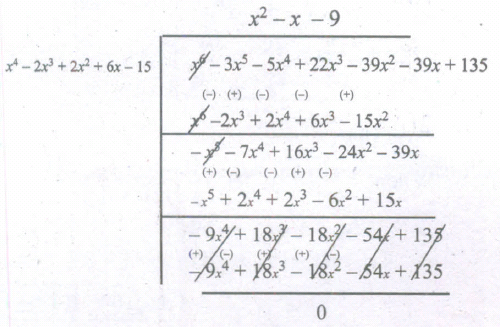
The other factor is x2 - x - 9
\(\Rightarrow x=\frac { 1\pm \sqrt { { (-1) }^{ 2 }-4(1)(-9) } }{ 2 } \left[ \because x=\frac { -b\pm \sqrt { { b }^{ 2 }-4ac } }{ 2a } \right] \)
\(\Rightarrow x=\frac { 1\pm \sqrt { 37 } }{ 2 } \)
Hence the roots are
1 - 2i, 1 + 2i, \(\sqrt { 3 }, -\sqrt { 3 }, \frac { 1+\sqrt { 37 } }{ 2 } ,\frac { 1-\sqrt { 37 } }{ 2 } \).
12.
The discriminant Δ =((4p)2 - 4(4)(p+2) = 16(p2-p-2) = 16(p+1)(p-2). So we get
Δ < 0 if -1
Δ = 0 if p = -1 or p = 2
Δ >0 if \(\infty\).
imaginary roots if -1 < p < 2
equal real roots if p = −1 or p = 2;
distinct real roots if -\(\infty\) < p < -1 or 2 < p < \(\infty\)
13.
Let α, β and γ be the roots of x3+ ax2+ bx + c = 0
Then, we get
Σ1 = α + β + γ = -a ....(1)
Σ2 = αβ + βγ + γα = b ...(2)
Σ3 = αβγ = -c ...(3)
We have to form the equation whose roots are α2, β2 and γ2.
Using (1), (2) and (3), we find the following
Σ1 = α2 + β2 + γ2 = (α + β + γ )2 - 2( αβ + βγ + γα) = (-a)2 -2(b) = a2-2b,
Σ2 = α2β2 + β2γ2 + γ2α2 = (αβ + βγ + γα)2 - 2((αβ)( βγ)(γα) + (γα)(αβ))
= (αβ + βγ + γα)2 - 2αβγ (β + γ + α) = (b)2 - 2(-c)(-a) = b2-2ca
Σ3 = α2β2γ2 = (αβγ)2 = (-c)2 = c2
Hence, the required equation is
x3-(α2 + β2 + γ2)x2 + (α2β2 + β2γ2 + γ2α2)x - α2β2γ2 = 0
That is, x3-(a2-2b)x2 + (b2-2ca)x-c2 = 0
14.
Let \({ cos }^{ -1 }\left( \frac { 1 }{ 2 } \right) =\theta \Rightarrow cos\theta =\frac { 1 }{ 2 } \)
\(\Rightarrow sin\theta =\sqrt { 1-{ cos }^{ 2 }\theta } =\sqrt { 1-\frac { 1 }{ 4 } } =\sqrt { \frac { 3 }{ 4 } } =\frac { \sqrt { 3 } }{ 2 } \)
\(\therefore sin\left( { cos }^{ -1 }\left( \frac { 1 }{ 2 } \right) \right) =\frac { \sqrt { 3 } }{ 2 } \)
15.
We have \(x=\sqrt { 2+x } \)
\(\Rightarrow { x }^{ 2 }=2+x \Rightarrow { x }^{ 2 }-x-2=0\)
\(\Rightarrow x=\frac { 1\pm \sqrt { 1+8 } }{ 2 } \Rightarrow x=\frac { 1\pm 3 }{ 2 } \)
\(\Rightarrow x=\frac { 1+3 }{ 2 } ,\frac { 1-3 }{ 2 } \Rightarrow x=2,-1\)
Also x>0, we get x = 2
16.
Agumented matrix
[A|B] \(\left[ \begin{matrix} 2 & 5 \\ 6 & 15 \end{matrix}|\begin{matrix} 7 \\ 13 \end{matrix} \right] \overset { { R }_{ 2 }\rightarrow { R }_{ 2 }-3{ R }_{ 1 } }{ \longrightarrow } \left[ \begin{matrix} 2 & 5 \\ 0 & 0 \end{matrix}|\begin{matrix} 7 \\ -8 \end{matrix} \right] \)
Here \(\rho\) (A) = 2 and \(\rho\)([A|B]) = 3
∴ \(\rho\) (a) ≠ \(\rho\) ([AIB])
Hence the system is inconsistent.
17.
(i)-1924+ (i)2018 = (i)-1924 + 0 + (i)2016 + 2 = (i)0 + (i)2 = 1 - 1 = 0
18.
\({ sin }^{ -1 }(-1)+{ cos }^{ -1 }\left( \frac { 1 }{ 2 } \right) +{ cot }^{ -1 }(2)\)
Let \({ sin }^{ -1 }\left( -1 \right) =x\)
\(\Rightarrow -1=sin\ x\)
\(\Rightarrow sin\ x=-1=-sin\frac { \pi }{ 2 } =sin\left( \frac { -\pi }{ 2 } \right) \)
\(\Rightarrow x=\frac { -\pi }{ 2 } \)
\(\Rightarrow x=\frac { -\pi }{ 2 } \)
\(\Rightarrow \frac { 1 }{ 2 } =cos\ y\Rightarrow cos\frac { \pi }{ 3 } \)
\(\Rightarrow y=\frac { \pi }{ 3 } \)
\(\therefore { sin }^{ -1 }\left( -1 \right) +{ cos }^{ -1 }\left( \frac { 1 }{ 2 } \right) +{ cot }^{ -1 }\left( 2 \right) \)
\(\frac { -\pi }{ 2 } +\frac { \pi }{ 3 } +{ cot }^{ -1 }\left( 2 \right) \)
\({ cot }^{ -1 }(2)+\frac { -3\pi +2\pi }{ 0 } ={ cot }^{ -1 }\left( 2 \right) -\frac { \pi }{ 6 } \)
19.
\(\left[ \begin{matrix} -1 & 3 \\ 4 & -7 \\ 3 & -4 \end{matrix} \right] \)
Let A =\(\left[ \begin{matrix} -1 & 3 \\ 4 & -7 \\ 3 & -4 \end{matrix} \right] \)
A is a matrix of order 3 \(\times\) 2
∴ \(\rho \)(A) ≤ min (3, 2) = 2
The highest order of minor of A is 2
It is \(\left| \begin{matrix} -1 & 3 \\ 4 & -7 \end{matrix} \right| \)= 7-12 = 5 ≠ 0
∴ \(\rho \)(A) = 2
20.
Using the given values for z1, z2 and z3 we get |z1| = |3+4i| =\(\sqrt { { 3 }^{ 2 }+{ 4 }^{ 2 } } =5\)
|z2| = |5-12i| = \(\sqrt { { 5 }^{ 2 }+(-12)^{ 2 } } =13\)
|z3| = |6+8i| = \(\sqrt { { 6 }^{ 2 }+{ 8 }^{ 2 } } =10\)
|z1+z2| = |(3+4i)+(5-12i)| = |8-8i| = \(\sqrt { 128 } =8\sqrt { 2 } \)
|z2-z3| = |(5-12i)-(6+8i)| = |1-20i| = \(\sqrt { 401 } \)
|z1+z3| = |(3+4i)+(6+8i)| = |9+12i| = \(\sqrt { 225 } =15\)
Note that the triangle inequality is satisfied in all the cases
|z1+z3| = |z1|+|z3| = 15
21.
\(\overline { (2-i)^{ 12 }+(2+i)^{ 12 } } =\overline { (2-i)^{ 12 } } +\overline { (2+i)^{ 12 } } \)
\(\left( 2+i\sqrt { 3 } \right) ^{ 10 }-\left( 2-i\sqrt { 3 } \right) ^{ 10 }\)
Now \(\overline { z } \) = \(\overline { (2+\sqrt { 3 } )^{ 10 }-(2-i\sqrt { 3 } )^{ 10 } } \)
\(\overline { z } \) = \(\overline { (2+i\sqrt { 3 } )^{ 10 } } -(2-i\sqrt { 3 } )^{ 10 }\)
[∵ \(\overline { { z }_{ 1 }-{ z }_{ 2 } } =\overline { { z }_{ 1 } } -\overline { { z }_{ 2 } } \)]
= \((2-i\sqrt { 3 } )^{ 10 }-(2+i\sqrt { 3 } )^{ 10 }\)
= -\(\left[ (2-i\sqrt { 3 } )^{ 10 }-(2+i\sqrt { 3 } )^{ 10 } \right] \)
∴ \(\overline { z } \) = -\(\ { z } \) ⇒ z is purely imaginary
Hence \((2-i\sqrt { 3 } )^{ 10 }-(2+i\sqrt { 3 } )^{ 10 }\)is purely imaginary
22.
It is known that cos-1 x : [-1, 1]\(\rightarrow\)[0, \(\pi\)] is given by
cos−1x = y if and only if x = cos y for -1\(\le x\le1 and 0\le y \le\pi\)
Thus, we have
cos-1 \((-\frac{1}{\sqrt2})\) = \(\frac{3\pi}{4}\), since \(\frac{3\pi}{4}\)\(\in[0,\pi]\)cos\(\frac{3\pi}{4}\) = cos\((\pi=\frac{\pi}{4})=-cos \frac{\pi}{4}=-\frac{1}{\sqrt2}\)
23.
Let cos−1\(\left( \frac { \sqrt { 3 } }{ 2 } \right) \) = y. Then, cos y = \( \frac { \sqrt { 3 } }{ 2 } \)
The range of the principal values of y = cos−1x is [0, \(\pi\)].
So, let us find y in [0, \(\pi\)] such that cos y =\( \frac { \sqrt { 3 } }{ 2 } \)
But, cos\(\frac{\pi}{6}=\frac{\sqrt3}{2} and \frac{\pi}{6}\in[0,\pi]\). Therefore, y = \(\frac{\pi}{6}\)
Thus, the principal value of cos-1 \(\left( \frac { \sqrt { 3 } }{ 2 } \right) is\frac { \pi }{ 6 } \)
24.
| x | 0 | \(\frac {3 \pi }{ 2 } \) | \(3\pi \) | \(\frac { 9\pi }{ 2 } \) | \(6\pi \) |
| y | 0 | 1 | 0 | -1 | 0 |
25.
The amplitude of sin x is 1 [Max of sin x curve is 1]
\(\Rightarrow \) amplitude of sin 7x is also 1
If p is the period of the function,
then f(x+p) = f(x)
Since the period of sine function is \(2\pi \)
The period of sin is \(\frac { 2\pi }{ 7 } \)
amplitude = 1
26.
Let the given complex number be
P (x, y) A(2, 1), and B(1, -2)
Given PA = PB ⇒ PA2 = PB2
⇒ (x - 2)2 + (y-1)2 = (x-1)2 + (y + 2)2
\(\Rightarrow \not x^{2}-4 x+4+\not y^{2}-2 y+1= \not x^{2}-2 x+1+\not y^{2}+4 y+4 \)
⇒ -4x-2y+5 = -2x+4y+5
⇒ -2x-6y = 0
⇒ x+3y = 0
27.
|A| =\(\left[ \begin{matrix} -2 & -3 \\ 5 & -6 \end{matrix} \right] \) = 12+15 = 27
∴ A-1 = \(\frac { 1 }{ |A| } adjA=\frac { 1 }{ 27 } \left[ \begin{matrix} -6 & 3 \\ -5 & 2 \end{matrix} \right] \)
(A-1)T = \(\frac { 1 }{ 27 } \left[ \begin{matrix} -6 & -5 \\ 3 & 2 \end{matrix} \right] \)...(1)
AT =\(\left[ \begin{matrix} -2 & 5 \\ -3 & -6 \end{matrix} \right] \)
|AT| =\(\left[ \begin{matrix} -2 & 5 \\ -3 & -6 \end{matrix} \right] \) = 12+15 = 27
∴ (AT)-1 = \(\frac { 1 }{ |A^{ T }| } adj(A^{ T })=\frac { 1 }{ 27 } \left[ \begin{matrix} -6 & -5 \\ 3 & -2 \end{matrix} \right] \)...(2)
From (1) and (2), (A-1)T = (AT)-1
28.
Put y = \(\frac { x-1+x-5 }{ 2 } =-3\)
⇒ x = y + 3
∴ (x-1)4+(x-5)4 = 82
⇒ (y+3-1)4+(y+3-5)4 = 82
⇒ (y+2)4+(y-2)4 = 82
⇒ 2(y4+24y2+16) = 82
⇒ y4+24y2+16 = 41
⇒ y4+24y2-25 = 0
⇒ (y2+25)(y2-1) = 0
⇒ y = 土5i, y = 士1
∴ x = 3土5i, 4, 2.
29.
tan-1\((tan(\frac{3\pi}{4})\)
Observe that \(\frac{3\pi}{4}\) is not in the interval \(\left( -\frac { \pi }{ 2 } ,\frac { \pi }{ 2 } \right) \), the principal range of tan-1 x.
So, we write \(\frac{3\pi}{4}=\pi-\frac{\pi}{4}\)
Now, \(tan\left( \frac { 3\pi }{ 4 } \right) =tan\left( \pi -\frac { \pi }{ 4 } \right) =-tan\frac { \pi }{ 4 } =tan\left( -\frac { \pi }{ 4 } \right) and-\frac { \pi }{ 4 } \left( -\frac { \pi }{ 2 } ,\frac { \pi }{ 2 } \right) \)
Hence, \({ tan }^{ -1 }\left( tan\left( \frac { 3\pi }{ 4 } \right) \right) ={ tan }^{ -1 }\left( tan\left( -\frac { \pi }{ 4 } \right) \right) =-\frac { \pi }{ 4 } ,since-\frac { \pi }{ 4 } \in \left( -\frac { \pi }{ 2 } ,\frac { \pi }{ 2 } \right) \)
30.
\(3-i\sqrt { 3 } \)
Let x + iy = \(3-i\sqrt { 3 } \)
= r(cos θ + i sin θ)
r = \(\\ \sqrt { { x }^{ 2 }+{ y }^{ 2 } } =\sqrt { 3^{ 2 }+(\sqrt { 3 } )^{ 2 } } =\sqrt { 9+3 } \)
= \(\sqrt { 12 } =2\sqrt { 3 } \)
α = \(tan^{ -1 }\left| \frac { y }{ x } \right| =tan^{ -1 }\left| \frac { -\sqrt { 3 } }{ 3 } \right| =tan^{ -1 }\left| \frac { 1 }{ \sqrt { 3 } } \right| =\frac { \pi }{ 6 } \)
Since the complex number \(3-i\sqrt { 3 } \) lies in the IV quadrant, [∵ x ⟶ +ve y ⟶ -ve]
Its principal value θ = -α
⇒ θ = \(\frac { \pi }{ 6 } \)
∴ Its polar form is
\(3-i\sqrt { 3 } \) = 2\(\sqrt { 3 } \)\(\left[ cos\left( 2k\pi -\frac { \pi }{ 6 } \right) +isin\left( 2k\pi -\frac { \pi }{ 6 } \right) \right] ,k\in Z\)
31.
\(\left[ \begin{matrix} 0 \\ \begin{matrix} 0 \\ 8 \end{matrix} \end{matrix}\begin{matrix} 1 \\ \begin{matrix} 2 \\ 1 \end{matrix} \end{matrix}\begin{matrix} 2 \\ \begin{matrix} 4 \\ 0 \end{matrix} \end{matrix}\begin{matrix} 1 \\ \begin{matrix} 3 \\ 2 \end{matrix} \end{matrix} \right] \)
Let A =\(\left[ \begin{matrix} 0 \\ \begin{matrix} 0 \\ 8 \end{matrix} \end{matrix}\begin{matrix} 1 \\ \begin{matrix} 2 \\ 1 \end{matrix} \end{matrix}\begin{matrix} 2 \\ \begin{matrix} 4 \\ 0 \end{matrix} \end{matrix}\begin{matrix} 1 \\ \begin{matrix} 3 \\ 2 \end{matrix} \end{matrix} \right] \)
A is a matrix of order 3 \(\times\) 4
∴ \(\rho \)(A) ≤ min(3, 4) = 3
The highest order of minor of A is 3
It is \(\left| \begin{matrix} 0 & 1 & 2 \\ 0 & 2 & 4 \\ 8 & 1 & 0 \end{matrix} \right| \) = 0+0-8(4-4) = 0
[Expanded along C1]
Also, \(\left| \begin{matrix} 0 & 2 & 1 \\ 0 & 4 & 3 \\ 8 & 0 & 2 \end{matrix} \right| =0+0-8\left| \begin{matrix} 2 & 1 \\ 4 & 3 \end{matrix} \right| \)
[Expanded along C1]
= -8(6-4) = -8(2) = -16 ≠ 0
∴ \(\rho \)(A) = 3
32.
(1+i)18
Let 1+ i = \(r(cos\theta +isin\theta )\). Then , we get
\(r=\sqrt { { 1 }^{ 2 }+{ 1 }^{ 2 } } =\sqrt { 2 } ;\alpha ={ tan }^{ -1 }\left( \frac { 1 }{ 1 } \right) =\frac { \pi }{ 4 } \)
\(\theta =\alpha =\frac { \pi }{ 4 } \) (\(\because\) 1+i lies in the first Quadrant)
Therefore 1+ i = \(\sqrt { 2 } \left( cos\frac { \pi }{ 4 } +isin\frac { \pi }{ 4 } \right) \)
Raising the power 18 on both sides
\(\left( 1+i \right) ^{ 18 }=\left[ \sqrt { 2 } \left( cos\frac { \pi }{ 4 } +isin\frac { \pi }{ 4 } \right) \right] ^{ 18 }=\sqrt { 12 } ^{ 18 }\left( cos\frac { \pi }{ 4 } +isin\frac { \pi }{ 4 } \right) \)
By de Moivre’s theorem
\(\left( 1+i \right) ^{ 18 }={ 2 }^{ 9 }\left( cos\frac { 18\pi }{ 4 } +isin\frac { 18\pi }{ 4 } \right) \)
= \({ 2 }^{ 9 }\left( cos\left( 4\pi +\frac { \pi }{ 2 } \right) +isin\left( 4\pi +\frac { \pi }{ 2 } \right) \right) ={ 2 }^{ 9 }\left( cos\frac { \pi }{ 2 } +isin\frac { \pi }{ 2 } \right) \)
\(\left( 1+i \right) ^{ 18 }={ 2 }^{ 9 }\left( cos\frac { 18\pi }{ 4 } +isin\frac { 18\pi }{ 4 } \right) \)
= \(\left( 1+i \right) ^{ 18 }={ 2 }^{ 9 }(i)=512i\)
33.
If P(x) denotes the polynomial in the equation, then P(2) = 0.
Hence 2 is a root of the polynomial.
To find other roots, we divide the given polynomial x3−5x2−4x + 20 by x − 2 and get Q(x) = x2 −3x−10 as the quotient.
Solving Q(x) = 0 we get −2 and 5 as roots.
Thus 2, −2, 5 are the solutions of the given equation.
34.
Since 2-\(\sqrt{3}\)i is a root of the required polynomial equation with real coefficients, 2 +\(\sqrt{3}\)i is also a root. Hence the sum of the roots is 4 and the product of the roots is 7. Thus x2-4x + 7= 0 is the required monic polynomial equation.
35.
For the given A, We get |A| = (2)(7) - (9)(1) = 14 - 9 = 5. So, A-1 = \(\frac { 1 }{ 5 } \left[ \begin{matrix} 7 & -9 \\ -1 & 2 \end{matrix} \right] =\left[ \begin{matrix} \frac { 7 }{ 5 } & -\frac { 9 }{ 5 } \\ -\frac { 1 }{ 5 } & \frac { 2 }{ 5 } \end{matrix} \right] \).
Then, (A-1)T = \(\left[ \begin{matrix} \frac { 7 }{ 5 } & -\frac { 1 }{ 5 } \\ -\frac { 9 }{ 5 } & \frac { 2 }{ 5 } \end{matrix} \right] =\frac { 1 }{ 5 } \left[ \begin{matrix} 7 & -1 \\ -9 & 2 \end{matrix} \right] \). ....(1)
For the given A, We get AT = \(\left[ \begin{matrix} 2 & 1 \\ 9 & 7 \end{matrix} \right] \). So |AT| = (2)(7) - (1)(9) = 5
Then, (AT)-1 = \(\frac { 1 }{ 5 } \left[ \begin{matrix} 7 & -1 \\ -9 & 2 \end{matrix} \right] \). ...(2)
From (1) and (2), we get (A-1)T = (AT)-1. Thus, we have verified the given property.
36.
(d)
Collinear
37.
(d)
x-iy
38.
(a)
\(\frac { \pi }{ 3 } \)
39.
(b)
inconsistent
40.
(a)
no solution
41.
(b)
n -1
42.
(b)
|A| = |AT|
43.
(a)
\(\left[ \begin{matrix} 2 & -5 \\ -3 & 8 \end{matrix} \right] \)
44.
(b)
x2−x−12 = 0
45.
(d)
\(-\frac{1}{5}\)
46.
(b)
\(0 \le x\le \pi\)
47.
(a)
\(cis\cfrac { 2\pi }{ 3 } \)
48.
(b)
-1
49.
(c)
\(\frac { 4 }{ 5 } \)
50.
(a)
\(-\frac { q }{ r } \)
51.
(a)
mn
52.
(d)
-4
53.
(a)
\(\cfrac { 1 }{ 2 } \)

12th Standard Syllabus & Materials
12th Standard
TN 12th Computer Applications களப்பெயர் முறைமை (DNS) Sample Question Papers Study Material - QB365 Set A
NEW12th Standard
TN 12th Computer Applications வலையமைப்பு எடுத்துக்காட்டுகள் மற்றும் நெறிமுறைகள் Sample Question Papers Study Material - QB365 Set A
NEW12th Standard
TN 12th Computer Applications கணினி வலையமைப்பு ஓர் அறிமுகம் Sample Question Papers Study Material - QB365 Set A
NEW12th Standard
TN 12th Computer Applications PHP-உடன் MySQL-ஐ இணைத்தல் Sample Question Papers Study Material - QB365 Set A



Tamilnadu Stateboard 12th Standard Subjects
Maths

Chemistry

Physics

Biology

Computer Science

Business Maths and Statistics

Economics

Commerce

Accountancy

History

Computer Applications
Biology
Computer Technology
Computer Applications
Computer Science
Business Maths and Statistics
Commerce
Economics
Maths
Chemistry
Physics
Computer Technology
History
Accountancy

Tamil

English

French
Tamilnadu Stateboard Standards

