
 100% FREE ACCESS
10th Standard Syllabus & Materials
10th Standard
TN 10th English Prose - 4 - The Attic Important Questions And Answers Study Material - QB365 Set A
NEW10th Standard
TN 10th English Supplementary - 3 - The Story of Mulan Important Questions And Answers Study Material - QB365 Set A
NEW10th Standard
TN 10th English Poem - 3 - I am Every Woman Important Questions And Answers Study Material - QB365 Set A
NEW10th Standard
TN 10th English Prose - 3 - Empowered Women Navigating The World Important Questions And Answers Study Material - QB365 Set A
NEW10th Standard
TN 10th English Supplementary - 2 - Zigzag Important Questions And Answers Study Material - QB365 Set A
NEW10th Standard
TN 10th English Poem - 2 - The Grumble Family Important Questions And Answers Study Material - QB365 Set A

Published on: 11/05/2020
Download Tamil Nadu 10th Standard Maths question papers, model tests, one-mark questions, important questions, and public exam papers in PDF format. Free study materials and answer keys for TN State Board students.
Questions + Answers key
Take MCQ Maths Test1.
Kamalam went to play a lucky draw contest 135 tickets of the lucky draw were sold. If the probability of Kamalam winning is \(\frac { 1 }{ 9 } \), then the number of tickets bought by kamalam is ____________
5
10
15
20
2.
A line passing through the point (2, 2) and the axes enclose an area ∝. The intercept on the axes made by the line are given by the roots of ____________
x2-2-∝x+∝ = 0
x2+2∝x+∝ = 0
x2-∝x+2∝ = 0
none of these
3.
Three circles are drawn with the vertices of a triangle as centres such that each circle touches the other two if the sides of the triangle are 2cm,3cm and 4 cm. find the diameter of the smallest circle.
1 cm
3 cm
5 cm
4 cm
4.
Which of the following are linear equation in three variables ___________
2x = z
2sin x + y cos y + z tan z = 2
x + 2y2 + z = 3
x - y - z = 7
5.
6.
The sum of all deviations of the data from its mean is
Always positive
always negative
zero
non-zero integer
7.
If sin \(\theta \) = cos \(\theta \), then 2 tan2 \(\theta \) + sin2 \(\theta \) -1 is equal to
\(\frac { -3 }{ 2 } \)
\(\frac { 3 }{ 2 } \)
\(\frac { 2 }{ 3 } \)
\(\frac { -2 }{ 3 } \)
8.
74k \(\equiv \) ________ (mod 100)
1
2
3
4
9.
A straight line has equation 8y = 4x + 21. Which of the following is true
The slope is 0.5 and the y intercept is 2.6
The slope is 5 and the y intercept is 1.6
The slope is 0.5 and the y intercept is 1.6
The slope is 5 and the y intercept is 2.6
10.
If A is a point on the Y axis whose ordinate is 8 and B is a point on the X axis whose abscissae is 5 then the equation of the line AB is
8x + 5y = 40
8x - 5y = 40
x = 8
y = 5
11.
Two poles of heights 6 m and 11 m stand vertically on a plane ground. If the distance between their feet is 12 m, what is the distance between their tops?
13 m
14 m
15 m
12.8 m
12.
In a hollow cylinder, the sum of the external and internal radii is 14 cm and the width is 4 cm. If its height is 20 cm, the volume of the material in it is
5600\(\pi\) cm3
1120\(\pi\) cm3
56\(\pi\) cm3
3600\(\pi\) cm3
13.
If f: A ⟶ B is a bijective function and if n(B) = 7, then n(A) is equal to
7
49
1
14
14.
The values of a and b if 4x4 - 24x3 + 76x2 + ax + b is a perfect square are
100, 120
10, 12
-120, 100
12, 10
15.
Find the depth of a cylindrical tank of radius 28 m, if its capacity is equal to that of a rectangular tank of size 28 m x 16 m x 11 m.
16.
Prove that the equation x2(a2+b2)+2x(ac+bd)+(c2+ d2) = 0 has no real root if ad≠bc.
17.
Find the LCM and HCF of 6 and 20 by the prime factorisation method.
18.
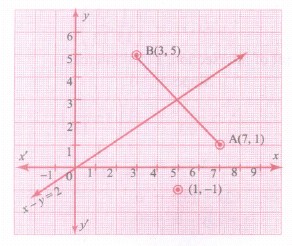
Find a relation between x and y such that the point (x, y) is equidistant from the points (7, 1) and (3, 5).
19.
calculate \(\angle \)BAC in the given triangles ( tan 69.4° = 2.6604 )
.JPG)
20.
Find the next three terms of the sequences.
5, 2, -1, -4,...,
21.
If P(A) = 0.37, P(B).= 0.42, P(A∩B) = 0.09 then find P(AUB).
22.
Solve x2 + 2x - 2 = 0 by formula method
23.
Find the equation of a straight line which has Slope \(\frac { -5 }{ 4 } \) passing through the point (–1, 2).
24.
prove the following identity.
cot \(\theta \) + tan \(\theta \) = sec \(\theta \) cosec\(\theta \)
25.
Find the equation of the straight line passing through (5, 7) and is Parallel to X axis
26.
The ratio of the radii of two right circular cones of same height is 1 : 3. Find the ratio of their curved surface area when the height of each cone is 3 times the radius of the smaller cone.
27.
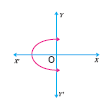
Determine whether the graph given below represent functions. Give a reason for your answer concerning the graph.
28.
Let A = {3,4,7,8} and B = {1,7,10}. Which of the following sets are relations from A to B?
R1 = {(3,7), (4,7), (7,10), (8,1)}
29.
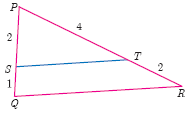
Show that \(\triangle\) PST~\(\triangle\) PQR
30.
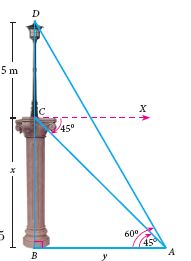
A pole 5 m high is fixed on the top of a tower. The angle of elevation of the top of the pole observed from a point ‘A’ on the ground is 60° and the angle of depression to the point ‘A’ from the top of the tower is 45°. Find the height of the tower.(\(\sqrt3\)=1.732)
31.
If sin 3A = cos (A - 26°), where 3A is an acute angle, find the value at A.
32.
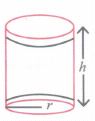
A wooden article was made by scooping out a hemisphere from each end of a cylinder as shown in figure. If the height of the cylinder is 10 cm and its base is of radius 3.5 cm find the total surface area of the article.
33.
Find the coordinates at the points of trisection (i.e. points dividing in three equal parts) of the line segment joining the points A(2, -2) and B(-7, 4).
34.
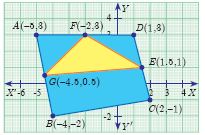
In the figure, find the area of quadrilateral BCEG.
35.
Let A = {x \(\in \) W| x < 2}, B = {x \(\in \) N| 1 < x ≤ 4} and C = (3,5). Verify that
(A U B) x C = (A x C) U (B x C)
36.
The standard deviation of some temperature data in degree celsius (0C) is 5. If the data were converted into degree Fahrenheit (0F) then what is the variance?
37.
Show that 107 is of the form 4q +3 for any integer q.
38.
There is a square field whose side is 10 m. A square flower bed is prepared in its centre leaving a gravel path all round the flower bed. The total cost of laying the flower bed and gravelling the path at Rs. 3 and Rs. 4 per square metre respectively is Rs. 364. Find the width of the gravel path.
39.
Find the number of coins, 1.5 cm in diameter and 2 mm thick, to be melted to form a right circular cylinder of height 10 cm and diameter 4.5 cm.
40.
if \(\frac { cos\theta }{ 1+sin\theta } =\frac { 1 }{ a } \),then prove that \(\frac { { a }^{ 2 }-1 }{ a^{ 2 }+1 } \) = sin\(\theta \)
41.
A solid sphere and a solid hemisphere have equal total surface area. Prove that the ratio of their volume is 3\(\sqrt{3}\) : 4.
42.
5 m long ladder is placed leaning towards a vertical wall such that it reaches the wall at a point 4m high. If the foot of the ladder is moved 1.6 m towards the wall, then find the distance by which the top of the ladder would slide upwards on the wall
43.
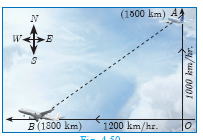
An Aeroplane after take off from an airport and flies due north at a speed of 1000 km/hr. At the same time, another aeroplane leaves the same airport and flies due west at a speed of 1200 km/hr. How far apart will be the two planes after 1½ hours?
44.
The data in the adjacent table depicts the length of a person's forehand and her corresponding height. Based on this data, a student finds a relationship between the height (y) and the forehand length(x) as y = ax + b, where a, b are constants.
(i) Check if this relation is a function.
(ii) Find a and b.
(iii) Find the height of a woman whose forehand length is 40 cm.
(iv) Find the length of forehand of a woman if her height is 53.3 inches.
| Length ‘x’ of forehand (in cm) | Height 'y' (in inches) |
| 35 | 56 |
| 45 | 65 |
| 50 | 69.5 |
| 55 | 74 |
45.
Graph the following quadratic equations and state their nature of solutions.
(2x - 3)(x + 2) = 0
46.
Discuss the nature of solutions of the following quadratic equations.
x2 - 8x + 16 = 0
47.
Draw a circle of radius 3 cm. Take a point P on this circle and draw a tangent at P.
48.
Construct a \(\triangle\)PQR in which QR = 5 cm, \(\angle\)P = 40o and the median PG from P to QR is 4.4 cm. Find the length of the altitude from P to QR.
1.
(c)
15
2.
(c)
x2-∝x+2∝ = 0
3.
(a)
1 cm
4.
(d)
x - y - z = 7
5.
(c)
6.
(c)
zero
7.
(b)
\(\frac { 3 }{ 2 } \)
8.
(a)
1
9.
(a)
The slope is 0.5 and the y intercept is 2.6
10.
(a)
8x + 5y = 40
11.
(a)
13 m
12.
(b)
1120\(\pi\) cm3
13.
(a)
7
14.
(c)
-120, 100
15.
Volume of the cylindrical tank = Volume of the rectangle tank
πr2h = 28 x 16 x 11 m3

\(h=\frac { 16\times 11 }{ 88 } =2m\)
16.
D= b2-4ac
⇒ 4(ac + bd)2 - 4(a2 + b2)(c2 + d2)
⇒ 4[(ac + bd)2 - (a2 + b2)(c2 + d2)]
⇒ 4(a2c2 + b2d2 + 2acbd - a2c2b2c2 - a2d2 - b2d2]
⇒ 4[2acbd - a2d2 - b2c2]
⇒ 4[a2d2 + b2c2 - 2adbc]
⇒-4[ ad - bc]2
We have ad≠ bc
∴ ad- be of 0
⇒ (ad - bc)2 > 0
⇒ 4(ad - bc)2 < 0 ⇒ D < 0
Hence the given equation has no real roots.
17.
We have 6 = 21 x 31 and
20 = 2 x 2 x 5 = 22 x 51
You can find HCF (6, 20) = 2 and LCM (6, 20) = 2 x 2 x 3 x 5 = 60.
As done in your earlier classes. Note that HCF (6, 20) = 21 = product of the smallest power of each common prime factor in the numbers.
LCM (6, 20) = 22 x 31 x 51 = 60.
= Product of the greatest power of each prime factor, involved in the numbers.
18.
Let P(x, y) be equidistant from the points A (7, 1) and B (3, 5).
We are given that AP = BP. So, AP2 = BP2
(x - 7)2 + (y - 1)2 = (x - 3)2 + (y - 5)2
x2- 14x + 49 + y - 2y + 1 = x2- 6x + 9 + y -10y + 25
x - y = 2
Which is the required relation.
19.
in right triangle ABC [see fig.(b)]
tan\(\theta \) =\(\frac { 8 }{ 3 } \)
= tan-1(2.66)
\(\theta \) = \(69.4°\)(since tan \(69.4°\)=2.6604)
\(\angle \)BAC = \(69.4°\)
20.
.JPG)
Here each term is decreased by 3. So the next three terms are -7, -10, -13.
21.
P(A) = 0.37, P(B) = 0.42, P(A∩B) = 0.09
P(AUB) = P(A) + P(B) - P(A∩B)
P(AUB) = 0.37 + 0.42 - 0.09 = 0.7
22.
Compare x2 + 2x - 2 with the standard form ax2 + bx + c = 0
a = 1, b = 2, c = -2
x = \({-b \pm \sqrt{b^2-4ac} \over 2a}\)
substituting the values of a, b and c in the formula we get,
x = \(\frac { -2\pm \sqrt { { \left( 2 \right) }^{ 2 }-4\left( 1 \right) \left( -2 \right) } }{ 2\left( 1 \right) } =\frac { -2\pm \sqrt { 12 } }{ 2 } =-1\pm \sqrt { 3 } \)
Therefore, x = \(-1+\sqrt { 3 } , -1-\sqrt { 3 } \)
23.
Given point (- 1,2), Slope m = \(-\frac{5}{4}\)
Equation of the line passing through (x1 ,y1) and having slope 'm' is
y - y1 = m(x - x1)
\(y-2=-\frac{5}{4}(x+1)\)
4y - 8 = -5x - 5
5x + 4y - 3 = 0
24.
\( \cot \theta+\tan \theta=\sec \theta \operatorname{cosec} \theta \)
\(\text { LHS } =\cot \theta+\tan \theta \)
\(=\frac{\cos \theta}{\sin \theta}+\frac{\sin \theta}{\cos \theta} \)
\(=\frac{\cos ^{2} \theta+\sin ^{2} \theta}{\sin \theta \cos \theta}=\frac{1}{\sin \theta \cos \theta} \)
\(=\frac{1}{\sin \theta} \times \frac{1}{\cos \theta} \)
\(=\operatorname{cosec} \theta \sec \theta \)
\(=\sec \theta \operatorname{cosec} \theta \)
= RHS
LHS = RHS
25.
The equation of any straight line parallel to X axis is y = b.
Since it passes through (5, 7), b = 7 .
Therefore, the required equation of the line is y = 7.
26.
Let the radii of two cones be r1 and r2 and heights be h1 and h2
Given ratio of their radii = \(\frac{r_{1}}{r_{2}}=\frac{1}{3}\)
\(r_{1}=\frac{r_{2}}{3}
\)
\(h_{1}=3 r_{1}, h_{2}=3 r_{1}
\)
[ r1 is the radius of smaller cone]
Slant heights \(l_{1} =\sqrt{h_{1}^{2}+r_{1}^{2}}
\)
\(=\sqrt{9 r_{1}^{2}+r_{1}^{2}}=\sqrt{10} r_{1}
\)
\(l_{2} =\sqrt{h_{2}^{2}+r_{2}^{2}}
\)
\(=\sqrt{9 r_{1}^{2}+9 r_{1}^{2}}=\sqrt{18 r_{1}^{2}}=3 \sqrt{2} r_{1}\)
Ratio of curved surface areas
\(=\frac{\text { CSA of I cone }}{\text { CSA of II cone }}
\)
\(=\frac{\pi r_{1} l_{1}}{\pi r_{2} l_{2}} =\frac{r_{1}\left(\sqrt{10} r_{1}\right)}{\left(3 r_{1}\right)\left(3 \sqrt{2} r_{1}\right)}
\)
\(=\frac{\sqrt{10}}{9 \sqrt{2}}= \frac{\sqrt{5} \sqrt{2}}{9 \sqrt{2}}=\frac{\sqrt{5}}{9}
\)
Ratio of C.S.A = \(\sqrt{5}: 9\)
27.
It is not a function. Since, a vertical line intersects the curve at more than one points.
28.
A x B = {(3,1), (3,7), (3,10), (4,1), (4,7), (4,10), (7,1), (7,7), (7,10), (8,1), (8,7), (8,10)}
We note that, R1 ⊆ A x B. Thus, R1 is a relation from A to B.
29.
In \(\triangle\)PST and \(\triangle\)PQR,
\(\frac { PS }{ PQ } =\frac { 2 }{ 2+1 } =\frac { 2 }{ 3 } ,\frac { PT }{ PR } =\frac { 4 }{ 4+2 } =\frac { 2 }{ 3 } \)
Thus, \(\frac { PS }{ PQ } =\frac { PT }{ PR } \) and \(\angle\)P is common
Therefore, by SAS similarity,
\(\triangle\) PST~\(\triangle\)PQR
30.
Let BC be the height of the tower and CD be the height of the pole
Let ‘A’ be the point of observation.
Let BC = x and AB = y.
From the diagram,
ㄥBAD = 60° and ㄥXCA = 45° = ㄥBAC
In right triangle ABC, tan 45o = \(\frac{BC}{AB}\)
gives 1 = \(\frac{x}{y}\) so, x = y ...(1)
In right triangle ABD, tan60° = \(\frac{BC}{AB}\) = \(\frac{BC+CD}{AB}\)
gives \(\sqrt3\) = \(\frac{x+5}{y}\) so, \(\sqrt3\)y = x + 5
we get \(\sqrt3\) x = x + 5 [From (1)]
so, \(\frac { 5 }{ \sqrt { 3 } -1 } =\frac { 5 }{ \sqrt { 3 } -1 } \times \frac { \sqrt { 3 } +1 }{ \sqrt { 3 } +1 } =\frac { 5(1.732+1) }{ 2 } \) = 6.83
Hence, height of the tower is 6.83 m.
31.
We are given that sin 3A = cos (A - 26°) ...(1)
Since sin 3A = cos(90° - 3A) we can write (1) as
cos (90° - 3A) = cos (A - 26°)
Since 90° - 3A and A - 26° are both acute angles
90° - 3A = A - 26°
which gives A = 29°
32.
Radius of the cylinder be r
Height of the cylinder be h
Total surface area of the article
= CSA of cylinder + CSA of 2 hemispheres
= 2ㅠrh + 2πr2 = 2πr(h + 2r)
\(=2\times \frac { 22 }{ 7 } \times 3.5\times (10+2\times 3.5)\)
= 22 x 17 = 374 cm2
33.
Let P and Q be the points of trisection at AB.
i.e., AP = PQ = QB
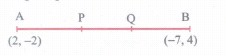
Therefore, P divides AB internally in the ratio 1:2. Therefore, the coordinates at P, by applying the section formula, are
\(\left[ \frac { 1(-7)+2(2) }{ 1+2 } ,\frac { 1(7)+2(-2) }{ 1+2 } \right] \) i.e., (-1,10)
Now, Q also divides AB internally in the ratio 2:1, so, the coordinates at Q are
\(\left[ \frac { 2(-7)+1(2) }{ 2+1 } ,\frac { 2(4)+(-2) }{ 2+1 } \right] \) i.e., (-4,2)
Therefore, the coordinates at the points at trisection of the line segment joining A and B are (-1, 0) and (-4, 2).
34.
Area of quadrilateral BCEG
Vertices are B (- 4, - 2), C (2, - 1), E (1.5, 1) and G (- 4.5, 0.5)
Area of quadrilateral \(=\frac{1}{2}\left[\left(x_{1}-x_{3}\right)\left(y_{2}-y_{4}\right)\right.
\left.-\left(x_{2}-x_{4}\right)\left(y_{1}-y_{3}\right)\right] \text { sq. units }
\)
\(=\frac{1}{2}[(-4-1.5)(-1-0.5)-(2+4.5)(-2-1)]
\)
\(=\frac{1}{2}[(-5.5)(-1.5)-(6.5)(-3)]
\)
\(=\frac{1}{2}[8.25+19.5]=\frac{1}{2} \cdot[27.75]
\)
= 13.875 = 13.88 sq. units
35.
(A U B) x C = (A x C) U (B x C)
A = {0,1} , B = {2,3,4} , C = {3,5}
\(A\cup B\) = {0,1,2,3,4}
\((A\cup B)\times C\) = {0,1,2,3,4} x {3,5}
= {(0,3),(0,5),(1,3),(1,5),(2,3),(2,5),(3,3),(3,5),(4,3),(4,5)} ...(1)
A x C = {0,1} x {3,5}
= {(0,3),(0,5),(1,3),(1,5)}
B x C = {2,3,4} x {3,5}
= {(2,3),(2,5),(3,3),(3,5),(4,3),(4,5)}
\((A\times C)\cup (B\times C)\) = {(0,3),(0,5),(1,3),(1,5),(2,3),(2,5),(3,3),(3,5),(4,3),(4,5)} .....(2)
From (1) and (2), it is clear that
(A U B) x C = (A x C) U (B x C)
Hence verified.
36.
Fo = (co x 1.8) + 32
σc = 5°C
σF = (1.8 x 5°C) . 9°F
Adding value to data doesn't affect standard deviation.
New variance = σ2F = 81°F.
37.
Given the number 107,
It is a positive odd integer.
Let a = 107 and b = 4
Applying division algorithm we have,
107 = 4q + r where 0 < r < 4
The possible r = 0, 1, 2, 3.
But 107 is odd, the remainders cannot be 0 or 2.
i.e. 4q or 4q + 2 is not possible to express 107.
The other possibilities are 4q + 1 or 4q + 3
Suppose 4q + 1 = 107
4q = 107- 1
= 105
\(q=\frac{106}{4}\) not a natural numbers
Only possibility is 107 = 4q + 3.
107 - 4q + 3
4q = 107 - 3 = 104
\(q=\frac{104}{4}=26\)
q = 26
38.
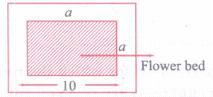
Area of the flower bed = a2
Area of the gravel path = 100 - a2
Area of total garden = 100
given cost of flower bed + gravelling = Rs.364
3a2 + 4 (100 - a2) = Rs.364
3a2 + 400 - 4a2 = 364
∴ a2 = 400-364
= 36 ⇒ a = 6
∴ width of gravel path \(=\frac { 10-6 }{ 2 } =\frac { 4 }{ 2 } =2cm\)
39.
Coin is in the form of a cylinder
Diameter of the coin = 1.5 cm
Radius of the coin = \(\frac{1.5}{2}\)
Thickness = height = 2 mm = \(\frac{2}{10}=0.2 \mathrm{~cm}\)
Volume of coin (cylinder) = \(\pi r^{2} h\)
\(=\pi\left(\frac{1.5}{2}\right)^{2}(0.2)
\)
\(=0.1125 \pi \mathrm{cm}^{3}
\)
Diameter of cylinder = 4.5 cm
radius = \(\frac{4.5}{2}=2.25 \mathrm{~cm}\)
height = 10 cm
volume = \(\pi r^{2} h\ sq. units
\)
= \(\pi(2.25)^{2}(10)
\)
= \(50.625 \pi
\)
No.of coins \(=\frac{\text { Volume of cylinder }}{\text { Volume of Coin }}
\)
\(=\frac{50.625 \pi}{0.1125 \pi}=450 \text { coins. }
\)
40.
Given \(\frac{\cos \theta}{1+\sin \theta}=\frac{1}{a}
\)
\(\therefore a=\frac{1+\sin \theta}{\cos \theta}
\)
\(\mathrm{LHS}=\frac{a^{2}-1}{a^{2}+1}
\)
\(=\frac{\left(\frac{1+\sin \theta}{\cos \theta}\right)^{2}-1}{\left(\frac{1+\sin \theta}{\cos \theta}\right)^{2}+1}\)
\(=\frac{\frac{1^{2}+\sin ^{2} \theta+2 \sin \theta}{\cos ^{2} \theta}-1}{\frac{1^{2}+\sin ^{2} \theta+2 \sin \theta}{\cos ^{2} \theta}+1}\)
\(=\frac{\frac{1+\sin ^{2} \theta+2 \sin \theta-\cos ^{2} \theta}{\cos ^{2} \theta}}{\frac{1+\sin ^{2} \theta+2 \sin \theta+\cos ^{2} \theta}{\cos ^{2} \theta}}\)
\(=\frac{\left(1-\cos ^{2} \theta\right)+\sin ^{2} \theta+2 \sin \theta}{\cos ^{2} \theta} \times \frac{\cos ^{2} \theta}{1+\left(\sin ^{2} \theta+\cos ^{2} \theta\right)+2 \sin \theta}\)
\(=\frac{\sin ^{2} \theta+\sin ^{2} \theta+2 \sin \theta}{1+1+2 \sin \theta}\)
\(=\frac{2 \sin ^{2} \theta+2 \sin \theta}{2+2 \sin \theta}
\)
\(=\frac{2 \sin \theta(\sin \theta+1)}{2(1+\sin \theta)}
\)
= sin \(\theta \) = RHS
41.
Let r1 and r2 be the radii of sphere and hemisphere respectively.
Given TS.A of sphere = T.S.A of hemisphere
\(4 \pi r_{1}^{2} =3 \pi r_{2}^{2}
\)
\(\frac{r_{1}^{2}}{r_{2}^{2}} =\frac{3}{4} \Rightarrow \frac{r_{1}}{r_{2}}=\frac{\sqrt{3}}{2}
\)
Ratio of their volumes : \(\frac{V_{1}}{V_{2}}=\frac{\frac{4}{3} \pi r_{1}^{3}}{\frac{2}{3} \pi r_{2}^{3}}=2\left(\frac{r_{1}}{r_{2}}\right)^{3}\)
\(=2\left(\frac{\sqrt{3}}{2}\right)^{3}
\)
\(=\frac{3 \sqrt{3}}{4}=3 \sqrt{3}: 4
\)
Ratio of their volumes = \(3 \sqrt{3}: 4\)
42.
Clearly the ladder AC make a right triangle with the wall AB force at a distance BC. \(\angle\)B - 90o
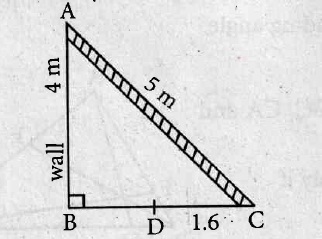
By Pythagoras theorem
AC2 = AB2 + BC2
52 = 42 + BC2
BC2 = 25 - 16
BC2 = 9
BC = 3m
If C moves 1.6 m towards the wall BC becomes
3m - 1.6m = 1.4m
Now in \(\triangle\)ABC
AC2 = AB2 + BC2
52 = AB2 +(1.4)2
25 - 1.96 = AB2
AB2 = 23.04
AB = 4.8m
The new height of the wall = 4.8 m
Difference =4.8 - 4 = -0.8m
The ladder would be placed 0.8 m upward the wall.
43.
Let the first aeroplane starts from O and goes upto A towards north, (Distance=Speed × time)
where \(OA=\left( 100\times \frac { 3 }{ 2 } \right) km=1500km\)
Let the second aeroplane starts from O at the same time and goes upto B towards west,
where \(OB=(1200\times \frac { 3 }{ 2 } )=1800km\)
The required distance to be found is BA.
In right angled triangle AOB, AOB, AB2 = OA2 + OB2
AB2 = (1500)2 + (1800)2 = 1002 (152 +182)
= 1002 x 549 = 1002 x 9 x 61
\(AB=100\times 3\times \sqrt { 61 } =300\sqrt { 61 } kms.\)
44.
y = ax + b; x = forehand length; y = height
| X | Y |
| 35 | 56 |
| 45 | 65 |
| 50 | 69.5 |
| 55 | 74 |
For all the x-values, there is an image which is 'y
Moreover, the difference between two consecutive 'y' values is constant
In y = ax + b,
(i) The Relation
R = { (35, 56), (45, 65), (50, 69.5), (55, 74) } is a function
(ii) In y = ax + b
when x = 35,y = 56
56 = 35a + b ..............(1)
when x = 45,y = 65
65 = 45a + b ..............(2)
Solving (1) and (2), we get a = 0.90 and b = 24.5
(iii) Given, forehand length is 40 cm
i.e., when x = 40,y = ax + b
So, y = (0.90) (40) + 24.5 = 60.5
Height of person is 60.5 inches.
(iv) Given height is 53.3 inches
i.e. when y = 53.3, x = ?
53.3 = 0.9x + 24.5
53.3 - 24.5 = 0.9x
x = \(\frac{28.8}{0.9}\)
x = 32 cm
Length of forehand is 32 cm.
45.
(2x-3)(x+2)=0
2x2 - 3x + 4x - 6 = 0
2x2 + 1x-6 = 0
Let y = 2x2 +X - 6= 0
| x | -4 | -3 | -2 | -1 | 0 | 1 | 2 | 3 | 4 |
| x2 | 16 | 9 | 4 | 1 | 0 | 1 | 4 | 9 | 16 |
| 2x2 | 32 | 18 | 8 | 2 | 0 | 2 | 8 | 18 | 32 |
| x | -4 | -3 | -2 | -1 | 0 | 1 | 2 | 3 | 4 |
| -6 | -6 | -6 | -6 | -6 | -6 | -6 | -6 | -6 | -6 |
| y=x2-x-6 | 22 | 9 | 0 | -5 | -6 | -3 | -4 | 15 | 30 |
Step 2:
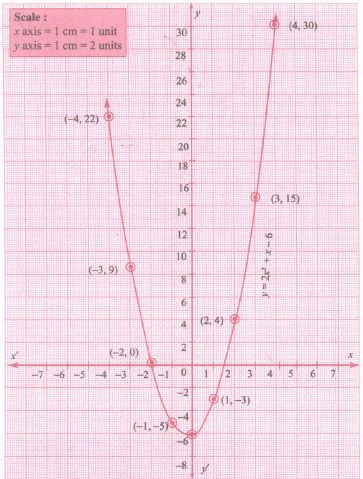
The points to be plotted: (-4,22), (-3, 9), (-2, 0), (-1, -5), (0, -6), (1, -3), (2,4), (3,15), (4, 30)
Step 3:
Draw. the parabola and mark the co-ordinates of the intersecting point of the parabola with the x-axis.
Step 4:
The points of intersection of the parabola with the x-axis are (-2, 0) and (1.5,0).
Since the parabola intersects the x-axis at two points, the equation has real and unequal roots
∴ Solution {-2, 1.5}
46.
x2 - 8x + 16 = 0
Step 1 Prepare the table of values for the equation y = x2 - 8x + 16
| x | -1 | 0 | 1 | 2 | 3 | 4 | 5 | 6 | 7 | 8 |
| y | 25 | 16 | 9 | 4 | 1 | 0 | 1 | 4 | 9 | 16 |
Step 2: Plot the points for the above ordered pairs (x, y) on the graph using suitable scale.
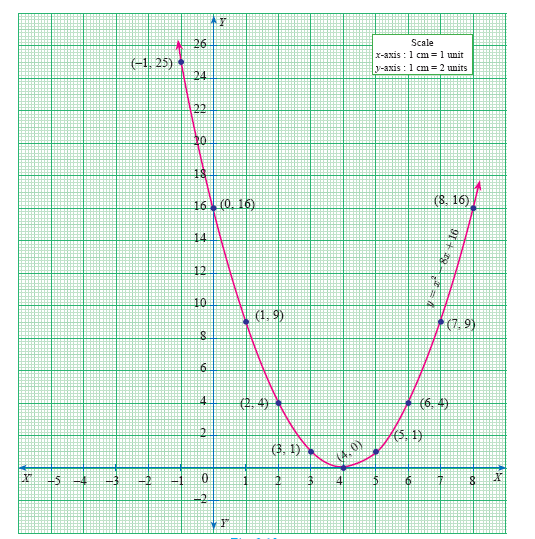
Step 3: Draw the parabola and mark the coordinates of the parabola which intersect with the X axis.
Step 4: The roots of the equation are the x coordinates of the intersecting points of the parabola with the X axis (4,0) which is 4.
Since there is only one point of intersection with X axis, the quadratic equation x2 - 8x + 16 = 0 has real and equal roots.
47.
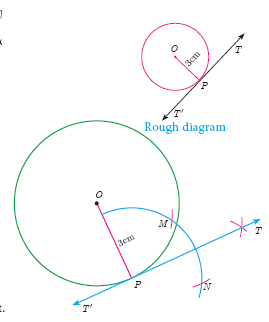
Given, radius r = 3 cm
Construction
Step 1: Draw a circle with centre at O of radius 3 cm.
Step 2: Take a point P on the circle. Join OP.
Step 3: Draw perpendicular line to OP which passes through P.
Step 4: TT' is the required tangent.
48.
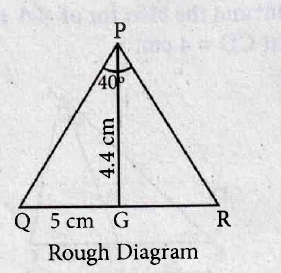
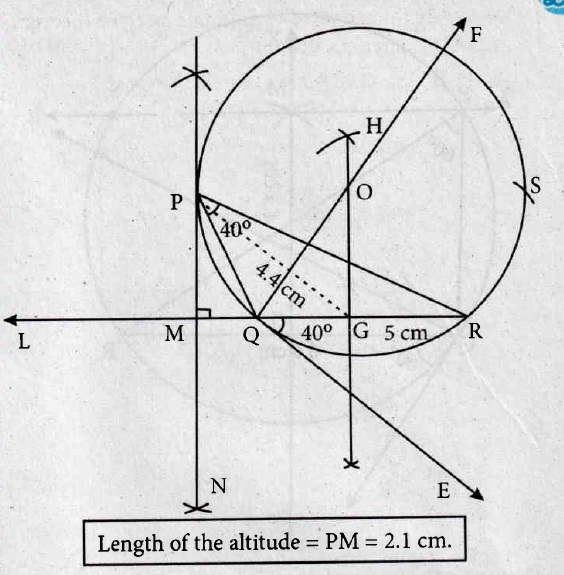
Construction:
Step (1) Draw a line segment QR = 5 cm.
Step (2) At Q, draw QE such that \(\angle RQE\) = 40°.
Step (3) At Q, draw QF such that \(\angle EQF\) = 90o
Step (4)Drawn a perpendicular bisector to QR, which intersects QF at 'O' and QR at G.
Step (5) With O as centre and OQ as radius, draw a circle
Step (6) From G marked arcs of radius 4.4 cm on the circle. Marked them as P and S.
Step (7) Joined QP and PR. Now \(\triangle\)PQR is the required triangle
Step (8) From P draw a line PN which is \(\bot \) to LR. LR meets PN at M.
Step (9) The length of the altitude is PM = 2.1cm

10th Standard Syllabus & Materials
10th Standard
TN 10th English Prose - 2 - The Night the Ghost Got in Important Questions And Answers Study Material - QB365 Set A
NEW10th Standard
TN 10th English Supplementary - 1 - The Tempest Important Questions And Answers Study Material - QB365 Set A
NEW10th Standard
TN 10th English Poem - 1 - Life Important Questions And Answers Study Material - QB365 Set A
NEW10th Standard
TN 10th English Prose - 1 - His First Flight Important Questions And Answers Study Material - QB365 Set A



Tamilnadu Stateboard 10th Standard Subjects
Tamilnadu Stateboard Standards





