
 100% FREE ACCESS
9th Standard Syllabus & Materials
9th Standard
TN 9th Tamil உள்ளத்தின் சீர் -கற்கண்டு (இலக்கணம்) - தொடர் இலக்கணம், ஆகுபெயர் Important Questions And Answers Study Material - QB365 Set A
NEW9th Standard
TN 9th Tamil உள்ளத்தின் சீர் -விரிவானம் (துணைப்பாடம்) - தாய்மைக்கு வறட்சி இல்லை! Important Questions And Answers Study Material - QB365 Set A
NEW9th Standard
TN 9th Tamil உள்ளத்தின் சீர் -கவிதை பேழை (செய்யுள்) - மார்கழி பெருவிழா Important Questions And Answers Study Material - QB365 Set A
NEW9th Standard
TN 9th Tamil உயிருக்கு வேர்-இலக்கணம் - பகுபத உறுப்பிலக்கணம் Important Questions And Answers Study Material - QB365 Set A
NEW9th Standard
TN 9th Tamil அமுதென்று பேர் - இலக்கணம்-எழுத்து -அளபெடை Important Questions And Answers Study Material - QB365 Set A
NEW9th Standard
TN 9th Tamil அமுதென்று பேர்-துணைப்பாடம் - ஆறாம்திணை Important Questions And Answers Study Material - QB365 Set A

Published on: 29/12/2018
Term 2 FA(B) Model Question
Download Tamil Nadu 9th Standard Maths question papers, model tests, one-mark questions, important questions, and public exam papers in PDF format. Free study materials and answer keys for TN State Board students.
Questions + Answers key
Take MCQ Maths Test1.
A set of numbers consists of five 4’s, four 5’s, nine 6’s, and six 9’s. What is the mode.
2.
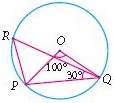
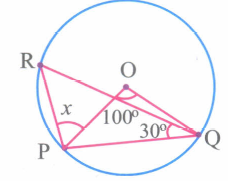
In the given figure, ㄥPOQ = 100o and ㄥPQR = 30o, then find ㄥRPO
3.
Expand: (2a + 3b)3
4.
Expand the following: (2a-3b+4c)2
5.
Expand the following using identities: (5x+4y)(5x-4y)
6.
Write the following in scientific notation: (4000000)3 ÷ (0.00002)4
7.
Simplify: (2.75 \(\times\)107)+(1.23 \(\times\) 108)
8.
Rationalise the denominator
(i) \(\frac { 1 }{ \sqrt { 50 } } \)
(ii) \(\frac { 5 }{ 3\sqrt { 5 } } \)
(iii) \(\frac { \sqrt { 75 } }{ \sqrt { 18 } } \)
(iv) \(\frac { 3\sqrt { 5 } }{ \sqrt { 6 } } \)
9.
If A = {0, 2, 4, 6, 8}, B = {x : x is a prime number and x < 11} and C = {x : x ∈ N and 5 ≤ x < 9} then verify \(A\cup (B\cap C)=(A\cup B)\cap (A\cup C)\).
10.
If A =\(\left\{ -\frac { 1 }{ 2 } ,0,\frac { 1 }{ 4 } ,\frac { 3 }{ 4 } ,2 \right\} \), B =\(\left\{ 0,\frac { 1 }{ 4 } ,\frac { 3 }{ 4 } ,2,\frac { 5 }{ 2 } \right\} \) and C =\(\left\{ -\frac { 1 }{ 2 } .\frac { 1 }{ 4 } ,1,2,\frac { 5 }{ 2 } \right\} \), then verify \(A\cap (B\cap C)=(A\cap B)\cap C\) .
11.
If A = {-2,0,1,3,5}, B = {-1,0,2,5,6} and C = {-1,2,5,6,7} then show that A-(B∪C) = (A-B)∩(A-C).
12.
If the arithmetic mean of 7 values is 30 and if each value is divided by 3, then find the arithmetic mean of new set of values
13.
Find the sum of the deviations from the arithmetic mean for the following observations:
21, 30, 22, 16, 24, 28, 18, 17
14.
Find the mean for the following frequency table:
| Class Interval | 100-120 | 120-140 | 140-160 | 160-180 | 180-200 | 200-220 | 220-240 |
|---|---|---|---|---|---|---|---|
| Frequency | 10 | 8 | 4 | 4 | 3 | 1 | 2 |
15.
If the quotient obtained on dividing (8x4- 2x2 + 6x - 7) by (2x +1) is (4x3+ px2- qx + 3), then find p, q and also the remainder.
16.
If \(\left( y-\frac { 1 }{ y } \right) ^{ 3 }\)= 27, then find the value of \({ y }^{ 3 }-\frac { 1 }{ { y }^{ 3 } } \) .
17.
Using algebraic identity, find the coefficients of x2, x and constant term without actual expansion.
(i) (x + 5)(x + 6)(x + 7)
(ii) (2x + 3)(2x − 5)(2x - 6)
18.
Represent the following information in scientific notation:
(i) The world population is nearly 7,000,000,000.
(ii) One light year means the distance 9460528400000000 km.
(iii) Mass of an electron is 0.000 000 000 000 000 000 000 000 000 00091093822 kg.
19.
Find the value of a and b if \(\frac { \sqrt { 7 } -2 }{ \sqrt { 7 } +2 } \) = a\(\sqrt{7}\) + b
20.
If U = {x: −4 ≤ x ≤ 4, x \(\in \)Z}, A = {x :−4 < x ≤ 2, x\(\in \)Z } and B = {x :−2 ≤ x ≤ 3,x \(\in \) Z} , then verify De Morgan’s laws for complementation.
21.
Verify \(A-(B\cap C)=(A-B)\cup (A-C)\)using Venn diagrams.
22.
The mean of the square of first 11 natural numbers is _______.
26
46
48
52
23.
The mean of 5, 9, x, 17, and 21 is 13, then find the value of x _______.
9
13
17
21
24.
Data available in an unorganized form is called __________ data
Grouped data
class interval
mode
raw data
25.
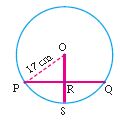
In the given figure, If OP = 17cm PQ = 30 cm and OS is perpendicular to PQ, then RS is ________.
10 cm
6 cm
7 cm
9 cm
26.
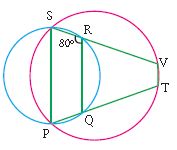
In the figure, PQRS and PTVS are two cyclic quadrilaterals, If ㄥQRS = 100°, then ㄥTVS = ______.
80°
100°
70°
90°
27.
PQ and RS are two equal chords of a circle with centre O such that ㄥPOQ = 70°, then ㄥORS = ________.
60°
70°
55°
80°
28.
GCD of any two prime numbers is _______.
-1
0
1
2
29.
(x+y)(x2−xy+y2) is equal to_______.
(x+y)3
(x-y)3
x3 + y3
x3 - y3
30.
If x - 3 is a factor of p(x), then the remainder is _______.
3
-3
p(3)
p(-3)
31.
What is 5.92 \(\times\)10-3 written in decimal form?
0.000592
0.00592
0.0592
0.592
32.
When written with a rational denominator, the expression \(\frac { 2\sqrt { 3 } }{ 3\sqrt { 2 } } \) can be simplified as ________.
\(\frac { \sqrt { 2 } }{ 3 } \)
\(\frac { \sqrt { 3 } }{ 2 } \)
\(\frac { \sqrt { 6 } }{ 3 } \)
\(\frac{2}{3}\)
33.
In simplest form, \(\sqrt{640}\) is ____________
8\(\sqrt{10}\)
10\(\sqrt{8}\)
2\(\sqrt{20}\)
4\(\sqrt{5}\)
34.
If n(A \(\cup \) B \(\cup \) C) = 40, n(A) = 30, n(B) = 25, n(C) = 20, n(A\(\cap \)B) = 12, n(B\(\cap \)C) = 18 and n(A\(\cap \)C) = 15 , then n(A\(\cap \)B\(\cap \)C) is ___________
5
10
15
20
35.
Which of the following is true?
A-B = A\(\cap \)B
A−B = B −A
(A\(\cup \)B)' = A'\(\cup \)B'
(A\(\cap \)B)' = A'\(\cup \)B'
36.
For any three sets P, Q and R, P-(Q\(\\ \cap \)R) is ________.
P-(Q\(\cup \)R)
(P\(\\ \cap \)Q)-R
(P-Q)\(\cup \)(P-R)
(P-Q)\(\\ \cap \)(P-R)
37.
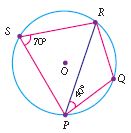
If PQRS is a cyclic quadrilateral in which ㄥPSR=70° and ㄥQPR = 40°, then find ㄥPRQ.
38.
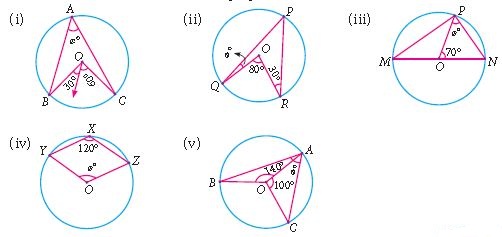
Find the value of x° in the following figures:
39.
Draw the \(\triangle \)ABC , where AB = 6 cm, B = 110° and AC = 9 cm and construct the centroid.
40.
Draw and locate the centroid of the triangle ABC where right angle at A, AB = 4cm and AC = 3cm
1.
| Size of item | 4 | 5 | 6 | 9 |
|---|---|---|---|---|
| Frequency | 5 | 4 | 9 | 6 |
6 has the maximum frequency 9. Therefore 6 is the mode.
2.
In the figure\(\angle \)POQ = 1000
\(\angle \)PQR = 300
\(\angle \)PQR = \(\cfrac { 1 }{ 2 } \)\(\angle \)PQR = \(\cfrac { 1 }{ 2 } \)\(\times\)100 = 500
In\(\triangle \)OPQ = \(\angle \)OQP =\(\angle \)POQ = 1800
2\(\angle \)OPQ = 1800
2\(\angle \) OPQ = 800
\(\therefore \) \(\angle \)OPQ = 400
In \(\triangle \)PRQ,
\(\angle \)R+\(\angle \)P+\(\angle \)Q = 1800
500 + (40 + x) + 300 = 1800
(40 + x)0 = 1800 - 80 = 1000
x0 = 1000 - 400 = 600
\(\therefore \) \(\angle \)RPO = x = 600
3.
We know that (a+b)3 ≡ a3+3a2b+3ab2+b3
(2a+3b)3 = (2a)3+3(2a)2(3b)+3(2a)(3b)2+(3b)3
= 8a3+36a2b+54ab2+27b3
4.
(2a-3b+4c)2= (2a+(-3b)+4c)2 = (2a)2+(-3b)2+(4c)2+2(2a)(-3b)+2(-3b)(4c)+2(4c)(2a)
= 4a2+9b2+16c2+(-12ab)+(-24bc)+16ca
= 4a2+9b2+16c2-12ab-24bc+16ca
5.
(5x + 4y)(5x −4y) [we have (a+b)(a-b) = a2-b2]
(5x+4y)(5x-4y) = (5x)2-(4y)2 put [a = 2a, b = 4y]
= 25x2-16y2
6.
(4000000)3 ÷ (0.00002)4
\( =\left(4.0 \times 10^{6}\right)^{3} \div\left(2.0 \times 10^{-5}\right) 4 \)
\(=(4.0)^{3} \times\left(10^{6}\right)^{3} \div(2.0)^{4} \times\left(10^{-5}\right)^{4} \)
\(=\frac{64.0 \times 10^{18}}{16.0 \times 10^{-20}} \)
\(=4 \times 10^{18} \times 10^{+20} \)
\(=4.0 \times 10^{38} \)
7.
\( \left(2.75 \times 10^{7}\right)+ \left(1.23 \times 10^{8}\right) \\ =\left(2.75 \times 10^{-1}+1.23\right) \times 10^{8} \\ =(0.275+1.23) \times 10^{8} \\ =1.505 \times 10^{8} \)
8.
(i) \(\frac{1}{\sqrt{50}}=\frac{1}{\sqrt{50}}\times\frac{\sqrt{50}}{\sqrt{50}}=\frac{\sqrt{50}}{\sqrt{50}}=\frac{\sqrt{5\times5\times2}}{5\times5\times2}=\frac{ ̶5̶\sqrt{2}}{ ̶5̶\times5\times2}=\frac{\sqrt{2}}{10}\)
(ii) \(\frac{5}{3\sqrt{5}}=\frac{5}{3\sqrt{5}}\times\frac{\sqrt{5}}{\sqrt{5}}=\frac{ ̶5̶\sqrt{5}}{3\times ̶5̶}=\frac{\sqrt{5}}{3}\)
(iii) \(\frac{\sqrt{75}}{\sqrt{18}}=\frac{\sqrt{3\times5\times5}}{\sqrt{3\times2\times3}}=\frac{5\sqrt{3}\times\sqrt{2}}{3\sqrt{2}\times\sqrt{2}}=\frac{5\sqrt{6}}{3\times2}=\frac{5\sqrt{6}}{6}\)
(iv) \(\frac{3\sqrt{5}}{\sqrt{6}}=\frac{3\sqrt{5}\times\sqrt{6}}{\sqrt{6}\times\sqrt{6}}=\frac{ ̶3̶\sqrt{30}}{ ̶6̶}=\frac{\sqrt{30}}{2}\)
9.
Given A = {0, 2, 4,6, 8} , B = {2, 3, 5, 7} and C = {5, 6, 7, 8}
First, we find \(B\cap C\) = {5, 7} ,\(A\cup (B\cap C)\) = {0, 2, 4, 5, 6, 7, 8} .......... (1)
Next, \(A\cup B\) = {0,2,3,4,5,6,7, 8}, \(A\cup C\) = {0, 2, 4, 5, 6, 7, 8}
Then, \((A\cup B)\cap (A\cup C)\) = {0, 2, 4, 5, 6, 7, 8} .............(2)
From (1) and (2), it is verified that \((A\cup \left( B\cap C \right) =(A\cup B)\cap (A\cup C)\).
10.
Now, \((B\cap C)=\left\{ \frac { 1 }{ 4 } ,2,\frac { 5 }{ 2 } \right\} \)
\(A\cap (B\cap C)=\left\{ \frac { 1 }{ 4 } ,2 \right\} \) .......(1)
Then, \(A\cap B=\left\{ 0,\frac { 1 }{ 4 } ,\frac { 3 }{ 4 } ,2 \right\} \)
\((A\cap B)\cap C=\left\{ \frac { 1 }{ 4 } ,2 \right\} \) .......(2)
From (1) and (2), it is verified that
\((A\cap B)\cap C=A\cap (B\cap C)\).
11.
A = {-2,0,1,3,5}, B = {-1,0,2,5,6}
C = {-1,2,5,6,7}
B∪C = {-1,0,2,5,6,7}
A-(B∪C) = {-2,1,3}.............(1)
(A-B) = {-2,1,3}
(A-C) = {-2,0,1,3}
(A-B)∩(A-C) = {-2,1,3}............(2)
From (1) and (2), it is verified that
A-(B∪C) = (A-B)⋂(A-C)
12.
Let X represent the set of seven values x1, x2, x3, x4, x5, x6, x7
Then \(\bar X={{\sum_{i=1}^7}\over 7}=30\) or \({\sum_{i=1}^7}x_i=210\)
If each value is divided by 3, then the mean of new set of values is
\({{\sum_{i=1}^7}{x_i\over3}\over7}={\left({x_1\over3}+{x_2\over3}+{x_3\over3}+{x_4\over3}+{x_5\over3}+{x_6\over3}+{x_7\over3} \right)\over7}\)
\({{\sum_{i=1}^7}x_i\over21}={210\over 21}=10\)
Aliter
If Y is the set of values obtained by dividing each value of X by 3.
Then, \(\bar Y= \frac {\bar x}{3} = \frac {30}{3}=10\)
13.
\(\bar{X}=\frac{\sum_{i=1}^{8} x_{i}}{n}=\frac{21+30+22+16+24+28+18+17}{8}=\frac{176}{8}=22\)
Deviation of an entry xi from the arithmetic mean \(\bar X\) is \(x_i-\bar X\), i = 1, 2,........8
Sum of the deviations = (21-22)+(30-22)+(22-22)+(16-22)+(24-22)+(28-22)+(18-22)+(17-22)
= 16–16 = 0. or equivalently, \(\sum_{i=1}^{8}\left(x_{i}-\bar{X}\right)=0\)
Hence, we conclude that sum of the deviations from the Arithmetic Mean is zero.
14.
Let Assumed mean A =170
| Class Interval | Frequency | Midvalue x | d = x–A d = x–170 |
fd |
|---|---|---|---|---|
| 100-120 | 10 | 110 | -60 | -600 |
| 120-140 | 8 | 130 | -40 | -320 |
| 140-160 | 4 | 150 | -20 | -80 |
| 160-180 | 4 | 170 | 0 | 0 |
| 180-200 | 3 | 190 | 20 | 60 |
| 200-220 | 1 | 210 | 40 | 40 |
| 220-240 | 2 | 230 | 60 | 120 |
| Σ f = 32 | Σ fd = –780 |
Mean \(\bar X = A+{Σfd\over Σf}\)
\(=170+\left(-780\over32\right)\)
Therefore \(\bar X\) = 170 - 24.375
= 145.625
15.
Let p(x) = 8x4- 2x2 + 6x-7
Standard form = 8x4+ 0x3- 2x2+ 6x - 7
Co-efficients are 8 0 - 2 6 -7
Q(x) = 2x+1,
To find zero of 2x + 1, put 2x + 1 = 0; 2x = -1, x = \(-\frac{1}{2}\)
Synthetic division
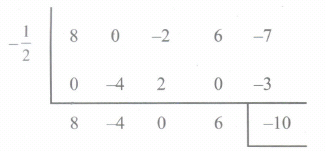
Quotient = \(\frac{1}{2}\)[8x3-4x2+6] = 4x3-2x2+3
Quotient 4x3 - 2x2 + 3 is compared with the given quotient 4x3-px2-qx+3
Co-efficients of x2 is p = -2
Co-efficients of x is q = 0
Remainder is - 10
16.
\((y-\frac{1}{y})^3=27\)
y3-\(\frac{1}{y^3}\) = \((y-\frac{1}{y})^3+3y+\frac{1}{y}(y-\frac{1}{y})\)
∵ x3-y3 ≡ (x-y)3+3xy(x-y)
= 27+3\((y-\frac{1}{y})\)
\(∵ (y-\frac{1}{y})^3=27; y-\frac{1}{y}=\sqrt[3]{27}=3\)
= 27+3\(\times\)3 = 27+9 = 36
17.
(i) (x + 5)(x + 6)(x + 7)
Coefficient of x2 = a + b + c = 5 + 6 + 7 = 18
Coefficient of x2= ab + bc + ca = (5\(\times\)6)+(6\(\times\)7)+(7\(\times\)5)
= 30 + 42 + 35 = 107
Constant term = abc = 5\(\times\)6\(\times\)7
Coefficient of constant term = 210
(ii) (2x + 3)(2x - 5)(2x - 6)
Coefficient of x2= 4(a+b+c) = 4(3+(-5)+(-6))
= 4\(\times\)(-8) = -32
Coefficient of x = 2(ab+bc+ca)
= 2[3x(-5)+(-5)(-6)+(-6)(3)]
= 2[-15+30-18] = 2x(-3) = -6
Constant term = abc = 3x(-5)x(-6) = 90
18.
(i) The world population is nearly
7,000,000,000 = 7.0 \(\times\) 109
(ii) One light year means the distance
9460528400000000 km = 9.4605284 \(\times\) 1015 km
(iii) Mass of an electron is
0.000 000 000 000 000 000 000 000 000 00091093822 kg = 9.1093822 \(\times\) 10-31 kg
19.
\(\frac { \sqrt { 7 } -2 }{ \sqrt { 7 } +2 } =a\sqrt{7}+b\)
L.H.S = \(\frac{\sqrt{7}-2\times\sqrt{7}-2}{\sqrt{7}+2\times\sqrt{7}-2}=\frac{(\sqrt{7}-2)^2}{\sqrt{7}^2-2^2}=\frac{\sqrt{7}^2-2\sqrt{7}\times2+2^2}{7-4}\)
=\(\frac{7-4\sqrt{7}+4}{3}=\frac{11-4\sqrt{7}}{3}=\frac{11}{3}-\frac{4\sqrt{7}}{3}\)
\(\frac{-4\sqrt{7}}{3}+\frac{11}{3}=a\sqrt{7}+b\)
a √7=\(\frac{-4\sqrt{7}}{3}\)
a = \(\frac{-4}{3}\)
b = \(\frac{11}{3}\)
20.
U = {x: −4 ≤ x ≤ 4, x \(\in \)Z}, U = {-4,-3,-2,-1,0,1,2,3,4}
A = {x:-4
(AUB)' = A'⋂B'
AUB = {-3, -2, -1,0, 1,2, 3}
(AUB)' = {-4,4} ...(1)
A' = {-4, 3, 4}; B' = {-4, -3, 4}
A'∩B' = {-4,4} ...(2)
From (1) and (2) it is verified that
(AUB)' = A'⋂B'
21.
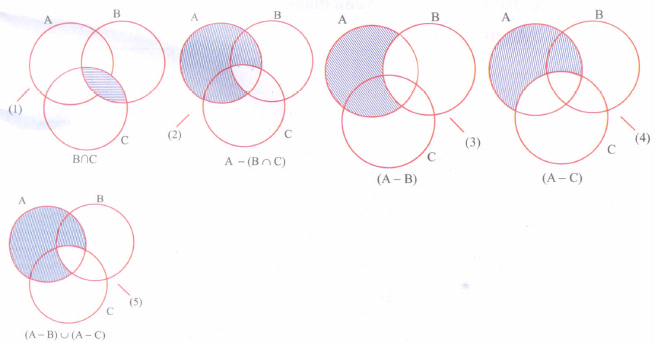
ஃ A-(B∩C)=(A-B)U(A-C)
Hence it is proved.
22.
(b)
46
23.
(b)
13
24.
(d)
raw data
25.
(d)
9 cm
26.
(a)
80°
27.
(c)
55°
28.
(c)
1
29.
(c)
x3 + y3
30.
(c)
p(3)
31.
(b)
0.00592
32.
(c)
\(\frac { \sqrt { 6 } }{ 3 } \)
33.
(a)
8\(\sqrt{10}\)
34.
(b)
10
35.
(d)
(A\(\cap \)B)' = A'\(\cup \)B'
36.
(c)
(P-Q)\(\cup \)(P-R)
37.
PQRS is a cyclic quadrilateral
Given ㄥPSR = 70°
ㄥPSR+ㄥPQR = 180° (state reason________)
70° +ㄥPQR = 180°
ㄥPQR = 180°− 70°
ㄥPQR = 110°
In ΔPQR we have, ㄥPQR+ㄥPRQ+ㄥQPR = 180° (state reason_________)
110° +ㄥPRQ + 40° = 180°
ㄥPRQ = 180°− 150°
ㄥPRQ = 30°
38.
(i)
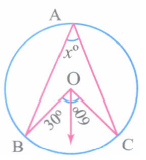
\({ x }^{ 0 }=\cfrac { 1 }{ 2 } \angle BOC=\cfrac { 1 }{ 2 } \times \left( { 30 }^{ 0 }+{ 60 }^{ 0 } \right) =\cfrac { 1 }{ 2 } \times { 90 }^{ 0 }={ 45 }^{ 0 }\)
(ii)
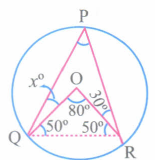
\(\angle QPR=\cfrac { 1 }{ 2 } \angle QOR=\cfrac { 1 }{ 2 } \times { 80 }^{ 0 }={ 40 }^{ 0 }\)
In \(\triangle QPR\)
\(\angle R+\angle P+\angle Q={ 180 }^{ 0 }\)
\(\angle Q\) = 180o-120o= 60o
\(\angle Q\) = xo+ 50o = 60o
xo = 60o-50o = 10o
(iii)
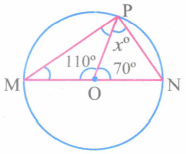
\(\angle \) MPN = 90° (Angle subtended by the diameter is 90°)
\(\angle OMP+\angle OPM={ 180 }^{ 0 }-{ 110 }^{ 0 }={ 70 }^{ 0 }\)
\(\angle MPO=\cfrac { 70 }{ 2 } =35^{ 0 }\)
But \(\angle MPN={ 90 }^{ 0 }\)
\(\therefore\) \(\angle \)OPN = 90o - 35o = 55o
(iv)
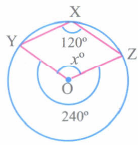
Central angle is twice that of angle subtended on the circumference
\(\angle \)YOZ = 120o\(\times\)2 = 40o
\(\therefore\) x+\(\angle\)YOZ = 360o
xo = 360o- 240o = 120o
(v)
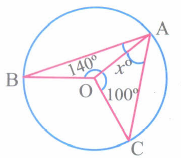
\(\angle\)BOC = 360o- 240o = 120o
\(\therefore\) \(\angle\)BAC = xo=\(\cfrac { { 120 }^{ 0 } }{ 2 } \) = 60o
39.
In \(\triangle \)ABC, AB = 6 cm, ∠B= 110°, AC = 9 cm
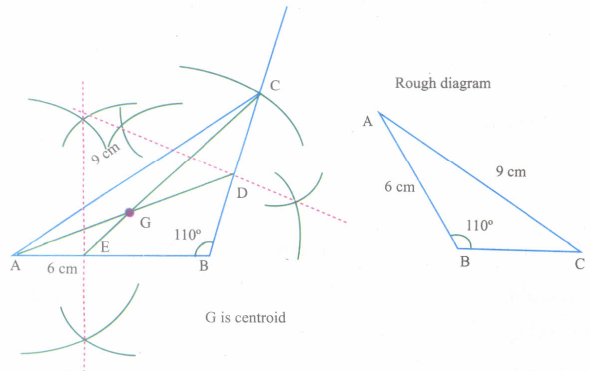
Construction :
Step 1: Draw \(\triangle \)ABC with AB = 6 cm, ∠B =110°, AC = 9 cm
Step 2: Draw perpendicular bisectors of any two sides (BC and AB) to find the midpoints of BC and AB.
Step 3: Construct medians AD and CE. Let them meet at G.
Step 4: G is the centroid of the given \(\triangle \)ABC.
40.
In \(\triangle \)ABC,
AB = 4 cm, AC = 3 cm, \(\angle\)A = 90°
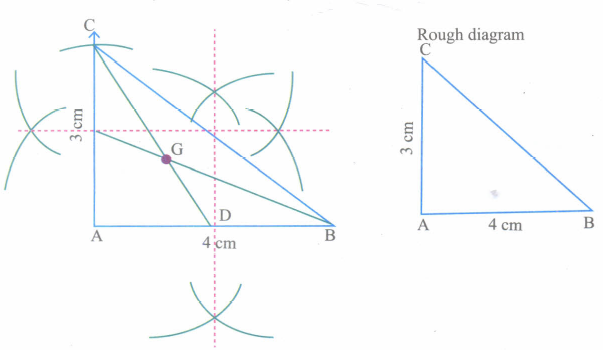
Construction :
Step 1: Draw \(\triangle \)ABC with AB = 4 cm, AC = 3 cm, \(\angle\)A = 90°
Step 2: Draw perpendicular bisectors of any two sides (AB and AC) to find the midpoints of AB and AC.
Step 3: Draw the medians CD and BE. Let them meet at G.
Step 4: G is the centroid of the given triangle.

9th Standard Syllabus & Materials
9th Standard
TN 9th Tamil உள்ளத்தின் சீர் - திருக்குறள் Important Questions And Answers Study Material - QB365 Set A
NEW9th Standard
TN 9th Tamil உள்ளத்தின் சீர் - மணிமேகலை Important Questions And Answers Study Material - QB365 Set A
NEW9th Standard
TN 9th Tamil உள்ளத்தின் சீர் - ஏறு தழுவுதல் Important Questions And Answers Study Material - QB365 Set A
NEW9th Standard
TN 9th Tamil உயிருக்கு வேர் - தண்ணீர் Important Questions And Answers Study Material - QB365 Set A



Tamilnadu Stateboard 9th Standard Subjects
Tamilnadu Stateboard Standards





