
 100% FREE ACCESS
7th Standard Syllabus & Materials
7th Standard
TN 7th Tamil பருவம் -1 இயல் 1 - அமுதத்தமிழ் - ஒன்றல்ல இரண்டல்ல Important Questions And Answers Study Material - QB365 Set A
NEW7th Standard
TN 7th Tamil பருவம் -1 இயல் 1 - அமுதத்தமிழ் - எங்கள் தமிழ் Important Questions And Answers Study Material - QB365 Set A
NEW7th Standard
TN 7th English T1 - Poem - Your Space Important Questions And Answers Study Material - QB365 Set A
NEW7th Standard
TN 7th English T1 - Prose - A Prayer to the Teacher Important Questions And Answers Study Material - QB365 Set A
NEW7th Standard
TN 7th English T1 - Poem - The Listeners Important Questions And Answers Study Material - QB365 Set A
NEW7th Standard
TN 7th English T1 - Prose - The Wind on Haunted Hill Important Questions And Answers Study Material - QB365 Set A

Published on: 29/06/2019
New syllabus model question paper for 7th standard state board english medium
Download Tamil Nadu 7th Standard Science question papers, model tests, one-mark questions, important questions, and public exam papers in PDF format. Free study materials and answer keys for TN State Board students.
Questions + Answers key
Take MCQ Science Test1.
Suppose a boy is enjoying a ride on a marry go round which is moving with a constant speed of 10 m/s. It implies that the boy _______.
at rest
moving with no acceleration
in accelerated motion
moving with uniform velocity
2.
Two spheres have equal mass and volume in the ratio 2:1. The ratio of their density is ________.
1:2
2:1
4:1
1:4
3.
What is the area of 10 squares each having side of 1 m?
4.
“She moves at a constant speed in a constant direction”. Rephrase the same sentence in fewer words using concepts related to motion.
5.
What is the density of gold?
6.
Name the units used to measure the distance between celestial objects.
7.
Name some of the derived quantities.
8.
A solid cylinder of mass 280 kg has a volume of 4 m3. Find the density of cylinder.
9.
What do you mean by constant acceleration?
10.
Distinguish between speed and velocity.
11.
What are derived quantities?
12.
The shortest distance between two places is_______.
13.
The area of a leaf can be measured using a ________.
14.
Density of mercury is ________.
15.
A ball of iron floats in mercury.
16.
Volume of liquids can be found using measuring containers.
17.
Volume
18.
Mass
19.
Volume
20.
Displacement
21.
Distance
22.
Copper, Aluminium, Gold, Iron
23.
Displacement / Time : Velocity : : Speed / time: ______.
24.
Area: m2 :: Volume _______
25.
Assertion: Volume of a stone is found using a measuring cylinder.
Reason: Stone is an irregularly shaped object.
a. Both assertion and reason are true and reason is the correct explanation of assertion.
b. Both assertion and reason are true, but reason is not the correct explanation of assertion.
c. Assertion is true but reason is false.
d. Assertion is false but reason is true.
26.
Explain the types of stability with suitable examples.
27.
Describe the graphical method to find the area of an irregularly shaped plane figure.
28.
A car started from rest and travelling with velocity of 20 m /s in 10 s. What is its acceleration?
29.
Two spheres of same size are made from copper and iron respectively. Find the ratio between their masses (Density of copper 8,900 kg/m3 and iron 7,800 kg/m3).
30.
A circular disc has a radius 10 cm. Find the area of the disc in m2. (Use π = 3.14).
31.
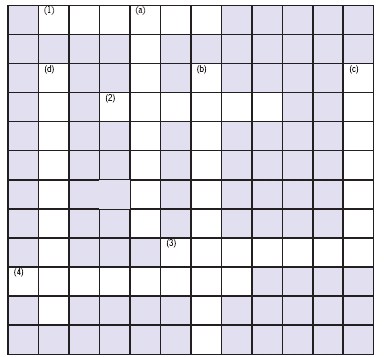
CLUES – ACROSS
1. SI unit of temperature
2. A derived quantity
3. Mass per unit volume
4. Maximum volume of liquid a container can hold
CLUES – DOWN
a. A derived quantity
b. SI unit of volume
c. A liquid denser than iron
d. A unit of length used to measure very long distances
32.
| S.No | First Move | Seconde Move | Distance (m) | Displacement |
| 1. | Move 4 meters east | Move 2 meters west | 6 | 2 m east |
| 2. | Move 4 meters north | Move 2 meters south | ||
| 3. | Move 2 meters east | Move 4 meters west | ||
| 4. | Move 5 meters east | Move 5 meters west | ||
| 5. | Move 5 meters south | Move 2 meters north | ||
| 6. | Move 10 meters west | Move 3 meters east |
1.
(d)
moving with uniform velocity
2.
(a)
1:2
3.
Area of a square = side \(\times \) side
= 1 m \(\times \) 1 m
= 1 m2 or 1 square metre
Area of 10 squares = 1 square metre \(\times \) 10
= 10 square metre
4.
She moves in a straight line with constant velocity.
5.
Density of gold is 19,300 kg/m3
6.
Astronomical unit and light year.
7.
Area, Volume, Speed, Electric charge and Density.
8.
Density of cylinder \(=\frac { mass \ of \ cylinder }{ volume \ of \ cylinder }\)
\(=\frac{280}{4}=70 \mathrm{~kg} / \mathrm{m}^{3}\)
9.
An object undergoes uniform acceleration when the change (increase or decrease) in its velocity for every unit of time is the same.
10.
| S.No | Speed | Velocity |
| 1. | Speed is the rate of change of distance | Velocity is the rate of change in displacement |
| 2. | Speed = distance / time | Velocity = displacement / time |
| 3. | SI unit of speed is m/s | SI unit of velocity is m/s |
| 4. | Speed = \(\frac{Distance \ travelled}{time \ taken}\) | Velocity = \(\frac{Displacement}{time \ takem}\) |
11.
Physical quantities which can be obtained by multiplying, dividing or by mathematically combining the fundamental quantities are known as derived quantities.
Ex: Area, volume
12.
()
displacement
13.
()
graph sheet
14.
()
13,600 kg/m3
15.
True
16.
True
17.
measuring jar
18.
kg
19.
m3
20.
Metre
21.
light year
22.
Aluminium, Iron, Copper, Gold
23.
speed
24.
m3
25.
a. Both assertion and reason are true and reason is the correct explanation of assertion.
26.
Stability:
Stability is a measure of the body's ability to maintain its original position.
The three types of stability are
(i) Stable equilibrium
(ii) Unstable equilibrium
(iii) Neutral equilibrium
Stable Equilibrium:
i) The frustum can be tilted through quite a big angle without toppling.
ii) Its centre of gravity is raised when it is displaced.
iii) The vertical line through its centre of gravity still falls within its base.
iv) So it can return to its original position.
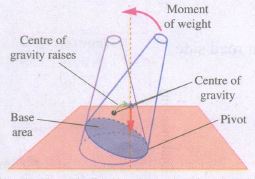
Unstable Equilibrium:
i) The frustum will topple with the slightest tilting. Its centre of gravity is lowered when it is displaced.
ii) The vertical line through its centre of gravity falls outside its base.
.JPG)
Neutral Equilibrium:
(i) It causes frustum to topple.
(ii) The frustum will rolls about but does not topple.
(iii) Its centre of gravity remains at the same height when it is displaced.
(iv) The body will stay in any position to which it has been displaced.
.JPG)
27.
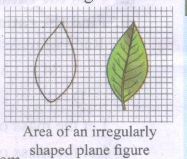
Take a leaf from any one of trees in your neighbourhood. Place the leaf on a graph sheet and draw the outline of the leaf with a pencil. Remove the leaf. You can see the outline of the leaf on the graph sheet.
i) Now count the number of whole squares enclosed within the outline of the leaf. Take it to be M
ii) Then count the number of squares that are more than half. Take it as N
iii) Next, Count the number of squares which are half of a whole square. Note it to be P.
iv) Finally, count the number of squares that are less than half. Let it be a Q.
v) Now the approximate area of the leaf can be calculated using the following formula.
Approximate area of the leaf = M+(3/4)N+(1/2)P+(1/4)
This formula can be used to calculate the area of any irregularly shaped plane figures.
28.
Final velocity (v) = 20 m/s Initial Velocity (u) = 0 m/s.
Time (t) = 10 s
Acceleration (a) =?
\(\text { Acceleration } =\frac{\text { Change in velocity }}{\text { time }} \)
\(=\frac{\text { Final velocity }(\mathrm{v})-\text { Initial velocity }(\mathrm{u})}{\text { time }}=\frac{\mathrm{v}-\mathrm{u}}{\mathrm{t}}=\frac{20-0}{10} \)
Acceleration of the car = 2 m/s2.
29.
Two spheres are same size. So the volume of two spheres are equal and take it as V
Density of copper \(=8900 \mathrm{~kg} / \mathrm{m}^{3}\)
Density of iron \(=7800 \mathrm{~kg} / \mathrm{m}^{3}\)
\(\mathrm{M}=\mathrm{D} \times \mathrm{V}\) mass of copper, take it as \(\mathrm{M}_{1}\)
mass of iron, take it as \(\mathrm{M}_{2}\)
Mass of copper \(\mathrm{M}_{1}=8900 \times \mathrm{V}\)
Mass of iron \(\mathrm{M}_{2}=7800 \times \mathrm{V}\)
Ratio of masses \(\mathrm{M}_{1} / \mathrm{M}_{2}=8900 \times \mathrm{V} / 7800 \times \mathrm{V}\)
\(\mathrm{M}_{1} / \mathrm{M}_{2} =89 / 78 \)
\(\mathrm{M}_{1}: \mathrm{M}_{2} =89: 78\)
30.
Given radius = 10 cm = 0.1m
π = 3.14
Area of a circular disc A = πr2 (in m2)
Formula: Area of a circle A = πr2
= 3.14 \(\times\) 10 / 100 \(\times\) 10 / 100
= 0.0314m2
Solution: A = 0.0314m2
31.
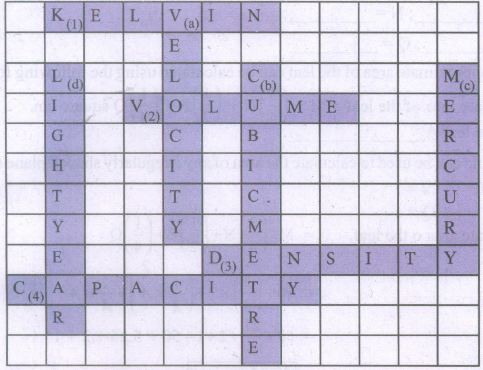
Clues - Across
1. KELVIN
2. VOLUME
3. DENSITY
4. CAPACITY
Clues-Down
a. VELOCITY
b. CUBIC METRE
c. MERCURY
d. LIGHT YEAR
32.
| S.No | First Move | Seconde Move | Distance (m) | Displacement |
| 1. | Move 4 meters east | Move 2 meters west | 6 m | 2 m east |
| 2. | Move 4 meters north | Move 2 meters south | 6 m | 2 m north |
| 3. | Move 2 meters east | Move 4 meters west | 6 m | 2 m west |
| 4. | Move 5 meters east | Move 5 meters west | 10 m | 0 (sample place) |
| 5. | Move 5 meters south | Move 2 meters north | 7 m | 3m south |
| 6. | Move 10 meters west | Move 3 meters east | 13 m | 7 m west |

7th Standard Syllabus & Materials
7th Standard
TN 7th English T1 - Supplementary - On Monday Morning Important Questions And Answers Study Material - QB365 Set A
NEW7th Standard
TN 7th English T1 - Prose - Eidgah Important Questions And Answers Study Material - QB365 Set A
NEW7th Standard
TN 7th Social Science T1 - ECO - Production Important Questions And Answers Study Material - QB365 Set A
NEW7th Standard
TN 7th Social Science T1 - GEO - Interior of the Earth Important Questions And Answers Study Material - QB365 Set A



Tamilnadu Stateboard 7th Standard Subjects
Tamilnadu Stateboard Standards




