
 100% FREE ACCESS
10th Standard Syllabus & Materials
10th Standard
TN 10th English Prose - 4 - The Attic Important Questions And Answers Study Material - QB365 Set A
NEW10th Standard
TN 10th English Supplementary - 3 - The Story of Mulan Important Questions And Answers Study Material - QB365 Set A
NEW10th Standard
TN 10th English Poem - 3 - I am Every Woman Important Questions And Answers Study Material - QB365 Set A
NEW10th Standard
TN 10th English Prose - 3 - Empowered Women Navigating The World Important Questions And Answers Study Material - QB365 Set A
NEW10th Standard
TN 10th English Supplementary - 2 - Zigzag Important Questions And Answers Study Material - QB365 Set A
NEW10th Standard
TN 10th English Poem - 2 - The Grumble Family Important Questions And Answers Study Material - QB365 Set A

Published on: 02/03/2020
Download Tamil Nadu 10th Standard Maths question papers, model tests, one-mark questions, important questions, and public exam papers in PDF format. Free study materials and answer keys for TN State Board students.
Questions + Answers key
Take MCQ Maths Test1.
A page is selected at random from a book. The probability that the digit at units place of the page number chosen is less than 7 is
\(\frac{3}{10}\)
\(\frac{7}{10}\)
\(\frac{3}{9}\)
\(\frac{7}{9}\)
2.
If the standard deviation of x, y, z is p then the standard deviation of 3x + 5, 3y + 5, 3z + 5 is
3p + 5
3p
p + 5
9p + 15
3.
A tower is 60 m height. Its shadow is x metres shorter when the sun’s altitude is 45° than when it has been 30°, then x is equal to
41.92 m
43.92 m
43 m
45.6 m
4.
5.
The value of (13 + 23 + 33 +...+153) - (1 + 2 + 3 +...+ 15)is
14400
14200
14280
14520
6.
Given F1 = 1, F2 = 3 and Fn = Fn-1 + Fn-2 then F5 is
3
5
8
11
7.
(2, 1) is the point of intersection of two lines.
x - y - 3 = 0; 3x - y - 7 = 0
x + y = 3; 3x + y = 7
3x + y = 3; x + y = 7
x + 3y - 3 = 0; x - y - 7 = 0
8.
If (5, 7), (3, p) and (6, 6) are collinear, then the value of p is
3
6
9
12
9.
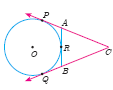
In figure CP and CQ are tangents to a circle with centre at O. ARB is another tangent touching the circle at R. If CP = 11 cm and BC = 7 cm, then the length of BR is
6 cm
5 cm
8 cm
4 cm
10.
In a hollow cylinder, the sum of the external and internal radii is 14 cm and the width is 4 cm. If its height is 20 cm, the volume of the material in it is
5600\(\pi\) cm3
1120\(\pi\) cm3
56\(\pi\) cm3
3600\(\pi\) cm3
11.
If g = {(1,1), (2,3), (3,5), (4,7)} is a function given by g(x) = αx + β then the values of α and β are
(-1,2)
(2,-1)
(-1,-2)
(1,2)
12.
If the ordered pairs (a + 2, 4) and (5, 2a + b) are equal then (a, b) is
(2,-2)
(5,1)
(2,3)
(3,-2)
13.
The number of points of intersection of the quadratic polynomial x2 + 4x + 4 with the X axis is
0
1
0 or 1
2
14.
Which of the following should be added to make x4 + 64 a perfect square
4x2
16x2
8x2
-8x2
15.
Let A = \(\left[ \begin{matrix} 1 & 2 \\ 1 & 3 \end{matrix} \right] \), B = \(\left[ \begin{matrix} 4 & 0 \\ 1 & 5 \end{matrix} \right] \), C = \(\left[ \begin{matrix} 2 & 0 \\ 1 & 2 \end{matrix} \right] \) Show that (A − B)T = AT − BT
16.
The angles of elevation and depression of the top and bottom of a lamp post from the top of a 66 m high apartment are 60° and 30° respectively. Find the distance between the lamp post and the apartment.(\(\sqrt { 3 } \) = 1.732)
17.
If α, β are the roots of the equation 2x2 - x - 1 = 0, then form the equation whose roots are
2α + β, 2β + α
18.
Find the values of m and n if the following expressions are perfect squares
x4 - 8x3 + mx2 + nx + 16
19.
The king and queen of diamonds, queen and jack of hearts, jack and king of spades are removed from a deck of 52 playing cards and then well shuffled. Now one card is drawn at random from the remaining cards. Determine the probability that the card is
(i) a clavor
(ii) a queen of red card
(iii) a king of black card.
20.
Find the equations of the lines, whose sum and product of intercepts are 1 and – 6 respectively.
21.
Find the equation of a straight line through the intersection of lines 5x − 6y = 2, 3x + 2y = 10 and perpendicular to the line 4x − 7y + 13 = 0
22.
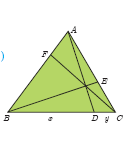
In \(\triangle\)ABC , points D,E,F lies on BC, CA, AB respectively. Suppose AB, AC and BC have lengths 13, 14 and 15 respectively. If \(\frac { AF }{ FB } =\frac { 2 }{ 5 } \quad \frac { CE }{ EA } =\frac { 5 }{ 8 } \). Find BD an DC
23.
A right circular cylindrical container of base radius 6 cm and height 15 cm is full of ice cream. The ice cream is to be filled in cones of height 9 cm and base radius 3 cm, having a hemispherical cap. Find the number of cones needed to empty the container.
24.
25.
If f(x) = x2, g(x) = 3x and h(x) = x - 2, Prove that (f o g) o h = f o (g o h).
26.
Find the domain of the function f(x) = \(\sqrt { 1+\sqrt { 1-\sqrt { 1-x^{ 2 } } } } \).
27.
The volumes of two cones of same base radius are 3600 cm3 and 5040 cm3. Find the ratio of heights.
28.
Pari needs 4 hours to complete a work. His friend Yuvan needs 6 hours to complete the same work. How long will it take to complete if they work together?
29.
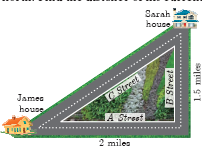
There are two paths that one can choose to go from Sarah’s house to James house. One way is to take C street, and the other way requires to take B street and then A street. How much shorter is the direct path along C street? (Using figure).
30.
P and Q are the mid-points of the sides CA and CB respectively of a \(\triangle\)ABC, right angled at C. Prove that 4(AQ2 + BP2) = 5AB2
31.
Simplify
\(\frac { 4{ x }^{ 2 }y }{ 2{ x }^{ 2 } } \times \frac { 6x{ z }^{ 3 } }{ 20{ y }^{ 4 } } \)
32.
In an A.P., sum of four consecutive terms is 28 and their sum of their squares is 276. Find the four numbers.
33.
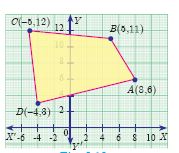
Find the area of the quadrilateral formed by the points (8, 6), (5, 11), (-5, 12) and (-4, 3).
34.
35.
Find the values of x, y and z from the following equations
\(\left[ \begin{matrix} 12 & 3 \\ x & \frac { 3 }{ 2 } \end{matrix} \right] =\left[ \begin{matrix} y & z \\ 3 & 5 \end{matrix} \right] \)
36.
If A is an event of a random experiment such that P(A) : P(\(\bar { A } \)) = 17.15 and n(S) = 640 then find (i) P(\(\bar { A } \)) (ii) n(A).
37.
Find the coefficient of variation of 24, 26, 33, 37, 29, 31.
38.
The standard deviation and mean of a data are 6.5 and 12.5 respectively. Find the coefficient of variation.
39.
Using the functions f and g given below, find f o g and g o f. Check whether f o g = g o f.
f(x) = x - 6, g(x) = x2
40.
The radius of a sphere increases by 25%. Find the percentage increase in its surface area.
41.
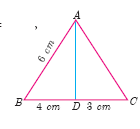
In the figure, AD is the bisector of \(\angle\)A. If BD = 4 cm, DC = 3 cm and AB = 6 cm, find AC.
42.
prove that \(\sqrt { \frac { 1+cos\theta }{ 1-cos\theta } } \) = cosec \(\theta \) + cot\(\theta \)
43.
Draw the graph of y = x2 - 4x + 3 and use it to solve x2 - 6x + 9 = 0
44.
Draw the graph of y = x2 + x - 2 and hence solve x2 + x - 2 = 0
45.
Draw the two tangents from a point which is 10 cm away from the centre of a circle of radius 5 cm. Also, measure the lengths of the tangents.
46.
Construct a △PQR which the base PQ = 4.5 cm, ∠R = 35oand the median RG from R to PG is 6 cm
1.
(b)
\(\frac{7}{10}\)
2.
(b)
3p
3.
(b)
43.92 m
4.
(d)
5.
(c)
14280
6.
(d)
11
7.
(b)
x + y = 3; 3x + y = 7
8.
(c)
9
9.
(d)
4 cm
10.
(b)
1120\(\pi\) cm3
11.
(b)
(2,-1)
12.
(d)
(3,-2)
13.
(b)
1
14.
(b)
16x2
15.
(A - B)T= AT-BT
L.H.S = \((A-B)=\left[ \begin{matrix} 1 & 2 \\ 1 & 3 \end{matrix} \right] -\left[ \begin{matrix} 4 & 0 \\ 1 & 5 \end{matrix} \right] =\left[ \begin{matrix} -3 & 2 \\ 0 & -2 \end{matrix} \right] ...(2)\)
\({ (A-B) }^{ T }=\left[ \begin{matrix} -3 & 0 \\ 2 & -2 \end{matrix} \right] ...(1)\)
\({ A }^{ T }=\left[ \begin{matrix} 1 & 1 \\ 2 & 3 \end{matrix} \right] ,{ B }^{ T }=\left[ \begin{matrix} 4 & 1 \\ 0 & 5 \end{matrix} \right] \)
\(=\left[\begin{array}{rr} -3 & 0 \\ 2 & -2 \end{array}\right]\)
From (1) and (2)
(A - B)T= AT-BT
Hence verified.
16.
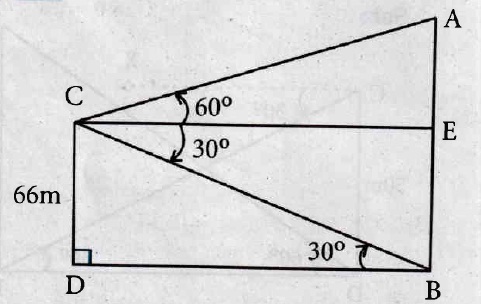
Let AB be the lamp post and CD be the apartment given CD = 66 m = EB.
\( \angle A C E=60^{\circ} \)
\(\angle E C B=\angle C B D=30^{\circ} \)
In the right triangle \(\triangle\)BDC
\(\tan 30^{\circ}=\frac{C D}{B D}\)
\( \frac{1}{\sqrt{3}}=\frac{66}{B D} \)
\(B D=66 \sqrt{3}\)
= 66 x 1.732 = 114.312 m
The distance between the lamp post and the apartment = 114.31 m
Now BD = EC = 114.31 m
In the right triangle \(\triangle\)ACE
\( \tan 60^{\circ} =\frac{A E}{C E} \)
\(\sqrt{3} =\frac{A E}{66 \sqrt{3}} \)
\(A E =66 \sqrt{3} \times \sqrt{3}[\text { From (1)] }\)
= 66 x 3 = 198m
The distance between the lamp post and apartment = 114.31 m.
17.
2x2 - x - 1 = 0 here, a = 2, b = -1, c = -1
α + β = \(\frac {-b}{a} = \frac {-(-1)}{2} = \frac {1}{2}\), αβ = \(\frac {c}{a} = -\frac {1}{2}\)
2α + β, 2β + α
Sum of the roots 2α + β + 2β + α = 3(α + β) = \(3\left( \frac { 1 }{ 2 } \right) =\frac { 3 }{ 2 } \)
Product of the roots = (2α + β) (2β + α) = 4αβ + 2α2 + 2β2 + αβ
= 5αβ + 2(α2 + β2) = 5αβ + 2[(α + β)2 - 2αβ]
= \(5\left( -\frac { 1 }{ 2 } \right) +2\left[ \frac { 1 }{ 4 } -2\times -\frac { 1 }{ 2 } \right] \) = 0
The required equation is x2 - (Sum of the roots)x + (Product of the roots) = 0
x2 - \(\frac { 3 }{ 2 } x\) + 0 = 0 gives 2x2 - 3x = 0
18.
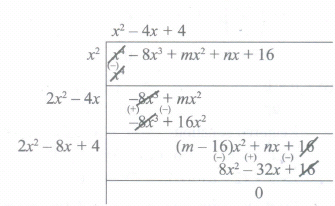
∵ m-16 = 8
m = 8 + 16 = 24
n = -32
19.
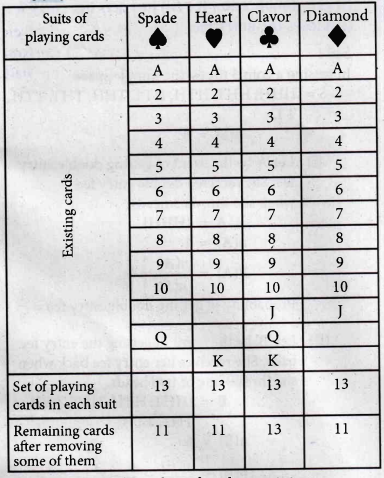
Total number of cards remaining
= 11 + 11 + 13 + 11 = 46
n(S) = 46
(i) Let A be the event of getting a clavor card
n(A) = 13
\(\mathrm{P}(\mathrm{A})=\frac{n(A)}{n(S)}=\frac{13}{46}\)
(ii) Let B be the event of getting queen of red card
n(B) = 0 (Removed red queens)
\(\mathrm{P}(\mathrm{B})=\frac{n(B)}{n(S)}=0\)
(iii) Let C be the event of getting a king of black card
n(C) = 1
\(\mathrm{P}(\mathrm{C})=\frac{n(C)}{n(S)}=\frac{1}{46}\)
20.
Let a, b be the intercepts
Given, Sum of the intercept a + b = 1 .........(1)
Product of the intercepts ab = -6 .........(2)
\(b=\frac{-6}{a}\)
Substituting in (1)
\(a-\frac{6}{a}=1\)
a2 - a - 6 = 0
(a - 3)(a + 2) = 0
a = -2, 3
When a = -2, \(b=\frac{-6}{-2}=3\)
When a = 3 , \(b=\frac{-6}{-2}=-2\)
Equation of the line in intercepts form is
\(\frac{x}{a}+\frac{y}{b}=1\)
(i) a = -2, b = 3 \(\Rightarrow \frac{x}{-2}+\frac{y}{3}=1\)
3x - 2y + 6 = 0
(ii) a = 3,b = -2 \(\Rightarrow \frac{x}{3}+\frac{y}{-2}=1\)
-2x + 3y + 6 = 0
= 2x - 3y - 6 = 0
21.
Given lines are 5x - 6y - 2 and 3x + 2y = 10.
Let us solve the equations to get the point of intersection
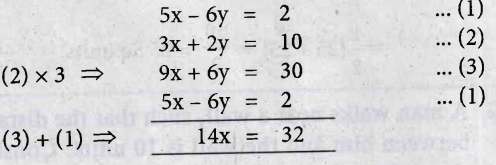
\(x=\frac{32}{14}=\frac{16}{7} \)
Substituting \(x=\frac{16}{7} \text { in }(2) \)
\(3\left(\frac{16}{7}\right)+2 y =10 \)
\(2 y =10-\frac{48}{7}=\frac{22}{7} \)
\(y =\frac{11}{7} \)
The point of intersection is \(\left(\frac{16}{7}, \frac{11}{7}\right)\)
Slope of the line 4x - 7y + 13 = 0 is
\(-\frac{a}{b}=\frac{-4}{-7}=\frac{4}{7}\)
Slope of the perpendicular line is \(-\frac{7}{4}\)
Now, equation of the line passing through \(\left(\frac{16}{7}, \frac{11}{7}\right)\) and having slope \(m=-\frac{7}{4}\) is
\(y-y_{1} =m\left(x-x_{1}\right) \)
\(y-\frac{11}{7} =\frac{-7}{4}\left(x-\frac{16}{7}\right) \)
\(\frac{7 y-11}{7} =\frac{-7 x}{4}+4 \)
28y - 44 = -49x + 112
49x + 28y - 156 = 0
22.
Given that AB = 13, AC = 14 and BC = 15
Let BD = x and DC = y
Using Ceva’s theorem, we have, \(\frac { BD }{ DC } \times \frac { CE }{ EA } \times \frac { AF }{ FB } =1\)
Substitute the values of \(\frac { AF }{ FB } \ and \ \frac { CE }{ EA } \) in (1)
we have \(\frac { BD }{ DC } \times \frac { 5 }{ 8 } \times \frac { 2 }{ 5 } =1\)
\(\frac { x }{ y } \times \frac { 10 }{ 40 } =1\) we get \(\frac { x }{ y } \times \frac { 1 }{ 4 } \), Hence x = 4y ...(2)
BC = BD + DC = 15 so, x + y = 15 ..(3)
From (2), using x = 4y in (3) we get, 4y + y = 15 gives 5y = 15 then y = 3
Substitute y = 3 in (3) we get, x = 12. Hence BD = 12, DC = 3.
23.
Let h and r be the height and radius of the cylinder respectively.
Given that, h = 15 cm, r = 6 cm
Volume of the container V = \(\pi\)r2h cubic units.
Let, r1 = 3 cm, h1 = 9 cm be the radius and height of the cone.
Also, r1 = 3 cm is the radius of the hemispherical cap.
Volume of one ice cream cone = (Volume of the cone + Volume of the hemispherical cap)
\(=\frac { 1 }{ 3 } \pi { r }_{ 1 }^{ 2 }{ h }_{ 1 }+\frac { 2 }{ 3 } \pi { r }_{ 1 }^{ 3 }\)
\(=\frac { 1 }{ 3 } \times \frac { 22 }{ 7 } \times 3\times 3\times 9+\frac { 2 }{ 3 } \times \frac { 22 }{ 7 } \times 3\times 3\times 3\)
\(=\frac { 22 }{ 7 } \times 9(3+2)=\frac { 22 }{ 7 } \times 45\)
\(Number\ of\ cones=\frac { volume\ of\ the\ cylinder }{ volume\ of\ one\ ice\ cream\ cone } \)
Number of ice cream cones needed \(=\frac { \frac { 22 }{ 7 } \times 6\times 6\times 15 }{ \frac { 22 }{ 7 } \times 45 } =12\)
Thus 12 ice cream cones are required to empty the cylindrical container.
24.
25.
f(x) = x2, g(x) = 3x, h(x) = x - 2
f o g = f [g(x)] = f (3x)
= (3x)2 - 9x2
(f o g) o h = (f o g) [h (x)] = (f o g) [x - 2]
= 9 ( x - 2)2
g o h = g [h (x)] = g[x - 2] = 3 (x - 2)
f o (g o h) = f [g (h(x))]
= f [3(x - 2)] = [3(x - 2))]2 = 9 (x - 2)2
(f o g) o h = f o( g o h)
Hence proved.
26.
f(x) = \(\sqrt { 1+\sqrt { 1-\sqrt { 1-{ x }^{ 2 } } } } \)
\(
f(x)=\sqrt{1-t}
\)
\(where\ t=\sqrt{1-\sqrt{1-x^{2}}}\)
\(1-t \geq 0
\)
\(t \leq 1
\)
\(\sqrt{1-\sqrt{1-x^{2}}} \leq 1
\)
Squaring \(\sqrt{1-\sqrt{1-x^{2}}} \leq 1
\)
\(-\sqrt{1-x^{2}} \leq 0
\)
\(\sqrt{1-x^{2}} \geq 0
\)
\(1-x^{2} \geq 0
\)
\(x^{2} \leq 1
\)
= x [-1, 1] i.e., {- 1, 0, 1}
27.
Let r1, r2 be the radii of two cones,
Given r1 = r1 and let h1, h2 be the heights of two
V1 = Volumes of I cone = \(\frac{1}{3} \pi r_{1}^{2} h_{1}=\frac{\pi}{3} r_{1}^{2} h\)
= 3600 cm3
V2 = Volume of II cone = \(\frac{1}{3} \pi r_{2}^{2} h_{2}=5040 \mathrm{~cm}^{3}\)
\(Now, \frac{V_{1}}{V_{2}}=\frac{3600}{5040} \Rightarrow \frac{\frac{\pi}{3} r_{1}^{2} h_{1}}{\frac{\pi}{3} r_{2}^{2} h_{2}}=\frac{3600}{5040}\left[\because r_{1}=r_{2}\right]. \)
\(\frac{h_{1}}{h_{2}}=\frac{5}{7}=5: 7\)
28.
Pari: time required to complete the work = 4 hrs.
∴ In 1 hr. he will complete =\(\frac{1}{4}\) of the work.
=\(\frac{1}{4}\)w
Yuvan: Time required to complete the work = 6 hrs.
∴ In 1 hr. he will complete the \(\frac{1}{6}\) of the work
=\(\frac{1}{6}\)w
Working together, in 1 hr. they will complete \(\frac { w }{ 4 } +\frac { w }{ 6 } \) of the work.
\(=\frac { 6w+4w }{ 24 } =\frac { 5 }{ 12 } \)
∴ To complete the total work tame taken
\(=\frac { w }{ \frac { 5 }{ 12 } w } =\frac { 12 }{ 5 } =2.5\)hrs
= 2 hrs 24 minutes
29.
Let Sarah's house is at A and James's house is at 'B' from the picture.
Distance between Sarah's house to James house through Street B and C
= 1.5 miles + 2 miles = 3.5 miles
Distance through street C is AC2 = AB2 + BC2
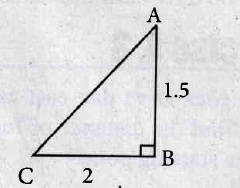
AC2 = = (1.5)2 + (2),
= 2.25 + 4
= 6.25
\(A C=\sqrt{6.25}=2.5\)
AC = 2.5 miles
Difference between two paths = 3.5 - 2.5 = 1 mile
Direct path along C street is 1 mile shorter
30.
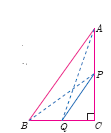
Since, \(\triangle\)QAQC is a right triangle at C, AQ2 = AC2 + QC2 ...(1)
Also, \(\triangle\)BPC is a right triangle at C, BP2 = BC2+ CP2 ...(2)
\(\triangle\) ABCC is a right triangle at C, AB2 = AC2 + BC2 ....(3)
From (1) and (2), AQ2+ BP2 = AC2+ QC2 + BC2 + CP2
4(AQ2 + BP2) = 4AC2 + 4QC2 + 4BC2 + 4CP2
= 4AC2 + (2QC)2+ ABC2 + (2CP)2
= 4AC2 + BC2 + 4BC2 + AC2 (Since P and Q are mid points)
= 5(AC2 + BC2) (From equation (3))
4(AQ2 + BP2) = 5AB2
31.
\(\frac { 4{ x }^{ 2 }y }{ 2{ x }^{ 2 } } \times \frac { 6x{ z }^{ 3 } }{ 20{ y }^{ 4 } } =\frac { { 3x }^{ 3 }z }{ 5{ y }^{ 3 } } \)
32.
Let us take the four terms in the form (a - 3d), (a -d), (a + d) and (a + 3d).
Since sum of the four terms is 28,
a - 3d + a - d + a + d + a + 3d = 28
4a = 28 gives a = 7
Similarly, since sum of their squares is 276,
(a - 3d)2 + (a - d)2 + (a + d)2 + (a + 3d)2 = 276
a2 - 6ad + 9d2 + a2 - 2ad + d2 + a2 + 2ad + d2 + a2 + 6ad + 9d2 = 276
4a2 + 20d2 = 276 \(\Rightarrow\) 4(7)2 + 20d2 = 276
d2 = 4 gives d = \(\pm\)2
If d = 2 then the four numbers are 7 - 3(2), 7 - 2, 7 + 2, 7 + 3(2)
That is the four numbers are 1,5,9 and 13.
If a = 7, d = -2 then the four numbers are 13,9, 5 and 1
Therefore, the four consecutive terms of the A.P are 1, 5, 9 and 13
33.
Before determining the area of quadrilateral, plot the vertices in a graph.
Let the vertices be A(8, 6), B(5, 11), C(-5, 12) and D(-4, 3).
Therefore, area of the quadrilateral ABCD
=\(\frac{1}{2}\) { (x1y2 + x2y3 + x3y1) - (x2y1 + x3y2 + x1y3) }
=\(\frac{1}{2}\) { (80 + 60 - 15 - 24) - (30 - 55 - 48 + 24)}
=\(\frac{1}{2}\) {109 + 49 }
=\(\frac{1}{2}\) { 158 } = 79 sq. units
34.
35.
\(\left[ \begin{matrix} 12 & 3 \\ x & \frac { 3 }{ 2 } \end{matrix} \right] =\left[ \begin{matrix} y & z \\ 3 & 5 \end{matrix} \right] \)
x = 3
y = 12
z = 3
36.
Given \(P\left( A \right) :P\left( \bar { A } \right) =17:15\)
(i) \(\frac{P(A)}{P(\bar{A})} =\frac{17}{15}
\)
\(\frac{P(A)}{1-P(A)} =\frac{17}{15} \quad[\therefore P(\bar{A})=1-P(A)]
\)
15 P(A) = 17 [1- P(A)]
15 P(A) = 17 - 17 P(A)
\(32 \mathrm{P}(\mathrm{A})=17 ; \quad \mathrm{P}(\mathrm{A})=\frac{17}{32}
\)
\(P(\bar{A})=1-\mathrm{P}(\mathrm{A})=1-\frac{17}{32}=\frac{32-17}{32}=\frac{15}{32}
\)
(ii) \(\mathrm{P}(\mathrm{A})=\frac{n(A)}{n(S)}=\frac{17}{32}\)
n(A) = 17
37.
Ascending order : 24, 26, 29, 31, 33, 37
Standard deviation \(\sigma=\sqrt{\frac{\sum d_{i}^{2}}{N}-\left(\frac{\sum d_{i}}{N}\right)^{2}}\)
Let the assumed mean A = 31
| xi | \(\mathrm{d}_{\mathrm{i}}=\mathrm{x}_{\mathrm{i}}-\mathrm{A} \) \(\mathrm{d}_{\mathrm{i}}=\mathrm{x}_{\mathrm{i}}-31 \) |
\(\mathrm{d}_{\mathrm{i}}^{2}\) |
| 24 | -7 | 49 |
| 26 | -5 | 25 |
| 29 | -2 | 4 |
| 31 | 0 | 0 |
| 33 | 2 | 4 |
| 37 | 6 | 36 |
| \(\Sigma d_{i}\) = -6 | \(\Sigma d_{i}^{2}\) = 118 |
\(\sigma=\sqrt{\frac{118}{6}-\left(\frac{-6}{6}\right)^{2}} \)
\(\sigma=\sqrt{19.67-(-1)^{2}}=\sqrt{19.7-1} \)
\(\sigma=\sqrt{18.67}=4.3 \)
\(\text { Mean } \ \bar{x} =\frac{\sum x_{i}}{N} \)
\(\text { Mean } \ \bar{x} =\frac{24+26+29+31+33+37}{6} \)
\(\bar{x} =\frac{180}{6}=30 \)
Now co- efficient of variation C.V \(=\frac{\sigma}{x} \times 100 \%\)
\(\mathrm{C.V}=\frac{4.3}{30} \times 100 \%=0.1433 \times 100 \%\)
= 14.33 %
Co-efficient of variation of the given data
= 14.33 %
38.
Standard deviation \(\sigma=6.5\)
Mean \(\bar{x}=12.5\)
Coefficient of variation C.V \(=\frac{\sigma}{x} \times 100 \%
\)
\(=\frac{6.5}{12.5} \times 100 \%
\)
\(=\frac{65}{125} \times 100 \%
\)
\(=\frac{13}{25} \times 100 \%
\)
= 52 %
Co-efficient of variation is 52%
39.
f(x) = x - 6, g(x) = x2
fog(x) = f(g(x)) = f(x2) = x2 - 6 ...(1)
gof(x) = g(f(x)) = g(f(x)) = g(x - 6) = (x - 6)2
= x2 - 12x + 36
fog(x) ≠ gof
40.
Let the radius of the sphere be 'r' cm
Surface area = \(4 \pi r^{2}\)
when radius is increased by 25% ,then new diameter = r + 25% + r
\(=r+\frac{25 r}{100}=\frac{5 r}{4}\)
Surface area of new sphere
\(=4 \pi\left(\frac{5 r}{4}\right)^{2} \)
\(=4 \pi\left(\frac{25 r^{2}}{16}\right) \)
\(=\frac{25 \pi r^{2}}{4} \)
Increase in surface area = \(\frac{25 \pi r^{2}}{4}-4 \pi r^{2}\)
\(=\frac{25 \pi r^{2}-16 \pi r^{2}}{4} \)
\(=\frac{9 \pi r^{2}}{4} \)
Percentage increase in surface area
\(=\frac{9 \pi r^{2} / 4}{4 \pi r^{2}} \times 100 \% \)
\(=\frac{900}{16} \%=56.25 \% \)
41.
In \(\triangle\)ABC, AD is the bisector of \(\angle\)A
Therefore by Angle Bisector of \(\angle\)A
\(\frac { AB }{ AC } =\frac { BD }{ DC } \)
\(\frac{4}{3}=\frac{6}{A C}\) gives 4AC = 18. Hence, AC \(=\frac{9}{2}=4.5 \mathrm{~cm}\)
42.
\(\sqrt { \frac { 1+cos\theta }{ 1-cos\theta } } \)=\(\sqrt { \frac { 1+cos\theta }{ 1-cos\theta } \times \frac { 1+cos\theta }{ 1+cos\theta } } \) [multiply numerator and denominator by the conjugate of 1 - cos\(\theta \)]
=\(\sqrt { \frac { (1+cos\theta { ) }^{ 2 } }{ (1-cos\theta { ) }^{ 2 } } } \) =\(\frac { 1+cos\theta }{ \sqrt { si{ n }^{ 2 }\theta } } \) [since sin2\(\theta \) + cos2\(\theta \) = 1]
=\(\frac { 1+cos\theta }{ sin\theta } =cosec\theta +cot\theta \)
43.
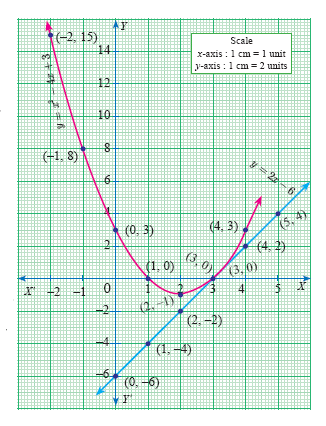
Step 1 : Draw the graph of y = x2 - 4x + 3 by preparing the table of values as below
| x | -2 | -1 | 0 | 1 | 2 | 3 | 4 |
| y | 15 | 8 | 3 | 0 | -1 | 0 | 3 |
Step 2 : To solve x2 - 6x + 9 = 0, subtract x2 - 6x + 9 = 0 from y = x2 - 4x + 3
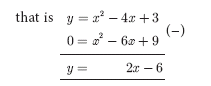
The equation y = 2x - 6 represent a straight line. Draw the graph of y = 2x - 6 forming the table of values as below.
| x | 0 | 1 | 2 | 3 | 4 | 5 |
| y | -6 | -4 | -2 | 0 | 2 | 4 |
The line y = 2x - 6 intersect y = x2 - 4x + 3 only at one point.
Step 3 : Mark the point of intersection of the curve y = x2 - 4x + 3 and y = 2x - 6 that is (3,0).
Therefore, the x coordinate 3 is the only solution for the equation x2 - 6x + 9 = 0
44.
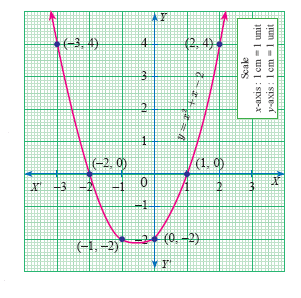
Step 1 : Draw the graph of y = x2 + x - 2 by preparing the table of values as below
| x | -3 | -2 | -1 | 0 | 1 | 2 |
| y | 4 | 0 | -2 | -2 | 0 | 4 |
Step 2 : To solve x2 + x - 2 = 0 subtract x2 + x - 2 = 0 from y = x2 + x - 2
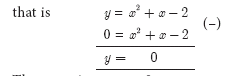
The equation y = 0 represents the X axis.
Step 3 : Mark the point of intersection of the curve x2 + x - 2 with the X axis. That is (–2,0) and (1,0)
Step 4 : The x coordinates of the respective points form the solution set {−2,1} for x2 + x - 2 = 0
45.
The distance between the point from the centre is 10 cm.
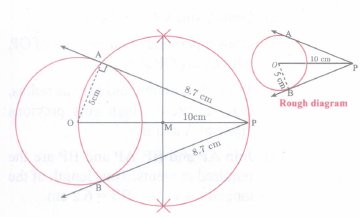
Length of the tangents PA - PB = 8.7 cm
Construction:
Steps:
(1) With O as centre, draw a circle of radius 5cm.
(2) Draw a line OP = 10 cm.
(3) Draw a perpendicular bisector of OP which cuts OP at M.
(4) With M as centre and MO as radius, draw a circle which cuts previous circle at A and B.
(5) Join AP and BP. AP and BP are the required tangents. Thus length of the tangents are PA and PB = 8.7 cm
46.
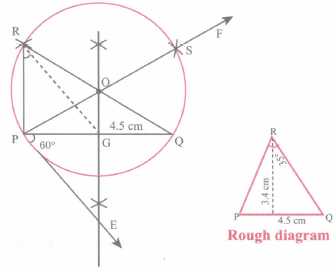
Construction:
Step (1) Draw a line segment PQ = 4.5 cm
Step (2) At P, draw PE such that \(\angle QPE={ 35 }^{ 0 }\)
Step (3) At P, draw PF such that \(\angle EPF={ 90 }^{ 0 }\)
Step (4) Draw \(\bot \) bisector to PQ which intersects PF at O.
Step (5) With O centre OP as radius draw a circle.
Step (6) From G, marked arcs of radius 6 cm on the circle marked them as R and S.
Step (7) Joined PR and RQ. Then \(\triangle\)PQR is the required triangle
Step (8) \(\triangle\)PQS is the required triangle

10th Standard Syllabus & Materials
10th Standard
TN 10th English Prose - 2 - The Night the Ghost Got in Important Questions And Answers Study Material - QB365 Set A
NEW10th Standard
TN 10th English Supplementary - 1 - The Tempest Important Questions And Answers Study Material - QB365 Set A
NEW10th Standard
TN 10th English Poem - 1 - Life Important Questions And Answers Study Material - QB365 Set A
NEW10th Standard
TN 10th English Prose - 1 - His First Flight Important Questions And Answers Study Material - QB365 Set A



Tamilnadu Stateboard 10th Standard Subjects
Tamilnadu Stateboard Standards





