
7th Standard Syllabus & Materials
7th Standard
TN 7th Tamil பருவம் -1 இயல் 1 - அமுதத்தமிழ் - ஒன்றல்ல இரண்டல்ல Important Questions And Answers Study Material - QB365 Set A
NEW7th Standard
TN 7th Tamil பருவம் -1 இயல் 1 - அமுதத்தமிழ் - எங்கள் தமிழ் Important Questions And Answers Study Material - QB365 Set A
NEW7th Standard
TN 7th English T1 - Poem - Your Space Important Questions And Answers Study Material - QB365 Set A
NEW7th Standard
TN 7th English T1 - Prose - A Prayer to the Teacher Important Questions And Answers Study Material - QB365 Set A
NEW7th Standard
TN 7th English T1 - Poem - The Listeners Important Questions And Answers Study Material - QB365 Set A
NEW7th Standard
TN 7th English T1 - Prose - The Wind on Haunted Hill Important Questions And Answers Study Material - QB365 Set A

Published on: 04/09/2026
Download Tamil Nadu 7th Standard Maths question papers, model tests, one-mark questions, important questions, and public exam papers in PDF format. Free study materials and answer keys for TN State Board students.
Questions + Answers key
Take MCQ Maths Test
1.
Identify the variables and constants among the following terms:
a,11 − 3x, xy, − 89, −m, − n, 5, 5ab, − 5, 3y, 8pqr,18, − 9t, −1,− 8
2.
Scientists use the Kelvin Scale (K) as an alternative temperature scale to degrees Celsius (°C) by the relation ToC = (T + 273)K
(i) −275°C
(ii) 45°C
(iii) −400oC
(iv) −273oC
3.
Divide:
(i) (−85) by 5
(ii) (–250) by (–25)
(iii) 120 by (–6)
(iv) 182 by (–2)
4.
Construct the following angles using protractor and draw a bisector to each of the angle using ruler and compass.
(a) 60°
(b) 100°
(c) 90°
(d) 48°
(e) 110°
5.
Draw a line segment of given length and construct a perpendicular bisector to each line segment using scale and compass.
(a) 8 cm
(b) 7cm
(c) 5.6 cm
(d) 10.4 cm
(e) 58 mm
6.
Solve:
(i) x + 5 = 8
(ii) p − 3 = 7
(iii) 2x = 30
\((iv) \frac{m}{6}=5 \)
(v) 7x + 10 = 80
7.
Find the sum of the following expressions
(i) 7p + 6q, 5p − q, q + 16p
(ii) a + 5b + 7c, 2a + 10b + 9c
(iii) mn + t, 2mn − 2t, − 3t + 3mn
(iv) u + v, u − v, 2u + 5v, 2u − 5v.
(v) 5xyz − 3xy, 3zxy − 5yx
8.
Add the expressions:
(i) pq −1 and 3pq + 2
(ii) 8x + 3 and 1 − 7x
9.
Add the following
(i) 8 and –12 using number line
(ii) (–3) and (–5) using number line
(iii) (-100 + (-10)
(iv) 20 + (-72)
(v) 82 + (-75)
(vi) -48 + (-15)
(vii) -225 + (-63)
10.
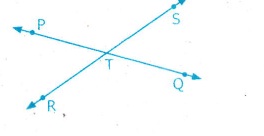
Name the two pairs of vertically opposite angles.
11.
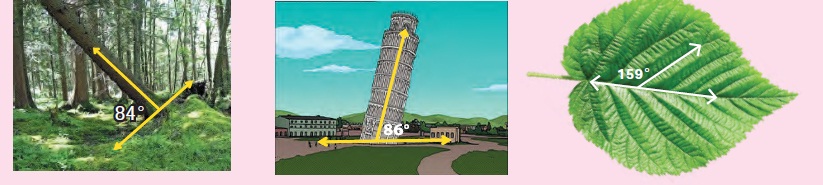
Observe the following pictures and find the other angle of linear pair.
12.
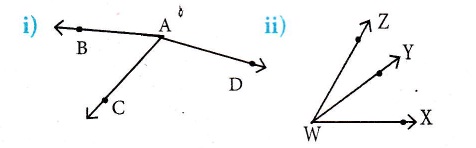
Name the adjacent angles in each of the following figure.
13.
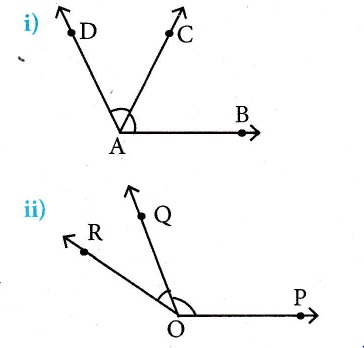
Identify the common arm, common vertex of the adjacent angles and shade the interior with two colours in each of the following figures.
14.
(i) (−32)÷ 4 = _____
(ii) (−50)÷ 50 = _____
(iii) 30 ÷15 = _____
(iv) −200 ÷10 = ____
(v) −48 ÷ 6 = ____
15.
Find the product of the following
(i) (−20) x (−45) = _____
(ii) (−9)x (−8) = _____
(iii) (−30) x 40 x (−1) = _____
(iv) (+50) x 2 x (−10) = _____
16.
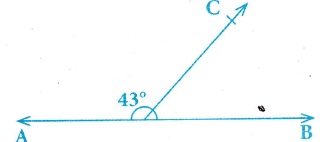
Find the missing angle.
17.
Identify the like terms among the following and group them:
7xy, 19x, 1, 5y, x, 3yx, 15, –13y, 6x, 12xy, −5, 16y, −9x, 15xy, 23, 45y, −8y, 23x, −y, 11.
18.
Find the amount that is left in the student’s bank account, if he has made the following transaction in a month. His initial balance is Rs. 690
(i) Deposit(+) of Rs.485
(ii) Withdrawal(-) of Rs.500
(iii) Withdrawal(-) of Rs. 350
(iv) Deposit(+) of Rs. 89
(v) If another Rs. 300 was withdrawn, what would the balance be?
19.
Find the values of the following.
(i) (−75) ÷ 5
(ii) (−100) ÷ (−20)
(iii) 45 ÷ (-9)
(iv) (-82) ÷ 82
20.
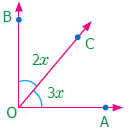
Find the value of x if \(\angle\)AOB is a right angle.
21.
Find all possible pairs of integers that give a product of −50.
22.
Construct the following angles using ruler and compass only.
(i) 60°
(ii) 120°
(iii) 30°
(iv) 90°
(v) 45°
(vi) 150°
(vii) 135
23.
What will be the sign of the product of the following.
(i) 16 times of negative integer.
(ii) 29 times of negative integer
24.
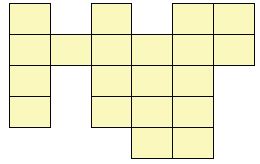
Shade the figure completely, by using five Tetromino shapes only once.
25.
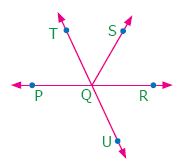
In the given figure, identify
(i) any two pairs of adjacent angles.
(ii) two pairs of vertically opposite angles.
26.
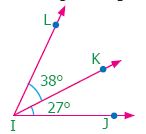
Find the angle \(\angle\)JIL from the given figure.
27.
Find the value of the following
(i) -3 - (-4) using number line,
(ii) 7 - (-10) using number line
(iii) 35 - (-64)
(iv) -200 - (+100)
28.
A postman can sort out 738 letters in 6 hours. How many letters can be sorted in 9 hours?
29.
A birthday party is arranged in third floor of a hotel. 120 people take 8 trips in a lift to go to the party hall. If 12 trips were made how many people would have attended the party?
30.
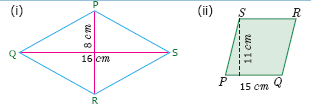
Find the area of rhombus PQRS shown in the following figures.
31.
If x = 2 and y = 3, then find the value of the following expressions
(i) 2x − 3y
(ii) x + y
(iii) 4y − x
(iv) x + 1 − y
32.
Identify the like terms among the following : 7x, 5y, −8x, 12y, 6z, z, −12x, −9y, 11z.
33.
Write the variables, constants and terms of the following expressions.
(i)18 + x − y
(ii) 7p − 4q + 5
(iii) 29x + 13y
(iv) b + 2
34.
Find the numerical coefficient of each of the following terms: −3yx, 12k, y, 121bc, − x, 9pq, 2ab
35.
Are (11 + 7) + 10 and 11 + (7 + 10) equal? Mention the property.
1.
| TERM | CONSTANT | VARIABLE |
| 1 | - | a |
| 11-3x | 11,3 | x |
| xy | - | xx,y |
| -89 | -89 | - |
| -m | -1 | m |
| -n | -1 | n |
| 5 | 5 | - |
| 5 ab | 5 | a,b |
| -5 | -5 | - |
| 3y | 3 | y |
| 8 pqr | 8 | p,q,r |
| 18 | 18 | - |
| -9t | -9 | t |
| -1 | -1 | - |
| -8 | -8 | - |
2.
(i) -275°C
T = -275°C
ToC = (T + 273)K
= (-275 + 273)K = -2K
-275°C = -2 Kelvin
(ii) 45°C
T = 45°C
ToC = (T + 273)K
(45 + 273)K = 318K
45°C = 318 Kelvin
(iii) -400°C
T = -400°C
ToC = (T + 273)K
= (-400 + 273) K = -127 K
-400°C = -127 Kelvin
(iv) -273°C
T = -273°C
ToC = (T + 273)K
= (-273 + 273) K = 0K.
-273°C = 0 Kelvin
3.
(i) (−85) ÷ 5 =−17
(ii) 250 ÷ (-25) = +10
(iii) 120 ÷ (–6) = −20
(iv) 182 ÷ (–2) = −91
4.
(a) 60° c
Construction:
Step 1 : Drawn the given angle ∠ABC with the measure 60° using protractor.
Step 2: With B as centre and convenient radius, drawn an arc to cut BA and BC. Marked the points of intersection as E on BA and F on BC.
Step 3: With the same radius and E as centre drawn an arc in the interior of ∠ABC and another arc of same measure with centre at F to cut the previous arc.
Step 4: Marked the point of intersection as G. Drawn a ray BX through G. BG is the required bisector of the given ∠ABC
Now ∠ABG = ∠CBG = 30°
.JPG)
(b) 100°
Construction:
Step 1: Drawn the given angle ∠ABC with the measure 100° using protractor.
Step 2: With B as centre and convenient radius, drawn an arc to cut BA and BC. Marked the points of intersection as E on BA and F on BC.
Step 3: With the same radius and E as centre drawn an arc in the interior of ∠ABC and another arc of the same measure with centre at F to cut the previous arc.
Step 4: Marked the point of intersection at G. Drawn a ray BX through G. BG is the required bisector of angle ∠ABC
∠ABG = ∠GBC = 50°
.JPG)
(c) 90°
Construction :
Step 1: Drawn the given angle ∠ABC with the measure 90° using protractor.
Step 2: With B as center and convenient radius, drawn an arc to cut BA and BC. Marked the points of intersection as E on BA and F on BC
Step 3: With the same radius and E as center drawn an arc in the interior of ∠ABC and another arc of same measure with center at F to cut the previous arc
Step 4: Mark the point of interaction as G. Drawn a ray BX through G BG is the required bisector of the given angle ∠ABC
∠ABG = ∠GBC = 45°
.JPG)
(d) 48°
Construction:
Step 1: Drawn the given angle ∠ABC with the measure 48° using protractor.
Step 2: With B as center and convenient radius, drawn an arc to cut BA and BC. Marked the points of intersection as E on BA and F on BC.
Step 3: With the same radius and E as center drawn an arc in the interior of ∠ABC and another arc of the same measure with center at F to cut the previous arc.
Step 4: Marked the point of intersection as G. Drawn a ray BX through G. BG is the required bisector of the given angle ∠ABC
Now ∠ABC = ∠GBC = 24°
.JPG)
(e) 110°
Construction:
Step 1: Drawn the given angle ∠ABC with the measure 110° using protractor
Step 2: With B as center and convenient radius, drawn an arc to cut BA and BC. Marked points of intersection as E on BA and F BC.
Step 3: With the same radius and E as center, drawn an arc in the interior of ∠ABC and another arc of same measure with center at F to cut the previous arc.
Step 4: Mark the point of intersection as G. Drawn a ray BX through G. BG is the required bisector of the given angle ∠ABC
∠ABG = ∠GBC = 55°.
.JPG)
5.
Construction:
Step 1:
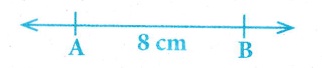
Drawn a line. Marked two points A and B on it so that AB = 8 cm
Step2:
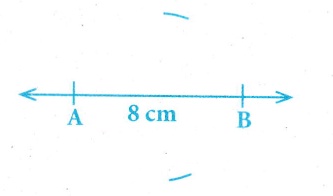
Using compass with A as centre and radius more than half of the length of AB, drawn two arcs of the same length one above AB and one below AB
Step3: With the same radius and B as centre drawn two arcs to cut the arcs drawn in step 2. Marked the points of intersection of the arcs as C and D.
Step4:
.JPG)
Joined C and D, CD intersect AB. Marked the point of intersection as 'O'. CD is the required perpendicular bisector of AB.
(b) 7 cm
Step 1:

Drawn a line and marked points A and B on it so that AB = 7cm.
Step 2:
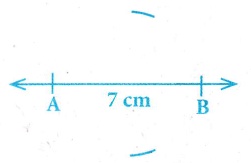
Using compass with A as, centre and radius more than half of the length of AB drawn two arcs of same length one above AB and one below AB.
Step 3: With the same radius and B as centre drawn two arcs to cut the already drawn arcs in step 2. Marked the intersection of the arcs as C and D.
Step 4:
.JPG)
Joined C and D, CD is the required perpendicular bisector of AB.
(c) 5.6 cm.
Construction:
.JPG)
Step 1: Drawn a line and marked two points A and B on it so that AB = 5.6 cm
Step 2: Using compass with A as centre and radius more than half of the length of AB, drawn two arcs of the same length, one above AB and one below AB
Step 3: With the same radius and B as centre drawn two arcs to cut the arcs drawn in step 2 and marked the points of intersection of the arcs as C and D
Step 4: Joined C and D. CD intersects AB. Marked the point of intersection as 'O' CD is the required perpendicular bisector of AB.
(d) 10.4 cm
Construction :
.JPG)
Step 1: Drawn a line and marked two points A and B on it so that AB = 10A cm.
Step 2: Using compass with A as centre and radius more than half of the length of AB, drawn two arcs of same length one above AB and one below AB
Step 3: With the same radius and B as centre drawn two arcs to cut the arcs drawn in step 2 and marked the points of intersection of the arcs as C and D.
Step 4: Joined C and D. CD intersects AB. Marked the points of intersection as 0 I CD is the required perpendicular bisector
(e) 58 mm
Construction :
.JPG)
Step 1: Drawn a line. Marked two points A and B on it so that AB = 5.8 cm = 58 mm.
Step 2: Using compass with A as centre and radius more than half of the length of AB, drawn two arcs of the same length one above AB and one below AB.
Step 3: With the same radius and B as centre drawn two arcs to cut the arcs of drawn in step 2. Marked the points of intersection of the arcs as C and D
Step 4: Joined C and D. CD intersects AB. Marked the point of intersection as O. CD is the required perpendicular bisector.
6.
(i) x + 5 = 8
x + 5 - 5 = 8 - 5
[Subtract 5 on both sides]
x = 3
(ii) p -3 = 7
P - 3 + 3 = 7 + 3
[ Add 3 on both sides]
P = 10
(iii) 2x = 30
\(\frac{2 x}{2}=\frac{30}{2}\)
[ Divide by 2 on both sides]
x = 15
\((iv) \frac{m}{6}=5 \)
\(\frac{m}{6} \times 6=5 \times 6 \)
[ Multiply by 6 on both sides]
m = 5 x 6
m = 30
(v) 7x + 10 = 80
7x + 10 - 10 = 80 - 10
[Subtract 10 on both sides]
7x = 70
\(\frac{7 x}{7}=\frac{70}{7}\)
[Divide by 7 onboth sides]
x = 10
7.
i) 7p + 6q, 5p - q, q + 16p
= (7p + 6q) + (5p - q) + (q + 16p)
=(7p+5p+ 16p) + (6q - q + q)
= (7 +5 + 16)p + (6- 1 + 1)q
= 28p + 6q
(ii) a + 5b + 7c, 2a + 10b + 9c
= (a + 2a) + (5b + 10b) + (7c + 9c)
= (1 + 2)a+ (5 + 10)b + (7 +9)c
=3a + 15b +16c
(iii) mn + (,2mn - 2t, - 3t + 3mn
(mn + t) + (2mn -2t) + (-3t + 3mn)
- (mn + 2mn + 3mn) + (t - 2t- 3t)
=(1 + 2 + 3)mn + (1 -2 - 3)t
= 6mn + (-4)t = 6mn - 4t
(iv) u + v, u - v, 2u+ 5v, 2u - 5v
(u + v) + (u -v) + (2u + 5v) + (2u- 5v)
- (u + u + 2u + 2u) + (v - v + 5v - 5v)
= (1 + 1 +2 + 2)a+ (1 - 1 + 5 - 5)v
= 6u + 0v = 6u
(v) 5xyz - 3xy,3zxy - 5yx
(5xyz - 3xy) + (3zxy - 5yx)
= (5xyz + 3zxy) + (-3xy - 5yx)
= 8xyz + (-8xy) = 8xyz - 8xy
8.
i) (pq − 1) + (3pq + 2) = (pq + 3pq) + ( − 1 + 2)
= (1 + 3)pq + 1
= 4pq + 1
ii) (8x + 3) + (1 − 7x) = 8x + 3 + 1 − 7x
= (8x − 7x) + (3 + 1)
= (8 − 7) x + 4
= x + 4.
9.
(i)

∴. 8 + (-12) = -4
(ii)
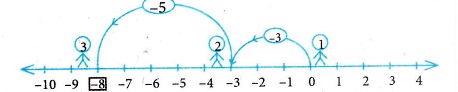
∴ (-3) + (-5) = -8
(iii) (-100) + (-10) = -100-10 = -110
(iv) 20 + (-72) = 20 - 72 = -52
(v) 82 + (-75) = 82 - 75 = 7
(vi) -48 + (-15) = -48 - 15 =- 63
(vii) -225 + (-63) = 225 - 63 = -288
10.
The vertically opposite angles are
\((i) \angle P T R \ and\ \angle S T Q
\)
\((ii) \angle P T S \ and\ \angle R T Q\)
11.
i) The other angle of the linear pair
= 180o - 84o = 96o
ii) The other angle of the linear pair
= 180o - 86o = 94o
iii) The other angle of the linear pair
= 180o - 159o = 21o
12.
i) From this figure \(\angle B A C \text { and } \angle D A C\) are adjacent angles
ii) From this figures \(\angle \mathrm{ZWY} \text { and } \angle \mathrm{XWY}\) are adjacent angles
13.
i) In this figure, AC is the common arm and A is the common vertex.
ii) In the figure, OQ is the common arm and O is the common vertex.
14.
(i) -8
(ii) -1
(iii) 2
(iv) -20
(v) -8
15.
(i) 900
(ii) 72
(iii) 1200
(iv) -1000
16.
\(\angle \mathrm{AOC}+\angle \mathrm{BOC} =180^{\circ}
\)
\(43^{\circ}+\angle \mathrm{BOC} =180^{\circ}
\)
\(\therefore \angle \mathrm{BOC} =180^{\circ}-43^{\circ}=137^{\circ}
\)
17.
(i) 7xy, 3yx, 12xy,15xy are like terms containing same algebraic variables x and y.
(ii) 19 x, x, 6x, -9x, 23x are like terms containing same algebraic variable x.
(iii) 5y, -13y, 16y, 45y, -8y, -y are the like terms containing same algebraic variable y.
(iv) 1, 15, -5, 23,11 are like terms containing numerical constants
18.
(i) Rs. 690 + Rs. 485 = Rs. 1175
(ii) Rs. 1175 - Rs. 500 = Rs. 675
(iii) Rs. 675 - Rs. 350 = Rs. 325
(iv) Rs. 325 + Rs. 89 = Rs.414
(v) Rs. 1214 - Rs. 300 = Rs. 914
19.
(I) \(\frac{-75}{5}{=-15}\)
(II) \(\frac{-100}{-20}=5\)
(III) \(\frac{45}{-9}=-5\)
(IV) \(\frac{-82}{82}=-1\)
20.
From the figure
2x + 3x = 90o
5x = 99o
x = 18o
21.
Possible pairs are
(1, -50), (2, -25), (5, -10), (50, -1), (25, -2), (10, -5)
22.
(i) 60°
Construction:
Step 1: Drawn a line and marked a point 'A' on it.
Step 2: With A as center drawn an arc of convenient radius to meet the line at a point B.
Step 3: With the same radius and B as center drawn an arc to cut the previous arc at C.
Step 4: Joined AC. The ∠ABC is the required angle with the measure 60
.JPG)
(ii) 120°
Construction:
We know that there are two 60° angles in 120°.
∴ We can construct two 60° angles consecutively construct 120°
Step 1: Drawn a line and marked a point 'A' on it
Step 2: With 'A' as center, drawn an arc of convenient radius to the line at a point B.
Step 3: With the same radius and B as center, drawn an arc to cut the previous arc at C
Step 4: With the same radius and C as center, drawn an arc to cut the arc drawn in step 2 at D
Step 5: Joined AD. Then ∠BAD is the required angle with measure 120°.
.JPG)
(iii) 30°
Constructions:
Since 30° is half of 60°, we can construct 30° by bisecting the angle. 60°.
Step 1: Drawn a line and marked a point A on it.
Step 2: With A as center drawn an arc of convenient radius to the line to meet at a point B.
Step 3: With the same radius and B as center drawn an arc to cut the previous arc at C.
Step 4: Joined AC to get ∠BAC = 60°
Step 5: With B as center drawn an arc of convenient radius in the interior of ∠BAC
Step 6: With the same radius and C as center drawn an arc to cut the previous arc at D
Step 7: Joined AD. ∴ ∠BAD is the required angle of measure 30°.
.JPG)
(iv) 90°
Construction:
Step 1: Drawn a line and marked a point' A' on it.
Step 2: With 'A' as center, drawn an arc of convenient radius to the line at a point B.
Step 3: With the same radius and B as center drawn an arc to cut the previous arc at 'C'.
Step 4: With the same radius and C as center, drawn an arc to cut the arc drawn in step 2 at D.
Step 5: Joined AD. ∠BAD = 120°.
Step 6: With C as center, drawn an arc of convenient radius in the interior of ∠CAD.
Step 7: With the same radius and D as center, drawn an arc to cut the arc at E.
Step 8: Joined AF ∠BAE = 90°.
.JPG)
(v) 45°
Construction:
Step 1: Drawn a line and marked a point A on it
Step 2: With A as center, drawn an arc of convenient radius to the line at a point B.
Step 3: With the same radius and B as center drawn an arc to cut the previous arc at C.
Step 4: With the same radius and C as center, drawn an arc to cut the arc drawn in step 2 at D.
Step 5: Joined AD. ∠BAD = 120°.
Step 6: With G as center and any convenient radius drawn an arc in the interior of ∠GAB
Step 7: With the same radius and B as center drawn an arc to cut the arc at F.
Step 8: Joined AF. ∠BAF = 45°
.JPG)
(vi) 150°
Construction:
Since 50° = 60° + 60° + 30°; we construct as follows
Step 1: Drawn a line and marked a point A on it.
Step 2: With' A' as center, drawn a full arc of convenient radius to the line at a point B and at E the other end.
Step 3: With the same radius and B as center, drawn an arc to cut the previous arc at C.
Step 4: With the same radius and C as center drawn an arc to cut the already drawn arc at D.
Step 5: With D as center, drawn an arc of convenient radius in the interior of ∠DAE
Step 6: With E as center and with the same radius drawn an arc to cut the previous arc at F.
Step 7: Joined AF, ∠FAB = 150°.
.JPG)
(vii) 135°
Construction:
Step 1: Drawn a line and marked a point A on it.
Step 2: With 'A' as center, drawn an arc of convenient radius to the line at a point B.
Step 3: With the same radius and B as center drawn an arc to cut the previous arc at C.
Step 4: With the same radius and C as center, drawn an arc to cut the arc at D.
Step 5: With C and D as centers drawn arcs of convenient (same) radius in the interior of ∠CAD. Marked the point of intersection as E.
Step 6: Joined AE, through G. ∠BAE = 90°.
Step 7: Drawn angle bisector to ∠GAH through F
Now ∠BAF = 135°.
.JPG)
23.
(i) positive integer.
(ii) negative integer.
24.
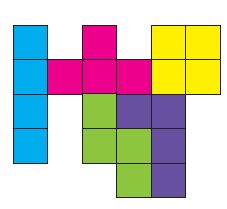
25.
(i) any two pairs of adjacent angles are
(a) ∠PQT and ∠TOS
(b) ∠PQU and ∠RQU
(ii) two pairs of vertically opposite angles are
(a) ∠PQT and ∠RQU
(b) ∠RQT and ∠PQU
26.
From the figure
∴ ∠JlL = ∠JIK + ∠KIL
= 38° + 27°
= 65°
∴ ∠JlL = 65°
27.
(i)
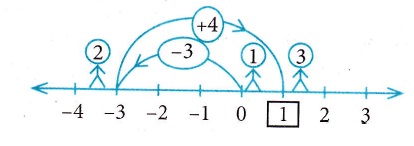
∴ (-3) - (-4) = +1
(ii)

7 - (-10) = 7 + 10 = 17
(iii) 35 - (-64) = 35 + 64 = 99
(iv) -200 - (+100) = -200 -100 = -300
28.
| Number of letters | 738 | x |
| Shortout time (in hours) | 6 | 9 |
Since the given data are in direct proportion.
\(\frac{738}{6}=\frac{x}{9}\)
6x = 738 x 9
\(x=\frac{738 \times 9}{6}=1107\)
1107 letters can be sorted in 9 hours.
29.
| Number of trips | 8 | 12 |
| Number of people | 120 | x |
Since the given data are in direct proportion
\(\frac{x_{1}}{y_{1}}=\frac{x_{2}}{y_{2}}\)
\(\frac{8}{120}=\frac{12}{x}\)
8x = 120 x 12
\(\therefore x=\frac{120 \times 12}{8}=180\)
In 12 trips, 180 people would have attended the party.
30.
(i) Given: d1 = 8 cm, d2 = 16 cm
Area of the rhombus
\(=\frac{1}{2} \times\left(\mathrm{d}_{1} \times \mathrm{d}_{2}\right) \text { sq.units }
\)
\(=\frac{1}{2} \times(8 \times 16)=\frac{128}{2}
\)
Area of the rhombus = 64 sq.cm
(ii) b = 15 cm, h = 11 cm
Area of the rhombus = b x h sq.units
= 15 x 11
Area of the rhombus = 165 sq.cm
31.
Given x = 2; y = 3.
(i) 2x - 3y = 2 (2) - 3 (3) = 4 - 9
= 4 + (Additive inverse of 9)
= 4 + (-9) = - 5
(ii) x + y =2 + 3 = 5
(iii) 4y - x = 4 (3) - 2 = 12 - 2 = 10
(iv) x + 1- y = 2 + 1 - 3 = 3 - 3 = 0
32.
(i) 7x, -8x, -12x are like terms containing same algebraic variable 'x'.
(ii) 5y, 12 -9y are like terms containing same algebraic variable 'y'.
(ili) 6z, z and 11 z are like terms containing same algebraic variables 'z'.
33.
| S.No | Expression | Variable | Constant | Terms |
| (i) | 18 + x - y | x,y | 18 | 18,x,y |
| (ii) | 7p - 4q + 5 | p,q | 5 | 7p,-4q,5 |
| (iii) | 29x + 13y | x,y | - | 29x,13y |
| (iv) | b + 2 | b | 2 | b,2 |
34.
| TERMS | NUMERICAL CO-EFFICIENT |
| -3 yx | -3 |
| 12k | 12 |
| y | 1 |
| 121bc | 121 |
| -x | -1 |
| 9pq | 9 |
| 2ab | 2 |
35.
(11 + 7) + 10 = 18 + 10 = 28
11 + (7 + 10) = 11 + 17 = 28
Yes, (11 + 7) + 10 and 11 + (7 + 10) are equal.
This is Associative property. a+ (b + c) = (a + b) + c.

7th Standard Syllabus & Materials
7th Standard
TN 7th English T1 - Supplementary - On Monday Morning Important Questions And Answers Study Material - QB365 Set A
NEW7th Standard
TN 7th English T1 - Prose - Eidgah Important Questions And Answers Study Material - QB365 Set A
NEW7th Standard
TN 7th Social Science T1 - ECO - Production Important Questions And Answers Study Material - QB365 Set A
NEW7th Standard
TN 7th Social Science T1 - GEO - Interior of the Earth Important Questions And Answers Study Material - QB365 Set A



Tamilnadu Stateboard 7th Standard Subjects
Tamilnadu Stateboard Standards



