
7th Standard Syllabus & Materials
7th Standard
TN 7th Tamil பருவம் -1 இயல் 1 - அமுதத்தமிழ் - ஒன்றல்ல இரண்டல்ல Important Questions And Answers Study Material - QB365 Set A
NEW7th Standard
TN 7th Tamil பருவம் -1 இயல் 1 - அமுதத்தமிழ் - எங்கள் தமிழ் Important Questions And Answers Study Material - QB365 Set A
NEW7th Standard
TN 7th English T1 - Poem - Your Space Important Questions And Answers Study Material - QB365 Set A
NEW7th Standard
TN 7th English T1 - Prose - A Prayer to the Teacher Important Questions And Answers Study Material - QB365 Set A
NEW7th Standard
TN 7th English T1 - Poem - The Listeners Important Questions And Answers Study Material - QB365 Set A
NEW7th Standard
TN 7th English T1 - Prose - The Wind on Haunted Hill Important Questions And Answers Study Material - QB365 Set A

Published on: 04/09/2026
Download Tamil Nadu 7th Standard Science question papers, model tests, one-mark questions, important questions, and public exam papers in PDF format. Free study materials and answer keys for TN State Board students.
Questions + Answers key
Take MCQ Science Test
1.
A particle is moving in a circular path of radius r. The displacement after half a circle would be _______.
Zero
R
2 r
r / 2
2.
Which one of the following is an example for a metal?
Iron
Oxygen
Helium
Water
3.
Which of the following is a derived quantity?
mass
time
area
length
4.
What is centre of gravity ?
5.
Distinguish between speed and velocity.
6.
Calculate the atomicity of H2SO4.
7.
Define molecule.
8.
Write the chemical formula for the following elements
a. Hydrogen
b. Nitrogen
c. Ozone
d. Sulphur
9.
Define - Astronomical unit?
10.
What is one light year?
11.
What are derived quantities?
12.
The shortest distance between two places is_______.
13.
________of some elements are derived from Latin or Greek names of the elements.
14.
The smallest particle of matter that can exist by itself is ______.
15.
Density
16.
Distance
17.
Area
18.
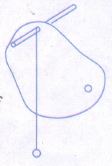
Write about the experiment to find the centre of gravity of the irregularly shaped plate.
19.
Differentiate metals and non metals.
20.
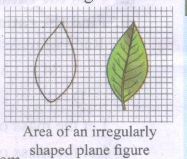
Describe the graphical method to find the area of an irregularly shaped plane figure.
1.
(c)
2 r
2.
(a)
Iron
3.
(c)
area
4.
The centre of gravity of an object is the point through which the entire weight of the object appears to act.
5.
| S.No | Speed | Velocity |
| 1. | Speed is the rate of change of distance | Velocity is the rate of change in displacement |
| 2. | Speed = distance / time | Velocity = displacement / time |
| 3. | SI unit of speed is m/s | SI unit of velocity is m/s |
| 4. | Speed = \(\frac{Distance \ travelled}{time \ taken}\) | Velocity = \(\frac{Displacement}{time \ takem}\) |
6.
(i) H2SO4 consists of 2H atoms, 1 S atom and 4 O atoms.
(ii) Hence, Atomicity = 2 + 1 + 4 = 7
7.
A molecule is made up of two or more atoms chemically combined.
8.
| Elements | Chemical Formula |
| Hydrogen | H2 |
| Nitrogen | N2 |
| Ozone | O3 |
| Sulphur | S8 |
9.
One astronomical unit is defined as the average distance between the earth and the sun.
1 AU = 1.4965 106 km = 1.496 \(\times\) 1011m.
10.
One light year is defined as the distance travelled by light in vacuum during the period of one year.
1 Light year = 9.46 \(\times\) 1015m
11.
Physical quantities which can be obtained by multiplying, dividing or by mathematically combining the fundamental quantities are known as derived quantities.
Ex: Area, volume
12.
()
displacement
13.
()
The Symbol
14.
()
atom
15.
kg / m3
16.
light year
17.
m2
18.
Apparatus: Irregularly shaped plate, string, pendulum bob, stand.
i) Make three holes in the lamina.
ii) Suspend the lamina from the optical pin through one of the holes as shown.
iii) Suspend the plumbline from the pin and mark the position of the plumbline on the lamina.
iv) Draw lines on the lamina representing the positions of the plumbline.
v) Repeat the above steps for the holes.
vi) Label the intersection of the three lines as X is the position of the centre of gravity of the lamina.
19.
| Metals | Non-metals |
| (i) Lustrous and have shiny surface. | (i) Non-lustrous and have non-shiny surface. |
| (ii) They are generally hard. | (ii) They are generally Soft. |
| (iii) They are ductile. | (iii) They are non-ductile. |
| (iv) Good conductors of heat and electricity. | (iv) Bad conductors of heat and electricity. |
| (v) Metals are making sound when struck.(Sonorous) | (v) Non-metals do not make sound when struck. (Non-sonorous) |
20.
Take a leaf from any one of trees in your neighbourhood. Place the leaf on a graph sheet and draw the outline of the leaf with a pencil. Remove the leaf. You can see the outline of the leaf on the graph sheet.
i) Now count the number of whole squares enclosed within the outline of the leaf. Take it to be M
ii) Then count the number of squares that are more than half. Take it as N
iii) Next, Count the number of squares which are half of a whole square. Note it to be P.
iv) Finally, count the number of squares that are less than half. Let it be a Q.
v) Now the approximate area of the leaf can be calculated using the following formula.
Approximate area of the leaf = M+(3/4)N+(1/2)P+(1/4)
This formula can be used to calculate the area of any irregularly shaped plane figures.

7th Standard Syllabus & Materials
7th Standard
TN 7th English T1 - Supplementary - On Monday Morning Important Questions And Answers Study Material - QB365 Set A
NEW7th Standard
TN 7th English T1 - Prose - Eidgah Important Questions And Answers Study Material - QB365 Set A
NEW7th Standard
TN 7th Social Science T1 - ECO - Production Important Questions And Answers Study Material - QB365 Set A
NEW7th Standard
TN 7th Social Science T1 - GEO - Interior of the Earth Important Questions And Answers Study Material - QB365 Set A



Tamilnadu Stateboard 7th Standard Subjects
Tamilnadu Stateboard Standards



