
 100% FREE ACCESS
10th Standard Syllabus & Materials
10th Standard
TN 10th English Prose - 4 - The Attic Important Questions And Answers Study Material - QB365 Set A
NEW10th Standard
TN 10th English Supplementary - 3 - The Story of Mulan Important Questions And Answers Study Material - QB365 Set A
NEW10th Standard
TN 10th English Poem - 3 - I am Every Woman Important Questions And Answers Study Material - QB365 Set A
NEW10th Standard
TN 10th English Prose - 3 - Empowered Women Navigating The World Important Questions And Answers Study Material - QB365 Set A
NEW10th Standard
TN 10th English Supplementary - 2 - Zigzag Important Questions And Answers Study Material - QB365 Set A
NEW10th Standard
TN 10th English Poem - 2 - The Grumble Family Important Questions And Answers Study Material - QB365 Set A

Published on: 13/11/2019
Download Tamil Nadu 10th Standard Science question papers, model tests, one-mark questions, important questions, and public exam papers in PDF format. Free study materials and answer keys for TN State Board students.
Questions + Answers key
Take MCQ Science Test1.
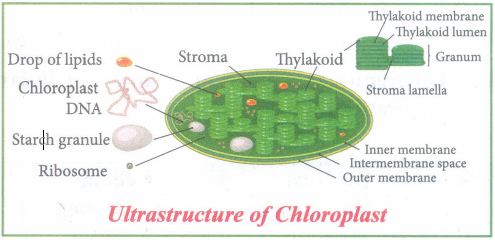
Describe the ultrastructure of a chloroplast.
2.
What is Lens? What are types of lenses?
3.
Among the following pairs, pick out the smallest
(i) Mg, Ca
(ii) AI, Si
(iii) CI, Br.
4.
What is the name given to the segments of DNA, which are responsible for the inheritance of a particular character?
5.
Name the endocrine glands associated with kidneys.
6.
What is Sprite?
7.
The aquatic animals live more in cold region Why?
8.
What happens to the resistance, as the conductor is made thicker?
9.
Define: Relative atomic mass.
10.
How does an astronaut float in a space shuttle?
11.
Write a note an selection.
12.
Explain the construction of Simple Microscope and derive its magnification power.
13.
Write the applications of Doppler effect.
14.
Water boils in an electric kettle in 15 mins after switching on. If the length of the heating wire is decreased to \(\frac{1}{3}\) of its initial value, then in how much time will the same amount of water boil with the same supply voltage?
15.
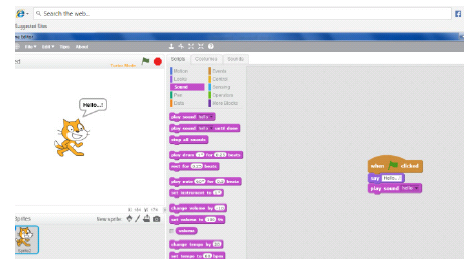
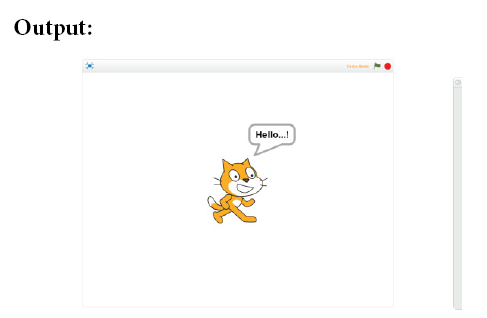
Program for print the word “Hello” with sound
16.
Differentiate between Type-1 and Type-2 diabetes mellitus
17.
State Soddy and Fajans displacement law.
18.
In the circuit diagram given below, three resistors R1, R2 and R3 of 5 Ω, 10 Ω and 20 Ω respectively are connected as shown. Calculate:
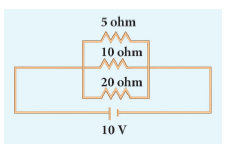
A) Current through each resistor
B) Total current in the circuit
C) Total resistance in the circuit
19.
Find the final temperature of a copper rod. Whose area of cross section changes from 10 m2 to 11 m2 due to heating. The copper rod is initially kept at 90 K. (Coefficient of superficial expansion is 0.0021 /K)
20.
The ratio of masses of two planets is 2:3 and the ratio of their radii is 4:7. Find the ratio of their accelerations due to gravity.
21.
Can a nickel spatula be used to stir copper sulphate solution? Justify your answer.
22.
If you keep ice at 0°C and water at 0°C in either of your hands, in which hand you will feel more chillness? Why?
23.
To create animations, cartoons and games easily we can use_________
Paint
Notepad
LINUX
Scratch
24.
Which among the following factors affect the rate of a reaction?
Surface area of reactants
Pressure
Temperature
all the above
25.
___________is the main circulatory medium in the human body.
Blood
Water
Lymph
Plasma
26.
The_______ on both sides join to form the genital atrium in leech.
ejaculatory ducts
epididymis
sperm Vesicle
vas efferens
27.
When an object undergoes acceleration
its speed always increase
a force always acts an it
its velocity always increases
velocity always decreases
28.
The miracle rice which saved millions of lives and celebrated its 50th birthday is _______.
IR 8
IR 24
Atomita 2
Ponni
29.
What is true of gametes?
They are diploid
They give rise to gonads
They produce hormones
They are formed from gonads
30.
Cancer of the epithelial cells is called
Leukemia
Sarcoma
Carcinoma
Lipoma
31.
Solubility of NaCl in 100 ml water is 36 g. If 25 g of salt is dissolved in 100 ml of water how much more salt is required for saturation _____________
12g
11g
16g
20g
32.
_____ is a relative periodic property.
atomic radii
ionic radii
electron affinity
electronegativity
33.
Velocity of sound in a gaseous medium is 330 ms-1. If the pressure is increased by 4 times without causing a change in the temperature, the velocity of sound in the gas is
330 ms-1
660 ms-1
156 ms-1
990 ms-1
34.
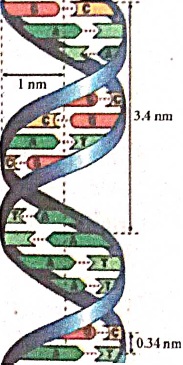
How is the structure of DNA organised? What is the biological significance of DNA?
35.
Write notes on
i) saturated solution
ii) unsaturated solution
36.
37.
Plutonium - 239 specimen emits radiation of 4.3 x 10³ GBq per second convert this disintegrations in terms of curie.
(1 Bq = 2.703 x 10⁻¹¹curie)
1.
Structure of Chloroplast: Chloroplasts are green plastids containing green pigment called chlorophyll. Chloroplasts are oval shaped organelles having a diameter of 2-10 micrometer and a thickness of 1-2 micrometer
(i) Envelope: Chloroplast envelope has outer and inner membranes which is seperated by intermembrane space.
(ii) Stroma: Matrix present inside to the membrane is called stroma. It contains DNA, 70 S ribosomes and other molecules required for protein synthesis
(iii) Thylakoids: It consists of thylakoid membrane that encloses thylakoid lumen.
(iv) Grana: Some of the thylakoids are arranged in the form of discs stacked one above the other. These stacks are termed as grana, they are interconnected to each other by membranous lamellae called Fret channels.
2.
(i) A lens is an optically transparent medium bounded by two spherical refracting surfaces or one plane and one spherical surface.
(ii) Lens is basically classified into two types. They are: (i) Convex Lens (ii) Concave Lens.
3.
(i) Mg
(ii) Si
(iii) CI
4.
The name of the segment of DNA is gene.
5.
Posterior lobe (Neurohypophysis) of pituitary gland.
6.
The characters on the background of a Scratch window are known as Sprite. Usually a cat appears as a sprite when the Scratch window is opened. The software provides facilities to make alternations in sprite.
7.
(i) Aquatic animals live more in cold regions.
(ii) More amount of dissolved oxygen is present in the water of cold regions.
(iii) This shows that the solubility of oxygen in water is more at low pressure.
8.
(i) Resistance is inversely proportional to area of cross section. \(\mathbf{R} \alpha \frac{l}{A}\)
(ii) A thicker wire has Iarger area of cross section and hence the resistance decreases.
9.
(i) Relative atomic mass of an element is the ratio between the average mass of its isotopes to \(\frac{1}{12^{\text {th }}}\) part of the mass of a carbon-12 atom.
(ii) It is denoted as Ar.
(iii) It is otherwise called "Standard atomic weight".
10.
(i) Since, space station and astronauts have equal acceleration, they are under free fall condition.
(ii) Both the astronauts and the space station are in the state of weightlessness.
(iii) They are not actually floating but falling freely around the earth due to the huge orbital velocity.
11.
Selection is one of the oldest methods of plant breeding in which individual plants or groups of plants are sorted out from a mixed population based on the morphological characters.
Methods of selection:
There are three methods of selection. They are
a) Mass selection
b) Pure line selection
c) Clonal selection
a) Mass selection:
(i) Seeds of best plants showing desired characters are collected from a mixed population.
(ii) The collected seeds are allowed to raise the second generation. This process is carried out for seven or eight generations.
(iii) At the end, they will be multiplied and distributed to the farmers for cultivation. Eg: Groundnut varieties like TMV-2 and AK-10.
b) Pureline selection :
(i) Pureline is "the progeny of a single individual obtained by self breeding":
(ii) This is also called as individual plant selection. In pureline selection large numbers of plants are selected from a self pollinated crop and harvested individually.
(iii) Individual plant progenies from them are evaluated separately. The best one is released as a pureline variety.
(iv) Progeny is similar both genotypically and phenotypically.
c) Clonal selection:
(i) A group of plants produced from a single plant through vegetative or asexual reproduction are called clones.
(ii) All the plants of a clone are similar both in genotype and phenotype.
(iii) Selection of desirable clones from the mixed population of vegetatively propagated crop is called clonal selection.
12.
(i) Simple Microscope: Simple microscope is a convex lens of short focal length. It is held near the eye to get enlarged image of small objects.
(ii) Let an object (AB) of height 'h' is placed at a point within the principal focus (u < f) of the convex lens and the observer's eye placed just behind the lens.
(iii) As per this position the convex lens CJ produces an erect, virtual and enlarged image (A'B'). The image formed is in the same side of the object and the distance equal to the least distance of distinct vision (D) (D = 25 cm for normal human eye).
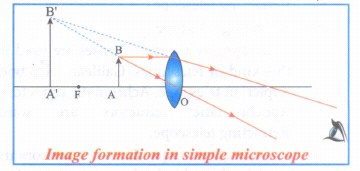
(iv) Magnification power (M): Ratio of the height of the image produced by the microscope h2) to the original height of the object (h1) is called magnification.
M=\(\frac { A'B' }{ AB } \)
Magnification M =\(\frac { height\ of\ the\ image }{ height\ of\ the\ object } \)
=\(\frac { { h }_{ 2 } }{ { h }_{ 1 } } \)
Magnification can also be defined as the ratio of distance of image (v) to the distance of object (u)
Magnification M =\(\frac { Distance\ of\ the\ image }{ Distance\ of\ the\ object } \)
=\(\frac { v }{ u } \)
Since, the image is virtual and erect; the Magnification (M) is taken as positive In simple Microscope,
when the image is formed at the near point
M=1+\(\frac { D }{ f } \)
when the image is formed at infinity
M=\(\frac { D }{ f } \).
13.
a) To measure the speed of an automobile:
(i) An electromagnetic wave is emitted by a source attached to a police car. The wave is reflected by a moving vehicle, which acts as a moving source.
(ii) There is a shift in the frequency of the reflected wave.
(iii) From the frequency shift, the speed of the car can be determined. This helps to track the over speeding vehicles.
b) Tracking a satellite:
(i) The frequency of radio waves emitted by a satellite decreases as the satellite passes away from the earth.
(ii) By measuring the change in the frequency of radio waves, the location of satellites is studied.
c) RADAR (Radio Detection And Ranging):
(i) In RADAR, radio waves are sent, and the reflected waves are detected by the receiver of the RADAR station.
(ii) From the frequency change, the speed and location of aeroplanes and aircrafts are tracked.
(d) SONAR: In SONAR, by measuring the Q change in the frequency between the sent signal and received signal, the speed of marine animals and submarines can be determined.
14.
Supply Voltage is same
Amount of heat produced is also same
Time taken to heat water t = 15 min.
\(H=\frac { { V }^{ 2 } }{ R } .t\quad [H={ I }^{ 2 }Rt\Rightarrow (V=IR)\therefore I=\frac { V }{ R } ]\)
\(\therefore \frac { { R }_{ 1 } }{ { R }_{ 2 } } =\frac { { t }_{ 1 } }{ { t }_{ 2 } } \quad ...(1)\)
\(R\alpha l\quad \quad \quad [R=\rho \frac { l }{ A } ]\)
\(\frac { { R }_{ 1 } }{ { R }_{ 2 } } =\frac { { l }_{ 1 } }{ { l }_{ 2 } } \quad \quad \quad ...(2)\)
From (i) and (2)
\(\frac { { l }_{ 1 } }{ { l }_{ 2 } } =\frac { { t }_{ 1 } }{ { t }_{ 2 } } =\frac { 15 }{ { t }_{ 2 } } \quad \quad ....(iii)\)
\({ l }_{ 2 }=\frac { 1 }{ 3 } { l }_{ 1 }\Rightarrow \frac { { l }_{ 1 } }{ { l }_{ 2 } } =3\)
Sub in (iii) \(3=\frac { 15 }{ { t }_{ 2 } } \)
\(\therefore { t }_{ 2 }=\frac { 15 }{ 3 } =5min\)
Time taken to heat \(\frac{1}{3}\) length of the wire = 5 min
15.
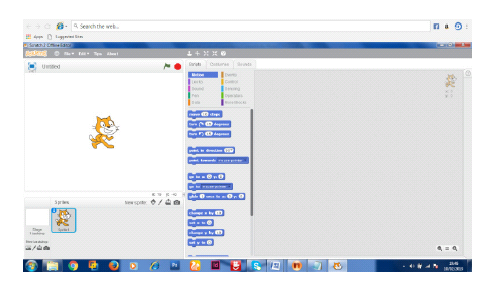
1. Click events in script option
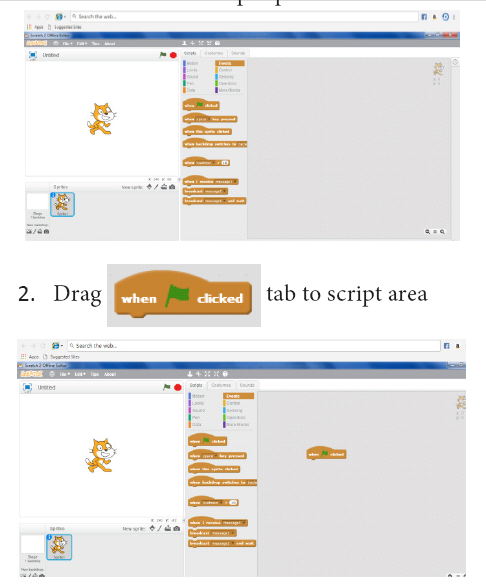
3. Click Looks in script option. Drag “say” to script area.
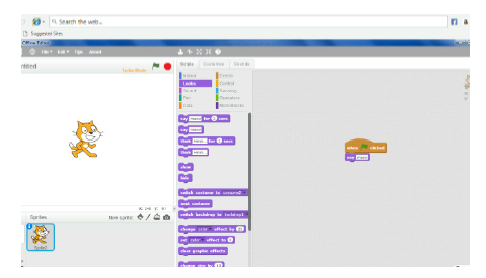
4. Type “Hello “ word in say tab.
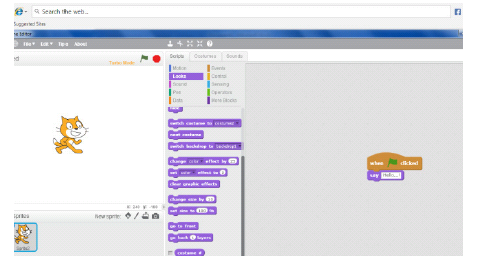
5.Click sounds in script option. Drag play sound to script area. Choose the hello sound from the audio file.
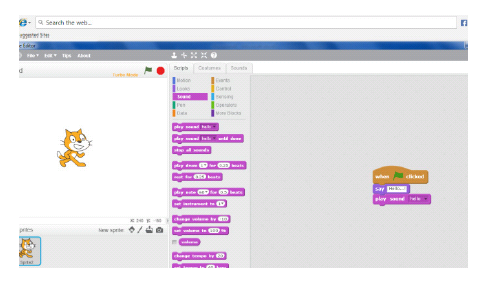
6. From File menu choose the Save option.
7. Click the green flag at the top right corner of the stage window to run the program
16.
| Factors |
Type I - Insulin-dependent diabetes mellitus(IDDM) |
Type II - Non-insulin-dependent diabetes mellitus(NIDDM) |
|---|---|---|
| Prevalence | 10 - 20% | 80 - 90% |
| Age of Onset | Juvenile onset(<20 years) | Maturity onset(>30 years) |
| Body weight | Normal or Underweight | Obese |
| Defect | Insulin deficiency due to destruction of \(\beta \) - cells | Target cells do not respond to insulin |
| Treatment | Insulin administration is necessary | Can be controlled by diet, exercise, and medicine. |
17.
Soddy and Fagan's displacement laws:
(i) When a parent element emits an alpha particle the new element is formed with a decrease in atomic number by two and mass number by four.
(ii) When a parent nucleus emits a beta particle the daughter nucleus is formed with an increase in atomic number by one and has same mass number of the parent nucleus.
(iii) In gamma decay, the energy level of nucleus only changes. No new elements are formed.
18.
A) Since the resistors are connected in parallel, the potential difference across each resistor is same (i.e. V=10V)
Therefore, the current through R1 is,
\({ I }_{ 1 }=\frac { V }{ { R }_{ 1 } } =\frac { 10 }{ 5 } =2A\)
Current through \({ R }_{ 2 }={ I }_{ 2 }=\frac { V }{ { R }_{ 2 } } =\frac { 10 }{ 10 } =1A\)
Current through \({ R }_{ 3 }={ I }_{ 3 }=\frac { V }{ { R }_{ 3 } } =\frac { 10 }{ 20 } =0.5A\)
B) Total current in the circuit, I = I1 + I2 + I3
= 2 + 1 + 0.5 = 3.5 A
C) Total resistance in the circuit \(\frac { 1 }{ { R }_{ P } } =\frac { 1 }{ { R }_{ 1 } } +\frac { 1 }{ { R }_{ 2 } } +\frac { 1 }{ { R }_{ 3 } } \)
\(=\frac { 1 }{ 5 } +\frac { 1 }{ 10 } +\frac { 1 }{ 20 } \)
\(=\frac { 4+2+1 }{ 20 } \)
\(\frac { 1 }{ { R }_{ P } } =\frac { 7 }{ 20 } \)
Hence, \({ R }_{ P }=\frac { 20 }{ 7 } =2.857\Omega \)
19.
Area of copper rod, Ao = 10 m2
Changes of Area of cross section,
Initial temperature \(\Delta \mathrm{A} =11 -10 =1 \mathrm{~m}^{2} \)
\(\mathrm{~T}_{1} =90 \mathrm{~K} \)
\(a_{\mathrm{A}} =0.0021 / \mathrm{K} \)
\(\mathrm{T}_{2} =? \)
\(\frac{\Delta A}{A_{0}} =a_{\mathrm{A}} \Delta \mathrm{T} \)
\(\frac{1 }{10 } =0.0021\left[\mathrm{~T}_{2}-90\right] \)
\(0.1 =0.0021\left[\mathrm{~T}_{2}-90\right]=\frac{0.1}{0.0021}+90=\mathrm{T}_{2} \)
\(\mathrm{~T}_{2} =137.61 \mathrm{~K}\)
So the final temperature of a copper rod is 137.61 K
20.
Given: The ratio of masses of two planets \(M_{1}: M_{2} \) is 2: 3 The ratio of their radii \(R_{1}: R_{2}\) is 4: 7
\(g_{1}: g_{2}= ? \)
\(\mathrm{g}=\frac{\mathrm{G \times M}}{\mathrm{R}^{2}} ; \quad \mathrm{g}_{1}=\frac{\mathrm{G\times M}_{1}}{\mathrm{R}_{1}^{2}} ; \quad \mathrm{g}_{2}=\frac{\mathrm{G \times M}_{2}}{\mathrm{R}_{2}^{2}} \)
\(\frac{g_{1}}{g_{2}}=\frac{\frac{G \times M_{1}}{R_{1}^{2}}}{\frac{G \times M_{2}}{R_{2}^{2}}} ; \quad \frac{g_{1}}{g_{2}}=\frac{M_{1}}{R_{1}^{2}} \times \frac{R_{2}^{2}}{M_{2}}=\frac{2 \times 7 \times 7}{4 \times 4 \times 3}=\frac{49}{24}\)
∴ \(g_{1}: g_{2}\) = 49: 24
21.
(i) No, because Nickel is more reactive than Copper.
(ii) So Nickel easily reacts and displaces copper from copper sulphate solution.
(iii) \(\mathrm{Ni}_{(\mathrm{s})}+\mathrm{CuSO_4}_{(\mathrm{aq})} \rightarrow \mathrm{NiSO_4}_{(\mathrm{aq})}+\mathrm{Cu}_{(\mathrm{S})}\)
22.
(i) 0°C ice is colder than water.
(ii) This can be explained in terms of the latent heat of fusion (336 kJ) which is required to convert ice at 0°C to water at 0°C.
(iii) In simpler terms water at 0°C has higher heat content than ice at the same temperature.
(iv) Thus we conclude ice at 0°C is colder, from either of your hands.
(v) Then, you would felt more chillness on those hand, you kept ice at 0°C.
23.
(d)
Scratch
24.
(d)
all the above
25.
(a)
Blood
26.
(a)
ejaculatory ducts
27.
(b)
a force always acts an it
28.
(a)
IR 8
29.
(d)
They are formed from gonads
30.
(c)
Carcinoma
31.
(b)
11g
32.
(d)
electronegativity
33.
(a)
330 ms-1
34.
DNA is a large molecule consisting of millions of nucleotides. Hence, it is also called a polynucleotide. Each nucleotide consists of three components.
(i) A sugar molecules - Deoxyribose sugar.
(ii) A nitrogenous base.
There are two types of nitrogenous bases in DNA.
They are
(a) Purines (Adenine and Guanine)
(b) Pyrimidines (Cytosine and Thymine)
(iii) A phosphate group
Nucleoside and Nucleotide:
Nucleoside = Nitrogen base + Sugar
Nucleotide = Nucleoside + Phosphate
The nucleotides are formed according to the purines and pyrimidines present in them.
Watson and Crick model of DNA:
(i) DNA molecule consists of two polynucleotide chains.
(ii) These chains form a double helix structure with two strands which run anti-parallel to one another.
(iii) Nitrogenous bases in the centre are linked to sugar-phosphate units which form the backbone of the DNA.
(iv) Pairing between the nitrogenous bases is very specific and is always between purine and pyrimidine linked by hydrogen bonds.
a) Adenine (A) links Thymine (T) with two hydrogen bonds (A = T)
b) Cytosine (C) links Guanine (G) with three hydrogen bonds( C ≡ G) This is called complementary base pairing.
(v) Hydrogen bonds between the nitrogenous bases make the DNA molecule stable.
(vi) Each turn of the double helix is 34 Ao (3.4 nm). There are ten base pairs in a complete turn.
(vii) The nucleotides in a helix are joined together by phosphodiester bonds.
Significance of DNA:
(i) DNA is responsible for the transmission of hereditary information from one generation to next generation.
(ii) It contains information required for the formation of proteins.
(iii) It controls the developmental process and life activities of an organism.
35.
(i) Saturated solution:
a) A solution in which no more solute can be dissolved in a definite amount of the solvent at a given temperature is called saturated solution.
b) E.g. 36 g of sodium chloride in 100 g of water at 25° C forms saturated solution.
c) Further addition of sodium chloride, leaves it undissolved.
(ii) Unsaturated solution:
a) Unsaturated solution is one that contains less solute than that of the saturated solution at a given temperature.
b) E.g. 10 g or 20 g or 30 g of Sodium chloride in 100 g of water at 25°C forms an unsaturated solution.
36.
37.
1 Bq = 2.703 x 10⁻¹¹ curie
∴ 4.3 x 10³ GBq = 4.3 x 103 x 109 x 2.703 x10-11
= 11.62 x 101
= 116.2 curie

10th Standard Syllabus & Materials
10th Standard
TN 10th English Prose - 2 - The Night the Ghost Got in Important Questions And Answers Study Material - QB365 Set A
NEW10th Standard
TN 10th English Supplementary - 1 - The Tempest Important Questions And Answers Study Material - QB365 Set A
NEW10th Standard
TN 10th English Poem - 1 - Life Important Questions And Answers Study Material - QB365 Set A
NEW10th Standard
TN 10th English Prose - 1 - His First Flight Important Questions And Answers Study Material - QB365 Set A



Tamilnadu Stateboard 10th Standard Subjects
Tamilnadu Stateboard Standards





