
 100% FREE ACCESS
10th Standard Syllabus & Materials
10th Standard
TN 10th English Prose - 4 - The Attic Important Questions And Answers Study Material - QB365 Set A
NEW10th Standard
TN 10th English Supplementary - 3 - The Story of Mulan Important Questions And Answers Study Material - QB365 Set A
NEW10th Standard
TN 10th English Poem - 3 - I am Every Woman Important Questions And Answers Study Material - QB365 Set A
NEW10th Standard
TN 10th English Prose - 3 - Empowered Women Navigating The World Important Questions And Answers Study Material - QB365 Set A
NEW10th Standard
TN 10th English Supplementary - 2 - Zigzag Important Questions And Answers Study Material - QB365 Set A
NEW10th Standard
TN 10th English Poem - 2 - The Grumble Family Important Questions And Answers Study Material - QB365 Set A

Published on: 29/10/2022
QB365 provides a detailed and simple solution for every Possible Book Back Questions in Class 10 Maths Subject -Numbers and Sequences , English Medium. It will help Students to get more practice questions, Students can Practice these question papers in addition to score best marks.
Download Tamil Nadu 10th Standard Maths question papers, model tests, one-mark questions, important questions, and public exam papers in PDF format. Free study materials and answer keys for TN State Board students.
Questions + Answers key
Take MCQ Maths Test1.
The sum of first n, 2n and 3n terms of an A.P are S1, S2 and S3 respectively prove that S3 = 3 (S2 - S1)
2.
A mosaic is designed in the shape of an equilateral triangle, 12 ft on each side. Each tile in the mosaic is in the shape of an equilateral triangle of 12 inch side. The tiles are alternate in colour as shown in the figure. Find the number of tiles of each colour and total number of tiles in the mosaic.
3.
Find the sum of all natural numbers between 300 and 600 which are divisible by 7.
4.
The 13th term of an A.P is 3 and the sum of the first 13 terms is 234.Find the common difference and the sum of first 21 terms.
5.
How many terms of the series 1 + 5 + 9 + ....must be taken so that their sum is 190?
6.
Find the sum of 0.40 + 0.43 + 0.46 + ....+ 1
7.
Priya earned Rs.15,000 in the first month. Thereafter her salary increased by Rs. 1500 per year. Her expenses are Rs. 13,000 during the first year and the expenses increases by Rs. 900 per year. How long will it take for her to save Rs. 20,000 per month
8.
In a winter season let us take the temperature of Ooty from Monday to Friday to be in A.P. The sum of temperatures from Monday to Wednesday is 00 C and the sum of the temperatures from Wednesday to Friday is 180 C. Find the temperature on each of the five days
9.
The ratio of 6th and 8th term of an A.P is 7:9 Find the ratio of 9th term to 13th term
10.
The sum of three consecutive terms that are in A.P. is 27 and their product is 288. Find the three terms.
11.
A mother divides Rs. 207 into three parts such that the amount are in A.P. and gives it to her three children. The product of the two least amounts that the children had Rs. 4623. Find the amount received by each child.
12.
In an A.P., sum of four consecutive terms is 28 and their sum of their squares is 276. Find the four numbers.
13.
The duration of flight travel from Chennai to London through British Airlines is approximately 11 hours. The airplane begins its journey on Sunday at 23:30 hours. If the time at Chennai is four and half hours ahead to that of London’s time, then find the time at London, when will the flight land at London Airport
14.
Find the remainder when 281 is divided by 17.
15.
Prove that 2n + 6 x 9n is always divisible by 7 for any positive integer n,
16.
Find the remainders when 70004 and 778 is divided by 7
17.
Find the least number that is divisible by the first ten natural numbers.
18.
What is the smallest number that when divided by three numbers such as 35, 56 and 91 leaves remainder 7 in each case?
19.
Find the greatest number consisting of 6 digits which is exactly divisible by 24,15,36?
20.
Find the LCM and HCF of 408 and 170 by applying the fundamental theorem of arithmetic.
1.
If S1, S2 and S3 are sum of first n, 2n and 3n terms of an A.P respectively then
\({ S }_{ 1 }=\frac { n }{ 2 } \left[ 2a+\left( n-1 \right) d \right] ,{ S }_{ 2 }=\frac { 2n }{ 2 } \left[ 2a+\left( n-1 \right) d \right] ,{ S }_{ 3 }=\frac { 3n }{ 2 } \left[ 2a+\left( 3n-1 \right) d \right]\)
Consider, S2 - S1 = \(\frac { 2n }{ 2 } \left[ 2a+\left( n-1 \right) d \right] -\frac { n }{ 2 } \left[ 2a+\left( n-1 \right) d \right] \)
\(\frac { n }{ 2 } \left[ \left[ 4a+2\left( 2n-1 \right) d \right] -\left[ 2a+\left( n-1 \right) d \right] \right] \)
S2 - S1 = \(\frac { n }{ 2 } \left[ 2a+\left( 3n-1 \right) d \right] \)
3(S1 - S2) = \(\frac { n }{ 2 } \times \left[ 2a+\left( 3n-1 \right) d \right] \)
3(S2 - S1) = S3
2.
Since the mosaic is in the shape of an equilateral triangle of 12 ft, and the tile is in the shape of an equilateral triangle of 12 inch (1 ft), there will be 12 rows in the mosaic.
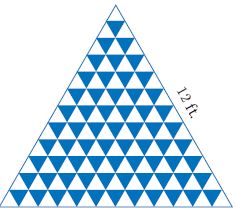
From the figure, it is clear that number of white tiles in each row are 1, 2, 3, 4, …, 12 which clearly forms an Arithmetic Progression.
Similarly the number of blue tiles in each row are 0, 1, 2, 3, …, 11 which is also an Arithmetic Progression.
Number of white tiles = 1 + 2 + 3 +....+12 = \(\frac { 12 }{ 2 } \left[ 1+12 \right] \) = 78
Number of blue tiles = 0 + 1+ 2 + 3 +...+\(\frac { 12 }{ 2 } \left[ 0+11 \right] \) = 66
The total number of tiles in the mosaic = 78 + 66 = 144
3.
The natural numbers between 300 and 600 which are divisible by 7 are 301, 308, 315, …, 595.
The sum of all natural numbers between 300 and 600 is 301 + 308 + 315 +...+ 595
The terms of the above series are in A.P.
First term a = 301; common difference d = 7; Last term l = 595.
\(n=\left( \frac { l-a }{ d } \right) +1=\left( \frac { 595-301 }{ 7 } \right) +1=43\)
Since, \({ S }_{ n }=\frac { n }{ 2 } \left[ a+l \right] \), we have \({ s }_{43 }=\frac { 43 }{ 2 } \left[ 301+595 \right] \) = 19264
4.
Given the 13th term = 3 so, t13 = a + 12d = 3..... (1)
Sum of first 13 terms = 234 gives \(\frac { 13 }{ 2 } \) [2a + 12d] = 234
2a + 12 = 36...(2)
Solving (1) and (2) we get , a = 33, d = \(\frac { -5 }{ 2 } \)
Therefore, common difference is \(\frac { -5 }{ 2 } \).
Sum of first 21 terms S21 = \(\frac { 21 }{ 2 } \left[ 2\times 33+\left( 21-1 \right) \times \left( -\frac { 5 }{ 2 } \right) \right] =\frac { 21 }{ 2 }\)[66 - 50] = 168.
5.
Here we have to find the value of m, such that Sn = 190.
Sum of first n terms of an A.P
Sn = \(\frac { n }{ 2 } \)[2a + (n - 1)d] = 190
\(\frac { n }{ 2 } \)[2 x 1 + (n - 1) x 4 ] = 190
n [4n - 2] = 380
2n2 -n - 190 = 0
(n - 10) (2n + 19) = 0
But n = 10 as n = \(\frac { 19 }{ 2 } \) is impossible , therefore, n = 10
6.
Here the value of n is not given. But the last term is given. From this, we can find the value of n.
Given a = 0.40 and l = 1, we find d = 0.43 - 0.40 = 0.03
Therefore, n = \(\left( \frac { l-a }{ d } \right) +1\)
= \(\left( \frac { 1-0.40 }{ 0.03 } \right) +1=21\)
Sum of first n terms of an A.P Sn = \(\frac { n }{ 2 } \left[ a+l \right] \)
Here, n = 21. Therefore, S21 = \(\frac { 21 }{ 2 } \left[ 0.40+1 \right] =14.7\)
So, the sum of 21 term of the given series is 14,7.
7.
Let the first month earning be
t1 = Rs. 15,000
Increase per year d = Rs. 1,500
Expenses for first year = Rs. 13,000
Expenses increase per year = Rs. 900
Saving for every year will be
(15000 - 13000), (16500 = 13900), (18000 - 14800),...
i.e. 2000, 2600, 3200, ...
Since t2 - t1 - t3 - t2, this sequence form an A.P
a = 2000, d = 2600 - 2000 = 600
Let the nth years saving be Rs 20,000 then
a + (n - 1)d = tn
2000 + (n - 1) (600) = 20,000
(n - 1) 600 = 20,000 - 2000
(n - 1) 600 = 18000
\(n-1=\frac{18000}{600}=30\)
n = 30 + 1 = 31
To save Rs. 20000, it takes 31 years.
8.
Given the temperatures are in A.P.
Let the temperatures of Monday, Tuesday, Wednesday, Thursday and Friday be t1, t2, t3, t4 and t5 respectively
Given t1 + t2 + t3 = 0oC
a + a + d + a + 2d = 0oC
3a + 3d = 0
And t3 + t4 + t5 = 18oC
a + 2d + a + 3d + a + 4d = 18oC
3a + 9d = 18oC .........(2)
Subtracting (1) from (2)
6d = 18oC
d = 3oC
Put d = 3oC in (1)
3a + 3 x 3 = 0
3a = -9
\(a=\frac{-9}{3}=-3^{\circ} \mathrm{C}\)
t1 = -3oC, t2 = (-3) + 3 = 0oC,
t3 = -3 + 2(3) = 3oC,
t4 = -3 + 3 (3) = 6oC , t5 = - 3 + 4(3) = 9oC.
Five days temperatures are -3oC, 0oC, 3oC, 6oC, 9oC
9.
Given in an A.P. 6th term : 8th term = 7 : 9
a+ (6 - 1)d : a + (8 - 1)d = 7 : 9
a + 5d : a + 7d = 7 : 9
Product of the extremes = product of the means.
9(a + 5d) = 7(a + 7d)
9a + 45d = 7a + 49d.
9a - 7a =.49 d - 45d
2a = 4d
a = 2d
To find the ratio of 9th term : 13th term
a + (9 - 1) d : a + (13 - 1) d = a + 8d : a + 12 d
= 2d + 8d : 2d + 17 d
= 10 d : 14 d
= 5 : 7
The ratio of 9th term to 13th term is 5 : 7.
10.
Let the three consecutive terms be a - d, a, a + d
Given their sum is 27
(a - d) + a + (a + d) = 27
a - d + a + a + d = 27
3a = 27
\(a=\frac{27}{3}=9\)
Product = 288
(a - d) a (a + d) = 288
a(a2 - d2) = 288
9(92 - d2) = 288
\(81-d^{2}=\frac{288}{9}\)
81 - d2 = 32
d2 = 81 - 32 = 49
d x d = 7 x 7
d = \(\pm\)7
(i) a = 9, d = 7, The three terms are,
= 9 -7, 9, 9 + 7
= 2,9, 16
(ii) a = 9, d = -7, The three terms are
9-(-7), 9, 9-7 \(\Rightarrow\) 16,9,2
The required three consecutive terms of the A.P are 2,9,16.
11.
Let the amount received by the three children be in the form of A.P. is given by
a - d, a, a + d, Since, Sum of the amount is Rs. 207, we have
(a - d) + a + (a + d) = 207
3a = 207 gives a = 69
It is given that product of the two least amounts is 4623.
(a - d)a = 4623
(69 - d)69 = 4623
d = 2
Therefore, amount given by the mother to her three children are
Rs. (69 - 2), Rs. 69, Rs. (69 + 2). That is Rs. 67, Rs. 69 and Rs. 71.
12.
Let us take the four terms in the form (a - 3d), (a -d), (a + d) and (a + 3d).
Since sum of the four terms is 28,
a - 3d + a - d + a + d + a + 3d = 28
4a = 28 gives a = 7
Similarly, since sum of their squares is 276,
(a - 3d)2 + (a - d)2 + (a + d)2 + (a + 3d)2 = 276
a2 - 6ad + 9d2 + a2 - 2ad + d2 + a2 + 2ad + d2 + a2 + 6ad + 9d2 = 276
4a2 + 20d2 = 276 \(\Rightarrow\) 4(7)2 + 20d2 = 276
d2 = 4 gives d = \(\pm\)2
If d = 2 then the four numbers are 7 - 3(2), 7 - 2, 7 + 2, 7 + 3(2)
That is the four numbers are 1,5,9 and 13.
If a = 7, d = -2 then the four numbers are 13,9, 5 and 1
Therefore, the four consecutive terms of the A.P are 1, 5, 9 and 13
13.
Starting time from Chennai = 23.30 hrs
Travelling time = 11 hrs
Here we use modulo 24.
Reaching time = 23.30 + 11 (mod 24)
= 34.30 (mod 24)
= 10.30 (mod 24)
Since 11 = 0 x 24 + 11
It reaches London on Monday at 10.30 a.m
Chennai time = 4.30 hrs + London time
London time = Chennai time - 4.30 a.m
= 10.30 - 4.30 = 6 a.m
The flight will land at London Airport on Monday at 5 a.m.
14.
First take 25 ≡ 15 (mod 17)
(25)2 ≡ 152 (mod 17)
≡ 4 (mod 17)
210 ≡ 4 (mod 17)
(210)4 ≡ 44 (mod 17)
240 ≡ 1 mod 17
(240)2 ≡ 12 mod 17
2.280 ≡ 2 x 1 (mod 17)
281 ≡ 2 mod 17
Remainder when 281 is divided by 17 is 2.
15.
7 is divisible by 7
7 ≡ 0 (mod 7)
7 + 2 ≡ 0 + 2 (mod 7)
[Adding the constant 2]
9 ≡ 2 (mod 7)
9n ≡ 2n (mod 7)
6 x 9n ≡ 6 x 2n (mod 7)
[multiplying by the constant 6]
2n + 6 x 9n ≡ 2n + 6 x 2n (mod 7)
≡ 2n (1 + 6) (mod 7)
≡ 2n x 7 (mod 7)
≡ 2n x 0 (mod 7)
≡ 0 (mod 7)
When 2n + 6 x 9n is divided by 7 we get remainder 0,
Hence 2n + 6 x 9n is always divisible by 7 for any positive integer n.
16.
Since 70000 is divisible by 7
70000 \(\equiv \) 0 (mod 7)
70000 + 4 \(\equiv \) 0 + 4 (mod 7)
70004 \(\equiv \) 4 (mod 7)
Therefore, the remainder when 70004 is divided 7 is 4
Since 777 is divisible by 7
777 \(\equiv \) 0 (mod 7)
777 + 1 \(\equiv \) 0 + 1 (mod 7)
778 \(\equiv \) 1 (mod 7)
Therefore, the remainder when 778 is divided by 7 is 1.
17.
The required number is the L.C.M. of first ten natural numbers
i.e., L.C.M. of (1,2,3,4,5,6,7,8,9,10)
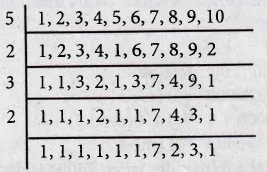
L.C.M. is 5 x 2 x 3 x 2x7 x 2 x 3 = 2520
The least number divisible by first ten natural numbers is 2520.
18.
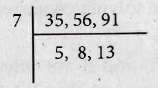
The required number = L.C.M. of (35, 56, 91) + 7
LCM of 35, 56, 91 = 7 x 5 x 8 x 3
= 3640
Required number = 3640 + 7
= 3647
19.
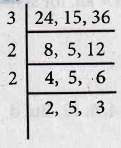
L.C.M.= 3 x 2 x 2 x 2 x 5 x 3 = 360
Greatest number of 6 digit is 999999
L.C.M. of 24,15 and 36 = 360
.jpg)
On dividing 999999 by 360 remainder obtained is 279.
Greatest number of 6 digit, divisible by 24,15 and 36 = 999999 - 279 = 999720
Hence the required number is = 999720
20.
By fundamental. theorem, every composite number can be expressed as a product of primes.
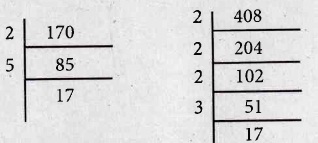
Factorizing 408 and 170 we get
408 = 23 x 31 x 171
170 = 21 x 51 x 171
H.C.F. of 408 and 170 = 21 x 171 = 34
Also we know that H.C.F. x L.C.M.
= product of two numbers
34 x L.C.M. = 408 x 170
L.C.M = \(\frac{408 \times 170}{34}=2040\)
H.C.F. (408, 170) = 34; L.C.M. (408, 170) = 2040

10th Standard Syllabus & Materials
10th Standard
TN 10th English Prose - 2 - The Night the Ghost Got in Important Questions And Answers Study Material - QB365 Set A
NEW10th Standard
TN 10th English Supplementary - 1 - The Tempest Important Questions And Answers Study Material - QB365 Set A
NEW10th Standard
TN 10th English Poem - 1 - Life Important Questions And Answers Study Material - QB365 Set A
NEW10th Standard
TN 10th English Prose - 1 - His First Flight Important Questions And Answers Study Material - QB365 Set A



Tamilnadu Stateboard 10th Standard Subjects
Tamilnadu Stateboard Standards





