
 100% FREE ACCESS
11th Standard Syllabus & Materials
11th Standard
TN 11th Tamil இயற்கை வேளாண்மை,சுற்றுச்சூழல் -செய்யுள் - மனோன்மணீயம் Important Questions And Answers Study Material - QB365 Set A
NEW11th Standard
TN 11th Tamil என்னுயிர் என்பேன் -துணைப்பாடம் - இசைத்தமிழர் இருவர் Important Questions And Answers Study Material - QB365 Set A
NEW11th Standard
TN 11th Tamil மொழி கலை -செய்யுள் - ஒவ்வொரு புல்லையும் Important Questions And Answers Study Material - QB365 Set A
NEW11th Standard
TN 11th Tamil பீடு பெற நில் - இலக்கணம் - பகுபத உறுப்புகள் Important Questions And Answers Study Material - QB365 Set A
NEW11th Standard
TN 11th Tamil பீடு பெற நில் - துணைப்பாடம் - வாடிவாசல் Important Questions And Answers Study Material - QB365 Set A
NEW11th Standard
TN 11th Tamil பீடு பெற நில் - செய்யுள் - குறுந்தொகை Important Questions And Answers Study Material - QB365 Set A

Published on: 28/12/2018
11th Half Yearly Model Question
Download Tamil Nadu 11th Standard Accountancy question papers, model tests, one-mark questions, important questions, and public exam papers in PDF format. Free study materials and answer keys for TN State Board students.
Questions + Answers key
Take MCQ Accountancy Test
1.
When the balance as per Cash Book is the starting point to ascertain balance as per bank statement, direct payments by bank are ____________
Added
subtracted
not adjusted
None of the above
2.
Merchandise stolen by someone should be debited to_______
Sales account
Purchases account
Loss by theft account
None of the above
3.
Deferred revenue expenditure is to be written off ___________
In the year in which the expenses are incurred
In the year in which the benefit of expenses are exhausted
Within 3 to 5 years
Within 5 to 10 years
4.
The expenses and incomes for the full accounting period must be taken into account while preparing ______
Final accounts
Trial balance
Balance sheet
Cash book
5.
___________ is a non-cash item.
Depreciation
Asset
Liabilities
None of these
6.
Two or more business units forming a single entity is known as __________.
Joint
Merger
Link
Compound
7.
An entry is passed in the beginning of current year is called _________
Original entry
Final entry
Opening entry
Adjusting entry
8.
People who write codes and programes are called as _______.
System analysts
System designers
System operators
System programmers
9.
10.
Goods returned by Senguttuvan were taken into stock, but no entry was passed in the books. While rectifying this error, which of the following accounts should be debited?
Senguttuvan account
Sales returns account
Returns outward account
Purchases returns account
11.
Carriage inwards will be shown _______.
In the trading account
In the profit and loss account
On the liabilities side
On the assets side
12.
Which one of the following is not a timing difference?
Cheque deposited but not yet credited
Cheque issued but not yet presented for payment
Among directly paid into the bank
Wrong debit in the cash book
13.
_____ is a statement prepared by a trader who receives back from his customer the goods sold.
Debit note
Credit note
Both
None of these
14.
'Cash withdrawn by the proprietor from the business for his personal use' causes
Decrease in assets and decrease in owner's capital
Increase in one asset and decrease in another asset
Increase in one asset and increase in liabilities
Increase in asset and decrease in capital
15.
Which of the following statements is not true?
Cash discount is recorded in the books of accounts
Assets purchased on credit are recorded in journal proper
Trade discount is recorded in the books of accounts
3 grace days are added while determining the due date of the bill
16.
The trial balance contains the balances of_____
Only personal accounts
Only real accounts
Only nominal accounts
All accounts
17.
The process of finding the net amount from the totals of debit and credit columns in a ledger is known as
Casting
Posting
Journalising
Balancing
18.
Which of the following does not follow dual aspect concept?
Increase in one asset and decrease in other asset
Increase in both asset and liability
Decrease in one asset and decrease in other asset
Increase in one asset and increase in capital
19.
Which one of the following is not a main objective of Accounting?
Systematic recording of transactions
Ascertainment of the profitability of the business
Ascertainment of the Financial position of the business
Solving tax disputes with tax authorities
20.
Briefly explain the relationship among accounting, accountancy and book-keeping.
21.
Explain the significance of debit and credit balances of various types of accounts.
22.
What are the classification of assets? (any five)
23.
Enter the following transactions in a simple cash book of Kuna
| 2017 | ||
|---|---|---|
| Jan | Rs | |
| 1 | Cash in hand | 11,200 |
| 5 | Received from ramesh | 300 |
| 7 | Pain Rent | 30 |
| 8 | Sold goods for cash | 300 |
| 10 | Paid mohan | 700 |
| 27 | Purchased furniture for cash | 200 |
| 31 | Paid salaries | 100 |
24.
The following errors were located by the accountant after the preparation of trial balance. There exists a suspense account. Rectify them.
(a) The total of the discount column of Rs.1,180 on the debit side of the cash book was not posted.
(b) Purchase of goods from Arivuchelvan on credit for Rs.600 was posted to the debit side of his account.
(c) The total of the discount column on the credit side of the cash book was undercast by Rs.400.
(d) The total of sales returns book of Rs.570 was posted twice.
(e) Sold goods to Mukil on credit for Rs.87 was posted to her account as Rs.78.
25.
Find out from the following data, minimum collection of Rs.500 on any one day achieved by the sales counters.
| Counter | Day 1 sales | Day 2 sales |
| Ground floor | 600 | 600 |
| First floor | 850 | 300 |
| Second floor | 350 | 400 |
26.
Show necessary entries to adjust the following on 31st December, 2017.
(i) Outstanding salaries Rs. 1,200
(ii) Outstanding rent Rs. 300
(iii) Prepaid insurance premium Rs. 450
(iv) Interest on investments accrued Rs. 400
(v) Bad debts written off Rs. 200
27.
Write a note on
(i) Bills Receivable Book
(ii) Bills Payable Book.
28.
Explain the meaning of accounting.
29.
Classify the following into capital and revenue.
i) Rs.560 spent on replacement of a worn our part of plant.
ii) Rs.1,500 spent on complete overhauling of a second hand machinery just bought.
iii) Carriage expenses Rs.230.
iv) Profit on sale of asset Rs.700
v) Rs.150 loss on sale of furniture.
30.
The following balances were extracted from the books of Thomas as on 31st March, 2018
| Particulars | Rs. | Particulars | Rs. |
|---|---|---|---|
| Purchases | 75,000 | Capital | 60,000 |
| Returns inward | 2,000 | Creditors | 30,000 |
| Opening stock | 10,000 | Sales | 1,20,000 |
| Freight inwards | 4,000 | Returns outward | 1,000 |
| Wages | 2,000 | ||
| Investments | 10,000 | ||
| Bank charges | 1,000 | ||
| Land | 30,000 | ||
| Machinery | 30,000 | ||
| Building | 25,000 | ||
| Cash at bank | 18,000 | ||
| Cash in hand | 4,000 | ||
| 2,11,000 | 2,11,000 |
Additional information:
(a) Closing stock Rs. 9,000
(b) Provide depreciation @ 10% on machinery
(c) Interest accrued on investment Rs. 2,000
Prepare trading account, profit and loss account and balance sheet.
31.
From the Trial balance, given by Saif, prepare final accounts for the year ended 31st March 2018 in his books.
| Debit Balances | Rs | Credit Balances | Rs |
|---|---|---|---|
| Land | 40,000 | Purchases returns | 15,000 |
| Opening stock | 40,000 | Bill payable | 7,000 |
| Machinery | 66,000 | Capital | 1,50,000 |
| Purchases | 1,30,000 | Sales | 2,20,000 |
| Wages | 35,000 | Creditors | 60,000 |
| Interest paid | 13,000 | ||
| Cash | 2,300 | ||
| Debtors | 80,000 | ||
| Bill receivable | 15,000 | ||
| Office rent paid | 12,700 | ||
| Furniture | 3,000 | ||
| Drawings | 5,000 | ||
| Sales returns | 10,000 | ||
| 4,52,000 | 4,52,000 |
Closing stock (31-12-2017) Rs. 14,500.
32.
Sara Ltd., sells goods on credit basis. Their policy is to charge interest @ 2% p.a., for the period of default. From the following data, find out the amount to be collected from each customer. Assume 365 days in the year.
| Customer | Sales | Date of Sales | Period of Credit (days) |
Date of Settlement |
| M | 25,000 | 10-04-2016 | 60 | 05-07-2016 |
| N | 14,000 | 28-05-2016 | 30 | 25-07-2016 |
| P | 28,000 | 14-07-2016 | 45 | 25-08-2016 |
| R | 54,000 | 03-08-2016 | 90 | 02-01-2017 |
33.
A manufacturing company purchased on 1 April, 2010, a plant and machinery for Rs. 4,50,000 and spent Rs. 50,000 on its installation. After having used it for three years, it was sold for Rs. 3,85,000. Depreciation is to be provided every year at the rate of 15% per annum on the fixed instalment method. Accounts are closed on 31st March every year. Calculate profit or loss on sale of machinery.
34.
The following errors were located after the preparation of the trial balance. Assume that there exists a suspense account. Pass journal entries to rectify them.
(a) The total of purchases book was undercast by Rs. 100.
(b) The total of the discount column on the debit side of cash book Rs. 575 were not posted.
(c) The total of one page of the sales book for Rs. 5,975 were carried forward to the next page as Rs. 5,795.
(d) Salaries Rs. 1,800 were posted as Rs. 18,000.
(e) Purchase of goods on credit from Mukilan for Rs. 150 have been posted to his account as Rs. 1,500.
35.
Record the following transactions in the three column cash book of John
| Particulars | Rs. | |
|---|---|---|
| 2017 Dec 1 | Cash balance brought forward | 12,600 |
| 1 | Bank overdraft brought forward | 36,000 |
| 1 | Advance paid to petty cashier by cheque | 3,000 |
| 5 | Goods sold for cash | 12,000 |
| 7 | Dividend on shares collected by the banker | 1,000 |
| 13 | Cash paid into Bank | 10,000 |
| 14 | Interest charged by the bank for bank overdraft | 1,500 |
| 18 | Cheque issued to Siddique | 8,000 |
| Discount received from him | 200 | |
| 24 | Insurance claim received by cheque and deposited into bank | 17,000 |
| 28 | Cash received from Baskar | 15,000 |
| Discount allowed to him | 150 | |
| 31 | Deposited into Bank all cash excess of Rs.18,600 |
36.
Enter the following transactions in a petty cash book of Mr. Murugan maintained on imprest system with analytical columns.
| Particulars | Rs | ||
|---|---|---|---|
| 2018 Mar | 15 | Cash in hand | 143 |
| Received from the chief cashier | 607 | ||
| 16 | Bought stamps | 25 | |
| 17 | Paid cartage | 40 | |
| 18 | Tea and lunch expenses to customers | 74 | |
| 19 | Telegram sent | 23 | |
| 20 | Paid taxi hire | 150 | |
| 21 | Purchased envelopes | 22 | |
| 22 | Paid for repairs of typewriter | 65 | |
| 23 | Purchased one bottle of ink | 12 | |
| 27 | Paid Railway fare to manager | 187 | |
| 31 | Paid to coolie | 20 |
37.
A trader received his bank statement on 31st December, 2017 which showed an overdraft balance of Rs. 12,000. On the same day, his cash book showed a debit balance of Rs. 2,000.
Analyse the following transactions. Choose the possible causes and prepare a bank reconciliation statement to show the causes of differences.
(a) Cheque deposited for Rs. 2,000 on 21st December, 2017. Bank credited the same on 26th December, 2017.
(b) Cheque issued for payment on 26th December, 2017 amounting to Rs. 2,500, not yet presented until 31st, December, 2017.
(c) Bank charges amounting to Rs. 200 not yet entered in the cash book.
(d) Online payment for Rs. 1,500 entered twice in the cash book.
(e) Cheque deposited amounting to Rs. 1,000, but omitted in the cash book. The same cheque was dishonoured by bank, but not yet entered in cash book.
(f) Cheque deposited, not yet credited by bank amounting to Rs. 17,800.
38.
Journalise the following transactions in the books of Arun and post them to ledger accounts.
| 2017 Dec | Rs. | |
| 1 | Arun started his business with cash | 10,000 |
| 3 | Bought goods for cash | 1,500 |
| 8 | Sold goods to Krishna on credit | 4,000 |
| 14 | Purchased goods from Govind on credit | 2,000 |
| 25 | Received cash from Krishna | 3,000 |
| 28 | Cash paid to Govind | 1,000 |
39.
Enter the following transactions in the sales book and sales returns book of M/s. Guhan & Sons, who is a textile dealer.
| 2017May 2 | Sold to MIs. Karan & Co., on credit |
| 100 pieces towels @ Rs. 280 per piece | |
| 200 metres shirtings @ Rs. 270 per metre | |
| May 5 | Sold to MIs. Veeran & Sons on credit |
| 10 pieces ready-made dress @ Rs. 1,500per piece | |
| May 16 | Sold to M/s. Jain & Sons on credit |
| 50 blankets @ Rs. 240 each | |
| May 20 | Damaged 10 pieces towels returned by Karan & co. and cash not paid |
| May 25 | Sold old furniture to MIs. Saran & Co., on credit Rs. 18,000 |
| May 27 | Returned 2 pieces ready-made dresses by M/s. Veeran & Sons due to inferior quality and cash not paid |
40.
Pass journal entries in the books of Sasi Kumar who is dealing in automobiles
| 2017 Oct. | Rs | |
|---|---|---|
| 1 | Commenced business with goods | 40,000 |
| 3 | Cash introduced in the business | 60,000 |
| 4 | Purchased goods from Arul on credit | 70,000 |
| 6 | Returned goods to Arul | 10,000 |
| 10 | Paid cash to Arul on account | 60,000 |
| 15 | Sold goods to Chandar on credit | 30,000 |
| 18 | Chandar returned goods worth | 6,000 |
| 20 | Received cash from Chandar in full settlement | 23,000 |
| 25 | Paid salaries through ECS | 2,000 |
| 30 | Sahil took for personal use goods worth | 10,000 |
41.
Prepare the trial balance from the following information:
| Name of the account | Rs | Name of the account | Rs |
|---|---|---|---|
| Bank Loan | 2,00,000 | Purchases | 1,80,000 |
| Bills Payable | 1,00,000 | Sales | 3,00,000 |
| Stock | 70,000 | Debtors | 4,00,000 |
| Capital | 2,50,000 | Bank | 2,00,000 |
42.
What is double entry system? State its advantages.
43.
Briefly explain the functions of accounting
44.
What is cash transaction?
45.
Goods worth Rs.3,00,000 were burnt by fire and claim of Rs.1,80,000 has been accepted by the insurance company. How It will be recorded in final accounts
46.
What are mnemonic codes?
47.
On 1.1.2017 a firm purchased a machine at a cost of Rs.1,00,000. Its life was estimated to be 10 years with a scrap value of Rs.10,000. Compute the amount of depreciation to be charged at the end of each year.
48.
Rectify the following errors discovered before the preparation of the trial balance:
(a) Sales book was undercast by Rs. 100
(b) Purchases returns book was overcast by Rs. 200
49.
Classify the following expenses as capital or revenue.
i) The sum of Rs.3,200 has been spent on a machine as follows:
a) Rs.2,000 for additions to double the output.
b) Rs.1,200 for repairs necessitated by negligence.
ii) Overhauling expenses of Rs.25,000 for the engine of a motor car to get better fuel efficiency.
50.
What is Alternative Presentation?
51.
What is suspense account?
52.
How are personal accounts classified?
53.
What is journal proper?
1.
(b)
subtracted
2.
(c)
Loss by theft account
3.
(c)
Within 3 to 5 years
4.
(a)
Final accounts
5.
(a)
Depreciation
6.
(b)
Merger
7.
(c)
Opening entry
8.
(d)
System programmers
9.
(b)
10.
(b)
Sales returns account
11.
(a)
In the trading account
12.
(d)
Wrong debit in the cash book
13.
(b)
Credit note
14.
(a)
Decrease in assets and decrease in owner's capital
15.
(c)
Trade discount is recorded in the books of accounts
16.
(d)
All accounts
17.
(d)
Balancing
18.
(c)
Decrease in one asset and decrease in other asset
19.
(d)
Solving tax disputes with tax authorities
20.
Book-keeping is part of Accounting. It is the primary stage in accounting. It is the process of recording transactions in the books of accounts.
Accounting is part of Accountancy. Accounting is the process of recording, classifying, analysing and interpreting of financial data. Accountancy is the systematic knowledge of accounting process and contains the standards, principles, policies and procedures to be followed in accounting.
21.
Significance of debit and credit balances of various types of accounts: There are three possibilities while balancing an account during a given period. It may be a debit balance or a credit balance or a nil balance depending upon the debit total and the credit total.
(i) Debit Balance: The excess of debit total over the credit total is called the debit balance.
(ii) Credit Balance: The excess of credit total over the debit total is called the credit balance.
(iii) Nil Balance: When the total of debits and credits are equal, it is closed by merely writing the total on both the sides. It indicates the equality of benefits received and given by that account.
Balancing of different accounts: Balancing is done periodically, (i.e.,) weekly, monthly, quarterly, half-yearly or yearly, depending on the requirements of the business.
(i) Personal Accounts: These accounts are generally balanced regularly to know the amounts due to the persons (creditors) or due from the persons (debtors).
(ii) Real Accounts: These accounts are generally balanced at the end of the financial year, when final accounts are being prepared. However, cash account is frequently balanced to know the cash on hand. A debit balance in an asset account indicated the value of the asset owned by the business. Assets accounts always show debit balances.
(iii) Nominal Accounts: These accounts are in fact, not to be balanced as they are to be closed by transfer to final accounts. A debit balance in a nominal account indicates that it is an expense or loss. A credit balance in a nominal account indicates that it is an income or gain.
All such balances in personal and real accounts are shown in the Balance Sheet and the balances in nominal accounts are taken to the Profit and Loss Account.
22.
According to the nature of assets, they may be classified into the following:
a) Fixed Assets: Fixed assets are those assets which are acquired or constructed for continued use in the business and last for many years such as land and building, plant and machinery, motor vehicles, furniture, etc.
b) Current Assets:
(a) Current assets are those assets which are either in the form of cash or can be easily converted into cash in the normal course of business or within one year.
(b) Current assets include cash in hand, cash at bank, short-term investments, bills receivable, debtors, prepaid expenses, accrued income, closing stock, etc.
c) Liquid Assets:
Liquid assets are the assets which are either in the form of cash or which can be immediately converted into cash within a very short period of time, such as cash at bank, bills receivable, short-term investments, debtors and accrued incomes.
d) Wasting Assets:
These are the assets which get exhausted gradually in the process of excavation.
Examples: mines and quarries.
e) Investments:
Amount invested outside the business in shares, debentures, bonds and other securities is called investments.
23.
| Date | Particulars | L.F | Amount Rs | Date | Payments | L.F | Amount Rs |
|---|---|---|---|---|---|---|---|
| 2017 | 2017 | ||||||
| Jan.1 | To Balance b/d | 11,200 | Jan.7 | By rent A/c | 30 | ||
| Jan.5 | To Ramesh A/c | 300 | Jan.10 | By Mohan A/c | 700 | ||
| Jan.8 | To Sales A/c | 300 | Jan.27 | by Furniture | 200 | ||
| Jan.31 | By Salaries A/c | 100 | |||||
| Jan.31 | By Balance C/d | 10,770 | |||||
| 11,800 | 11,800 | ||||||
| Feb.1 | To Balance B/d | 10,770 |
24.
| S.No. | Particulars | L.F. | Debit Rs | Credit Rs | |
|---|---|---|---|---|---|
| (a) | Discount allowed A/c | Dr. | 1,180 | ||
| To Suspense A/c | 1,180 | ||||
| (Being the omission to post the total of discount allowed, now rectified) | |||||
| (b) | Suspense A/c | Dr. | 1,200 | ||
| To Arivuchelvan A/c | 1,200 | ||||
| (Being the excess amount posted to Arivuchelvan account rectified) | |||||
| (c) | Suspense A/c | Dr. | 400 | ||
| To Discount received A/c | 400 | ||||
| (Being Partial omission in discount received A/c is now rectified) | |||||
| (d) | Suspense A/c | Dr. | 570 | ||
| To Sales returns book | 570 | ||||
| (Being Sales return book of Rs. 570 was po ted twice, now rectified) | |||||
| (e) | Mukil A/c | Dr. | 9 | ||
| To Suspense A/c | 9 | ||||
| (Being Sales to Mukil Rs 87 was posted to her Account as Rs. 78, now rectified) |
25.
Procedure
1. Open new excel sheet.
2. Input the table as given in the question.
3. Enter the data “Achieved” in Cell D1.
4. Type the following in Cell D2:
= OR (B2 > = 500,C2 > = 500)
5. Copy the formula from D2 into D3 and D4
Output
| Counter | Day 1 sales | Day 2 sales | Achieved |
| Ground floor | 600 | 600 | TRUE |
| First floor | 850 | 300 | TRUE |
| Second floor | 350 | 400 | FALSE |
26.
| Date | Particulars | L.F. | Debit Rs | Credit Rs |
|---|---|---|---|---|
| 2017 | Salaries A/c Dr. | 1,200 | ||
| Dec. 31 | To Outstanding salaries A/c | 1,200 | ||
| (Salaries outstanding provided) | ||||
| Dec. 31 | Rent A/c Dr. | 300 | ||
| To Outstanding rent A/c | 300 | |||
| (Provided for rent outstanding) | ||||
| Dec. 31 | Prepaid insurance premium A/c Dr. | 450 | ||
| To Insurance premium A/c | 450 | |||
| (Insurance prepaid) | ||||
| Dec. 31 | Accrued Interest on investment A/c Dr. | 400 | ||
| To Interest on investment A/c | 400 | |||
| (Provided for interest accrued) | ||||
| Dec. 31 | Bad debts A/c Dr. | 200 | ||
| To Sundry debtors A/c | 200 | |||
| (Bad debts written off) |
27.
(i) Bills Receivable Book :
(a) Bills receivable refers to Bills drawn, the payment for which has to be received.
(b) Such bills are drawn on debtor for a specified amount payable at sign on or after specified period.
(c) Bills receivable book contains the details of bills drawn and its disposal.
(ii) Bills Payable Book:
(a) Details recorded in the bills payable book are the names of the parties whose bills are accepted, date of the bills payable, due date, amount, etc.
(b) The individual accounts of the parties whose bills are accepted will be debited with the corresponding amount in the bills payable book.
28.
(i) Accounting is the systematic process of identifying, measuring, recording, classifying, summarising, interpreting and communicating financial information.
(ii) Accounting gives information on :
1. the resources available
2. how the available resources have been employed and
3. the results achieved by their use.
(iii) The profit earned or loss incurred during the accounting period, value and nature of assets, liabilities, and capital can be ascertained from the information recorded in accounts.
29.
| S.No. | Transactions | classification |
|---|---|---|
| i) | Rs.560 spent on replacement of a worn our part of plant. | Capital expenditure |
| ii) | Rs.1,500 spent on complete overhauling of a second hand machinery just bought. | Capital expenditure |
| iii) | Carriage expenses Rs.230. | Revenue expenditure |
| iv) | Profit on sale of asset Rs.700 | Capital profit |
| v) | Rs.150 loss on sale of furniture. | Capital loss |
30.
In the books of Thomas
Dr. Trading and Profit and Loss Accounts for the year ended 31st March, 20198 Cr.
| Particulars | Rs. | Rs. | Particulars | Rs. | Rs. |
|---|---|---|---|---|---|
| To Opening stock | 10,000 | By Sales | 1,20,000 | ||
| To Purchases | 75,000 | Less: Returns inward | 2,000 | 1,18,000 | |
| Less: Returns outward | 1,000 | 74,000 | |||
| To Freight inwards | 4,000 | By Closing stock | 9,000 | ||
| To Wages | 2,000 | ||||
| To Gross profit c/d | 37,000 | ||||
| 1,27,000 | 1,27,000 | ||||
| To Depreciation on machinery | 3,000 | By Gross Profit b/d | 37,000 | ||
| To Bank charges | 1,000 | By Accrued interest on investment | 2,000 | ||
| To Net profit (transferred to capital a/c) | 35,000 | ||||
| 39,000 | 39,000 |
| Particulars | Rs. | Rs. | Particulars | Rs. | Rs. |
|---|---|---|---|---|---|
| Capital | 60,000 | Land | 30,000 | ||
| Add: Net profit | 35,000 | 95,000 | Building | 25,000 | |
| Creditors | 30,000 | Machinery | 30,000 | ||
| Less: Depreciation | 3,000 | 27,000 | |||
| Investment | 10,000 | ||||
| Add: Accrued interest | 2,000 | 12,000 | |||
| Stock-in-trade | 9,000 | ||||
| Cash at bank | 18,000 | ||||
| Cash in hand | 4,000 | ||||
| 1,25,000 | 1,25,000 |
31.
| Deblt Balances | Rs. | Rs. | Credit Balances | Rs. | Rs. |
|---|---|---|---|---|---|
| To Opening stock | 40,000 | By Sales | 2,20,000 | ||
| To Wages | 35,000 | Less: Sales returns | 10,000 | 2,10,000 | |
| To Purchases | 1,30,000 | By Closing stock | 14,500 | ||
| Less: Purchases returns | 15,000 | 1,15,000 | |||
| To Gross profit c/d | 34,500 | ||||
| 2,24,500 | 2,24,500 | ||||
| To Office rent | 12,700 | By Gross profit b/d | 34,500 | ||
| To Interest paid | 13,000 | ||||
| To Net profit c/d | 8,800 | ||||
| (Transferred to Capital accounts) | |||||
| 34,500 | 34,500 |
| Liabilities | Rs. | Rs. | Assets | Rs. | Rs. |
|---|---|---|---|---|---|
| Bills payable | 7,000 | Land | 40,000 | ||
| Capital | 1,50,000 | Machinery | 66,000 | ||
| Add: Net profit | 8,800 | Cash | 2,300 | ||
| 1,58,800 | Debtors | 80,000 | |||
| Less: Drawings | 5,000 | 1,53,800 | Bills receivable | 15,000 | |
| Creditors | 60,000 | Furniture | 3,000 | ||
| Closing stock | 14,500 | ||||
| 2,20,800 | 2,20,800 |
32.
(i) Open a new spreadsheet in MS-Excel
(ii) Enter the table headings as given below in different cells
A1 Customer
B1 Sales (`)
C1 Date of sales
D1 Period of credit (days)
E1 Date of settlement
F1 Credit period availed (days)
G1 Days of default
H1 Interest
I1 Amount collected
(iii) Enter customer names in A2:A5
(iv) Enter sales figures in B2:B5
(v) Enter date of sales in C2:C5
(vi) Enter period of credits in D2:D5
(vii) Enter date of settlements in E2:E5
(viii) In the cell F2 enter the formula =E2-C2 to calculate the period of credit availed in days. (ix) In the cell G2 enter the formula
=IF(F2-D2>0,F2-D2,0) to calculate the default days. (IF condition is used to avoid negative values in the case of payment before due date)
(x) In the cell H2 enter the formula =ROUNDUP((B2*2%)*(G2/365),0) to calculate interest for the default days and to round it to the nearest rupee.
(xi) In the cell I2 enter the formula =B2+H2 to add the amount of Sales and Interest.
(xii) Select the range F2:I2 and copy these cells down to the last customer.
| Customer | Sales | Date of Sales | Period of Credit (days) |
Date of Settlement |
Credit period availed |
Days of default |
Interest | Amount to be collected |
| M | 25,000 | 10-04-2016 | 60 | 05-07-2016 | 86 | 26 | 36 | 25,036 |
| N | 14,000 | 28-05-2016 | 30 | 25-07-2016 | 58 | 28 | 22 | 14,022 |
| P | 28,000 | 14-07-2016 | 45 | 25-08-2016 | 42 | 0 | 0 | 28,000 |
| R | 54,000 | 03-08-2016 | 90 | 02-01-2017 | 152 | 62 | 184 | 54,184 |
33.
| Particulars | Amount Rs. |
|---|---|
| Cost price | 4,50,000 |
| Add : Installation charges | 50,000 |
| 5,00,000 | |
| Less : Depreciation for 2010 - 11 | 75,000 |
| \(\left(5,00,000\times{15\over 100}\right)\) | |
| 4,25,000 | |
| Less: Depreciation for 2011 - 12 | 75,000 |
| \(\left(5,00,000\times{15\over 100}\right)\) | |
| 3,50,000 | |
| Less: Depreciation for. 2012 - 13 | 75,000 |
| \(\left(5,00,000\times{15\over 100}\right)\) | |
| Book value on the date of sale | 2,75,000 |
| Less: Selling price | 3,85,000 |
| Profit on sale | 1,10,000 |
The selling price is more than the book value on the date of sale of machinery. Hence, the difference 1,10,000 is profit on sale of machinery.
34.
| Particulars | L.F. | Dr. | Cr. | ||
|---|---|---|---|---|---|
| a | Purchases A/c | Dr | 100 | ||
| To Suspense A/c | 100 | ||||
| (Under casting of purchases book rectified) | |||||
| b | Discount allowed A/c | Dr | 575 | ||
| To Suspense A/c | 575 | ||||
| (Omission to post the total of discount allowed, now rectified) | |||||
| c | Suspense A/c | 180 | |||
| To Sales A/c | 180 | ||||
| (Lesser amount carried forward in the sales book rectified) | |||||
| d | Suspense A/c (18,000 −1,800) | Dr | 16,200 | ||
| To salaries A/c | 16,200 | ||||
| (Excess amount posted to the salaries account rectified) | |||||
| e | Mukilan A/c (1,500 −150) | Dr | 1,350 | ||
| To Suspense A/c | 1,350 | ||||
| (Excess amount posted to Mukilan account rectified) |
35.
| Date | Receipts | R.N. | L.F. | Amount | Date | Payments | V.N. | L.F. | Amount | ||||
|---|---|---|---|---|---|---|---|---|---|---|---|---|---|
| Discount allowed | Cash | Bank | Discount received | Cash(Rs.) | Bank | ||||||||
| 2017 Dec 1 | To Balance b/d | 12,600 | 2017 Dec 1 | By Balance b/d | 36,000 | ||||||||
| 5 | To Sales A/c | 12,000 | By Petty cashier | 3,000 | |||||||||
| 7 | To Dividend on Shares | 1,000 | By Bank A/c | 'C' | 10,000 | ||||||||
| 13 | To Cash A/c | 'C' | 10,000 | By Bank charges | 1,500 | ||||||||
| 24 | To Insurance claim A/c | 17,000 | By Siddique | 200 | 8,000 | ||||||||
| 28 | To Baskar | 150 | 15,000 | By Bank A/c | 11,000 | ||||||||
| 31 | To Cash A/c | 'C' | 11,000 | By Balance c/d | 18,600 | ||||||||
| 31 | To Balance c/d | 9,500 | |||||||||||
| 150 | 39,600 | 48,500 | 200 | 39,600 | 48,500 | ||||||||
| Jan 1 | To Balance b/d | 18,600 | 2018 Jan 1 | To Balance b/d | 9,500 | ||||||||
36.
| Receipts | C.B.F.N. | Date | Particulars | V.N. | Total Payment | Postage and | Carriage | Printing & Stationary | Repairs | Sundries | L.F. | Personal Accounts |
|---|---|---|---|---|---|---|---|---|---|---|---|---|
| Rs | Rs | Rs | Rs | Rs | Rs | Rs | ||||||
| 2018 Mar |
||||||||||||
| 143 | 15 | To Balance b/d | ||||||||||
| 607 | 15 | To Cash | ||||||||||
| 16 | By Stamps | 25 | 25 | |||||||||
| 17 | By Cartage | 40 | 40 | |||||||||
| 18 | By Tea and Lunch | 74 | 74 | |||||||||
| 19 | By Telegram | 23 | 23 | |||||||||
| 20 | By Taxi hire | 150 | 150 | |||||||||
| 21 | By Envelops | 22 | 22 | |||||||||
| 22 | By Repairs | 65 | 65 | |||||||||
| 23 | By Ink | 12 | 12 | |||||||||
| 27 | By Railway fare | 187 | 187 | |||||||||
| 31 | By coolie | 20 | 20 | |||||||||
| 618 | 48 | 60 | 337 | 34 | 65 | 74 | ||||||
| 31 | By Balance c/d | 132 | ||||||||||
| 750 | 750 | |||||||||||
| Apr | ||||||||||||
| 132 | 1 | To Balance b/d | ||||||||||
| 618 | 1 | To Cash |
37.
| Particulars | Amount Rs |
Amount Rs |
|---|---|---|
| Bank as per pass book Cr. | 12,000 | |
| Add: Cheque deposited with the bank but not credited | 1,000 | |
| Cheque deposited with the balance but not yet | 17,800 | |
| Bank Charges | 200 | |
| 19,000 | ||
| 31,000 | ||
| Less: Online payment twice | 1,500 | |
| Cheque issued but not presented | 2,000 | 3,500 |
| Balance as per cash book | 27,500 |
38.
| Date | Particulars | L.F. | Debit Rs | Credit Rs |
|---|---|---|---|---|
| 2017 Dec. 1 | Cash A/c Dr. To Arun's Capital A/c (Amount invested in business) |
10,000 |
10,000 |
|
| 3 | Purchases A/c Dr To Cash A/c (Cash purchases) |
1,500 |
1,500 |
|
| 8 | Krishna A/c Dr. To Sales A/c (Credit Sales) |
4,000 |
4,000 |
|
| 14 | Purchases A/c Dr. To Govind A/c (Credit purchases) |
2,000 | 2,000 | |
| 25 | Cash A/c Dr. To Krishna A/c (Cash received) |
3,000 | 3,000 | |
| 28 | Govind A/c Dr. To Cash A/c (Cash paid) |
1,000 | 1,000 |
| Date | Particulars | J.F. | Amount Rs | Date | Particulars | J.F. | Amount Rs |
|---|---|---|---|---|---|---|---|
| 2017 Dec. 1 | To Arun's Capital A/c | 10,000 | 2017 Dec. 3 | By Purchases A/c | 1,500 | ||
| 25 | To Krishna A/c | 3,000 | 28 | By Govind A/c | 1,000 | ||
| 31 | By Balance c/d | 10,500 | |||||
| 13,000 | 13,000 | ||||||
| 2017 Jan. 1 | To Balance b/d | 10,500 |
| Date | Particulars | J.F. | Amount Rs | Date | Particulars | J.F. | Amount Rs |
|---|---|---|---|---|---|---|---|
| 2017 Dec. 31 | To Balance c/d | 10,000 | 2017 Dec. 1 | By Cash A/c | 10,000 | ||
| 10,000 | 10,000 | ||||||
| 2018 Jan. 1 | By Balance b/d | 10,000 |
| Date | Particulars | J.F. | Amount Rs | Date | Particulars | J.F. | Amount Rs |
|---|---|---|---|---|---|---|---|
| 2017 Dec. 3 | To Cash A/c | 1,500 | 2017 Dec. 31 | By Balance c/d | 3,500 | ||
| 14 | To Govind A/c | 2,000 | |||||
| 3,500 | 3,500 | ||||||
| 2018 Jan. 1 | To Balance b/d | 3,500 |
| Date | Particulars | J.F. | Amount Rs | Date | Particulars | J.F. | Amount Rs |
|---|---|---|---|---|---|---|---|
| 2017 Dec.8 | To Sales A/c | 4,000 | 2017 Dec. 25 | By Cash A/c | 3,000 | ||
| 31 | By Balance c/d | 1,000 | |||||
| 4,000 | 4,000 | ||||||
| 2018 Jan. 1 | To Balance b/d | 1,000 |
| Date | Particulars | J.F. | Amount Rs | Date | Particulars | J.F. | Amount Rs |
|---|---|---|---|---|---|---|---|
| 2017 Dec. 31 | To Balance c/d | 4,000 | 2017 Dec. 8 | By Krishna A/c | 4,000 | ||
| 4,000 | 4,000 | ||||||
| 2018 Jan. 1 | To Balance b/d | 4,000 |
| Date | Particulars | J.F. | Amount Rs | Date | Particulars | J.F. | Amount Rs |
|---|---|---|---|---|---|---|---|
| 2017 Dec. 28 | To Cash A/c | 1,000 | 2017 Dec. 14 | By Purchases A/c | 2,000 | ||
| 31 | To Balance c/d | 1,000 | |||||
| 2,000 | 2,000 | ||||||
| 2018 Jan. 1 | To Balance b/d | 1,000 |
39.
| Date | Particulars | Outward Invoice No | L.F. | Amount | |
| Details (Rs) | Total (Rs) | ||||
| 2017 May 2 | M/s. Karan & Co., | ||||
| 100 pieces towels @ Rs. 280 | 28,000 | ||||
| 200-meter shirtings @ Rs. 270 | 54,000 | 82,000 | |||
| May 5 | M/s. Veeran & Sons | ||||
| 10 pieces ready made dress @ 1,500 | 15,000 | ||||
| May 16 | Mis. Jain & Sons | ||||
| 50 blankets @ Rs. 240 | 12,000 | ||||
| Sales A/c Cr. | 1,09,000 | ||||
| Date | Particulars | Credit Notes No. | L.F. | Amount | Remarks | |
| Details (Rs) | Total (Rs) | |||||
| 2017 May 20 | Karan & Co. | |||||
| lo pieces towel @ Rs. 280 | 2,800 | Damaged in transit | ||||
| May 27 | Mis. Veeran & Sons | |||||
| 2 pieces ready-made dress @ Rs. 1,500 | 3,000 | Due to inferior quality | ||||
| Sales return A/c Dr. | 5,800 | |||||
40.
| Date | Particulars | L.F | Debit Rs | Credit Rs | |
|---|---|---|---|---|---|
| 2017 Oct 1 | Stock A/c | Dr | 40,000 | ||
| To Sasi Kumar's capital A/c | 40,000 | ||||
| (Business started with goods) | |||||
| 3 | Cash A/c | Dr | 60,000 | ||
| To Capital A/c | 60,000 | ||||
| (Capital introduced) | |||||
| 4 | Purchase A/c | Dr | 70,000 | ||
| To Arul's A/c | 70,000 | ||||
| (Credit Purchases) | |||||
| 6 | Arul's A/c | Dr | 10,000 | ||
| To Purchase return A/c | 10,000 | ||||
| (Goods returned to Arul) | |||||
| 10 | Arul's A/c | Dr | 60,000 | ||
| To Cash A/c | 60,000 | ||||
| (Cash Paid) | |||||
| 15 | Chandar's Alc | Dr | 30,000 | ||
| To SalesA/c | 30,000 | ||||
| (Credit Sales) | |||||
| 18 | Sales Return A/c | Dr | 6,000 | ||
| To Chandar's A/c | 6,000 | ||||
| (Goods returned from Chandar) | |||||
| 20 | Cash A/c | Dr | 23,000 | ||
| Discount A/c | Dr | 1,000 | |||
| To Chandar's A/c | 24,000 | ||||
| (Received cash from Chandar) | |||||
| 25 | Salaries A/c | Dr | 2,000 | ||
| To Bank A/c | 2,000 | ||||
| (Paid salaries) | |||||
| 30 | Drawings A/c | Dr | 10,000 | ||
| To Purchases A/c | 10,000 | ||||
| (Being goods taken away by proprietor for personal use) |
41.
Trial Balance
| S.No | Name of account | L.F | Debit Balance | Credit Balance |
|---|---|---|---|---|
| 1 | Bank Loan | 2,00,000 | ||
| 2 | Bills Payable | 1,00,000 | ||
| 3 | Stock | 70,000 | ||
| 4 | Capital | 2,50,000 | ||
| 5 | Purchases | 1,80,000 | ||
| 6 | Sales | 3,00,000 | ||
| 7 | Debtors | 4,00,000 | ||
| 8 | Bank | 2,00,000 | ||
| Total | 8,50,000 | 8,50,000 |
42.
(i) Double entry system of bookkeeping is a scientific and complete system of recording the financial transactions of an organisation.
(ii) According to this system, every transaction has a two fold effect.
(iii) That is, there are two aspects involved, namely, receiving aspect and giving aspect.
(iv) It is denoted by debit (Dr.) and credit (Cr.).
Following are the advantages of double entry system:
(1) Accuracy: In this system, the two aspects of each transaction are recorded in the books of accounts. This helps in checking the accuracy in accounting
(2) Ascertainment of business results: Details regarding expenses, losses, incomes, gains, assets, liabilities, debtors, creditors, etc: are readily available. This helps to ascertain the net profit earned or loss incurred during an accounting period and also to know the financial position as on a particular date.
(3) Comparative study: The business results of the current year can be compared with those of the previous years and also with other business firms. It facilitates business planning for future.
(4) Common acceptance: The business records maintained under this system are accepted by financial institutions, government and others, because it is a systematic and scientific system.
43.
The main functions of accounting are as follows:
(i) Measurement:
1. The main function of accounting is to keep systematic record of business transactions, post them to the ledger and ultimately to prepare the final accounts.
2. Accounting works as a tool for measuring past performance of the business enterprises.
(ii) Forecasting:
With the help of the various tools of accounting, future performance and financial position of the business enterprises can be forecasted.
(iii) Comparison:
1. Accounting helps to assess the actual performance with the targets.
2. It also discloses the accounting policies.
(iv) Decision making:
1. Accounting assists the management in planning, evaluation of performance, control and decision making by providing required information to various users of accounts.
2. This will help them to take various decisions on cost, price, sales, volume, etc.
(v) Control:
1. As accounting works as a tool of control, the strengths and weaknesses are identified to provide feedback on various measures adopted.
2. It serves as a tool for evaluating compliance of business policies and programmes.
(vi) Assistance to Government regulations:
Government needs full information on the financial aspects of the business, so that proper tax can be levied on the income earned by the enterprises.
44.
Cash Transaction is a transaction which involves immediate cash receipt or immediate cash payment.
45.
Rs.3,00,000 will be deducted from purchases on the debit die of trading account, Rs.1,20,000 will be shown on the debit side of profit and loss account and Rs.1,80,000 will be shown on the assets side of the balance sheets.
46.
A mnemonic code consists of alphabets or abbreviations as symbols to codify a piece of information.
For example:
| CODE | Information |
|---|---|
| SJ | Sales Journals |
| HQ | Head Quarters |
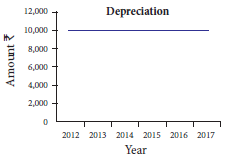
47.
Amount of depreciation per year = \(Original\ cost\ of\ the\ asset − Estimated\ scrap\ value\over Estimated\ useful\ life\ of\ the\ asset\ in\ years\)
\(={1,00,000 – 10,000\over 10}={90,000\over 10}\) = Rs. 9,000 per year
When it is plotted on a graph for 5 years, it appears as follows:
48.
(a) Sales account should be credited with Rs. 100.
(b) Purchases returns account should be debited with Rs. 200.
49.
i) a) Rs.2,000 spent on additions should be treated as capital expenditure
b) Rs.1200 spent on repairs should be treated as revenue expenditure.
ii) Overhauling expenses are incurred for the engine of a motor car to get better fuel efficiency. So this expenditure should be treated as capital expenditure.
50.
(i) Bank reconciliation statement can also be presented in an alternative method.
(ii) In such presentation, two columns are given, one to record items that increase the balance [plus items] and the other one to record items that decrease the balance [minus items].
(iii) Balances as per the cash book or bank statement are written as the starting balance.
51.
(i) After transferring all the ledger account balances, if the trial balance does not tally, steps must be taken to locate and rectify errors.
(ii) If the errors cannot be rectified, then the trial balance is tallied by transferring the difference between the total of debit balances and the total of credit balances to a temporary account called suspense account.
52.
Personal accounts can be classified into natural, artificial and representative personal accounts
53.
Journal Proper is a residuary book which contains record of transactions which do not find a place in the subsidiary books such as cash book, purchases book, sales book, purchases returns book, sales returns book, bills receivable book and bills payable book.

11th Standard Syllabus & Materials
11th Standard
TN 11th Tamil பீடு பெற நில் - செய்யுள் - காவடிச்சிந்து Important Questions And Answers Study Material - QB365 Set A
NEW11th Standard
TN 11th Tamil பீடு பெற நில் - உரைநடை - மலை இடப்பெயர்கள் : ஓர் ஆய்வு Important Questions And Answers Study Material - QB365 Set A
NEW11th Standard
TN 11th Tamil மாமழை போற்றுதும் - துணைப்பாடம் - யானை டாக்டர் Important Questions And Answers Study Material - QB365 Set A
NEW11th Standard
TN 11th Tamil மாமழை போற்றுதும் - செய்யுள் - ஐங்குறுநூறு Important Questions And Answers Study Material - QB365 Set A



Tamilnadu Stateboard 11th Standard Subjects

Maths

Commerce

Economics

Biology

Business Maths and Statistics
Accountancy

Computer Science

Physics

Chemistry
Maths
Biology
Economics
Physics
Chemistry

History
Business Maths and Statistics

Computer Science
Accountancy

Computer Applications
History
Computer Technology
Commerce
Computer Applications
Computer Technology

Tamil

English

French
Tamilnadu Stateboard Standards
