
 100% FREE ACCESS
11th Standard Syllabus & Materials
11th Standard
TN 11th Tamil இயற்கை வேளாண்மை,சுற்றுச்சூழல் -செய்யுள் - மனோன்மணீயம் Important Questions And Answers Study Material - QB365 Set A
NEW11th Standard
TN 11th Tamil என்னுயிர் என்பேன் -துணைப்பாடம் - இசைத்தமிழர் இருவர் Important Questions And Answers Study Material - QB365 Set A
NEW11th Standard
TN 11th Tamil மொழி கலை -செய்யுள் - ஒவ்வொரு புல்லையும் Important Questions And Answers Study Material - QB365 Set A
NEW11th Standard
TN 11th Tamil பீடு பெற நில் - இலக்கணம் - பகுபத உறுப்புகள் Important Questions And Answers Study Material - QB365 Set A
NEW11th Standard
TN 11th Tamil பீடு பெற நில் - துணைப்பாடம் - வாடிவாசல் Important Questions And Answers Study Material - QB365 Set A
NEW11th Standard
TN 11th Tamil பீடு பெற நில் - செய்யுள் - குறுந்தொகை Important Questions And Answers Study Material - QB365 Set A

Published on: 13/12/2019
Operations Research
Download Tamil Nadu 11th Standard Business Maths and Statistics question papers, model tests, one-mark questions, important questions, and public exam papers in PDF format. Free study materials and answer keys for TN State Board students.
Questions + Answers key
Take MCQ Business Maths and Statistics Test
1.
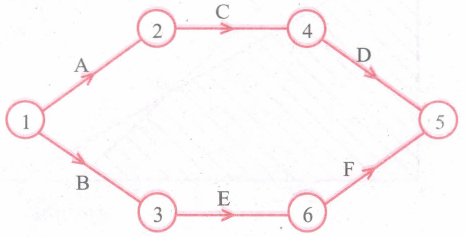
Develop a network based on the following information.
| Activity | A | B | C | D | B | E |
| Immediate Predecessor | - | - | A | C | E | F |
2.
Solve the following LPP graphically, Minimize \(Z=3{ x }_{ 1 }+5{ x }_{ 2 }\)
Subject to the constraints \({ x }_{ 1 }+3{ x }_{ 2 }\ge 3,\quad { x }_{ 1 }+{ x }_{ 2 }\ge 2\quad and\quad { x }_{ 1 },{ x }_{ 2 }\ge 0.\)
3.
Solve the following LPP graphically. Minimize\(Z=-3{ x }_{ 1 }+4{ x }_{ 2 }\)
Subject to the constraints \({ x }_{ 1 }+2{ x }_{ 2 }\le 8\quad ,{ 3x }_{ 1 }+{ 2x }_{ 2 }\le 12\quad and\quad \quad { x }_{ 1 }\ge 0,{ x }_{ 2 }\ge 2.\)
4.
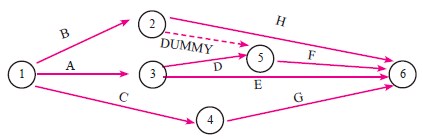
Construct a network diagram for the following situation:
A < D, E; B, D < F; C < G and B < H.
5.
A soft drink company has two bottling plants C1 and C2. Each plant produces three different soft drinks S1, S2 and S3. The production of the two plants in number of bottles per day are:
| Product | Plant | |
| C1 | C2 | |
| S1 | 3000 | 1000 |
| S2 | 1000 | 1000 |
| S3 | 2000 | 6000 |
A market survey indicates that during the month of April there will be a demand for 24000 bottles of S1, 16000 bottles of S2 and 48000 bottles of S3. The operating costs, per day, of running plants C1 and C2 are respectively Rs.600 and Rs.400. How many days should the firm run each plant in April so that the production cost is minimized while still meeting the market demand? Formulate the above as a linear programming model.
6.
The following table use the activities in a building project.
| Activity | 1-2 | 1-3 | 2-3 | 2-4 | 3-4 | 4-5 |
|---|---|---|---|---|---|---|
| Duration (days) | 21 | 26 | 11 | 13 | 5 | 11 |
Draw the network for the project, calculate the earliest start time, earliest finish time, latest start time and latest finish time of each activity and find the critical path. Compute the project duration.
7.
Every gram of wheat provides 0.1 g of proteins and 0.25 g of carbohydrates. The corresponding values of rice are 0.05 g and 0.5 g respectively. Wheat cost Rs.4 per kg and rice cost Rs.6 per kg. The minimum daily requirements of proteins and carbohydrate for an average child are 50 g and 200 g respectively. In what quantities should wheat and rice be mixed in the daily diet to provide minimum daily requirements of proteins and carbohydrate at minimum cost. Frame an LPP and solve it graphically.
8.
A manufacturer makes two types of toys A and B. Three machines are needed for this purpose and the time (min) required for each toy on the machine is given below:
| Type | Machine I | Machine II | Machine III |
| A | 12 | 18 | 6 |
| B | 6 | 0 | 9 |
Each machine is available for a maximum of 6 hours/day. If the profit on each toy of type A is Rs.7.50 and for B is Rs.5. Show that 15 toys of type A and 30 of type B should be manufactured in a day to get maximum profit.
9.
One kind of the cake requires 200 g of flour and 25 g of fat, and another kind of cake requires 100 g of flour and 50 g of fat. Find the maximum number of cakes which can be made from 5 kg of flour and 1 kg of fat assuming that there is no shortage of other ingredients used in making the cakes?
10.
Maximize Z = 3x1 + 4x2 subject to x1 – x2 ≤ –1; –x1 + x2 ≤ 0 and x1, x2 ≥ 0
11.
A producer has 30 and 17 units of labour and capital respectively which he can use to produce two types of goods X and Y. To produce one unit of X, 2 unit of labour and 3 units of capital are required. Similarly, 3 units of labour and 1 unit of capital is required to produce one unit of Y. If X and Yare priced at HOO and H20 per unit respectively, how should the producer use his resources to maximize the total revenue? Formulate the LPP for the above.
12.
A toy company manufactures two types of dolls A and B. Market tests and available resources have indicated that the combined production level should not exceed 1200 dolls per week and the demand for dolls of type B is atmost half of that for dolls of type A. Further, the production level of dolls of type A can exceed three times the production of dolls of other type by at most 600 units. If the company makes profit of n2 and n6 per doll, how many of each should be produced weekly in order to maximize the profit. Formulate the above as mathematical LPP.
13.
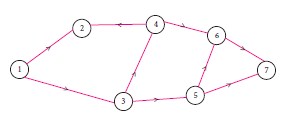
Draw the event oriented network for the following data:
| Events | 1 | 2 | 3 | 4 | 5 | 6 | 7 |
| Immediate Predecessors | - | 1 | 1 | 2,3 | 3 | 4,5 | 5,6 |
14.
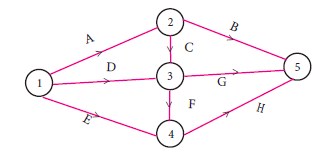
Draw the network for the project whose activities with their relationships are given below:
Activities A, D, E can start simultaneously; B, C > A; G, F > D, C; H > E, F.
15.
Given an L.P.P maximize Z = 2x1 + 3x2 subject to the constrains x1 + x2 ≤ 1, 5x1 + 5x2 ≥ 0 and x1 ≥ 0, x2 ≥ 0 using graphical method, we observe ______.
No feasible solution
unique optimum solution
multiple optimum solution
none of these
16.
In critical path analysis, the word CPM mean ______.
Critical path method
Crash project management
Critical project management
Critical path management
17.
The minimum value of the objective function Z = x + 3y subject to the constraints 2x + y ≤ 20, x + 2y ≤ 20, x > 0 and y > 0 is ______.
10
20
0
5
18.
A solution which maximizes or minimizes the given LPP is called ______.
a solution
a feasible solution
an optimal solution
none of these
19.
In a network while numbering the events which one of the following statement is false?
Event numbers should be unique
Event numbering should be carried out on a sequential basis from left to right
The initial event is numbered 0 or 1
The head of an arrow should always bear a number lesser than the one assigned at the tail of the arrow
1.
Using the immediate precedence relationship and following the rules of network construction, the required network is shown in the diagram.
2.
Since the decision variables are non-negative, the solution lies in the I-quadrant of the plane.Consider the equations
\({ x }_{ 1 }+3{ x }_{ 2 }=3\)
| \({ x }_{ 1 }\) | 0 | 3 |
| \({ x }_{ 2 }\) | 1 | 0 |
\({ x }_{ 1 }+{ x }_{ 2 }=2\)
| \({ x }_{ 1 }\) | 0 | 2 |
| \({ x }_{ 2 }\) | 2 | 0 |
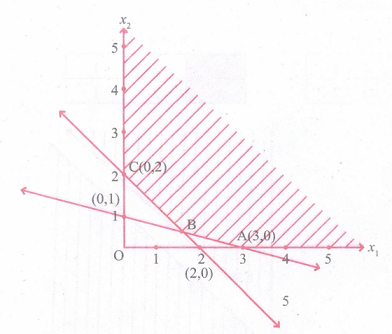
The feasible region is ABC and its co-ordinates are A(3, 0) C(0,2) and B its the point of intersection of the lines
\({ x }_{ 1 }+3{ x }_{ 2 }=3\) ...(1) and \({ x }_{ 1 }+{ x }_{ 2 }=2\) ...(2)
Verification of B:
\((1)\Rightarrow { x }_{ 1 }+3{ x }_{ 2 }=3\)
\( \quad \quad (-)\quad (-)\quad \quad (-)\)
\((2)\Rightarrow { x }_{ 1 }+{ x }_{ 2 }=2\)
\( \quad -----------\)
\(2{ x }_{ 2 }=1\Rightarrow { x }_{ 2 }=\frac { 1 }{ 2 } \)
\( From(2),\ { x }_{ 1 }+\frac { 1 }{ 2 } =2\ \Rightarrow { x }_{ 1 }=2-\frac { 1 }{ 2 } \Rightarrow \frac { 3 }{ 2 } \therefore B\quad is\quad \left( \frac { 3 }{ 2 } ,\frac { 1 }{ 2 } \right) \)
| Corner Points | \(Z=3{ x }_{ 1 }+5{ x }_{ 2 }\) |
|---|---|
| A(3,0) | 9 |
| B\(\left( \frac { 3 }{ 2 } ,\frac { 1 }{ 2 } \right) \) | \(\frac { 9 }{ 2 } +\frac { 5 }{ 2 } =7\) |
| C (0, 2) | 10 |
Minimum of Z occurs at B(3/2, 1/2)
Hence, the solution is x1= 3/2, x2 = 1/2 and Zmin = 7
3.
Since the decision variables are non-negative, the solution lies in the I-quadrant of the plane. Consider the equations
\({ x }_{ 1 }+2{ x }_{ 2 }= 8\)
| \({ x }_{ 1 }\) | 0 | 8 |
| \({ x }_{ 2 }\) | 4 | 0 |
\({ 3x }_{ 1 }+{ 2x }_{ 2 }=12\)
| \({ x }_{ 1 }\) | 0 | 4 |
| \({ x }_{ 2 }\) | 6 | 0 |
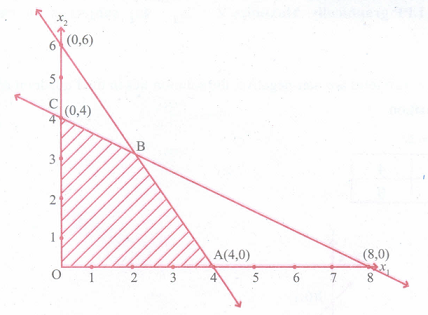
The feasible region is OABC and its co-ordinates are 0(0, 0) A( 4, 0) qo, 4) and B is the point of intersection of the lines
\({ x }_{ 1 }+2{ x }_{ 2 }=8\) ... (1) \(and\quad { 3x }_{ 1 }+{ 2x }_{ 2 }=12\) ...(2)
Verification of B:
\((1)\Rightarrow { x }_{ 1 }+2{ x }_{ 2 }=8\\ \quad \quad (-)\quad (-)\quad \quad (-)\\ (2)\Rightarrow 3{ x }_{ 1 }+2{ x }_{ 2 }=12\\ -----------\\ -2{ x }_{ 1 }=-4 \Rightarrow { x }_{ 1 }=2\)
\(From(1), 2+2{ x }_{ 2 }=8\Rightarrow 2{ x }_{ 2 }=6\Rightarrow { x }_{ 2 }=3\)
∴ B is (2,3)
| Corner Points | \(Z=-3{ x }_{ 1 }+4{ x }_{ 2 }\) |
|---|---|
| O(0,0) | 0 |
| A(4, 0) | -12 |
| B (2, 3) | 6 |
| C(0,4) | 16 |
Minimum of Z occurs at A(4, 0).
Hence, the solution is x1= 4, x2 = 0 and Zmin = - 12.
4.
Using the precedence relationships and following the rules of network construction, the required network is shown in following figure.
5.
(i) Variables: Let x1 be the number of days required to run plant C1 and x2 be the number of days required to run plant C2
Objective function: Minimize Z = 600 x1 + 400 x2
(ii) Constraints: 3000 x1 + 1000 x2 ≥ 24000 (since there is a demand of 24000 bottles of drink A, production should not be less than 24000)
1000 x1 + 1000 x2 ≥ 16000
2000 x1 + 6000 x2 ≥ 48000
(iii) Non-negative restrictions: Since be the number of days required of a firm are non-negative, we have x1, x2 ≥ 0
Thus we have the following LP model.
Minimize Z = 600 x1 + 400 x2
subject to 3000 x1 + 1000 x2 ≥ 24000
1000 x1 + 1000 x2 ≥ 16000
2000 x1 + 6000 x2 ≥ 48000 and x1, x2 ≥ 0
6.
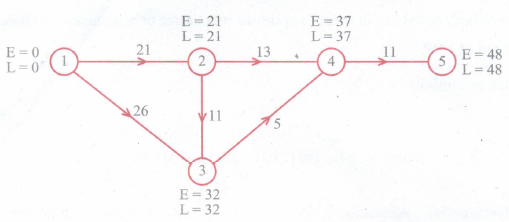
| E1= 0 | L5= 48 |
| E2= 0+21=21 | L4= 48 -11 = 37 |
| E3 =(21 + 11) or (0 + 26) Whichever is maximum =32 |
L3= 37 - 5 = 32 |
| E4= (32 + 5) or (21 + 13) =Whichever is maximum = 37 |
L2= (37 - 13) or (32 - 11) Whichever is minimum =21 |
| E5=37 + 11 = 48 | L1=(21 - 21) or (32 - 26) Whichever is minimum = 0 |
| Activity | Duration | EST | EFT = EST + tij | EFT = EST - tij | LFT |
|---|---|---|---|---|---|
| 1-2 | 21 | 0 | 21 | 21-21=0 | 21 |
| 1-3 | 26 | 0 | 26 | 32-26=6 | 32 |
| 2-3 | 11 | 21 | 32 | 32-11=21 | 32 |
| 2-4 | 13 | 21 | 34 | 37-13=24 | 37 |
| 3-4 | 5 | 32 | 37 | 37-5=32 | 37 |
| 4-5 | 11 | 37 | 48 | 48-11=37 | 48 |
EFT and LFT are same in the activities.
1 - 2, 2 - 3, 3 - 4 and 4 - 5
Hence, the critical path is 1 - 2 - 3 - 4 - 5 and the duration of project completion is 48 days .
7.
Let x1 g of wheat and x2 g of rice be mixed in the daily diet. Let Z be the minimum cost of diet.
| Proteins | Carbohydrates | Cost | |
|---|---|---|---|
| 1 g of Wheat | 0.1 g | 0.25 g | Rs.4/kg |
| 1 g of Rice | 0.05 g | 0.5 g | Rs.6/kg |
| Minimum Requirement |
50 g | 200 g |
Thus, the mathematical formulation of the LPP
Minimize \(Z=\frac { 4{ x }_{ 1 } }{ 1000 } +\frac { 6{ x }_{ 2 } }{ 1000 } \quad \Rightarrow \quad Z=\frac { { x }_{ 1 } }{ 250 } +\frac { 3{ x }_{ 2 } }{ 500 } \)
Subject to the constraints
\(0.1{ x }_{ 1 }+0.05{ x }_{ 2}\ge 50 \Rightarrow 2{ x }_{ 1 }+{ x }_{ 2 }\ge 1000\)
\( 0.25{ x }_{ 1 }+0.5{ x }_{ 2\quad }\ge 200 \Rightarrow { x }_{ 1 }+2{ x }_{ 2 }\ge 800\)
\(and\ { x }_{ 1 },{ x }_{ 2 }\ge 0\)
Consider the equation
\(2{ x }_{ 1 }+{ x }_{ 2 }= 1000\)
| \({ x }_{ 1 }\) | 0 | 500 |
| \({ x }_{ 2 }\) | 1000 | 0 |
\({ x }_{ 1 }+2{ x }_{ 2 }= 800\)
| \({ x }_{ 1 }\) | 0 | 500 |
| \({ x }_{ 2 }\) | 1000 | 0 |
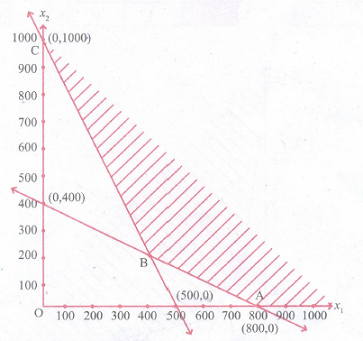
The feasible region is ABC an its co-ordinates are A(800, 0), C(0, 1000) and B is the point of intersection of the lines 2x1+ x2 = 1000 ... (1) x1+ 2x2 = 800 ... (2)
Verification of B:
\(\Rightarrow (1)\times 2 4{ x }_{ 1 }+2{ x }_{ 2 }=2000\)
\(\quad (-)\quad (-)\quad \quad (-)\)
\(\Rightarrow (2) 15{ x }_{ 1 }+6{ x }_{ 2 }=30 \Rightarrow { x }_{ 1 }=400\)
\(--------------\)
Substracting, \(3{ x }_{ 1 }=2000\)
From (2), \(\quad 400+2{ x }_{ 2 }=800\)
\(2{ x }_{ 2 }=400\quad \Rightarrow \quad { x }_{ 2 }=200\)
| Corner Points | \( Z=\frac { { x }_{ 1 } }{ 250 } +\frac { 3{ x }_{ 2 } }{ 500 } \) |
|---|---|
| A(800,0) | \(\frac { 800 }{ 250 } =3.2\) |
| B(400, 200) | \(\frac { 400 }{ 250 } +\frac { 600 }{ 500 } =2.8\) |
| C(0,1000) | \(\frac { 3000 }{ 500 } =6\) |
Minimum of Z occurs at B(400, 200). Hence, the solution is x1= 400, x2 = 200 and Zrnin = 2.8
8.
Let x1 toys of type A and x2 toys of type B are produced. Let Z be the maximum profit on two types of toys A and B.
| Type | Machine I | Machine II | Machine III | Profit |
|---|---|---|---|---|
| A | 12 | 18 | 6 | Rs. 7.50 |
| B | 6 | 0 | 9 | Rs. 5 |
| Time available | 6h = 360 min | 6h = 360 min | 6h = 360 min |
Thus, the mathematical formulation of the LPP is maximize Z = 7.50x1 + 5x2
Subject to the constraints
12x1 + 6x2 ≤ 360,18x1 ≤ 360,6x1 + 9x2 ≤ 360,x1,x2 ≥ 0
Consider the equations
12x1 + 6x2 ≤ 360
| \({ x }_{ 1 }\) | 0 | 30 |
| \({ x }_{ 2 }\) | 60 | 0 |
\(18{ x }_{ 1 }=360\)
| x1 | 20 |
\({ 6x }_{ 1 }+9{ x }_{ 2 }=360\)
| \({ x }_{ 1 }\) | 0 | 60 |
| \({ x }_{ 2 }\) | 40 | 0 |
X1 = 20 is a line parallel to x2-axis at a distance of 20 units from it
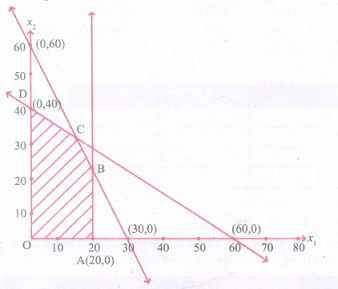
The feasible region is OABCD and its co-ordinates are O(0, 0) A(20, 0) D(0, 40), B is the point of intersection ofthe lines x1 = 20 and 12x1+ 6x2 = 360
\(\Rightarrow 2{ x }_{ 1 }+{ x }_{ 2 }=60\)
\(\Rightarrow 40+{ x }_{ 2 }=60\)
\( \Rightarrow { x }_{ 2 }=20\)
Verification of Band C:
\(\therefore \quad B\quad (20,20)\)
And C is the point of intersection of the lines
\(2{ x }_{ 1 }+{ x }_{ 2 }=60...(1)\)
\( (-)\quad \quad (-)\quad \quad (-)\)
\(2{ x }_{ 1 }+3{ x }_{ 2 }=120 \left[ \because \quad 6{ x }_{ 1 }+{ 9x }_{ 2 }=360 \right] ...(2)\)
\(-------------\)
\( -2x_{ 2 }=-60 \Rightarrow { x }_{ 2 }=30\)
\(2{ x }_{ 1 }+30=60 [\because \quad From\quad (1)] \Rightarrow { x }_{ 1 }=\frac { 30 }{ 2 } =15\)
\( \therefore \quad C\quad is\quad (15,30)\)
| Corner Points | Z = 7.5x1 + 5x2 |
|---|---|
| O(0,0) | 0 |
| A(20,0) | 150 |
| B(20, 20) | 250 |
| C(15,30) | 262.5 |
| D(0, 40) | 200 |
Maximum of Z occurs at (15,30)
Hence, the solution is x1 = 15, x2 = 30 and Zmax= 262.5
9.
Let x1cakes of the one kind and x2 cakes of another kind are made. Let Z be the maximum number of cakes
| Ingredients | x1(g) | x2(g) | Total (kg) |
| Flour | 200 | 100 | 5 |
| Fat | 25 | 50 | 1 |
Thus, the mathematical formulation of the LPP is Maximize Z = x1+ x2
Subject to the constraints
\(200{ x }_{ 1 }+100{ x }_{ 2 }\le 5000\)
\(25{ x }_{ 1 }+50{ x }_{ 2 } \le 1000\)
\({ x }_{ 1 },{ x }_{ 2 }\ge 0\)
Consider the equations
\(200{ x }_{ 1 }+100{ x }_{ 2 }= 5000\)
| \({ x }_{ 1 }\) | 0 | 25 |
| \({ x }_{ 2 }\) | 50 | 0 |
\(25{ x }_{ 1 }+50{ x }_{ 2 }=1000\)
| \({ x }_{ 1 }\) | 0 | 25 |
| \({ x }_{ 2 }\) | 50 | 0 |
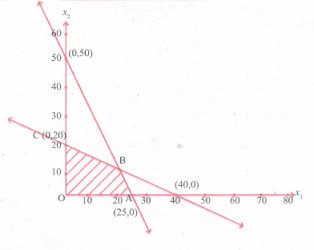
The feasible region is OABC and its co-ordinates are O(0, 0) A(25, 0) C(O, 20) and B is the point of intersection of the lines
200x1 + 100x2 = 1000 .... (1)
and 25x1 + 50x2 = 1000 ... (2)
Verification of B:
\((1) \Rightarrow 200{ x }_{ 1 }+100{ x }_{ 2 }=5000\)
\( (-)\quad \quad \quad (-)\quad \quad (-)\)
\( (2)\times 5\Rightarrow 50{ x }_{ 1 }+100{ x }_{ 2 }=2000\)
\(------------------\)
\(150x_{ 1 }=3000 \Rightarrow { x }_{ 1 }=20\)
\(From(2), 25(20)+50{ x }_{ 2 }=1000\Rightarrow 500+50{ x }_{ 2 }=1000 \Rightarrow 50{ x }_{ 2 }=500\)
\(\Rightarrow { x }_{ 2 }=10\)
\(\therefore B\ is\ (20,10)\)
| Corner Points | Z=x1 +x2 |
|---|---|
| O(0,0) | 0 |
| A(25, 0) | 25 |
| B(20, 10) | 30 |
| C(0,20) | 20 |
Maximum of Z occurs at B(20, 10)
Hence, the solution is x1 = 20, x2 = 10 and Zmax = 30.
10.
Since both the decision variables x1, x2 are non-negative, the solution lies in the first quadrant of the plane.
Consider the equations x1 – x2 = –1 and – x1 + x2 = 0
x1 – x2 = –1 is a line passing through the points (0,1) and (–1,0)
–x1 + x2 = 0 is a line passing through the point (0,0)
Now we draw the graph satisfying the conditions x1 – x2 ≤ –1; –x1 + x2 ≤ 0 and x1, x2 ≥ 0
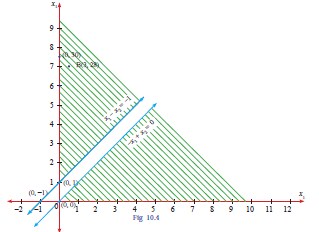
There is no common region(feasible region) satisfying all the given conditions. Hence the given LPP has no solution.
11.
(i) Variables:
Let x1, x2 represent the number of units of X and Y.
(ii) Constraints:
| Labour | Capital | |
|---|---|---|
| X | 2 | 3 |
| Y | 3 | 1 |
∴ 2x1 + 3x2 ≤ 30 and 3x1 + x2 ≤ 17
(iii) Non-negative restrictions:
Since the number of units of X and Y cannot be negative,x1, x2 ≥ 0.
Hence, the mathematical formulation of the LPP is maximize \(Z=100{ x }_{ 1 }+120{ x }_{ 2 }\)
Subject to the constraints
\( { 2x }_{ 1 }+3{ x }_{ 2 }\le 30\)
\({ 3x }_{ 1 }+{ x }_{ 2 }\le 17\)
and x1, x2 ≥ 0.
12.
(i) Variables:
Let x1, x2 represent the dolls of A and B produced in a week.
(ii) Objective function:
Let Z be the total profit in a week.
\(\therefore Z={ 12x }_{ 1 }+16{ x }_{ 2 }\)
Since we have to maximize the profit, we have maximize \(Z={ 12x }_{ 1 }+16{ x }_{ 2 }\)
(iii) Constraints:
\({ x }_{ 1 }+{ x }_{ 2 } \le 2000\)
\({ x }_{ 1 }-{ 2x }_{ 2 }\ge 0\)
\( { x }_{ 1 }-{ 3x }_{ 2 }\le 600\)
(iv) Non-negative restictions:
Since the number of dolls on type A and B cannot be negative, we have \({ x }_{ 1 },{ x }_{ 2 }\ge 0\)
Hence, the mathematical formation of LPP is
Maximize \(Z={ 12x }_{ 1 }+16{ x }_{ 2 }\)
Subject to the constraints
\({ x }_{ 1 }+{ x }_{ 2 } \le 2000\)
\({ x }_{ 1 }-{ 2x }_{ 2 }\ge 0\)
\( { x }_{ 1 }-{ 3x }_{ 2 }\le 600\)
and x1, x2 ≥ 0.
13.
Using the immediate precedence relationships and following the rules of network construction the required network is shown in the following figure
14.
The required network for the above information.
15.
Since there is no common area between the lines x1 + x2 ≤ 1 and 5x1 + 5x2 ≥ 0
16.
(a)
Critical path method
17.
| 2x | + | y | = | 20 | x | + | y | = | 20 | |
| x | 0 | 10 | x | 0 | 20 | |||||
| y | 20 | 0 | y | 20 | 0 |
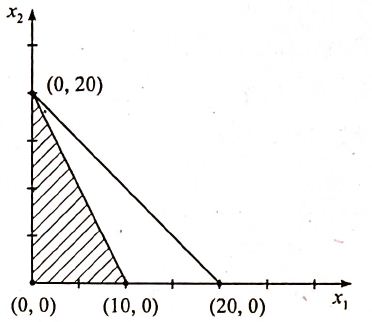
| Corner points | Z = x + 3y |
| (0, 0) | 0 |
| (0, 20) | 60 |
| (10, 0) | 10 |
18.
(c)
an optimal solution
19.
(d)
The head of an arrow should always bear a number lesser than the one assigned at the tail of the arrow

11th Standard Syllabus & Materials
11th Standard
TN 11th Tamil பீடு பெற நில் - செய்யுள் - காவடிச்சிந்து Important Questions And Answers Study Material - QB365 Set A
NEW11th Standard
TN 11th Tamil பீடு பெற நில் - உரைநடை - மலை இடப்பெயர்கள் : ஓர் ஆய்வு Important Questions And Answers Study Material - QB365 Set A
NEW11th Standard
TN 11th Tamil மாமழை போற்றுதும் - துணைப்பாடம் - யானை டாக்டர் Important Questions And Answers Study Material - QB365 Set A
NEW11th Standard
TN 11th Tamil மாமழை போற்றுதும் - செய்யுள் - ஐங்குறுநூறு Important Questions And Answers Study Material - QB365 Set A



Tamilnadu Stateboard 11th Standard Subjects

Maths

Commerce

Economics

Biology
Business Maths and Statistics

Accountancy

Computer Science

Physics

Chemistry
Maths
Biology
Economics
Physics
Chemistry

History
Business Maths and Statistics

Computer Science
Accountancy

Computer Applications
History
Computer Technology
Commerce
Computer Applications
Computer Technology

Tamil

English

French
Tamilnadu Stateboard Standards
