
 100% FREE ACCESS
11th Standard Syllabus & Materials
11th Standard
TN 11th Tamil இயற்கை வேளாண்மை,சுற்றுச்சூழல் -செய்யுள் - மனோன்மணீயம் Important Questions And Answers Study Material - QB365 Set A
NEW11th Standard
TN 11th Tamil என்னுயிர் என்பேன் -துணைப்பாடம் - இசைத்தமிழர் இருவர் Important Questions And Answers Study Material - QB365 Set A
NEW11th Standard
TN 11th Tamil மொழி கலை -செய்யுள் - ஒவ்வொரு புல்லையும் Important Questions And Answers Study Material - QB365 Set A
NEW11th Standard
TN 11th Tamil பீடு பெற நில் - இலக்கணம் - பகுபத உறுப்புகள் Important Questions And Answers Study Material - QB365 Set A
NEW11th Standard
TN 11th Tamil பீடு பெற நில் - துணைப்பாடம் - வாடிவாசல் Important Questions And Answers Study Material - QB365 Set A
NEW11th Standard
TN 11th Tamil பீடு பெற நில் - செய்யுள் - குறுந்தொகை Important Questions And Answers Study Material - QB365 Set A

Published on: 14/12/2019
Gaseous State
Download Tamil Nadu 11th Standard Chemistry question papers, model tests, one-mark questions, important questions, and public exam papers in PDF format. Free study materials and answer keys for TN State Board students.
Questions + Answers key
Take MCQ Chemistry Test
1.
When the gas behaves ideally, the compression factor Z is ___________
> 1
< 1
= 0
= 1
2.
Pick the equation that gives you the relationship between molecular mass and density.
\(M=\frac { dRT }{ P } \)
PV = nRT
both (a) & (b)
neither (a) nor (b)
3.
The mathematical expression V\(\infty \) n relates to _____________
Boyle's law
Charles law
Avogadro's hypothesis
Gay Lussac's law
4.
The standard atmospheric pressure is the pressure that supports a column of mercury exactly ___________ high at 0° C at sea level.
760mm
76 cm
both a & b
760 cm
5.
Pressure is _____________
Force/ area
force x Area
Area/ force
Force / area \(\times\) volume
6.
What are ideal and real gases? Out of CO2 and NH3 gases, which is expected to show more deviation from the ideal gas behaviour?
7.
Define inversion temperature.
8.
Give an expression for the diffusion of two gases diffusing at different pressures PA and PB and their molecular weighs.
9.
Use of hot air balloon in meteorological observation is based on which gas law? Explain.
10.
Why should divers never hold their breath while diving?
11.
At what temperature would 4.25 g of oxygen gas O2 exert a pressure of 1.21 atm. in a 2.15 dm3 flask.
12.
If the weather balloon at a pressure 0.0965 atm. at ground level has a volume of 10.0 m3 What will be the pressure at an altitude of 5300 m where its volume is 20.0 m3?
13.
Van der Waals' constant for gas are a = 3.67 atm lit2 mo1-2 b = 0.0408 lit mol-1. Find the critical temperature and critical pressure of the gas.
14.
Find the pressure of 5 mole CI2 gas filled in a 2 litre vessel at 27 °C temperature.
15.
What is meant by Boyle temperature (or) Boyle point? How is it related with compression point?
16.
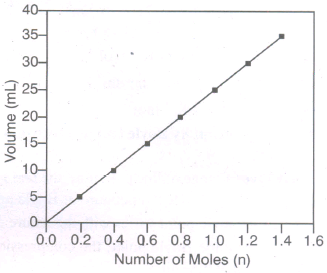
Explain the graphical representation of Avogadro's hypothesis.
17.
A mixture of gases contains 4.76 mole of Ne, 0.74 mole of Ar and 2.5 mole of Xe. Calculate the partial pressure of gases, if the total pressure is 2 atm. at a fixed temperature. Solve this problem using Dalton's law.
18.
Show how the molar volume of a real and ideal gas are related to each other?
19.
Explain the term 'Boyle's point.' Mention is significance.
1.
(d)
= 1
2.
(a)
\(M=\frac { dRT }{ P } \)
3.
(c)
Avogadro's hypothesis
4.
(c)
both a & b
5.
(a)
Force/ area
6.
Ideal gas: A gas that follows Boyle's law, Charles' law and Avogadro law strictly is called an ideal gas. It is assumed that intermolecular forces are not present between the molecules of an ideal gas.
Real gases: Gases which deviate from ideal gas behaviour are known as real gases. NH3 is expected to show more deviation. Since NH3 is polar in nature and it can be liquefied easily.
7.
The temperature below which a gas obeys Joule - Thomson effect is called inversion temperature (Ti). This value is given using van der waals constants a and b.,
\(T_i=\frac{2a}{Rb}\)
8.
When diffusing gases are at different pressures (PA,PB),
\(\frac{r_A}{r_B}=\frac{P_A}{P_B}\sqrt{\frac{M_B}{M_A}}\)
Where rA and rB are the rates of diffusion of A and B and the MA and MB are their respective molecular masses.
9.
Charles law: According to Charles law ,gases expand on heating. Since mass of gas is unchanged, increase in volume decreases density. Thus hot air is less dense than cold air. This causes hot air balloon to rise displacing the cooler air of the atmosphere.
10.
For every 10 m of depth, a diver experiences an additional 1 atm of pressure due to the weight of water surrounding him so the most important rule in diving is never hold breath. Divers must ascend slowly and breathe continuously allowing the regulator to bring the air pressure in their lungs to 1atm by the time they reach the surface.
11.
Mass of oxygen = 4.25 g
No. of moles of oxygen = \(\frac { 4.25 }{ 32 } =0.1328\) moles
Pressure P = 1.21 atm, volume V = 2.15 dm3
According to ideal gas equation
PV = nRT
\(T=\frac { PV }{ nR } =\frac { 1.21\times 2.15 }{ 0.1328\times 0.0821 } \)
\(\because\) R is the gas constant
R = 0.0821 L atm K mol-1
\(=\frac { 2.6015 }{ 0.0109 } =238\quad K\)
12.
Pressure of a gas at ground level P1 = 0.965 atm
Volume of the gas at ground level V1 = 10.0 m3
Volume of the gas at an altitude of 5300m V2 = 20.0 m3
Pressure of the gas at an altitude of 5300 P2 = ?
According to Boyle's law = T1 V1 = P2 V2
0.0965 \(\times\) 10 = P2 \(\times\) 20.0
\({ P }_{ 2 }=\frac { 0.0965\times 10.0 }{ 20.0 } \)
= 0.04825 atm
Pressure of the gas at an altitude of 5300m
P2 = 0.04825 atm
13.
a = 3.67 atm lit2 mol-2
b = 0.0408 lit mol-1
R = 0.0821 atm lit K-1 mol-1
(i) \({ T }_{ c }=\frac { 8a }{ 27Rb } \)
\(=\frac { 8\times 3.67 }{ 27\times 0.082\times 0.0408 } =324.7\quad K\)
Tc = 324.7 K
(ii) \({ P }_{ c }=\frac { a }{ 27{ b }^{ 2 } } \)
\(=\frac { 3.67 }{ 27\times { (0.0408) }^{ 2 } } =81.6\)
Pc = 81.6 atm.
14.
n = 5; V = 2 Iitre;T= 27 + 273 = 300 K
\(P=\frac { nRT }{ V } [\because PV=nRT]\)
\(P=\frac { 5\times 8.314\times 300 }{ 2 } =62.355\quad bar\)
\(\therefore\) The pressure of CI2 gas will be 62.355 bar.
15.
(i) Over a range of low pressures, the real gases can behave ideally at a particular temperature called as Boyle temperature or Boyle point.
(ii) The Boyle point varies with the nature of the gas.
(iii) Above the Boyle point, the compression point Z > 1 for real gases i.e. real gases show positive deviation.
(iv) Below the Boyle point, the real gases first show a decrease for Z, reaches a minimum and then increase with increase in pressure. So, it is clear that at low pressure and at high temperature, the real gases behave as ideal gases.
(v) Hence, \(Z=\frac{PV_{real}}{nRT}\)
\(PV_{ideal}=\frac{nRT}{P}\)
So, \(Z=\frac{V_{real}}{V_{ideal}}\)
16.
Avogadro's hypothesis states that equal volumes of all gases under the same conditions of temperature and pressure contain equal number of molecules.
\(V\propto n\)
\(\frac{V_1}{n_1}=\frac{V_2}{n_2}\) = Constant
Where V1 and n1 are the volume and number of moles of a gas and V2 and n2 are the different set of values of volume and number of moles of the same gas.
A better example to illustrate Avogadro's hypothesis is to observe the effect of pumping more gas into a balloon. When more gas molecules (particularly CO2) are passed, the volume of the balloon increases. The pressure and temperature stay constant as the balloon inflates, so the increase in volume is due to the increase in the quantity of gas inside the balloon.
17.
PNe = XNe PTotal
\(X_{Ne}=\frac{n_{Ne}}{n_{Ne}+n_{Ar}+n_{Xe}}\)
\(=\frac{4.76}{4.76+0.74+2.5}=0.595\)
\(X_{Ar}=\frac{n_{Ar}}{n_{Ne}+n_{Ar}+n_{Xe}}\)
\(=\frac{0.74}{4.76+0.74+2.5}=0.0093\)
\(X_{Xe}=\frac{n_{Xe}}{n_{Ne}+n_{Ar}+n_{Xe}}\)
\(=\frac{2.5}{4.76+0.74+2.5}=0.312\)
PNe = XNe PTotal = 0.595 x 2
= 1.19 atm.
PAr = XAr PTotal = 0.093 x 2
= 0.186 atm.
PXe = XXe PTotal = 0.312 x 2
= 0.624 atm.
18.
\(Z=\frac { { PV }_{ real } }{ nRT } \) ......(1)
\({ V }_{ ideal }=\frac { nRT }{ P } \) ......(2)
Substituting (2) in (1)
\(Z=\frac { { V }_{ real } }{ { V }_{ ideal } } \)
Where Vreal is the molar volume of the real gas and ideal is the molar volume of it when it behaves ideal. i.e. compressibility is the ratio of real volume of the. gas to ideal volume of any gas.
19.
(i) Boyle's point is the temperature at which, real gases behave ideally over a range of low pressures.
(ii) The Boyle point varies with the nature of the gas.
(iii) Above the Boyle point, Z > 1 for real gases. i.e., they show positive deviation.
(iv) Below the Boyle point, the real gases first show a decrease for Z, reaches a minimum and then increase with increase in pressure.

11th Standard Syllabus & Materials
11th Standard
TN 11th Tamil பீடு பெற நில் - செய்யுள் - காவடிச்சிந்து Important Questions And Answers Study Material - QB365 Set A
NEW11th Standard
TN 11th Tamil பீடு பெற நில் - உரைநடை - மலை இடப்பெயர்கள் : ஓர் ஆய்வு Important Questions And Answers Study Material - QB365 Set A
NEW11th Standard
TN 11th Tamil மாமழை போற்றுதும் - துணைப்பாடம் - யானை டாக்டர் Important Questions And Answers Study Material - QB365 Set A
NEW11th Standard
TN 11th Tamil மாமழை போற்றுதும் - செய்யுள் - ஐங்குறுநூறு Important Questions And Answers Study Material - QB365 Set A



Tamilnadu Stateboard 11th Standard Subjects

Maths

Commerce

Economics

Biology

Business Maths and Statistics

Accountancy

Computer Science

Physics
Chemistry
Maths
Biology
Economics
Physics
Chemistry

History
Business Maths and Statistics

Computer Science
Accountancy

Computer Applications
History
Computer Technology
Commerce
Computer Applications
Computer Technology

Tamil

English

French
Tamilnadu Stateboard Standards
