
 100% FREE ACCESS
11th Standard Syllabus & Materials
11th Standard
TN 11th Tamil இயற்கை வேளாண்மை,சுற்றுச்சூழல் -செய்யுள் - மனோன்மணீயம் Important Questions And Answers Study Material - QB365 Set A
NEW11th Standard
TN 11th Tamil என்னுயிர் என்பேன் -துணைப்பாடம் - இசைத்தமிழர் இருவர் Important Questions And Answers Study Material - QB365 Set A
NEW11th Standard
TN 11th Tamil மொழி கலை -செய்யுள் - ஒவ்வொரு புல்லையும் Important Questions And Answers Study Material - QB365 Set A
NEW11th Standard
TN 11th Tamil பீடு பெற நில் - இலக்கணம் - பகுபத உறுப்புகள் Important Questions And Answers Study Material - QB365 Set A
NEW11th Standard
TN 11th Tamil பீடு பெற நில் - துணைப்பாடம் - வாடிவாசல் Important Questions And Answers Study Material - QB365 Set A
NEW11th Standard
TN 11th Tamil பீடு பெற நில் - செய்யுள் - குறுந்தொகை Important Questions And Answers Study Material - QB365 Set A

Published on: 12/11/2019
Download Tamil Nadu 11th Standard Chemistry question papers, model tests, one-mark questions, important questions, and public exam papers in PDF format. Free study materials and answer keys for TN State Board students.
Questions + Answers key
Take MCQ Chemistry Test
1.
Identify the colour formed in the test for phosphorous using ammonium molybdate.
Crimson red colour
Deep violet colour
Prussian blue colour
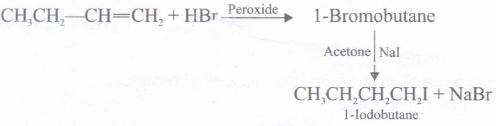
Canary yellow colour
2.
Which of the following is the most stable cycloalkane?
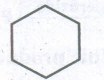


3.
Which of the following compounds will give racemic mixture on nucleophilic substitution by OH- ion?
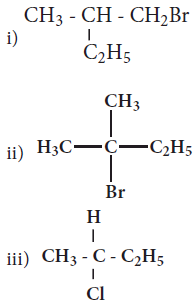
(i)
(ii) and (iii)
(iii)
(i) and (ii)
4.
Peroxide effect (Kharasch effect) can be studied in case of ___________
Oct – 4 – ene
hex – 3 – ene
pent – 1 – ene
but – 2 – ene
5.
The geometrical shape of carbocation is ______________.
Linear
tetrahedral
Planar
Pyramidal
6.
Which one of the following names does not fit a real name?
3 – Methyl –3–hexanone
4–Methyl –3– hexanone
3– Methyl –3– hexanol
2– Methyl cyclo hexanone
7.
The KH for the solution of oxygen dissolved in water is 4\(\times\)104 atm at a given temperature. If the partial pressure of oxygen in air is 0.4 atm, the mole fraction of oxygen in solution is ________
4.6\(\times\)103
1.6\(\times\)104
1\(\times\)10-5
1\(\times\)105
8.
Solubility of carbon dioxide gas in cold water can be increased by ____________
increase in pressure
decrease in pressure
increase in volume
none of these
9.
The ideal gas equation is ____________.
PV = RT for 1 mole
P1V1 = P2V2
\(\frac{P}{T}=R\)
P = P1 + P2 + P3
10.
Law of triad was unable to explain for the element
Ca, Sr and Ba
Fe, Co, Ni
Li, Na, K
Cl, Br, I
11.
An ideal gas expands from the volume of 1 x 10⁻³ m3 to 1 x 10⁻² m3 at 300 K against a constant pressure at 1 x 10⁵ Nm-2. The work done is ______________
- 900 J
900 kJ
270 kJ
-900 kJ
12.
The suspension of slaked lime in water is known as ___________
lime water
quick lime
milk of lime
aqueous solution of slaked lime
13.
Two electrons occupying the same orbital are distinguished by ___________
azimuthal quantum number
spin quantum number
magnetic quantum number
orbital quantum number
14.
Heavy water is used as _________
moderator in nuclear reactions
coolant in nuclear reactions
both (a) and (b)
none of these
15.
40 ml of methane is completely burnt using 80 ml of oxygen at room temperature The volume of gas left after cooling to room temperature is _______.
40 ml CO2 gas
40 ml CO2 gas and 80 ml H2O gas
60 ml CO2 gas and 60 ml H2O gas
120 ml CO2 gas
16.
What is Grignard reagent? How is it prepared from ethyl bromide?
17.
Name the first and the last elements in the following periods (n) .
(i) n=:4
(ii) n = 5
(iii) n = 6
(iv) n = 7
18.
After the execution of the \(\alpha\)-ray scattering experiment, what were the observations made by Rutherford? What did he conclude from his observations?
19.
Write short notes on Deuterium.
20.
Explain intensive properties with two examples
21.
Why sodium hydroxide is much more water soluble than chloride ?
22.
Calculate the molar mass of the following compounds.
Acetone [CH3 COCH3]
23.
Write the equations for the preparation of l-iodobutane from.
24.
0.16 g of an organic compound was heated in a carius tube and H2SO4 acid formed was precipitated with BaCl2. The mass of BaSO4 was 0.35g. Find the percentage of sulphur [30.04]
25.
A 0.25 M glucose solution at 370.28 K has approximately the pressure as blood does what is the osmotic pressure of blood ?
26.
The value of Kc for the reaction
N2O2(g) \(\rightleftharpoons \) 2NO2(g)
27.
How much volume of chlorine is required to form 11.2 L of HCI at 273 K and 1 atm pressure?
28.
Using Aufbau principle, write the ground state electronic configuration of following atoms.
(i) Boron (Z = 5)
(ii) Neon (Z = 10)
(iii) Aluminium (Z = 13)
(iv) Chlorine (Z = 17)
(v) Calcium (Z = 20)
(vi) Rubidium (Z = 37)
29.
Identify processes under the following conditions
(i) dT = 0
(ii) dP = 0
(iii) dV = 0
30.
Noble gases have maximum ionisation energy. Justify.
31.
Why alkaline earth metals are harder than alkali metals.
32.
Would it be easier to drink water with a straw on the top of Mount Everest?
33.
Give the uses of gypsum.
34.
Explain electron movement in organic reactions.
35.
What happens when propene is treated with the following.
(i) H2SO4
(ii) Ozone
(iii) HBr
(iv) Red hot Fe tube
(v) Acidified KMnO4
36.
Explain the nature of non - ideal solution with positive deviation from Raoult,s law.
37.
A laboratory analysis of an organic compound gives the following mass percentage composition: C = 60%, H = 4.48% and remaining oxygen.
38.
In an experiment of verification of Charle's law, the following are the set of readings taken by a student
| Experiment | Volume (L) | Temperature (°C) |
| 1 | 1.54 | 20 |
| 2 | 1.65 | 40 |
| 3 | 1.95 | 100 |
| 4 | 2.07 | 120 |
What is the average value of the constant of proportionality?
39.
Dihydrogen reacts with dioxygen (O2) to form water. Write the name and formula of the product when the isotope of hydrogen which has one proton and one neutron in its nucleus is treated with oxygen. Will the reactivity of both the isotopes be the same towards oxygen? Justify your answer.
40.
Suggest and explain an indirect method to calculate lattice enthalpy of sodium chloride crystal
41.
What is the de Broglie wavelength (in cm) of a 160 g cricket ball travelling at 140 Km hr -1.
42.
By using paulings method calculate the ionic radii of K+ and CI- ions in the potassium chloride crystal. Given that dk+-cl-=3.14 Å.
43.
Distinguish between diffusion and effusion.
1.
(d)
Canary yellow colour
2.
(a)
3.
(c)
(iii)
4.
(c)
pent – 1 – ene
5.
(c)
Planar
6.
(a)
3 – Methyl –3–hexanone
7.
(c)
1\(\times\)10-5
8.
(a)
increase in pressure
9.
(a)
PV = RT for 1 mole
10.
(b)
Fe, Co, Ni
11.
(a)
- 900 J
12.
(c)
milk of lime
13.
(b)
spin quantum number
14.
(c)
both (a) and (b)
15.
(a)
40 ml CO2 gas
16.
When a solution of haloalkane in either is treated with magnesium, we will get alkyl magnesium halide known as Grignard reagent, ethyl magnesium bromide is prepared from ethyl bromide as:
\(\underset { Ethyl \ bromide }{ { CH }_{ 3 }-{ CH }_{ 2 }Br+ } \)Mg \(\underrightarrow { dry \ ether } \)\(\underset { Ethyl \ magnesium \ bromide\\ (or)\\ Grignard \ reagent }{ { CH }_{ 3 }{ CH }_{ 2 }{ MgBr } } \)
17.
| First Element | Last Element | ||
|---|---|---|---|
| (i) | N = 4 | K (4s1) | Kr(4s2 4p6) |
| (ii) | N =5 | Rb(5s1) | Xe(5s25p6) |
| (iii) | N =6 | Cs(6s1) | Rn(6s26P6) |
| (iv) | n =7 | Fr(7x1) | Og(7s27p6) |
18.
| OBSERVATION | CONCLUSION | |
| 1 | Most of the \(\alpha\)-particles passed through the foil | Presence of large empty space in the atom |
| 2. | Few \(\alpha\)-particles were deflected by small angles | Positive charge is concentrated at a very small region and not uniformly distributed in whole atom |
| 3. | Very few \(\alpha\)-particles reflected completely at 180° | Positively charged core is known as nucleus |
19.
1H2 or 1D2 . It occurs naturally in very small traces. It's nucleus consists of a proton, a neutron and one electron revolving around the nucleus. Its chemical properties are similar to those of protium but their reaction rates are different.
20.
The property that is independent of the mass or the size of the system is called an intensive property.
Examples: Refractive index, Surface tension, density, temperature, Boiling point, Freezing point, molar volume, etc.,
21.
The solubility product of NaCl is lower than that of NaOH. The more soluble a substance is, the higher the Ksp value it has In aqueous solution NaOH gives OH- ions. It can be solvated by establishing H-bonds with water molecules. So it is more water soluble.
22.
Mol.mass = 3(C) + 6(H) + 1(0)
= 3(12) + 6(1) + 1(16)
= 36 + 6 + 16 = 58
23.
(i) l-butanol
(ii) I-chlorobutane
(iii) but-l-ene
(i) \(\underset { 1-buanol }{ CH_{ 3 }{ CH }_{ 2 }{ CH }_{ 2 }Cl } \overset { P/{ I }_{ 2 } }{ \longrightarrow } \underset { 1-Iodobutene }{ { CH }_{ 3 }{ CH }_{ 2 }{ CH }_{ 2 }I } \)
(ii) \({ CH }_{ 3 }{ CH }_{ 2 }{ CH }_{ 2 }Cl+Nal\overset { Acetone }{ \longrightarrow } { CH }_{ 3 }{ CH }_{ 2 }{ CH }_{ 2 }I+Nacl\)
(iii)
24.
(w) = 0.16 g
(x) = 0.35 g
\(\% S=\frac{32}{233} \times \frac{x}{\mathrm{w}} \times 100=\frac{32}{233} \times \frac{0.35}{0.16} \times 100=30.04 \%\)
25.
Given : C = 0.25 M
T = 370.28 K
R = 0.0821 L atm mol-1 K-1
\(\pi\) = ?
\(\pi\) = CRT
= 0.25 x 0.0821 x 370.28
= 7.59 atm.
26.
N2O2(g) \(\rightleftharpoons \) 2NO2(g)
Kc = 0.21 at 373 K. The concentrations N2O4 and NO2 are found to be 0.125 mol dm-3 and 0.5 mol dm-3 respectively at a given time. From the above information we can predict the direction of reaction as follows.
\(Q={[NO_2]^2\over [N_2O_4]}={0.5\times 0.5\over 0.125}=2\)
The Q value is greater than Kc. Hence, the reaction will proceed in the reverse direction until the Q value reaches 0.21.
27.
The balanced equation for the formation of HCI is,
H2(g) + CI2(g) \(\rightarrow\) 2 HCI (g)
As per the stoichiometric equation, under given conditions,
To produce 2 moles of HCI, 1 mole of chlorine gas is required.
To produce 44.8 litres of HCI, 22.4 litres of chlorine gas are required.
\(\therefore\) To produce 11.2 litres of HCI,
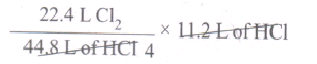
= 5.6 litres of chlorine are required.
28.
(i) Boron (Z = 5) ; 1s2 2s2 2p1
(ii) Neon (Z = 10) ; 1s2 2S22p6
(iii) Aluminium (Z = 13) ;1s2 2S22p6 3s2 3p1
(iv) Chlorine(Z = 17) ; 1s2 2s2 2p6 3s2 3p5
(v) Calcium (Z = 20) ;1s2 2S22p6 3s2 3p6 4s2
(vi) Rubidium (Z = 37) ; 1s2 2s2 2p6 3s2 3p6 3d10 4s2 4p6 5s1
29.
(i) Isothermal process: Isothermal process is defined as one in which the temperature of the system remains constant, during the change from its initial to final states.
For an isothermal process dT = 0
(ii) Isobaric process: Isobaric process is defined as one in which the pressure of the system remains constant during its change from the initial to final state.
For an isobaric process dP = 0.
(iii) Isochoric process: Isochoric process is defined as one in which the volume of system remains constant during its change from initial to final state of the process.
For an isochoric processes dV = 0.
30.
(i) Noble gases have completely filled electronic configuration and are stable.
(ii) It is difficult to remove the electrons from the valence shell. So the ionisation energy is maximum.
31.
Alkali metals have one eo in their outer most shell. Alkaline earth metals have 2 eo in their outer most shell. More valence electrons and more positively charged nucleii leads to greater opportunity for metallic bonding.
32.
It will be more difficult to drink water with a straw on the top of a Mount Everest. This is because the reduced atmospheric pressure is less effective in pushing water up into the straw, below the water surface.
The force that propels water through a straw is atmospheric pressure, which is less at high altitude.
33.
1. Gypsum is used in making drywalls or plaster boards.
2. Another important use of gypsum is the production of plaster of Paris. Gypsum is heated to about 300 degree Fahrenheit to produce plaster of paris, which is also known as gypsum plaster. It is mainly used as a sculpting material.
3. Gypsum is used in making surgical and orthopedic casts, such as surgical splints and casting moulds.
4. Gypsum plays an important role in agriculture as a soil additive, conditioner, and fertilizer. It helps loosen up compact or clay soil, and provides calcium and sulphur, which are essential for the healthy growth of a plant.
5. Gypsum is used in toothpastes, shampoos, and hair products.
6. Gypsum is a component of portland cement, where it acts as a hardening retarder to control the speed at which concrete sets.
34.
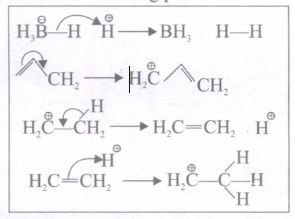
All organic reactions can be understood by following the electron movements.
(i) Lone pair becomes a bonding pair.
(ii) Bonding pair becomes a lone pair.
(iii) A bond breaks and becomes another bond.
The electron movement depends on the nature of the substrate, reagent and the prevailing conditions.
Type 1.A lone pair to a bonding pair
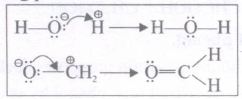
Type 2. A bonding pair to a lone pair
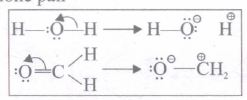
Type 3. A bonding pair to an another bonding pair
35.
(i) CH3-CH = CH2 + H2SO4 \(\rightarrow\) \({ CH }_{ 3 }-\underset { \overset { | }{ OSO_{ 2 } } OH }{ CH } -{ CH }_{ 3 }\overset { { H }_{ 2 }O }{ \longrightarrow } \) \({ CH }_{ 3 }-\underset { \overset { | }{ OH } }{ CH-{ CH }_{ 3 } } +{ H }_{ 2 }{ SO }_{ 4 }\)
2-Propyl hydrogen sulphate 2-proponel
(ii) 
(iii) CH3 - CH = CH2 + HBr \(\overset { Peroxide }{ \underset { ({ C }_{ 6 }{ H }_{ 5 }CO)_{ 2 }{ O }_{ 2 } }{ \longrightarrow } } \) CH3 - CH2 - CH2 - Br
1-Bromopropane
(iv) nCH3 - CH = CH2 \(\overset { Reol\ Hot\ Fe\ Tube }{ \underset { 873\ K }{ \longrightarrow } } \)\({ \left[ \underset { \overset { | }{ { CH }_{ 3 } } }{ \sim \sim CH } -CH_{ 2 }\sim \sim \right] }_{ n }\)
Polypropene
(v) \({ CH }_{ 3 }-\overset { \underset { | }{ { CH }_{ 3 } } }{ C } ={ CH }_{ 2 }\overset { KMn{ O }_{ 4 }/{ H }^{ + } }{ \underset { -{ CO }_{ 2 },-{ H }_{ 2 }O }{ \longrightarrow } } { CH }_{ 3 }-\overset { \underset { | }{ { CH }_{ 3 } } }{ C } =O\)
2-methyl prop-1-ene Propan-2-one
36.
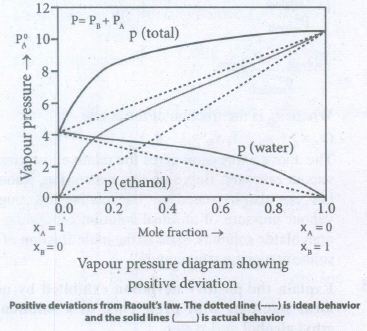
The nature of the deviation from the Rauolt's law can be explained in terms of the intermolecular interactions between solute (A) and solvent (B). Consider a case in which the intermolecular attractive forces between A and B are weaker than those between the molecules of A (A - A) and molecules of B (B - B). The molecules present in such a solution have a greater tendency to escape from the solution when compared to the ideal solution formed by A and B, in which the intermolecular attractive forces (A - A, B - B, A - B) are almost similar. Consequently, the vapour pressure of such non-ideal solution increases and it is greater than the sum of the vapour pressure of A and B as predicted by the Raoult's law. This type of deviation is called positive deviation.
Here, \({ p }_{ A }>{ p }_{ A }^{ 0 }{ x }_{ A }\) and \({ p }_{ B }>{ p }_{ A }{ x }_{ B }\)
Hence \({ p }_{ total }>{ p }_{ A }^{ 0 }{ x }_{ A }+{ p }_{ B }^{ 0 }{ x }_{ B }\)
Letus understand the positive deviation by considering a solution of ethyl alcohol and water. In this solution the hydrogen bonding interaction between ethanol and water is weaker than those hydrogen bonding interactions amongst themselves (ethyl alcohol-ethyl alcohol and water-water interactions). This results in the increased evaporation of both components from the aqueous solution of ethanol. Consequently, the vapour pressure of the solution is greater than the vapour pressure predicted by Raoult's law. Here, the mixing process is endothermic i.e. \(\triangle\)Hmixing > 0 and there will be a slight increase in volume (\(\triangle\)Vmixing > 0).
Examples for non - ideal solutions showing postive deviations:
Ethyl alcohol & cyclohexane, Benzene & acetone, Carbon tetrachloride & chloroform, Acetone & ethyl alcohol, Ethyl alcohol & water.
37.
| Element | Percentage | Atomic mass | Relative No. of atoms | Simple ratio of atoms | Simplest whole number ratio |
|---|---|---|---|---|---|
| C | 60% | 12 | \(\frac{60}{12}=4.99\) | \(\frac{4.99}{2.22}=2.25\times\frac{9}{4}\) | 9 |
| H | 4.48% | 1 | \(\frac{4.48}{1}=4.48\) | \(\frac{4.48}{2.22}=2.02\times 4\) | 8 |
| O | 35.53% | 16 | \(\frac{35.53}{16}=2.22\) | \(\frac{2.22}{2.22}=1\times 4\) | 4 |
\(\therefore\) The empirical formula is C9H8O4.
38.
According to charles law
\(\frac { { V }_{ 1 } }{ { T }_{ 1 } } =\frac { 1.54 }{ 293 } \)
= 0.0052
T1 = 20 C + 273 = 293 K
T2 = 40°C
\(\frac { { V }_{ 2 } }{ { T }_{ 2 } } =\frac { 1.65 }{ 40+273 } =\frac { 1.65 }{ 313 } =0.0052\)
T3 = 100°C + 273 = 373 K
\(\frac { { V }_{ 3 } }{ { T }_{ 3 } } =\frac { 1.95 }{ 373K } =0.0052\)
T4 = 120°C+273 = 393 K
\(\frac { { V }_{ 4 } }{ { T }_{ 4 } } =\frac { 2.07 }{ 393 } =0.0052\)
The average value of constant of proportionality is 0.0052.
39.
2H2 + O2 ➝ 2H2O
The isotope of hydrogen which has one proton and one neutron in its nucleus is Deuterium.
2D2 + O2 ➝ 2D2O
The product is heavy water (Deuterium oxide). H2O and D2O have same chemical properties but the
reaction velocity of D2O is slightly less due to the difference in the mass number of the isotopes known as isotopic effect. Deuterium is heavier than protium so reacts slowly.
40.
Let us use the Born - Haber cycle for determining the lattice enthalpy of NaCl as follows:
Since the reaction is carried out with reactants in elemental forms and products in their standard states, at 1 bar, the overall enthalpy change of the reaction is also the enthalpy of formation for NaCl. Also, the formation of NaC1 can be considered in 5 steps. The sum of the enthalpy changes of these steps is equal .to the enthalpy change for the overall reaction from which the lattice enthalpy of NaCl is calculated.
Let us calculate the lattice energy of sodium chloride using Born-Haber cycle
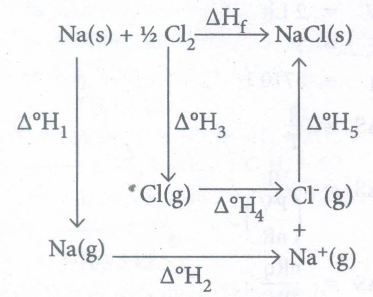
Δ°Hf = heat of formation of sodium chloride
= - 411.3 kJ mol-1
Δ°H1= heat of sublimation ofNa(S) = 108.7 kJ mol-1
Δ°H2 = ionisation energy ofNa(S) = 495.0 kJ mol-1
Δ°H3= dissociation energy ofCI2(S) = 244 kJ mol-1
Δ°H4= Electron affinity ofCl(S) = - 349.0 kJ mol-1
Δ°Hf = Δ°H1+Δ°H2+1/2Δ°H3+Δ°H4+Δ°H5
Δ°H5=(Δ°Hf )-( Δ°H1+Δ°H2+1/2Δ°H3+Δ°H4)
⇒Δ°H5 = (-411.3)-(108.7+495.0+ 122-349)
Δ°H5= (-411.3)-(376.7)
∴ Δ°H5 = -788 kJ mol-1
This negative sign in lattice energy indicates that the energy is released when sodium is formed from its constituent gaseous ions Na+ and Cl-
41.
m 160 g = 160 x 10-3 kg
\(v=140 km hr^{-1}=\frac{104\times10^{3}}{60\times60}ms^{-1}\)
\(v=38.88ms^{-1}\)
\(\lambda=\frac{h}{mv}\)
\(=\frac{6.626\times^{-34}Kgm^{2}s^{-1}}{160\times10^{-3}Kg\times38.88ms^{-1}}\)
\(\lambda=1.065\times10^{-34}m\)
42.
r(K+)+r(Cl-) = d(K+-Cl-) = 3.14 Å.
The effective nuclear charge for K+ and CI- can be calculated as follows.
K+ = (1s2) (2s22p6) (3s23p6)
inner shell (n-1)th shell nth shell
Z*(K-) = Z-S
= 19 - [(0.35 x 7) + (0.85 x 8) + (1 x 2)]
= 19 - 11.25 = 7.75
Z*(Cl-) = 17- [(0.35 x 7) + (0.85 x 8) + (1 x 2)]
= 17-11.25 = 5.75
∴ \(\frac { r({ K }^{ + }) }{ r(Cl^{ - }) } =\frac { Z*(Cl^{ - }) }{ Z*(K^{ + }) } =\frac { 5.75 }{ 7.75 } \)=0.74
∴ r(K+) = 0.74 r(Cl-)
Substitute (2) in (1)
0.74 r(Cl-) + r(Cl-) = 3.14 Å.
1.74 r(Cl-) = 3.14 Å
r(Cl-) = \(\frac { 3.14\overset { 0 }{ A } }{ 1.74 } \)=1.81.Å.
43.
| S.NO | diffusion | effusion |
| 1 | It is the spreading of molecules of a substance throughout a space or second substance | It is the escape of the gas molecules through a very small hole (orifice) in a membrane into an evacuated area. |
| 2 | It is typically used to describe statistical properties of a gas at length scales that are much larger than mean free path. | The diameter of the hole should be smaller than mean free path of the molecules. |
| 3 | It is the spreading of gases. | It is the pouring out of gases. |

11th Standard Syllabus & Materials
11th Standard
TN 11th Tamil பீடு பெற நில் - செய்யுள் - காவடிச்சிந்து Important Questions And Answers Study Material - QB365 Set A
NEW11th Standard
TN 11th Tamil பீடு பெற நில் - உரைநடை - மலை இடப்பெயர்கள் : ஓர் ஆய்வு Important Questions And Answers Study Material - QB365 Set A
NEW11th Standard
TN 11th Tamil மாமழை போற்றுதும் - துணைப்பாடம் - யானை டாக்டர் Important Questions And Answers Study Material - QB365 Set A
NEW11th Standard
TN 11th Tamil மாமழை போற்றுதும் - செய்யுள் - ஐங்குறுநூறு Important Questions And Answers Study Material - QB365 Set A



Tamilnadu Stateboard 11th Standard Subjects

Maths

Commerce

Economics

Biology

Business Maths and Statistics

Accountancy

Computer Science

Physics
Chemistry
Maths
Biology
Economics
Physics
Chemistry

History
Business Maths and Statistics

Computer Science
Accountancy

Computer Applications
History
Computer Technology
Commerce
Computer Applications
Computer Technology

Tamil

English

French
Tamilnadu Stateboard Standards
