
 100% FREE ACCESS
11th Standard Syllabus & Materials
11th Standard
TN 11th Tamil இயற்கை வேளாண்மை,சுற்றுச்சூழல் -செய்யுள் - மனோன்மணீயம் Important Questions And Answers Study Material - QB365 Set A
NEW11th Standard
TN 11th Tamil என்னுயிர் என்பேன் -துணைப்பாடம் - இசைத்தமிழர் இருவர் Important Questions And Answers Study Material - QB365 Set A
NEW11th Standard
TN 11th Tamil மொழி கலை -செய்யுள் - ஒவ்வொரு புல்லையும் Important Questions And Answers Study Material - QB365 Set A
NEW11th Standard
TN 11th Tamil பீடு பெற நில் - இலக்கணம் - பகுபத உறுப்புகள் Important Questions And Answers Study Material - QB365 Set A
NEW11th Standard
TN 11th Tamil பீடு பெற நில் - துணைப்பாடம் - வாடிவாசல் Important Questions And Answers Study Material - QB365 Set A
NEW11th Standard
TN 11th Tamil பீடு பெற நில் - செய்யுள் - குறுந்தொகை Important Questions And Answers Study Material - QB365 Set A

Published on: 19/08/2019
Joint Stock Company
Download Tamil Nadu 11th Standard Commerce question papers, model tests, one-mark questions, important questions, and public exam papers in PDF format. Free study materials and answer keys for TN State Board students.
Questions + Answers key
Take MCQ Commerce Test1.
If the issue price of the share is less than the face value, it is______________.
share discount
share premium
over subscription
minimum subscription
2.
Where the shares are issued at a discount and the nominal value of share is Rs.100 the maximum discount that can be allowed is ____________
Rs.5
Rs.10
Rs.20
Rs.15
3.
Shares can be forfeited for________.
non-payment of any debt due to the company
not attending three annual general meetings consecutively
for non-payment of call money
for violent activities at the annual general meetings
4.
A preference share has priority in_____________.
dividend only
only in return of capital at the time of winding up
voting rights
Both dividend and return of capital on winding up
5.
Registration of a Joint Stock Company is ________
Compulsory
Optional
Compulsory for Public Limited Companies and Optional for Private Limited Companies
Optional for Public Limited Companies and compulsory for Private Limited Companies.
6.
__________ in a Company are freely transferable.
Members
Shares
Both
None of these
7.
A _________ is a distinct legal entity.
Company
Organisation
Business
None of these
8.
Companies established as a result of a charter granted by the King or Queen of a country is called ____________
Chartered companies
Statutory companies
Registered companies
Foreign companies
9.
The Board of directors of a company is elected by _________
Creditors
Debtors
Debenture holders
Shareholders (members)
10.
What is the Significance of the common seal of the Company?
11.
What does the Articles of Association deal with?
12.
What is meant by Chartered Company?
13.
14.
What are the different types of companies?
15.
What do you mean by Domestic Companies?
16.
What is Articles of Association?
17.
What is Memorandum of Association?
18.
What is meant by Foreign Company?
19.
What are the advantages of Companies?(Any 3)
20.
Enumerate the advantages of company.(Any five).
21.
What is meant by Holding and Subsidiary company?
22.
What is meant by Multi National Company?
1.
(a)
share discount
2.
(b)
Rs.10
3.
(c)
for non-payment of call money
4.
(d)
Both dividend and return of capital on winding up
5.
(a)
Compulsory
6.
(b)
Shares
7.
(a)
Company
8.
(a)
Chartered companies
9.
(d)
Shareholders (members)
10.
(i) Though the separate personality of the Company is legally recognised, it needs the human agency to Act.
(ii) Obviously it cannot sign.
(iii) Any contract entered into by a Company, to be valid, must bear the official seal of the Company.
11.
(i) Articles of Association is a supplementary document to be prepared by a Joint Stock Company.
(ii) It contains the rules and regulations for the Internal functioning of the Company.
12.
Chartered companies are established by the King or Queen of a country. Powers and privileges of chartered company are specified in the charter. Power to cancel the charter is vested with King/Queen. Examples: East Indian Company, Bank of England, Hudson's Bay Company. The Companies Act does not apply to them. Such companies cannot be started in India.
13.
14.
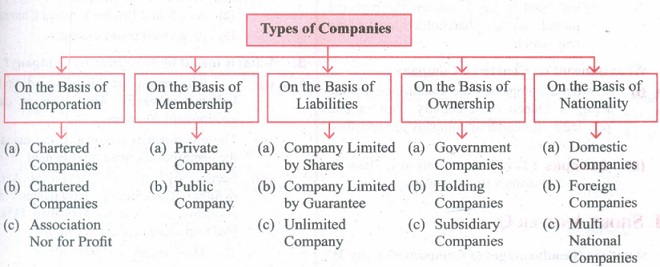
Chartered company, statutory company, public limited company, private limited company and government company are some of the different types of Companies.
15.
Domestic Company means an Indian Company, or any other company which, in respect of its income liable to tax under the act, has made the prescribed arrangements for the declaration and payment, within India, of the dividends (including dividends on preference shares) payable out of such income.
16.
(i) The Articles of Association (AOA) is a document that contains the purpose of the company as well as the duties and responsibilities of its members.
(ii) It is an important document which needs to be filed with the Registrar of Companies.
(iii) In the Companies Act, Table A Prescribes model for the articles of the companies. Table A is a document containing rules and regulations for the internal management of a company.
17.
(i) A Memorandum of Association (MOA) is a legal document prepared in the formation and registration process of a limited liability company to define its relationship with shareholders.
(ii) It reveals what powers it has and what activities the company is permitted to undertake.
(iii) It is a public document and any person dealing with the company is presumed to have sufficient knowledge of it. It is the primary document of a company.
18.
A foreign company means a company which is incorporated in a country outside India under the law of that country. After the establishment of business in India, the following documents must be filed with the Registrar of Companies within 30 days from the date of establishment.
1. A certified copy of the charter or statutes under which the company is incorporated, or the Memorandum and articles of the company translated into English.
2. The full address of the registered office of the company.
3. A list of directors and secretary of the company.
4. The name and address of any person resident of India who is authorised to accept, on behalf of the company, service of legal process and any notice served on the company.
5. The full address of the company's principal place of business in India.
19.
Transferability of Shares:
Transaction of Shares between two individuals is easy. So there is liquidity of investment. Any shareholder can easily convert his shares into money by selling his shares.
Perpetual Succession:
A company has perpetual or continuous existence. Members may go or new members may come in, but the company continues to exist. This ensures continuity in operations and the company can undertake long term investments.
Promotion of Saving and Investment Habit:
Joint stock company system encourages people to save. Even small amount can be used for the purchase of shares. A person can buy even one share of a company.
20.
Advantages of a joint stock company are:
(i) Large capital:
A company can secure large capital compared to a sale trader or partnership. Large amount of capital is necessary for conducting business on a large scale. For ego Reliance has invested more than Rs.25,000 crore in its telecom venture. Raising such huge amount of funds would be utter impossible in a soletradership or partnership.
(ii) Limited liability:
The liability of a shareholder is limited. In 'the case of a company limited by guarantee, his liability is restricted to the amount that he has guaranteed to contribute in the event of winding up of the company.
(iii) Transferability of shares:
Transaction of Shares between two individuals is easy. So there is liquidity of investment. Any shareholder can easily convert his shares into money by selling his shares.
(iv) Perpetual succession:
A company has perpetual or continuous existence. Members may go or new members may come in, but the company continues to exist. This ensures continuity in operations and the company can undertake long term investments.
(v) Promotion of saving and investment habit:
Joint stock company system encourages people to save. Even small amount can be used for the purchase of shares. A person can buy even one share of a company.
(vi) Risk Bearing capacity:
The loss of the company is distributed over a large number of shareholders. So each shareholder bears a very little amount of loss. Hence the company form of organisation has risk bearing capacity.
(vii) Economies of Large-scale Operation:
A joint stock company can undertake business on large scale. As a result it can derive all the advantages of large scale production. For e.g. Hero Moto Corp Ltd. 2015, the world's largest seller of twowheelers, manufactures motorbikes on a large scale and is able to enjoy cost efficiency.
(viii) Economic Development:
Joint stock company system has been responsible for the rapid growth of industries and trade in many countries. Since Joint Stock Companies have large financial resources, they are able to undertake large scale production, satisfy the needs of more number of consumers, create large scale employment opportunities, promote balanced regional development and contribute substantially to the government by way of taxes.
21.
Holding Companies :
As per Section 2(87) "subsidiary company" or "subsidiary", in relation to any other company (that is to say the holding company), means a company in which the holding company
1. Controls the composition of the Board of Directors; or
2. Exercises or controls more than one-half of the total share capital either at its own or together with one or more of its subsidiary companies:
Provided that such class or classes of holding companies as may be prescribed shall not have layers of subsidiaries beyond such numbers as may be prescribed.
Subsidiary Company:
"Subsidiary company" or "Subsidiary" in relation to any other company (that is to say the holding company), means a company in which the holding
company.
1. controls the composition of the Board of Directors; or
2. exercises or controls more than one-half of the total share capital either at its own or together with one or more of its subsidiary companies:
Examples: H Ltd., holds more than 50% of the equity share capital of S Ltd. Now H Ltd., is the holding company of S Ltd. , and S Ltd., is the subsidiary of H Ltd.
22.
A Multi National Company (MNC) is a huge industrial organisation which:
(i) Operates in more than one country
(ii) Carries out production, marketing and research activities on international Scale in those countries.
(iii) Seeks to maximise profits world over.
Examples: Microsoft Corporation, Nokia Corporation, Nestle, Coca-Cola International Business Machine, PepsiCo, Sony Corporation.

11th Standard Syllabus & Materials
11th Standard
TN 11th Tamil பீடு பெற நில் - செய்யுள் - காவடிச்சிந்து Important Questions And Answers Study Material - QB365 Set A
NEW11th Standard
TN 11th Tamil பீடு பெற நில் - உரைநடை - மலை இடப்பெயர்கள் : ஓர் ஆய்வு Important Questions And Answers Study Material - QB365 Set A
NEW11th Standard
TN 11th Tamil மாமழை போற்றுதும் - துணைப்பாடம் - யானை டாக்டர் Important Questions And Answers Study Material - QB365 Set A
NEW11th Standard
TN 11th Tamil மாமழை போற்றுதும் - செய்யுள் - ஐங்குறுநூறு Important Questions And Answers Study Material - QB365 Set A



Tamilnadu Stateboard 11th Standard Subjects

Maths
Commerce

Economics

Biology

Business Maths and Statistics

Accountancy

Computer Science

Physics

Chemistry
Maths
Biology
Economics
Physics
Chemistry

History
Business Maths and Statistics

Computer Science
Accountancy

Computer Applications
History
Computer Technology
Commerce
Computer Applications
Computer Technology

Tamil

English

French
Tamilnadu Stateboard Standards

