
 100% FREE ACCESS
11th Standard Syllabus & Materials
11th Standard
TN 11th Tamil இயற்கை வேளாண்மை,சுற்றுச்சூழல் -செய்யுள் - மனோன்மணீயம் Important Questions And Answers Study Material - QB365 Set A
NEW11th Standard
TN 11th Tamil என்னுயிர் என்பேன் -துணைப்பாடம் - இசைத்தமிழர் இருவர் Important Questions And Answers Study Material - QB365 Set A
NEW11th Standard
TN 11th Tamil மொழி கலை -செய்யுள் - ஒவ்வொரு புல்லையும் Important Questions And Answers Study Material - QB365 Set A
NEW11th Standard
TN 11th Tamil பீடு பெற நில் - இலக்கணம் - பகுபத உறுப்புகள் Important Questions And Answers Study Material - QB365 Set A
NEW11th Standard
TN 11th Tamil பீடு பெற நில் - துணைப்பாடம் - வாடிவாசல் Important Questions And Answers Study Material - QB365 Set A
NEW11th Standard
TN 11th Tamil பீடு பெற நில் - செய்யுள் - குறுந்தொகை Important Questions And Answers Study Material - QB365 Set A

Published on: 13/11/2019
Download Tamil Nadu 11th Standard Economics question papers, model tests, one-mark questions, important questions, and public exam papers in PDF format. Free study materials and answer keys for TN State Board students.
Questions + Answers key
Take MCQ Economics Test
1.
Examples of non-renewable energy sources__________.
Transport, Banking
Communication service
Coal, oil, gas
None of these
2.
The rank of a non-singular matrix of order n x n is ________
n
n2
0
1
3.
When there is an unemployment attributed to recession it is called as _______ unemployment.
cyclical
structural
technological
seasonal
4.
In the pre-Iiberalisation period__________.
full support was given to private sector in all industries
industries were reserved exclusively for public sector
Both (a) and (b)
Neither (a) nor (b)
5.
The reward in respect of entrepreneurial ability is called___________.
Rent
Wages
Interest
Profit
6.
Which of the following is riot a determinant of the firms cost functions?
The production function
The price of labour
Taxes
The price of the firm's output
7.
_____________remove regional disparities industrializing rural and backward areas.
Small Scale industries
Large scale industries
Rural industries
None
8.
The _________ will bring down the prices to raise demand.
Subsidies
Taxes
Income
Savings
9.
Who assumed that "utility is measurable".
Alfred Marshall
Adam smith
Hicks
Ricardo
10.
Super Normal Profit = __________.
Actual Profit - Normal Profit
Total Profit + Total Cost
Total Cost - Average Profit
Actual Profit + Total Cost
11.
When marginal utility reaches zero, the total utility will be
Minimum
Maximum
Zero
Negative
12.
__________ market in which there are two sellers.
Monopoly
Duopoly
Oligopoly
Monopolistic competition
13.
Identify the advantages of rural roads.
Rural marketing
Rural employment
Rural development
All the above
14.
The Planning Commission was set up in the year ____________
1950
1955
1960
1952
15.
Which district in TN has the highest sex ratio?
Nagapattinam
Nilgiris
Tiruchirappalli
Thanjavur
16.
Marginal revenue is the addition made to the
total sales
total revenue
total production
total cost
17.
The Arguments against LPG relate to ________
Economic growth
More investment
Disparities among people and regions
Modernization
18.
The equilibrium price is the price at which
Everything is sold
Buyers spend their money
Quantity demanded equals quantity supplied
Excess demand is zero
19.
The main gold mine region in Karnataka is ______
Kolar
Ramgiri
Anantapur
Cochin
20.
In Economics, distribution of income is among the
factors of production
Individual
firms
traders
21.
Define elasticity of demand?
22.
What do you mean by colonialism?
23.
According to classical theory, how is equilibrium interest rate determined?
24.
Explain the supply function mathematically?
25.
Define Demand Function?
26.
Which is called developed economies?
27.
What is prime cost?
28.
Define GSDP.
29.
Give the meaning of deductive method.
30.
What do you mean by interest?
31.
What are the services in Tamil Nadu? Explain.
32.
Explain the Integral Calculus?
33.
Describe the problems of British Rule on economic condition.
34.
Explain the four sources depend upon the supply of loanable funds.
35.
How is the price and output determined in the long run under monopolistic competition?
36.
Explain about monetary and financial sector reforms.
37.
38.
List out the properties of iso-quants with the help of diagrams.
39.
40.
41.
Bring out the features of perfect competition.
42.
Bring out the relationship between AR and MR curves under various price conditions.
43.
Bring out Jawaharlal Nehru's contribution to the idea of economic development.
44.
Find the Elasticity of demand for the function x = 100 - p - p2 when p = 5.
45.
How did Biswajeet Guha enlarged the Scope of HDI?
46.
Explain the Market Demand for a commodity with, the help of a diagram.
47.
Explain the different types of goods?
48.
What are the Kinds of profit?
49.
Explain about MUDRA.
50.
Write a note on Regional Rural Banks.
51.
Describe development of textile industry in Tamil Nadu.
52.
State the features of the duopoly.
53.
Discuss the Long run cost curves with suitable diagram.
1.
(c)
Coal, oil, gas
2.
(a)
n
3.
(a)
cyclical
4.
(b)
industries were reserved exclusively for public sector
5.
(d)
Profit
6.
(d)
The price of the firm's output
7.
(a)
Small Scale industries
8.
(a)
Subsidies
9.
(a)
Alfred Marshall
10.
(a)
Actual Profit - Normal Profit
11.
(b)
Maximum
12.
(b)
Duopoly
13.
(d)
All the above
14.
(a)
1950
15.
(b)
Nilgiris
16.
(b)
total revenue
17.
(c)
Disparities among people and regions
18.
(c)
Quantity demanded equals quantity supplied
19.
(a)
Kolar
20.
(a)
factors of production
21.
Stonier and Hague, "Elasticity of demand is therefore a technical term used by the Economists to describe the degree of responsiveness of the quantity demand for a commodity to a change in its price" .
22.
(i) Colonialism refers to a system of political and social relations between two countries, of which one is the ruler and the other is its colony.
(ii) The ruling country not only has political control over the colony, but it also determines the economic policies of the subjugated country.
23.
(i) According to classical theory the equilibrium interest rate is determined by the intersection of demand and supply curves
(ii) Demand for money refers to investment and supply of money refers to savings.
(iii) S = I
24.
Mathematically the supply function is
Qs = f (Px' PI' Pf, T, O, E)
Where Qs = Quantity supplied of x commodity
Px = Price of x Commodity
Pr = Price of related goods
Pf = Price of factors of production
T = Technology
O = Objective of the producer
E = Expected Price of the commodity.
25.
Qd=f (Px) where Qd stands for Quantity demand of a commodity and Px is the price of that commodity
26.
Developed economies are those countries which are industrialised utilized their resources efficiently and high per capita income.
27.
(i) All costs that vary with output, together with the costs of administration are known as prime cost.
(ii) In short, prime cost = variable costs + cost of administration.
28.
Gross State Domestic Product refers to the total money value of all goods and services produced annually in the state.
29.
(i) In deductive method we move from general to particular.
(ii) It is also called as analytical (or) abstract method.
30.
(i) Interest is a payment made by a borrower to the lender for the money borrowed.
(ii) It is the price paid for the use of capital.
31.
Banking, insurance, energy, transport and communications fall under tertiary sector.i.e., services.
Banking: In Tamil Nadu, Nationalised banks account for 52% with 5,337 branches, Private Commercial Banks 30% (3,060) branches, State Bank of India and its associates 13(1,364), Regional Rural Banks 5% (537) branches and the remaining 22 foreign bank branches.
Education:
(a) School Education: Tamil Nadu is grouped among high Gross Enrolment Ratio (GER) States. It ranks third next only to Kerala (81%)and Himachal Pradesh (74%). The all India average is 43%and the world average is 59%.
(b) Higher Education: In Gross Enrolment Ratio under higher education (Tertiary level) Tamil Nadu continues to be at the top level well ahead of other states. The GER is 46.9% in Tamil Nadu which is far higher against national average and all other States.
Tamil Nadu has 59 Universities, 40 Medical colleges, 517 Engineering colleges, 2,260 Arts and Science colleges, 447 Polytechnics and 20 dental colleges. Tamil Nadu produces nearly four lakh engineering and polytechnic students every year, the highest in the country.
Educational Loans: As far as educational loans disbursed by Public Sector Banks under priority sector are concerned, 20.8% of the total amount was disbursed in Tamil Nadu between 2013-14 and 2015-16.
Health: Tamil Nadu has a three-tier health infrastructure comprising hospitals, primary health centres, health units, community health centres and sub-centres. As of March 2015, the State had 34 district hospitals, 229 sub-divisional hospitals, 1,254 primary health centres, 7,555 Sub-centres and 313 community health centres.
Communication: Maharashtra has the highest number of internet subscribers in the country at 29.47 million, followed by States like Tamil Nadu, Andhra Pradesh and Karnataka.
Transport: Tamil Nadu has a well established transportation system that connects all parts of the State.
(a) Road: There are 28 national highways in the State, covering a total distance of 5,036 km. The State has a total road length of 167,000 km, of which 60,628 km are maintained by Highways Department. It ranks second in India with a share of over 20% in total road projects under operation in the public-private partnership (PPP) model.
(b) Air: Tamil Nadu has four major international airports. Chennai International Airport is currently the third largest airport in India after Mumbai and Delhi. Other international airports in Tamil Nadu include Coimbatore International Airport, Madurai International Airport and Tiruchirapalli International Airport. It also has - domestic airports at Tuticorin, Salem, and Madurai which connect-several parts of the country.
(c) Ports: Tamil Nadu has three major ports; one each at Chennai, Ennore, and Tuticorin, as well as one intermediate port in Nagapattinam, and 23 minor port.
32.
Differential calculus measures the rate of change of functions. In Economics it is also necessary to reverse the process of differentiation and find the function F(x) whose rate of change has been given. This is called integration. The function F(x) is termed an integral or anti-derivative of the function f(x) The integral of a function f(x) is expressed mathematically as \(\int { f\left( x \right) dx } =F(x)+C\)
Here the left hand side of the equation is read "the integral of f(x) with respect to x" The symbol +" is an integral sign, f(x) is integrand, C is the constant of integration, and F(x)+c is an indefinite integral. It is so called because, as a function of x, which is here unspecified, it can assume many values.
33.
(i) During the British rule stunned the growth of Indian enterprise.
(ii) The economic policies of British checked and retarded capital formation in India.
(iii) Indian agriculture sector became stagnant and deteriorated.
(iv) The British rule in India led the collapse of handicraft industries.
(v) The drain of wealth financed capital development in Britain.
34.
The supply of loanable funds depends upon the following four sources.
(i) Savings (S)
(ii) Bank Credit (BC)
(iii) Dishoarding (DH)
(iv) Disinvestment (DI)
(i) Savings (S):
1. Supply of loanable funds comes from savings
2. Savings may be of two types.
They are
(i) "ex-ante savings" and
(ii) "ex-post savings".
(ii) Bank Credit (BC):
1. Commercial banks create credit and supply of loanable funds to the investors.
(iii) Dishoarding (DH):
1. Dishoarding means bringing out the hoarded money into use.
2. It constitutes a source of supply of loanable funds.
(iv) Disinvestment (DI):
1. Disinvestment is the opposite of investment.
2. Not providing sufficient funds for depreciation of equipment.
3. All the four sources of supply of loanable funds vary directly with the interest rate.
35.
Long run equilibrium of the firm and group equilibrium:
(i) In the short run under monopolistic competition, the firm earns supernormal profit or loss.
(ii) But in the long run, the entry of new firms will wipe out supernormal profit.
(iii) And the loss experienced by existing firms, monopolists leaving the industry.
(iv) Hence, the firm will earn the only normal profit in the long run.
(v) In the long run, AR curve is more elastic or flatter due to plenty of substitutes available.
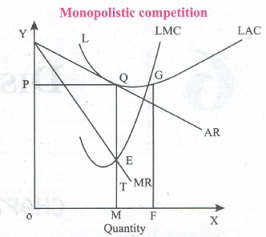
(vi) At Point E the firm achieves the equilibrium where MC = MR.
(vii) OP - Price, OM - Output
(viii) MQ - Average Cost, M = Average Revenue
\(\therefore\) MQ = MQ (AR = AC)
(ix) It means a firm earn the only normal profit in the long run.
36.
(i) Monetary reforms aimed at doing away with interest rate distortions and rationalizing the structure of lending rates.
(ii) The new policy tried in many ways to make the banking system more efficient.
(a) Reserve Requirements:
(i) In mid-1991, SLR and CRR were very high.
(ii) It was proposed to cut down the SLR from 38.5% to 25% within a time span of three years.
(b) Interest rate Liberalisation:
(i) Earlier, RBI controlled the rates payable on deposits of different maturities.
(ii) The rates which could be charged for bank loans which varied according to the sector, use and size of the loan.
(iii) Earlier, it was longer term deposits after the liberalisation it was progressively extended to deposits of shorter maturity.
(c) Greater Competition:
(i) Among public sector, private sector, and foreign banks and elimination of administrative constraints.
(ii) Banks were given freedom to relocate branches.
(iii) Bank branch licensing policy in order to rationalize the existing branch network.
(iv) Guidelines for opening new private sector bank.
(v) New accounting norms regarding classification of assets and provisions of bad debts were introduced for Narasimham Committee Report.
37.
38.
Iso and quant are derived from the Greek language, meaning 'equal' and 'quantity'.
Definition:
Isoquant curve is a locus of points representing various combinations of two inputs capital and labour yielding the same output. It is also called equal product curve or product indifference curve.
Properties:
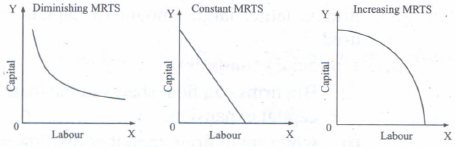
1. The isoquant curve has negative slope:
(i) Capital is being substituted by labour.
(ii) Isoquant has negative slope because of diminishing MRTS.
(iii) Constant MRTS (straight line) and increasing MRTS (concave) are also possible.
(iv) It depends on the nature of isoquant curve
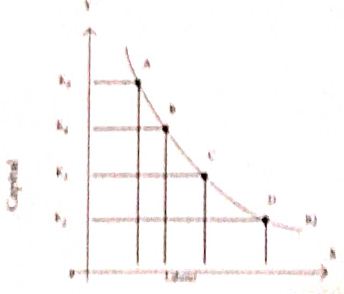
2. Isoquant curve is convex to origin:
The capital substituted per unit of labour goes on decreasing so the isoquant is convex to the origin.
3. Isoquant curves cannot intersect each other:
Point A lies on IQ1 and IQ2, Point C lies on IQ2, showing higher output Point B
lies on IQ1, showing lower output. C = A, B = A But C > B.
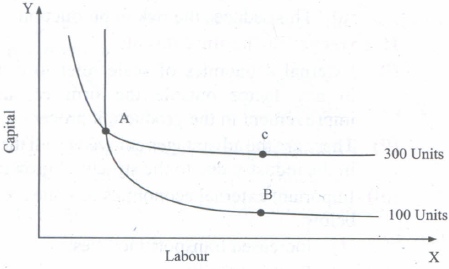
4. Upper isoquant curve represents a higher level of output:
Higher IQ2 shows higher output 200 units. Lower IQ1 shows lower output 100 units. IQ2 means the use of more factors than IQ1. Arrow shows increase in output with a right and upward shift of an isoquant curve.
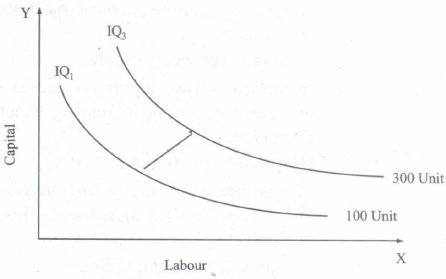
5. Isoquant curve does not touch either x axis or y axis:
In IQ2 only capital is used and in IQ1 only labour is used.
.JPG)
Conclusion:
These are the properties of isoquant curves.
39.
40.
41.
Large number of buyers and sellers:
(i) Since there are large number of buyers and sellers each individual buyer or seller buys or sells a very small quantity of the product found in the market.
(ii) So he has no power to fix the price of the product.
(iii) He is only a price taker.
Homogeneous product & uniform price:
(i) All the units of the product are perfectly substitutable - they are of the same size, shape, colour, quality.
(ii) So a uniform price prevails in the market.
Free entry and exit:
(i) In the short run, the very efficient producer can produce the product at a very low cost & earn super normal profit.
(ii) This attracts new firms to enter.
(iii) When there are more firms, supply increases, so price falls.
(iv) Inefficient producer faces loss & so quits the market.
Absence of transport cost:
The prevalence of the uniform price is also due to the absence of the transport cost.
Perfect knowledge of the market:
(i) All buyers and sellers have a thorough knowledge of the quality of the product, prevailing price.
No government intervention:
(i) No government regulation on supply of raw materials & in price determination.
42.
| Q | Price Rs | TR | AR | MR |
| 1 | 5 | 5 | 5 | 5 |
| 2 | 5 | 10 | 5 | 5 |
| 3 | 5 | 15 | 5 | 5 |
| 4 | 5 | 20 | 5 | 5 |
| 5 | 5 | 25 | 5 | 5 |
| 6 | 5 | 30 | 5 | 5 |
.JPG)
\(A R=\frac{T R}{Q}\)
\( M R=T R_{n}-T R_{n-1}\)
Constant AR & MR (fixed price)
When price remains constant, MR is also constant and AR / MR curves coincide.
Declining AR and MR
When a firm sells large quantities at lower prices both AR & MR will fall but the fall in MR will be steeper than the fall in AR.
| Q | AR | TR | MR |
| 1 | 10 | 10 | 10 |
| 2 | 9 | 18 | 8 |
| 3 | 8 | 24 | 6 |
| 4 | 7 | 28 | 4 |
| 5 | 6 | 30 | 2 |
| 6 | 5 | 30 | 0 |
| 7 | 4 | 28 | -2 |
.JPG)
(i) MR is lower than AR.
(ii) Both AR and MR slope downwards.
(iii) MR divides the distance between AR curve and axis into 2 equal parts.
(iv) The decline in AR need not be a straight line or linear.
(v) If the prices are declining with the increase in quantity sold, the AR can be nonlinear, taking a shape of concave or convex to the origin.
43.
Introduction:
(i) Jawaharlal Nehru one of the chief builders of modern India was the first Prime Minister of Independent India.
(ii) He was a great patriot, thinker and statesman.
Democracy and secularism:
(i) Nehru believed in democracy, free speech, civil liberty, adult franchise, the Rule of law and Parliamentary democracy.
(ii) He favoured secularism.
(iii) Secularism means equal respect for all religions. In our country we have Hinduism, Islam, Christianity, Buddhism, Jainism, Sikhism and so on.
(iv) But there is no domination by religious majority.
Planning:
(i) Nehru introduced planning in our country.
(ii) Planning was linked with industrialisation and self-reliance.
(iii) Nehru contributed to the advancement of science, research, technology and industrial development.
(iv) Many IITs and Research Institutions were established.
Democratic socialism:
(i) Nehru wanted a socialistic pattern of society.
(ii) His socialism is democratic socialism.
Conclusion:
(i) Nehru's views on economics and social problems are found in his innumerable speeches and in the books he wrote.
44.
x = 100 - p - p2
\(\frac { dx }{ dp } =-1-2p\)
Elasticity of demand ղd = \(-\frac { p }{ x } \frac { dx }{ dp } =\frac { -p\left( -1-2p \right) }{ 100-p-{ p }^{ 2 } } =\frac { p+2{ p }^{ 2 } }{ 100-p-{ p }^{ 2 } } \)
When p = 5, ղd = \(\frac { 5+50 }{ 100-5-25 } =\frac { 55 }{ 70 } =\frac { 11 }{ 14 } \)
45.
(i) Biswajeet Guha has stated that the calculation of HDI neglected many important aspects of human development.
(ii) He has created four indices of HDI as HDI1, HDI2, HDI3, and HDI4. HDI1 is based on UNDP methodology as given in Human Development Report.
(iii) He has enlarged the scope of HDI by adding three more dimensions such as quality of life, poverty eradication, and urbanization.
(iv) Various countries including India are continuously making efforts to improve and enlarge the scope of available statistical information.
46.
Market Demand for a commodity:
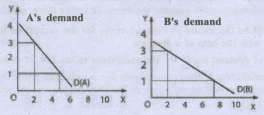
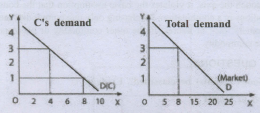
The market demand curve for a commodity is derived by adding the quantum demanded of the commodity by all the individuals constituting the market. In the diagram, the final market demand curve represents the addition of the demand curve of the individuals A, B and C at the same price. When Price is rs.3, the Market demand is 2 + 2 + 4 = 8
When Price is rs. 1 the Market demand is 6 + 8 + 8 = 22
As in the case of individual demand schedule the Market Demand Curve is at a price, at a place and at a time.
47.
Introduction: Goods and services satisfy human wants. Goods also called "Products", "Commodities", "things" etc.
Types of Goods
1. Free and Economic Goods: Free goods are available in nature and in abundance. They do not command a price in the market: (Ex) Air, Sunshine. Economic goods common a price in the market. They are scarce in relation to supply (Ex) T.V, Furniture.
2. Consumer goods and capital goods: Consumer goods directly satisfy human wants (Ex) Table, Chair. Capital goods also called Producers goods do not directly satisfy the consumer wants. They help to produce consumer goods. (Ex) Machinery.
3. Perishable goods and durable goods: Perishable goods are short-lived. Their life span is limited (Ex) Fish, Fruits. Durable and semi-durable goods have a little longer life time than the perishable goods (Ex) TV, Table.
48.
1. Monopoly Profit
2. Windfall Profit
3. Profit as functional reward
49.
(i) It is a public sector financial institution.
(ii) It provides loans at low rates to micro finance institutions.
(iii) And also provides credit to non-banking financial institutions, micro, small and medium enterprises.
(iv) It was launched on 8th April 2015.
(v) Mostly individual proprietorships running small manufacturing, trading or services activities.
(vi) Most of these are owned by people belonging to scheduled caste, scheduled tribe (or) other backward classes.
(vii) MUDRA was started specifically for financing these units.
50.
(i) RRBs came into existence in 1975.
(ii) They develop the rural economy by providing credit and other facilities to the small and marginal farmers, agricultural labourers, artisans and small entrepreneurs.
(iii) RRBs are set up by the joint efforts of the Centre and State governments and commercial banks.
(iv) At present there are 64 RRBs.
(v) The RRBs confine their lending only to the weaker sections and their lending rates are at par with the prevailing rate of co-operative societies.
51.
(i) Tamil Nadu is the largest textile hub of India.
(ii) It is known as the "Yarn Bowl' of India with 41% of India's cotton yarn production.
(iii) It provides employment to 35 million people, contributing 4% of GDP and 35% of gross export earnings.
(iv) From spinning to garment manufacturing the entire textile production chain facilities are in Tamil Nadu.
(v) Coimbatore, Tiruppur, Erode, Dindigul & Karur have the majority of spinning mills manufacturing cotton/polyester/ blended yarn.
(vi) Yarn is exported to China, Bangladesh, Tiruppur (knitting city) exports garments worth USD 3 billion. Karur is famous for textile manufacturing.
(vii) Erode is the main cloth market in south India for retail & wholesale ready-mades.
52.
(i) In duopoly there are only two sellers.
(ii) Each seller is fully aware of his rival's motive and actions.
(iii) Both sellers may collude.
(iv) They may enter into cut-throat competition.
(v) There is no product differentiation.
(vi) They fix the price to get maximum profit.
53.
(i) In the long run all factors of production become variable.
(ii) The size of the firm can be increased.
(iii) There are no fixed inputs in the long run
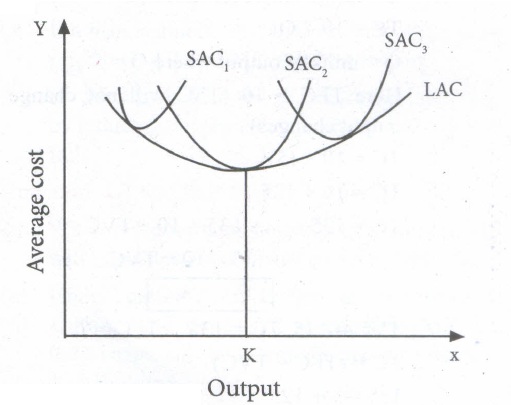
LAC = LTC/Q
(iv) It is the locus of points denoting the least cost curve of producing the corresponding output.
(v) The LAC curve is called as 'Plant curve' or Boat shape curve or planning curve or envelope curve.

11th Standard Syllabus & Materials
11th Standard
TN 11th Tamil பீடு பெற நில் - செய்யுள் - காவடிச்சிந்து Important Questions And Answers Study Material - QB365 Set A
NEW11th Standard
TN 11th Tamil பீடு பெற நில் - உரைநடை - மலை இடப்பெயர்கள் : ஓர் ஆய்வு Important Questions And Answers Study Material - QB365 Set A
NEW11th Standard
TN 11th Tamil மாமழை போற்றுதும் - துணைப்பாடம் - யானை டாக்டர் Important Questions And Answers Study Material - QB365 Set A
NEW11th Standard
TN 11th Tamil மாமழை போற்றுதும் - செய்யுள் - ஐங்குறுநூறு Important Questions And Answers Study Material - QB365 Set A



Tamilnadu Stateboard 11th Standard Subjects

Maths

Commerce
Economics

Biology

Business Maths and Statistics

Accountancy

Computer Science

Physics

Chemistry
Maths
Biology
Economics
Physics
Chemistry

History
Business Maths and Statistics

Computer Science
Accountancy

Computer Applications
History
Computer Technology
Commerce
Computer Applications
Computer Technology

Tamil

English

French
Tamilnadu Stateboard Standards
