
 100% FREE ACCESS
11th Standard Syllabus & Materials
11th Standard
TN 11th Tamil இயற்கை வேளாண்மை,சுற்றுச்சூழல் -செய்யுள் - மனோன்மணீயம் Important Questions And Answers Study Material - QB365 Set A
NEW11th Standard
TN 11th Tamil என்னுயிர் என்பேன் -துணைப்பாடம் - இசைத்தமிழர் இருவர் Important Questions And Answers Study Material - QB365 Set A
NEW11th Standard
TN 11th Tamil மொழி கலை -செய்யுள் - ஒவ்வொரு புல்லையும் Important Questions And Answers Study Material - QB365 Set A
NEW11th Standard
TN 11th Tamil பீடு பெற நில் - இலக்கணம் - பகுபத உறுப்புகள் Important Questions And Answers Study Material - QB365 Set A
NEW11th Standard
TN 11th Tamil பீடு பெற நில் - துணைப்பாடம் - வாடிவாசல் Important Questions And Answers Study Material - QB365 Set A
NEW11th Standard
TN 11th Tamil பீடு பெற நில் - செய்யுள் - குறுந்தொகை Important Questions And Answers Study Material - QB365 Set A

Published on: 27/12/2018
11th First Revision Test
Download Tamil Nadu 11th Standard Maths question papers, model tests, one-mark questions, important questions, and public exam papers in PDF format. Free study materials and answer keys for TN State Board students.
Questions + Answers key
Take MCQ Maths Test1.
Two cards are drawn at random and without replacement from a pack of 52 playing cards. Find the probability that both the cards are black.
2.
Evaluate \(\lim _{ x\rightarrow 1 }{ \frac { 1+(x-1{ ) }^{ 2 } }{ 1+{ x }^{ 2 } } } \)
3.
Integrate the following functions with respect to x : \({1\over (2-3x)^4}\)
4.
Integrate the following with respect to x : ex
5.
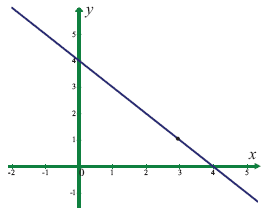
Use the graph to find the limits (if it exists). If the limit does not exist, explain why?
\(lim_{x\rightarrow3}(4-x)\).
6.
Find \(\overrightarrow{a}.\overrightarrow{b}\) when \(\overrightarrow{a}\)= \(\hat{i}-\hat{j}+5\hat{k}\) and \(\overrightarrow{b}=3\hat{i}-2\hat{k}\)
7.
Find the combined equation of the straight lines through the origin one of which is parallel to and the other is perpendicular to the straight line 3x + y + 5 = 0.
8.
If a, b, c are in A.P., show that (a-c)2 = 4(b2 - ac).
9.
If nP4 = 20 \(\times\) 3 nP2, then find n.
10.
Prove that the relation "friendship" is not an equivalence relation on the set of all people in Chennai.
11.
Express each of the following angles in radian measure
300
12.
Write the following in roster form.
The set of all positive roots of the equation (x-1)(x+1)(x2-1) = 0.
13.
If \({ x }^{ 2 }+2xy+{ y }^{ 3 }=42,\) find \(\frac { dy }{ dx } \)
14.
Integrate the following functions with respect to x : \({sin^2x\over 1+cos \ x}\)
15.
Differentiate the following with respect to x : \(y={log x \ x \over e^x}\)
16.
Evaluate the following limits :\(lim_{x\rightarrow 0}{e^{ax}-e^{bx}\over x}\)
17.
Determine whether the following functions are even, odd or neither.
sin2x - 2 cos2x - cos x.
18.
The Sum of infinite number of terms of G.P is 23 and the sum of their sequence is 69. Find the G.P
19.
If the slope of one of the lines given by ax2+2hxy+by2 = 0 is k times the other, prove that 4Kh2 = ab (HK)2
20.
Find the equation of the lines passing through the point of intersection lines 4x - y + 3 = 0 and 5x + 2y + 7 = 0
(i) through the point (-1, 2)
(ii) Parallel to x - y + 5 = 0
(iii) Perpendicular to x - 2y + 1 = 0.
21.
If f, g, h are real valued functions defined on R, then prove that (f + g) o h = f o h + g o h. What can you say about f o(g + h)? Justify your answer.
22.
Solve the quadratic equation 52x- 5x + 3+ 125 = 5x.
23.
\(\int { \frac { \left( log{ x } \right) ^{ 3 } }{ x } } \) dx = _________+c.
\(\frac { \left( log{ x } \right) ^{ 4 } }{ 4 } \)
(sin-1 x)4
(log x)4
\(\frac { 1 }{ 3logx } \)
24.
Three integers are chosen at random from the first 20 integers. The probability that their product is even is
\(\frac { 2 }{ 19 } \)
\(\frac { 3 }{ 19 } \)
\(\frac { 17 }{ 19 } \)
\(\frac { 4 }{ 19 } \)
25.
The points of discontinuity of the function \(\frac { { x }^{ 2 }+6x+8\quad }{ { x }^{ 2 }-5x+6\quad } is\)
3,2
3,-2
-3,2
-3,-2
26.
The value of \(\left| \begin{matrix} x+1 & x+2 & x+a \\ x+2 & x+3 & x+b \\ x+3 & x+4 & x+c \end{matrix} \right| \) =_____________ 0, where a, b, c are in AP is
(x+1)(x+2)(x+3)
I
0
(x+a)(x+b)(x+c)
27.
28.
29.
\(\text { If } f(x)=\left\{\begin{array}{ll} a x^2-b, & -1<x<1 \\ \frac{1}{|x|}, & \text { elsewhere } \end{array} \ \text { is differentiable at } x=1\right. \text {, then }\)
\(a={1\over2},b={-3\over 2}\)
\(a={-1\over2},b={3\over 2}\)
\(a=-{1\over2},b=-{3\over 2}\)
\(a={1\over2},b={3\over 2}\)
30.
\(lim_{x\rightarrow {\pi/2}}{2x-\pi\over cosx} \)
2
1
-2
0
31.
If \(\overrightarrow{a}, \overrightarrow{b}, \overrightarrow{c}\) are the position vectors of three collinear points, then which of the following is true?
\(\overrightarrow{a}=\overrightarrow{b}+\overrightarrow{c}\)
\(2\overrightarrow{a}=\overrightarrow{b}+\overrightarrow{c}\)
\(\overrightarrow{b}=\overrightarrow{c}+\overrightarrow{a}\)
\(4\overrightarrow{a}+\overrightarrow{b}+\overrightarrow{c}=0\)
32.
If \(\left\lfloor . \right\rfloor \) denotes the greatest integer less than or equal to the real number under consideration and −1\(\le\) x < 0, 0 \(\le\) y < 1, 1 \(\le\) z < 2, then the value of the determinant \(\begin{vmatrix} \left\lfloor x \right\rfloor +1& \left\lfloor y \right\rfloor & \left\lfloor z \right\rfloor \\ \left\lfloor x \right\rfloor & \left\lfloor y \right\rfloor +1& \left\lfloor z \right\rfloor \\ \left\lfloor x \right\rfloor & \left\lfloor y \right\rfloor & \left\lfloor z \right\rfloor +1\end{vmatrix}\) is
\(\left\lfloor z \right\rfloor \)
\(\left\lfloor y \right\rfloor \)
\(\left\lfloor x \right\rfloor \)
\(\left\lfloor x \right\rfloor \)+1
33.
The numerical value of tan-11 + tan-12 + tan-13 = _______________
\(\pi\)
\(\frac{\pi}{2}\)
0
\(\frac{\pi}{4}\)
34.
The equation of the bisectors of the angle between the co-ordinate axes are ______________
x+y=0
x-y=0
x\(\pm\)y=0
x=0
35.
There is a letter lock with 3 rings each marked with 5 letters and do not know the keyword. The total number of attempts can be made to know the keyword is _________
35
53
124
5
36.
The quadratic equation whose roots are tan 75° and cot 75° is _______________
x2+4x+ 1 = 0
4x2-x+ 1 = 0
4x2+ 4x - 1 = 0
x2 - 4x + 1 = 0
37.
\(n(A\cap B)=4\) and \((A\cup B)=11\) then \(n(p(A\triangle B))\) is __________
44
256
64
128
38.
Equation of the straight line that forms an isosceles triangle with coordinate axes in the I-quadrant with perimeter 4 + 2\(\sqrt{2}\) is
x + y + 2 = 0
x + y - 2 = 0
\(x+y-\sqrt{2}=0\)
\(x+y+\sqrt{2}=0\)
39.
If 10 lines are drawn in a plane such that no two of them are parallel and no three are concurrent, then the total number of points of intersection are
45
40
10!
210
40.
The sum up to n terms of the series \(\frac { 1 }{ \sqrt { 1 } +\sqrt { 3 } } +\frac { 1 }{ \sqrt { 3 } +\sqrt { 5 } } +\frac { 1 }{ \sqrt { 5 } +\sqrt { 7 } } +\)....is
\(\sqrt { 2n+1 } \)
\(\frac { \sqrt { 2n+1 } }{ 2 } \)
\(\sqrt { 2n+1 } -1\)
\(\frac { \sqrt { 2n+1 } -1 }{ 2 } \)
41.
The value of \({ log }_{ 3 }\frac { 1 }{ 81 } \) is
-2
-8
-4
-9
42.
If n((A \(\times\) B) ∩(A \(\times\) C)) = 8 and n(B ∩ C) = 2, then n(A) is
6
4
8
16
43.
Evaluate \(\int { \frac { { x }^{ 3 }dx }{ { x }^{ 4 }+{ 3x }^{ 2 }+2 } } \)
44.
A purse contains 3 silver and 4 copper coins. A second purse contains 4 silver and 3 copper coins. If a coin is pulled out at random from one of the two purses, what is the probability that it is a silver coin?
45.
Discuss the differentiability of \(f\left( x \right) =\begin{cases} x{ e }^{ -\left( \frac { 1 }{ \left| x \right| } +\frac { 1 }{ x } \right) } \\ 0,\quad x=0 \end{cases}, x\neq 0\) at x = 0
46.
The chances of A, B, and C becoming manager of a certain company are 5 : 3: 2. The probabilities that the office canteen will be improved if A, B, and C become managers are 0.4, 0.5 and 0.3 respectively. If the office canteen has been improved, what is the probability that B was appointed as the manager?
47.
48.
A shopkeeper in a Nuts and Spices shop makes gift packs of cashew nuts, raisins, and almonds.
Pack I contains 100 gm of cashew nuts, 100 gm of raisins and 50 gm of almonds.
Pack-II contains 200 gm of cashew nuts, 100 gm of raisins and 100 gm of almonds.
Pack-III contains 250 gm of cashew nuts, 250 gm of raisins and 150 gm of almonds.
The cost of 50 gm of cashew nuts is Rs.50, 50 gm of raisins is Rs.10, and 50 gm of almonds is Rs.60. What is the cost of each gift pack?
49.
Solve the equation x3+ 5x2-16x-14 = 0. Given x + 7 is a root
50.
Locus of the mid points of the portion of the line \(x\sin\theta+y\cos\theta=p\) intercepted between the axis is ............
51.
Prove that \(\sqrt [ 3 ]{ x^3+7 } -\sqrt [ 3 ]{ x^3+4 } \) is approximately equal to \({1\over x^2}\) when x is large.
52.
Find the sum of all 4-digit numbers that can be formed using the digits 1, 2, 4, 6, 8.
53.
In a \(\triangle \)ABC, if \(\frac { sin \ A }{ sin \ C } =\frac { sin(A-B) }{ sin(B-c) },\), prove that a2, b2, c2are in arithmetic progression
54.
Identify the singular and non-singular matrices:\(\begin{bmatrix} 0&a-b &k \\ b-a & 0 &5 \\ -k & -5 & 0 \end{bmatrix}\)
1.
Let A and B the events of drawing a black card in first draw and second draw respectively.
In the first draw, there are 26 black cards out of 52 cards.
\(\therefore P(A)=\frac { 26 }{ 52 } =\frac { 1 }{ 2 } \)
In the second draw, there are 25 black cards out of 51 cards.
\(\therefore P(B/A)=\frac { 25 }{ 51 } \)
\(\therefore P(A\cap B)=P(A).P(B/A)=\frac { 1 }{ 2 } \times \frac { 25 }{ 51 } =\frac { 25 }{ 102 } \)
2.
\(\lim _{ x\rightarrow 1 }{ \frac { 1+(x-1{ ) }^{ 2 } }{ 1+{ x }^{ 2 } } } =\frac { 1+0 }{ 1+{ 1 }^{ 2 } } =\frac { 1 }{ 2 } \)
3.
\(\int \frac{1}{(2-3 x)^4} d x=\int(2-3 x)^{-4} d x \)
\(=-\frac{1}{3} \frac{(2-3 x)^{-4+1}}{-4+1}\)
\(=\frac{1}{9} \cdot \frac{1}{(2-3 x)^3}+c
\)
4.
\(\int { { e }^{ x } } dx\) = ex + c
5.
\(lim_{x\rightarrow3}(4-x)\)
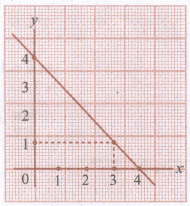
At x = 3, the value of the curve on y-axis is 1.
\(\therefore lim_{x\rightarrow3}(4-x)=1\)
6.
\(\overrightarrow{a}.\overrightarrow{b}\)= (\(\hat{i}-\hat{j}+5\hat{k}\) ).(\(3\hat{i}-2\hat{k}\)) = (1)(3) + (1)(0) + (5)(2)
= 3 - 10 = -7
7.
(3x +y) (x - 3y) = 0 \(\Rightarrow\) 3x2- 8xy - 3y2 = 0
8.
Given a, b, c are in A.P
\(\Rightarrow b=\frac { a+c }{ 2 } \)
RHS = 4[b2 - ac]
\(=4\left[ { \left( \frac { a+c }{ 2 } \right) }^{ 2 }-ac \right] =4\left[ { \left( \frac { a+c }{ 4 } \right) }^{ 2 }-ac \right] \)
\(=4\left[ \frac { { \left( a+c \right) }^{ 2 }-4ac }{ 4 } \right] ={ a }^{ 2 }+{ c }^{ 2 }+2ac-4ac\)
= a2 + c2 - 2ac
= (a - c)2 = LHS
Hence proved.
9.
Given nP4 = 20 \(\times\)nP2.
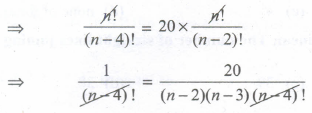
\(\Rightarrow\) (n-2) (n-3) = 20 \(\Rightarrow\) n2-5n+6 = 20
\(\Rightarrow\) n2-5n-14 = 0
\(\Rightarrow\) (n-7)(n+2) = 0
\(\Rightarrow\) n = 7 or -2 \(\Rightarrow\) n = 7
10.
Let a, b, c are people in Chennai
Reflexivity: "a" is a friend of "a" \(\Rightarrow\) a R a \(\Rightarrow\) R is not reflexive.
Symmetric: a is friend of b \(\Rightarrow\) b is the friend of a.
\(\therefore\) aRb \(\Rightarrow\) bRa \(\Rightarrow\) R is symmetric
Transitive: a is the friend of b and b is the friend of c \(\Rightarrow\) a need not be the friend of c.
\(\therefore\) aRb \(\Rightarrow\) bRc \(\neq \) aRc \(\Rightarrow\) R is not transitive
Hence, the relation "friendship" is not equivalent.
11.
300
300 = 30 \(\times\) \(\frac { \pi }{ 180 } =\frac { \pi }{ 6 } \)
12.
The set of all positive roots of the equation (x-1)(x+1)(x2-1)=0.
Let B = { the set of positive roots of the equation (x-1)(x+10(x2-1)=0}
\(\Rightarrow\) x = 1, -1
B = {1}.
13.
\({ x }^{ 2 }+2xy+{ y }^{ 3 }=42\)
Differentiating both sides with respect to 'x' we get,
\(2x+2\left[ x.\frac { dy }{ dx } +y(1) \right] +3{ y }^{ 2 }\frac { dy }{ dx } =0 \Rightarrow 2x+2x\frac { dy }{ dx } +2y+3{ y }^{ 2 }\frac { dy }{ dx } =0\)
\(\Rightarrow \frac { dy }{ dx } (2x+3{ y }^{ 2 })=-2x-2y \Rightarrow \frac { dy }{ dx } =\frac { -2\left( x+y \right) }{ 2x+3{ y }^{ 2 } } \)
14.
\(
\int \frac{\sin ^2 x}{1+\cos x} d x
=\int \frac{1-\cos ^2 x}{1+\cos x} d x \)
\(=\int \frac{(1-\cos x)(1+\cos x)}{(1+\cos x)} d x \)
\(=\int(1-\cos x) d x \)
\(=x-\sin x+c
\)
15.
\(y={log \ x \over e^x }=e^{-x}.log \ x\)
\({dy\over dx}=e^{-x}({1\over x})+log \ x(e^{-x})(-1)\)
\(=e^{-x}[{1\over x}-log \ x]\).
16.
\(lim_{x\rightarrow 0}{e^{ax}-e^{bx}\over x}\)\(=lim_{x\rightarrow 0}{e^{ax}-1-e^{bx}+1\over x}=lim_{x\rightarrow 0}{e^{ax}-1-(e^{bx}-1)\over x}\)
\([lim_{ax\rightarrow 0}{e^{ax}-1\over ax}\times a]-[lim_{bx\rightarrow0}{e^{bx}-1\over bx}\times b]\)
\(=log \ a -log \ b=log({a\over b})\)
17.
Let f(x) = sin2x - 2 cos2x - cos x
f(-x) = f(x) [since sin(-x) = -sin x and cos(-x) = cos x]
Thus f(x) is even.
18.
Let the G.P. be a, ar, ar2, .. with |r|<1 ....(1)
Given a + ar + ar2+...= 23 ...(2)
and a2+(ar)2+(ar2)2+....= 69 ..(3)
\((1)\Rightarrow{a\over1-r}=23\Rightarrow a=23(1-r)\)
\((2)\Rightarrow{a^2\over 1-r^2}=69\)
\(\Rightarrow\) a2 = 39 (1-r2)
\(\Rightarrow\) 232(1-r)2 = 69(1-r2) [from (3)]
\(\Rightarrow\) 232 (1-r)2 = 3(1+r)(1-r)
\(\Rightarrow\) 23(1-r) = 3(1+r)
\(\Rightarrow\) 23-23r = 3 + 3r
\(\Rightarrow\) \(20=26r\Rightarrow r={20\over60}={10\over13}.\)
From (3) \(a=23\left(1-{{10}\over{13}} \right)=23\left({3\over 13} \right)={69\over 13}\)
\(\therefore\)The G.P is \(\frac { 69 }{ 13 } ,\frac { 69 }{ 13 } \left( \frac { 10 }{ 13 } \right) ,\frac { 69 }{ 13 } \left( \frac { 10 }{ 13 } \right) ^{ 2 },..\)
19.
Given pair of lines is ax2 + 2hxy + by2 = 0
Since the lines passes through the origin, let the equation of one of the line by y = mx.
Slope of the other line is Km (given)
\(\therefore\) Equation of the second line is y = Kmx.
\(\therefore\) m1 = m and m2 = m
We know that sum of the slopes
m1 + m2 = \(-\frac{2h}{b}\)
\(\therefore\) m + Km = \(-\frac{2h}{b}\)
\(\Rightarrow\) m (1 + K) = \(-\frac{2h}{b}\) \(\Rightarrow\) m = \(\frac{-2h}{b(1+K)}\)
Also product of the slopes
m1 m2 = \(\frac{a}{b}\) \(\Rightarrow\) m.Km = \(\frac{a}{b}\)
\(\Rightarrow\) Km2 = \(\frac{a}{b}\)
\(\Rightarrow\) m2 = \(\frac{a}{Kb}\)
From (1), \({ m }^{ 2 }={ \left[ -\frac { 2h }{ b\left( 1+K \right) } \right] }^{ 2 }=\frac { 4{ h }^{ 2 } }{ { b }^{ 2 }{ \left( 1+K \right) }^{ 2 } } \)
Equation (2) and (3) we get,
\(\frac { a }{ Kb } =\frac { { 4h }^{ 2 } }{ { b }^{ 2 }{ \left( 1+K \right) }^{ 2 } } \)
\(\Rightarrow \frac { a }{ K } =\frac { { 4h }^{ 2 } }{ b{ \left( 1+K \right) }^{ 2 } } \)
\(\Rightarrow\) 4Kh2 = ab (1 + K)2 Hence proved.
20.
The family of equations of straight lines is of the form (a1 x + b1 y + c1) + \(\lambda\)(a2 x + b2 y + c2) = 0
(i) That is (4x - y + 3) + \(\lambda\)(5x + 2y + 7) = 0....(1)
Since the required equation passes through the point (-1, 2), the point satisfies equation (1),
\(\therefore\) (-4 - 2 + 3) + \(\lambda\)(-5 + 4 + 7) = 0
\(\Rightarrow\) (-3) + \(\lambda\)(6) = 0
\(\Rightarrow\) 6\(\lambda\) = 3
\(\Rightarrow\)\(\lambda\) = 2
Substituting \(\lambda\) = 2 in (1) we get,
(4x - y + 3) + 2(5x + 2y + 7) = 0
\(\Rightarrow\)4x - y + 3 + 10x + 4y + 14 = 0
\(\Rightarrow\) 14x + 3y + 17 = 0
(ii) Any line perpendicular to x - 2y + 1 = 0 will be of the form 2x + y + k = 0
Since this line passes through (-1,-1)
2 (-1) -1 + k = 0
\(\Rightarrow\) 2 - 1 + k = 0
\(\Rightarrow\) -3 + k = 0
\(\Rightarrow\) k = 3
\(\therefore\) Equation of the required line is 2x + y + 3 = 0
(ii) Parallel to x - y + 5 = 0....(1)
Given lines are 4x - y + 3 = 0 and...(2)
5x + 2y + 7.....(3)
\(\begin{matrix} (2)\times 2\Rightarrow 8x-2y+6=0 \\(3)\Rightarrow \ \ \ \ \ 58x+2y+7=0 \\ \_ \_ \_ \_ \_ \_ \_ \_ \_ \_\_ \_ \_ \_ \_ \_ \_ \_ \_\_ \_ \_ \_\\ \ \ \ \ \ \ \ \ \ \ \ \ \ \ \ \ 13x\ \ \ +13=0 \end{matrix}\\\Rightarrow x=-1\)
Substituting x = -1 in (2) we get,
-4x - y + 3 = 0
\(\Rightarrow\) -1 - y = 0
\(\Rightarrow\) -1 = +y
\(\Rightarrow\) y = -1
\(\therefore\) (-1, -1) is the point of intersection of the given lines.
Slope of the required line is \(m=-\frac { Co-efficient\quad of\quad x }{ Co-efficient\quad of\quad y } =\frac { -1 }{ -1 } =1\)
\(\therefore\) Equation of the line passing through (-1, -1) with slope 1 is
y + 1 = 1(x + 1) [ y - y1 = m(x - x1) ]
\(\Rightarrow\) y + 1 = x + 1
\(\Rightarrow\) x - y = 0
\(\Rightarrow\) x - y = 0
(iii) Any line perpendicular to x - 2y + 1 = 0 will be of the form 2x + y + k = 0
Since this line passes through (-1, -1)
2 (-1) -1 + k = 0
\(\Rightarrow\) 2 - 1 + k = 0
\(\Rightarrow\) -3 + k = 0
\(\Rightarrow\) k = 3
\(\therefore\) Equation of the required line is 2x + y + 3 = 0
21.
(i) Since f, g, h are functions from R \(\rightarrow\) R,
(f + g)o h: R \(\rightarrow\) R and f o h + g o h: R\(\rightarrow\) R. For any x \(\in \) R,
[(f + g)oh](x) = (f + g)(h(x) - f(h(x)) + g(h(x)) = f o h(x) + g o h(x)
(f + g)o h = f o h + g o h
(ii) Also fo(g + h) = f[(g + h)(x)] for any x \(\in \)R
= f[g(x) + h(x)] = f(g(x) + f(h(x)) = f o g(x) + f o h(x)
\(\therefore\) fo(g + h) = fog(x) + f o h(x).
22.
Given quadratic equation is
52x-5x+3 + 125 = 5x
\(\Rightarrow\) (5x)2-5x 53- 5x + 125 = 0
\(\Rightarrow\) (5x)2-125 5x- 5x + 125 = 0
\(\Rightarrow\) (5x)2-126.5x+125=0
Let 5x=y
\(\Rightarrow\)y2-126y + 125 = 0
\(\Rightarrow\)(y-1)(y-125) = 0
\(\Rightarrow\) y = 1 or 125
\(\Rightarrow\) 5x = 1 or 125
Case (i) When 5x = 1 \(\Rightarrow\) 50 \(\Rightarrow\) x = 0
Case (ii) When 5x = 125 \(\Rightarrow\) 5x = 53\(\Rightarrow\) x = 3
\(\therefore\) The roots are 0, 3.
23.
(a)
\(\frac { \left( log{ x } \right) ^{ 4 } }{ 4 } \)
24.
(c)
\(\frac { 17 }{ 19 } \)
25.
(a)
3,2
26.
(c)
0
27.
(b)
28.
(c)
29.
Given f is differentiable
\(\therefore f^{\prime}\left(1^{-}\right)=f^{\prime}\left(1^{+}\right)=1 \)
\(f^{\prime}\left(1^{-}\right) =\lim _{x \rightarrow 1^{-}} \frac{f(x)-f(1)}{x+1}=\lim _{x \rightarrow 1^{-}} \frac{\left(a x^{2}-b\right)-(a-b)}{x+1} \)
\(=\lim _{x \rightarrow 1^{-}} \frac{a x^{2}-b-a+b}{x+1}=\lim _{x \rightarrow 1^{-}} \frac{a\left(x^{2}-1\right)}{x+1} \)
\(=\lim _{x \rightarrow 1^{-}}-a(x+1) \)
\(=a(1+1)=2 a \)
\(\therefore f^{\prime}\left(1^{+}\right) =\lim _{x \rightarrow 1^{+}} \frac{f(x)-f(1)}{x-1}=\lim _{x \rightarrow 1^{+}} \frac{\frac{1}{x}-1}{x-1} \)
\(=\lim _{x \rightarrow 1^{+}} \frac{1-x}{x(x-1)}=\lim _{x \rightarrow 1^{+}} \frac{-1}{x}=-1\)
\(\therefore 2 a =-1 \)
\(a =\frac{-1}{2} \)
\(\text { and } f(1)=1\)
\(a-b=1 \)
\(-1 / 2-1=b \)
\(b=-3 / 2 \)
30.
\(\lim _{x \rightarrow \pi / 2} \frac{2 x-\pi}{\cos x} =\lim _{x \rightarrow \pi / 2} \frac{2 x-\pi}{\sin \left(\frac{\pi}{2}-x\right)} \)
\(=\lim _{\left(\frac{\pi}{2}-x\right) \rightarrow 0} \frac{-2\left(\frac{\pi}{2}-x\right)}{\sin \left(\frac{\pi}{2}-x\right)}=-2
\)
31.
\(2 \vec{a}=\vec{b}+\vec{c} \Rightarrow \vec{a}+\vec{a}=\vec{b}+\vec{c} \Rightarrow \vec{a}-\vec{b}=\vec{c}-\vec{a} \)
\(\overrightarrow{O A}-\overrightarrow{O B}=\overrightarrow{O C}-\overrightarrow{O A} \Rightarrow \overrightarrow{B A}=\overrightarrow{A C} \)
\(\Rightarrow \vec{a}, \vec{b}, \vec{c} \text { are collinear }\)
32.
\(-1 \leq x<0 \Rightarrow\lfloor x\rfloor=-1 ;\)
\(0 \leq y<1 \Rightarrow\lfloor y\rfloor=0 ; 1 \leq z<2 \Rightarrow\lfloor z\rfloor=1 \)
\(\therefore|\cdot A|=\left|\begin{array}{ccc} -1+1 & 0 & 1 \\ -1 & 0+1 & 1 \\ -1 & 0 & 1+1 \end{array}\right|=\left|\begin{array}{ccc} 0 & 0 & 1 \\ -1 & 1 & 1 \\ -1 & 0 & 2 \end{array}\right|=1(0+1)=1 \)
\(|A|=1=\lfloor z\rfloor \)
33.
(a)
\(\pi\)
34.
(c)
x\(\pm\)y=0
35.
(b)
53
36.
(d)
x2 - 4x + 1 = 0
37.
(d)
128
38.
\(\text {Perimeter }=4+2 \sqrt{2}\)
\(a+a+\sqrt{2} =4+2 \sqrt{2} \)
\(2 a+\sqrt{2} a =4+2 \sqrt{2} \)
\(\therefore a =2 \)
\(\text {Equation of line is } \frac{x}{2}+\frac{y}{2}=1\)
\(x+y-2=0\)
39.
\(\text { Number of points of intersection }={ }^{10} \mathrm{C}_{2}\)
\(=\frac{10 \times 9}{1 \times 2}=45\)
40.
\(\frac{1}{\sqrt{1}+\sqrt{3}} =\frac{1}{\sqrt{3}+\sqrt{1}} \times \frac{\sqrt{3}-1}{\sqrt{3}-1}=\frac{\sqrt{3}-1}{2} \)
\(\frac{1}{\sqrt{3}+\sqrt{5}} =\frac{1}{\sqrt{5}+\sqrt{3}} \times \frac{\sqrt{5}-\sqrt{3}}{\sqrt{5}-\sqrt{3}} \)
\(=\frac{\sqrt{5}-\sqrt{3}}{2} \)
\(\text { Sum to } \mathrm{n} \text { terms }=\frac{(\sqrt{3}-1)}{2}+\frac{(\sqrt{5}-\sqrt{3})}{2}+\ldots . .\left(\frac{\sqrt{2 n+1}-\sqrt{2 n-1}}{2}\right)\)
\(=\frac{\sqrt{2 n+1}-1}{2}\)
41.
\(\text { Let } \log _{3} \frac{1}{81}=x \Rightarrow 3^{x}=\frac{1}{81}\)
\(\Rightarrow 3^{x}=3^{-4}\)
\(\Rightarrow x=-4 \)
42.
\((A \times B) \cap(A \times C) =A \times(B \cap C) \)
\(n[(A \times B) \cap(A \times C)] =n(A) \times n(B \cap C) \)
\(\Rightarrow 8 =n(A) \times 2 \Rightarrow n(A)=4 \)
43.
Let I = \(\int { \frac { { x }^{ 3 }dx }{ { x }^{ 4 }+{ 3x }^{ 2 }+2 } } \) = \(\int { \frac { { x }^{ 2 }.xdx }{ \left( { x }^{ 2 } \right) ^{ 2 }+{ 3x }^{ 2 }+2 } } \)
Let t = x2 \(\Rightarrow\) dt = 2x dx \(\Rightarrow\) \(\frac { dt }{ 2 } \) = x dx
\(\therefore\) I = \(\int { \frac { t.\frac { dt }{ 2 } }{ { t }^{ 2 }+3t+2 } =\frac { 1 }{ 2 } \int { \frac { tdt }{ { t }^{ 2 }+3t+2 } } }\)
Now t = A \(\frac { d }{ dx } \) (t2 + 3t + 2) + B \(\Rightarrow\) t = A (2t + 3) + B
Equating the x - term constant terms we get,
1 = 2A \(\Rightarrow\) A = \(\frac { 1 }{ 2 } \) 0 = 3A + B \(\Rightarrow\) 0 = \(\frac { 3 }{ 2 } \) + B\(\Rightarrow\) B = \(-\frac { 3 }{ 2 } \); \(\therefore\) t = \(\frac { 1 }{ 2 } \)(2t + 3) -\(\frac { 3 }{ 2 } \)
I = \(\int { \frac { tdt }{ { t }^{ 2 }+3t+2 } } =\frac { 1 }{ 2 } \left[ \int { \frac { 2t+3 }{ 2\left( { t }^{ 2 }+3t+2 \right) } dt-\frac { 3 }{ 2 } \int { \frac { dt }{ { t }^{ 2 }+3t+2 } } } \right] \)
\(\Rightarrow\) I = \(\frac { 1 }{ 4 } \left[ log\left| { t }^{ 2 }+3t+2 \right| -3\int { \frac { dt }{ { t }^{ 2 }+3t+\frac { 9 }{ 4 } -\frac { 9 }{ 4 } +2 } } \right] =\frac { 1 }{ 4 } \left[ log\left| { t }^{ 2 }+3t+2 \right| -3\int { \frac { dt }{ \left( t+\frac { 3 }{ 2 } \right) -\left( \frac { 1 }{ 2 } \right) ^{ 2 } } } \right] \)
Now I1 = \(\int { \frac { dt }{ { t }^{ 2 }+3t+2 } } =\int { \frac { dt }{ { t }^{ 2 }+3t+\left( \frac { 3 }{ 2 } \right) ^{ 2 }-\left( \frac { 3 }{ 2 } \right) ^{ 2 }+2 } } \) = \(3\frac { 1 }{ 4 } \left[ log\left| { t }^{ 2 }+3t+2 \right| -3log\left| \frac { t+\frac { 3 }{ 2 } -\frac { 1 }{ 2 } }{ t+\frac { 3 }{ 2 } +\frac { 1 }{ 2 } } \right| \right] \)
I = \(\frac { 1 }{ 4 } log\left| { t }^{ 2 }+3t+2 \right| -3log\left| \frac { t+1 }{ t+2 } \right| +c\)
\(\therefore\) I = \(\frac { 1 }{ 4 } log\left| { x }^{ 4 }+3{ x }^{ 2 }+2 \right| -3log\left| \frac { { x }^{ 2 }+1 }{ { x }^{ 2 }+1 } \right| +c\)
44.
Consider the following events.
E1: I purse is chosen
E2: II purse is chosen
A: Coin pulled out is silver
\(\Rightarrow \quad \therefore P(E_{ 1 })=P({ E }_{ 2 })=\frac { 1 }{ 2 }\)
There are 3 silver and 4 copper coins in I purse
\(\Rightarrow \quad P(A/{ E }_{ 1 })=\frac { 3 }{ 7 } \)
There are 4 silver and 3 copper coins in II Purse
\(\therefore\) P(A/E1) = \(\frac { 4 }{ 7 } \)
By the theorem of total probability
P(A) = P(E1).P(A/E1)+P(E2).P(A/E2) = \(\frac { 1 }{ 2 } \times \frac { 3 }{ 7 } +\frac { 1 }{ 2 } \times \frac { 4 }{ 7 } =\frac { 3 }{ 14 } +\frac { 4 }{ 17 } =\frac { 7 }{ 14 } =\frac { 1 }{ 2 } \)
45.
\(f\left( x \right) =\begin{cases} x{ e }^{ -\left( \frac { 1 }{ \left| x \right| } +\frac { 1 }{ x } \right) }=x{ e }^{ -\frac { 2 }{ x } },\quad x>0 \\ \quad \quad \ 0,\quad \quad \quad \quad \quad \quad \quad x=0\quad \\ x{ e }^{ -\left( -\frac { 1 }{ x } +\frac { 1 }{ x } \right) }=x,\quad \quad \quad \quad x<0 \end{cases}\)
\(\therefore f\left( x \right) =\begin{cases} x{ e }^{ -\frac { 2 }{ x } }\quad x>0 \\ 0,\quad \quad \quad x=0 \\ x,\quad \quad x<0 \end{cases}\)
\( \therefore f^{ ' }\left( { 0 }^{ - } \right) =\lim _{ x\rightarrow { 0 }^{ + } }{ \frac { f\left( x \right) -f\left( 1 \right) }{ x-0 } } =\lim _{ x\rightarrow { 0 }^{ + } }{ \frac { x-0 }{ x-0 } } =\lim _{ x\rightarrow { 0 }^{ - } }{ \frac { x }{ x } } =1\quad \left[ \because f\left( x \right) =x\quad for\quad x<0\quad and\quad f\left( 0 \right) =0 \right] \)
\(\therefore f^{ ' }\left( { 0 }^{ + } \right) =\lim _{ x\rightarrow { 0 }^{ + } }{ \frac { f\left( x \right) -f\left( 0 \right) }{ x-0 } } =\lim _{ x\rightarrow { 0 }^{ + } }{ \frac { x{ e }^{ -\frac { 2 }{ x } }-0 }{ x } } =\lim _{ x\rightarrow { 0 }^{ + } }{ { e }^{ -\frac { 2 }{ x } } } =0\quad \left[ \because f\left( x \right) =x{ e }^{ -2x }\quad for\quad x>0\quad and\quad f\left( 0 \right) =0 \right] \)
\(\therefore f^{ ' }\left( { 0 }^{ - } \right) \neq f^{ ' }\left( { 0 }^{ + } \right) \)
\(\therefore f\left( x \right) \)is not differentiate at x = 0.
46.
Let A1, A2 and A3 be the event of A, B, C becoming managers of the company respectively. Let X be the event that the office canteen will be improved.
Then, \(P\left(A_1\right)=\frac{5}{10}=0.5 \)
\(P\left(A_2\right)=\frac{3}{10}=0.3 \)
\(P\left(A_3\right)=\frac{2}{10}=0.2 \)
\(P\left(X / A_1\right)=0.4 \)
\(P\left(X / A_2\right)=0.5\)
\(P\left(X / A_3\right)=0.3\)
\(P\left(A_2 / X\right)=\frac{P\left(A_2\right) P\left(X / A_2\right)}{P\left(A_1\right) P\left(X / A_1\right)+P\left(A_2\right) P\left(X / A_2\right)}+P\left(A_3\right) P\left(X / A_3\right)\)
\(=\frac{0.3(0.5)}{0.5(0.4)+0.3(0.5)+0.2(0.3)} \)
\(=\frac{0.15}{0.2+0.15+0.06} \)
\(=\frac{0.15}{0.41}=\frac{15}{41}\)
47.
48.
Gift pack matrix
\(A=\left[\begin{array}{ccc} \text { Pack I } & \text { PII } & \text { PIII } \\ 100 & 200 & 250 \\ 100 & 100 & 250 \\ 50 & 100 & 150 \end{array}\right] \begin{aligned} &\text { Cashew } \\ &\text { raisins } \\ &\text { almonds } \end{aligned}\)
Given Cost of 50 gm of cashew is Rs. 50
\(\therefore\)1 gm of cashew is Rs. 1
Cost of 50 gm of raisin is Rs. 10
1 gm of raisin is Rs. 1/5
Cost of 50gm of almonds is Rs. 60
1 gm of raisin is Rs. 6/5
Cost matrix \(B=\left(1, \frac{1}{5}, \frac{6}{5}\right)\)
Cost of package is AB.
\(A B=\left(\begin{array}{lll} 1 & \frac{1}{5} & \frac{6}{5} \end{array}\right)\left[\begin{array}{ccc} 100 & 200 & 250 \\ 100 & 100 & 250 \\ 50 & 100 & 150 \end{array}\right]\)
\(=\left[\begin{array}{c} 100+20+60 \\ 200+20+120 \\ 250+50+180 \end{array}\right]=\left[\begin{array}{c} 180 \\ 340 \\ 480 \end{array}\right]\)
Pack I Cost Rs. 180
Pack II Cost Rs. 340
Pack III Cost Rs. 480
49.
x3+5x2-16x-14 = (x+7)(x2+px-2)
equating co-eff of x
7p-2 = -16
7p = -16+2 =-14
⇒ p = -2
so the other factor is x2-2x-2
Solving x2-2x-2 = 0
⇒ x =\(\frac { 2\pm \sqrt { 4-4(1)(-2) } }{ 2(1) } \)
= \(\frac { 2\pm \sqrt { 4+8 } }{ 2 } =\frac { 2\pm 2\sqrt { 3 } }{ 2 } =1\pm \sqrt { 3 } \)
so the roots\(1\pm \sqrt { 3 } ,-7\)
50.
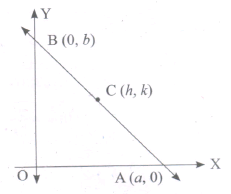
Given equation of the line is \(x\cos\theta+y\sin\theta=p\) .
Let C (h, k) be the mid point of the given line AB where it meets the two axis atA (a, 0) andB (0, b).
Since (a, 0) lies on eq (i) then \(a\cos\theta+0=p^n\)
\(\Rightarrow a=\frac{p}{\cos\theta}\) .....(ii)
B (0, b) also lies on the eq (i) then 0 + \(b\sin\theta\) = p
\(\Rightarrow b=\frac{p}{\sin\theta}\) ...(iii)
Since C(h, k) is the mid point of AB
\(\therefore h=\frac{0+a}{2}\Rightarrow a=2h\) and \(k=\frac{b+0}{2}\Rightarrow b=2k\)
Putting the values of a and b is eq (ii) and (iii) we get
\(2h=\frac{p}{\cos\theta}\Rightarrow\cos\theta=\frac{p}{2k}\) .....(iv)
and \(2k=\frac{p}{\sin\theta}\Rightarrow\sin\theta=\frac{p}{2k}\) ....(v)
Squaring and adding eq (iv) and (v) we get
\(\Rightarrow \cos^2\theta+\sin^2\theta=\frac{p^2}{4h^2}+\frac{p^2}{4k^2}\Rightarrow 1=\frac{p^2}{4h^2}+\frac{p^2}{4k^2}\)
So, the locus of the mid point is \(1=\frac{p^2}{4x^2}+\frac{p^2}{4y^2}\)
\(\Rightarrow \) 4x2y2 = p2 (x2 + y2)
Hence, the value of the filter is 4x2y2 = p2 (x2 + y2).
51.
\(\sqrt [ 3 ]{ x^3+7 } ={(x^3+7)}^{{1\over 3}}\)
\(={\left[ x^3\left( 1+{7\over x^3} \right) \right]}^{{1\over 3}}\) (\(\left |{7\over x^3}\right |<1\) as x is large)
\(=x{\left( 1+{7\over x} \right)}^{1\over 3}\)
\(=x\left( 1+{1\over 3} \times {7\over x^3}+{{{1\over3}\left( {1\over 3}-1 \right)}\over{2!}} {\left( {{7\over x^3}} \right)}^{2} +......\right)\)
\(=x\left( 1+{7\over 3}\times{1\over x^3}-{49\over 9}\times{1\over x^6}+...... \right)\)
\(=x+{7\over 3}\times{1\over x^2}-{49\over 9}\times{1\over x^5}+...\)
\(\sqrt [ 3 ]{ x^3+4 } ={(x^3+4)}^{1\over 3}\)
\(={\left[ x^3\left( 1+{4\over x^3} \right) \right]}^{1\over 3}\)
\(=x\left( 1+{4\over x^3} \right)^{1\over 3}\)
\(=x{\left( 1+{1\over3}\times{4\over x^3}+{{1\over 3}\left( {1\over3}-1 \right)\over{2!}} {\left( {4\over x^3} \right)}^{2}+... \right)}^{1\over3}\)
\(=x+{4\over 3}\times{1\over x^3}-{16\over 9}\times{1\over x^5}+...\)
Since x is large, \({1 \over x}\) is very small and hence higher powers of \({1 \over x}\) are negligible.
Thus \(\sqrt [ 3 ]{ x^3+7 } =x+{7\over 3}\times{1\over x^2}\) and \(\sqrt [ 3 ]{ x^3+4 } =x+{4\over3}\times{1\over x^3}.\) Therefore
\(\sqrt [ 3 ]{ x^3+7 } -\sqrt [ 3 ]{x^3+4 } =\left(x+{7\over 3}\times{1\over x^2} \right)-\left( x+{4\over 3}\times{1\over x^2} \right)={1\over x^2}\)
52.
The number of 4-digit numbers that can be formed using the given 5 digits is 5P4 = 120. We first find the sum of the digits in the unit place of all these 120 numbers. By filling the 1 in unit place, the remaining three places can be filled with remaining 4 digits in 4P3 = 24 ways. This means, the number of 4-digit numbers having 1 in units place is 4P3 = 24. Similarly, each of the digits 2, 4, 6, 8 appear 24 times in units place. An addition of all these digits gives the sum of all the unit digits of all 120 numbers. Therefore,
(4P3 \(\times\)1) + (4P3 \(\times\) 2) + (4P3 \(\times\) 4) + (4P3 \(\times\) 6) + (4P3 \(\times\) 8)
= 4P3 \(\times\) (1 + 2 + 4 + 6 + 8)
= 4P3 \(\times\) (sum of the digits)
= 4P3 \(\times\) 21
Similarly, we get the sum of the digits in 10th place as 4P3 \(\times\) 21. Since it is in 10th place, its value is 4P3 x 21 x 10. Similarly, the values of the sum of the digits in 100th place and 1000th place are 4P3 \(\times\) 21 \(\times\) 100 and 4P3 \(\times\) 21 \(\times\) 1000 respectively. Hence the sum of all the 4 digit numbers formed by using the digits 1, 2, 4, 6, 8 is (4P3 \(\times\) 21) + (4P3 \(\times\) 21 \(\times\) 10) + (4P3 \(\times\) 21 \(\times\) 100) + (4P3 \(\times\) 21\(\times\) 1000)
= 4P3 (21\(\times\)1111)
= 24 \(\times\) 21 \(\times\) 1111
= 559944.
53.
Using sine formula,
Let \(\frac { sinA }{ a } =\frac { sinB }{ b } =\frac { sinC }{ c } =k\)
sin A = ak, sin B = bk, sin C = ck
Given \(\frac { sin\quad A }{ sin\quad C } =\frac { sin\left( A-B \right) }{ sin\left( B-C \right) } \)
\(\Rightarrow \frac { sin\left( B+C \right) }{ sin\left( A+B \right) } =\frac { sin\left( A-B \right) }{ sin\left( B-C \right) } \)
⇒ Sin(B + C) sin(B - C) = sin(A + B) sin(A - B)
⇒ sin2B - sin2C = sin2A - sin2B
⇒ k2b2- k2c2 = k2a2 - k2b2
⇒ b2- c2 = a2- b2
⇒ 2b2 = a2 + c2
⇒ a2, b2, c2 are in A.P.
Hence proved
54.
\(|A|=\left|\begin{array}{ccc} 0 & a-b & k \\ b-a & 0 & 5 \\ -k & -5 & 0 \end{array}\right|\)
\(=0-(a-b)[0+5 k]+k(-5(b-a)-0)\)
\(=(-a+b)(5 k)+k(-5 b+5 a)\)
\(=-5 k a+5 k b-5 k b+5 a k\)
= 0
\(|A|=0\)
\(\therefore\) A is singular

11th Standard Syllabus & Materials
11th Standard
TN 11th Tamil பீடு பெற நில் - செய்யுள் - காவடிச்சிந்து Important Questions And Answers Study Material - QB365 Set A
NEW11th Standard
TN 11th Tamil பீடு பெற நில் - உரைநடை - மலை இடப்பெயர்கள் : ஓர் ஆய்வு Important Questions And Answers Study Material - QB365 Set A
NEW11th Standard
TN 11th Tamil மாமழை போற்றுதும் - துணைப்பாடம் - யானை டாக்டர் Important Questions And Answers Study Material - QB365 Set A
NEW11th Standard
TN 11th Tamil மாமழை போற்றுதும் - செய்யுள் - ஐங்குறுநூறு Important Questions And Answers Study Material - QB365 Set A



Tamilnadu Stateboard 11th Standard Subjects
Maths

Commerce

Economics

Biology

Business Maths and Statistics

Accountancy

Computer Science

Physics

Chemistry
Maths
Biology
Economics
Physics
Chemistry

History
Business Maths and Statistics

Computer Science
Accountancy

Computer Applications
History
Computer Technology
Commerce
Computer Applications
Computer Technology

Tamil

English

French
Tamilnadu Stateboard Standards

