
 100% FREE ACCESS
11th Standard Syllabus & Materials
11th Standard
TN 11th Tamil இயற்கை வேளாண்மை,சுற்றுச்சூழல் -செய்யுள் - மனோன்மணீயம் Important Questions And Answers Study Material - QB365 Set A
NEW11th Standard
TN 11th Tamil என்னுயிர் என்பேன் -துணைப்பாடம் - இசைத்தமிழர் இருவர் Important Questions And Answers Study Material - QB365 Set A
NEW11th Standard
TN 11th Tamil மொழி கலை -செய்யுள் - ஒவ்வொரு புல்லையும் Important Questions And Answers Study Material - QB365 Set A
NEW11th Standard
TN 11th Tamil பீடு பெற நில் - இலக்கணம் - பகுபத உறுப்புகள் Important Questions And Answers Study Material - QB365 Set A
NEW11th Standard
TN 11th Tamil பீடு பெற நில் - துணைப்பாடம் - வாடிவாசல் Important Questions And Answers Study Material - QB365 Set A
NEW11th Standard
TN 11th Tamil பீடு பெற நில் - செய்யுள் - குறுந்தொகை Important Questions And Answers Study Material - QB365 Set A

Published on: 02/08/2018
Based on the syllabus, in this model question paper is prepared.it covers the important one mark, two, three marks and five marks questions.
The chapter that covers the syllabus is
1. Nature of Physical World and Measurement
2. Kinematics
3. Laws of Motion
Download Tamil Nadu 11th Standard Physics question papers, model tests, one-mark questions, important questions, and public exam papers in PDF format. Free study materials and answer keys for TN State Board students.
Questions + Answers key
Take MCQ Physics Test1.
A person moving horizontally with velocity \(\vec{V_m}\) Rain falls vertically with velocity \(\vec{V_R}\) To save himself from the rain, he should hold an umbrella with vertical at an angle of ____________.
\(\tan^{-1}(\frac{V_R}{V_m})\)
\(\tan^{-1}(\frac{V_m}{V_R})\)
\(\tan\theta=V_m+V_R\)
\(\tan^{-1}(V_R+V_m/V_R-V_m)\)
2.
A person moving horizontally with velocity \(\vec{V_m}\) The relative velocity of rain with respect to the person is ___________.
VR + Vm
\(\sqrt{V_R+V_m}\)
VR - Vm
\(\sqrt{V_R^2+V_m^2}\)
3.
If the force is proportional to square of velocity, then the dimension of proportionality constant is
[MLT0]
[MLT-1]
[MLT-2T]
[MLT-1T0]
4.
The density of a material in CGS system of units is 4 g cm-3. In a system of units in which unit of length is 10 cm and unit of mass is 100 g, then the value of density of material will be
0.04
0.4
40
400
5.
If the length and time period of an oscillating pendulum have errors of 1% and 3% respectively then the error in measurement of acceleration due to gravity is
4%
5%
6%
7%
6.
If the error in the measurement of radius is 2%, then the error in the determination of volume of the sphere will be
8%
2%
4%
6%
7.
Write about the properties of components of vectors.
8.
What is three dimensional motion? Give example.
9.
Bodies of larger mass need greater initial effort to put them in motion. Why?
10.
A body is acted upon by a number of external forces. Can it remain at rest?
11.
Will the momentum remain conserved if some external force acts on the system.
12.
Show that if the force acting on the particle is zero, its momentum remains unchanged.
13.
When the sum of two vectors is maximum?
14.
What is Physics?
15.
Write the rules for determining significant figures.
16.
How will you measure the diameter of the Moon using parallax method?
17.
On a foggy day two drivers spot each other when they are just 80 mts apart. They are travelling at 72 kmh-1 and 60 kmh-1, respectively. Both of them applied brakes retarding their cars at the rate of 5 ms-2. Determine whether they avert collision or not.
18.
A bullet going with speed 350 m/s enters in a concrete wall and penetrates a distance of 5 cm before coming to rest. Find the deceleration.
19.
Explain the addition of two vectors using components method.
20.
How is a function represented graphically and mathematically.
21.
Write an expression for displacement vector in Cartesian coordinate system and also show graphically.
22.
23.
Give any three applications of physics in our society.
24.
Explain various types of friction. Suggest a few methods to reduce friction.
25.
Using free body diagram, show that it is easy to pull an object than to push it.
26.
What are the steps involved in scientific method?
27.
A van is moving along x-axis. As shown in the figure, it moves from 0 to P in 18s and returns from P to Q in 6s. What are the average velocity and average speed of the van in going from
(i) from O to P
(ii) from O to P and back to Q?
28.
A body falling freely descends 0.3m in 0.1s and 0.398m in the next 0.1s in some other planet. Find the value of g in that planet.
29.
Write the rules for "Rounding off" with example
30.
Explain the propagation of errors in subtraction, quotient and power of a quantity.
31.
Prove Impulse - Momentum equation.
32.
Describe Galileo's experiments concerning motion of objects on inclined planes?
1.
(b)
\(\tan^{-1}(\frac{V_m}{V_R})\)
2.
(d)
\(\sqrt{V_R^2+V_m^2}\)
3.
F = kv2
Dimensional of k
\(=\frac{\text { Dimension of } \mathrm{F}}{\text { Dimension of }(v)^{2}}\)
\(=\frac{\mathrm{MLT}^{-2}}{\left(\mathrm{LT}^{-1}\right)^{2}}=\frac{\mathrm{MLT}^{-2}}{\mathrm{~L}^{2} \mathrm{~T}^{-2}} \)
\(=\left[\mathrm{ML}^{-1-2} \mathrm{~T}^{-2+2}\right] \)
Dimension of proportionality constant \(=\left[\mathrm{ML}^{-1} \mathrm{~T}^{0}\right]\)
4.
(c)
40
5.
\(T =2 \pi \sqrt{\frac{l}{g}} \)
\(g =4 \pi^{2} l / T^{2} \)
\(\frac{d g}{g} =\frac{d l}{l}-\frac{2 d T}{T} \)
\(\frac{d g}{g} \% =\left(\frac{d l}{l}\right) \%-2\left(\frac{d T}{T}\right) \% \)
\(=1 \%-2 \times(-3 \%) \)
\(=1+6=7 \% \)
6.
\(\text { Error in radius }=2 \%\)
\(\Delta r=\frac{2}{100}=0.02\)
\(\text {Volume of the sphere }=\frac{4}{3} \pi r^{3}\)
\(V =\frac{4}{3} \pi r^{3} \)
\(\frac{d V}{V} =\frac{4}{3} \pi \times 3 r^{2} d r \)
\(=3 d r=3(2 \%)=6 \%\)
7.
If two vectors \(\bar{A}\) and \(\bar{B}\) are equal, then their individual components are also equal.
Let \(\bar{A}=\bar{B}\)
then \(A_x \hat{i}+A_y\hat{j}+A_z\hat{k}=B_x\hat{i}+B\hat{j}+B_z\hat{k}\)
\(i.e A_x=B_x,A_y=B_y,A_z=B_z\)
8.
If a particle moving in used three dimensional space, then the particle is said to be in three dimensional motion.
E.g. A bird flying in the sky.
9.
As F = ma so for given a, more force will be required to put a large mass in motion.
10.
Yes, if the external forces acting on the body can be represented in magnitude and direction by the sides of a closed polygon taken in the same order.
11.
No, the momentum remain conserved if some external force acts on the System.
12.
\(\vec { F } =\frac { d\vec { p } }{ dt } \)
As \(\vec { F } \) = 0
\(\frac { d\vec { p } }{ dt } \) =0 (or) \(\vec { p } \) = constant
13.
Two vectors have same direction.
14.
(i) Physics is a branch of science.
(ii) The word comes from a Greek word meaning 'nature'.
(iii) It deals with the study of nature and natural phenomena.
15.
| Rule | Example |
| (i) All non-zero digits are significant | 1342 has four significant figures |
| (ii) All zeros between two non-zero digits are significant | 2008 has four significant figures |
| (iii) All zeros to the right of a non-zero digit but to the left of a decimal point are significant. | 30700 has five significant figures |
| (iv) a) The number without a decimal point, the terminal or trailing zero(s) are not significant. | 30700 has three significant figures |
| b) All zeros are significant if they come from a measurement | 30700 has three significant figures |
| (v) If the number is less than 1, the zero (s) on the right of the decimal point but to the left of the first non-zero digit are not significant. | 0.00345 has three significant figures |
| (vi) All zeros to the right of a decimal point and to the right of non-zero digit are significant. | 40.00 has four significant figures and 0.030400 has five significant figures |
| (vii) The number of significant figures does not depend on the system of units used | 1.53 cm, 0.0153 m, 0.0000153 km, all have three significant figures. |
16.
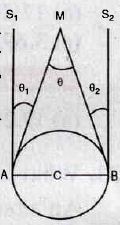
C is the centre of the Earth. A and B are two diametrically opposite places on the surface of the Earth. From A and B, the parallaxes θ1 and θ2 respectively of Moon M with respect to some distant star are determined with the help of an astronomical telescope. Thus, the total parallax of the Moon subtended on Earth.
\(\angle AMB=\theta_1+ \theta_2=\theta\)
If θ is measured in radians, then
\(\theta=\frac{A B}{A M} ; A M \approx M C \quad {\theta}=\frac{A B}{M C} \text { or } M C=\frac{A B}{\theta}\)
Knowing the values of AB and θ, we can calculate the distance MC of Moon from the Earth.
17.
For the first car: u = 72 kmh-1 = 29 ms-1 = 20 ms-1, v = 0, a = -5 ms-2
As v2 - u2 = 2as
\(\therefore\) 02 - 202 = 2(-5)s.
For the second car: u = 60 kmh-1 = \(\frac{60\times 5}{18}\)
= \(\frac{50}{3}\) ms-1, v = 0, a = -5 ms-2
As v2 - u2 = 2as
\(\therefore 0^2-(\frac{50}{3})^2\) = 2(-5)s2
Distance covered by second car, s2 = \(\frac{2500}{9\times 10}\) = 27.78
Total distance covered by the two cars
\(\Rightarrow\) S1 + S2 = 40 + 27.78 = 67.78 m
As this distance is less than the initial distance (= 80m) between the two cars, so the collision will be averted.
18.
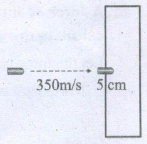
Given: Speed of the bullet = 350 m/s
i.e., u = 350 m/s
s = 5 cm
v = 0 m/s
a = ?
Formula: v2 = u2 + 2as
\(\Rightarrow\) 0 = u2 + 2as
(or) u2 = -2as (or) a = \(\frac{-u^2}{2s}\)
(or) a = \(\frac{-350\times 350}{2\times 0.5}\) = -12.25\(\times\)105 m/sec2.
19.
The two vectors \(\vec{A}\) and \(\vec{B}\) in a Cartesian coordinate system can be expressed as
\(\overrightarrow { A } ={ A }_{ x }\hat { i } +{ A }_{ y }\hat { j } +{ A }_{ z }\hat { k } \)
\(\overrightarrow { B } ={ B }_{ x }\hat { i } +{ B }_{ y }\hat { j } +{ B }_{ z }\hat { k } \)
Then the addition of two vectors is equivalent to adding their corresponding x, y and z components.
\(\vec{A}+\vec{B}=(A_x+B_x)\hat{i}+(A_y+B_y)\hat{j}+(A_z+B_z)\hat{k}\)
20.
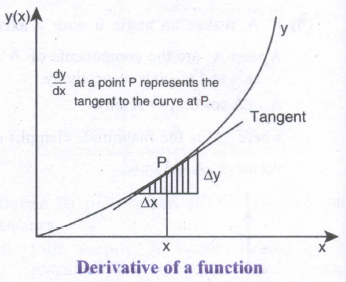
(i) If a function is represented by y = f (x), then dy/dx represents the derivative of y with respect to x.
(ii) Mathematically this represents the variation of y with respect to change in x, for various continuous values of x.
(iii) Mathematically the derivative dy/dx is defined as follows
\(\frac { dy }{ dx } =\underset { \Delta x\rightarrow 0 }{ lim } \frac { y(x+\Delta x)-y(x) }{ \Delta x } \)
\(=\lim _{ \Delta x\rightarrow 0 }{ \frac { \Delta y }{ \Delta x } } \)
\(\frac { dy }{ dx } \) represents the limit that the quantity \(\frac { \Delta y }{ \Delta x } \)
attains, as \(\Delta \)x tends to zero.
21.
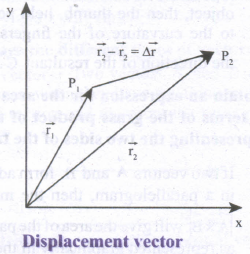
(i) In terms of position vector, the displacement vector is given as follows. Consider a particle moving from a point P1 having position vector \(\overrightarrow { { r }_{ 1 } } ={ x }_{ 1 }\hat { i } +{ y }_{ 1 }\hat { j } +{ z }_{ 1 }\hat { k } \) to a point P2 where its position vector is \(\overrightarrow { { r }_{ 2 } } ={ x }_{ 2 }\hat { i } +{ y }_{ 2 }\hat { j } +{ z }_{ 2 }\hat { k } \)
(ii) The displacement vector is given by \(\Delta \overrightarrow { r } =\overrightarrow { { r }_{ 2 } } -\overrightarrow { { r }_{ 1 } } \)
= (x2-x1)\(\hat { i } \) + (y2-y1)\(\hat { j } \)+(z2-z1)\(\hat {k } \)
(iii) This displacement is also shown in
22.
23.
(i) Basic laws of electricity and magnetism led to the discovery of wireless communication technology which has shrunk the world with effective communication over large distances.
(ii) The launching of satellite into space has revolutionized the concept of communication.
(iii) Microelectronics, lasers, computers, superconductivity and nuclear energy have comprehensively changed the thinking and living style of human beings.
24.
Static friction: The opposing force that comes into play when one body tends to move over the surface of another, but the actual motion has yet not started is called static friction.
Limiting friction: If the applied force is increased the force of static friction also increases. If the applied force exceeds a certain (maximum) value, the body starts moving. This maximum value of static friction up to which body does not move is called limiting friction.
Kinetic or dynamic friction: If the applied force is increased further and sets the body in motion, the friction opposing the motion is called kinetic friction.
We can reduce friction
(1) By polishing.
(2) By lubrication.
(3) By proper selection of material.
(4) By streamlining the shape of the body.
(5) By using ball bearing.
25.
| Free Body Diagram for Pushing | Free Body Diagram for Pulling |
.JPG) |
.JPG) |
| F sin θ acts downwards along with the weight mg and therefore increases the normal reaction N (Normal reaction is equal to sum of all the vertical forces). And friction is directly dependent on Normal reaction; More in N more is the frictional force. |
F sin θ acts upwards along with the weight mg and therefore decreases the normal reaction N. Therefore the frictional force is reduced. |
26.
(i) Systematic observation
(ii) Controlled experimentation
(iii) Reasoning (qualitative and quantitative)
(iv) Modelling (Mathematical)
(v) Prediction and verification (theories)
27.

(i) Formula: From O to P \(Average\ velocity=\frac{Displacement}{Time\ interval}\)
\(=\frac{+360m}{18s}=+20\ ms^-1\)
\(Average\ speed=\frac{Path\ length}{Time\ interval}=\frac{360m}{18s}=20ms^{-1}\)
(ii) From O to P and back to Q.
\(Average\ velocity=\frac{Displacement}{Time\ interval}\)
\(=\frac{OQ}{18+6}=\frac{+240m}{24s}=10ms^{-1}\)
\(Average\ speed=\frac{Path\ length}{Time\ interval}\)
\(=\frac{OP+OQ}{18+6}=\frac{(360+120)}{24s}=20ms^{-1}\)
28.
Given:
During t1 = 0.1s, distance covered is s1 = 0.3m
During next t2 = 0.1s, distance covered is s2= 0.398m
We know \(s=ut+\frac{1}{2}at^2\)
In this case u = 0, a = g, \(s=\frac{1}{2}gt^2\)
t = t1+ t2 = 0.1 + 0.1 = 0.2
\(\therefore g=\frac{2s}{t^2}\)
For this problem,
\(g=\frac{2(s_2-s_1)}{t^2}\)
\(g=\frac{2(0.398-0.3)}{(0.2)^2}=\frac{2\times(0.098)}{0.04}=\frac{0.196}{0.04}\)
\(g=\frac{19.6}{4}=4.9m/s^2\)
∴ Acceleration due to gravity in that planet = 4.9 m/s2
29.
| Rule | Example |
| If the digit to be dropped is smaller than 5, then the preceding digit should be left unchanged. | 7.32 is rounded off to 7.3 8.94 is rounded off to 8.9 |
| If the digit to be dropped is greater than 5, then the preceding digit should be increased by 1. | 17.26 is rounded off to 17.3 11.89 is rounded off to 11.9 |
| If the digit to be dropped is 5 followed by digits other than zero, then the preceding digit should be raised by 1. | 7.352, on being rounded off to first decimal becomes 7.4 18.159 on being rounded off to first decimal, become 18.2 |
| If the digit to be dropped is 5 or 5 followed by zeros, then the preceding digit is not changed if it is even. | 3.45 is rounded off to 3.4 8.250 is rounded off to 8.2 |
| If the digit to be dropped is 5 or 5 followed by zeros, then the preceding digit is raised by 1 if it is odd. | 3.35 is rounded off to 3.4 8.350 is rounded off to 8.4 |
30.
(i) Error in the difference of two quantities:
Let \(\triangle\)A and \(\triangle\)B be the absolute errors in the two quantities, A and B, respectively. Then,
Measured value of A = A \(\pm \triangle\)A
Measured value of B = B \(\pm \triangle\)B
Consider the difference, Z =A - B
The error \(\triangle\)Z in Z is then given by
\(Z\pm\triangle Z=(A\pm\triangle A)-(B\pm\triangle B)\)
\(=(A-B)\pm(\triangle A+\triangle B)\)
\(=Z\pm(\triangle A + \triangle B)\)
(or) \(\triangle Z=\triangle A+\triangle B\)
(ii) Error in the division or quotient of two quantities: Let \(\triangle\)A and \(\triangle\)B be the absolute errors in the two quantities A and B respectively.
Consider the quotient, Z = \(A\over B\)
The error \(\triangle\)Z in Z is given by \(Z\pm\triangle Z={A\pm\triangle A\over B\pm\triangle B}={A{(1\pm{\triangle A \over A})\over B{(\pm {\triangle B\over B})}}}={A\over B}(1\pm{\triangle A\over A})(1\pm{\triangle B\over B})^{-1}\)
\(or Z\pm \triangle Z=Z(1\pm {\triangle A\over A})(1\mp{\triangle B\over B}) \) [using (1 +x)n=1+ nx, when x «1]
Dividing both sides by Z, we get, \(1\pm{\triangle Z\over Z}=(1\pm{\triangle A\over A})(1\mp{\triangle B\over B})=1\pm {\triangle A\over A}\mp {\triangle B\over B}\pm{\triangle A\over A}{\triangle B\over B}\)
As the terms \(\triangle\)A / A and \(\triangle\)B/B are small, their product term can be neglected,
The maximum fractional error in Z is given by \({\triangle Z \over Z}=({\triangle A \over A}+{\triangle B\over B})\)
(iii) Error in the power of a quantity: Consider the nth power of A, Z = An The error\(\triangle\) Zin Z is given by
Z\(\pm \triangle\)Z=(A\(\pm \triangle\)A)n=An =\(=(1\pm{\triangle A\over A})^n=Z(1\pm n{\triangle A\over A})\)
We get [(1+x)n + nx, when x« 1] neglecting remaining terms, Dividing both sides by Z
\(1\pm{\triangle Z \over Z}=1\pm n{\triangle A \over A}or{\triangle Z \over Z}=n{\triangle A \over A}\)
31.
If a force (F) acts on the object in a very short interval of time (M), from Newton's second law in magnitude form
Fdt = dp
Integrating over time from an initial time ti to a final time tf, we get
\(\int _{ i }^{ f }{ dp } =\int _{ { t }_{ i } }^{ { t }_{ f } }{ Fdt } \)
pf-pi = \(\int _{ { t }_{ i } }^{ { t }_{ f } }{ Fdt } \)
pi = initial momentum of the object at time ti
Pt = final momentum of the object at time tf.
pf - pi = Δp change in momentum of the object during the time interval
tf - ti = Δt
The integral \(\int _{ { t }_{ i } }^{ { t }_{ f } }{ Fdt } \)=J is called the impulse and it is equal to change in momentum of the object.
If the force is constant over the time interval, then
\(\int _{ { t }_{ i } }^{ { t }_{ f } }{ F } dt=\int _{ i }^{ f }{ dp } \) = F(tf - ti) = FΔt
FΔt = Δp
32.
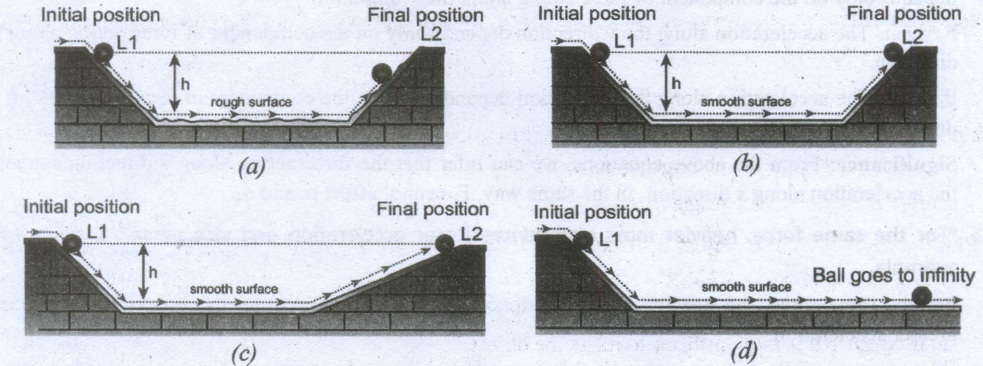
Galileo's experiment with. the second plane (a) at same inclination angle Cisthe first (b) with increased smoothness (c) with reduced angle of inclination (d) with zero angle of inclination
When a ball rolls from the top of an inclined plane to its bottom, after reaching the ground it moves some distance and continues to move on to another inclined plane of same angle of inclination as shown in the Figure (a). By increasing the smoothness of both the inclined planes, the ball reach almost the same height (h) from where it was released (L1) in the second plane (L2) [figure (b)]. The motion of the ball is then observed by varying the angle of inclination of the second plane keeping the same smoothness. If the angle of inclination is reduced, the ball travels longer distance in the second plane to reach the same height [figure (c)). When the angle of inclination is made zero, the ball moves forever in the horizontal direction [figure (d)]. If the Aristotelian idea were true, the ball would not have moved in the second plane even if its smoothness is made maximum since no force acted on it in the horizontal direction.

11th Standard Syllabus & Materials
11th Standard
TN 11th Tamil பீடு பெற நில் - செய்யுள் - காவடிச்சிந்து Important Questions And Answers Study Material - QB365 Set A
NEW11th Standard
TN 11th Tamil பீடு பெற நில் - உரைநடை - மலை இடப்பெயர்கள் : ஓர் ஆய்வு Important Questions And Answers Study Material - QB365 Set A
NEW11th Standard
TN 11th Tamil மாமழை போற்றுதும் - துணைப்பாடம் - யானை டாக்டர் Important Questions And Answers Study Material - QB365 Set A
NEW11th Standard
TN 11th Tamil மாமழை போற்றுதும் - செய்யுள் - ஐங்குறுநூறு Important Questions And Answers Study Material - QB365 Set A



Tamilnadu Stateboard 11th Standard Subjects

Maths

Commerce

Economics

Biology

Business Maths and Statistics

Accountancy

Computer Science
Physics

Chemistry
Maths
Biology
Economics
Physics
Chemistry

History
Business Maths and Statistics

Computer Science
Accountancy

Computer Applications
History
Computer Technology
Commerce
Computer Applications
Computer Technology

Tamil

English

French
Tamilnadu Stateboard Standards

