
 100% FREE ACCESS
11th Standard Syllabus & Materials
11th Standard
TN 11th Tamil இயற்கை வேளாண்மை,சுற்றுச்சூழல் -செய்யுள் - மனோன்மணீயம் Important Questions And Answers Study Material - QB365 Set A
NEW11th Standard
TN 11th Tamil என்னுயிர் என்பேன் -துணைப்பாடம் - இசைத்தமிழர் இருவர் Important Questions And Answers Study Material - QB365 Set A
NEW11th Standard
TN 11th Tamil மொழி கலை -செய்யுள் - ஒவ்வொரு புல்லையும் Important Questions And Answers Study Material - QB365 Set A
NEW11th Standard
TN 11th Tamil பீடு பெற நில் - இலக்கணம் - பகுபத உறுப்புகள் Important Questions And Answers Study Material - QB365 Set A
NEW11th Standard
TN 11th Tamil பீடு பெற நில் - துணைப்பாடம் - வாடிவாசல் Important Questions And Answers Study Material - QB365 Set A
NEW11th Standard
TN 11th Tamil பீடு பெற நில் - செய்யுள் - குறுந்தொகை Important Questions And Answers Study Material - QB365 Set A

Published on: 14/03/2020
11th Standard Accountancy English Medium All Chapter Book Back and Creative Three Marks Questions 2020
Download Tamil Nadu 11th Standard Accountancy question papers, model tests, one-mark questions, important questions, and public exam papers in PDF format. Free study materials and answer keys for TN State Board students.
Questions + Answers key
Take MCQ Accountancy Test
1.
What is opearating system? Give two examples.
2.
Write any three examples of revenue expenditure.
3.
What are the classifications of expenditures?
4.
What is Depletion method?
5.
What are the types of errors at the stage of preparing trial balance?
6.
Why is the preparation of Bank Reconciliation Statement necessary?
7.
Write notes on posting the petty cash book.
8.
What is cash book? What are its features?
9.
Write notes on rectifying entries.
10.
Write notes on closing entries.
11.
What is Accounting Standards in the words of Kohler?
12.
What are the steps in posting?
13.
From the following information prepare balance sheet of Mrs. Nasreenkhan as at 31st December 2017.
| Particulars | Rs. | Particulars | Rs. |
|---|---|---|---|
| Goodwill | 10,000 | Sundry debtors | 25,000 |
| Capital | 90,000 | Drawings | 15,000 |
| Cash in hand | 10,000 | Land and buildings | 30,000 |
| Investment | 500 | Bank | 10,000 |
| Net profit | 46,900 | Creditors | 31,500 |
| Bills receivable | 6,500 | Plant and Machinery | 20,000 |
| Bills payable | 5,350 | Closing stock | 40,000 |
| Furniture | 6,750 |
14.
M/s. Shankar & Co. purchased a machinery on 01-01-2012 for Rs. 10,00,000. The firm writes off depreciation at 10% on the original cost every year. The books are closed on 31st March every year. Pass the necessary journal entries.
15.
What are the need for preparing a Balance sheet?
16.
Explain the types of People Interact.
17.
The Trial balance shows the followings:
Capital as on 31-03-2013 Rs.6,00,000 .
Drawings as on 31-03-2013 Rs.50,000
Charge interest on drawings @ 5% pass adjusting entry. Show how this item appear in the final accounts.
18.
Explain the concept of Matching Principle.
19.
Following are some accounting errors. Rectify the same through Suspense Alc.
(i) Goods Purchased from Manohar of Rs. 2,500 has been posted to the debit of his account.
(ii) Cash of Rs. 4,500 paid to Munish was credited to Manish.
(iii) Discount Rs. 100 allowed to Anthony was not debited to discount account.
20.
Imagine that you are the owner of a small shop. You maintain the three column cash book for your business. Now, think on the following points and discuss with the whole class:
• How often would you check your cash balance in hand? Everyday/once in a week?
• Why do you check your cash balance?
• How will you make sure that the bank column in cash book is correct and is the same as shown by the bank statement?
21.
From the following information, prepare bank reconciliation statement as on 31st December, 2017 to find out the balance as per bank statement.
| Particulars | Rs | |
|---|---|---|
| (i) | Balance as per bank statement | 6,000 |
| (ii) | Cheques deposited on 28th December, 2017 but not yet credited | 2,000 |
| (iii) | Cheques issued for 10,000 on 20th December, 2017 but not yet presented for payment | 3,000 |
| (iv) | Interest on debentures directly collected by the bank not recorded in cash book | 4,000 |
| (v) | Insurance premium on building directly paid by the bank | 1,000 |
| (vi) | Amount wrongly credited by bank | 500 |
22.
Enter the following transactions in a single column cash cash book of Pradeep for April, 2017
| April | Particulars | Rs |
|---|---|---|
| 1 | Commenced Bussiness with cash | 27,000 |
| 5 | Bought goods for cash | 6,000 |
| 10 | Goods sold for cash | 11,000 |
| 13 | Paid into bank | 5,000 |
| 14 | Goods sold to Sangeetha for cash | 9,000 |
| 17 | Goods purchased from Preethi on credit | 13,000 |
| 21 | Purchased stationery by cash | 200 |
| 25 | Paid Murugan by cash | 14,000 |
| 26 | Commission paid by cash | 700 |
| 29 | Drew from bank for office use | 4,000 |
| 30 | Rent paid by cheque | 3,000 |
23.
Enter the following transactions in a simple cash book of Kuna
| 2017 | ||
|---|---|---|
| Jan | Rs | |
| 1 | Cash in hand | 11,200 |
| 5 | Received from ramesh | 300 |
| 7 | Pain Rent | 30 |
| 8 | Sold goods for cash | 300 |
| 10 | Paid mohan | 700 |
| 27 | Purchased furniture for cash | 200 |
| 31 | Paid salaries | 100 |
24.
The following balances are extracted from the books of Murali, as on 31st March, 2017. Prepare trial balance.
| Particulars | Rs | Particulars | Rs |
|---|---|---|---|
| Sales | 35,000 | Audit fees | 1,000 |
| Interest paid | 350 | Octroi duty | 8,000 |
| Returns inward | 2,500 | Land | 90,000 |
| Depreciation | 2,400 | Capital | 60,000 |
| Office rent | 2,000 | Bank overdraft | 11,250 |
25.
Prepare cash account from the following transactions for the month of January 2018. (Direct Ledger Posting)
| Jan 1 | Commenced business with cash Rs. 62,000 |
| 3 | Goods purchased for cash Rs. 12,000 |
| 10 | Goods sold for cash Rs. 10,000 |
| 12 | Wages paid Rs. 4,000 |
| 25 | Furniture purchased for cash Rs. 6,000 |
26.
What is the difference between cash transaction and credit transactions?
27.
Give the adjusting entries for interest on capital and interest on drawings.
28.
Explain how closing stock is treated in final accounts.
29.
State the input and output devices of a computer system.
30.
Mention any three limitations of computerised accounting system.
31.
Rectify the following errors assuming that the trial balance is already prepared and the difference was placed to suspense account:
(a) Sales book was undercast by Rs.250
(b) Purchases book was undercast by Rs.120
(c) Sales book was overcast by Rs.130
(d) Bills receivable book was undercast by Rs.75
(e) Purchases book was overcast by Rs.35.
32.
State the advantages and limitations of straight line method of depreciation.
33.
What are the objectives of providing depreciation?
34.
Ascertain net profit or net loss from the following:
| Particulars | Rs | Particulars | Rs |
|---|---|---|---|
| Gross profit | 12,000 | Administration expenses | 4,000 |
| Salary (office) | 9,000 | Freight outwards | 3,000 |
| Apprenticeship premium received | 5,000 | Advertisement | 2,000 |
35.
What is meant by closing entries? Why are they passed?
36.
The following errors were located after the preparation of the trial balance. Assume that there exists a suspense account. Rectify them.
(a) Sale of goods on credit to Arun for Rs. 152 posted to his account as Rs. 125.
(b) Bought goods from Lakshmi on credit for Rs. 550, credited to her account as Rs. 505.
(c) Purchase of furniture from Abirupa for Rs. 404 on credit was debited to furniture account as Rs. 440.
(d) Purchased machinery for cash Rs. 200 was not posted to machinery account.
(e) The total of purchases book Rs. 89 was carried forward as Rs. 98.
37.
Distinguish between capital receipt and revenue receipt.
38.
Distinguish between capital expenditure and revenue expenditure.
39.
Write the transactions from the Journal Entries.
Drawings A/c Dr
To Purchases
40.
Write the transactions from the Journal Entries
Cash A/c Dr.
Discount Alc Dr.
To Aravind A/c
41.
State the timing differences in BRS with examples.
42.
Show the accounting equation on the basis of the following transactions:
i) Ramya started business with Cash Rs.25,000
ii) Purchases goods from Harsha Rs.20,000
iii) Sold goods to Amala costing Rs.18,000 Rs.25,000
iv) Ramya withdrew from business Rs.5,000
43.
From the following balances extracted from the books of Mrs. Kokila, prepare trial balance as on 31.03.2017.
| Rs | Rs | ||
| Purchases | 40,000 | Advertisement | 4,000 |
| Rent paid | 2,000 | Generalexpenses | 700 |
| Discount received | 1,000 | Commission paid | 1,500 |
| Carriage inward | 2,700 | Capital | 50,000 |
| Closing stock | 38,600 | Sales | 38,500 |
44.
Post the following transactions direct into ledger of Akbar.
| 2018 March | Rs | |
| 1 | Bought goods for Cash | 25,000 |
| 2 | Sold goods for Cash | 50,000 |
| 3 | Bought goods for Credit from Gopi | 19,000 |
| 5 | Sold goods on Credit to Robert | 8,000 |
| 7 | Received from Robert | 6,000 |
| 9 | Paid to Gopi | 5,000 |
| 20 | Bought furniture for Cash | 7,000 |
45.
State the principles of double entry system of bookkeeping.
46.
Write short notes on :
(a) Endorsement of a bill and
(b) Discounting of a bill
47.
What are the advantages of subsidiary books?
48.
How is posting made from the journal to the ledger?
49.
What are the objectives of preparing trial balance?
50.
What is the need for preparing trial balance?
51.
What are the objectives of book-keeping?
52.
Briefly explain the following terms
a) Account
b) Voucher
c) Invoice
53.
"Business units last indefinitely". Mention and explain the concept on which the statement is based.
54.
What is matching concept? Why should a business concern follow this concept?
55.
Explain the meaning of accounting.
56.
Discuss briefly the branches of accounting.
1.
A set of tools and programs to manage the overall working of a computer using a defined set of hardware components is called an operating system.
Example:
1. DOS
2. Windows.
2.
1. Purchase of goods for sale
2. Administrative, selling and distribution expenses
3. Manufacturing expenses
3.
1. Capital expenditure
2. Revenue expenditure
3. Deferred revenue expenditure
4.
Depletion means exhaustion of natural resources. That is depletion means quantitative reduction in the content of assets. This is applicable to those assets that get exhausted due to extraction and exploitation. Examples: mines and oil fields, etc. Under this method, depreciation rate is calculated on the basis of the estimated quantities of the output during the whole life of the asset.
5.
(i) Error of Omission
(ii) Error of Commission:
(a) Entering to wrong account
(b) Entering wrong amount
(c) Entering to the wrong side of trial balance, etc.
6.
Preparation of Bank Reconciliation Statement and its importance:
Normally entries in the cash book should tally (agree) with those in the pass book and the balances shown by both the books should be the same. But in practice the balances may generally differ. In case of disagreement in the balance of the cash book and the pass book, on a particular date the need for preparing 'Bank Reconciliation Statement' arises. After tracing the various items of difference, the statement is prepared.
The following are the advantages of bank reconciliation statement in which lies its importance:
(i) The errors that might have taken place in the cash book in connection with bank transactions can be easily found.
(ii) Regular preparation of bank reconciliation statement prevents frauds.
(iii) It directly imposes moral check on the accounting staff.
(iv) By the preparation of this statement, uncredited cheques can be detected and steps can be taken for their collection.
7.
Posting of entries in the petty cash account:
(i) When petty cash is advanced at the beginning:
A separate petty cash account is opened in the ledger. When advance is received by the petty cashier, petty cash account will be debited and cash account will be credited.
(ii) When individual expenses column are periodically totalled. The total of various petty expenses are debited and the petty cash account is credited with the total of the payments made.
The petty cash account will show the balance of cash. This balance will be shown in the balance sheet as part of cash balance.
8.
Cash book: It is a special journal (subsidiary book) which is used to record all cash receipts and cash payments. It is a book of original entry or prime entry since transactions are recorded for the first time from the source document.
The features of cash book are:
(i) It is one of the subsidiary books.
(ii) It is a book of original entry.
(iii) The cash book is a ledger. It is designed in the form of a cash account.
(iv) It records all cash receipts on the debit side and all cash payments on the credit side.
(v) It always shows debit balance, as payments can never exceed cash available.
9.
Rectifying entries are passed for rectifying the errors which might have committed in the books of accounts.
Example: Purchase of furniture for Rs. 10,000 was wrongly debited in Purchases A/c. To rectify the error the following entry is to be passed.
| Date | Particulars | L.F. | Debit Rs. | Credit Rs. | |
|---|---|---|---|---|---|
| 31.12.13 | Furniture A/c | Dr. | 10,000 | ||
| To Purchases A/c | 10,000 | ||||
| (Wrong debit of purchases Alc rectified) |
10.
Closing entries are recorded at the end of the accounting year for closing the accounts relating to expenses and revenues. The accounts are closed by transferring the balances to the Trading Alc and Profit and Loss A/c.
Example: On 31.12.2013 salaries account shows Rs. 15,000 - the closing entry is,
| Date | Particulars | L.F. | Debit Rs. | Credit Rs. | |
|---|---|---|---|---|---|
| 31.12.13 | Profit and Loss A/c | Dr. | 15,000 | ||
| To Salaries A/c | 15,000 | ||||
| (Closing entry for the salaries A/c) |
11.
"Accounting standards are codes of conduct imposed by customs, law or professional bodies for the benefit of public accountants and accountants generally".
From the above statement, Accounting Standards are written policy documents issued by the expert accounting body or by government or other regulatory body.
12.
Steps in posting:
(i) Procedure of posting for an account which has been debited in the journal entry:
Step 1: Locate in the ledger, the account to be debited and enter the date of the transaction in the date column on the debit side.
Step 2: Record the name of the account credited in the journal in the particulars column on the debit side as "To .......... (name of the account credited)".
Step 3: Record the page number of the journal in the J.F. column on the debit side of the ledger. And in the journal, write the page number of the ledger on which a particular account appears in the L.F. column.
Step 4: Enter the relevant amount in the amount column on the debit side.
(ii) Procedure of posting for an account which has been credited in the journal entry:
Step 1: Locate in the ledger, the account to be credited and enter the date of the transaction in the date column on the credit side.
Step 2: Record the name of the account debited in the journal in the particulars column on the credit side as "By................ (name of the account debited)".
Step 3: Record the page number of the journal in the J.F. column on the credit side in the ledger. And in the journal, write the page number of the ledger on which a particular account appears in the L.F column.
Step 4: Enter the relevant amount in the amount column on the credit side.
13.
| Liabilities | Rs. | Rs. | Assets | Rs. | Rs. |
|---|---|---|---|---|---|
| Creditors | 31,500 | Cash in hand | 10,000 | ||
| Bills payable | 5,350 | Bank | 10,000 | ||
| Capital | 90,000 | Sundry debtors | 25,000 | ||
| Add: Net Profit | 46,900 | Bills receivable | 6,500 | ||
| 1,36,900 | Closing stock | 40,000 | |||
| Less: Drawings | 15,000 | 1,21,900 | Investments | 500 | |
| Land and Buildings | 30,000 | ||||
| Furniture | 6,7500 | ||||
| Plant & Machinery | 20,000 | ||||
| Goodwill | 10,000 | ||||
| 1,58,750 | 1,58,750 |
14.
| Date | Particulars | L.F | Debit (Rs) |
Credit (Rs) |
|
|---|---|---|---|---|---|
| 2012 Jan 01 | Machinery A/c | Dr | 10,00,000 | ||
| To Bank A/c | 10,00,000 | ||||
| (Machinery Bought) | |||||
| 2012 Mar 31 | Depreciation A/c | Dr | 25,000 | ||
| To Machinery A/c | 25,000 | ||||
| (Being depreciation @ 10% provided for 3 months) | |||||
| Profir and Loss A/c | Dr | 25,000 | |||
| To Depreciation A/c | 25,000 | ||||
| (Being the closure of depreciation account) | |||||
| 2013 Mar 31 | Depreciation A/c | Dr | 1,00,000 | ||
| To Machinery A/c | 1,00,000 | ||||
| (Being depreciation @ 10% provided) | |||||
| Profit and Loss A/c | Dr | 1,00,000 | |||
| To Depreciation Alc | 1,00,000 | ||||
| (Being the closure of depreciation account) | |||||
| 2014 Mar 31 | Depreciation A/c | Dr | 1,00,000 | ||
| To Machinery A/c | 1,00,000 | ||||
| (Being depreciation @ 10% provided) | |||||
| Profit and Loss A/c | Dr | 1,00,000 | |||
| To Depreciation A/c | 1,00,000 | ||||
| (Being the closure of depreciation account) |
15.
The purposes of preparing a balance sheet are as follows:
(i) The main purpose of preparing a balance sheet is to ascertain the true financial position of the business at a particular point of time.
(ii) It helps in comparing the cost of various assets of the business such as the amount of closing stock, amount due from debtors, amount of fictitious assets, etc.
(iii) It helps in finding out the solvency position of the firm. The firm's solvency position is favourable if the assets exceed the external liabilities.
16.
(a) System Analysts :
People who design the operation and processing of the system.
(b) System Programmers :
People who write codes and programs to implement.the working of the system.
(c) System Operators :
People who operate the system and use it for different purposes. They are also called as end users.
17.
| Date | Particulars | L.F. | Debit Rs. | Credit Rs. | |
|---|---|---|---|---|---|
| 2013 Mar 31 | Capital A/c | Dr. | 2,500 | ||
| To Interest on drawings Al/c (Interest on drawings charged) |
2,500 |
| Particulars | Amount Rs. | Amount Rs. | Particulars | Amount Rs. | Amount Rs. |
|---|---|---|---|---|---|
| By Interest on drawings | 2,500 | ||||
| 2500 |
| Liabilities | Amount Rs. | Amount Rs. | Assets | Amount. Rs. | Amount Rs. |
|---|---|---|---|---|---|
| Capital | 6,00,000 | ||||
| Less: Drawings | 50,000 | ||||
| 5,50,000 | |||||
| Less: Interest on drawings | 2,500 | ||||
| 5,47,500 |
18.
(i) Matching Principle demands that expenses incurred to earn the revenue should be properly matched.
(ii) The expenses and incomes for the current accounting period whether they have been paid or not received or not must be included.
(iii) Similarly, expenses and incomes which do not pertain to current accounting period must be excluded.
19.
| S.No | Particulars | L.F. | Debit Rs | Credit Rs | |
|---|---|---|---|---|---|
| (i) | Suspense A/c | Dr. | 5,000 | ||
| To Manohar A/c | 5,000 | ||||
| (Goods Purchased from Manohar debited to his account is now corrected) | |||||
| (ii) | Manish A/c | Dr. | 4,500 | ||
| Munish A/c | Dr. | 4,500 | |||
| To Suspense A/c | 9,000 | ||||
| (Cash paid to Munish was wrongly credited to Manish, now rectified) | |||||
| (iii) | Discount A/c | Dr. | 100 | ||
| To Suspense A/c | 100 | ||||
| (Discount allowed is not debited to discount A/c) |
20.
We can check cash balance in hand daily alow because such informations received in the business.
• When we check the cash balance, the difference between cash balance and bank balance statement must be known by the business concern.
• We can not make sure that the bank column in cash book in correct and is the same as shown the bank statement. Because the three column cash bank is maintained by the cashier of the business. But the bank statement is maintained by the Banker. No Both will not be recorded as a time. No the difference may be occured. For this purpose of difference, the bank reconciliation statement is prepaned.
21.
| Particulars | Amount Rs | Amount Rs |
|---|---|---|
| Balance as per bank statement | 6,000 | |
| Add: Cheque deposited but not yet credited | 2,000 | |
| Insurance premium on building directly paid by the bank | 1,000 | 3,000 |
| 9,000 | ||
| Less: Cheque issued but not yet presented for payment | 3,000 | |
| Interest on debentures directly collected by the bank not entered in cash book | 4,000 | |
| Amount wrongly credited by bank | 500 | 7,500 |
| Balance as per cash book | 1,500 |
22.
| Date | Receipts | L.F | Amount Rs. | Date | Payments | L.F | Amount Rs. |
| 2017 | 2017 | ||||||
| Apr.1 | To Pradeep's capital Alc | 27,000 | Apr.5 | By Purchases Alc | 6,000 | ||
| 10 | To Sales Alc | 11,000 | 13 | By BankA/c | 5,000 | ||
| 14 | To Sales Alc | 9,000 | 21 | By Stationery Alc | 200 | ||
| 29 | To Bank Alc | 4,000 | 25 | By Murugan Alc | 14,000 | ||
| 26 | By Commission A/c | 700 | |||||
| 30 | By Balance c/d | 25,100 | |||||
| 51,000 | 51,000 | ||||||
| May 1 | To Balance B/d | 25,100 |
23.
| Date | Particulars | L.F | Amount Rs | Date | Payments | L.F | Amount Rs |
|---|---|---|---|---|---|---|---|
| 2017 | 2017 | ||||||
| Jan.1 | To Balance b/d | 11,200 | Jan.7 | By rent A/c | 30 | ||
| Jan.5 | To Ramesh A/c | 300 | Jan.10 | By Mohan A/c | 700 | ||
| Jan.8 | To Sales A/c | 300 | Jan.27 | by Furniture | 200 | ||
| Jan.31 | By Salaries A/c | 100 | |||||
| Jan.31 | By Balance C/d | 10,770 | |||||
| 11,800 | 11,800 | ||||||
| Feb.1 | To Balance B/d | 10,770 |
24.
In the books of Murali Trial balance as on 31st March, 2017
| S.No. | Name of the account | L.F. | Debit balance Rs. |
Credit balance Rs. |
|---|---|---|---|---|
| 1. | Sales | 35,000 | ||
| 2. | Interest paid | 350 | ||
| 3. | Returns inward | 2,500 | ||
| 4. | Depreciation | 2,400 | ||
| 5. | Office rent | 2,000 | ||
| 6. | Audit fees | 1,000 | ||
| 7. | Octroi duty | 2,000 | ||
| 8. | Land | 90,000 | ||
| 9. | Capital | 60,000 | ||
| 10. | Bank overdraft | 11,250 | ||
| Total | 1,06,250 | 1,06,250 | ||
25.
| Date | Particulars | J.F. | Rs. | Date | Particulars | J.F. | Rs. |
|---|---|---|---|---|---|---|---|
| 2018 | 2018 | ||||||
| Jan. 1 | To Capital A/c | 62,000 | Jan 3 | By Purchase A/c | 12,000 | ||
| 10 | To Sales A/c | 10,000 | 12 | By Wages A/c | 4,000 | ||
| 25 | By Furniture A/c | 6,000 | |||||
| 31 | By Balanced c/d | 50,000 | |||||
| 72,000 | 72,000 | ||||||
| Feb 1 | By Balance b/d | 50,000 |
26.
| Cash transaction | Credit transaction |
|---|---|
| It is a transaction which involves immediate cash receipt or immediate cash payment. | It is a transaction in which cash is not received or paid immediately but will be received or paid later. |
27.
| Date | Particulars | L.F. | Debit Rs | Credit Rs | |
|---|---|---|---|---|---|
| Iriterest on capital A/c | Dr | xxxxxx | |||
| To Capital A/c | xxxxxx | ||||
| (Interest on capital due) |
| Date | Particulars | L.F. | Debit Rs | Credit Rs | |
|---|---|---|---|---|---|
| capital A/c | Dr | xxxxxx | |||
| To Interest on drawings A/c | xxxxxx | ||||
| (Interest on drawings) |
28.
(i) The unsold goods in stock at the end of the accounting period is termed as closing stock. The stock is valued at cost price or not realisable value whichever is lower.
(ii) The valuation principle is based on the convention of conservatism.
| Date | Particulars | L.F. | Debit Rs | Credit Rs | |
|---|---|---|---|---|---|
| Closing Stock A/c | Dr | xxxxxx | |||
| To Trading A/c | xxxxxx | ||||
| (Closing Stock brought into Account) |
Value of Closing Stock will appear :
(a) On the credit side of trading account and
(b) On the assets side of balance sheet.
29.
(i) Input Devices:
(a) Keyboard
(b) Optical scanner
(c) Mouse
(d) Joystick
(ii) Output Devices:
(a) Monitor
(b) Printer
30.
(i) Heavy cost of installation:
Computer hardware needs replacement and software needs to be updated from time to time with the availability of newer versions.
(ii) Cost of training:
To ensure effective and efficient use of computerised system of accounting, newer versions of hardware and software are to be introduced.
(iii) Fear of unemployment:
On account of the introduction of computerised accounting system, the employees feel insecure that they may lose employment and show less interest in computer related work.
31.
| S.No. | Particulars | L.F. | Debit Rs | Credit Rs. | |
|---|---|---|---|---|---|
| (a) | Suspense A/c | Dr. | 250 | ||
| To Sales A/c | 250 | ||||
| (Being the uridercasting of sales book now rectified) | |||||
| (b) | Purchases A/c | Dr. | 120 | ||
| To Suspense A/c | 120 | ||||
| (Being the undercasting of Purchase book now rectified) | |||||
| (c) | Sales A/c | Dr. | 130 | ||
| To Suspense A/c | 130 | ||||
| (Being the overcasting the sales book now rectified) | |||||
| (d) | Bills receivable A/c | Dr. | 75 | ||
| To Suspense A/c | 75 | ||||
| (Being bills receivable book undercast, now rectified) | |||||
| (e) | Suspense A/c | Dr. | 35 | ||
| To Purchases A/c | 35 | ||||
| (Being Purchase book was overcast by Rs 35, now rectified) |
32.
Merits:
Following are the merits of straight line method of depreciation:
(a) Simple and easy to understand: Computation of depreciation under this method is very simple and is easy to understand.
(b) Equality of depreciation burden: Under this method, equal amount of depreciation is debited to the profit and loss account each year.
(c) Assets can be completely written off: Under this method, the book value of an asset can be reduced to zero if there is no scrap value or to the scrap value at the end of its useful life.
(d) Suitable for the assets having fixed working life: This method is appropriate for the fixed assets having certain fixed period of working life.
Limitations:
Following are the limitations of straight line method of depreciation:
(a) Ignores the actual use of the asset: Under this method, a fixed amount of depreciation is provided, on each asset by applying the predetermined rate of depreciation on its original cost.
(b) Ignores the interest factor: This method does not take into account the loss of interest on the amount invested in the asset.
(c) Total charge on the assets will be more when the asset becomes older: With the passage of, time, the cost of maintenance of an asset goes up. Hence, the amount of depreciation and cost of maintenance put together is less in the initial period and goes up year after year.
(d) Difficulty in the determination of scrap value: It may be quite difficult to assess the true scrap value of the asset after a long period say 10 or 15 years after the date of its installation.
33.
Following are the objectives of providing depreciation:
(i) To find out, the true profit or loss:
(a) When all asset is used for generating income for a business, the reduction in the value of the asset proportionate to the benefit derived from it, should be charged against the revenue.
(b) This is to be done to find out the true profit or loss of the business for every accounting period.
(ii) To present the true and fair view of financial position:
(a) When the depreciation is charged on fixed assets, the book value of fixed assets are reduced to that extent and the remaining value is shown in the balance sheet.
(b) The balance represents the value of benefit that is yet to be derived from them.
(iii) To facilitate replacement of fixed assets:
(a) Depreciation is a non-cash item. That is why, when the depreciation is debited to profit and loss account, an equal amount is retained in the business.
(b) When the life of an asset comes to an end, a new asset can be purchased by using the resources available in the business.
(iv) To Comply with legal requirements :
Depreciation is provided on fixed assets to comply with the provisions, of law.
34.
| Particulars | Rs. | Particulars | Rs. |
|---|---|---|---|
| To Salary (office) | 9,000 | By Gross profit | 12,000 |
| To Administration expenses | 4,000 | By Apprenticeship Premium received | 5,000 |
| To Freight outwards | 3,000 | By Net loss (transferred to capital a/c) | 1,000 |
| To Advertisement | 2,000 | ||
| 18,000 | 18,000 |
35.
(i) Balances of all the nominal accounts and accounts are required to be closed on the last day of the accounting year to facilitate the preparation of trading and profit and loss account.
(ii) It is done by passing necessary closing entries in the journal proper. Purchases has debit balance and purchases returns has credit balance.
(iii) Similarly, sales account has credit balance and sales returns has debit balance.
(iv) At the end of the accounting year, the balance in sales returns account is closed by transferring to sales account.
(e.g.) For Closing purchases returns Account
| S.No. | Particulars | Debit(Rs.) | Credit(Rs.) | |
|---|---|---|---|---|
| 1. | Purchases Returns A/c | Dr. | xxxxx | |
| To Purchases A/c | xxxxx | |||
| (Closing of purchase returns account by transferring to Purchases Account) |
36.
| Particulars | L.F. | Dr. | Cr. | ||
|---|---|---|---|---|---|
| a | Arun A/c | Dr. | 27 | 27 | |
| To Suspense A/c | |||||
| (Wrong amount posted to Arun account rectified) | |||||
| b | Suspense A/c | Dr. | 45 | ||
| To Lakshmi A/c | 45 | ||||
| (Short credit to Lakshmi account rectified) | |||||
| c | Suspense A/c | Dr. | 36 | ||
| To Furniture A/c | 36 | ||||
| (Excess debit to furniture account rectified) | |||||
| d | Machinery A/c | Dr | 200 | ||
| To Suspense A/c | 200 | ||||
| (Omission to debit machinery account rectified) | |||||
| e | Suspense A/c | Dr | 9 | ||
| To Purchases A/c | 9 | ||||
| (Excess amount carried forward to purchases account rectified) |
37.
| Basis | Capital receipts | Revenue receipts |
|---|---|---|
| 1. Nature | Non-recurring in nature | Recurring in nature |
| 2. Size | Amount is generally substantial | Amount is generally smaller |
| 3.Distribution | These amounts are not available for distribution as profits | The excess of revenue receipts over the revenue expenses can be used for distribution as profits. |
38.
| Basis | Capital expenditure | Revenue expenditure |
|---|---|---|
| i) Nature | It is non - recurring in nature | It is recurring in nature |
| ii) Purpose | To contribute to the revenue earning capacity of the business. | To carry on the day to day activities of the business |
| iii) Period of benefits | Its benefit is available for a longer period. | Its benefit is obtained within one accounting period. |
| iv) Effect on profit earning capacity | It increases the profit earning capacity of the business. | It maintains the profit earning capacity of the business. |
| v) Accounting treatment | It will appear on the assets side of the balance sheet. | It will be shown on the debit side of the trading and profit and loss account depending on whether direct or indirect in nature. |
39.
Goods used for Personal use.
40.
Aravind settled his Account
41.
(a) Cheques issued but not yet presented for payment: When the cheques are issued by the business, it is immediately entered on the credit side of the cash book by the business. But, this may not be entered in the bank statement on the same day. It will be entered in the bank statement only after it is presented with the bank.
For example, the balances as per cash book and bank statement are Rs. 20,000 for X & Co. X & Co. issued a cheque in favour of Y & Co for Rs. 10,000, on 27th March 2017. So, X & Co's cash book is credited with Rs. 10,000 on 27th March 2017.
(b) Cheques deposited into bank but yet credited: When the cheques are deposited into bank, the amount is debited in the cash book on the same day. But, these may not be shown in the bank passbook on the same day because these will be entered in the bank statement only after the collection of the cheques.
For example, the balances as per cash book and bank statement are Rs. 20,000 for X & Co. X & Co. receives a cheque on 25th March 2016, from ABC Limited for Rs. 5,000. On the same day, X & Co, debits its cash book with Rs. 5,000.
(c) Bank charges and Interest on loan and overdraft by the bank: The bank has to cover the cost of running the customer's account. So debit is given to the account of the business towards bank charges.
For example, the opening balance as per cash book and the bank statement as on 1st March 2017 is Rs. 7,000. Bank debits for bank charges Rs. 300 as on 27th March 2017. But there is no entry for the same in the cash book as on such date.
42.
| S.no | Transaction | Cash | Stock | Debtors | Total Assets | Total Liabilities | Capital | Creditors | |
|---|---|---|---|---|---|---|---|---|---|
| i) | Ramya started business | +25,000 | - | - | +25,000 | ||||
| Balance | +25,000 | +25,000 | |||||||
| Equation | +25,000 | = | +25,000 | ||||||
| ii) | Credit purchases | +20,000 | +20,000 | ||||||
| Balance | +25,000 | +20,000 | +25,000 | +20,000 | |||||
| Equation | +45,000 | = | +45,000 | ||||||
| ii) | Credit Sales | -18,000 | +25,000 | +,7000 | |||||
| Balance | +25,000 | +2,000 | +25,000 | +32,000 | +20,000 | ||||
| Equation | +52,000 | = | +52,000 | ||||||
| iv) | Cash withdraw for personal use | -5,000 | -5,000 | ||||||
| Balance | +20,000 | +2,000 | +25,000 | +27,000 | +20,000 | ||||
| Equation | +47,000 | = | +47,000 |
43.
| S.No | Name of account | L.F | Debit balance Rs |
Credit balance Rs |
| 1 | Purchases | 40,000 | ||
| 2 | Rent paid | 2,000 | ||
| 3 | Discount received | 1,000 | ||
| 4 | Carriage inward | 2,700 | ||
| 5 | Closing stock | 38,600 | ||
| 6 | Advertisement | 4,000 | ||
| 7 | General expenses | 700 | ||
| 8 | Commission paid | 1,500 | ||
| 9 | Capital | 50,000 | ||
| 10 | Sales | 38,500 | ||
| Total | 89,500 | 89,500 |
44.
| Date | Particulars | J.F. | Amount Rs | Date | Particulars | J.F. | Amount Rs |
| 2018 Mar. 5 | To Sales A/c | 50,000 | 2018 Mar. 1 | By Purchases A/c | 25,000 | ||
| 7 | To Robert A/c | 6,000 | 9 | By Gopi A/c | 5,000 | ||
| 20 | By Furniture A/c | 7,000 | |||||
| 31 | By Balance c/d | 19,000 | |||||
| 56,000 | 56,000 | ||||||
| 2018 Apr. 1 | To Balance b/d | 19,000 |
| Date | Particulars | J.F. | Amount Rs | Date | Particulars | J.F. | Amount Rs |
| 2018 Mar. 1 | To Cash A/c | 25,000 | 2018 Mar 31 | By Balance c/d | 44,000 | ||
| 3 | To Gopi A/c | 19,000 | |||||
| 44,000 | 44,000 | ||||||
| 2018 Apr. 1 | To Balance b/d | 44,000 |
| Date | Particulars | J.F. | Amount Rs | Date | Particulars | J.F. | Amount Rs |
| 2018 Mar. 31 | To Balance c/d | 58,000 | 2018 Mar. 2 | By Cash A/c | 50,000 | ||
| 5 | By Robert A/c | 8,000 | |||||
| 58,000 | 58,000 | ||||||
| 2018 Apr. 1 | By Balance b/d | 58,000 |
| Date | Particulars | J.F. | Amount Rs | Date | Particulars | J.F. | Amount Rs |
| 2018 Mar. 20 | To Cash A/c | 7,000 | 2018 Mar. 31 | By Balance c/d | 7,000 | ||
| 7,000 | 7,000 | ||||||
| 2016 Apr. 1 | To Balance b/d | 7,000 |
| Date | Particulars | J.F. | Amount Rs | Date | Particulars | J.F. | Amount Rs |
| 2018 Mar. 9 | To Cash A/c | 5,000 | 2018 Mar 03 | By Purchases A/c | 19,000 | ||
| 31 | To Balance c/d | 14,000 | |||||
| 19,000 | 19,000 | ||||||
| 2018 Apr 01 | By Balance b/d | 14,000 |
| Date | Particulars | J.F. | Amount Rs | Date | Particulars | J.F. | Amount Rs |
| 2018 Mar. 5 | To Sales A/c | 8,000 | 2018 Mar. 7 | By Cash A/c | 6,000 | ||
| 30 | By Balance c/d | 2,000 | |||||
| 8,000 | 8,000 | ||||||
| 2018 Apr. 1 | To Balance b/d | 2,000 |
45.
Following are the principles of double entry system:
(i) In every business transaction, there are two aspects
(ii) The two aspects involved are the benefit or value receiving aspect and benefit or value giving aspect.
(iii) These two aspects involve minimum two accounts; at least one debit and at least one credit.
(iv) For every debit, there is a corresponding and equivalent credit. If one account is debited the other account must be credited.
46.
(a) Endorsement of a bill :
(i) Endorsement means signing on the face or back of a bill for the purpose of transferring the title of the bill to another person. The person who endorses is called the "Endorser".
(ii) The person to whom a bill is endorsed is called the "Endorsee". The Endorsee is entitled to collect the money.
(b) Discounting of a bill :
(i) When the holder of a bill is in need of money before the due date of a bill, he can convert it into cash by discounting the bill with his banker. This process is referred to as the discounting of bill.
(i) The banker deducts a small amount of the bill which is called discount and pays the balance in cash immediately to the holder of the bill.
47.
The advantages of maintaining subsidiary books can be summarised as under :
(i) Proper and systematic record of the business transactions : All the business transactions are classified and grouped conveniently as cash and non cash transactions, which are further classified as credit purchases, credit sales and returns etc.
(ii) Convenient posting: All the transactions of a particular nature are recorded at one place, i.e., in one of the subsidiary books. For Example: All credit purchases of goods are recorded in the purchases book and all credit sales of goods are recorded in the sales book.
(iii) Division of work: As journals are sub-divided, the work will be sub-divided and different persons can work on different books at the same time and the work can be speedily completed.
(iv) Efficiency: The sub-division of work gives the advantage of specialisation. Thus specialisation leads to efficiency in accounting work.
(v) Helpful in decision making: Subsidiary books provide complete details about every type of transactions separately. Hence the management can use the information as the basis for deciding its future actions.
(vi) Prevents errors and frauds: Internal check becomes more effective as the work can be divided in such a manner that the work of one person is automatically checked by another person. With the use of internal check, the possibility of occurrence of errors or fraud may be avoided or minimised.
(vii) Availability of requisite information at a glance : The maintenance of subsidiary books helps in obtaining the necessary information at a glance.
48.
The procedure of posting from journal to ledger is as follows:
(i) Locate the ledger account that is debited in the journal entry. Open the respective account in the ledger if already not opened. Write the name of the account in the top middle. If already opened, locate the account from the ledger index.
(ii) Record the date of the transaction in the date column on the debit side of that account.
(iii) Record the name of the account credited in the Journal with the prefix 'To' in particulars column.
(iv) Record the amount of the debit in the 'Amount column'.
(v) Locate the Ledger account that is credited in the journal entry. Open the respective account in the ledger if already not opened.
(vi) Write the name of the account in the top middle. If already opened, locate the account from the ledger index.
(vii) Record the name of the account debited in the journal entry particulars column with the prefix 'By' and write the amount in the amount column.
49.
Trial balance is prepared with the following objectives:
(i) Test of arithmetical accuracy:
Trial Balance is a means by which the arithmetical accuracy of the book-keeping work is checked.
(ii) Basis for preparing final accounts:
Financial statements, namely, trading and profit and loss account and balance sheet are prepared on the basis of summary of ledger balances obtained from the trial balance.
(iii) Location of Errors:
1) When the Trial balance does not tally, it is an indication that certain errors have occurred.
2) The errors may have occurred at one or more of the stages of the accounting process, namely, journalising or recording in subsidiary books, totalling subsidiary books, posting in ledger accounts, balancing the ledger accounts, carrying ledger account balances to the trial balance, totalling the trial balance columns, etc.
(iv) Summarised information of Ledger Accounts:
1) The summary of ledger accounts is shown in the trial balance.
2) Ledger accounts have to be seen only when details are required in respect of an account
50.
(i) Trial balance helps to check the arithmetical accuracy of entries made in the accounting records.
(ii) Trial balance serves as a lubricant for the smooth movement and completion of the accounting cycle.
(iii) The trial balance helps in discovering errors which may have been committed in the accounting records.
(iv) However, in computerised Accounting system, once the transactions are recorded in the journals, all the other records are made simultaneously, i.e. ledger postings, trial balance and final accounts.
51.
Following are the objectives of book-keeping :
(i) To have a complete and permanent record of all business transactions in chronological order and under appropriate headings.
(ii) To facilitate ascertainment of the profit or loss of the business during a specific period.
(iii) To facilitate ascertainment of financial position.
(iv) To know the progress of the business.
(v) To find out the tax liabilities.
(vi) To fulfill the legal requirements
52.
a) Account:
(i) An Account is the basic unit of accounting.
(ii) Transactions are recorded into various accounts.
(iii) In other words, an account is a summary of transactions under some common head.
b) Voucher:
(i) Any written document in support of a business transaction is called a voucher.
(ii) Example: Cash receipt, invoice, cash memo, bank pay-in slip etc.
c) Invoice:
(i) It is a statement prepared by a seller of goods to be sent to the buyer.
(ii) It shows details of quantity, price, value etc., of the goods and any discount given, finally showing the net amount payable by the buyer.
53.
(i) "Business units last indefinitely". This statement is used in Going Concern Concept.
(ii) Going concern concept influences Accounting practices in relation to valuation of assets and liabilities, depreciation of the fixed assets, treatment of outstanding and prepaid expenses and incomes.
(iii) The values involved in the going concern concept are
1. Growth: By following the going concern concept, business activities are to be carried out for future growth.
2. Preparing for future: By following the going concern assumption, business firm always intends to prepare for the future.
54.
(i) According to this concept, revenues during an accounting period are matched with expenses incurred during that period to earn the revenue during that period.
(ii) This concept is based on accrual concept and periodicity concept.
(iii) Periodicity concept fixes the time frame for measuring performance and determining financial status.
(iv) All expenses paid during the period are not considered, but only the expenses related to the accounting period are considered.
55.
(i) Accounting is the systematic process of identifying, measuring, recording, classifying, summarising, interpreting and communicating financial information.
(ii) Accounting gives information on :
1. the resources available
2. how the available resources have been employed and
3. the results achieved by their use.
(iii) The profit earned or loss incurred during the accounting period, value and nature of assets, liabilities, and capital can be ascertained from the information recorded in accounts.
56.
The various branches of accounting are
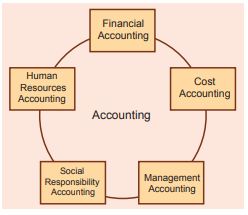
(i) Financial Accounting :
1. It involves recording of financial transactions and events.
2. It provides financial information to the users for taking decisions.
3. It ends up with the preparation of trading and profit and loss account and balance sheet,
(ii) Cost Accounting :
It involves the collection, recording, classification and appropriate allocation of expenditure for the determination of the costs of products or services and for the presentation of data for the purposes of cost control and managerial decision making.
(iii) Management Accounting :
It is concerned with the presentation of accounting information in such a way as to assist management in decision making and in the day-to-day operations of an enterprise.
(iv) Social Responsibility Accounting :
It is concerned with presentation of accounting information from the viewpoint of the society by showing the social costs and social benefits.
(v) Human Resource Accounting :
It is concerned with identification, quantification, and reporting of investments made in human resources of an enterprise.

11th Standard Syllabus & Materials
11th Standard
TN 11th Tamil பீடு பெற நில் - செய்யுள் - காவடிச்சிந்து Important Questions And Answers Study Material - QB365 Set A
NEW11th Standard
TN 11th Tamil பீடு பெற நில் - உரைநடை - மலை இடப்பெயர்கள் : ஓர் ஆய்வு Important Questions And Answers Study Material - QB365 Set A
NEW11th Standard
TN 11th Tamil மாமழை போற்றுதும் - துணைப்பாடம் - யானை டாக்டர் Important Questions And Answers Study Material - QB365 Set A
NEW11th Standard
TN 11th Tamil மாமழை போற்றுதும் - செய்யுள் - ஐங்குறுநூறு Important Questions And Answers Study Material - QB365 Set A



Tamilnadu Stateboard 11th Standard Subjects

Maths

Commerce

Economics

Biology

Business Maths and Statistics
Accountancy

Computer Science

Physics

Chemistry
Maths
Biology
Economics
Physics
Chemistry

History
Business Maths and Statistics

Computer Science
Accountancy

Computer Applications
History
Computer Technology
Commerce
Computer Applications
Computer Technology

Tamil

English

French
Tamilnadu Stateboard Standards
