
 100% FREE ACCESS
11th Standard Syllabus & Materials
11th Standard
TN 11th Tamil இயற்கை வேளாண்மை,சுற்றுச்சூழல் -செய்யுள் - மனோன்மணீயம் Important Questions And Answers Study Material - QB365 Set A
NEW11th Standard
TN 11th Tamil என்னுயிர் என்பேன் -துணைப்பாடம் - இசைத்தமிழர் இருவர் Important Questions And Answers Study Material - QB365 Set A
NEW11th Standard
TN 11th Tamil மொழி கலை -செய்யுள் - ஒவ்வொரு புல்லையும் Important Questions And Answers Study Material - QB365 Set A
NEW11th Standard
TN 11th Tamil பீடு பெற நில் - இலக்கணம் - பகுபத உறுப்புகள் Important Questions And Answers Study Material - QB365 Set A
NEW11th Standard
TN 11th Tamil பீடு பெற நில் - துணைப்பாடம் - வாடிவாசல் Important Questions And Answers Study Material - QB365 Set A
NEW11th Standard
TN 11th Tamil பீடு பெற நில் - செய்யுள் - குறுந்தொகை Important Questions And Answers Study Material - QB365 Set A

Published on: 14/03/2020
11th Standard Business Mathematics English Medium All Chapter Book Back and Creative Five Marks Questions 2020
Download Tamil Nadu 11th Standard Business Maths and Statistics question papers, model tests, one-mark questions, important questions, and public exam papers in PDF format. Free study materials and answer keys for TN State Board students.
Questions + Answers key
Take MCQ Business Maths and Statistics Test
1.
Show that \( f(x)= \begin{cases}5 x-4, & \text { if } 0< x \leq 1 \\ 4 x^3-3 x, & \text { if } 1< x< 2\end{cases}\)
2.
Show that the maximum value of the function f(x) = x3 - 27x + 108 is 108 more than the minimum value.
3.
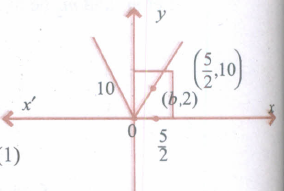
For the following observations, find the regression co-efficient byx and bxy and hence find the correlation co-efficient (4,2)(2,3)(3,2)(4,4)(2,4).
4.
The equations of two regression lines are 4x+3y+7=0 and 3x+4y+8=0.
Find (i) the mean of x and the mean of y
(ii) the regression co-efficient bxy and byx
(iii) the correlation co-efficient between x and y.
5.
The following table use the activities in a building project.
| Activity | 1-2 | 1-3 | 2-3 | 2-4 | 3-4 | 4-5 |
|---|---|---|---|---|---|---|
| Duration (days) | 21 | 26 | 11 | 13 | 5 | 11 |
Draw the network for the project, calculate the earliest start time, earliest finish time, latest start time and latest finish time of each activity and find the critical path. Compute the project duration.
6.
If z = 4x6 - 8x3 - 7x + 6xy + 8y + x3y5, find
(i) \({\partial^2z\over \partial y^2}\) (ii)\(\partial^2 z\over \partial x\partial y\)(iii) \(\partial^2z\over \partial y\partial x\)
7.
In a Shooting test, the probabilities of hitting the target are \(\frac { 1 }{ 2 } \) for A, \(\frac { 2 }{ 3 } \) for B and \(\frac { 3 }{ 4 } \) for C. If all of them fire at the same target, calculate the probabilities that only one of them hit the target.
8.
Find D6,D8,P7 and P20 for the data 57, 58, 61, 42, 38, 65, 72, 66.
9.
Reshma wishes to mix two types of food P and Q in such a way that the Vitamin contents of the mixture contain at least 8 units of vitamin A and 11 units of vitamin B. Food P costs Rs.60/kg and Food Q costs Rs.80/kg. Food P contains 3 units 1 kg of vitamin A and 5 units 1 kg of vitamin B while food Q contains 4 units 1 kg of vitamin A and 2 units 1 kg of vitamin B. Determine the minimum cost of the mixture.
10.
A company has a total capital of Rs.5,00,000 divide into 1000 preference shares of 6% dividend with par value RS.100 each and 4000 ordinary shares of per value Rs.100 each. The company delares an annual dividend of Rs.40,000. Find the dividend received by Sundar having 100 preference shares and 200 ordinary shares.
11.
Equal amounts are invested in 12% stock at 95 (brokerage). If 12% stock brought at Rs.120 more by way of dividend income than the other, find the amount invested in each stock?
12.
Three coins are tossed simultaneously. Consider the events A ‘three heads or three tails’, B ‘atleast two heads’ and C ‘at most two heads’ of the pairs (A, B), (A, C) and (B, C), which are independent? Which are dependent?
13.
Find out the coefficient of mean deviation about median in the following series.
| Age in years | 0-10 | 10-20 | 20-30 | 30-40 | 40-50 | 50-60 | 60-70 | 70-80 |
| No. of persons | 20 | 25 | 32 | 40 | 42 | 35 | 10 | 8 |
Calculations have to be made correct to two places of decimals.
14.
Babu sold some Rs. 100 shares at 10% discount and invested his sales proceeds in 15% of Rs. 50 shares at Rs. 33. Had he sold his shares at 10% premium instead of 10% discount, he would have earned Rs. 450 more. Find the number of shares sold by him.
15.
For the cost function C = 2000 + 1800 x - 75x2 + x3 find when the total cost (C) is increasing and when it is decreasing
16.
The heights ( in cm.) of a group of fathers and sons are given below
| Heights of fathers: | 158 | 166 | 163 | 165 | 167 | 170 | 167 | 172 | 177 | 181 |
| Heights of Sons: | 163 | 158 | 167 | 170 | 160 | 180 | 170 | 175 | 172 | 175 |
Find the lines of regression and estimate the height of son when the height of the father is 164 cm.
17.
A person deposits Rs. 2,000 at the end of every month from his salary towards his contributory pension scheme. The same amount is credited by his employer also. If 8% rate of compound interest is paid, then find the maturity amount at end of 20 years of service. [(1.0067)240 = 4.9661]
18.
For the given lines of regression 3X – 2Y = 5 and X – 4Y = 7. Find
(i) Regression coefficients
(ii) Coefficient of correlation
19.
The demand for a commodity A is q = 80 - \({ p }_{ 1 }^{ 2}\) + 5p2 - p1p2. Find the partial elasticities \(\frac { { E }q }{ { E }p_{ 1 } } \) and \(\frac { { E }q }{ { E }p_{ 2 } } \) when p1 = 2, p2 = 1.
20.
A Project has the following time schedule
| Activity | 1-2 | 2-3 | 2-4 | 3-5 | 4-6 | 5-6 |
| Duration (in days) | 6 | 8 | 4 | 9 | 2 | 7 |
Draw the network for the project, calculate the earliest start time, earliest finish time, latest start time and latest finish time of each activity and find the critical path. Compute the project duration.
21.
Solve the following LPP by graphical method Minimize z = 5x1 + 4x2 Subject to constraints 4x1 + x2 ≥ 40 ; 2x1 + 3x2 ≥ 90 and x1, x2 > 0.
22.
If \(sin\left( { sin }^{ -1 }\left( \frac { 1 }{ 5 } \right) +{ cos }^{ -1 }(x) \right) =1\) then find the value of x
23.
Prove that cos 20° cos 40° cos 60° cos 800 = \(\frac { 1 }{ 16 } \)
24.
An arch is in the form of a parabola with its axis vertical. The arch is 10 m high and 5 m wide at the base. How high is the arch 2 m from the vertex of the parabola?
25.
Prove that the tangents to the circle x2 + y2 = 169 at (5,12) and (12,-5) are perpendicular to each other.
26.
Prove that sin(n+1)x sin(n+2) x+cos(n+1)x cos(n+2)x=cosx.
27.
Find the derivative of (x3-27) from first principles.
28.
Differentiate: xy + y2 = tan x + y.
29.
Using binomial theorem, find the value of \({ \left( \sqrt { 2 } +1 \right) }^{ 5 }+{ \left( \sqrt { 2 } -1 \right) }^{ 5 }\)
30.
Using the principle of mathematical induction, prove that 1.3 + 2.32 + 3.33 + ... + n.3n =\(\frac { (2n-1){ 3 }^{ n+1 }+3 }{ 4 } for\ all\ n\in N\)
31.
Prove that: \(\sin { \theta } \cos { \theta } \left\{ \sin { \left( \frac { \pi }{ 2 } -\theta \right) } \csc { \theta } +\cos { \left( \frac { \pi }{ 2 } -\theta \right) \sec { \theta } } \right\} =1\)
32.
As the number of units produced increases from 500 to 1000 and the total cost of production increases from Rs 6000 to Rs 9000. Find the relationship between the cost (y) and the number of units produced (x) if the relationship is linear.
33.
By the principle of mathematical induction, prove the following.
1 + 4 + 7 + ..... + (3n - 2) = \(\frac { n(3n-1) }{ 2 } \) , for all \(n\in N\).
34.
Find the equation of the circle on the line joining the points (1,0), (0,1) and having its centre on the line x + y = 1
35.
An amount of Rs. 5000 is put into three investments at the rate of interest of 6%, 7% and 8% per annum respectively. The total annual income is Rs. 358. If the combined income from the first two investments is Rs. 70 more than the income from the third, find the amount of each investments by matrix method.
36.
Examine the following functions for continuity at indicated points
\(f(x)=\left\{\begin{array}{cl} \frac{x^2-4}{x-2}, & \text { if } x \neq 2 \\ 0, & \text { if } x=2 \end{array} \right.\) at x = 2
37.
Use the product \(\left[ \begin{matrix} 1 & -1 & 2 \\ 0 & 2 & -3 \\ 3 & -2 & 4 \end{matrix} \right] \left[ \begin{matrix} -2 & 0 & 1 \\ 9 & 2 & -3 \\ 6 & 1 & -2 \end{matrix} \right] \)to solve the system of equations x - 2y + 2z = 1, 2y - 3z = 1, 3x - 2y + 4z = 2.
38.
The sum of three numbers is 20. If we multiply the first by 2 and add the second number and subtract the third we get 23. If we multiply the first by 3 and add second and third to it, we get 46. By using matrix inversion method find the numbers.
39.
Prove that \(\begin{vmatrix} {1\over a}&bc&b+c\\{1\over b}&ca&c+a\\{1\over c}&ab&a+b \end{vmatrix}=0\)
40.
Resolve into partial fractions for the following : \(\frac{1}{\left(x^2+4\right)(x+1)}\)
1.
\(L\left| f(x) \right| _{ x=1 }=\underset { x\rightarrow { 1 }^{ - } }{ lim } f(x)\\ =\underset { h\rightarrow 0 }{ lim } f\left( 1-h \right) ,x=1-h\\ =\underset { h\rightarrow 0 }{ lim } \left[ 5\left( 1-h \right) -4 \right] \\ =5(1)-4=1\)
\(R\left[ f\left( x \right) \right] _{ x=-1 }=\underset { x\rightarrow { 1 }^{ + } }{ lim } f(x)\\ =\underset { h\rightarrow 0 }{ lim } f\left( 1+h \right) ,x=1+h\\ =\underset { h\rightarrow 0 }{ lim } \left[ 4(1+h)^{ 2 }-3\left( 1+h \right) \right] \\ =4\left( 1 \right) ^{ 3 }-3(1)\\ =4-3=1\)
Now.\(f(1)=5(1)-4=5-4=1\)
\(\therefore \underset { x\rightarrow { 1 }^{ - } }{ lim } f(x)=\underset { x\rightarrow { 1 }^{ + } }{ lim } f(x)=f\left( 1 \right) \)
f(x) is continuous at x = 1
2.
Given f(x)= x3-27x+108
f'(x) = = 3x2 - 27
f'(x) = 0 ⇒ 3x2 - 27 = 0
⇒ x2 - 9 = 0 [Divided by 3]
⇒ x2=9
⇒ x= 3, - 3
Also,f"(x) = 6x
when x = 3, f"(x) = 6(3) = 18 > 0
∴ f is minimum at x = 3.
∴ Minimum Value = f(3) = 33 - 27(3) + 108
=27-81+108=54 ....(1)
when x = -3,f"(x) = 6(-3) = -18 < 0
∴ f is maximum at x = - 3
Maximum value = 1(-3) = (-3)3 - 27(-3) + 108
= -27 + 81 + 108 = 162 ...(2)
From (1) and (2)
Maximum value - Minimum value = 162 - 54 = 108.
Hence, the maximum value of f(x) is 108 more than the minimum value
3.
| x | y | x2 | y2 | xy |
| 4 | 2 | 16 | 4 | 8 |
| 2 | 3 | 4 | 9 | 6 |
| 3 | 2 | 9 | 4 | 6 |
| 4 | 4 | 16 | 16 | 16 |
| 2 | 4 | 4 | 16 | 8 |
| 15 | 15 | 49 | 49 | 44 |
Here n=5,
byx=\(\frac { n\sum { xy } -(\sum { x } )(\sum { y } ) }{ n\sum { { x }^{ 2 }-{ (\sum { x } ) }^{ 2 } } } \)
=\(\frac { 5(44)-(15)(15) }{ 5(49)-{ (15) }^{ 2 } } \)
=\(\frac { 220-225 }{ 245-225 } =\frac { -5 }{ 20 } =\frac { -1 }{ 4 } \)
bxy=\(\frac { n\sum { xy } -(\sum { x } )(\sum { y } ) }{ n\sum { { y }^{ 2 }-{ (\sum { y } ) }^{ 2 } } } \)
=\(\frac { 5(44)-15(15) }{ 5(49)-{ (15) }^{ 2 } } \)
\(\frac { 220-225 }{ 245-225 } =\frac { -5 }{ 20 } =\frac { -1 }{ 4 } \)
bxy and byx are negative, r is also negative.
\(\therefore\)Correlation co-efficient
r(x,y)=-\(\sqrt { { b }_{ xy }.{ b }_{ yx } } \)
=-\(\sqrt { \left( \frac { -1 }{ 4 } \right) \left( \frac { -1 }{ 4 } \right) } =\frac { -1 }{ 4 } \)
r=-0.25
4.
We know that the lines of regression intersect at the mean values of x and y.
Given lines are 4x+3y =-7 ....(i)
and 3x+4y =-8 ....(ii)
\(\Rightarrow\)(1)x3 12x+9y =-21
(-) (+) (-)
\(\Rightarrow\)(2)x4 12x+16y=-32
_______________
Subtracting, -7y =+11 \(\Rightarrow\) y =-\(\frac{11}{7}\)
Subtarcting y=-\(\frac{11}{7}\) in (1) we get,
4x+3(\(\frac{11}{7}\)) =-7
4x-\(\frac{33}{7}\) =-7
4x=-7+\(\frac{33}{7}\) =\(\frac{-49+33}{7}\)
4x=\(\frac{-16}{7}\)
x=\(\frac{-16}{4\times7}=\frac{-4}{7}\)
\(\bar{X}\)=\(\frac{-4}{7}\) and \(\bar{Y}\)=\(\frac{11}{7}\)
(ii) Let us take the equation 4x+3y+7=0 as the line of regression of X on Y and 3x+4y+8=0 as the line of regression of Y on X.
Then, \(\Rightarrow\)4x+3y+7 =-3y-7
x=\(\frac{-3}{4}\) y -\(\frac{7}{4}\)
\(\therefore\)bxy=\(\frac{-3}{4}\)
and 3x+4y+8=0 \(\Rightarrow\)4y=-3x-8
\(\Rightarrow\)y=\(\frac{-3}{4}x-\frac{8}{4}\)
\(\Rightarrow\)byx=\(\frac{-3}{4}\)
(iii) The correlation co-efficient is
r=\(\sqrt { { b }_{ xy }-{ b }_{ yx } } =\sqrt { \left( \frac { -3 }{ 4 } \right) \left( \frac { -3 }{ 4 } \right) } =\frac { 3 }{ 4 } \)=0.75
As bxy and byx are both negative,
r=-0.75
5.
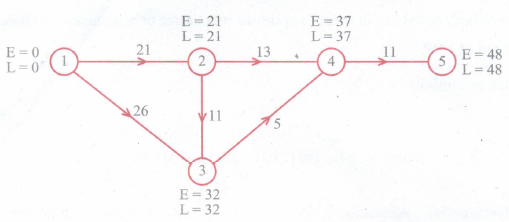
| E1= 0 | L5= 48 |
| E2= 0+21=21 | L4= 48 -11 = 37 |
| E3 =(21 + 11) or (0 + 26) Whichever is maximum =32 |
L3= 37 - 5 = 32 |
| E4= (32 + 5) or (21 + 13) =Whichever is maximum = 37 |
L2= (37 - 13) or (32 - 11) Whichever is minimum =21 |
| E5=37 + 11 = 48 | L1=(21 - 21) or (32 - 26) Whichever is minimum = 0 |
| Activity | Duration | EST | EFT = EST + tij | EFT = EST - tij | LFT |
|---|---|---|---|---|---|
| 1-2 | 21 | 0 | 21 | 21-21=0 | 21 |
| 1-3 | 26 | 0 | 26 | 32-26=6 | 32 |
| 2-3 | 11 | 21 | 32 | 32-11=21 | 32 |
| 2-4 | 13 | 21 | 34 | 37-13=24 | 37 |
| 3-4 | 5 | 32 | 37 | 37-5=32 | 37 |
| 4-5 | 11 | 37 | 48 | 48-11=37 | 48 |
EFT and LFT are same in the activities.
1 - 2, 2 - 3, 3 - 4 and 4 - 5
Hence, the critical path is 1 - 2 - 3 - 4 - 5 and the duration of project completion is 48 days .
6.
Given Z = 4x6 - 8x3 - 7x + 6xy + 8y + x3y5
(i) Differentiating partially w.r.t. 'y' we get,
\({\partial z\over \partial y^2}=0-0-0+6x(1)+8+x^3(5y^4)\)
= 6x + 8 + 5x3y4
Differentiating again partially w.r.t. 'y' we get
\({\partial^2z\over \partial y^2}=.0 + 0 + 5x^3( 4y^3)\)
=20x3,y3
(ii) We know that \({\partial z\over \partial y}=6x+8+5x^3y^4\)
Differentiating partially w.r.t. 'x' we get,
\({\partial^2z\over \partial x \partial y}=6(1)+0+5y^4(3x^2)\)
= 6+15x2y4
(iii) \({\partial z\over \partial x}=4( 6x^5) - 8 (3x^2) - 7 + 6y(1) + 0 + y^5(3x2^)\)
= 24x5 - 24x2 - 7 + 6y + 3x2y5
Differentiating again partially w.r.t. 'y' we get,
\({\partial^2z\over \partial y \partial x}=0+ 0 - 0 + 6(1) + 3x^2 (5y^4)\)
= 6 + 15x2y4
7.
Given \(P(A)=\frac { 1 }{ 2 } \Rightarrow p(\bar { A } )=1-P(A)=1-\frac { 1 }{ 2 } =\frac { 1 }{ 2 } \)
\(P(B)=\frac { 2 }{ 3 } \Rightarrow P(\bar { B } )=1-\frac { 2 }{ 3 } =\frac { 1 }{ 3 } \)
\(P(C)=\frac { 3 }{ 4 } \Rightarrow P(\bar { C } )=1-P(C)=1-\frac { 3 }{ 4 } =\frac { 1 }{ 4 } \)
P(Only one of them hits the target)
\(=P(A\cap \bar { B } \cap \bar { C } )+P(\bar { A } \cap B\cap \bar { C } )+P(\bar { A } \cap \bar { B } \cap C)\)
\(=P(A).P(\bar { B) } .P(\bar { C) } +P(\bar { A } ).P(B).P(\bar { C } )+P(\bar { A } ).P(\bar { B } ).P(C)\)
\(=\frac { 1 }{ 2 } \times \frac { 1 }{ 3 } \times \frac { 1 }{ 4 } +\frac { 1 }{ 2 } \times \frac { 2 }{ 3 } \times \frac { 1 }{ 4 } +\frac { 1 }{ 2 } \times \frac { 1 }{ 3 } \times \frac { 3 }{ 4 } \)
\(=\frac { 1 }{ 24 } +\frac { 2 }{ 24 } +\frac { 3 }{ 24 } =\frac { 6 }{ 24 } =\frac { 1 }{ 4 } \)
8.
Given observations arranged in ascending order are
38, 42, 57, 58, 61, 65, 66, 72 and n = 8
D6 = Size of 6\({ \left( \frac { n+1 }{ 10 } \right) }^{ th }\) value = Size of \(6{ \left( \frac { 8+1 }{ 10 } \right) }^{ th }\) value
= Size of 5.4th value \(\simeq \) Size of 5th value
= 61
D8 = Size of \(8{ \left( \frac { n+1 }{ 10 } \right) }^{ th }\) value = Size of \(8{ \left( \frac { 8+1 }{ 10 } \right) }^{ th }\) value
=size of 7.2th value \(\simeq \) size of 7th value
= 66
P7 = Size of \(7{ \left( \frac { n+1 }{ 100 } \right) }^{ th }\) value = size of \(7{ \left( \frac { 8+1 }{ 100 } \right) }^{ th }\) value
= size of (0.6)th value \(\simeq \) size of first value
=38
P20=Size of 20\({ \left( \frac { n+1 }{ 100 } \right) }^{ th }\) value = Size of \({ 20\left( \frac { 9 }{ 100 } \right) }^{ th }\) value
= Size of (1.8th value) \(\simeq \) size of 2nd value
= 42
9.
Let Reshma mix x1 kg of food P and x2 kg of food Q to make the mixture.
Let Z be the total cost of mixture
| Food P | Food Q | Minimum requirement | |
|---|---|---|---|
| Vitamin A | 3 | 4 | 8 |
| Vitamin B | 5 | 2 | 11 |
| Cost | Rs.60 | Rs.80 |
Thus, the mathematical formation of the given LPP is minimize Z = 60x1+ 80x2
Subject to the constraints
\(3{ x }_{ 1 }+4{ x }_{ 2 }\ge 8\quad 5{ x }_{ 1 }+2{ x }_{ 2 }\ge 11\quad and\quad { x }_{ 1 },{ x }_{ 2 }\ge 0\)
Consider the equations
\(3{ x }_{ 1 }+4{ x }_{ 2 }=8\)
| \({ x }_{ 1 }\) | 0 | 8/3 |
| \({ x }_{ 2 }\) | 2 | 0 |
\(5{ x }_{ 1 }+2{ x }_{ 2 }=11\)
| \({ x }_{ 1 }\) | 0 | 8/3 |
| \({ x }_{ 2 }\) | 2 | 0 |
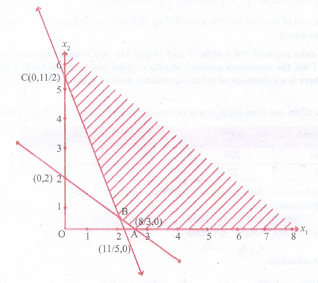
The feasible region is ABC and its co-ordinates are A\(\left( \frac { 8 }{ 3 } ,0 \right) \), C\(\left( 0,\ \frac { \pi }{ 2 } \right) \)and B is the point of intersection of the lines 3x1 + 4x2 = 8 ..... (1) and 5x1 + 2x2 = 11 .... (2)
Verification of B:
\((1) \Rightarrow 3{ x }_{ 1 }+4{ x }_{ 2 }=8\)
\( (-)\quad (-)\quad \quad (-)\)
\((2)\times 2\Rightarrow 10{ x }_{ 1 }+4{ x }_{ 2 }=22\)
\(--------------\)
\( -7x_{ 1 }=-14 \Rightarrow { x }_{ 1 }=2\)
\(From(1), 3(2)+4{ x }_{ 2 }=8\)
\(4{ x }_{ 2 }=8-6=2\Rightarrow { x }_{ 2 }=\frac { 1 }{ 2 } \)
\( \therefore \ B\ is\ \left( 2,\frac { 1 }{ 2 } \right) \)
| Corner Points | Z = 60x1+ 80x2 |
|---|---|
| A(8/3,0) | \(60\times \frac { 8 }{ 3 } =160\) |
| B (2, 1/2) | \(120+80\times \frac { 1 }{ 2 } =160\) |
| C(0,11/2) | \(80\times \frac { 11 }{ 2 } =440\) |
Minimum of Z occurs at \(A\left( \frac { 8 }{ 3 } ,0 \right) and\quad B\left( 2,\frac { 1 }{ 2 } \right) \)
Hence, least cost of mixture is n60 when 8/3 kg of food P and 0 kg of food Q and 2 kg of food P and 112kg of food Q are mixed
10.
Number of preference shares = 1000
Preferential stock = 1000 X 100 = Rs.1,00,000
Ordinary shares = 4000
Ordinary shares = 4000 x 100 = Rs.4,00,000
Total dividend = Rs.40,000
Dividend on preference share=\(\frac { 1,00,000 }{ 100 } \) x 6 = Rs.6,000
Dividend on ordinary shares=Total dividend-dividend on preference shares
= 40,000-6000
=Rs.34,000
Sundar's income on preference shares
= No.of shares X FV XRate percentage
=100 x 100 x \(\frac { 6 }{ 100 } \)
=Rs.600 ...(1)
Sundar's income on ordinary shares
=\(\frac { 2500 \times 100 }{ 4,00,000 } \) x 34,000=Rs.1700 ..(2)
\(\therefore\)Sundar's total income = 600+1700
= Rs.2300
11.
Let the amount invested in each stock be Rs.x
For 12% Stock
Investment =Rs.x
Purchased Price = 89+1 = 90
Income=\(\frac {\text { Investment} }{ \text {Purchase Price } }\) x Dividend Rate
=\(\frac { x }{ 90 } \times 12=\frac { 2x }{ 15 } \) ...(1)
For 8% Stock
Investment = Rs.x
market Price = 95+1= 96
Dividend Rate = 8%
Income=\(\cfrac { x }{ 96 } \times 8 =\cfrac { x }{ 12 } \) ...(2)
Difference in income = Rs.120
From (1) and (2), \(\cfrac { 2x }{ 15 } -\cfrac { x }{ 12 } \) = 120
\(x\left( \cfrac { 2 }{ 15 } -\cfrac { 1 }{ 12 } \right) \) = 120
\(x\left( \cfrac { 8-5 }{ 60 } \right) \) = 120
\(\cfrac { 3x }{ 60 } \) = 120
\(\Rightarrow\) x = \(\cfrac { 120\times 60 }{ 3 } \) = Rs.2400
Hence, investment in each stock is Rs.2400
12.
Here the sample space of the experiment is
S = {HHH, HHT, HTH, HTT, THH, TTH, THT, TTT}
A = {Three heads or Three tails}
= {HHH, TTT}
B = {at least two heads}
= {HHH, HHT, HTH, THH} and
C = {at most two heads} = {HHT, HTH, HTT, THH, TTH, THT, TTT}
Also (A∩B) = {HHH}; (A∩C) = {TTT} and (B∩C) ={HHT, HTH, THH}
∴ P(A) = \(\frac { 2 }{ 8 } =\frac { 1 }{ 4 } \); P(B) =\(\frac{1}{2}\); P(C) = \(\frac{7}{8}\) and
P(A∩B)= \(\frac{1}{8}\), P(A∩C)=\(\frac{1}{8}\), P(B∩C)=\(\frac{3}{8}\)
Also P(A). P(B)=\(\frac { 1 }{ 4 } .\frac { 1 }{ 2 } =\frac { 1 }{ 8 } \)
P(A). P(C) =\(\frac { 1 }{ 4 } .\frac { 7 }{ 8 } =\frac { 7 }{ 32 } \)
and P(B). P(C) =\(\frac { 1 }{ 2 } .\frac { 7 }{ 8 } =\frac { 7 }{ 16 } \)
Thus, P(A∩B) = P(A). P(B)
P(A∩C) ≠ P(A) P(C) and
P(B∩C) ≠ P(B). P(C)
Hence, the events (A and B) are independent, and the events (A and C) and (B and C) are dependent.
13.
Calculation for median follows by the following table
| X | f | cf |
| 0-10 | 20 | 20 |
| 10-20 | 25 | 45 |
| 20-30 | 32 | 77 |
| 30-40 | 40 | 117 |
| 40-50 | 42 | 159 |
| 50-60 | 35 | 194 |
| 60-70 | 10 | 204 |
| 70-80 | 8 | N = 212 |
\(\frac { N }{ 2 } =\frac { 212 }{ 2 } =106\) Class interval corresponding to cumulative frequency 106 is (30 – 40). So, the corresponding values from the median class are L = 30, pcf = 77, f = 40 and c = 10.
Median = L+\(\left( \frac { \left( \frac { N }{ 2 } \right) -pcf }{ f } \right) \times c\)
Median = \(30+\left( \frac { 106-77 }{ 40 } \right) \times 10\)
∴ Median = 37.25 (corrected to two places of decimals)
Calculations proceeded for mean deviation about the median.
| X | f | M | |D|=|X-37.25| | f|D| |
| 0-10 | 20 | 5 | 32.25 | 645 |
| 10-20 | 25 | 15 | 22.25 | 556.25 |
| 20.-30 | 32 | 25 | 12.25 | 392 |
| 30-40 | 40 | 35 | 2.25 | 90 |
| 40-50 | 42 | 45 | 7.75 | 325.5 |
| 50-60 | 35 | 55 | 17.75 | 321.25 |
| 60-70 | 10 | 65 | 27.75 | 277.5 |
| 70-80 | 8 | 75 | 37.75 | 302 |
| N = 212 | Σf|D| = 3209.5 |
Then the mean deviation about median is to be computed by the following
MD about Median = \(\frac { \Sigma f|D| }{ N } =\frac { 3209.5 }{ 212 } \) = 15.14
Coefficient of MD about Median = \(\frac { M.D \ about \ median }{ Median } =\frac { 15.14 }{ 37.25 } \) = 0.4064 = 0.41 (corrected to two decimal places).
14.
Let the number of shares be x.
Market value of 1 share = 100 - 10 = 90
Market value of x shares = 90x
Income from 10% discount shares
If Investment = 33, Income = 15
If Investment = 90x, Income \(=\cfrac { 15 \times90x }{ 33 } \)
Income from 10% premium shares
= \(\cfrac { 110x }{ 33 } \times 15\)
\(\cfrac { 110x }{ 33 } \times 15-\cfrac { 90x }{ 33 } \times 15=450\)
\(\cfrac { 15x }{ 33 } {( 110 - 90) } =450\)
x = \(\cfrac { 450\times 33 }{ 15\times 20 } \) = 49.5~50 shares
15.
C = 2000 + 1800x -75 x2 + x3
\({dC\over dx}=1800-150x+3x^2\)
\({dC\over dx}=0\)
\(\Rightarrow 3(x^2-50x+600)=0\)
\(\Rightarrow x^2-50x+600=0\) (Divided by 3)
\(\Rightarrow x=30,20\)
The intervals are (0, 20) (20, 30) and (30, \(\infty\))
| Intervals | Sign of \({dC\over dx}\) | Nature of Function |
| (0,20) | + ve | Increasing |
| (20,30) | - ve | Decreasing |
| (30,\(\infty\)) | + ve | Increasing |
16.
| X | Y | dx = X-168 | dy = Y-169 | dx2 | dy2 | dxdy |
|---|---|---|---|---|---|---|
| 158 | 163 | -10 | -6 | 100 | 36 | 60 |
| 166 | 158 | -2 | -11 | 4 | 121 | 22 |
| 163 | 167 | -5 | -2 | 25 | 4 | 10 |
| 165 | 170 | -3 | 1 | 9 | 1 | -3 |
| 167 | 160 | -1 | 9 | 1 | 81 | -9 |
| 170 | 180 | 2 | 11 | 4 | 121 | 22 |
| 167 | 170 | -1 | 1 | 1 | 1 | -1 |
| 172 | 175 | 4 | 6 | 16 | 36 | 24 |
| 177 | 172 | 9 | 3 | 25 | 9 | 27 |
| 181 | 175 | 13 | 6 | 169 | 36 | 78 |
| \(\Sigma X\) = 1686 | \(\Sigma Y\) = 1690 | \(\Sigma dx\) = 6 | \(\Sigma dy\) = 0 | \(\Sigma dx^2\) = 410 | \(\Sigma dy^2\)= 446 | \(\Sigma dxdy\) = 248 |
\(\bar{X} =\frac{\Sigma X}{N}=\frac{1686}{10}=168.6 \)
\(\bar{Y} =\frac{\Sigma Y}{N}=\frac{1690}{10}=169 \)
\(b_{x y} =\frac{N \Sigma d x d y-(\Sigma d x)(\Sigma d x)}{N \Sigma d y^2-(\Sigma d y)^2} \)
\(=\frac{10(248)-0}{10(446)-0}=\frac{248}{446}=0.556 \)
\(b_{y x} =\frac{N \Sigma d x d y-(\Sigma d x)(\Sigma d y)}{N \Sigma d x^2-(\Sigma d x)^2} \)
\(=\frac{2480}{4100-36}=\frac{2480}{4064}=0.6102\)
Regression equation of X on Y
\(X-\bar{X}=b_{x y}(Y-\bar{Y}) \)
X - 168.6 = 0.556(Y - 169)
X = 0.556 Y + 168.6-93.964
X = 0.556 Y + 74.64
Regression equation of Y on X
\(Y-\bar{Y}=b_{y x}(X-\bar{X}) \)
Y - 169 = 0.6102(X - 168.6)
Y = 0.6102 X - 102.8 + 169
Y = 0.6102X + 66.12
If X = 164
Y= 100.07 + 66.12
= 166.19
Height of son is 166.19
17.
a = 2000 + 2000 = Rs. 4000
i = \(\cfrac { 8 }{ 12 \times 100} \)= 0.0067, n = 20 x 12 = 240
A = \(\cfrac { a }{ i } \left[ \left( 1+i \right) ^{ n }-1 \right] \)
\(=\cfrac { 4000 }{ 0.0067 } \left[ \left(1.0067 \right) ^{ 240 }-1 \right] \)
= 597014.93 [4.9661 - 1]
= 597014.93 x 3.9661
= 2367820.91.
18.
(i) First convert the given equations Y on X and X on Y in standard form and find their regression coefficients respectively.
Given regression lines are
3X–2Y = 5 ... (1)
X–4Y = 7 ... (2)
Let the line of regression of X on Y is
3X–2Y = 5
3X = 2Y+5
X = \(\frac{1}{3}\)(2Y+5)
X = \(\frac{1}{3}\)(2Y+5)
X = \(\frac { 2 }{ 3 } Y+\frac { 5 }{ 3 } \)
∴ Regression coefficient of X on Y is
bxy =\(\frac{2}{3}\)(<1)
Let the line of regression of Y on X is
X–4Y = 7
–4Y = –X+7
4Y = X–7
Y = \(\frac{1}{4}\)(X-7)
Y = \(\frac{1}{4}\)X-\(\frac{7}{4}\)
∴ Regression coefficient of Y on X is
byx = \(\frac{1}{4}\)(<1)
(ii) Coefficient of correlation
Since the two regression coefficients are positive then the correlation coefficient is also positive and it is given by
r = \(\sqrt { { b }_{ yx }.{ b }_{ xy } } \)
= \(\sqrt { \frac { 2 }{ 3 } .\frac { 1 }{ 4 } } \)
= \(\sqrt { \frac { 1 }{ 6 } } \)
= 0.4082
∴ r = 0.4082
19.
q = 80 - \({ p }_{ 1 }^{ 2 }\) + 5p2 - p1p2
\({\partial q\over \partial p_1}=-2p_1-p_2\)
\({\partial q\over \partial p_2}=5 - p_1\)
\(\frac{E q}{E p_1}=\frac{-p_1}{q} \frac{\partial q}{\partial p_1}=-\frac{p_1\left(-2 p_1-p_2\right)}{80-p_1^2+5 p_2-p_1 p_2}=\frac{2 p_1^2+p_1 p_2}{80-p_1^2+5 p_2-p_1 p_2}\)
\(\frac{E q}{E p_2}=\frac{-p_2}{q} \frac{\partial q}{\partial p_2}\)
\(=\frac{-p_2\left(5-p_1\right)}{80-p_1^2+5 p_2-p_1 p_2} \)
\(={-5p_2+p_1p_2\over 80-p^2_1+5p_2-p_1p_2}\)
\(\frac { { E }q }{ { E }p_{ 1 } } ={8+2\over 80-4+5-2}={10\over 79}\)
\(\frac { { E }q }{ { E }p_{ 2 } } ={-5+2\over 80-4+5-2}={-3\over 79}\)
20.
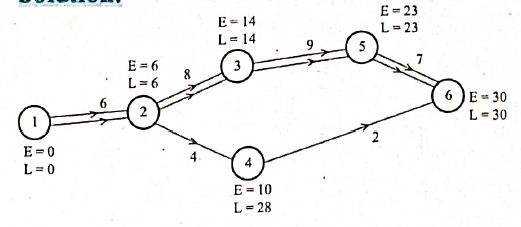
| E1 = 0 | L6 = 30 |
| E2 = 0 + 6 = 6 | L5 = 30 - 7 = 23 |
| E3 = 6 + 8 = 14 | L4 = 30 - 2 = 28 |
| E4 = 6 + 4 = 10 | L3 = 23 - 9 = 14 |
| E5 = 14 + 9 = 23 | L2 = min of {28 - 4, 14 - 8} = 6 |
| E6 = max of { 23 + 7,10 + 2 } = 30 | L1 = 6 - 6 = 0 |
| Activity | Duration ti | EST | EFT=EST+tij | LST=LFT-tij | LFT |
| 1-2 | 6 | 0 | 6 | 6-6 = 0 | 6 |
| 2-3 | 8 | 6 | 14 | 14-8 = 6 | 14 |
| 2-4 | 4 | 6 | 10 | 28-4 = 24 | 28 |
| 3-5 | 9 | 14 | 23 | 23-9 = 14 | 23 |
| 4-6 | 2 | 10 | 22 | 30-28 = 28 | 30 |
| 5-6 | 7 | 23 | 30 | 30-7 = 23 | 30 |
Since EFT and LFT. are the same in 1-2,2-3, 3-5, and 5-6, the critical path is 1-2-3-5-6 and time duration is 30 days.
21.
Since both the decision variables x1 and x2 are non-negative, the solution lies in the first quadrant of the plane.
Consider the equations 4x1 + x2 = 40 and 2x1 + 3x2 = 90
4x1 + x2 = 40 is a line passing through the points (0,40) and (10,0). Any point lying on or above the line 4x1 + x2 = 40 satisfies the constraint 4x1 + x2 ≥ 40.
2x1 + 3x2 = 90 is a line passing through the points (0,30) and (45,0). Any point lying on or above the line 2x1 + 3x2 = 90 satisfies the constraint 2x1 + 3x2 ≥ 90.
Draw the graph using the given constraints.
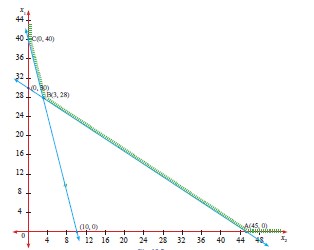
The feasible region is ABC (since the problem is of minimization type we are moving towards the origin.
| Corner points | z = 5x1 + 4x2 |
| A(45,0) | 225 |
| B(3,28) | 127 |
| C(0,40) | 160 |
The minimum value of Z occurs at B(3,28).
Hence the optimal solution is x1 = 3, x2 = 28 and Zmin = 127.
22.
Given \(sin\left( { sin }^{ -1 }\frac { 1 }{ 5 } +{ cos }^{ -1 }x \right) =1\)
⇒ \({ sin }^{ -1 }\left( \frac { 1 }{ 5 } \right) +{ cos }^{ -1 }(x)={ sin }^{ -1 }(1)=\frac { \pi }{ 2 } \)
⇒ \({ sin }^{ -1 }\left( \frac { 1 }{ 5 } \right) +{ cos }^{ -1 }(x)=\frac { \pi }{ 2 } \)
⇒ \({ sin }^{ -1 }\left( \frac { 1 }{ 5 } \right) =\frac { \pi }{ 2 } -{ cos }^{ -1 }(x)\)
⇒ \({ sin }^{ -1 }\left( \frac { 1 }{ 5 } \right) =sin^{ -1 }x\) \(\left[ \because { sin }^{ -1 }(x)+{ cos }^{ -1 }(x)=\frac { \pi }{ 2 } \right] \)
⇒ \({ sin }^{ -1 }\left( \frac { 1 }{ 5 } \right) =sin^{ -1 }x\)
⇒ \(x=\frac { 1 }{ 5 } \)
Thus, \(x=\frac { 1 }{ 5 } \) is a root of the given equation.
23.
\(\mathrm{LHS} =\cos 20^{\circ} \cos 40^{\circ} \cos 60^{\circ} \cos 80^{\circ} \)
\(=\cos 20^{\circ} \cos 40^{\circ}\left(\frac{1}{2}\right) \cos 80^{\circ}\)
\(=\frac{1}{2} \cos 20^{\circ}\left(\cos 40^{\circ} \cos 80^{\circ}\right)\)
\(=\frac{1}{2} \cos 20^{\circ}\left(\cos \left(60^{\circ}-20^{\circ}\right) \cos \left(60^{\circ}+20^{\circ}\right)\right)\)
\(=\frac{1}{2} \cos 20^{\circ}\left(\cos ^2 60^{\circ}-\sin ^2 20\right)\)
\(=\frac{1}{2} \cos 20^{\circ}\left(\frac{1}{4}-\left(1-\cos ^2 20^{\circ}\right)\right)\)
\(=\frac{1}{2} \cos 20^{\circ}\left(\frac{1-4+4 \cos ^2 20^{\circ}}{4}\right)\)
\(=\frac{1}{8}\left(4 \cos ^3 20^{\circ}-3 \cos 20^{\circ}\right)\)
\(=\frac{1}{8} \cos 3\left(20^{\circ}\right)=\frac{1}{8} \cos 60^{\circ}\)
\(=\frac{1}{8}\left(\frac{1}{2}\right)=\frac{1}{16}\)
Hence proved.
24.
Since the axis of the parabola is vertical, its equation will be x2 = 4ay.
Arch is 10 m high and 5 m wide at base.
\(\therefore\) Point \((\frac{5}{2},10)\) lies on the parabola
\(\therefore\) \(\frac{25}{4}\) = 4a(10)⇒ 4a = \(\frac{25}{40}\) = \(\frac{5}{8}\)(y)
\(\therefore\) Equation of the parabola becomes x2 = \(\frac{5}{8}\)(y)
Let the width of the arch 2 m from the vertex is 2b, then point (b, 2) lies on the parabola
\(\therefore\) b2 = \(\frac { 5(2) }{ 8 } =\frac { 10 }{ 8 } =\frac { 5 }{ 4 } \Rightarrow b=\frac { \sqrt { 5 } }{ 2 } \)
\(\therefore\) width of arch is 2b = 2.\(\frac{\sqrt{5}}{2}\) = √5m = 2.23m(app)
25.
Given equation of the circle is x2 + y2 = 169...(1)
Equation of the tangent at (x1, y1) to circle (1) is xx1 + yy1 = 169
Now, Equation of the tangent at (5,12) to circle (1) is
x(5) + y(12) = 169 ⇒ 5x + 12y - 169 = 0...(2)
and equation of the tangent at (12,-5) to circle (1) is
x(12) + y(-5) = 169 ⇒ 12x - 5y - 169 = 0...(3)
Let m1 and m2 be the slopes of the tangents (2) and (3)
ஃ m1=\(\frac { -Co-efficient\quad of\quad x }{ Co-efficient\quad of\quad y } =\frac { -5 }{ 12 } \)
Similarly m2 = \(\frac { -12 }{ -5 } =\frac { 12 }{ 5 } \)
Consider m1m2 = \(\left( \frac { -5 }{ 12 } \right) \left( \frac { 12 }{ 5 } \right) =-1\)
Since m1m2 = -1, the tangents at (5,12) and (12,-5) to the circle x2 + y2 = 169 are perpendicular to each other.
26.
LHS = sin(n + 1)x sin(n + 2) x + cos(n + 1)x cos(n + 2)x
Let A = (n + 1)x and B = (n + 2)x
= sinAsinB + cosAcosB = cos(A - B)
= cos[(n + 1)x - (n + 2)x] = cos[nx + x - nx - 2x]
= cos[x - 2x] = cos(-x) = cosx[since cos x is an even function]
= RHS Hence proved.
27.
Let f(x)=x3-27
\(\therefore \frac { d }{ dx } (f(x))=\begin{matrix} \underset { h\rightarrow 0 }{ lim } & \frac { f(x+h)-f(x) }{ h } \end{matrix}\)
\(\frac { d }{ dx } (f(x))=\begin{matrix} \underset { h\rightarrow 0 }{ lim } & \frac { \left[ { \left( x+h \right) }^{ 3 }-27 \right] -({ x }^{ 3 }-27) }{ h } \end{matrix}\)
\(=\begin{matrix} \underset { h\rightarrow 0 }{ lim } & \frac { { x }^{ 3 }+3{ x }^{ 2 }h+3x{ h }^{ 2 }+{ h }^{ 3 }-27-{ x }^{ 3 }+27 }{ h } \end{matrix}\)
\(=\begin{matrix} \underset { h\rightarrow 0 }{ lim } & \frac { 3{ x }^{ 2 }h+3x{ h }^{ 2 }+{ h }^{ 3 } }{ h } \end{matrix}\)
\(\begin{matrix} \underset { h\rightarrow 0 }{ lim } & \frac { h(3{ x }^{ 2 }+3x{ h }+{ h }^{ 2 }) }{ h } \end{matrix}\)
\(=\begin{matrix} \underset { h\rightarrow 0 }{ lim } & 3{ x }^{ 2 }+3x{ h }+{ h }^{ 2 }\end{matrix}\)
\(=3{ x }^{ 2 }+3x{ (0) }+0)\)
\(=3{ x }^{ 2 }\)
\(\therefore \frac { d }{ dx } ({ x }^{ 3 }-27)=3{ x }^{ 2 }\)
28.
Given xy + y2 = tan x + y
Differentiating with respect to 'x' we get,
\(x.\frac { dy }{ dx } +y\left( 1 \right) +2y\frac { dy }{ dx } =\sec ^{ 2 }{ x } +\frac { dy }{ dx } \)
\(\Rightarrow x.\frac { dy }{ dx } +y+2y\frac { dy }{ dx } =\sec ^{ 2 }{ x } +\frac { dy }{ dx } \)
\(\Rightarrow \frac { dy }{ dx } \left( x+2y-1 \right) =\sec ^{ 2 }{ x-y } \Rightarrow \frac { dy }{ dx } =\frac { \sec ^{ 2 }{ x-y } }{ x+2y-1 } \)
29.
Given \(({\sqrt{2}+1})^{5}+{(\sqrt{2}-1)}^{5}\)
=[\({ \left( \sqrt { 2 } \right) }^{ 5 }\)+ 5CI \({ \left( \sqrt { 2 } \right) }^{ 4}\) (1)1 + 5C2 \({ \left( \sqrt { 2 } \right) }^{ 3 }\) .(1)2 + 5C3 \({ \left( \sqrt { 2 } \right) }^{ 2 }\) . (1)3+ 5C4 \({ \left( \sqrt { 2 } \right) }^{ 1}\) .(1)4 + (1)5] +[\({ \left( \sqrt { 2 } \right) }^{ 5 }\) - 5CI \({ \left( \sqrt { 2 } \right) }^{ 4}\) (l)1 + 5C2 \({ \left( \sqrt { 2 } \right) }^{ 3 }\) (1)2 - 5C3 \({ \left( \sqrt { 2 } \right) }^{ 2 }\) (1)3+ 5C4 \({ \left( \sqrt { 2 } \right) }^{ }\) (1)4 -15 ]
=2[\({ \left( \sqrt { 2 } \right) }^{ 5 }\) + 10\({ \left( \sqrt { 2 } \right) }^{ 3 }\) +5 \({ \left( \sqrt { 2 } \right) }^{ }\)] = 2[ 4\(\sqrt { 2 } \) + 20\(\sqrt 2\) + 5.\(\sqrt 2\)] = 2[29.\( \sqrt { 2 } \)] = 58\( \sqrt 2\)
30.
Let P (n) be the statement. 1.3+2.32+3.3 + ... +n.3n = \({{(2n-1){3}^{n+1}+3}\over{4}} \) for all n \(\in\) N.
Step-1:
Put n = 1 \(\Rightarrow1.3(1){{(2-1){3}^{1+1}+3}\over{4}}={{3^2+3}\over{4}}={{12}\over{4}}\Rightarrow\ 3=3\)
\(\therefore\) P(1) is true.
Step-2:
Let us assume that P(k) is true
\(\therefore\) 1.3 + 2.32 + 3.33 + ... + k.3k = \({{(2k-1){3}^{k+1}+3}\over{4}}\) ....(1)
Step-3:
To prove that P (k + 1) is true i.e. to P.T. 1.3 + 2.32 + 3.33 + ... + k.3k + (k + 1)3k+1
\(={{[2(k+1)-1]{3}^{k+2}+3}\over{4}}={{(2k+1){3}^{k+2}+3}\over{4}}\)
LHS = 1.3 + 2.32 + ... + k.3k + (k+ 1)3k+ 1
\(={{(2k-1){3}^{k+1}+3}\over{4}}+(k+1){3}^{k+1}={{(2k+1){3}^{k+1}+3+(4k+3){3}^{k+1}}\over{4}}\)
\(={{{3}^{k+1}(2k-1+4k+4)+3}\over{4}}={{{3}^{k+1}(6k+3)+3}\over{4}}={{{3}^{k+1}(2k+1)+3}\over{4}}={{{3}^{k+2}(2k+1)+3}\over{4}}\) = RHS
\(\therefore\) P (k + 1) is true whenever P(k) is true.
\(\therefore\) By mathematical induction, P(n) is true for all values n.
31.
\(\text { LHS }=\sin \theta \cdot \cos \theta\left\{\sin \left(\frac{\pi}{2}-\theta\right) \cdot \operatorname{cosec} \theta\right. \left.+\cos \left(\frac{\pi}{2}-\theta\right) \cdot \sec \theta\right\} \)
\(=\sin \theta \cos \theta\left\{\cos \theta\left(\frac{1}{\sin \theta}\right)+\sin \theta\left(\frac{1}{\cos \theta}\right)\right\} \)
\(=\cos ^2 \theta+\sin ^2 \theta=1=\text { RHS } \)
Hence proved.
32.
Let x and y represent the number of units produced and the cost of production respectively. By the given data.
x1 (500) y1 (6000)
x2 (1000) y2 (9000)
Equation of straight line is
\(\frac { y-{ y }_{ 1 } }{ { y }_{ 2 }-{ y }_{ 1 } } =\frac { x-{ x }_{ 1 } }{ { x }_{ 2 }-{ x }_{ 1 } } \)
\(\Rightarrow \frac { y-6000 }{ 9000-6000 } =\frac { x-500 }{ 1000-500 } \)
\( { y-6000 }{ } =\frac { 3000 }{ 500 } (x - 500)\)
\(\Rightarrow\) y - 6000 = 6(x - 500)
\(\Rightarrow\) y - 6000 = 6x - 3000
\(\Rightarrow\) y = 6x + 3000
33.
Let P (n) denote the statement 1 + 4 + 7 + .............. + 3n - 2 = \({{n(3n-1)}\over{2}}\)
Step-1: Put n = 1
LHS 3 - 2 = 1
RHS \(={{1(2)}\over{2}}\Rightarrow1=1\)
LHS = RHS
\(\therefore\) P(1) is true.
Step-2: Let us assume that P(k) is true.
\(\therefore\) 1 + 4 + 7 + ............+ 3k - 2 = \({{k(3k-1)}\over{2}}\)
Step-3: To prove that P (k+ 1) is true
1 + 4 + 7 + ........... + 3k- 2 + [3 (k+ 1) - 2]
= P (k) + 3k + 3 - 2
\(= \frac{k(3 k-1)}{2}+3 k+1=\frac{3 k^2-k+6 k+2}{2} \)
\(=\frac{3 k^2+5 k+2}{2}=\frac{3 k^2+3 k+2 k+2}{2} \)
\(=\frac{(3 k+2)(k+1)}{2} \)
= RHS
\(\therefore\) P (k + 1) is true whenever P(k) is true.
\(\therefore\) By mathematical induction, p(n) is true for all n \(\in\) N.
34.
Equation of circle be x2 + y2 + 2gx + 2fy + c = 0 ...(1)
It passes through (1, 0)
1 + 0 + 2g + 0 + c = 0 \(\Rightarrow\) 2g + c = -1..(2)
The circle passes through (0, 1)
0 + 1 + 0 + 2f + c = 0 \(\Rightarrow\) 2f + c = -1 ...(3)
centre (-g, -f) lies on x + y = 1
-g - f = 1 ...(4)
Solving (1), (2) and (3) we get
\(g=-\frac { 1 }{ 2 } , f=-\frac { 1 }{ 2 } \) c = 0
Equation of circle is
\(\therefore \)x2 + y2 + 2 \(\left( -\frac { 1 }{ 2 } \right) x+2\left( -\frac { 1 }{ 2 } \right) y+0=0\)
\(\Rightarrow\) x2 + y2 - x - y = 0
35.
Let x, y and z be the investments at the rate of interest 6%, 7% and 8% per annum respectively.
Then x + y + z = 5000 ...(1)
Also, \(\frac{6x}{100}+\frac{7y}{100}+\frac{8z}{100}=358\)
\(\Rightarrow\) 6x + 7y + 8z = 35800 ...(2)
And \(\frac{6x}{100}+\frac{7y}{100}=70+\frac{8z}{100}\) (Given)
\(\Rightarrow\) 6x + 7y - 8z = 7000 ...(3)
From (1), (2) and (3),
\(\left[ \begin{matrix} 1 & 1 & 1 \\ 6 & 7 & 8 \\ 6 & 7 & -8 \end{matrix} \right] \left[ \begin{matrix} x \\ y \\ z \end{matrix} \right] =\left[ \begin{matrix} 5000 \\ 35800 \\ 7000 \end{matrix} \right] \)
AX = B where A = \(\left[ \begin{matrix} 1 & 1 & 1 \\ 6 & 7 & 8 \\ 6 & 7 & -8 \end{matrix} \right] ,\quad X=\left[ \begin{matrix} x \\ y \\ z \end{matrix} \right] ,\quad Z=\left[ \begin{matrix} 5000 \\ 35800 \\ 7000 \end{matrix} \right] \)
\(\therefore |A|\) \(=\begin{bmatrix} 1&1&1\\6&7&8\\6&7&-8 \end{bmatrix}=1(-56-56)-1(-48-48)1(42-42)\)
\(=-16\neq0\Rightarrow{A}^{-1}\) exists.
A11 = -112, A12 = 96, A13= 0
A21 = 15, A22 = -14 A23 = -1
A31 = 1, A32 = -2, A33 = -1
\(\therefore \ adj\ A=\begin{bmatrix} -112&96&0\\15&-14&-1\\1&-2&1 \end{bmatrix}^{T}=\begin{bmatrix} -112&15&1\\96&-14&-2\\0&-1&1\end{bmatrix}\)
\(\therefore \quad A^{ -1 }=\quad \frac { 1 }{ |A| } adjA=-\frac { 1 }{ 16 } \left[ \begin{matrix} -112 & 15 & 1 \\ 96 & -14 & -2 \\ 0 & -1 & 1 \end{matrix} \right] \)
Hence, the solution is given by
\(X={A}^{-1}B=-\frac{1}{16}\begin{bmatrix} -112&15&1 \\96 &-4&-2\\0&-1&1 \end{bmatrix}\begin{bmatrix} 5000\\35800\\7000 \end{bmatrix}=-{{1}\over{16}}\begin{bmatrix} -560000+537000+7000\\480000-501200-14000\\0-35800+7000 \end{bmatrix}\)
\(X=\begin{bmatrix} 1000\\2200\\1800 \end{bmatrix}\) [ \(\because\) x = 1000, y = 2200, z = 1800]
Hence, the three investment are of Rs. 1000,Rs. 2200 and Rs. 1800.
36.
Given f(2) = 0
= 2 + 2
\(=4 \neq 0\)
\(\therefore \lim _{x \rightarrow 2} f(x) \neq f(2)\)
The function is not continuous at x = 2
37.
Let \(A=\left[ \begin{matrix} 1 & -1 & 2 \\ 0 & 2 & -3 \\ 3 & -2 & 4 \end{matrix} \right] and\quad B=\left[ \begin{matrix} -2 & 0 & 1 \\ 9 & 2 & -3 \\ 6 & 1 & -2 \end{matrix} \right] \)
Now, AB =\(\left[ \begin{matrix} 1 & -1 & 2 \\ 0 & 2 & -3 \\ 3 & -2 & 4 \end{matrix} \right] \left[ \begin{matrix} -2 & 0 & 1 \\ 9 & 2 & -3 \\ 6 & 1 & -2 \end{matrix} \right] =\left[ \begin{matrix} -2-9+12 & 0-2+2 & 1+3-4 \\ 0+18-18 & 0+4-3 & 0-6+6 \\ -6-18+24 & 0-4+4 & 3+6-8 \end{matrix} \right] =\left[ \begin{matrix} 1 & 0 & 0 \\ 0 & 1 & 0 \\ 0 & 0 & 1 \end{matrix} \right] \)
\(\therefore\) AB = I3\(\Rightarrow\) A-1 = B
\(\therefore { A }^{ -1 }=\left[ \begin{matrix} -2 & 0 & 1 \\ 9 & 2 & -3 \\ 6 & 1 & -2 \end{matrix} \right] \)
Now \(A=\left[ \begin{matrix} 1 & -1 & 2 \\ 0 & 2 & -3 \\ 3 & -2 & 4 \end{matrix} \right] ,x=\left[ \begin{matrix} x \\ y \\ z \end{matrix} \right] and\quad c=\left[ \begin{matrix} 1 \\ 1 \\ 2 \end{matrix} \right] \)
\(X={ A }^{ -1 }C=\left[ \begin{matrix} -2 & 0 & 1 \\ 9 & 2 & -3 \\ 6 & 1 & -2 \end{matrix} \right] \left[ \begin{matrix} 1 \\ 1 \\ 2 \end{matrix} \right] =\left[ \begin{matrix} -2 & +0 & +2 \\ 9 & +2 & -6 \\ 6 & +1 & -4 \end{matrix} \right] =\left[ \begin{matrix} 0 \\ 5 \\ 3 \end{matrix} \right] \)
\(\because\) x = 0, y = 5 and z = 3
38.
Let the 3 numbers be x, y and z.
Given x + y + z = 20
2x + y - z = 23
3x+ y + z = 46
It can be rewritten as
\(\begin{bmatrix} 1&1&1\\2&1&-1\\3&1&1 \end{bmatrix}\begin{bmatrix} x\\y\\z \end{bmatrix}=\begin{bmatrix} 20\\23\\46 \end{bmatrix}\)
\(\Rightarrow\) \(A X=B \Rightarrow X=A^{-1} B\)
Where \(A=\begin{bmatrix} 1&1& 1\\2&1&-1\\3&1&1 \end{bmatrix},X=\begin{bmatrix} x\\y\\z \end{bmatrix},B=\begin{bmatrix} 20\\23\\46 \end{bmatrix}\)
= 1 ( 1 + 1 ) - 1 ( 2 + 3 ) + 1 ( 2 - 3)
= 2 - 5 - 1 = 2 - 6 = - 4 \(\neq \) 0
\(\therefore\) A-1 exists.
\(\text {Co-factor matrix }=\left(\begin{array}{ccc} 2 & -5 & -1 \\ 0 & -2 & 2 \\ -2 & 3 & -1 \end{array}\right)\)
\(\therefore{A}^{-1}={{1}\over{|A|}}adj\ A={{-1}\over{4}}\begin{bmatrix} 2&0&-2\\-5&-2&3\\-1&2&-1 \end{bmatrix}\)
\(X={A}^{-1}B={{-1}\over{4}}\begin{bmatrix}2&0&-2\\5&-2&3\\-1&2&-1 \end{bmatrix}\begin{bmatrix} 20\\23\\46 \end{bmatrix}\)
\(= \begin{bmatrix} x\\y\\z \end{bmatrix},={{-1}\over{4}}\begin{bmatrix} 40+0-92\\-100-46+138\\-20+46-46 \end{bmatrix}={{-1}\over{4}}\begin{bmatrix} -5\\-8\\-20 \end{bmatrix}\)
\(X=\begin{bmatrix} 13\\2\\5 \end{bmatrix}\)
\(x=13, y=2, z=5\)
\(\therefore\) The 3 numbers are 13, 2 and 5.
39.
LHS = \(\begin{vmatrix} {1\over a}&bc&b+c\\{1\over b}&ca&c+a\\{1\over c}&ab&a+b \end{vmatrix}\)
Multiplying R1 by a, R2 by b, and R3 by c respectively and dividing the determinant by abc we get.
\(LHS={1\over abc}\begin{vmatrix} 1&abc&ab+ac\\1&abc&bc+ab\\{1}&abc&ac+bc \end{vmatrix}\)
\(={1\over abc}(abc)\begin{vmatrix} 1&1&ab+ac\\1&1&bc+ab\\{1}&1&ac+bc \end{vmatrix}\) = 0 \([\because C_1\equiv C_2]\) = RHS.
Hence proved.
40.
\(\frac{1}{\left(x^2+4\right)(x+1)}=\frac{A}{x+1}+\frac{B x+C}{x^2+4}\)
(Since x2 + 4 cannot be factorised into linear factors)
\(\frac{1}{\left(x^2+4\right)(x+1)}=\frac{A\left(x^2+4\right)+(B x+C)(x+1)}{x^2+4}\)
\(1=A\left(x^2+4\right)+(B x+C)(x+1)\) ...(1)
putting x = -1 in (1) we get
1 = c(5) \(\Rightarrow\) \(c=\frac { 1 }{ 5 } \)
Equate co-efficient of x2 on both sides of (1)
0 = A + B \(\Rightarrow\) \(B= -A = \frac { -1 }{ 5 } \)
Putting x = 0 in (1) we get,
1 = 4A + C
\(1=\frac{4}{5}+C\)
\(C=1-\frac{4}{5}=\frac{1}{5}\)
\(\frac{1}{\left(x^2+4\right)(x+1)}=\frac{1}{5(x+1)}+\frac{\frac{-1}{5} x+\frac{1}{5}}{x^2+4}\)
\(=\frac{1}{5(x+1)}+\frac{1-x}{5\left(x^2+4\right)}\).

11th Standard Syllabus & Materials
11th Standard
TN 11th Tamil பீடு பெற நில் - செய்யுள் - காவடிச்சிந்து Important Questions And Answers Study Material - QB365 Set A
NEW11th Standard
TN 11th Tamil பீடு பெற நில் - உரைநடை - மலை இடப்பெயர்கள் : ஓர் ஆய்வு Important Questions And Answers Study Material - QB365 Set A
NEW11th Standard
TN 11th Tamil மாமழை போற்றுதும் - துணைப்பாடம் - யானை டாக்டர் Important Questions And Answers Study Material - QB365 Set A
NEW11th Standard
TN 11th Tamil மாமழை போற்றுதும் - செய்யுள் - ஐங்குறுநூறு Important Questions And Answers Study Material - QB365 Set A



Tamilnadu Stateboard 11th Standard Subjects

Maths

Commerce

Economics

Biology
Business Maths and Statistics

Accountancy

Computer Science

Physics

Chemistry
Maths
Biology
Economics
Physics
Chemistry

History
Business Maths and Statistics

Computer Science
Accountancy

Computer Applications
History
Computer Technology
Commerce
Computer Applications
Computer Technology

Tamil

English

French
Tamilnadu Stateboard Standards
