
 100% FREE ACCESS
11th Standard Syllabus & Materials
11th Standard
TN 11th Tamil இயற்கை வேளாண்மை,சுற்றுச்சூழல் -செய்யுள் - மனோன்மணீயம் Important Questions And Answers Study Material - QB365 Set A
NEW11th Standard
TN 11th Tamil என்னுயிர் என்பேன் -துணைப்பாடம் - இசைத்தமிழர் இருவர் Important Questions And Answers Study Material - QB365 Set A
NEW11th Standard
TN 11th Tamil மொழி கலை -செய்யுள் - ஒவ்வொரு புல்லையும் Important Questions And Answers Study Material - QB365 Set A
NEW11th Standard
TN 11th Tamil பீடு பெற நில் - இலக்கணம் - பகுபத உறுப்புகள் Important Questions And Answers Study Material - QB365 Set A
NEW11th Standard
TN 11th Tamil பீடு பெற நில் - துணைப்பாடம் - வாடிவாசல் Important Questions And Answers Study Material - QB365 Set A
NEW11th Standard
TN 11th Tamil பீடு பெற நில் - செய்யுள் - குறுந்தொகை Important Questions And Answers Study Material - QB365 Set A

Published on: 26/02/2019
Class 11 Revision Test 3
Download Tamil Nadu 11th Standard Maths question papers, model tests, one-mark questions, important questions, and public exam papers in PDF format. Free study materials and answer keys for TN State Board students.
Questions + Answers key
Take MCQ Maths Test1.
The angle between two vectors \(\vec{a}\) and \(\vec{b}\) with magnitudes\(\sqrt{3}\) and 4 respectively and \(\vec{a}.\vec{b}=2\sqrt{3}\) is ________ .
\(\frac{\pi}{6}\)
\(\frac { \pi }{ 3 } \)
\(\frac { \pi }{ 2 } \)
\(\frac { 5\pi }{ 2 } \)
2.
\(\int { \left| x \right| ^{ 3 } } \) dx is equal to ________+c.
\(\frac { -{ x }^{ 4 } }{ 4 } +c\)
\(\frac { \left| x \right| ^{ 4 } }{ 4 } \)
\(\frac { { x }^{ 4 } }{ 4 } \)
none of these
3.
If P(B)=\(\frac { 3 }{ 5 } \), P(A/B)=\(\frac { 1 }{ 2 } \) and P(AUB)=\(\frac { 4 }{ 5 } \), then P(B/\(\bar { A } \)) =
\(\frac { 1 }{ 5 } \)
\(\frac { 3 }{ 10 } \)
\(\frac { 1 }{ 2 } \)
\(\frac { 3 }{ 5 } \)
4.
If y= 6x -x3 and x increases at the ratio of 5 units per second, the rate of change of slope when x = 3 is ______ units/sec.
-90
90
180
-180
5.
The value of\(\left| \begin{matrix} 1 & 1 & 1 \\ 1 & 1+sin\theta & 1 \\ 1 & 1 & 1+cos\theta \end{matrix} \right| \) is _____________
3
1
2
\(\frac{1}{2}\)
6.
If a and b are chosen randomly from the set {1,2,3,4} with replacement, then the probability of the real roots of the equation \(x^2+ax+b=0\) is
\({3\over 16}\)
\({5\over 16}\)
\({7\over 16}\)
\({11\over 16}\)
7.
\(\int e^{\sqrt{x}} d x\) is
\(2\sqrt{x}(1-e^{\sqrt{x}})+c\)
\(2\sqrt{x}(e^{\sqrt{x}}-1)+c\)
\(2e^{\sqrt{x}}(1-\sqrt{x})+c\)
\(2e^{\sqrt{x}}(\sqrt{x}-1)+c\)
8.
If f(x) = x2 - 3x, then the points at which f(x) = f '(x) are
both positive integers
both negative integers
both irrational
one rational and another irrational
9.
The value of \(lim_{x\rightarrow k^-}x-\left\lfloor x \right\rfloor \) , where k is an integer is
-1
1
0
2
10.
If the square of the matrix \(\begin{bmatrix} \alpha & \beta \\ \gamma & -\alpha \end{bmatrix}\) is the unit matrix of order 2, then \(\alpha ,\beta \) and \(\gamma\) should satisfy the relation.
1 + \(\alpha ^2+\beta \gamma=0\)
1 - \(\alpha ^2-\beta \gamma=0\)
1 - \(\alpha ^2+\beta \gamma=0\)
1 + \(\alpha ^2-\beta \gamma=0\)
11.
If tan θ = \(\frac{-4}{3}\), then sin θ is _____________
\(\frac{-4}{5}\)
\(\frac{4}{5}\)
\(\frac{-4}{5}\quad or\quad \frac{4}{5}\)
None
12.
The image of the point (1, 2) with respect to the line y = x is ______________
(-1, -2)
(2, 1)
(2, -1)
(2, 1)
13.
Which one of the following is false?
A⋂(BΔ\C) = (A ⋂ B)Δ(A ∩ C)
A∩(B - C) = (A ∩B) \ (A∩C)
(A U B), = A' ∩ B'
(A \ B) U B = A ⋂ B
14.
The distance between the line 12x - 5y + 9 = 0 and the point (2, 1) is ______________
\(\pm\frac{28}{13}\)
\(\frac{28}{13}\)
\(-\frac{28}{13}\)
none of these
15.
There are 10 points in a plane and 4 of them are collinear. The number of straight lines joining any two of them is _________
45
40
39
38
16.
The sum up to n terms of the series \(\sqrt { 2 } +\sqrt { 8 } +\sqrt { 18 } +\sqrt { 32 } +\).....is
\(\frac { n(n+1) }{ 2 } \)
2n(n+1)
\(\frac { n(n+1) }{ \sqrt { 2 } } \)
1
17.
The number of ways in which a host lady invite 8 people for a party of 8 out of 12 people of whom two do not want to attend the party together is
2 \(\times\) 11 C7+10C8
11C7+10C8
12C8-10C6
10C6+2!
18.
If a and b are the real roots of the equation x2- kx + c = 0, then the distance between the points (a, 0) and (b, 0) is
\(\sqrt { { k }^{ 2 }-4c } \)
\(\sqrt { { 4k }^{ 2 }-c } \)
\(\sqrt { 4c-{ k }^{ 2 } } \)
\(\sqrt { k-8c } \)
19.
If tan400 = λ, then \(\frac { tan{ 140 }^{ 0 }-tan{ 130 }^{ 0 } }{ 1+tan{ 140 }^{ 0 }.tan{ 130 }^{ 0 } } \) =
\(\frac { 1-\lambda ^{ 2 } }{ \lambda } \)
\(\frac { 1+{ \lambda }^{ 2 } }{ \lambda } \)
\(\frac { 1+{ \lambda }^{ 2 } }{ 2\lambda } \)
\(\frac { 1-{ \lambda }^{ 2 } }{ 2\lambda } \)
20.
The function f:[0,2π]➝[-1,1] defined by f(x) = sin x is
one-to-one
onto
bijection
cannot be defined
21.
Evaluate \(\int { \frac { { x }^{ 3 }dx }{ { x }^{ 4 }+{ 3x }^{ 2 }+2 } } \)
22.
The probability of simultaneous occurrence of atleast one of two events A and B is p. if the probability that exactly one A, B occurs is q then prove that P(\(\bar { A } \)) + P(\(\bar { B } \)) = 2-2 p+q.
23.
Discuss the differentiability of \(f\left( x \right) =\begin{cases} x{ e }^{ -\left( \frac { 1 }{ \left| x \right| } +\frac { 1 }{ x } \right) } \\ 0,\quad x=0 \end{cases}, x\neq 0\) at x = 0
24.
A firm manufactures PVC pipes in three plants viz, X, Y, and Z. The daily production volumes from the three firms X, Y and Z are respectively 2000 units, 3000 units, and 5000 units. It is known from the past experience that 3% of the output from plant X, 4% from plant Y and 2% from plant Z are defective. A pipe is selected at random from a day’s total production,
(i) find the probability that the selected pipe is a defective one.
(ii) if the selected pipe is a defective, then what is the probability that it was produced by plant Y?
25.
Sketch the graph of a function f that satisfies the given values :
f(0) is undefined
\(lim_{x\rightarrow0}f(x)=4\)
f(2) = 6
\(lim_{x\rightarrow2}f(x)=3\)
26.
Find \(\lambda\), when the projection of \(\overrightarrow{a}=\lambda \hat{i}+\hat{j}+4\hat{k}\) on \(\overrightarrow{b}=2\hat{i}+6\hat{j}+3\hat{k}\) is 4 units.
27.
Find the value of \(\begin{vmatrix} 1 & log_xy & log_x z \\ log_y x & 1 & log_yz \\ log_z x & log_zy & 1 \end{vmatrix}\) if x, y, z \(\neq\) 1.
28.
Using the Mathematical induction, show that for any integer
n\(\ge\) 2, 3n2 > (n + 1)2
29.
Resolve into partial fractions \(\frac { { x }^{ 2 }-2x-9 }{ (x+1)({ x }^{ 2 }+x+6) } \)
30.
Show that the locus of the mid-point of the segment intercepted between the axes of the variable line x cos \(\alpha\) + y sin \(\alpha\) = p is \(\frac{1}{x^2}+\frac{1}{y^2}=\frac{4}{p^2}\) where p is a constant.
31.
Using Heron's formula, show that the equilateral triangle has the maximum area for any fixed perimeter. [Hint: In xyz \(\le\) k, maximum occurs when x = y = z]
32.
Solve the equation sin 9\(\theta\) = sin \(\theta\).
33.
Find all the equations of the straight lines in the family of the lines y = mx - 3, for which m and the x - coordinate of the point of intersection of the lines with x - y = 6 are integers.
34.
What will Rs. 500 amounts to in 10 years after its deposit in a bank which pays annual interest rate of 10% compounded annually?
35.
On the set of natural numbers let R be the relation defined by aRb if a + b \(\le\) 6. Write down the relation by listing all the pairs. Check whether it is symmetric
36.
Consider the functions:
(i) f(x) = |x|
(ii) f(x) = |x| − 1
(iii) f(x) = |x| + 1
37.
Show that\(f\left( x \right) ={ x }^{ 2 }\) is differentiable at x = 1 and find \(f^{ ' }\left( 1 \right) \)
38.
Integrate the following with respect to x : x sin 3x
39.
Integrate the following with respect to x : \({1\over xlog \ xlog(log \ x)}\)
40.
Evaluate : \(\int{x^3+2\over x-1}dx\)
41.
Find the derivative of the tan (x + y) + tan (x - y) = x
42.
For what value of x, the matrix A = \(\begin{bmatrix} 0 & 1 & -2 \\ -1 & 0 & x^3 \\ 2 & -3 & 0 \end{bmatrix}\) is skew-symmetric.
43.
Simplify: \(\sqrt { 98 } +\sqrt { 50 } -\sqrt { 18 } +\sqrt { 75 } -\sqrt { 27 } \)
44.
An A.P. consists of 21 terms. The sum of the three terms in the middle is 129 and of the last three is 237. Find the series.
45.
Find \(\sqrt [ 3 ]{ 65 } \).
46.
If the arcs of same lengths in two circles subtend central angles 30° and 800, find the ratio of their radii.
47.
Find the locus of a point P that moves at a constant distance of
(i) two units from the X-axis
(ii) three units from the Y-axis
48.
The probability that student selected at random from a class will pass in Mathematics is \(\frac { 2 }{ 3 } \) and the probability that he passes in Mathematics and English is \(\frac { 1 }{ 3 } \). What is the probability that he will pass in English if it is known that he has passed in Mathematics?
49.
\(If\lim _{ x\rightarrow 2 }{ \frac { { x }^{ n }-{ 2 }^{ n } }{ x-2 } } =80\quad and\quad n\in N,\quad find\quad n.\)
50.
Evaluate the following limits :\(lim_{x\rightarrow 0}{1-cosx\over x^2}\)
51.
If \(f:R-\{ -1,1\}\rightarrow R\) is defined by \(f(x)={x \over x^2-1},\) verify whether f is one-to-one or not.
52.
Find the sum of first n terms of the series 12 + 32 + 52+...
53.
Let p(n) be the statement "7 divides 23n-1" What is p(n+1) =?
1.
(b)
\(\frac { \pi }{ 3 } \)
2.
(d)
none of these
3.
(d)
\(\frac { 3 }{ 5 } \)
4.
(a)
-90
5.
(d)
\(\frac{1}{2}\)
6.
\(n(S)=n(A \times A) \quad=16\)
\(\text {To find } n(A)\)
\(\text {Let } a=4, b=1 \text { then } a^{2}-4 b \text { is }\)
A = 1,b = 1 then 16 - 4 > 0
b = 2. then 16 - 8 > 0
b=3 then 16-L2>0
b = 4 then 16 - 16 = 0
Let Q = 3,b = 1 thg,l, 9-4 > 0
b = 2 then 9 - 8 > 0
Let a = 2,b = l then 4 - 4 > 0
n(A).= 7,
\(P(A)=\frac{n(A)}{n(S)}=\frac{7}{16}\)
7.
\(\text { Let } \sqrt{x}=t\)
\(\text { Then } x=t^{2}\)
\(\therefore d x =2 t d t \)
\(\therefore \int e^{\sqrt{x}} d x =\int e^{t} \times 2 t d t \)
\(=2 \int t e^{t} d t \)
Applying Bernoulli's formula
\(=2\left[t\left(e^{t}\right)-1\left(e^{t}\right)\right]+c \)
\(=2(t-1) e^{t}+c \)
\(\text { Putting } t=\sqrt{x}\)
\(=2(\sqrt{x}-1) e^{\sqrt{x}}+c\)
8.
\(\text { Given } f(x)=x^{2}-3 x\)
\(f^{\prime}(x) =2 x-3 \)
\(f(x) =f^{\prime}(x) \)
\(x^{2}-3 x =2 x-3 \)
\(x^{2}-3 x-2 x+3 =0 \)
\(x^{2}-5 x+3 =0 \)
\(\text { It has irrational roots. }\)
9.
\(\text { WKT }\left\lfloor k^{-}\right\rfloor=k-1 \text { and }\left\lfloor k^{+}\right\rfloor=k \text { where } k \text { is an integer }\)
\(\therefore \lim _{x \rightarrow k^{-}} x-\lfloor x\rfloor=k-(k-1)=1\)
10.
\(\text { Given } \text {matrix } A=\left[\begin{array}{cc} \alpha & \beta \\ \gamma & -\alpha \end{array}\right] \text { is unit matrix }\)
\(|A|=1 \)
\(-\alpha^{2}-\beta \gamma=1 \)
\(1+\alpha^{2}+\beta \gamma=0 \)
11.
(c)
\(\frac{-4}{5}\quad or\quad \frac{4}{5}\)
12.
(d)
(2, 1)
13.
(d)
(A \ B) U B = A ⋂ B
14.
(b)
\(\frac{28}{13}\)
15.
(b)
40
16.
\(\sqrt{2}+\sqrt{8}+\sqrt{18}+\sqrt{32} \ldots . . =\sqrt{2}+2 \sqrt{2}+3 \sqrt{2}+4 \sqrt{2} . \)
\(=\sqrt{2}[1+2+3+\ldots .] \)
\(S_{n} =\frac{\sqrt{2}[n(n+1)]}{2} \)
\(=\frac{n(n+1)}{\sqrt{2}} \)
17.
Number of ways of selecting 8 people from 12 in 12C8 ways.
Let A and B both attend the party
Out of 10 remaining people 8 can attend in 10C6 ways.
.'. Number of ways in which two of them do not attend together = 12C8 - 10C6
18.
\(x^{2}-\mathrm{k} x+\mathrm{c}=0\)
a and b are the roots
\(\therefore a+b=k, a b=c\)
To find
\(\sqrt{(a-b)^{2}+0^{2}}=a-b=\sqrt{(a+b)^{2}-4 a b}=\sqrt{k^{2}-4 c}\)
19.
\(\frac{\tan 140^{\circ}-\tan 130^{\circ}}{1+\tan 140^{\circ} \tan 130^{\circ}} =\tan \left(140^{\circ}-130^{\circ}\right) \)
\(=\tan 10^{\circ} \ldots \ldots(1) \)
\(\tan 40^{\circ} =\lambda \)
\(\tan 80^{\circ}=\frac{2 \tan 40^{\circ}}{1-\tan ^{2} 40^{\circ}} =\frac{2 \lambda}{1-\lambda^{2}} \)
\(\tan \left(90^{\circ}-10^{\circ}\right) =\frac{2 \lambda}{1-\lambda^{2}} \)
\(\cot 10^{\circ} =\frac{2 \lambda}{1-\lambda^{2}} \)
\(\Rightarrow \tan 10^{\circ} =\frac{1-\lambda^{2}}{2 \lambda} \)
\(\frac{\tan 140^{\circ}-\tan 130^{\circ}}{1+\tan 140^{\circ} \tan 130^{\circ}} \)
\(=\frac{1-\lambda^{2}}{2 \lambda}\)
20.
It is onto not one-one
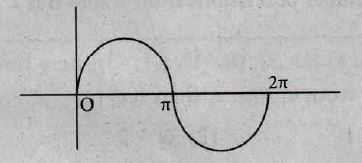
\(\text { Since } \sin 30^{\circ}=\frac{1}{2}\)
\(\sin 150^{\circ}=\frac{1}{2}\)
21.
Let I = \(\int { \frac { { x }^{ 3 }dx }{ { x }^{ 4 }+{ 3x }^{ 2 }+2 } } \) = \(\int { \frac { { x }^{ 2 }.xdx }{ \left( { x }^{ 2 } \right) ^{ 2 }+{ 3x }^{ 2 }+2 } } \)
Let t = x2 \(\Rightarrow\) dt = 2x dx \(\Rightarrow\) \(\frac { dt }{ 2 } \) = x dx
\(\therefore\) I = \(\int { \frac { t.\frac { dt }{ 2 } }{ { t }^{ 2 }+3t+2 } =\frac { 1 }{ 2 } \int { \frac { tdt }{ { t }^{ 2 }+3t+2 } } }\)
Now t = A \(\frac { d }{ dx } \) (t2 + 3t + 2) + B \(\Rightarrow\) t = A (2t + 3) + B
Equating the x - term constant terms we get,
1 = 2A \(\Rightarrow\) A = \(\frac { 1 }{ 2 } \) 0 = 3A + B \(\Rightarrow\) 0 = \(\frac { 3 }{ 2 } \) + B\(\Rightarrow\) B = \(-\frac { 3 }{ 2 } \); \(\therefore\) t = \(\frac { 1 }{ 2 } \)(2t + 3) -\(\frac { 3 }{ 2 } \)
I = \(\int { \frac { tdt }{ { t }^{ 2 }+3t+2 } } =\frac { 1 }{ 2 } \left[ \int { \frac { 2t+3 }{ 2\left( { t }^{ 2 }+3t+2 \right) } dt-\frac { 3 }{ 2 } \int { \frac { dt }{ { t }^{ 2 }+3t+2 } } } \right] \)
\(\Rightarrow\) I = \(\frac { 1 }{ 4 } \left[ log\left| { t }^{ 2 }+3t+2 \right| -3\int { \frac { dt }{ { t }^{ 2 }+3t+\frac { 9 }{ 4 } -\frac { 9 }{ 4 } +2 } } \right] =\frac { 1 }{ 4 } \left[ log\left| { t }^{ 2 }+3t+2 \right| -3\int { \frac { dt }{ \left( t+\frac { 3 }{ 2 } \right) -\left( \frac { 1 }{ 2 } \right) ^{ 2 } } } \right] \)
Now I1 = \(\int { \frac { dt }{ { t }^{ 2 }+3t+2 } } =\int { \frac { dt }{ { t }^{ 2 }+3t+\left( \frac { 3 }{ 2 } \right) ^{ 2 }-\left( \frac { 3 }{ 2 } \right) ^{ 2 }+2 } } \) = \(3\frac { 1 }{ 4 } \left[ log\left| { t }^{ 2 }+3t+2 \right| -3log\left| \frac { t+\frac { 3 }{ 2 } -\frac { 1 }{ 2 } }{ t+\frac { 3 }{ 2 } +\frac { 1 }{ 2 } } \right| \right] \)
I = \(\frac { 1 }{ 4 } log\left| { t }^{ 2 }+3t+2 \right| -3log\left| \frac { t+1 }{ t+2 } \right| +c\)
\(\therefore\) I = \(\frac { 1 }{ 4 } log\left| { x }^{ 4 }+3{ x }^{ 2 }+2 \right| -3log\left| \frac { { x }^{ 2 }+1 }{ { x }^{ 2 }+1 } \right| +c\)
22.
Given P(Simultaneous occurrence of atleast one of A and B) =p
\(\Rightarrow P(AUB)\) = p and P (occurrence of exactly one of A and B) = q
\(\Rightarrow P(AUB)-P(A\cap B)=q\)
\(\therefore p-P(A\cap B)=q\)
\(\Rightarrow P(A\cap B)=p-q\)
\(\Rightarrow 1-P(\overline { A\cap B) } =p-q\) \(\left[ \because P(A\cap B)+P(\overline { A\cap B } )=1 \right] \)
\(\Rightarrow 1-P(\bar { A } \cup \bar { B } )=p-q\)
\(\Rightarrow P(\bar { A } \cup \bar { B } )=p-q\)
\(\Rightarrow P(\bar { A } )+P(\bar { B } )-P(\bar { A } \cap \bar { B } )=1-p+q\)
\(\Rightarrow P(\bar { A } )+(P\bar { B } )=1-p+q+p(\bar { A } \cap \bar { B } )=1-p+q+P(\overline { A\cup B } )\)
= 1 - p + q +1 - p \(\left[ \because P\overline { A\cup B } =1-P(AUB)=1-p \right] \)
= 2 - p+q
\(\therefore P(\bar { A } )+P(\bar { B } )\) = 2 - 2 p+q Hence proved.
23.
\(f\left( x \right) =\begin{cases} x{ e }^{ -\left( \frac { 1 }{ \left| x \right| } +\frac { 1 }{ x } \right) }=x{ e }^{ -\frac { 2 }{ x } },\quad x>0 \\ \quad \quad \ 0,\quad \quad \quad \quad \quad \quad \quad x=0\quad \\ x{ e }^{ -\left( -\frac { 1 }{ x } +\frac { 1 }{ x } \right) }=x,\quad \quad \quad \quad x<0 \end{cases}\)
\(\therefore f\left( x \right) =\begin{cases} x{ e }^{ -\frac { 2 }{ x } }\quad x>0 \\ 0,\quad \quad \quad x=0 \\ x,\quad \quad x<0 \end{cases}\)
\( \therefore f^{ ' }\left( { 0 }^{ - } \right) =\lim _{ x\rightarrow { 0 }^{ + } }{ \frac { f\left( x \right) -f\left( 1 \right) }{ x-0 } } =\lim _{ x\rightarrow { 0 }^{ + } }{ \frac { x-0 }{ x-0 } } =\lim _{ x\rightarrow { 0 }^{ - } }{ \frac { x }{ x } } =1\quad \left[ \because f\left( x \right) =x\quad for\quad x<0\quad and\quad f\left( 0 \right) =0 \right] \)
\(\therefore f^{ ' }\left( { 0 }^{ + } \right) =\lim _{ x\rightarrow { 0 }^{ + } }{ \frac { f\left( x \right) -f\left( 0 \right) }{ x-0 } } =\lim _{ x\rightarrow { 0 }^{ + } }{ \frac { x{ e }^{ -\frac { 2 }{ x } }-0 }{ x } } =\lim _{ x\rightarrow { 0 }^{ + } }{ { e }^{ -\frac { 2 }{ x } } } =0\quad \left[ \because f\left( x \right) =x{ e }^{ -2x }\quad for\quad x>0\quad and\quad f\left( 0 \right) =0 \right] \)
\(\therefore f^{ ' }\left( { 0 }^{ - } \right) \neq f^{ ' }\left( { 0 }^{ + } \right) \)
\(\therefore f\left( x \right) \)is not differentiate at x = 0.
24.
Let A1, A2 and A3 be the event that the units of PVC pipes produced by plants X, Y, Z respectively.
Let B be the event of selected item is defective.
Then \(P\left(A_1\right)=\frac{2000}{10,000}=0.2, P\left(B / A_1\right)=0.03\)
\(P\left(A_2\right)=\frac{3000}{10,000}=0.3, P\left(B / A_2\right)=0.04\)
\(P\left(A_3\right)=\frac{5000}{10,000}=0.5, P\left(B / A_3\right)=0.02\)
(i) P (the selected pipe is defective) = P(B)
\(=P\left(A_1\right) \cdot P\left(B / A_1\right)+P\left(A_2\right) \cdot P\left(B / A_2\right)+P\left(A_3\right) \cdot P\left(B / A_3\right)\)
\(=0.2(0.03)+0.3(0.04)+0.5(0.02)\)
\(=0.006+0.012+0.010\)
\(=0.028=\frac{28}{1000}=\frac{7}{250}\)
(i) By Bayes theorem
\(P\left(A_2 / B\right)=\frac{P\left(A_2\right) \cdot P\left(B / A_2\right)}{P\left(A_1\right) P\left(B / A_1\right)+P\left(A_2\right) P\left(B / A_2\right)} +P\left(A_3\right) P\left(B / A_3\right)\)
\(=\frac{0.3(0.04)}{0.2(0.03)+0.3(0.04)+0.5(0.02)}\)
\(=\frac{0.012}{0.028}=\frac{12}{28}=\frac{3}{7}\)
25.
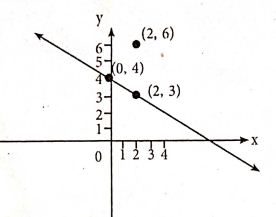
i) Given: f(0) is undefined
\(\lim _{x \rightarrow 0} f(x)=4, f(2)=6, \lim _{x \rightarrow 2} f(x)=3\)
To sketch the graph of y = f(x)
(i) Consider the points (0, 4) and (2, 3)
(ii) Draw a curve straight. line passing through (0, 4) and (2, 3)
(iii) Remove (0, 4), (2, 3) and plot the point (2, 6)
26.
Given \(\overrightarrow{a}=\lambda \hat{i}+\hat{j}+4\hat{k}\) and \(\overrightarrow{b}=2\hat{i}+6\hat{j}+3\hat{k}\)
\(|\overrightarrow{b}|=\sqrt{2^2+6^2+3^2}=\sqrt{4+36+9}=\sqrt{49}=7\)
\(\overrightarrow{a}.\overrightarrow{b}=(\lambda \hat{i}+\hat{j}+4\hat{k}).(2\hat{i}+6\hat{j}+3\hat{k})=2\lambda+6+12=2\lambda +18\)
Also projection of \(\overrightarrow{a}\) on \(\overrightarrow{b}\) is \(\overrightarrow{a}.\overrightarrow{b}\over |\overrightarrow {b}|\)
\(4={2\lambda +18\over 7}\)
\(28=2\lambda +18\)
\(28-18=2\lambda \)
\(10=2\lambda \)
\(\lambda ={10\over2}=5\)
\(\therefore \lambda =5\)
27.
\(\left|\begin{array}{ccc}
1 & \log _x y & \log _x z \\
\log _y x & 1 & \log _y z \\
\log _z x & \log _z y & 1
\end{array}\right|\)
\(=\left|\begin{array}{lll}
\log _x x & \log _x y & \log _x z \\
\log _y x & \log _y y & \log _y z \\
\log _z x & \log _z y & \log _z z
\end{array}\right|\)
\(\left.=\left|\begin{array}{lll}
\frac{\log _a x}{\log _a x} & \frac{\log _a y}{\log _a x} & \frac{\log _a z}{\log _a x} \\
\frac{\log _a x}{\log _a y} & \frac{\log _a y}{\log _a y} & \frac{\log _a z}{\log _a y} \\
\frac{\log _a x}{\log _a z} & \frac{\log _a y}{\log _a z} & \frac{\log _a z}{\log _a z}
\end{array}\right| \therefore \log _a b=\frac{\log _{\mathrm{a}} b}{\log _{\mathrm{a}} \mathrm{a}}\right)\)
\(=\frac{1}{\log _a x \log _a y \log _a z}\left|\begin{array}{lll}
\log _a x & \log _a y & \log _a z \\
\log _a x & \log _a y & \log _a z \\
\log _a x & \log _a y & \log _a z
\end{array}\right|\)
\(=\frac{1}{\log _a x \log _a y \log _a z}(0)\)
= 0
28.
Let p(n) be the statement that 3n2 > (n + 1)2 with n\(\ge\) 2. Therefore the first stage is n = 2.
Now, P(2) = 3 x 22 = 12 and 32 = 9. As 12> 9 we get P(2) is true.
We assume that p(n) is true for n = k.
Now,
P(k+ 1) 3(k+ 1)2 = 3k2 + 6k+ 3
P(k) + 6k+ 3
> (k + 1)2 + 6k + 3
k2 + 8k+4
k2 + 4k+4 + 4k
(k+ 2)2 + 4k
> (k+ 2)2 since k> 0.
This is the statement P(k + 1). The validity of P(k + 1) follows from that of P(k).
Therefore by the principle of mathematical induction, for all n\(\ge\) 2, 3n2 > (n + 1)2.
29.
\(\frac { { x }^{ 2 }-2x-9 }{ (x+1)({ x }^{ 2 }+x+6) } =\frac { A }{ (x+1) } +\frac { Bx+C }{ ({ x }^{ 2 }+x+6) } \)
= \(\frac { A({ x }^{ 2 }+x+6)+(Bx+C)(x+1) }{ (x+1)({ x }^{ 2 }+x+6) } \)
Equating numerator on b/s
x2-2x-9 = A(x2+x+6)+B(Bx+C)(x+1)
put x=-1
1+2-9 = A(1-1+6)+0
-6 = 6A ⇒ A=-1
Equating co-eff of x2
1 = A+B
a =1+B ⇒B =2
Equating co-eff of x
-2 = A+B+C
-2 =-1+2+C
-2 =1+C ⇒ C=-2-1 =-3
\(\frac { { x }^{ 2 }-2x-9 }{ (x+1)({ x }^{ 2 }+x+6) } =\frac { -1 }{ x+1 } +\frac { 2x-3 }{ { x }^{ 2 }+x+6 } \)
30.
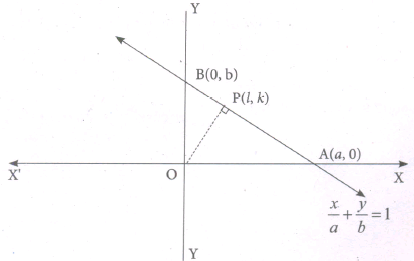
The given equation is x cos \(\alpha\) + y sin \(\alpha\) = p or \(\frac{x}{p/\cos\alpha}+\frac{y}{p/sin\alpha}=1\) ........(i)
This cuts the coordinate axes at \(A(p/\cos\alpha,0)\) and \(B(0,p/\sin\alpha)\). Let P (h, k)be the mid point of the intercept AB. Then,
\(h=\frac{p/\cos\alpha+0}{2},k=\frac{0+p/\sin\alpha}{2}\)
\(\Rightarrow h=\frac{p}{2\cos\alpha},k=\frac{p}{2\sin\alpha}\)
\(\Rightarrow \cos\alpha=\frac{p}{2h},\sin\alpha=\frac{p}{2k}\)
Here, u is a variable. to find the locus of P (h, k), we have to eliminate c.
From (i), we obtain
\(\cos^2\alpha+\sin^2\alpha=\frac{p^2}{4h^2}+\frac{p^2}{4k^2}\Rightarrow 1=\frac{p^2}{4h^2}+\frac{p^2}{4k^2}\Rightarrow \frac{4}{p^2}=\frac{1}{h^2}+\frac{1}{k^2}\)
Hence, the locus of (h, k) is \(\frac{1}{x^2}+\frac{1}{y^2}=\frac{4}{p^2}\)
31.
Let ABC be a triangle with constant perimeter 2s. Thus s is constant.
We know that \(\triangle =\sqrt{s(s-a)(s-b)(s-c)}\)
Observe that \(\triangle\) is maximum, when (s - a) (s - b) (s - c) is maximum.
Now, (s-a)(s-b)(s-c)\(\le\)\(({(s-a)+(s-b)+(s-c)\over 3})^3\) = \({s^3\over 27}\) [G.M\(\le\) A.M]
Thus, we get (s - a) (s - b) (s - c) \(\le\) \({s^3\over 27}\)
Equality occurs when s - a = s - b = s - c. That is, when a = b = c maximum of (s - a) (s - b) (s - c) is \({s^3\over 27}\)
Thus, for a fixed perimeter 2s, the area of a triangle is maximum when a = b = c.
Hence, for a fixed perimeter, the equilateral triangle has the maximum area and the maximum area is given by \(\triangle =\sqrt {s(s)^3\over 27}={s^2\over3\sqrt{3}}sq.units\)
32.
sin 9\(\theta\) = sin \(\theta\) \(\Rightarrow\)sin 9\(\theta\) - sin \(\theta\) = 0
2cos 5\(\theta\) sin 4\(\theta\) = 0
Either cos 5\(\theta\) = 0 (or) sin 4θ = 0
| When, cos 5\(\theta\) = 0 \(\Rightarrow\) 5\(\theta\) = (2n+1)\({\pi \over2}\) \(\Rightarrow \theta =(2n+1){\pi \over 10},n \in Z\) |
When, sin 4\(\theta\) = 0 \(\Rightarrow\) 4\(\theta\) = \(n\pi\) \(\Rightarrow \theta= {n\pi \over 4},n \in Z\) |
Thus, the general solution of the given equation is \(\theta=(2n+1){\pi\over10},\theta={n\pi\over 4},n\in Z.\)
33.
Given lines are y = mx - 3
\(\Rightarrow\) mx - y = 3 ......(1)
and x-y = 6.....(2)
Solving (1) and (2), we get
(1) \(\Rightarrow\) mx-y = 3
- + -
(2) \(\Rightarrow\) x-y = 6
______________
x(m-1) = -3 \(\Rightarrow \quad x=\frac { -3 }{ m-1 } =\frac { 3 }{ 1-m } \)
Substituting x = \(\frac { 3 }{ 1-m } \) in (2) we get,
\(\frac { 3 }{ 1-m } -y=6\quad \Rightarrow \quad \frac { 3 }{ 1-m } -6=y\)
\(y=\frac { 3-6+6m }{ 1-m } \Rightarrow \quad y=\frac { 6m-3 }{ 1-m } \)
The point of intersection of the given line is \( \left( \frac { 3 }{ 1-m } ,\frac { 6m-3 }{ 1-m } \right) \)
It is given that the slope m and the x-Co-ordinates are integers.
\(\therefore \ \frac { 3 }{ 1-m } \) is an integer \(\Rightarrow\) (1-m) is a divisor of 3.
\(\Rightarrow\) 1-m = \(\pm 1,1-m=\pm 3\) where m is an integer
\(\Rightarrow\) 1-m = 1 or 1 - m = -1 \(\Rightarrow\) m = 0 or m = -2
\(\Rightarrow\) 1-m = \(\pm 3\ or\ 1-m=-3\ \Rightarrow \ m=-2\ or\ m=4\)
\(\therefore\) The equations are y =0 x-3 (\(\because\) y = mx-3)
y = -2x-3 and y = 4x-3
\(\Rightarrow\) y = -3, y = -2x-3 and y = 4x-3
\(\Rightarrow\) y+3 = 0 or 2x + y +3 = 0, or 4x - y - 3 = 0
34.
We have P = Principal = Rs. 500, R = rate of interest = 10%
Amount at the end of one year = \(\left(P+{R\over100}\right)\)
\(=P\left(1+{R\over100}\right)\)
Amount at the end of second year
\(=P\left(1+{R\over100}\right)+P\left(1+{R\over100}\right)\left(R\over 100\right)\)
\(=P\left(1+{R\over100}\right)\left(1+{R\over100}\right)=P\left(1+{R\over 100}\right)^2\)
and so on.
Clearly amount at the end of various year form a G.P. with first term and common ratio \(1+{R\over100}\)
∴ Amount at the end of 10th year
= 11th term of the G.P
\(=P\left(1+{R\over100}\right)^{10}\)
\(=500\left(1+{10\over100}\right)^{10}=500\left(11\over10\right)^{10}\)
Amount at the end of the 10th year = 500 (1.1)10 = 1296.87 of the 10 th year.
35.
The relation is defined by aRb if a + b \(\le\) 6 for all a, b \(\in \)N.
a+b \(\le\)6 \(\Rightarrow\) a \(\le\) 6 - b
| a | 5 | 4 | 3 | 2 | 1 |
| b | 1 | 2 | 3 | 4 | 5 |
\(\therefore\) The list of ordered pairs are (5,1) (4, 2) (3, 3) (2, 4) and (1, 5).
Symmetric : (5, 1) \(\in \) R \(\Rightarrow\) (1, 5) \(\in \) R
(4, 2) \(\in \) R \(\Rightarrow\) (2, 4) \(\in \) R
\(\therefore\) R is symmetric
36.
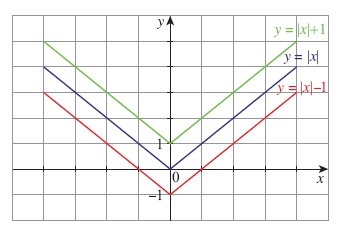
f(x) = |x| − 1 causes the graph of the functionf(x) = |x| shifts to the downward for one unit. f(x) = |x| + 1 causes the graph of the function f(x) = |x| shifts to the upward for one unit.
37.
\(f^{ ' }\left( 1^{ - } \right) =\lim _{ x\rightarrow 1^{ - } }{ \frac { f\left( x \right) -f\left( 1 \right) }{ x-1 } } =\lim _{ x\rightarrow 1^{ - } }{ \frac { { x }^{ 2 }-1 }{ x-1 } } =\lim _{ x\rightarrow 1^{ - } }{ \frac { (x+1)(x-1) }{ x-1 } } =\lim _{ x\rightarrow 1^{ - } }{ (x+1) } =1+1=2\quad ...(1)\)
\(f^{ ' }\left( 1^{ + } \right) =\lim _{ x\rightarrow 1^{ + } }{ \frac { f\left( x \right) -f\left( 1 \right) }{ x-1 } } =\lim _{ x\rightarrow 1^{ + } }{ \frac { { x }^{ 2 }-1 }{ x-1 } } =\lim _{ x\rightarrow 1^{ + } }{ \frac { (x+1)(x-1) }{ x-1 } } =\lim _{ x\rightarrow 1^{ + } }{ x+1 } =1+1=2 ...(2)\)
From (1)and (2), \(f^{ ' }\left( 1^{ - } \right) =f^{ ' }\left( 1^{ + } \right) \)
\(\therefore f\left( x \right) \)is differentiable at x = 1 and \(f^{ ' }\left( 1 \right) =2\)
38.
\(=\int x \sin 3 x d x \)
\(=x\left(\frac{-\cos 3 x}{3}\right)-1\left(\frac{-\sin 3 x}{3 \times 3}\right)+c \)
\(=-\frac{x}{3} \cos 3 x+\frac{1}{9} \sin 3 x+c\)
39.
Let \(I=\int \frac{1}{x \log x \cdot \log (\log x)} d x\)
\(=\int \frac{\frac{1}{x \log x}}{\log (\log x)} d x \)
\(t =\log (\log x) \)
\(d t =\frac{1}{\log x} \cdot \frac{1}{x} d x \)
\(I =\int \frac{d t}{t}=\log |t|+c \)
\(I =\log |\log (\log x)|+c\)
40.
\(\int{x^3+2\over x-1}dx=\int {x^3-1+3\over x-1}dx=\int ({x^3-1\over x-1}+{3\over x-1})dx\)
\(=\int\left[\frac{(x-1)\left(x^2+x+1\right)}{x-1}+\frac{3}{x-1}\right] d x\)
\(\int (x^2+x+1+{3\over x-1})dx\)
\(={x^3\over 3}+{x\over 2}+x+3log|(x-1)|+c.\)
41.
tan(x + y) + tan(x - y) = x
Differentiate w.r. to x
\(\sec ^2(x+y)\left[1+\frac{d y}{d x}\right]+\sec ^2(x-y)\left[1-\frac{d y}{d x}\right]=1\)
\(
\sec ^2(x+y)+\sec ^2(x+y) \frac{d y}{d x}+\sec ^2(x-y)
-\sec ^2(x-y) \frac{d y}{d x}=1\)
\(
\frac{d y}{d x}\left[\sec ^2(x+y)-\sec ^2(x-y)\right]
=1-\sec ^2(x+y)-\sec ^2(x-y)
\)
\(\frac{d y}{d x}=\frac{1-\sec ^2(x+y)-\sec ^2(x-y)}{\sec ^2(x+y)-\sec ^2(x-y)}\)
42.
\(\text { (i) Civen } A=\left[\begin{array}{ccc}
0 & 1 & -2 \\
-1 & 0 & x^3 \\
2 & -3 & 0
\end{array}\right] \text { is skew-symmetric. }\)
\(A^T=-A\)
\(aA^T=\left(\begin{array}{ccc}
0 & -1 & 2 \\
1 & 0 & -3 \\
-2 & x^3 & 0
\end{array}\right)\)
\(A^T=-A\)
\(\left[\begin{array}{ccc}
0 & -1 & 2 \\
1 & 0 & -3 \\
-2 & x^3 & 0
\end{array}\right]=\left[\begin{array}{ccc}
0 & -1 & 2 \\
1 & 0 & -x^3 \\
-2 & 3 & 0
\end{array}\right]\)
\(x^3=3\)
\(\therefore x=3^{1 / 3}\)
43.
\(\sqrt { 98 } =\sqrt { 49\times 2 } =7\sqrt { 2 } ;\sqrt { 18 } =\sqrt { 9\times 2 } 3\sqrt { 2 } \)
\(\sqrt { 50 } =\sqrt { 25\times 2 } =5\sqrt { 2 } ;\sqrt { 75 } =\sqrt { 25\times 3 } 5\sqrt { 3 } \)
\(\sqrt { 27 } =\sqrt { 9\times 3 } 3\sqrt { 3 } \)
∴ \(\sqrt { 98 } +\sqrt { 50 } -\sqrt { 18 } +\sqrt { 75 } -\sqrt { 27 } =7\sqrt { 2 } +5\sqrt { 2 } -3\sqrt { 2 } +5\sqrt { 3 } -3\sqrt { 3 } \)
= \(9\sqrt { 2 } +2\sqrt { 3 } \)
44.
Let a1 be the first term and d, the common difference. Here n = 21.
∴ The three middle terms are a10, a11, a12
Now, a10 + a11 + a12 = 129 [Given]
∴ \((a_1+9d)+(a_1+10d)+(a_1+11d)=129\)
⇒ \(3a_1+30d=129 \Rightarrow a_1+10d=43\) --- (i)
The last three terms are a19, a20, a21
∴ a19 + a20 + a21 [Given]
∴ \((a_1+8d)+(a_1+19d)+(a_1+20d)=237\)
(i.e)\(3a_1+57d=237, \)
∴ a1 + 19d = 79 -- (ii)
Subtracting (i) from (ii), we get 9d = 36, ∴ d = 4
∴ From(i), a1 + 40 = 43, ∴ a1 = 3
Hence, the series is 3, 7, 11, 15 ....
45.
We know that for |x|I< 1
(1+x)n = \(1+nx+\frac { n(n-1) }{ 2! } { x }^{ 2 }+\frac { n(n-1)(n-2) }{ 3! } { x }^{ 3 }+...\)
\(\sqrt [ 3 ]{ 65 } \) =651/3
=64+1)1/3
=\(\left( 1+\frac { 1 }{ 64 } \right) ^{ 1/3 }\Rightarrow \left( 1+\frac { 1 }{ 64 } \right) ^{ 1/3 }\)
=\(4\left( 1+\frac { 1 }{ 3 } \times \frac { 1 }{ 64 } +\frac { \frac { 1 }{ 3 } \left( \frac { 1 }{ 3 } -1 \right) }{ 2! } \times \left( \frac { 1 }{ 64 } \right) ^{ 2 }+... \right) \)
=\(4+\frac { 1 }{ 48 } -4\times \frac { 1 }{ 9 } \times \frac { 1 }{ 64 } \times \frac { 1 }{ 64 } +...\)
=\(4+\frac { 1 }{ 48 } -\frac { 4 }{ 36864 } +...\)
=\(4+\frac { 1 }{ 48 } -\frac { 4 }{ 9216 } +...\)
= 4+0.2 (since \(\frac { 1 }{ 9216 } \) +....is very small)
\(\sqrt [ 3 ]{ 65 } \)=4.02 (approximately)
46.
Let r1 and r2 be the radii of the two given circles and l be the length of the arc,
\(\theta_1=30^0=\frac{\pi}{6}\ radians\)
\(\theta_2=80^0=\frac{4\pi}{9}\ radians\)
Given that \(l=r_1\theta_1=r_2\theta_2\)
Thus, \(\frac{\pi}{6}r_1=\frac{4\pi}{9}r_2\)
\(\frac{r_1}{r_2}=\frac{8}{3}\) Which implies r1 : r2 = 8 : 3
47.
(i) two units from the X-axis
(h, k) be any point on the required path
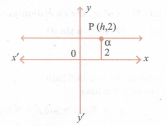
Any line parallel to x - axis will be of the form y = c.
By the given condition, the distance from x - axis is 2 units ⇒ c = 2.
ஃ Locus of the point P is y = 2.
(ii) Any line parallel to y-axis will be of the form y = c.
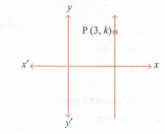
By the given condition, the distance from y-axis is 3 units ⇒ c = 2
ஃ Locus of the point P is x = 3.
48.
Let m be the event the selected student passes in mathematics and E be the event that the selected student passes in English.
\(\therefore P(M)=\frac { 2 }{ 3 } \) and P(M\(\cap \)E)=\(\frac { 1 }{ 3 } \)
\(\therefore P(E/M)=\frac { P(M\cap E) }{ P(M) } =\frac { \frac { 1 }{ 3 } }{ \frac { 2 }{ 3 } } =\frac { 1 }{ 3 } \times \frac { 3 }{ 2 } =\frac { 1 }{ 2 } \)
49.
\(Given,\quad \lim _{ x\rightarrow 2 }{ \frac { { x }^{ n }-{ 2 }^{ n } }{ x-2 } } =80\)
\( \Rightarrow n.{ 2 }^{ n-1 }=80\)
By trial method, put n 5
\(\Rightarrow 5({ 2 }^{ 5-1 })=80\)
\(\Rightarrow 5({ 2 }^{ 4 })=80\)
\( \Rightarrow 5(16)=80\)
\( \Rightarrow 80=80\)
\(\therefore n=5\)
50.
\(lim_{x\rightarrow 0}{1-cosx\over x^2}=lim_{x\rightarrow 0}{2sin^2{x \over 2}\over x^2}[\because cos 2x=1-2sin^2x]\)
\(=2.lim_{x\rightarrow0}{sin^2({x\over 2})\over {x^2\over 4}\times 4}={2\over4}[lim{{x\over 2}\rightarrow 0}{sin({x\over2})\over ({x\over2})}]^2\)
\(={2\over4}\times 1^2={2\over4}={1\over2}\) \([\because lim_{\theta \rightarrow o}{sin \theta \over \theta}=1]\)
\(\therefore lim_{x\rightarrow 0}{1-cosx\over x^2}={1\over2}\)
51.
We start with the assumption f(x) = f(y). Then
\({x \over x^2-1}={y \over y^2-1}\)
\(\Rightarrow x(y^2-1)=(x^2-1)\)
\(\Rightarrow xy^2-x-yx^2+y-0\Rightarrow (y-x)(xy+1)=0\)
This implies that x =y or xy = - 1. So if we select two numbers x and y so that xy = -1, then f(x) = f(y). \(f(x)=f(y) \cdot\left(2,-\frac{1}{2}\right),\left(7,-\frac{1}{7}\right),\left(-2, \frac{1}{2}\right)\)are some among the infinitely many possible pairs. Thus \(f(2)=f\left(\frac{-1}{2}\right)=\frac{2}{3}\). That is, f(x) = f(y) does not imply x = y. Hence it is not one-to-one.
52.
Given series is 12 + 32 + 52 +...
Let Tn be the nth term
Tn = (nth term of 1, 3, 5,...)2
= [1+(n-1)2]2 = (1 + 2n - 2)2 = (2n-1)2
= 4n2 + 1 - 4n
∴ Sum of n terms = \(\sum { 4{ n }^{ 2 } } -4n+1=4\sum { n^{ 2 } } -4\sum { n } +n\)
= \(4\frac { (n)(n+1)(2n+1) }{ 6 } -\frac { 4n(n+1)+n }{ 2 } \)
= \(\frac { n }{ 2 } \) [2(n + 1)(n + 1) - 6(n + 1) + 3]
= \(\frac { n(4{ n }^{ 2 }-1) }{ 3 } \)
53.
Given p(n) :"7 divides 23n- 1"
\(\Rightarrow\) 23n- 1 = 7k [where k is a constant]
\(\Rightarrow\) 23n = 7k+1 ...(1)
Now, p(n+1) is 7 divides 23(n+1)-1
23(n+1)-1 = 7k1
23n.23-1 = 7k1
8(23n) = 7k1+1 which is the required statement.

11th Standard Syllabus & Materials
11th Standard
TN 11th Tamil பீடு பெற நில் - செய்யுள் - காவடிச்சிந்து Important Questions And Answers Study Material - QB365 Set A
NEW11th Standard
TN 11th Tamil பீடு பெற நில் - உரைநடை - மலை இடப்பெயர்கள் : ஓர் ஆய்வு Important Questions And Answers Study Material - QB365 Set A
NEW11th Standard
TN 11th Tamil மாமழை போற்றுதும் - துணைப்பாடம் - யானை டாக்டர் Important Questions And Answers Study Material - QB365 Set A
NEW11th Standard
TN 11th Tamil மாமழை போற்றுதும் - செய்யுள் - ஐங்குறுநூறு Important Questions And Answers Study Material - QB365 Set A



Tamilnadu Stateboard 11th Standard Subjects
Maths

Commerce

Economics

Biology

Business Maths and Statistics

Accountancy

Computer Science

Physics

Chemistry
Maths
Biology
Economics
Physics
Chemistry

History
Business Maths and Statistics

Computer Science
Accountancy

Computer Applications
History
Computer Technology
Commerce
Computer Applications
Computer Technology

Tamil

English

French
Tamilnadu Stateboard Standards

