
 100% FREE ACCESS
11th Standard Syllabus & Materials
11th Standard
TN 11th Tamil இயற்கை வேளாண்மை,சுற்றுச்சூழல் -செய்யுள் - மனோன்மணீயம் Important Questions And Answers Study Material - QB365 Set A
NEW11th Standard
TN 11th Tamil என்னுயிர் என்பேன் -துணைப்பாடம் - இசைத்தமிழர் இருவர் Important Questions And Answers Study Material - QB365 Set A
NEW11th Standard
TN 11th Tamil மொழி கலை -செய்யுள் - ஒவ்வொரு புல்லையும் Important Questions And Answers Study Material - QB365 Set A
NEW11th Standard
TN 11th Tamil பீடு பெற நில் - இலக்கணம் - பகுபத உறுப்புகள் Important Questions And Answers Study Material - QB365 Set A
NEW11th Standard
TN 11th Tamil பீடு பெற நில் - துணைப்பாடம் - வாடிவாசல் Important Questions And Answers Study Material - QB365 Set A
NEW11th Standard
TN 11th Tamil பீடு பெற நில் - செய்யுள் - குறுந்தொகை Important Questions And Answers Study Material - QB365 Set A

Published on: 27/05/2020
11th Standard Chemistry English Medium Model Question Paper Part II
Download Tamil Nadu 11th Standard Chemistry question papers, model tests, one-mark questions, important questions, and public exam papers in PDF format. Free study materials and answer keys for TN State Board students.
Questions + Answers key
Take MCQ Chemistry Test
1.
Statement - I: Alkenes are more reactive than alkanes.
Statement -II: Because of the presence of a double bond.
Statement -I and II are correct and statement - II is correct explanation of statement - I
Statement-I and II are correct but statement- II is not correct explanation of statement - I
Statement - I is correct but statement - II is wrong.
Statement - I is wrong but statement - II is correct.
2.
Statement - I : Heterolytic cleavage is unsymmetrical one.
Statement- II : A covalent bond breaks and one of the bonded atom retains the bond pair of electrons.
Statement-I and II are correct and statement-II is correct explanation of statement-I.
Statement-I and II are correct but statement-II is not correct explanation of statement-I.
Statement-I is correct but statement-I! is wrong.
Statement-I is wrong but statement-II is correct
3.
Which one of the following has pentagonal bipyramidal shape?
XeF4
XeOF4
IF7
IOF5
4.
Which ofthe following halogen exchange reaction will occur in acetone?
R-I +NaCI
R-F + KCI
R-CI +NaI
R- F +AgBrv
5.
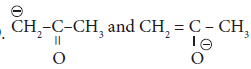 are ____________
resonating structure
tautomers
Optical isomers
Conformers
6.
For the reaction AB (g) ⇌ A(g) + B(g), at equilibrium, AB is 20% dissociated at a total pressure of P, The equilibrium constant KP is related to the total pressure by the expression __________
P = 24 KP
P = 8 KP
24 P = KP
none of these
7.
The compound in which mass percentage of carbon is 75% and that of hydrogen is 25% is _____________.
C2H6
C2H2
CH4
C2H4
8.
Pick out the correct relation for 1 mole of real gas.
\(\left( P+\frac { V }{ { a }^{ 2 } } \right) (V-b)=RT\)
\(P=\frac { RT }{ (V-b) } +\frac { a }{ { V }^{ 2 } } \)
\(\left( P+\frac { a }{ { V }^{ 2 } } \right) (V-b)=RT\)
\(\left( P-\frac { a }{ { V }^{ 2 } } \right) (V+b)=\frac { 1 }{ RT } \)
9.
The reducing power of a metal depends on various factors. Suggest the factor. which makes Li, the strongest reducing agent in aqueous solution __________
Sublimation enthalpy
Ionisation enthalpy
Hydration enthalpy
Electron-gain enthalpy
10.
In an isothermal reversible compression of an ideal gas the sign of q, ΔS and w are respectively _______________
+, -, -
-, +, -
+, -, +
-, -, +
11.
The first list of 23 chemical elements was published by _____ in the year 1789.
Berzelius
Dobereiner
Lavoisier
John Dalton
12.
Based on equation E = \(-2.178\times { 10 }^{ -18 }J\left( \frac { { Z }^{ 2 } }{ { n }^{ 2 } } \right) \)certain conclusions are written. Which of them is not correct?
Equation can be used to calculate the change in energy when the electron changes orbit
For n = 1, the electron has a more negative energy than it does for n = 6 which means that the electron is more loosely bound in the smallest allowed orbit
The negative sign in equation simply means that the energy of electron bound to the nucleus is lower than it would be if the electrons were at the infinite distance from the nucleus.
Larger the value of n, the larger is the orbit radius.
13.
Volume strength of 1.5 N H2O2 is _____________
1.5
4.5
16.8
8.4
14.
Carry over the following reaction mechanisms.
(i) Bromination of alkene
(ii) Addition of HCN to CH3CHO
(iii) Formation of alkyl bromide with benzoyl peroxide as radical initiator.
15.
What is compressibility factor? How does it explain the deviation of non ideal gases from ideal behaviour.
16.
Calculate the entropy change when 1 mole of ethanol is evaporated at 351 K The molar heat of vaporisation of ethanol is 39.84 kJ mol-1.
17.
Statues coated with white lead turn black on exposure to air. Its original colour is restored on treatment with H2O2 Explain.
18.
Calculate the oxidation number of nitrogen in nitrous acid and nitric acid
19.
The equilibrium constant of a reaction is 10, what will be the sign of ΔG? Will this reaction be spontaneous?
20.
How is plaster of paris prepared ?
21.
In what period and group will an element with Z = 118 will be present?
22.
Starting from methyl magnesium iodide how would you prepare
(i) Ethanol
(ii) 2-propanol
(iii) Tert-butyl alcohol
23.
What are the salient features of Valence Bond (VB) theory?
24.
Differentiate the following
(i) BOD and COD
(ii) Viable and non-viable particulate pollutants
25.
0.30 g of a substance gives 0.88 g of carbon dioxide and 0.54 g of water calculate the percentage of carbon and hydrogen in it.
26.
Write a balanced chemical equation for equilibrium reaction for which the equilibrium constant is given by expression
\(K_c={[NH_3]^4[O_2]^5\over [NO]^4[H_2O]^6}\)
27.
State as to why
(a) Alkali metals show only +1 oxidation state.
(b) Na and K impart colour to the flame but Mg does not.
(c) Lithium on being heated in air mainly forms the monoxide and not the peroxide.
(d) Li is the best reducing agent in aqueous solution
28.
An insecticide has the following percentage composition by mass: 47.5% C, 2.54% H, and 50.0% Cl. Determine its empirical formula and molecular formulae. Molar mass of the substance is 354.5g mol-1
29.
Bring out the differences between electronegativity and electron affinity
30.
Determine the following for the fourth shell of an atom.
(a) The number of subshells
(b) The designation for each subshell
(c) The number of orbitals in each subshell
(d) The maximum number of electrons that can be contained in each subshell
31.
A group-1 metal (A) which is present in common salt reacts with (B) to give compound (C) in which hydrogen is present in –1 oxidation state. (B) on reaction with a gas (C) to give universal solvent (D). The compound (D) on reacts with (A) to give (E), a strong base. Identify A, B, C, D and E. Explain the reactions.
32.
State and explain pauli exclusion principle.
33.
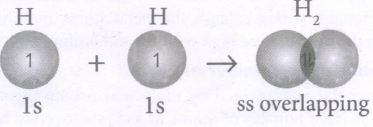
Explain the bond formation of hydrogen molecule.
34.
Explain the preparation of the following compounds
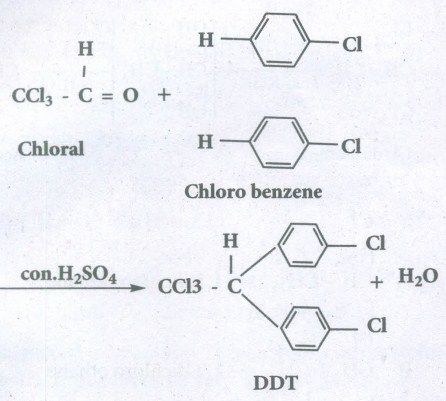
i) DDT
ii) Chloroform
iii) Biphenyl
iv) Chloropicrin
v) Freon-12
35.
Give IUPAC names for the following compounds
CH3 – CH = CH – CH = CH – C ≡ C – CH3
36.
If 5.6 g of KOH is present in
(a) 500 mL and
(b) 1 litre of solution
Calculate the molarity of each of these solutions.
37.
Calculate the number of moles present in 60 g of ethane.
38.
For the reaction, at 298K
2A + B ⟶ C
ΔH = 400 KJ mol-1, ΔS = 2 KJ mol-1
At what temperature will the reaction become spontaneous, considering, ΔH and ΔS to be constant over the temperature range?
39.
What is absolute zero? Mention its significance.
40.
Why sodium hydroxide is much more water soluble than chloride ?
41.
Which quantum number reveal information about the shape, energy, orientation and size of orbitals?
42.
Assertion (A) : Excessive use of chlorinated pesticide causes soil and water pollution.
Reason (R) : Such pesticides are non-biodegradable.
i) Both (A) and R are correct and (R) is the correct explanation of (A)
ii) Both (A) and R are correct and (R) is not the correct explanation of (A)
iii) Both (A) and R are not correct
iv) (A) is correct but( R) is not correct
Both (A) and R are correct and (R) is the correct explanation of (A)
Both (A) and R are correct and (R) is not the correct explanation of (A)
Both (A) and R are not correct
(A) is correct but( R) is not correct
43.
Assertion: An ideal solution obeys Raoults Law
Reason: In an ideal solution, solvent-solvent, as well as solute-solute interactions, are similar to solute-solvent interactions.
a) both assertion and reason are true and reason is the correct explanation of assertion
b) both assertion and reason are true but reason is not the correct explanation of assertion
c) assertion is true but reason is false
d) both assertion and reason are false
both assertion and reason are true and reason is the correct explanation of assertion
both assertion and reason are true but reason is not the correct explanation of assertion
assertion is true but reason is false
both assertion and reason are false
1.
(a)
Statement -I and II are correct and statement - II is correct explanation of statement - I
2.
(a)
Statement-I and II are correct and statement-II is correct explanation of statement-I.
3.
(c)
IF7
4.
(c)
R-CI +NaI
5.
(b)
tautomers
6.
(a)
P = 24 KP
7.
(c)
CH4
8.
(c)
\(\left( P+\frac { a }{ { V }^{ 2 } } \right) (V-b)=RT\)
9.
(c)
Hydration enthalpy
10.
(d)
-, -, +
11.
(c)
Lavoisier
12.
(b)
For n = 1, the electron has a more negative energy than it does for n = 6 which means that the electron is more loosely bound in the smallest allowed orbit
13.
(d)
8.4
14.
(i) Brominatin of alkene to give bromo alkane.
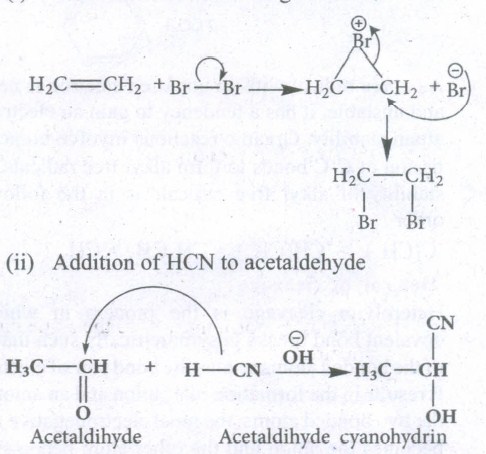
(iii) In this reaction, benzoyl peroxide acts as a radical initiator. The mechanism involves free radicals.
\({ H }_{ 2 }C=CH+H-Br\overset { \overset { Benzoyl }{ Peroxide } }{ \longrightarrow } C{ H }_{ 3 }-C{ H }_{ 2 }-Br\)
15.
Compressibility factor is the ratio of PV to nRT.
Z = \(\frac{PV}{nRT}\)
For ideal gases PV = nRT i.e., Z = 1
At high pressures Z > 1 (Positive deviation)
At inter mediate pressures Z < 1 (negative deviation)
16.
Tb = 351 K
ΔHvap = 39840 Jmol-1
ΔSV = ?
ΔSv = \(\frac { { \triangle H }_{ vap } }{ { T }_{ b } } \)
ΔSv = \(\frac { 39840 }{ 351 } \)
ΔSv = 113.5 JK-1 mol-1
17.
Statues turn black due to the formation of lead sulphide. Hydrogen peroxide oxidises black coloured lead sulphide to white coloured lead sulphate, thereby restoring the colour.
PbS + 4H2O2 ➝ PbSO4 + 4H2O
18.
(i) Nitrous acid: HNO2
+ 1 + x - 2 x 2 = 0
x = +3
(ii) Nitric acid: HNO3
+ 1 + x - 2 x 3 =0
x = +5.
19.
Given Keq= 10
Gas constant R = 8.314 JK-1 mol-1
T=300K
The relationship between Free energy change ΔG and equilibrium constant K is ΔGo=-RTlnK
Since K, T and R are positive values, ΔGo will be negative.
When ΔG is -ve, the process is spontaneous and feasible
20.
Calcium Sulphate (plaster of paris), CaSO4. 1/2H2O :
It is a hemihydrate of calcium sulphate. It is obtained when gypsum, CaSO4 .2H2O,is heated to 393 K
2(CaSO4.2H2O) ⟶ 2CaSO4,H2O + 3H2O
Above 393 K, no water of crystallisation is left and anhydrous calcium sulphate, CaSO4 is formed. This is a known 'dead burnt plaster'.
It has a remarkable property of setting with water. on mixing with an adequate quantity of water it forms a plastic mass that gets into hard solid in 5 to 15 minutes.
21.
Z = 118; [86Rn] 5f14 6d10 7s2 7p6
In the periodic table the element with Z = 118 is located in p-block,
Period no = 7 (as n = 7 for valence shell)
Group no. = 18 (group no = 10+ ns electrons + np electrons) (n - outer most shell)
22.
(i) Ethanol: Formaldehyde reacts with CH3MgI to give an addition product which onhydrolysis yields ethanol

(ii) 2-Propanol : Acetaldehyde react with CH3MgI to give an addition product which on hydrolysis yields 2-propanol.

23.
(i) When half filled orbitals of two atoms overlap, a covalent bond will be formed between them.
(ii) The resultant overlapping orbitals are occupied by the two electrons with opposite spins. For example when H2 is formed, the two Is electron of two hydrogen atoms get paired up and occupy the overlapped orbitals.
(iii) The strength of a covalent bond depends upon the extent of overlap of atomic orbitals. Greater the overlap, larger is the energy released and stronger will be the bond formed.
(iv) Each atomic orbital has a specific direction (except s-orbital which is spherical) and hence orbital overlap takes place in the direction that maximises overlap.
(v) Depending upon the nature of overlap, the bonds are classified as c covalent bond and n covalent bond.
(vi) When two atomic orbitals overlap linearly along the axis, the resultant bond is called a sigma (c) bond. This overlap is also called "head-on-overlap" or "axial overlap".
(vii) When two atomic orbitals overlap sideways the resultant covalent bond is called a pi (n) bond.
24.
(i) BOD and COD
| No | BOD | COD |
| 1 | This is Bio chemical oxygen demand | This is chemical oxygen demand |
| 2 | The total amount of oxygen in milligrams consumed by microorganisms in decomposing the waste in one litre of water at 20o for a period of 5 days is called biochemical oxygen demand (BOD) |
Chemical oxygen demand (COD) is defined as the amount of oxygen required by the organic matter in a sample of water for its oxidation by strong oxidising agent like K2Cr2O7 in acid medium for a Period of 2 hrs. |
| 3 | It is expressed in ppm | It is expressed in mg/L |
| 4 | It is a measure of consumed oxygen | It isa measurement of requirement of dissolved oxygen. |
| 5 | In waste streams BOD levels are less than COD. | In waste streams COD levels are higher than than BOD. |
| 6 | BOD measurements takes 5 days | COD measurements takes 2 hrs only. |
(ii) Viable and non-viable particulate pollutants
| No | Viable particulates | Non - Viable Particulates |
| 1 | These are small sized living organisms which are dispersed in air. Eg : bacteria, fungi, moulds, algae, etc. |
These are small solid particles and liquid droplets suspended in air. Eg : Smoke, Dust, Mists, Fumes, etc. |
| 2 | Fungi causes allergy in humans and diseases in Plants. | Causes long cancer, asthma, affects mattuation of RBC, affects Photosynthesis, etc. |
| 3 | They do not help in the transportation of Particulates. | They help in transportation of viable particulates |
25.
W = 0.3 g
x = 0.54 g
y = 0.88 g
\(
\% \mathrm{C} =\frac{12}{44} \times \frac{\mathrm{y}}{\mathrm{w}} \times 100=\frac{12}{44} \times \frac{0.88}{0.30} \times 100=80 \%
\)
\(\% \mathrm{H}=\quad \frac{2}{18} \times \frac{\mathrm{x}}{\mathrm{w}} \times 100=\frac{2}{18} \times \frac{0.54}{0.30} \times 100=20 \%\)
26.
\(K_c={[NH_3]^4[O_2]^5\over [NO]^4[H_2O]^6}\)
\(4 \mathrm{NO}_{(\mathrm{g})}+6 \mathrm{H}_{2} \mathrm{O}_{(\mathrm{g})} \rightleftharpoons 4 \mathrm{NH}_{3(\mathrm{~g})}+5 \mathrm{O}_{2(\mathrm{~g})}\)
27.
(a) Alkali metals have low ionization enthalpies.
They have a strong tendency to lose 1 electron to form unipositive ions. Thus they show an oxidation state of + 1 and are strongly electropositive.
(b) Valence electrons of alkali metals like Na and K easily absorb energy from the flame and are excited to higher energy levels. When these electrons return to the ground state, the energy is emitted in the form of light. Magnesium atom has small size so electrons are strongly bound to the nucleus. Thus they need large amount of energy for excitation of electrons to higher energy levels, which is not possible in Bunsen flame.
(c) Due to the small size of Li+ it has a strong positive field, which attracts the negative charge so strongly that it does not permit the oxide ion (O2-) to combine with another oxygen atom to form peroxide ion.
(d) Among alkali metals, lithium has the most negative electrode potential (Ee = -3.04 V), so it is the strongest reducing agent in the aqueous solution.
28.
| Element | Percentage | Atomic mass | Relative No. of moles | Simple ratio of atoms | Simplest whole number ratio |
| C | 47.5% | 12 | \(\frac{47.5}{12}=3.96\) | \(\frac{3.96}{1.41}=2.8\times 5\) | 14 |
| H | 2.54% | 1 | \(\frac{2.54}{1}=2.54\) | \(\frac{2.54}{1.41}=1.8\times 5\) | 9 |
| Cl | 50% | 35.5 | \(\frac{50}{35.5}=1.41\) | \(\frac{1.41}{1.41}=1\times 5\) | 5 |
\(\therefore\) The empirical formula is C14H9Cl5.
Calculation of Molecular formula:
The empirical formula mass(C14H9Cl5) = \((14\times 12)+(9\times1)+(5\times 35.5)\)
= 168 + 9 + 177.5 = 354.5
\(n=\frac{Molecular\ mass}{Empirical\ formula\ mass}=\frac{354.5}{354.5}=1\)
Molecular formula = (Empirical formula)n
= (C14H9Cl5)l
\(\therefore\) Molecular formula = C14H9Cl5
29.
| Electron gain Enthalpy | Electro negativity |
| It is the tendency of an isolated gaseous atom to attract an electron. |
It is the tendency of an atom in a molecule to attract the shared pair of electrons |
| It is measured in electron volts/atom or kcal/mole or kj/mole. |
It is a number and has no units |
| It is the property of an isolated atom. | It is property of a bonded atom. |
| An atom has an absolute value of electron gain enthalpy |
An atom has a relative value of electronegativity depending upon its bonding state. For example, sphybridized carbon is more electronegative than sp2-hybridized carbon which, in turn, is more electronegative than sp,- hybridized carbon. |
| It does not change regularly in a period or group. | It changes regularly in a period or a group |
30.
(a) The number of subshells is the same as the number used to designate the shell ie., n = 4 so contains 4 sub shells.
(b) The subshells in the fourth shell are designated as 4s. 4p. 4d and 4f
(c) The number of orbitals in s, p, d and subshell is 1,3,5 and 7-respectively.
(d) Each orbital can contain a maximum of two electrons.
4s - 1 orbital - 2 electrons
4p - 3 orbital - 6 electrons
4d - 5 orbital -10 electrons
4s - 7 orbital - 14 electrons
31.
The group metal - 1 which is present in common salt is sodium.
So (A) is sodium
Sodium reacts with hydrogen (B) to give, sodium hydride (C). In sodium hydride the hydrogen is present in -1 oxidation state.
\(2\underset { (A) }{ Na } +\underset { (B) }{ { H }_{ 2 } } \rightarrow 2\underset { (C) }{ NaH } \)
So (B) hydrogen and (C) is sodium hydride
H2 reacts with oxygen gas (D) to give an universal solvent, water (E) follows:
\(2\underset { (B) }{ { H }_{ 2 } } +{ O }_{ 2 }\rightarrow 2\underset { (D) }{ { H }_{ 2 }O } \)
So (E) is water. Water is the universal solvent
Water (E) reacts with sodium (A) follow to give (F), which is a strong base.
\(2\underset { (E) }{ { H }_{ 2 }O } +\underset { (A) }{ 2Na } \rightarrow 2\underset { (F) }{ NaOH } +{ { H }_{ 2 } } \)
So (F) is sodium hydroxide.
| Element / Compound | Symbol / Formula | Name |
| A | Na | Sodium |
| B | H2 | Hydrogen |
| C | NaH | Sodium hydride |
| D | H2O | Water |
| E | NaOH | Sodium hydroxide |
32.
Statement : "No two electrons in an atom can have the same set of values of all four quantum numbers"
Explanation : It means that, each electron must have unique values for the four quantum numbers (n, l, m and s).
For the lone electron present in hydrogen atom, the four quantum numbers are: n = 1; l = 0; m = 0 and s = +1/2. For the two electrons present in helium, one electron has the quantum numbers same as the electron of hydrogen atom, n = 1.
l = 0, m = 0 and s = +1/2. For other electron, the fourth quantum number is different i.e., n = 1, l = 0, m = 0 and s = -1/2.
As we know that the spin quantum number can have only two values +1/2 and - 1/2, only two electrons can be accommodated in a given orbital in accordance with pauli exclusion principle.
| Atom | e- | n | l | m | s |
| Helium | First | 1 | 0 | 0 | +1/2 |
| Second | 1 | 0 | 0 | +1/2 |
33.
1. Electronic configuration of hydrogen atom is Is 1.
2. During the formation of H2 molecule, the Is orbitals of two hydrogen atoms containing one unpaired electron with opposite spin overlaps with each other along the internuclear axis. This overlap is called s-s overlap. Such axial overlap results in the formation of a sigma (0-) covalent bond.
34.
i) DDT: DDT can be prepared by heating a mixture of chlorobenzene with chloral (Trichloro acetaldehyde) in the presence of con. H2SO4,
ii) Chloroform :The reaction of methane with excess of chlorine in the presence of sunlight will give carbon tetrachloride as the major product.
\(\underset { Methane }{ { CH }_{ 4 }+4C{ l }_{ 2 }\overset { h\gamma }{ \longrightarrow } } +\underset { Carbon \ tetrachloride }{ 4HCl } \)
iii) Bipheenyl :
\(\underset { Chlorobenzene }{ { C }_{ 6 }{ H }_{ 5 }Cl } +2Na+Cl-{ C }_{ 6 }{ H }_{ 5 }\overset { Ether }{ \longrightarrow } \underset { Biphenyl }{ { C }_{ 6 }{ H }_{ 5 }-{ C }_{ 6 }{ H }_{ 5 }+2NaCl } \)
iv) Chloropicrin : Chloroform reacts with nitric acid to form chloropicrin.(Trichloro nitro methane)
\(\underset { Chloroform }{ { CH }_{ 3 }+HN{ O }_{ 3 }\overset { \triangle }{ \longrightarrow } } \underset { Chloropicrin }{ C{ Cl }_{ 3 }N{ O }_{ 2 }+{ H }_{ 2 }O } \)
v) Freon-12 :Freon - 12 is prepared by the action of hydrogen fluoride on carbon tetrachloride in . the presence of catalylic amount of antimony pentachloride. is is called swartz reaction
\(\underset { Carbontetrachloridew }{ { CCl }_{ 3 }+2HF\overset { SbC{ l }_{ 5 } }{ \longrightarrow } } \underset { Freon-12 }{ 2HC{ l }+CCl_{ 2 }F_{ 2 } } \)
35.

36.
No.of moles ; n = \(\frac{\mathrm{m}}{\mathrm{M}}=\frac{5.6}{56}=0.1 \mathrm{~mol}\)
(i) V = 500 ml = \(\frac{500}{1000}=0.5 \mathrm{~L} \)
Molarity = \(\frac{\mathrm{n}}{\mathrm{v}}=\frac{0.1}{0.5}=0.2 \mathrm{M} \)
(ii) V = IL
Molarity = \(\frac{\mathrm{n}}{\mathrm{v}}=\frac{0.1}{1}=0.1 \mathrm{M} \)
37.
No.of moles = \(\frac { mass\ of\ the\ substance }{ Molar\ mass\ of\ the\ substanc } =\frac { W }{ M } \)
Molar mass of ethane (C2H6) = 24 + 6 = 30
\(\therefore\) Number of moles in 60 g of ethane = \(\frac { 60 }{ 30 } \) = 2 moles.
38.
For the reaction to be spontaneous
ΔG = Negative (ΔG < 0)
i.e., ΔH - TΔS < 0
or T > \(\frac { ΔH }{ ΔS } \)
i.e., T > \(\frac { 400x1000 }{ 2000 } \)
= T >200 K
The reaction will be spontaneous above 200 K
39.
Absolute zero is a temperature at which all gases have zero volume. This temperature cannot be obtained. It has a value of - 273 .15°C and theoretically it is the lowest temperature obtainable.
40.
The solubility product of NaCl is lower than that of NaOH. The more soluble a substance is, the higher the Ksp value it has In aqueous solution NaOH gives OH- ions. It can be solvated by establishing H-bonds with water molecules. So it is more water soluble.
41.
a) Principal quantum number defines energy and size of an orbital.
b) Azimuthal quantum number defines shape of an orbital
c) Magnetic quantum number defines spatial orientation (direction) of an orbital.
42.
i) Both (A) and R are correct and (R) is the correct explanation of (A)
43.
both assertion and reason are true and reason is the correct explanation of assertion

11th Standard Syllabus & Materials
11th Standard
TN 11th Tamil பீடு பெற நில் - செய்யுள் - காவடிச்சிந்து Important Questions And Answers Study Material - QB365 Set A
NEW11th Standard
TN 11th Tamil பீடு பெற நில் - உரைநடை - மலை இடப்பெயர்கள் : ஓர் ஆய்வு Important Questions And Answers Study Material - QB365 Set A
NEW11th Standard
TN 11th Tamil மாமழை போற்றுதும் - துணைப்பாடம் - யானை டாக்டர் Important Questions And Answers Study Material - QB365 Set A
NEW11th Standard
TN 11th Tamil மாமழை போற்றுதும் - செய்யுள் - ஐங்குறுநூறு Important Questions And Answers Study Material - QB365 Set A



Tamilnadu Stateboard 11th Standard Subjects

Maths

Commerce

Economics

Biology

Business Maths and Statistics

Accountancy

Computer Science

Physics
Chemistry
Maths
Biology
Economics
Physics
Chemistry

History
Business Maths and Statistics

Computer Science
Accountancy

Computer Applications
History
Computer Technology
Commerce
Computer Applications
Computer Technology

Tamil

English

French
Tamilnadu Stateboard Standards
