
 100% FREE ACCESS
11th Standard Syllabus & Materials
11th Standard
TN 11th Tamil இயற்கை வேளாண்மை,சுற்றுச்சூழல் -செய்யுள் - மனோன்மணீயம் Important Questions And Answers Study Material - QB365 Set A
NEW11th Standard
TN 11th Tamil என்னுயிர் என்பேன் -துணைப்பாடம் - இசைத்தமிழர் இருவர் Important Questions And Answers Study Material - QB365 Set A
NEW11th Standard
TN 11th Tamil மொழி கலை -செய்யுள் - ஒவ்வொரு புல்லையும் Important Questions And Answers Study Material - QB365 Set A
NEW11th Standard
TN 11th Tamil பீடு பெற நில் - இலக்கணம் - பகுபத உறுப்புகள் Important Questions And Answers Study Material - QB365 Set A
NEW11th Standard
TN 11th Tamil பீடு பெற நில் - துணைப்பாடம் - வாடிவாசல் Important Questions And Answers Study Material - QB365 Set A
NEW11th Standard
TN 11th Tamil பீடு பெற நில் - செய்யுள் - குறுந்தொகை Important Questions And Answers Study Material - QB365 Set A

Published on: 09/10/2019
Market Structure and Pricing
Download Tamil Nadu 11th Standard Economics question papers, model tests, one-mark questions, important questions, and public exam papers in PDF format. Free study materials and answer keys for TN State Board students.
Questions + Answers key
Take MCQ Economics Test
1.
Group of the firm is known as _________
Firm
Industry
Market
None of these
2.
_____________ classifies market on the basis of time
Adam Smith
Alfred Marshall
Samuelson
E.H. Chamberlin
3.
An example of selling cost is __________
Raw material cost
Transport cost
Advertisement cost
Purchasing cost
4.
5.
Under perfect competition, the shape of demand curve of a firm is ___________
Vertical
Horizontal
Negatively sloped
Positively sloped
6.
Monopolistic competition is a form of __________
Oligopoly
Duopoly
Imperfect competition
Monopoly
7.
Group equilibrium is analysed in ____________
Monopolistic competition
Monopoly
Duopoly
Pure competition
8.
In which type of market, AR and MR are equal _______
Duopoly
Perfect competition
Monopolistic competition
Oligopoly
9.
There is no excess capacity under _________
Monopoly
Monopolistic competition
Oligopoly
Perfect competition
10.
Which of the following is a market structure where the Price is expected to be lower?
Perfect competition
Monopoly
Duopoly
Oligopoly
11.
What is a local market?
12.
Define Firm.
13.
Who introduced imperfect competition?
14.
What is Oligopoly?
15.
What is Monopoly?
16.
Define "Excess capacity".
17.
Mention any two types of price discrimination.
18.
Draw demand curve of a firm for the following:
(a) Perfect competition, (b) Monopoly
19.
Point out the essential features of pure competition.
20.
Define Market.
21.
Explain 'Monopsony'.
22.
Differentiate between 'firm' and 'industry'.
23.
State the meaning of selling cost with an example.
24.
Describe the degrees of price discrimination.
25.
What are the features of a market?
26.
Explain how price and output are determined under monopolistic competition with help of a diagram.
27.
28.
Bring out the features of perfect competition.
1.
(b)
Industry
2.
(b)
Alfred Marshall
3.
(c)
Advertisement cost
4.
(b)
5.
(b)
Horizontal
6.
(c)
Imperfect competition
7.
(a)
Monopolistic competition
8.
(b)
Perfect competition
9.
(d)
Perfect competition
10.
(a)
Perfect competition
11.
(i) When products or services are sold and bought in the place of their production, it is known as local market.
(ii) In such markets, the products exchanged are mostly perishable and semi-durable in nature.
Example: Vegetables, fruits, etc.
12.
A single organization which employs factors of production to produce goods and sells.
13.
The concept of imperfect competition was propounded in 1933 in England by Mrs. Joan Robinson (1903 - 1983) and in America by E.H. Chamberlin (1899 - 1967).
14.
(i) Oligopoly is a market situation in which there are few firms selling homogeneous or differentiated products.
(ii) Competition among only a few firms in the market.
15.
(i) Monopoly has been derived from two words 'Mono' - single, 'poly' - to control.
(ii) Monopoly is a market situation in which there is only one seller.
(iii) There is no scope for competition.
16.
Excess capacity is the difference between the optimum output that can be produced and the actual output produced by the firm.
17.
Personal - Different prices are charged for different individuals. (eg) railway
Geographical - Different prices are charged at different places for the same product.
18.
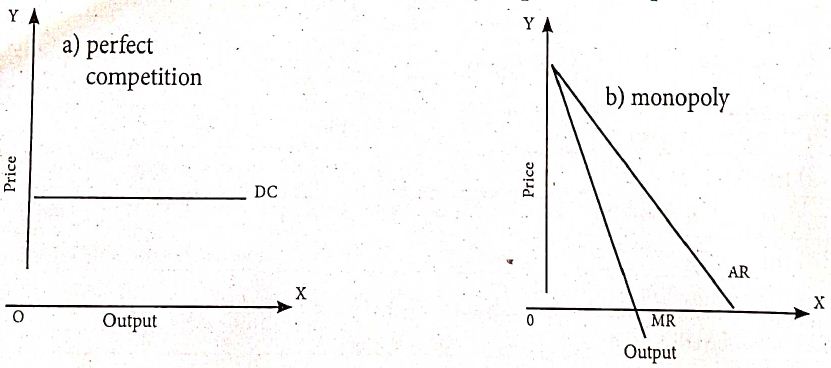
19.
(i) Pure competition is a narrower term for perfect competition.
(ii) Its features are presence of large number of buyers & sellers; homogeneous products and free entry and exit of the firms.
20.
Market refers to a system of exchange between the buyers and the sellers of a commodity.
21.
(i) It is a market structure in which there is only one buyer of a good or service.
(ii) If there is only one customer for a certain good that customer has 'Monopsony' power in the market for that good.
(iii) Monopsony is analogous to monopoly. But monopoly has market power on the demand side rather than the supply side.
22.
Firm : A single production unit in an industry, producing a large or a small amount of the commodity. (eg) Hamam, Lux are 2 firms.
Industry : A group of firms producing the same product. (eg) soap industry.
23.
(i) Expenditure involved in selling the product is called selling cost.
(ii) It is the cost incurred to alter the position of the demand curve for a product. (eg) advertisement.
(iii) Sales promotion by advertisement is called non-price competition.
24.
First degree price discrimination:
(i) A monopolist charges the maximum price that a buyer is willing to pay.
(ii) This is perfect price discrimination.
(iii) Consumer's surplus is zero.
Second degree price discrimination:
(i) Price charged is such that a part of consumer's surplus is taken away by the sellers.
(ii) This is called imperfect discriminating monopoly.
(iii) Buyers are divided into groups and a different price is charged for each group. (eg) cinema theaters charge different price for the same film for different class.
Third degree price discrimination
(i) The entire market is split into a few sub markets and different prices are charged in each sub market.
(ii) The division is done based on age, sex, location. (eg) senior citizens pay lower fares in railways.
25.
(i) Buyers and sellers of a commodity or a service. A commodity is bought and sold.
(ii) Price agreeable to buyer and seller.
(iii) Direct exchange and indirect exchange.
26.
Introduction:
E.H. Chamberlin introduced the concept of monopolistic competition.
(i) Firm under monopolistic competition has equilibrium when MC = MR & when MC cuts MR from below.
(ii) The AR curve slopes downward and is fairly elastic.
(iii) Different firms produce different varieties of the product and sell them at different prices.
Each firm seeks to get equilibrium with regard to
1) price & output 2) product adjustment 3) selling cost adjustment
Short run equilibrium
.JPG)
In fig (a) OM is the equilibrium output. OP is the price.
TR = OMQP, TC = OMRS, Abnormal Profit = PQRS
In fig (b) TR = OMQP, TC = OMLR, Loss = PQLR
Long run equilibrium:
.JPG)
(i) In short run the firm may earn super normal profit or incur loss.
(ii) In the long run the AR is more elastic.
(iii) The firms earn only normal profit.
(iv) Equilibrium output = OM. Price = OP, AR = QM, AC = QM.
(v) Equilibrium is got when AR = AC. AR is tangent to AC at Q.
27.
28.
Large number of buyers and sellers:
(i) Since there are large number of buyers and sellers each individual buyer or seller buys or sells a very small quantity of the product found in the market.
(ii) So he has no power to fix the price of the product.
(iii) He is only a price taker.
Homogeneous product & uniform price:
(i) All the units of the product are perfectly substitutable - they are of the same size, shape, colour, quality.
(ii) So a uniform price prevails in the market.
Free entry and exit:
(i) In the short run, the very efficient producer can produce the product at a very low cost & earn super normal profit.
(ii) This attracts new firms to enter.
(iii) When there are more firms, supply increases, so price falls.
(iv) Inefficient producer faces loss & so quits the market.
Absence of transport cost:
The prevalence of the uniform price is also due to the absence of the transport cost.
Perfect knowledge of the market:
(i) All buyers and sellers have a thorough knowledge of the quality of the product, prevailing price.
No government intervention:
(i) No government regulation on supply of raw materials & in price determination.

11th Standard Syllabus & Materials
11th Standard
TN 11th Tamil பீடு பெற நில் - செய்யுள் - காவடிச்சிந்து Important Questions And Answers Study Material - QB365 Set A
NEW11th Standard
TN 11th Tamil பீடு பெற நில் - உரைநடை - மலை இடப்பெயர்கள் : ஓர் ஆய்வு Important Questions And Answers Study Material - QB365 Set A
NEW11th Standard
TN 11th Tamil மாமழை போற்றுதும் - துணைப்பாடம் - யானை டாக்டர் Important Questions And Answers Study Material - QB365 Set A
NEW11th Standard
TN 11th Tamil மாமழை போற்றுதும் - செய்யுள் - ஐங்குறுநூறு Important Questions And Answers Study Material - QB365 Set A



Tamilnadu Stateboard 11th Standard Subjects

Maths

Commerce
Economics

Biology

Business Maths and Statistics

Accountancy

Computer Science

Physics

Chemistry
Maths
Biology
Economics
Physics
Chemistry

History
Business Maths and Statistics

Computer Science
Accountancy

Computer Applications
History
Computer Technology
Commerce
Computer Applications
Computer Technology

Tamil

English

French
Tamilnadu Stateboard Standards
