
 100% FREE ACCESS
11th Standard Syllabus & Materials
11th Standard
TN 11th Tamil இயற்கை வேளாண்மை,சுற்றுச்சூழல் -செய்யுள் - மனோன்மணீயம் Important Questions And Answers Study Material - QB365 Set A
NEW11th Standard
TN 11th Tamil என்னுயிர் என்பேன் -துணைப்பாடம் - இசைத்தமிழர் இருவர் Important Questions And Answers Study Material - QB365 Set A
NEW11th Standard
TN 11th Tamil மொழி கலை -செய்யுள் - ஒவ்வொரு புல்லையும் Important Questions And Answers Study Material - QB365 Set A
NEW11th Standard
TN 11th Tamil பீடு பெற நில் - இலக்கணம் - பகுபத உறுப்புகள் Important Questions And Answers Study Material - QB365 Set A
NEW11th Standard
TN 11th Tamil பீடு பெற நில் - துணைப்பாடம் - வாடிவாசல் Important Questions And Answers Study Material - QB365 Set A
NEW11th Standard
TN 11th Tamil பீடு பெற நில் - செய்யுள் - குறுந்தொகை Important Questions And Answers Study Material - QB365 Set A

Published on: 13/05/2022
QB365 provides detailed and simple solution for every Book back Questions in class 11 Business Maths Subject. It will helps to get more idea about question pattern in every book back questions with solution.
latest Book back QuestionsDownload Tamil Nadu 11th Standard Business Maths and Statistics question papers, model tests, one-mark questions, important questions, and public exam papers in PDF format. Free study materials and answer keys for TN State Board students.
Questions + Answers key
Take MCQ Business Maths and Statistics Test
1.
A firm manufactures two products A and B on which the profits earned per unit are Rs. 3 and Rs. 4 respectively. Each product is processed on two machines M1 and M2. Product A requires one minute of processing time on M1 and two minutes on M2, While B requires one minute on M1 and one minute on M2. Machine M1 is available for not more than 7 hrs 30 minutes while M2 is available for 10 hrs during any working day. Formulate this problem as a linear programming problem to maximize the profit.
2.
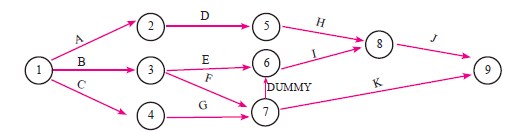
Draw a network diagram for the project whose activities and their predecessor relationships are given below:
| Activity: | A | B | C | D | E | F | G | H | I | J | K |
| Predecessor activity: | - | - | - | A | B | B | C | D | F | H,I | F,G |
3.
A company produces two types of pens A and B. Pen A is of superior quality and pen B is of lower quality. Profits on pens A and B are Rs. 5 and Rs. 3 per pen respectively. Raw materials required for each pen A is twice as that of pen B. The supply of raw material is sufficient only for 1000 pens per day. Pen A requires a special clip and only 400 such clips are available per day. For pen B, only 700 clips are available per day. Formulate this problem as a linear programming problem.
4.
A dietician wishes to mix two types of food F1 and F2 in such a way that the vitamin contents of the mixture contains atleast 6 units of vitamin A and 9 units of vitamin B. Food F1 costs Rs.50 per kg and F2 costs Rs 70 per kg. Food F1 contains 4 units per kg of vitamin A and 6 units per kg of vitamin B while food F2 contains 5 units per kg of vitamin A and 3 units per kg of vitamin B. Formulate the above problem as a linear programming problem to minimize the cost of mixture.
5.
A furniture dealer deals only two items viz., tables and chairs. He has to invest Rs.10,000/- and a space to store atmost 60 pieces. A table cost him Rs.500/– and a chair Rs.200/–. He can sell all the items that he buys. He is getting a profit of Rs.50 per table and Rs.15 per chair. Formulate this problem as an LPP, so as to maximize the profit.
1.
i) variables:
Let x1 and x2 denote the product A and B respectively.
ii) Objective function:
Profit on x1 of the product A = 3x1
Profit on x2 of the product B = 4x2
Total profit = 3x1 + 4x2
Let Z = 3x1 + 4x2, which is the objective function. Since the total profit is to be maximized, we have to maximize Z = 3x1 + 4x2.
(iii) Constraints:
We make the following table from the given data
| Title | Requirement for A | Requirement for B | (min) Available time |
| (min) M1 | 1 min | 2 min | 7 x 60 + 30 = 450 |
| (min) M2 | 1 min | 1 min | 10 x 60 = 600 |
x1 + x2 \(\le \) 450 [\(\because\) Machine M1 is available for not more than 7 hrs 30 minutes]
2x1 + x2 \(\le \) 600 [\(\because\) Machine M2 is available for 10 hrs during any working day]
(iv) Non-negative restrictions:
Since the product A and product B are non-negative, we have x1, x2\(\ge \) 0.
Thus, we have the following linear programming model.
Maximize \(Z=3{ x }_{ 1 }+{ 4x }_{ 2 }\)
subject to the constraints
\(x_{ 1 }+{ x }_{ 2 }\le 450\)
\(2x_{ 1 }+{ x }_{ 2 }\le 600\)
\(x_1,x_2\ge0\)
2.
Using the precedence relationships and following the rules of network construction, the required network diagram is shown in following figure.
3.
(i) variables: Let x1 and x2 represents the types of pen A and B respectively.
(ii) Objective function:
Profit on x1 pens = 5x1
Profit on x2 pens = 3x2
Total profit = 5x1 + 3x2
Let Z = 5x1 + 3x2 which is the objective function.
Since the total is to be maximized, we have to maximize Z = 5x1 + 3x2
(iii) Constraints:
The supply of raw material is sufficient only for 1000 pens per day.
2x1 + x2 ≤ 1000 [\(\because\) pen A is twice as that of pen B]
clips are available per day, for pen A: x1 ≤ 400
clips are available per day, for pen B: x2 ≤ 700
(iv) Non-negative restrictions: Since the number of pen A and pen B cannot be negative, we have x1 ≥ 0, x2 ≥ 0.
Thus, the mathematical formulation of the LPP is
Max Z = 5x1 + 3x2
Subject to the constraints
2x1 + x2 ≤ 1000
x1 ≤ 400
x2 ≤ 700
x1, x2 ≥ 0 (non-negative constraints)
4.
(i) Variables: Let the mixture contains x1 kg of food F1 and x2 kg of food F2
(ii) Objective function: Cost of x1 kg of food F1 = 50 x1
Cost of x2 kg of food F2 = 70x2
The cost is to be minimized
Therefore minimize Z = 50 x1 + 70x2
(iii) Constraints:
We make the following table from the given data
| Resources | Food (in kg) | Requirement | |
| F1(x1) | F2(x2) | ||
| Vitamin A (units/kg) | 4 | 5 | 6 |
| Vitamin B (units/kg) | 6 | 3 | 9 |
| Cost (Rs/kg) | 50 | 70 | |
4x1 + 5x2 ≥ 6 (since the mixture contains ‘atleast 6’ units of vitamin A, we have the inequality of the type ≥ )
6x1 + 3x2 ≥ 9 (since the mixture contains ‘atleast 9’ units of vitamin B, we have the inequality of the type ≥ )
(iv) Non-negative restrictions:
Since the number of kgs of vitamin A and vitamin B are non-negative, we have x1, x2 ≥ 0
Thus, we have the following linear programming model
Minimize Z = 50x1 + 70x2 subject to 4x1+ 5x2 ≥ 6
6x1 + 3x2 ≥ 9 and x1, x2 ≥ 0
5.
(i) Variables:
Let x1 and x2 denote the number of tables and chairs respectively.
(ii) Objective function:
Profit on x1 tables = 50 x1
Profit on x2 chairs = 15 x2
Total profit = 50 x1 + 15 x2
Let Z = 50 x1 + 15 x2, which is the objective function.
Since the total profit is to be maximized, we have to maximize Z = 50 x1 + 15 x2
(iii) Constraints:
The dealer has a space to store atmost 60 pieces
x1 + x2 ≤ 60
The cost of x1 tables = Rs. 500 x1
The cost of x2 tables = Rs. 200 x2
Total cost = 500 x1 + 200 x2, which cannot be more than 10000
500 x1 + 200 x2 ≤ 10000
5 x1+ 2 x2 ≤ 100
(iv) Non-negative restrictions:
Since the number of tables and chairs cannot be negative, we have x1 ≥ 0, x2 ≥ 0
Thus, the mathematical formulation of the LPP is
Maximize Z = 50 x1 + 15 x2
Subject to the constrains
x1 + x2 ≤ 60
5x1 + 2x2 ≤ 100
x1, x2 ≥ 0

11th Standard Syllabus & Materials
11th Standard
TN 11th Tamil பீடு பெற நில் - செய்யுள் - காவடிச்சிந்து Important Questions And Answers Study Material - QB365 Set A
NEW11th Standard
TN 11th Tamil பீடு பெற நில் - உரைநடை - மலை இடப்பெயர்கள் : ஓர் ஆய்வு Important Questions And Answers Study Material - QB365 Set A
NEW11th Standard
TN 11th Tamil மாமழை போற்றுதும் - துணைப்பாடம் - யானை டாக்டர் Important Questions And Answers Study Material - QB365 Set A
NEW11th Standard
TN 11th Tamil மாமழை போற்றுதும் - செய்யுள் - ஐங்குறுநூறு Important Questions And Answers Study Material - QB365 Set A



Tamilnadu Stateboard 11th Standard Subjects

Maths

Commerce

Economics

Biology
Business Maths and Statistics

Accountancy

Computer Science

Physics

Chemistry
Maths
Biology
Economics
Physics
Chemistry

History
Business Maths and Statistics

Computer Science
Accountancy

Computer Applications
History
Computer Technology
Commerce
Computer Applications
Computer Technology

Tamil

English

French
Tamilnadu Stateboard Standards


