
 100% FREE ACCESS
11th Standard Syllabus & Materials
11th Standard
TN 11th Tamil இயற்கை வேளாண்மை,சுற்றுச்சூழல் -செய்யுள் - மனோன்மணீயம் Important Questions And Answers Study Material - QB365 Set A
NEW11th Standard
TN 11th Tamil என்னுயிர் என்பேன் -துணைப்பாடம் - இசைத்தமிழர் இருவர் Important Questions And Answers Study Material - QB365 Set A
NEW11th Standard
TN 11th Tamil மொழி கலை -செய்யுள் - ஒவ்வொரு புல்லையும் Important Questions And Answers Study Material - QB365 Set A
NEW11th Standard
TN 11th Tamil பீடு பெற நில் - இலக்கணம் - பகுபத உறுப்புகள் Important Questions And Answers Study Material - QB365 Set A
NEW11th Standard
TN 11th Tamil பீடு பெற நில் - துணைப்பாடம் - வாடிவாசல் Important Questions And Answers Study Material - QB365 Set A
NEW11th Standard
TN 11th Tamil பீடு பெற நில் - செய்யுள் - குறுந்தொகை Important Questions And Answers Study Material - QB365 Set A

Published on: 13/05/2022
QB365 provides detailed and simple solution for every Creative Questions in class 11 Economics Subject. It will helps to get more idea about question pattern in every Creative questions with solution.
latest Creative QuestionsDownload Tamil Nadu 11th Standard Economics question papers, model tests, one-mark questions, important questions, and public exam papers in PDF format. Free study materials and answer keys for TN State Board students.
Questions + Answers key
Take MCQ Economics Test1.
What are the importance of elasticity of demand?
2.
Explain ordinal utility approach.
3.
When does a shift in the demand curve occur? Explain the shift in the demand curve with the help of a diagram.
4.
Explain the importance or the application of the Law of Diminishing Marginal Utility.
5.
What will be the nature of demand curve for the exceptions to the law of demand? Explain with the help of a diagram.
1.
(i) Price fixation: Each seller under monopoly and imperfect competition has to take into account elasticity of demand while fixing the price for his product. If the demand for the product is inelastic, he can fix a higher price.
(ii) Production: Producers generally decide their production level on the basis of demand for the product.
(iii) Distribution: Elasticity of demand also helps in the determination of rewards for factors of production.
(iv) International trade: It helps in finding out the terms of trade between two countries. Terms of trade depends upon the elasticity of demand for the goods of the two countries.
(v) Public finance: It helps the government in formulating tax policies, For example, for imposing tax on a commodity.
(vi) Nationalisation: The concept of elasticity of demand enables the government to decide over nationalization of industries.
2.
F. W. Edgeworth and Vilfredo Pareto criticised the Cardinal Utility Approach. It is otherwise called "Indifference Curve Approach". J. R. Hicks and R.G.D. Allen Approach. J. R. Hicks in his book "Value and Capital" gave a final shape to this "Indifference Curve Analysis".
Scale of Preference: This theory is also based on scale of preference. A rational consumer usually prefers the combination of goods which gives him maximum level of satisfaction. Thus, the consumer can arrange goods and their combination in order of their satisfaction.
Such an arrangement of combination of goods in the order of level of satisfaction is called the "Scale of Preference".
Assumptions:
(i) It assumes that the consumer possesses 'complete information' about all the relevant aspects of economic environment.
(ii) Consumer behaves rationally.
(iii) It also assumes 'continuity'. This means that the consumers are capable of ordering or ranking all combination of goods.
(iv) The consumer is not interested in anyone commodity as that utility analysis, but is a combination of goods.
(v) It assumes that the consumer has before him in indifference map for a pair of commodities.
(vi) The prices of these goods are given in the market and are assumed to be constant.
3.
Shift in the Demand Curve:
(i) A shift in the demand curve occurs with a change in the value of a variable other than its price in the general demand function.
(ii) An increase or decrease in demand due to changes in conditions of demand is shown by way of shifts in the demand curve.
(iii) On the left hand side of the diagram, the original demand curve is d1d1, the price is OP1 and the quantity demanded is \({ OQ }_{ 1 }\) Due to change in the conditions of demand (change in income, taste or change in prices of substitutes and lor complements) the quantity demanded decreases from \({ OQ }_{ 1 }\) to \({ OQ }_{ 2 }\) This is shown in the demand curve to the left. The new demand curve is \({ d }^{ 1 }{ d }^{ 1 }\) This is called decrease in demand.
(iv) On the right hand side of the diagram, the original price is \({ OP }_{ 1 }\) and the quantity demanded is \({ OQ }_{ 1 }\) Due to changes in other conditions, the quantity purchased has increased to. \({ OQ }_{ 2 }\)Thus the demand curve shifts to the right \({ d }^{ 1 }{ d }^{ 1 }\) This is called increase in demand.
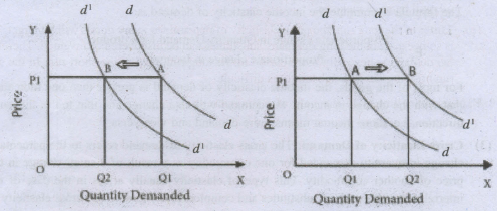
(v) 'Extension' and 'Contraction' of demand follow a change in price. Increases and decreases in demand take place when price remains the same and the other factors bring about demand changes.
4.
Importance or Application of the Law of DMU:
(1) The Law of DMU is one of the fundamental laws of consumption. It has applications in several fields of study.
(2) This law is the basis for other consumption laws such as Law of Demand, Elasticity of Demand, Consumer's Surplus and the Law of Substitution etc.
(3) The Finance Minister taxes a more-moneyed person more and a less-moneyed person less. When a person's income rises, the tax-rate rises because the MU of money to him falls with every rise in his income. Thus, the Law of DMU is the basis for progressive taxation.
(4) This law emphasises an equitable distribution of wealth. The MU of money to the more-moneyed is low. Hence, redistribution of income from rich to poor is justified.
(5) Adam Smith explains the famous "diamond-water paradox". Diamond is scarce, hence, its MU is high and its price is high, even though it is not very much needed. Water is abundant, hence, its MU is low and its price is low, even though it is very much essential.
5.
Nature of demand curve for the exceptions to the law of demand:
(i) Normally, the demand curve slopes downwards from left to right. But there are some unusual demand curves which do not obey the law and the reverse occurs.
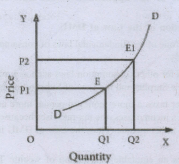
(ii) A fall in price brings about a contraction of demand and a rise in price results in an extension of demand.
(iii) Therefore the demand curve slopes upwards from left to right. It is known as exceptional demand curve.
(iv) In the diagram, DD is the demand curve which slopes upwards from left to right.
(v) It shows that when price is \({ OP }_{ 1 }\), \({ OQ }_{ 1 }\) is the demand and when the price rises to \({ OP }_{ 2 }\), demand also extends to \({ OQ }_{ 2 }\).

11th Standard Syllabus & Materials
11th Standard
TN 11th Tamil பீடு பெற நில் - செய்யுள் - காவடிச்சிந்து Important Questions And Answers Study Material - QB365 Set A
NEW11th Standard
TN 11th Tamil பீடு பெற நில் - உரைநடை - மலை இடப்பெயர்கள் : ஓர் ஆய்வு Important Questions And Answers Study Material - QB365 Set A
NEW11th Standard
TN 11th Tamil மாமழை போற்றுதும் - துணைப்பாடம் - யானை டாக்டர் Important Questions And Answers Study Material - QB365 Set A
NEW11th Standard
TN 11th Tamil மாமழை போற்றுதும் - செய்யுள் - ஐங்குறுநூறு Important Questions And Answers Study Material - QB365 Set A



Tamilnadu Stateboard 11th Standard Subjects

Maths

Commerce
Economics

Biology

Business Maths and Statistics

Accountancy

Computer Science

Physics

Chemistry
Maths
Biology
Economics
Physics
Chemistry

History
Business Maths and Statistics

Computer Science
Accountancy

Computer Applications
History
Computer Technology
Commerce
Computer Applications
Computer Technology

Tamil

English

French
Tamilnadu Stateboard Standards



