
 100% FREE ACCESS
11th Standard Syllabus & Materials
11th Standard
TN 11th Tamil இயற்கை வேளாண்மை,சுற்றுச்சூழல் -செய்யுள் - மனோன்மணீயம் Important Questions And Answers Study Material - QB365 Set A
NEW11th Standard
TN 11th Tamil என்னுயிர் என்பேன் -துணைப்பாடம் - இசைத்தமிழர் இருவர் Important Questions And Answers Study Material - QB365 Set A
NEW11th Standard
TN 11th Tamil மொழி கலை -செய்யுள் - ஒவ்வொரு புல்லையும் Important Questions And Answers Study Material - QB365 Set A
NEW11th Standard
TN 11th Tamil பீடு பெற நில் - இலக்கணம் - பகுபத உறுப்புகள் Important Questions And Answers Study Material - QB365 Set A
NEW11th Standard
TN 11th Tamil பீடு பெற நில் - துணைப்பாடம் - வாடிவாசல் Important Questions And Answers Study Material - QB365 Set A
NEW11th Standard
TN 11th Tamil பீடு பெற நில் - செய்யுள் - குறுந்தொகை Important Questions And Answers Study Material - QB365 Set A

Published on: 07/06/2021
QB365 provides detailed and simple solution for every book back questions in class 11 Maths subject.It will helps to get more idea about question pattern in every book back questions with solution.
Download Tamil Nadu 11th Standard Maths question papers, model tests, one-mark questions, important questions, and public exam papers in PDF format. Free study materials and answer keys for TN State Board students.
Questions + Answers key
Take MCQ Maths Test1.
Solve x = \(\sqrt{x+20}\) for x ∈ R
2.
Solve the equation \(\sqrt{6-4x-x^2}=x+4\)
3.
If a2+b2 = 7ab. Show that log \(\ \frac { a+b }{ 3 } =\frac { 1 }{ 2 } \) (log a + log b)
4.
Solve log8 x + log4 x + log2 x = 11
5.
Solve for x \(\left| 3-\frac { 3 }{ 4 } x \right| \le \frac { 1 }{ 4 } \)
6.
Find two irrational numbers such that their sum is a rational number. Can you find two irrational numbers whose product is a rational number
7.
Prove that \(\sqrt { 3 } \) is an irrational number. (Hint: Follow the method that we have used to prove \(\sqrt { 2 } \notin Q\))
8.
If \(\left( { x }^{ \frac { 1 }{ 2 } }+{ x }^{ -\frac { 1 }{ 2 } } \right) ^{ 2 }=\frac { 9 }{ 2 } \), then find the value of \(\left( { x }^{ \frac { 1 }{ 2 } }-{ x }^{ -\frac { 1 }{ 2 } } \right) \)for x > 1
9.
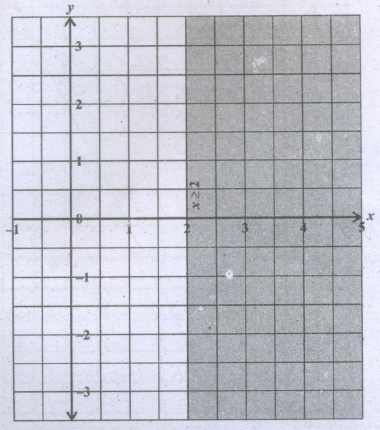
Shade the region given by the inequality x ≥ 2.
10.
Determine the region in the Plane determined by the inequalities.
\(3x+5y\ge 45,\ x\ge 0,\ y\ge 0\)
1.
Observe that \(\sqrt{x+20}\) is defined only if x + 20 ≥ 0
By definition, \(\sqrt{x+20}\ge0\). So, x is positive.
Now squaring we get x2= x + 20. x2- x - 20 = 0
(x - 5)(x + 4) = 0, which gives x = 5, x = -4
Since, x is positive, the required solution is x = 5
2.
The given equation is equivalent to the system (x + 4) ≥ 0 and 6 - 4x - x2 = (x + 4)2
This implies x ≥ -4 and x2 + 6x + 5 = 0. Thus x = -1, -5.
But only x = -1 satisfies both the conditions. Hence, x = -1.
3.
Given a2+ b2 = 7ab
Adding 2ab both sides we get,
a2+b2+2ab = 7ab + 2ab
⇒ (a+b)2 = 9ab
⇒ \(\frac { (a+b)^{ 2 } }{ 9 } \) = ab
⇒ \(\left( \frac { a+b^{ 2 } }{ 9 } \right) ^{ 2 }\) = ab
Taking square root,we get
\(\frac { a+b }{ 3 } \) = ab
\(log\left( \frac { a+b }{ 3 } \right) =log(ab)^{ \frac { 1 }{ 2 } }\)
= \(\frac { 1 }{ 2 } \) log (ab)
log \(\left( \frac { a+b }{ 3 } \right) \) = \(\frac { 1 }{ 2 } \) [log a + log b]
Hence proved.
4.
Given log8 x + log4 x + log2 x = 11
⇒ \(\frac { 1 }{ { log }_{ x }^{ 8 } } +\frac { 1 }{ { log }_{ x }^{ 4 } } +\frac { 1 }{ { log }_{ x }^{ 2 } } \) = 11
⇒ \(1-\frac { 1 }{ { { log }_{ x }^{ { 2 }^{ 3 } } } } +\frac { 1 }{ { log }_{ x }^{ { 2 }^{ 2 } } } +\frac { 1 }{ { log }_{ x }^{ 2 } } \) = 11
⇒ \(\frac { 1 }{ 3{ { log }_{ x }^{ 2 } } } +\frac { 4 }{ 2{ { log }_{ x }^{ 2 } } } +\frac { 1 }{ { log }_{ x }^{ 2 } } \) = 11
⇒ \(\frac { 1 }{ { { log }_{ x }^{ 2 } } } \left( \frac { 1 }{ 3 } +\frac { 1 }{ 2 } +1 \right) \) = 11
⇒ \(\frac { 1 }{ { { log }_{ x }^{ 2 } } } \left( \frac { 2+3+6 }{ 6 } \right) \)= 11
⇒ \(\frac { 1 }{ { { log }_{ x }^{ 2 } } } \left( \frac { 11 }{ 6 } \right) \) = 11
⇒ \(\frac { 1 }{ { { log }_{ x }^{ 2 } } } =11\times \frac { 6 }{ 11 } =6\)
⇒ \(\frac { 1 }{ { { log }_{ x }^{ 2 } } } \) = 6
⇒ log2x = 6
⇒ 26 = x
⇒ x = 64
∴ x = 64
5.
The means \(-{{1}\over{4}}-3\le{3\over4}x\le{1\over 4}.\)
\(⇒-{{1}\over{4}}-3≤-{3\over4}x≤{1\over4}-3\)
\(⇒-{13\over 4}≤-{3\over4}x≤-{11\over4}\)
Multiplying by 4 throughout we get,
\(-13≤-3x≤-11\)
\({-13\over -3}≥x≥{-11\over3}.\)
\(\therefore\) The Solution set is \(\left[ \frac { -11 }{ 3 } ,\frac { 13 }{ 3 } \right] \)
6.
Let the two irrational numbers be \(5+\sqrt { 7 } \) and \(7-\sqrt { 7 } \)
Their sum = \(\left( 5+\sqrt { 7 } \right) +\left( 7-\sqrt { 7 } \right) \ = \ 5+\sqrt { 7 } +7-\sqrt { 7 } \)
= 5 + 7 = 12 which is a rational number.
Consider the two irrational numbers \(4+\sqrt { 6 } \) and \(4-\sqrt { 6 } \)
Their product = \(\left( 4+\sqrt { 6 } \right) +\left( 4-\sqrt { 6 } \right) ={ 4 }^{ 2 }-{ \left( \sqrt { 6 } \right) }^{ 2 }\)= 16 - 6 = 10 which is a rational number.
7.
Suppose √3 is a rational number
Then √3 can be written as \(√3={m\over n}\)
Where m and n are rational numbers with no common factors other than 1.
Squaring both sides we get,
\(3={m^2\over n^2}⇒3n^2=m^2\)
multiplying by 2 we get
6n2 = 2m2 ⇒ 3(2n2) = 2 m2
Since 2n2 is divisible by 2, m2 is also an even number
⇒ m must be even
⇒ m = 2k for some natural number k
⇒ 3n2 = (2k)2
⇒ 3n2 = 4k2
⇒ n is also an even number
Thus both m and n are even numbers having a common factor.
This contradicts our initial assumption that m and n do not have a common factor
Hence √3 cannot be a rational number.
⇒ √3 is an irrational number.
Hence proved.
8.
Given \(\left( { x }^{ +\frac { 1 }{ 2 } }+{ x }^{ -\frac { 1 }{ 2 } } \right) ^{ 2 }=\frac { 9 }{ 2 } \)
⇒ \(x+\frac { 1 }{ 2 } +{ 2x }^{ \frac { 1 }{ 2 } }.\frac { 1 }{ { x }^{ -\frac { 1 }{ 2 } } } =\frac { 9 }{ 2 } \)
⇒ \(x+\frac { 1 }{ x } +2=\frac { 9 }{ 2 } \)
⇒ \(x+\frac { 1 }{ x } =\frac { 9 }{ 2 } -2=\frac { 9-4 }{ 2 } =\frac { 5 }{ 2 } \)
Consider \(\left( { x }^{ \frac { 1 }{ 2 } }-{ x }^{ -\frac { 1 }{ 2 } } \right) ^{ 2 }\)
= \(x+\frac { 1 }{ x } -2x^{ \frac { 1 }{ 2 } }.\frac { 1 }{ { x }^{ \frac { 1 }{ 2 } } } \)
= \(x+\frac { 1 }{ x } -2\) [From(1)]
= \(\frac { 5 }{ 2 } -2=\frac { 5-4 }{ 2 } =\frac { 1 }{ 2 } \) [using 1]
∴ \(x^{ \frac { 1 }{ 2 } }-x^{ -\frac { 1 }{ 2 } }=\pm \frac { 1 }{ \sqrt { 2 } } \)
⇒ \(x^{ \frac { 1 }{ 2 } }-x^{ -\frac { 1 }{ 2 } }=\frac { 1 }{ \sqrt { 2 } } \) since x > 1
9.
First we consider equation x = 2. It is a line parallel to y axis at a distance of 2 units from it. This line divides the cartesian plane into two parts. Substituting (0, 0) in the inequality we get 0 ≥ 2 which is false. Hence the region which does not contain the origin is represented by the inequality x ≥ 2. The shaded region is the required solution set of the given inequality. Since x ≥ 2, the points on the line x = 2 are also solutions.
10.
If 3x + 5y = 45
| x | 0 | 15 |
| y | 9 | 0 |
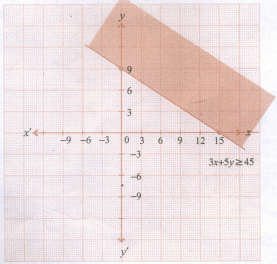
All points bounded above x = 0, y = 0 and 3x + 5y = 45 is required region. Darkly shaded area will represents the solution set of the given linear inequalities.

11th Standard Syllabus & Materials
11th Standard
TN 11th Tamil பீடு பெற நில் - செய்யுள் - காவடிச்சிந்து Important Questions And Answers Study Material - QB365 Set A
NEW11th Standard
TN 11th Tamil பீடு பெற நில் - உரைநடை - மலை இடப்பெயர்கள் : ஓர் ஆய்வு Important Questions And Answers Study Material - QB365 Set A
NEW11th Standard
TN 11th Tamil மாமழை போற்றுதும் - துணைப்பாடம் - யானை டாக்டர் Important Questions And Answers Study Material - QB365 Set A
NEW11th Standard
TN 11th Tamil மாமழை போற்றுதும் - செய்யுள் - ஐங்குறுநூறு Important Questions And Answers Study Material - QB365 Set A



Tamilnadu Stateboard 11th Standard Subjects
Maths

Commerce

Economics

Biology

Business Maths and Statistics

Accountancy

Computer Science

Physics

Chemistry
Maths
Biology
Economics
Physics
Chemistry

History
Business Maths and Statistics

Computer Science
Accountancy

Computer Applications
History
Computer Technology
Commerce
Computer Applications
Computer Technology

Tamil

English

French
Tamilnadu Stateboard Standards



