
 100% FREE ACCESS
11th Standard Syllabus & Materials
11th Standard
TN 11th Tamil இயற்கை வேளாண்மை,சுற்றுச்சூழல் -செய்யுள் - மனோன்மணீயம் Important Questions And Answers Study Material - QB365 Set A
NEW11th Standard
TN 11th Tamil என்னுயிர் என்பேன் -துணைப்பாடம் - இசைத்தமிழர் இருவர் Important Questions And Answers Study Material - QB365 Set A
NEW11th Standard
TN 11th Tamil மொழி கலை -செய்யுள் - ஒவ்வொரு புல்லையும் Important Questions And Answers Study Material - QB365 Set A
NEW11th Standard
TN 11th Tamil பீடு பெற நில் - இலக்கணம் - பகுபத உறுப்புகள் Important Questions And Answers Study Material - QB365 Set A
NEW11th Standard
TN 11th Tamil பீடு பெற நில் - துணைப்பாடம் - வாடிவாசல் Important Questions And Answers Study Material - QB365 Set A
NEW11th Standard
TN 11th Tamil பீடு பெற நில் - செய்யுள் - குறுந்தொகை Important Questions And Answers Study Material - QB365 Set A

Published on: 25/06/2021
QB365 provides detailed and simple solution for every Creative Questions in class 11 Maths Subject. It will helps to get more idea about question pattern in every Creative questions with solution.
Download Tamil Nadu 11th Standard Maths question papers, model tests, one-mark questions, important questions, and public exam papers in PDF format. Free study materials and answer keys for TN State Board students.
Questions + Answers key
Take MCQ Maths Test1.
Find matrix C if \(A=\left[ \begin{matrix} 3 & 7 \\ 2 & 5 \end{matrix} \right] ,B=\left[ \begin{matrix} -3 & 2 \\ 4 & -1 \end{matrix} \right] \) and 5C + 2B = A.
2.
If x = \(a\sec ^{ 3 }{ \theta }\) and \(y=a\tan ^{ 3 }{ \theta }\) find \(\frac { dy }{ dx }\) at \(\theta =\frac { \pi }{ 3 }\)
3.
If \(tan\alpha=\frac{1}{3}\ and\ tan \beta=\frac{1}{7}\) show that \(2\alpha+\beta=\frac{\pi}{4}.\)
4.
Prove that sin (A+B) sin (A - B) = cos2B - cos2A.
5.
Out of 18 points in a plane, no three are in the same line except five points which are collinear. Find the number of lines that can be formed joining the points.
6.
How many 3-digit even numbers can be made using the digits 1, 2, 3, 4, 6, 7 if no digit is repeated?
7.
Simplify: \(\frac{cos(90°+\theta)sec(-\theta)tan(180°-\theta)}{sec(360°-\theta)sin(180°+\theta)cot(90°+\theta)}\)
8.
Sum up to n terms the series:
7 + 77 + 777 + 7777 + ...
9.
If the letter of the word 'RACHIT' are arranged in all possible ways as listed in dictionary, then what is the rank of the word 'RACHIT'?
10.
The line 2x - y = 5 turns about the point on it, whose ordinate and abscissae are equal, through an angle of 45° in the anti-clockwise direction. find the equation of the line in the new position.
11.
Find \(\sum_{1}^{\infty}{\frac{1}{(k+1)(k+2)}}\).
12.
Find 3 numbers in AP where sum is 15 and sum of their reciprocals is \(\frac{71}{105}.\)
13.
Prove that in the expansion of (1+x)n, the Co-efficient of terms equidistant from the beginning and from the end are equal
14.
If 9P5 + 5.9P4 = 10Pr , find r.
15.
How many 3-digit numbers more than 600 can be formed using the digits 2, 3, 4, 6, 7?
16.
Prove that n!(n + 2) = n! + (n + 1)!
17.
if n is an odd positive integer, prove that the Co-efficients of the middle terms in the expansion equal
18.
Draw venn diagram of three sets A, B and C which illustrates the following:
A ∩ B ∩ C
19.
Write a description of each shaded area. Use symbols U, A, B, C, U, ∩, ' and \ as necessary.
.png)
20.
Which of the following sets are finite and which are infinite?
Set of concentric circles in a plane.
21.
Show that the function f : R ⟶ R given by f(x) = cos x for all x ∈ R is neither one-one nor onto.
22.
Find the quotient of the identity function by the modulus function
23.
Find the value of log2 \(\left({{\sqrt [ 3 ]{4 } }\over{4^2\sqrt{8}}} \right).\)
24.
Solve \(\sqrt [ 8 ]{{{x}\over{x+3}} } -\sqrt{{{x+3}\over{x}}}=2.\)
25.
Solve the equation x2/3 + x1/3 - 2 = 0.
1.
5C + 2B = A
⇒ 5C = A - 2B
\(\therefore C=\cfrac { 1 }{ 5 } \left[ A-2B \right] \)
Here \(A=\left[ \begin{matrix} 3 & 7 \\ 2 & 5 \end{matrix} \right] B=\left[ \begin{matrix} -3 & 2 \\ 4 & -1 \end{matrix} \right] \)
\(\therefore A-2B=\left[ \begin{matrix} 3 & 7 \\ 2 & 5 \end{matrix} \right] -2\left[ \begin{matrix} -3 & 2 \\ 4 & -1 \end{matrix} \right] =\left[ \begin{matrix} 3 & 7 \\ 2 & 5 \end{matrix} \right] +\left[ \begin{matrix} 6 & -4 \\ -8 & 2 \end{matrix} \right] \)
= \(\left[ \begin{matrix} 3+6 & 7-4 \\ 2-8 & 5+2 \end{matrix} \right] =\left[ \begin{matrix} 9 & 3 \\ -6 & 7 \end{matrix} \right] \)
\(\therefore C=\cfrac { 1 }{ 5 } \left( A-2B \right) =\cfrac { 1 }{ 2 } \left[ \begin{matrix} 9 & 3 \\ -6 & 7 \end{matrix} \right] =\left[ \begin{matrix} 9/5 & 3/5 \\ -6/5 & 7/5 \end{matrix} \right] \)
2.
\(x=a\sec ^{ 3 }{ \theta } \)
\(\Rightarrow \frac { dx }{ d\theta } =3a\sec ^{ 2 }{ \theta } .\frac { d }{ d\theta } (\sec { \theta } )=3a\sec ^{ 2 }{ \theta } .\sec { \theta } \tan { \theta } =3a\sec ^{ 3 }{ \theta } \tan { \theta } \)
\(y=a\tan ^{ 3 }{ \theta } \)
\(\Rightarrow \frac { dy }{ d\theta } =a.3\tan ^{ 2 }{ \theta } .\frac { d }{ d\theta } (\tan { \theta } )=3a\tan ^{ 2 }{ \theta } .\sec ^{ 2 }{ \theta } \)
\(\frac { dy }{ dx } =\frac { dy }{ d\theta } /\frac { dx }{ d\theta } =\frac { 3a\tan ^{ 2 }{ \theta } \sec ^{ 2 }{ \theta } }{ 3a\sec ^{ 3 }{ \theta } \tan { \theta } } =\frac { \tan { \theta } }{ \sec { \theta } } =\frac { \sin { \theta } }{ \cos { \theta \times \frac { 1 }{ \cos { \theta } } } } =\sin { \theta } \)
\(\therefore \frac { dy }{ dx } \quad at\quad \theta =\frac { \pi }{ 3 } =\sin { \frac { \pi }{ 3 } } =\frac { \sqrt { 3 } }{ 2 } \)
3.
\(tan2\alpha=\frac{2tan\alpha}{1-tan^2\alpha}=\frac{2(\frac{1}{3})}{1-(\frac{1}{3})^2}=\frac{\frac{2}{3}}{\frac{8}{9}}=\frac{3}{4}\)
\(tan(2\alpha+\beta)=\frac{tan2\alpha+tan\beta}{1-tan2\alpha+tan\beta}=\frac{\frac{3}{4}+\frac{1}{7}}{1-(\frac{3}{4})(\frac{1}{7})}=\frac{\frac{21+4}{28}}{\frac{28-3}{28}}=1\)
\(\therefore2\alpha+\beta=45^0=\frac{\pi}{4}\)
4.
LHS = sin (A + B) sin (A - B)
= (sin A cos B + cos A sin B) (sin A cos B - cos A sin B)
= sin2A cos2B - cos2A sin2B
= (1 - cos2A) cos2B - cos2A (1 - cos2B)
= cos2B - cos2A cos2B - cos2A + cos2A cos2B
= cos2B - cos2A = RHS
5.
Total number of points = 18
Out of 18 numbers, 5 are collinear and we get a straight line by joining any two points.
\(\therefore\) Total number of straight line formed by joining 2 points out of 18 points = 18C2
Number of straight lines formed by joining 2 points out of 5 points = 5C2
But 5 points are collinear and we get only one line when they are joined pairwise.
So, the required number of straight lines are
=18C2 -5C2 +1 = \({18 ·17\over2.1}-{5·4\over2.1}+1= 153 -10 + 1-144\)
Hence, the total number of straight lines = 144
6.
Here total number of digits = 6
The unit place can be filled with any one of the digits 2, 4, 6.
So number of permutation = 5P1 = \({3!\over 2!}=3\)
Now the tens and hundreds place can be filled by remaining 5 digits.
So number of permutation = 5P1= \({5!\over3!}={5\times 4\times 3!\over 3!}=20\)
Hence total number of permutations = 3 \(\times\) 20 = 60
7.
cos (90°+ \(\theta\)) = -sin\(\theta\)
sec(-\(\theta\)) = sec \(\theta\)
tan(180°-\(\theta\)) = -tan\(\theta\)
sec(360°-\(\theta\)) = sec\(\theta\)
sin(180°+\(\theta\)) = -sin\(\theta\)
cot(90°+\(\theta\)) = -tan\(\theta\)
\(\therefore\frac{cos(90°+\theta)sec(-\theta)tan(180°-\theta)}{sec(360°-\theta)sin(180°+\theta)cot(90°+\theta)}\)
\(=\frac{(-sin\theta)(sec\theta)(-tan\theta)}{(sec\theta)(-sin\theta)(-tan\theta)}=1\)
8.
7 + 77 + 777 + 7777 + ...
Sn = 7 + 77 + 777 + 7777 + ... to n terms
= \(\frac{7}{9}[9+99+999+9999+\)...to n terms]
= \(\frac{7}{9}[(10-1)+(10^{2}-1)+(10^{3}-1)+(10^{4}-1)+..\).to n terms]
= \(\frac{7}{9}[(10+10^{2}+10^{3}+... to n terms)-(1+1+1+... n terms)]\)
= \(\frac{7}{9}[\frac{10(10^{n}-1)}{10-1}-n]=\frac{7}{9}[\frac{10}{9}(10^{n}-1)-n]\)
= \(\frac{7}{81}[10^{n+1}-9n-10]\)
9.
The alphabetical order of RACHIT is A, C, H, I, Rand T
Number of words beginning with A = 5!
Number of words beginning with C = 5!
Number of words beginning with H = 5!
Number of words beginning with I = 5!
and Number of words beginning with R (i.e) RACHIT = 1
\(\therefore\)The rank of the word 'RACHIT' in the dictionary
= 5! + 5! + 5! + 5! + 1 = 4 \(\times\) 5! + 1
= 4 \(\times\) 5 \(\times\)4\(\times\)3 \(\times\)2\(\times\)1 + 1 = 4 \(\times\) 120 + 1 = 480 + 1 = 481
10.
If the line 2x - y = 5 makes an angle \(\theta\) with x - axis. Then, tan \(\theta\) = 2. Let P (a, a) be a point on the line 2x - y = 5. Then, 2 a - a = 5 \(\Rightarrow\) a = 5
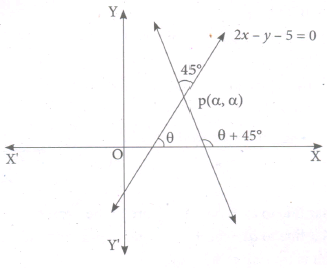
So, the coordinates of Pare (5, 5). If the line 2x - y - 5 = 0 is rotated about point P through 45° in anti-clockwise direction, then the line in its new position makes angle 8 + 45° with x -axis. Let m be the slope of the line in its new position. Then,
\(m'=tan(\theta+45^o)=\frac{\tan\theta+\tan45^o}{1-\tan\theta\tan45^o}=\frac{2+1}{1-2\times 1}=-3\)
Thus, the line in its new position passes through P (5, 5) and has slope m' = -3
So, its equationy -5 = m' (x - 5) or, y -5 = -3 (x - 5) or, 3x + y - 20 = 0.
11.
\(\frac{1}{2}\)
12.
3, 5, 7
13.
In (1 + x)n, (r + 1)th term from the beginning.
Tr+1 = nCr 1n-r. xr = nCrxr ....(1)
Its co-efficient is nCr
In (1 + x)n, there are (n + 1)terms
So, the (r +1)th term from the end will have (n + 1) - (r + 1) = n - r terms
∴ Tn-r+1 = nCn-r 1n-(n-r).xn-r = nCn-rxn-r ...(2)
Its Co-efficient is nCn-r
From (1) and (2), the Co-efficient of (r + 1)th term from the beginning and from the end are equal
14.
Given 9P5 + 5.9P4 = 10Pr
\(\Rightarrow \frac { 9! }{ 4! } +5\times \frac { 9! }{ 5! } =\frac { 10! }{ (10-r)! } \)
\(\Rightarrow \frac { 9! }{ 4! } +\frac { 9! }{ 4! } =\frac { 10! }{ (10-r)! } \quad \left[ \because \frac { 5 }{ 5! } =\frac { 5 }{ 5\times 4! } =\frac { 1 }{ 4! } \right] \)
\(\Rightarrow 2\times \frac { 9! }{ 4! } =\frac { 10! }{ (10-r)! } \)
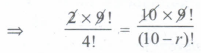
\(\Rightarrow\) (10-r)! = 5 \(\times\)4!
\(\Rightarrow\) (10-r)! = 5! [n(n-1)! = n!]
\(\Rightarrow\) 10-r = 5 \(\Rightarrow\) r = 5.
15.
Clearly repetition of digits is allowed.
Since, a 3-digit number greater than 600 will have 6 or 7 at hundred's place.
So, hundred's place can be filled in 2 ways. Each of the ten's and one's place can be filled in 5 ways.
Hence, total number of required numbers = 2 \(\times\) 5 \(\times\) 5 = 50.
16.
LHS = n!(n + 2)
RHS = n! + (n+1)!
= n!+(n+1)(n)!....(1)
= n!(1+n+1)
= n!(n+20)...(2)
From (1) and (2), LHS = RHS
Hence Proved.
17.
Given (x + y)n
If n is odd, the two middle terms in (x +y)n are \({T_{n-1}\over 2}\ and \ {T_{n+1}\over 2}\)
\({T_{n-1}\over 2}=nC_{n+1\over 2}x^{n+1\over 2}y^{n-1\over 2}\ and\ {T_{n+1}\over2}=nC_{n-1\over2}x^{n-1\over 2}y^{n+1\over 2}\)
The co-efficients of middle terms are \(nC_{n+1\over2}\ and \ nC_{n-1\over2}\)
\(nC_{n+1\over2}=nC_{n-1\over2}⇒{n+1\over2}={n-1\over 2}\ or\ {n+1\over2}+{n-1\over 2}=n\)
[∴ nCx = nCy ⇒ x = y or x +y = n]
\(⇒\ {n+1\over 2}={n-1\over 2}0=2\) which is not possible
Also, \({n+1\over 2}+{n-1\over 2}=n⇒{n+n+1-1\over 2}=n\)
⇒ \({2n\over 2}=n⇒ n=n\)
∴ \(nC_{n+1\over 2}=nC_{n-1\over 2}\). Hence the coefficients of two middle terms are equal
18.
The Venn diagram of A∩B∩C is as follows.
.png)
19.
The shaded region is (A ∩ B)\C.
20.
Set of concentric circles in a plane is an infinite set since number of concentric circles in a plane is infinite
21.
Given f : R ⇾ R, defined by f(x) = cos x
We know f(0) = cos 0 = 1
and f(2π) = cos 2π = 1
∴ f(0) = f(2π) ⇒ 0 ≠ (2π)
∴ f is not one-one.
Since the values of cos x tie between -1 and 1, the range of f(x) is not equal to its co-domains.
∴ f is not onto.
Hence, f is neither one-one nor onto.
22.
Let f and g denote the identity function and the modulus function.
Then f : R ⟶ R is defined as f(x) = x and g : R ⟶ R is defined as g(x) = |x|
g(x) = 0 ⇒ |x| = 0 ⇒ x =0
∴ The quotient of f by g is \({f\over g}:R-\{0\}⟶R\) and is defined as
\(\left(f\over g \right)(x )={f(x)\over g(x)}={x\over |x|}=\begin{cases} {x\over x}=1\ if\ xx>0 \\{x\over -x}=-1\ if\ x<0 \end{cases}\)
23.
Given \(log_2\left({{\sqrt [ 3 ]{4 } }\over{4^2\sqrt{8}}} \right)\)
= \({log}_{2}\sqrt [ 3 ]{4 }-{log}_{2}4^2(\sqrt{8})\)
= \(log_24^{1/3}-[log_24^2+log_2\sqrt{8}]\)
= log2(22)1/3- log2(22)2- log2(23)1/2
= log221/3- log224- log223/2
\(={{2}\over{3}}(1)-4(1)-{{3}\over{2}}(1)\) \([\because {log}^{2}_{2}=1]\)
\(={{4-24-9}\over{6}}={{-29}\over{6}}\)
24.
Given quadratic equation is \(\sqrt [ 8 ]{{{x}\over{x+3}} } -\sqrt{{{x+3}\over{x}}}=2.\)
Let y \(=\sqrt{x\over x+3}\Rightarrow{1\over y}=\sqrt{x+3\over x}\)
∴ (1) becomes 8y - \(\frac{1}{y}\) = 2
\(⇒\ {8y^2-1\over y}=2⇒8y^2-1=2\)
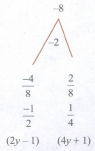
8y2-2y-1 = 0
(2y - 1)(4y + 1) = 0
2y = 1 or 4y = -1
\(y={1\over 2}\)or \(y={-1\over 4}\)
\(\sqrt{x\over x+3}={1\over 2}\sqrt{x\over x+3}={1\over 2}\ or\ \sqrt{x\over x+3}={-1\over 4}\)
Case(i) \(\sqrt{x\over x+3}={1\over 2}\Rightarrow{x\over x+3}={-1\over 4}\)
4x = x + 3 ⇒ 3x = 3 ⇒ x = 1
Case(ii) \(\sqrt{x\over x+3}={-1\over 4}\)
This is impossible since LHS is non-negative.
∴ The root is 1.
25.
Given x2/3 + x1/3 - 2 = 0.
\(\Rightarrow\) (x1/3)2 + x1/3-2 = 0
Let x1/3= y
\(\Rightarrow\)y2 + y - 2 = 0
\(\Rightarrow\) \(y={{-1\pm\sqrt{{(1)}^{2}-4(1)(-2)}}\over{2}}\)
\(\left[{ \because y={{-b\pm\sqrt{{b}^{2}-4ac}}\over{2a}} a=1, \ \ \ b=1, \ \ \ c=-2}\right] \)
\(\Rightarrow\) \(y={{-1\pm\sqrt{9}}\over{}2}\)
\(\Rightarrow\) \(y={{-1\pm3}\over{2}}\Rightarrow y=1,-2\Rightarrow x^{1/3}=1\) or -2.
Case (i) When x1/3 = 1 \(\Rightarrow\) x1/3 = 11/3\(\Rightarrow\) x = 1
Case (ii) When x1/3 = - 2 \(\Rightarrow\) x = (-2)3 = -8
\(\therefore\) The roots are 1, -8.

11th Standard Syllabus & Materials
11th Standard
TN 11th Tamil பீடு பெற நில் - செய்யுள் - காவடிச்சிந்து Important Questions And Answers Study Material - QB365 Set A
NEW11th Standard
TN 11th Tamil பீடு பெற நில் - உரைநடை - மலை இடப்பெயர்கள் : ஓர் ஆய்வு Important Questions And Answers Study Material - QB365 Set A
NEW11th Standard
TN 11th Tamil மாமழை போற்றுதும் - துணைப்பாடம் - யானை டாக்டர் Important Questions And Answers Study Material - QB365 Set A
NEW11th Standard
TN 11th Tamil மாமழை போற்றுதும் - செய்யுள் - ஐங்குறுநூறு Important Questions And Answers Study Material - QB365 Set A



Tamilnadu Stateboard 11th Standard Subjects
Maths

Commerce

Economics

Biology

Business Maths and Statistics

Accountancy

Computer Science

Physics

Chemistry
Maths
Biology
Economics
Physics
Chemistry

History
Business Maths and Statistics

Computer Science
Accountancy

Computer Applications
History
Computer Technology
Commerce
Computer Applications
Computer Technology

Tamil

English

French
Tamilnadu Stateboard Standards



