
 100% FREE ACCESS
11th Standard Syllabus & Materials
11th Standard
TN 11th Tamil இயற்கை வேளாண்மை,சுற்றுச்சூழல் -செய்யுள் - மனோன்மணீயம் Important Questions And Answers Study Material - QB365 Set A
NEW11th Standard
TN 11th Tamil என்னுயிர் என்பேன் -துணைப்பாடம் - இசைத்தமிழர் இருவர் Important Questions And Answers Study Material - QB365 Set A
NEW11th Standard
TN 11th Tamil மொழி கலை -செய்யுள் - ஒவ்வொரு புல்லையும் Important Questions And Answers Study Material - QB365 Set A
NEW11th Standard
TN 11th Tamil பீடு பெற நில் - இலக்கணம் - பகுபத உறுப்புகள் Important Questions And Answers Study Material - QB365 Set A
NEW11th Standard
TN 11th Tamil பீடு பெற நில் - துணைப்பாடம் - வாடிவாசல் Important Questions And Answers Study Material - QB365 Set A
NEW11th Standard
TN 11th Tamil பீடு பெற நில் - செய்யுள் - குறுந்தொகை Important Questions And Answers Study Material - QB365 Set A

Published on: 13/05/2022
QB365 provides detailed and simple solution for every Creative Questions in class 11 Maths Subject. It will helps to get more idea about question pattern in every Creative questions with solution.
latest Creative QuestionsDownload Tamil Nadu 11th Standard Maths question papers, model tests, one-mark questions, important questions, and public exam papers in PDF format. Free study materials and answer keys for TN State Board students.
Questions + Answers key
Take MCQ Maths Test1.
A relation R is defined on the set z of integers as follows:
(x, Y) ∈ R ⇔ x2 + y2 = 25. Express R and R-1 as the set of ordered pairs and hence find their respective domains.
2.
Solve: tan-1 (x + 1) + tan-1 (x - 1) = tan-1\(\frac{4}{7}\).0
3.
Solve : 2 tan θ - cot θ = - 1
4.
2n < (n + 2)! for all natural number n.
5.
Solve \((x+1)^{ \frac { 1 }{ 3 } }=\sqrt { x-3 } \)
6.
Determine the region in the Plane determined by the inequalities x+y≤9,y>x,x≥0
7.
Prove that tan 70° - tan 20° - 2 tan 40° = 4 tan 10°.
8.
Find r if 5Pr = 2 6Pr-1
9.
Forensic Scientists use h = 61.4+2.3F to predict the height h in centimeters for a female whose thigh bone (femur) measures F cm. If the height of the female lies between 160 to 170 cm find the range of values for the length of the thigh bone?
10.
Find the pairs of ceonsecutive odd positive integers both of which are smaller than 10 such that their sum is more than 11
11.
\(\frac { |x-2|-1 }{ |x-2|-2 } \le 0\)
12.
Prove that \(\sqrt { 5 } \) is an irrational number
13.
If nPr = nPr+1 and nCr = nCr-1 find the values of n and r.
14.
In how many ways can the letters of the word PERMUTATIONS be arranged if the words start with P and end with S.
15.
How many numbers are there between 100 and 1000 such that atleast one of the their digits is 7?
16.
Show that \(\sin ^{ -1 }{ \left( \frac { 12 }{ 13 } \right) } +\cos ^{ -1 }{ \left( \frac { 4 }{ 5 } \right) } +\tan ^{ -1 }{ \left( \frac { 63 }{ 16 } \right) } =\pi \)
17.
Solve \(\sin { 2x } +\sin { 4x } +\sin { 6x } =0\)
18.
Consider the function \(f:[0,{\pi\over 2}]⟶R\) given by f(x) = sin x and \(g:[0,{\pi\over 2}]⟶R\)given by g(x) = cos x. Show that f and g are one-one but (f + g) is not one-one.
19.
Show that \({{1}\over{3-\sqrt{8}}}-{{1}\over{\sqrt{8}-\sqrt{7}}}+{{1}\over{\sqrt{7}-\sqrt{6}}}-{{1}\over{\sqrt{6}-\sqrt{5}}}+{{1}\over{\sqrt{5}-2}}=5\)
20.
Evaluate \(\sqrt [ 3 ]{ {{{(45.4)}^{2}}\over{{(3.2)}^{2}}\times{(6.5)}^{2}} } \)
21.
Show that the relation R on the set R of all real numbers defined as R = {(a, b): a < b2} is neither reflexive, nor symmetric nor transitive.
22.
The cartesian product A \(\times\) A has 9 elements among which are found (-1, 0) and (0, 1).Find the set A and the remaining elements of A \(\times\)A.
23.
For A = {0,1,2,3, 4}, B = {1, -2, 3, 4, 5, 6} and C = {2, 4, 6, 7} verify A\(B ∩ C) = (A\B) U(A\C) Using venn diagram.
24.
If \({{{log}_{e}^{x}}\over{b-c}}={{{log}_{e}^{y}}\over{c-a}}={{{log}_{e}^{z}}\over{a-b}},\) show that xyz = 1
25.
Solve: \(\sqrt{x+5}+\sqrt{x+21}=\sqrt{6x+40}\)
1.
x2 +y2 = 25
y = 土\(\sqrt { 25-{ x }^{ 2 } } \)
x = 0 ⇒ y = 士5
y = 0 ⇒ x = 土5
(0, 5), (0, -5) ∈R
x = 3 ⇒ y = 土4
x = -3 ⇒ y = 土4
Domain of R = {0, 3, -3, -4, 4, -5, 5}
Domain of R-1 {0, 3, -3, -4, 4, -5, 5}
2.
tan-1 (x + 1) + tan-1 (x - 1) = tan-1\((\frac{4}{7})\)
\({ tan }^{ -1 }\left( \frac { x+1+x-1 }{ 1-({ x }^{ 2 }-1) } \right) ={ tan }^{ -1 }\left( \frac { 4 }{ 7 } \right) \)
\(tan\left( \frac { 2x }{ 2-{ x }^{ 2 } } \right) ={ tan }^{ -1 }\left( \frac { 4 }{ 7 } \right)\)
\(\frac { 2x }{ 2-{ x }^{ 2 } } =\frac { 4 }{ 7 } \)
8 - 4x2 = 14x
4x2 + 14x - 8 = 0
⇒ 2x2+ 7x - 4 = 0
2x2+ 8x - x - 4 = 0
2x (x + 4) -1(x + 4) = 0
(x + 4) (2x - 1) = 0
x = -4 or x = \(\frac{1}{2}\)
∴ x = \(\frac{1}{2}\)
3.
2 tan θ - cot θ = - 1
2 tan θ-\(\frac{1}{tan θ}\) = 1 ⇒ 2tan2θ - 1 = tan θ
2 tan2 θ - 1 + tan θ = 0
⇒ (2tan θ-1) (tan θ+1) = 0
2tan θ-1 = 0 (or) tan θ+1 = 0
tan θ = \(\frac{1}{2}\) (or) tan θ = -1
When tan θ = -1 = -tan\(\frac{\pi}{4}\)
tan θ = tan\((\frac{-\pi}{4})\)
⇒ θ = nπ + \((\frac{-\pi}{4})\)
= nπ -\(\frac{\pi}{4}\);n∈Z
When tan θ = \(\frac{1}{2}\)= tan β (say)
∴ θ = nπ + β + nπ + tan-1\((\frac{1}{2})\)
Hence θ = nπ - \(\frac{\pi}{4}\) (or) θ = nπ + tan-1\((\frac{1}{2})\); n∈Z
4.
Let p(n) : 2n < (n + 2)! for all k\(\in\)N.
Step1: P(1) 2.1 < (1+2)!
\(\Rightarrow\) 2 < 3!\(\Rightarrow\) 2 < 6 which is true for P(1) [\(\because\) 3! = 3 x 2 x 1 = 6]
Step 2: P(k) : 2k < (k + 2)!. Let it be true for P(k)
Step3:P(k+1) 2(k+1) < (k+1+2)!
Since 2k < (k + 2)! (from Step 2)
\(\Rightarrow\)2k+2 < (k+2)! +2
\(\Rightarrow\) 2(k+1) < (k+2)!+2
Also, (k+ 2)! + 2 < (k+ 3)!
\(\therefore\) 2(k+1) < (k+3)!
\(\Rightarrow\) 2(k + 1) < (k + 2 + 1)! which is true for P(k + 1)
Hence, P(k + 1) is true whenever P(k) is true.
5.
\((x+1)^{1\over 3} = (x-3)^{1\over 2}\)
L.C.M. of 2 and 3 is 6 & Raising to the power 6
\(\left\{ (x+1)^{ \frac { 1 }{ 3 } } \right\} ^{ 6 }=\left\{ (x-3)^{ \frac { 1 }{ 2 } } \right\} ^{ 6 }\)
(x+1)2 = (x-3)3
x2+2x+1 =x3-9x2+27x-27
0 = x3-9x2+27x-27-x2-2x-1
x3-10x2+25x-28 =0
since constant term is - 28
we can have a factor as (x ± 2) or (x ± 4) or (x ± 7)
By trial and error method we find that (x - 7) is a factor
Using synthetic division
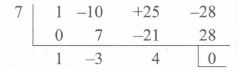
we get x3-10x2+25x-28=(x-7)(x2-3x+4)
solving x2-3x+4 =0
x=\(\frac { 3\pm \sqrt { 9-16 } }{ 2 } =\frac { 3\pm \sqrt { -7 } }{ 2 } \)
the roots are x =7 x=\(\frac { 3\pm \sqrt { -7 } }{ 2 } \)
6.
The given inequality is x+y≤9
Draw the graph of the line x+y =9
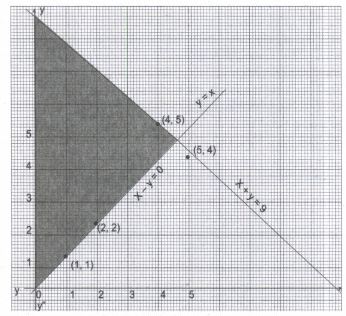
Table of values satisfying the equation
x+y = 9
| x | 5 | 4 |
| y | 4 | 5 |
Putting (0, 0) in the given inequation, we have 0+0≤9⇒0≤9, is towards is origin
∴ Half plane of x+y≤9 is away from origin
Also, the given inequality is x-y < 0
Draw the graph of the line x - y = 0.
Table of values satisfying the equation
x-y =0
| x | 1 | 2 |
| y | 1 | 2 |
Putting (0, 3) in the given inequation, we have 0-3-0<0⇒-3<0 which is true.
∴ Half plane of x-y < 0 containing the points (0,3).
7.
LHS = tan 70° - tan 20° - 2 tan 40°
\(=(\frac{sin70°}{cos70°}-\frac{sin20°}{cos20°})-2tan40°\)
\(=(\frac{sin70°cos20°-cos70°sin20°}{cos70°cos20°})-2tan40°\)
\(=\frac{sin(70°-20°)}{cos70°cos20°}-2tan40°\)
\(=\frac{2sin50°}{2cos70°cos20°}-2tan40°\)
\(=\frac{2sin50°}{cos90°+cos50°}-2tan40°\)
\(=\frac{2sin50°}{cos50°}-2tan40°\ [\because cos90°=0]\)
\(=2(\frac{sin50°}{cos50°}-\frac{sin40°}{cos40°})\)
\(=2(\frac{sin50°cos40°-cos50°sin40°}{cos50°cos40°})\)
\(=2[\frac{sin(50°-40°)}{cos50°cos40°}]=\frac{4sin10°}{2cos50°cos40°}\)
\(=\frac{4sin10°}{cos90°+cos10°}=\frac{4sin10°}{cos10°}\)
= 4 tan 10° = RHS
8.
Given,5Pr = 2 6Pr-1
\(\Rightarrow {5!\over (5-r)!}=2\times{6!\over \{6-(r-1)\}!}\)
\(\Rightarrow {5!\over (5-r)!}=2\times{6.5!\over (7-r)!}\)
\(\Rightarrow {5!\over (5-r)!}={6.5!\over (7-r)(6-r)(5-r)!}\)
\(1={12\over (7-r)(6-r)}\)
\(\Rightarrow\) r2 - 13r + 42 = 12 or r2 - 13r + 30 = 0
or (r-3)(r-10) = 0
\(\therefore\) r = 3, 10
Now, 5prand 6pr-1are meaningless when r = 10
[\(\therefore\)nPr is defined only if r\(\le\)n]
\(\therefore\) Rejecting r = 10, we have r = 3
9.
Given h = 61.4 + 2.3 F
Given h = 160 ⇒160 = 61.4 + 2.3 F
⇒ 2.3 F = 160-61.4 = 98.6
F =\(\frac { 98.6 }{ 2.3 } \) = 42.87
Given h = 170,
170 = 61.4 + 2.3 F
⇒ 170 - 61.4 = 2.3 F
2.3 F = 108.6
⇒ F =\(\frac { 108.6 }{ 2.3 } \)= 47.23
So the ranges of values are
42.8 < x < 47.23
10.
Let x be the smaller of the two consecutive odd positive integers, then the other is x + 2. According to the given conditions.
x < 10, x + 2 < 10
and x + ( x + 2 ) > 11
⇒ x < 10, x < 8
and 2x > 9 (\(\because\) x < 8 automatically smallest of the lesser than) ...(1)
⇒ x < 10
and \(x>\frac { 9 }{ 2 } \) ....(2)
From (1) and (2), we get
\(\frac { 9 }{ 2 } \)
x can take values 5 and 7.
So, the required possible pairs will be (x, x+2) = (5,7),(7, 9)
11.
Given that \(\frac { |x-2|-1 }{ |x-2|-2 } \le 0\)
Put | x - 2 | = y
∴ \(\frac { y-1 }{ y-2 } \le 0\)
⇒ y - 1 > 0, y - 2 < 0 ⇒ y < 2
⇒ 1 < y, 2 ⇒ 1 < | x - 2 | < 2
⇒ 1
⇒ x - 2 < -1 (or) x - 2 >1 and -2
⇒ x < 1 (or) x > 3 and 0< x < 4
Hence, the required solution is (0, 1) U (3, 4)
12.
Suppose that is rational
then \(\sqrt { 5 } \) = (where p and q are integer which are co-prime)
⇒ p =\(\sqrt { 5 } \)q = p2 = 5q2 ....(1)
\(\frac { { p }^{ 2 } }{ 5 } \)= q2 ⇒ 5 is a factor of p
So let P = 5c
substituting p = 5c in (1) we get
(5c)2 = 5q2 ⇒ 252 = 5q2
⇒ c2 = \(\frac { { 5q }^{ 2 } }{ 25 } =\frac { { q }^{ 2 } }{ 5 } \)
⇒ 5 is a factor of q also
⇒ So 5 is a factor of p and q which is a contradiction.
⇒ \(\sqrt { 5 } \) is not a rational number.
⇒\(\sqrt { 5 } \) is an irrational number.
13.
Given nPr = nPr+ 1
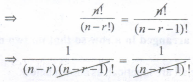
⇒ 1 = n-r ...(1)
Also, it is given that nCr = nCr-1
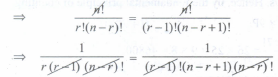
\(⇒\ {1\over r}={1\over n-r+1}\)
⇒ n - r + 1 = r
⇒ n -2r = -1 ...(2)
(1) - (2} ⟶ 2 = r
Substituting r = 2 in (1) we get,
n-2 = 1 ⇒ = 3
∴ n = 3 and r = 2
n = 3 and r = 2
14.
There are 12 letters in the given word of which 2 are T's and the remaining are distinct.
Remaining 10 letters between P and S can be arranged in \(\frac{10!}{2!}\) ways.
ஃ Total number of words starting with P and ending is S = \(\frac{10!}{2!}\)
= \(\frac { 10\times 9\times 8\times 7\times 6\times 5\times 4\times 3\times 2! }{ 2! } \)
= 1814400
15.
Clearly a number between 100 and 1000 has 3 digits.
\(\therefore\) Total number of 3 digit numbers having atleast one of their digits as y.
= (Total number of 3 digit numbers) - (Total number of 3 digit numbers in which y does not appear at all)
Total number of 3 digit numbers' we have to form 3 digit numbers by using the digits 0, 1, 2, 3, ... 9. Hundreds' place can be filled in 9 ways and each of the ten's and one's place can be filled in 10 ways. So, total number of 3 digit numbers = 9 \(\times\) 10 \(\times\) 10 = 900.
Total number of 3 digit number in which 7 does not appear. Here, we have to form 3-digit numbers by using the digits 0 to 9, except 7. So, hundreds place can be filled in 8 ways, and each of the ten's and one's place can be filled in 9 ways.
So, total number of 3-digit numbers in which 7 does not appear at all is 8 \(\times\) 9 \(\times\) 9.
Hence, total number of 3-digit numbers having atleast one of their digits as 7 is 9 \(\times\) 10 \(\times\) 10 - 8 \(\times\)9 \(\times\)9
= 900 - 648 = 252
16.
Let sin-1 \(\left( \frac { 12 }{ 13 } \right) +{ cos }^{ -1 }\left( \frac { 4 }{ 5 } \right) +{ tan }^{ -1 }\left( \frac { 63 }{ 16 } \right) =\pi \)
Then \(sin\quad x=\frac { 12 }{ 13 } ,cosy\frac { 4 }{ 5 } ,\quad and\quad tanz\frac { 63 }{ 16 } \)
\(cos\quad x\sqrt { 1-{ sin }^{ 2 }x } =\sqrt { 1-\frac { 144 }{ 169 } } =\sqrt { \frac { 25 }{ 169 } } =\frac { 5 }{ 13 } \)
\(and\quad tan\quad x=\frac { sin\quad x }{ cos\quad x } =\frac { 12 }{ 13 } /\frac { 5 }{ 13 } =\frac { 12 }{ 5 } \)
\(sin\quad y\sqrt { 1-{ cos }^{ 2 }y } =\sqrt { 1-\frac { 16 }{ 25 } } =\sqrt { \frac { 9 }{ 25 } } =\frac { 3 }{ 5 } \)
\(tan\quad y=\frac { sin\quad y }{ cos\quad y } =\frac { \frac { 3 }{ 5 } }{ \frac { 4 }{ 5 } } =\frac { 3 }{ 4 } \)
i.e have tan (x + y) = \(\frac { tan\quad x+tan\quad y }{ 1-tan\quad x.tan\quad y } \)
\(\frac { \frac { 12 }{ 5 } +\frac { 3 }{ 4 } }{ 1-\frac { 12 }{ 5 } \times \frac { 3 }{ 4 } } =\frac { \frac { 48+15 }{ 20 } }{ \frac { 20-36 }{ 20 } } =-\frac { 63 }{ 16 } \)
From (1) and (2), tan (x+y) = -tan z
\(\Rightarrow tan\quad (x+y)=tan\quad (-z)\)
\(\Rightarrow tan(x+y)=tan(\pi -z)\)
\(\Rightarrow x+y= -z\quad or\quad x+y=\pi -z\)
Since x, y, and z are positive, x + y \(\neq \) -z
\(\therefore\) x + y + z = p
\(\Rightarrow { sin }^{ -1 }\left( \frac { 12 }{ 13 } \right) +{ cos }^{ -1 }\left( \frac { 4 }{ 5 } \right) +{ tan }^{ -1 }\left( \frac { 63 }{ 16 } \right) =\pi \)
17.
Given sin 2x + sin 4x + sin 6x = 0
⇒ sin 4x + (sin 2x + sin 6x) = 0
\(\Rightarrow sin4x+2sin\left( \frac { 6x+2x }{ 2 } \right) cos\left( \frac { 6x-2x }{ 2 } \right) =0\)
⇒ sin 4x + 2 sin 4x . cos 2x = 0
⇒ sin 4x (1 + 2 cos 2x) = 0
⇒ sin 4x = 0 or 1 + 2 cos 2x = 0
⇒ sin 4x = 0, cos 2x = \(\frac{-1}{2}\)
case (i) :
When sin 4x = 0
⇒ 4x = nπ, n∈z
⇒ x = \(\frac { n\pi }{ 4 } ,\ n\epsilon z\)
case(ii) :
When cos 2x = \(\frac{-1}{2}\)
\(\Rightarrow cos2x=-cos\left( \frac { \pi }{ 3 } \right) \)
\(cos2x=-cos\left( \pi -\frac { \pi }{ 3 } \right) \)
\(cos2x=-cos\frac { 2\pi }{ 3 } m\epsilon z\)
\(x=m\pi \pm \frac { \pi }{ 3 } ,\quad m\epsilon z\)
Hence \(x=\frac { n\pi }{ 4 } \) or x = \(m\pi \pm \frac { \pi }{ 3 } \), where m,n∈z
18.
For any two distinct elements x1, x2 in \([0,{\pi\over 2}]\)
in x1 = sin x2 ⇒ x1 = x2
∴ f is one - one...(1)
Also cos x1 = cos x2 ⇒ x1 = x2
∴ g is also one-one...(2)
Now, (f + g) (x) = f(x) + g(x) = sin x + cos x
⇒ (f+g)(0) = sin0 + cos0 = 0+1=1
and \(f+g\left(\pi\over 2\right)=sin\frac{\pi}{2}+cos{\pi}{2}=1+0=1\)
(f+g)(0) = (f+g)\((\frac{\pi}{2})\) ⇒ 0 ≠ \(\frac{\pi}{2}\)
∴ (f + g) is not one-one...(3)
From (1), (2) and (3), we get f and g are one-one but (f +g) is not one-one.
19.
LHS= \({{1}\over{3-\sqrt{8}}}-{{1}\over{\sqrt{8}-\sqrt{7}}}+{{1}\over{\sqrt{7}-\sqrt{6}}}-{{1}\over{\sqrt{6}-\sqrt{5}}}+{{1}\over{\sqrt{5}-2}}=5\)
Multiplying each term by the conjugate of the denominator we get
\(={3+\sqrt8\over (3-\sqrt8)(3+\sqrt8)}-{\sqrt8+\sqrt7\over(\sqrt8-\sqrt7)(\sqrt8+\sqrt7)}+{\sqrt7+\sqrt6\over( \sqrt7-\sqrt6)(\sqrt7+\sqrt6)}-{\sqrt6+\sqrt5\over(\sqrt6-\sqrt5)(\sqrt6+\sqrt5)}+{\sqrt5+2\over(\sqrt5-2)(\sqrt5+2)}\)
\(={3+\sqrt8\over3^2-(\sqrt8)^2}-{\sqrt8+\sqrt7\over (\sqrt8)^2-(\sqrt7)^2}+{\sqrt7+\sqrt6\over (\sqrt7)^2-( \sqrt6)^2}-{\sqrt6+\sqrt5\over(\sqrt6)^2-(\sqrt5)^2}+{\sqrt5+2\over (\sqrt5)^2-2^2}\)
\(={3+8\over 9-8}-{\sqrt8-\sqrt7\over 8-7}+{\sqrt7+\sqrt6\over 7-6}-{\sqrt6+\sqrt5\over 6-5}+{\sqrt5+2\over5-4}\)

Hence proved
20.
Let x = \(\sqrt[3]{(45.4)^2\over (3.2)^2\times(6.5)^3}\)
Taking logarithms of both sides, we get
log x = \(log\left[ (45.4)^2\over (3.2)^2\times(6.5)^3 \right]^{1/3}\)
\(={1\over 3}log\left(45.4)^2\over (3.2)^2\times(6.5)^2\right)\)
\(={1\over 3}[2log 45.4 - 2 log3.2 - 3 log 6.5]\)
\(={1\over 3}[2(1.6571) - 2(0.5052)- 3 (0.8129)]\)
\(={1\over 3}(-0.1349)= -0.0450\)
= -1 + 1 - 0.0450 = -1.9550
log x = -1.9550
⇒ x = anti log (-1.9550)
⇒ x = 0.9016
21.
Given R = {(a, b): a < b2} where a, b ∈ R
reflexivity: We know that \(\left(1\over 2\right)\le\left(1\over 2\right)^2\)is not true
\(⇒\ \left({1\over 2},{1\over 2}\right)∉R\)
⇒ R is not reflexive
Symmetry: We know that -1< 32 but 3 ≰ (-1)2 is not true
⇒ (-1, 3) ∈ R but (3, -1)∉R
∴ R is not symmetric
Transitive: We observe that 2< (-3)2 and -3< (1)2 but 2 ≰ (1)2 is not true
⇒ (2, -3) ∈ R and (-3, 1) ∈ R but (2, 1) ∉ R
⇒ R is not transitive
∴ R is neither reflexive nor symmetric nor transitive.
22.
Given (-1, 0) ∈ A x A and (0, 1) ∈ A \(\times\) A
(-1,0) ∈ A \(\times\) A ⇒ -1,0 ∈ A and (0, 1) ∈ A \(\times\) A ⇒ 0, 1 ∈ A
∴ -1,0,1 ∈ A
∴ A = {-1, 0, 1}
Also it is given that A\(\times\) A has 9 elements.
∴ A has exactly three elements.
∴ A {-1, 0, 1}
∴ A \(\times\) A = {(-1, -1) (-1, 0) (-1, 1) (0, -1) (0, 0) (0, 1) (1, -1) (1, 0) (1, 1)}
23.
B ⋂ C = {4, 6}
A\(B ⋂ C) = {0, 1, 2, 3}
A\B = {0,2}
A\B = {0, 1, 3}
(A\B) U (A\C)= {a, 1,2, 3}
From (1) and (2), A\(B ∩ C) = (A\B) U (A\C)
Venn diagram:
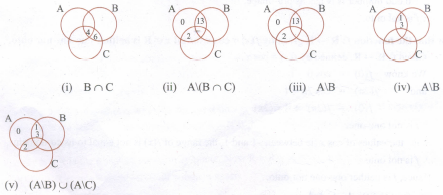
From (ii) and (v), we get
A\(B ∩ C) = (A\B) U (A\C)
24.
Let \({{{log}_{e}^{x}}\over{b-c}}={{{log}_{e}^{y}}\over{c-a}}={{{log}_{e}^{z}}\over{a-b}}=k\)
\({log}_{e}^{x}= k(b-c),{log}_{e}^{y}=k(c-a)\) and
\({log}_{e}^{z}=k(a-b)\) ...(1)
\(\Rightarrow\) x = ek(b-c),y=ek(c-a)and z = ek(a-b) ....(2)
xyz = ek(b-c).ek(c-a).ek(a-b)
= ek(b-c+c-a+a-b) = ek(0) = e0 = 1
\(\Rightarrow\) xyz = 1
25.
Given \(\sqrt{x+5}+\sqrt{x+21}=\sqrt{6x+40}\)
Squaring both sides we get
\((\sqrt{x+5}+\sqrt {x+21})^2=(\sqrt{6x+40})^2\)
⇒ \(z+5+z+21+2\sqrt{(x+5)(x+21)}=6x+40\)
⇒ \( 2x+26+2\sqrt{(x+5)(x+21)}=6x+40\)
⇒ \(2\sqrt{(x+5)(x+21)}=6x+40-2x-26\)
⇒ \(2\sqrt{(x+5)(x+21)}=4x+14\)
\(\sqrt{(x+5)(x+21)}=2x+7\)
Squaring again we get
(x + 5)(x + 21) = (2x + 7)2
⇒ x2 + 21x + 5x + 105 = 4x2+ 49 + 28x
⇒ x2 + 26x + 105 = 4x2 +49 + 28x
⇒ 3x2 + 2x- 56 = 0
\(x = {-2 \pm \sqrt{4-4(3)(-56)} \over 6}\)
\(x = {-2 \pm \sqrt{4+672)} \over 6}\)
\(x={-2\pm26\over 6}⇒x=4,{-14\over 3}\)
⇒ When x = 4
Case (i) :
\(\sqrt{4+5}+\sqrt{4+21}=\sqrt{6(4)}+40\)
\(\sqrt9+\sqrt{25}=\sqrt{64}\)
3 + 5 = 8
8 = 8 which is true ⇒ x = 4 is a root
Case (ii) : When x = \(-14\over 3\)
\(\sqrt{{1-\over3}+5}+\sqrt{{-14\over 3}+21}=\sqrt{+6\left(-14\over 3\right)+40}\)
\(\sqrt{1\over 3}+\sqrt{49\over 3}=\sqrt{12}\) which is not true
\(\therefore\) x \(={{-14}\over{3}}\) is not a root.

11th Standard Syllabus & Materials
11th Standard
TN 11th Tamil பீடு பெற நில் - செய்யுள் - காவடிச்சிந்து Important Questions And Answers Study Material - QB365 Set A
NEW11th Standard
TN 11th Tamil பீடு பெற நில் - உரைநடை - மலை இடப்பெயர்கள் : ஓர் ஆய்வு Important Questions And Answers Study Material - QB365 Set A
NEW11th Standard
TN 11th Tamil மாமழை போற்றுதும் - துணைப்பாடம் - யானை டாக்டர் Important Questions And Answers Study Material - QB365 Set A
NEW11th Standard
TN 11th Tamil மாமழை போற்றுதும் - செய்யுள் - ஐங்குறுநூறு Important Questions And Answers Study Material - QB365 Set A



Tamilnadu Stateboard 11th Standard Subjects
Maths

Commerce

Economics

Biology

Business Maths and Statistics

Accountancy

Computer Science

Physics

Chemistry
Maths
Biology
Economics
Physics
Chemistry

History
Business Maths and Statistics

Computer Science
Accountancy

Computer Applications
History
Computer Technology
Commerce
Computer Applications
Computer Technology

Tamil

English

French
Tamilnadu Stateboard Standards



