
 100% FREE ACCESS
11th Standard Syllabus & Materials
11th Standard
TN 11th Tamil இயற்கை வேளாண்மை,சுற்றுச்சூழல் -செய்யுள் - மனோன்மணீயம் Important Questions And Answers Study Material - QB365 Set A
NEW11th Standard
TN 11th Tamil என்னுயிர் என்பேன் -துணைப்பாடம் - இசைத்தமிழர் இருவர் Important Questions And Answers Study Material - QB365 Set A
NEW11th Standard
TN 11th Tamil மொழி கலை -செய்யுள் - ஒவ்வொரு புல்லையும் Important Questions And Answers Study Material - QB365 Set A
NEW11th Standard
TN 11th Tamil பீடு பெற நில் - இலக்கணம் - பகுபத உறுப்புகள் Important Questions And Answers Study Material - QB365 Set A
NEW11th Standard
TN 11th Tamil பீடு பெற நில் - துணைப்பாடம் - வாடிவாசல் Important Questions And Answers Study Material - QB365 Set A
NEW11th Standard
TN 11th Tamil பீடு பெற நில் - செய்யுள் - குறுந்தொகை Important Questions And Answers Study Material - QB365 Set A

Published on: 07/06/2021
QB365 provides detailed and simple solution for every book back questions in class 11 Maths subject.It will helps to get more idea about question pattern in every book back questions with solution.
Download Tamil Nadu 11th Standard Maths question papers, model tests, one-mark questions, important questions, and public exam papers in PDF format. Free study materials and answer keys for TN State Board students.
Questions + Answers key
Take MCQ Maths Test1.
An anti-aircraft gun can take a maximum of four shots at an enemy plane moving away from it. The probability of hitting the plane in the first, second, third, and fourth shot are respectively 0.2, 0.4, 0.2 and 0.1. Find the probability that the gun hits the plane.
2.
Urn-I contains 8 red and 4 blue balls and urn-II contains 5 red and 10 blue balls. One urn is chosen at random and two balls are drawn from it. Find the probability that both balls are red.
3.
The chances of A, B, and C becoming manager of a certain company are 5 : 3: 2. The probabilities that the office canteen will be improved if A, B, and C become managers are 0.4, 0.5 and 0.3 respectively. If the office canteen has been improved, what is the probability that B was appointed as the manager?
4.
A firm manufactures PVC pipes in three plants viz, X, Y, and Z. The daily production volumes from the three firms X, Y and Z are respectively 2000 units, 3000 units, and 5000 units. It is known from the past experience that 3% of the output from plant X, 4% from plant Y and 2% from plant Z are defective. A pipe is selected at random from a day’s total production,
(i) find the probability that the selected pipe is a defective one.
(ii) if the selected pipe is a defective, then what is the probability that it was produced by plant Y?
5.
There are two identical urns containing respectively 6 black and 4 red balls, 2 black and 2 red balls. An urn is chosen at random and a ball is drawn from it.
(i) find the probability that the ball is black
(ii) if the ball is black, what is the probability that it is from the first urn?
6.
7.
A coin is tossed twice. Events E and F are defined as follows E= Head on first toss, F = Head on second toss. Find.
(i) \(P(E \cup F)\)
(ii) \(P(E / F)\)
(iii) \(P(\bar{E} / F)\)
(iv) Are the events E and F independent
8.
A year is selected at random. What is the probability that
(i) it contains 53 Sundays (ii) it is a leap year which contains 53 Sundays.
9.
One bag contains 5 white and 3 black balls. Another bag contains 4 white and 6 black balls. If one ball is drawn from each bag, find the probability that (i) both are white (ii) both are black (iii) one white and one black.
10.
A problem in Mathematics is given to three students whose chances of solving \(\frac { 1 }{ 3 } ,\frac { 1 }{ 4 } \) and \(\frac { 1 }{ 5 } \) (i) What is the probability that the problem is solved? (ii) What is the probability that exactly one of them will solve it?
1.
Let H1, H2, H3 and H4 be the events of hitting the plane by the anti-aircraft gun in the first second, third and fourth shot respectively.
Let H be the event that anti-aircraft gun hits the plane. Therefore \(\bar{H}\) is the event that the plane is not shot down. Given that
P(H1) = 0.2 ⇒ P(\({ \bar { H } }_{ 1 }\)) = 1 - P(H1) = 0.8
P(H2) = 0.4 ⇒ P(\({ \bar { H } }_{ }\)) = 1-P(H2) = 0.6
P(H3) = 0.2 ⇒ P(\({ \bar { H } }_{ 3 }\)) = 1-P(H3) = 0.8
P(H4) = 0.1 ⇒ P(\({ \bar { H } }_{ 4 }\)) = 1-P(H4) = 0.9
The probability that the gun hits the plane is
P(H) = 1 - P\((\bar { H } )\) = 1 - \((\overline { { H }_{ 1 }\cup { H }_{ 2 }\cup { H }_{ 3 }\cup { H }_{ 4 } } )\)
= 1 - P\(\left( { \bar { H } }_{ 1 }\cap { \bar { H } }_{ 2 }{ \bar { H } }_{ 3 }\cap { \bar { H } }_{ 4 } \right) \)
= 1 - P\(P(\bar { { H }_{ 1 } } )P(\bar { { H }_{ 2 } } )P(\bar { { H }_{ 3 } } )P(\bar { { H }_{ 4 } } )\)
= 1 - (0.8)(0.6)(0.8)(0.9) = 1 - 0.3456
P(H) = 0.6544
2.
Let A1 be the event of selecting urn-I and A2 be the event of selecting urn-II.
Let B be the event of selecting 2 red balls.
We have to find the total probability of event B. That is, P(B).
Clearly A1 and A2A1 are mutually exclusive and exhaustive events.
| Red balls | Blue balls | Total | |
| Urn-I | 8 | 4 | 12 |
| Urn-II | 5 | 10 | 15 |
| Total | 13 | 14 | 27 |
We have, \(P(A_1)={1\over2},P(B/A_1)={8c_2\over 12c_2}={14\over 33}\)
\(P(A_2)={1\over2},P(B/A_2)={5c_2\over 15c_2}={2\over21}\)


We know P(B) = P(A1).P(B/A1) + P(A2).P(B/A2)
P(B) =\({1\over2}.{14\over33}+{1\over2}.{2\over21}={20\over77}.\)
3.
Let A1, A2 and A3 be the event of A, B, C becoming managers of the company respectively. Let X be the event that the office canteen will be improved.
Then, \(P\left(A_1\right)=\frac{5}{10}=0.5 \)
\(P\left(A_2\right)=\frac{3}{10}=0.3 \)
\(P\left(A_3\right)=\frac{2}{10}=0.2 \)
\(P\left(X / A_1\right)=0.4 \)
\(P\left(X / A_2\right)=0.5\)
\(P\left(X / A_3\right)=0.3\)
\(P\left(A_2 / X\right)=\frac{P\left(A_2\right) P\left(X / A_2\right)}{P\left(A_1\right) P\left(X / A_1\right)+P\left(A_2\right) P\left(X / A_2\right)}+P\left(A_3\right) P\left(X / A_3\right)\)
\(=\frac{0.3(0.5)}{0.5(0.4)+0.3(0.5)+0.2(0.3)} \)
\(=\frac{0.15}{0.2+0.15+0.06} \)
\(=\frac{0.15}{0.41}=\frac{15}{41}\)
4.
Let A1, A2 and A3 be the event that the units of PVC pipes produced by plants X, Y, Z respectively.
Let B be the event of selected item is defective.
Then \(P\left(A_1\right)=\frac{2000}{10,000}=0.2, P\left(B / A_1\right)=0.03\)
\(P\left(A_2\right)=\frac{3000}{10,000}=0.3, P\left(B / A_2\right)=0.04\)
\(P\left(A_3\right)=\frac{5000}{10,000}=0.5, P\left(B / A_3\right)=0.02\)
(i) P (the selected pipe is defective) = P(B)
\(=P\left(A_1\right) \cdot P\left(B / A_1\right)+P\left(A_2\right) \cdot P\left(B / A_2\right)+P\left(A_3\right) \cdot P\left(B / A_3\right)\)
\(=0.2(0.03)+0.3(0.04)+0.5(0.02)\)
\(=0.006+0.012+0.010\)
\(=0.028=\frac{28}{1000}=\frac{7}{250}\)
(i) By Bayes theorem
\(P\left(A_2 / B\right)=\frac{P\left(A_2\right) \cdot P\left(B / A_2\right)}{P\left(A_1\right) P\left(B / A_1\right)+P\left(A_2\right) P\left(B / A_2\right)} +P\left(A_3\right) P\left(B / A_3\right)\)
\(=\frac{0.3(0.04)}{0.2(0.03)+0.3(0.04)+0.5(0.02)}\)
\(=\frac{0.012}{0.028}=\frac{12}{28}=\frac{3}{7}\)
5.
Let A1 be the event of selecting balls from urn I and A2 be the event of selecting urn II.
Let B be the event of a black ball is drawn from it.
Then we have \(P\left(A_1\right)=P\left(A_2\right)=\frac{1}{2}\)
\(P\left(B / A_1\right)=\frac{6 C_1}{10 C_1} ; P\left(B / A_2\right)=\frac{2 C_1}{1 C_1}\)
\(\text {(i) } P(B)=P\left(A_1\right) \cdot P\left(B / A_1\right)+P\left(A_2\right): P\left(B / A_2\right)\)
\(=\frac{1}{2} \cdot \frac{6 C_1}{10 C_1}+\frac{1}{2} \cdot \frac{2 C_1}{4 C_1} \)
\(=\frac{1}{2}\left[\frac{6}{10}+\frac{2}{4}\right]=\frac{1}{2}\left[\frac{3}{5}+\frac{1}{2}\right]=\frac{1}{2}\left[\frac{6+5}{10}\right]\)
\(=\frac{11}{20} \)
(ii) P(I/B)
\(=\frac{P(B/I)P(I)}{P(B)}\)
\(=\frac{\frac{6}{10}\times \frac{1}{2}}{\frac{11}{20}}=\frac{6}{20}/\frac{11}{20}=\frac{6}{11}\)
6.
7.
The sample space is S = {H, T} \(\times\) {H, T}
\(S=\{(H, H),(H, T),(T, H),(T, T)\}\)
and E = {{H, H), (H, T)}
F = {(H, H), (T, H)}
E\(\cup \)F = {(H, H), (H, T), (T, H)}
E\(\cap \)F = {(H, H)}
(i) P(E\(\cup \)F) = P(E) + P(F) - P(E\(\cap \)F) or \(\left( \frac { n(E\cup F) }{ n(S) } \right) \)
=\(\frac { 2 }{ 4 } +\frac { 2 }{ 4 } -\frac { 1 }{ 4 } =\frac { 3 }{ 4 } \)
(ii) P(E/F) =\(\frac { P(E\cap F) }{ P(F) } =\frac { (1/4) }{ (2/4) } =\frac { 1 }{ 2 } \)
(iii) \(P(\bar { E } /F)=\frac { P(\bar { E } \cap F) }{ P(F) } \)
=\(\frac { P(F)-P(E\cap F) }{ P(F) } \)
=\(\frac { (2/4)-(1/4) }{ (2/4) } \)
=\(\frac { 1 }{ 2 } \)
We have \(P(E\cap F)=\frac { 1 }{ 4 } \)
P(E) = \(\frac{2}{4}\), P(F) = \(\frac{2}{4}\)
P(E)P(F) = \(\frac { 2 }{ 4 } .\frac { 2 }{ 4 } =\frac { 2 }{ 5 } \)
⇒ P(E\(\cap \)F) =P(E).P(F)
Therefore E and F are independent events.
8.
Let L be the' event of select a leap year
Then, \(P(L)=\frac{1}{4}, P(\bar{L})=\frac{3}{4}\)
If A is the year containing 53 Sundays
Then, \(P(A / L)=\frac{2}{7} \text { and } P(A / \bar{L})=\frac{1}{7}\)
\(\text {(i) } P(A)=P(L \cap A)+P(\bar{L} \cap A)\)
\(=P(L) \cdot P(A / L)+P(\bar{L}) \cdot P(A / \bar{L})\)
\(=\frac{1}{4} \times \frac{2}{7}+\frac{3}{4} \times \frac{1}{7}=\frac{5}{28}\)
\(\text {(ii) } P(L \cap A)=P(L) \cdot P(A / L)\)
\(=\frac{1}{4} \times \frac{2}{7} \)
\(=\frac{1}{14}\)
9.
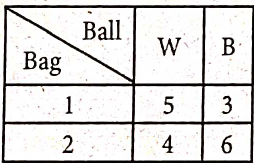
Let W, W, be the event that the white ball is drawn from bag. 1 and bag 2 respectively. Also let B,B, be the event that the black ball is drawn from bag 1 and 2 respectively.
Then \(P\left(W_1\right)=\frac{5}{8}, \quad P\left(W_2\right)=\frac{4}{10}\)
\(P\left(B_1\right)=\frac{3}{8}, \quad P\left(B_2\right)=\frac{6}{10}\)
(i) P (Both are white \(=P\left(W_1 \cap W_2\right)\)
\(=P\left(W_1\right) \cdot P\left(W_2\right)\)
\(=\frac{5}{8} \times \frac{4}{10}=\frac{1}{4}\)
(ii) P (Both are black) \(=P\left(B_1 \cap B_2\right) \)
\(=P\left(B_1\right) \cdot P\left(B_2\right) \)
\(=\frac{3}{8} \times \frac{6}{10}=\frac{9}{40}\)
(ii) P (One white and one black) \(=P\left(W_1 \cap B_2\right)+P\left(W_2 \cap B_1\right) \)
\(=P\left(W_1\right) \cdot P\left(B_2\right)+P\left(W_2\right) \cdot P\left(B_1\right) \)
\(=\frac{5}{8} \times \frac{6}{10}+\frac{4}{10} \times \frac{3}{8} \)
\(=\frac{3}{8}+\frac{3}{20}=\frac{15+6}{40}=\frac{21}{40}
\)
10.
Let A, B, C be the events that the problems solved by 3 students. Then,
\(P(A)=\frac{1}{3}, P(B)=\frac{1}{4}, P(C)=\frac{1}{5}\)
(i) P (Problem is solved) \(=P(A \cup B \cup C)\)
\(=1-P(\overline{A \cup B \cup C})\)
\(=1-P(\bar{A} \cap \bar{B} \cap \bar{C})\)
\(=1-P(\bar{A}) P(\bar{B}) P(\bar{C})\)
\(=1-\frac{2}{3} \times \frac{3}{4} \times \frac{4}{5} \)
\(=1-\frac{2}{5}=\frac{3}{5}\)
(ii) P (exactly one of them will solve)
\(=P(A \bar{B} \bar{C} \cup \bar{A} B \bar{C} \cup \bar{A} \bar{B} C)\)
\(=P(A) \cdot P(\bar{B}) \cdot P(\bar{C})+P(\bar{A}) \cdot P(B) \cdot P(\bar{C})
+P(\bar{A}) \cdot P(\bar{B}) \cdot P(C)\)
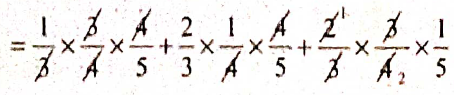
\(=\frac{1}{5}+\frac{2}{15}+\frac{1}{10}=\frac{1}{5}\left(1+\frac{2}{3}+\frac{1}{2}\right) \)
\(=\frac{6+4+3}{30}=\frac{13}{30}\)

11th Standard Syllabus & Materials
11th Standard
TN 11th Tamil பீடு பெற நில் - செய்யுள் - காவடிச்சிந்து Important Questions And Answers Study Material - QB365 Set A
NEW11th Standard
TN 11th Tamil பீடு பெற நில் - உரைநடை - மலை இடப்பெயர்கள் : ஓர் ஆய்வு Important Questions And Answers Study Material - QB365 Set A
NEW11th Standard
TN 11th Tamil மாமழை போற்றுதும் - துணைப்பாடம் - யானை டாக்டர் Important Questions And Answers Study Material - QB365 Set A
NEW11th Standard
TN 11th Tamil மாமழை போற்றுதும் - செய்யுள் - ஐங்குறுநூறு Important Questions And Answers Study Material - QB365 Set A



Tamilnadu Stateboard 11th Standard Subjects
Maths

Commerce

Economics

Biology

Business Maths and Statistics

Accountancy

Computer Science

Physics

Chemistry
Maths
Biology
Economics
Physics
Chemistry

History
Business Maths and Statistics

Computer Science
Accountancy

Computer Applications
History
Computer Technology
Commerce
Computer Applications
Computer Technology

Tamil

English

French
Tamilnadu Stateboard Standards



